
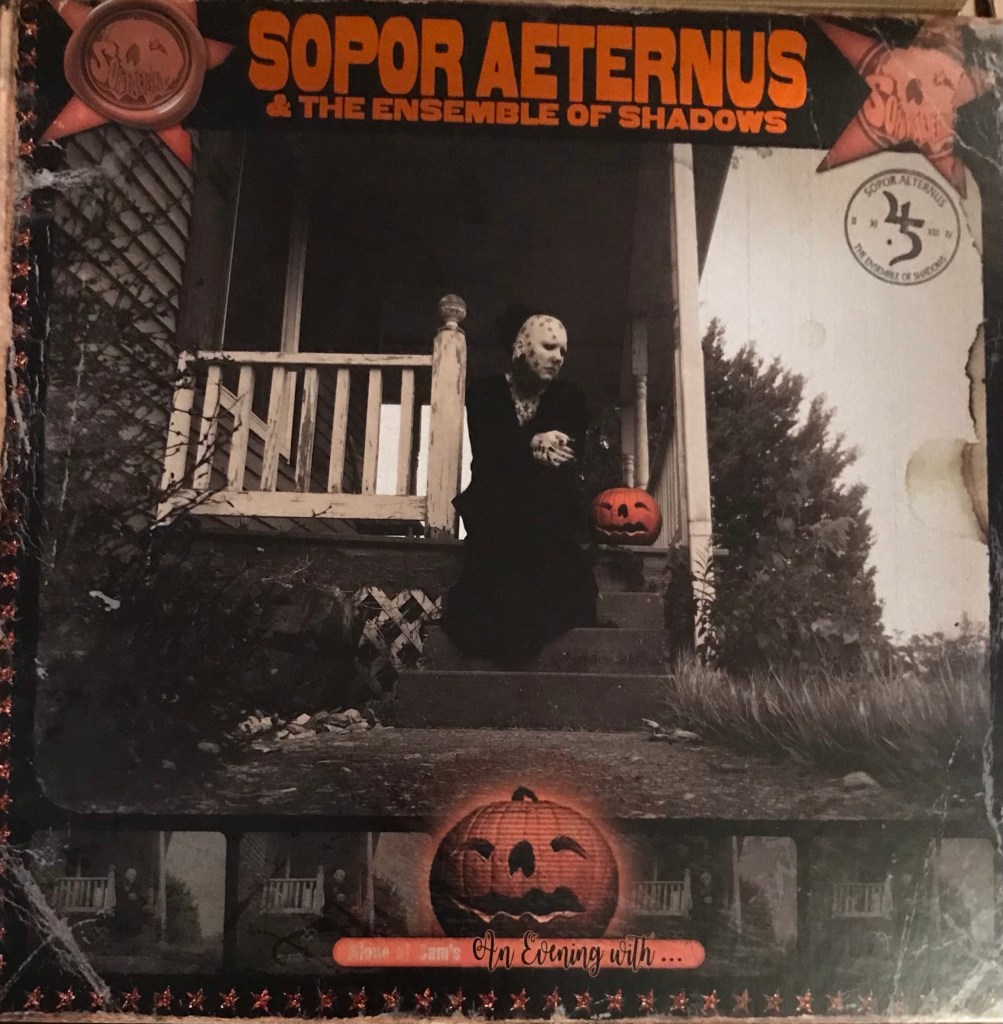
The abstraction of the lyrics are poetic.
So is their non-abstraction. Just like Island Of The Dead and Death and Flamingos, the writing is more conversational and direct than in a lot of older Sopor Aeternus material. In the opening track ‘Evening’, the only lyrics are “Hello children, we are Anna-Varney…and you are not!”
One similarity to older Sopor lyrics comes through, though. On my vinyl copy of Ehjeh Ascher Ehjeh, the lyrics of ‘Watch your Step’ look a lot like something you would see on a sign in a national park: “Please, don’t take anything with you, except for maybe some photographs, and please don’t leave anything behind, save your own footprints in the sand.”
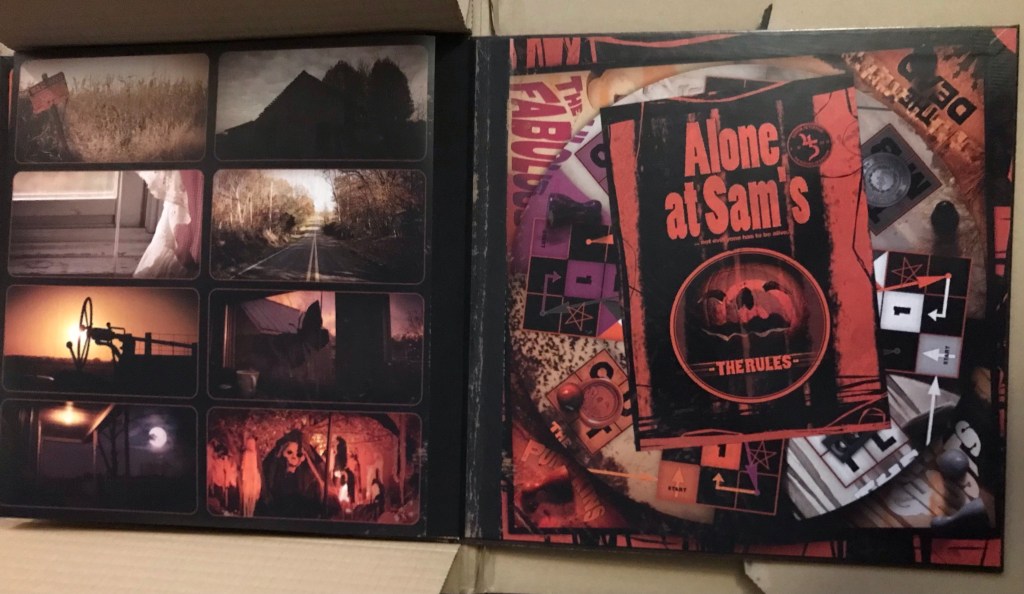
Alone at Sam’s uses similar double entendres with official-sounding language. On this album though, the models for inspiration are board game instruction booklets from Anna’s childhood. Lots of pieces with rules for moving in this or that direction and what their roles are in regard to one another and dice rolls. Since this is a longer body of work than Ehjeh Ascher Ehjeh, a little more author’s presence comes through than on ‘Watch your Step’. In the middle of all the pieces and boards and rules, there are also souls and bodies with all the dice numbers and space numbers and instructions. The use of Roman numerals on the four sides of the LP lead me to wonder about the song ‘Column’, in particlar, which deals with a game where no two pieces can occupy the same space.
A few months before this album dropped in October 2023, Anna-Varney posted a blog entry about rediscovering a rare collection of surviving toys and games from childhood. These survived, to hear Anna tell it, because of their obscurity. This means that the survivors were toys that they specifically did not care for as a child. Only the least appreciated and most mistaken gift ideas continued to represent what toys were to them as a child. They ended the post with a small phonograph which they would use, mostly, to listen to records of spoken-word stories with (at least with the Disney records) background music. Their mother threw away their childhood record collection. Last sentence of the post: “Well, I make my OWN records now. :)”
This emotional journey is present on the album.
As for the music- this is not a specific genre exploration like Death and Flamingos or a discrete palette of genres like Island of the Dead. If I had to look for a basis of comparison from the Sopor Aeternus discography, I find myself seeing similarities with Children of the Corn, The Spiral Sacrifice and- suprisingly for me –Mitternacht.
Mitternacht is a beautiful album but it is painfully intense for me, which is ironic. Anna said in an interview that the prior album, POETICA: All Beauty Sleeps ended on too dark a note for them to be at peace with. I found the opposite to be true for me. POETICA has been my favorite Sopor Aeternus album for awhile now. It’s like a well of imagination. It’s my favorite Sopor album to write to. To me this makes sense, given the role that the work of Edgar Allen Poe has played in their life. The energy exchange between their music and the poetry of Edgar Allen Poe would likely not permit it to resemble anything else in their discography. It has a sense of place and size that is unlike anything else by Sopor Aeternus.
Other Sopor albums have a sense of place and size, obviously; just nothing like POETICA. Mitternacht has those things to. Anna has described POETICA as an exploration of dreams while Mitternacht was that dream-realm transitioning into the waking world. Maybe Mitternacht hit me too emotionally for me to think about it clearly or critically…but I believe Anna intended to portray a shift to waking wisdom or maturity. To value someone else’s happiness over your own pain. It’s a tall order and it’s worth doing but the ending feels masochistically fair. The point of view, at the end, endeavors to be equitable and forgiving to all involved. Yet the pain of the loneliness, rejection and self-loathing still come through in that ending, in their voice, even while their words are reaching further.
Yes I’ve been in comparable situations and yes it can be every bit as bad as that. It can be worth doing, under the right circumstances. Yet I find my experiences have made me less forgiving to the prospect rather than more.
Perhaps a similar realization unleashed the venom of Island of the Dead and its staunch reclamation of personal agency.
The sense of place and size of Alone at Sam’s– the emotive world-building -can be most readily compared with Children of the Corn. Children of the Corn is- obviously -filled with allusions to horror tropes, in multiple lyrics and song titles. The alternation between the songs with Anna’s voice and the instrumental songs introduces something like an AB pattern. Like with Bowie’s Blackstar, the alternating gives Children of the Corn a sense of intimate, procedural immersion. Almost as if each sung piece is a character-encounter or monologue and the instrumental pieces are connective action.
This comes through most powerfully in the ending. ‘To walk behind the Rows’ is like a moment of spoken audio-drama. Anna’s voice is quiet, earnest and determined and they are clearly embodying a character, in a place, doing things. The subject matter evokes, for me, lots of very specific references to transfeminine dysphoria and its potential to wall you into a pit of futility…and what release from that futility can feel like. ‘Harvest Moon (Cornflowers II)’ conveys that release. To date, it is my favorite instrumental Sopor Aeternus song. Children of the Corn is set in an inhumane and inhospitable world. The unrequited desire, horror allusions and overall tone give the ending the release of fully submitting to destruction and coming out the other side. The sweet ineffibility of the ‘other side’ is expressed far more beautifully as an instrumental than it could have been with lyrics. Part of me softens when I hear ‘Harvest Moon (Cornflowers II)’. It evokes the ghost of a sob…but it is a relieved, joyous sob: the weight of permanent misery falling away.
There is an emotional nuance in Alone at Sam’s that hits me as hard as Mitternacht yet contains some of the bottomless peace of ‘Harvest Moon (Cornflowers II)’.
The first time I tried to listen to Alone at Sam’s, I stopped after the first two songs. Track one, ‘Evening’, is our moment of induction. I don’t know which specific Disney audio drama records they listened to as a child…but the musical cues, here, somehow feel like the background music for such a record. ‘Come and Play With Us’ can be thought of as the “post-intro” beginning. Perfectly strong, perfectly good point-of-view / character introduction. Then, at the end, there is a line that is sung repeatedly: “You don’t have to be alone”. Simple lyric. Yet something about the poetic language of games and rules beforehand invests it with…something. I tend to remember this line as “you don’t have to play alone”.
I recently heard of an alien abduction account, in which an old woman sees a younger man, on a couch, lying asleep, who then appears to rotate as if the couch and the wall were now a one-dimensional background and he was magically rotating in three dimensions. The woman was so shocked by what she saw that she began banging her head on the floor.
That line, “you don’t have to be / play alone” triggers a similar response in me.
At present, I am in no way ‘alone’. Whatever feelings ‘Come and Play With Us’ addresses in me are likely decades in the past. But the implied pain is so deep and the potential relief so acute that it feels cruel to bring it up. To mention it is to do so in vain…but what if it wasn’t? What if such a thing could be said with confidence?
So much sweeter and so much worse, at the same time. That is why I listened to this album once, three years ago when it came out, then never again until today.
Now that I have, I wish I hadn’t waited so long.
Like Children of the Corn, there is an alternating / procedural format but it is less of an AB pattern. ‘Evening’ through ‘Column’ can be classified as the first half, in which Anna’s narration is front-and-center and most songs contain their voice. Anna is both a narrator and an ever-present arbiter. In the second half, the centralization budges. The narration still speaks largely in double-entendres that sound like outdated board game rules but instrumental digressions become more common and more vivid. ‘The House of Poe’ has sparse lyrics that merge the narrated perspective with the non-verbal, procedural one, which is followed by ‘Squares of HA!’- an instrumental that seems to echo ‘Tanz der Grausamkeit’. After this comes ‘The Beast’: a vocal song describing gaming rules which are similar to ‘Column’. While ‘Column’ and ‘The Beast’ are on different sides on the vinyl version, their lyrics are beside one another in the gatefold. Correction: ‘Column’ is above ‘The Beast’ (no overlapping, remember?).
These lyrical themes continue in the final act. ‘The Spell’ reurns to the recurring sixes of the die-rolls. If you show up having already rolled a six, the spell loses its hold on you- yet no bonus roll for you.
Showing up without one and continuing to roll a six will maintain the hold of the spell. “Moobs” seem to be non-player pieces that can be deployed to take the hit of a bad roll for you. Each player only has so many and they tend to come in groups of two (lol).
“When you are under a spell,
and you come to a square of HA!,
you must follow the sign,
no matter what colour you are”
(It may be appropriate here to remember the resemblance shared between ‘Squares of HA!’ and ‘Tanz der Grausamkeit’, which in English means ‘the dance of cruelty’)
The ‘Colours’ represent four different players: purple, black, white and orange. The accompanying EP, The Colours, is instrumental except for one song: ‘Orange’, which builds on the last line of the song called ‘The Colours’ on the LP:
“Purple: queer and fabulous.
White: mostly insane.
Black: alone and a little sad.
Orange: the spirit of the game.“
The sole lyrics on the Colours EP describe ineffible blank spaces between ceremonial associations (“the cult of pumpkins / is what you might call / The true spirit of / Halloween”). ‘Orange’ also shares motifs with ‘Squares of HA!’, creating another association in addition to ‘Tanz der Grausamkeit’.
The thematic references of Alone at Sam’s are as ever-present as those on Children of the Corn but are less on-the-nose. The narrated album is the gameboard and the narration is the rules. Players do not speak on this level; they are spoken to. The Colours is more action-driven and therefore less verbal.
Since the centralizing voice on the LP backs up a little in the second act, I wonder if the “player perspective” is more relevant in the second act. The last words spoken by the narrator of Alone at Sam’s are in the song ‘Counter: Spell’. If, while moving backwards, you encounter another spell square “then the spell you’re under is reversed / by the magic of a counter-spell.” You roll your die again “but now you move forward, / like you used to do. / Roll your die again, / but if you roll a six, / there’ll be no gift for you!”
The sparse appearances of the narrator in the second act, combined with the less-verbal player perspective in The Colours, create an association between references that shines brighter than the associative references on Children of the Corn. Both of them contain references with easy resonance for many Western listeners yet with enough semantic drift to make you wonder if this is really the same mythic landscape you remember. If so, it is a remote and wild corner of it, bordering a completely different country.
 AilixChaerea