There are a handful of factual reasons why this is true. Neil Gaiman grew close to Alan Moore in the early eighties, having recently discovered one of these very comics. Gaiman even worked on supplemental prose in Moore’s Watchmen. The more fun reasons, though, come through within Moore’s ’84-’87 run on Swamp Thing (titled The Saga of The Swamp Thing for the first year, even though the six volume collection of Moore’s four year run is also sold under the same name).
The Bogeyman, from the cereal convention in ‘The Doll’s House’ Sandman story? He started out as a Swamp Thing character. This person believes they killed the actual bogeyman and therefore inherited the chance to fill the role. Swamp Thing kills the successor, in the end. That wouldn’t stop someone from taking up the moniker afterward, though- just like he did.
Before Matthew Cable dies, he manifests the power to make dreams and imaginings real. When he dies, he receives a mysterious reassurance of a purpose waiting for him beyond the veil. Perhaps a cawing, eye-ball-gulping purpose.
Yes, Cain and Abel in their twin Houses of Secrets and Mysteries existed in the world of D.C. comics before then. But a fan of the original Sandman would recognize them exactly in Swamp Thing. Their appearance and behavior are identical…which meshes with something that’s been on my mind since I read Promethea and Sandman: Overture. The mother of the Endless- Night -looks almost exactly like a being called the Lady in Promethea. Considering the role of these figures in both stories and the closeness of Alan Moore and Neil Gaiman, I find it hard to believe that the resemblance is coincidental.
(Speaking of: there is a brief Swamp Thing story about aliens aboard a ship which they named Find The Lady. This usage of the word ‘lady’ refers to a planet)
In Swamp Thing, Cain and Abel dwell in a collective psychic space between worlds. Travellers between different planes sometimes encounter Cain and Abel. Cain and Abel are also capable of perceiving cosmically significant events before they make contact with the material world (even if they bicker over it like a homicidal sit-com duo).
Another piece of relative common ground: the Phantom Stranger, Boston Brand, Etrigan and John Constantine. Constantine and Etrigan are the only direct Sandman links out of those four but Neil Gaiman’s Books of Magic is directly adjacent to The Sandman. Both Constantine and the Phantom Stranger are major characters in Books of Magic. Dr. Occult, Boston Brand / Dead Man, Zatana, Zatara, Baron Winter, Doctor Fate and the Spectre also appeear in both Swamp Thing and Books of Magic.
To say nothing of the importance of John Constantine in both of those and The Sandman. What’s funny: I originally had the desire to read Moore’s Swamp Thing run because I had just finished the SU story Hellblazer: Dead in America. What do I find? The first ever appearance of John Constantine as a fictional character. In a story arc which ‘Dead in America’ echoes very closely.
Alan Moore basically invented Constantine to connect Swamp Thing with the wider plot threads in the American Gothic arc. My wife recently showed me the early nineties TV show. I vaguely remember that my mom used to watch it but nothing about what it was actually like. I also suspect that the TV show was addressing an audience with a broader awareness of the character than mine. I just read the Alan Moore stuff. Before the early eighties, Dr. Arcane was a big enough re-occurring villain for him to be filed away as the obvious big bad. The early nineties show also decided to make Dr. Arcane British and gave him a few lines making vegetible jokes. Swamp Thing and John Constantine have this romantic American / snarky Brit dynamic…which they couldn’t have been trying to shift onto Swamp Thing and Arcane…could they?
Arcane definitely matters in the Alan Moore stuff but mostly by the consequences of previously depicted actions. His pro-active involvement in Moore’s Swamp Thing starts when he manages to rope Abigail Cable into Hell, sending Swamp Thing on a Divine Comedy-like journey. Like Timothy Hunter, Swamp Thing’s quest across dimensions puts him in touch with both Boston Brand (in the realm of the recently dead) and the Phantom Stranger (in Heaven). Etrigan, of course, shows up in Hell.
The long, interdimensional treks are some of the more chaotic and interesting moments in the comic and the Divine Comedy themes are never altogether gone from that point forward.
Like Dante and Beatrice, a lot of the astral travel (at this point and elsewhere) is catalyzed by the romance between Swamp Thing and Abby Cable. It’s interesting to me how often the journey of the Orphic pilgrim is prompted by the need to find someone- usually a lover, even if Hans Christian Andersen did his best to blunt those edges in The Snow Queen.
Alan Moore did a sympathetic version of The Creature from the Black Lagoon decades before The Shape of Water. The Dantean themes add something to this. Regarding the woman whom he modeled Beatrice after, Dante said that he wanted to write about her in a way that no woman had ever been written about.
I just remembered- there are three prolonged journeys across dimensions in Moore’s Swamp Thing. The first is rescuing Abby from Hell, the second is confronting the menace at the heart of the American Gothic story and the last is a long, hard journey toward reunion after a painful separation. Three journeys across worlds, like the Divine Comedy. Also like the Divine Comedy: the last one happens mostly in space.
Or, at least, you could be forgiven for thinking Il Paradisio happens in space. He describes Heaven as a bed of stars, surrounding a central light. Different souls are like planets unto themselves. One travels between stars and planets by looking at them.
Before entering Heaven, Dante must drink from the waters of Lethe, to cleanse himself of his human fallibility, which causes a fundamental shift in his perspective. He romantically loved Beatrice while she was alive but in Heaven spiritual love reaches full maturity and the mortal perspective is removed by Lethe.
Swamp Thing is driven from Earth by a weapon devised by Lex Luthor. Yes, he is a plant elemental with the ability to manifest anywhere that plants live (Swamp Thing, I mean). But what Luthor’s weapon did was separate his subjective point of view from Earth’s plant life, forcing Swamp Thing to look for a manifestation vector outside of Earth.
He makes a few different stops before he is able to manifest long enough to set out for Earth. The love between Swamp Thing and Abby deepens. This is, however, far from pleasurable. Swamp Thing wrestles with the prospect of total separation. Abby goes through the same thing and a mysterious encounter with John Constantine occurs.
I wondered if this related to the entanglement referred to throughout ‘Dead in America.’ That, it turns out, occurred after Moore’s work on Swamp Thing.
Swamp Thing and Abigail both experience an interrogation of their love. Swamp Thing tries to abolish the whole thing from his memory, then tries to embody a museum of nostalgia on another world, including his own lifeless recreation of Abigail.
A demonic echo of Abigail’s uncle- Dr. Anton Arcane -briefly reaches out to her from Hell. Because of his psychic contact with Abby, Arcane turns into a blocky, Frankenstein’s-creature-type-wight embodying Abby’s buried and sublimated feelings toward various masculine figures in her life.
With all the older, male, broad-shouldered remembrances, it is difficult not to notice the subtle resemblance to Swamp Thing. As if Abby is beginning to shake off her “daddy issues” and is now re-evaluating her relationship. In the end, she finds that her love and loyalty are still justified.
This really reminded me of the 2019 Alejandro Jodorowsky comic Angel Claws, which tells a similar story with more dream logic and sex.
Relationship problems were not the only way in which Dream of the Endless echoed Swamp Thing.
I wondered if, given the range of Swamp Thing’s abilities and domain, Dream must necessarily have some connection to him. This is demonstrated in Moore’s run on the Swamp Thing comics but it was made explicit and canon in the recent Hellblazer story ‘Dead in America’.
As expressed in ‘Dead in America’, Dream rules over dreaming sentience (the Dreaming) and Swamp Thing rules over dreaming non-sentience (the Green). The living non-sentience Swamp Thing communes with are (obviously) either plant life or things directly adjacent to it, like mycelial networks.
At the very least, there’s got to be some aspect of the Green that overlaps with the Dreaming and some aspect of the Dreaming that overlaps with the Green. I find it easy to think that they are different emanations of one another, perhaps like how the shape of an Endless depends on who is looking. Swamp Thing may literally be Dream in the plant world.
There are serious differences in perspective, though.
Dream is a monarch, with duties set in stone, as a perpetual condition of his existence. Swamp Thing exists within the same holistic network as all plant life and this connection compels his love and loyalty to the planet. He defends it as a champion and is capable of preventing outside threats. He feels obliged to take a protective stand when necessary but does not identify completely with his custodial authority, as Dream does.
I wonder if a lot of those existential ‘purpose’ questions disappeared with the realization that he is his own being, rather than Alec Holland.
Also on the overlap between Dream and Swamp Thing: Swamp Thing’s protective duty to the planet carries him all the way through the American Gothic arc, leading up to the confrontation with the primordial darkness outside of creation, charging into battle alongside the Phantom Stranger and Etrigan. It is important enough for Swamp Thing to bet his life and his sanity on it.
However, Abby Cable re(?)entered Swamp Thing’s life after he realized he wasn’t Alec Holland. He fell in love with Abby at the same time that he was coming to terms with his true nature. Her love has anchored much of his stability, up until that point. The loss of this anchor is also reminiscent of Dream’s mortal relationships in The Sandman. Swamp Thing is different, though, in that he never flinches from the long, hard road toward reconciliation.
This split in loyalties does not haunt or paralyze Swamp Thing like it did Morphius. What haunts and paralyzes Swamp Thing is losing Abby. Morpheus will agonize over an ex but his priorities are always crystal clear: the Dreaming above all.
The ending of the American Gothic arc also makes me wonder about the cosmological relevance of Lucifer.
This is going to get into the weeds of my interpretation of Mike Carey’s run on Lucifer. The story begins with the Silver City approaching Lucifer with a big payment for a big favor: get rid of an emerging deity.
This being once belonged to a pantheon called the nameless gods. These are divine spirits that respond to non-specific or non-linguistic prayers. The ones who respond to spirits reaching out with no point of linguistic contact.
Later, another group of beings enters the plot: the Jin En Mok, who were the deities that remain from an earlier universe, who typically see our universe as an obstruction or an enemy. One group are the survivors of a defunct pantheon and the other are the gods of those with none in particular. Those sound like two groups that could easily overlap- potentially two societies within the same race.
The latter arc of Mike Carey’s Lucifer concerns a character called Fenris Yggdrasil. Fenris entered existence as the Fenris from Norse mythology. Since Lucifer takes place within the continuity of The Sandman, we can assume that this Fenris is an emergent dream-construct, like the deities throughout both The Sandman and American Gods. In other words, he sprang from the oneiric energy of believers, from when his existence was more widely credited. By the time he shows up in Lucifer, Fenris is trying to tear down the multiverse. If he ever succeeded at doing that, it would make him a refugee from another universe like the Jin En Mok.
The human family that the nameless god from the beginning of Lucifer incarnated into begins and ends Mike Cary’s story, what with Lucifer holding the destiny of the soul of the nameless deity over one of the members of the family he incarnated in (Rachel Begai).
At the culmination of American Gothic, Swamp Thing, Dead Man, Etrigan, Phantom Stranger and other astral combatants meet the darkness outside of creation in battle.
This was the opening of a cosmic floodgate, enacted by the Brujeria. This is the darkness outside of creation encountering existence for the first time. Existence and definition. It learns to identify as evil, from the blandishments of Etrigan and Phantom Stranger. Swamp Thing recalls the words shared with him by the Parliament of Trees: “Where, in all the forest, is evil?” Swamp Thing tells the darkness (after being absorbed by it) that evil is the best and most nurturing companion of good, which makes an impression on the young mind.
Smitten, it turns to embrace its cosmic opposite. A giant finger rises from the astral battle field, bringing with it a great, dark hand, reaching out in affection to a golden hand of light.
The menace represented by the primordial darkness was described, by Constantine, as a threat to the multiverse. It existed before creation, being either the space that creation was built within, the substance of which it was made or perhaps both. The origins and manifestations remind me of both the Jin En Mok and the silent gods.
Then…there’s my ususal stalking horse with anything connecting to the Sandman universe.
Both The Sandman and Books of Magic take place within the same multiverse. Punctuated, as usual, with things like timeless regions- ‘soft spots’ and skerries of the Dreaming. The Dreaming itself is beyond space and time. Both Sandman and Books of Magic also include monsters that reach across planets and timelines. I’ve talked a lot on this blog about my theory that the mad star from Sandman: Overture also includes the extradimensional region called the Gemworld mentioned in Books of Magic. As in: they are different facets of the same infernal, eldritch conglomerate.
It seems possible, to me, that this conglomerate might also include the primordial darkness from Swamp Thing. Given the behavior and origins of the Jin En Mok in Mike Carey’s Lucifer run, it is fair to assume that they share interests with the conglomerate. Then there’s the second camp (or another name for the same one, if you prefer- I do)- the nameless gods. They are the quiet layers of divinity sensitive to inarticulate prayerful yearning. The primordial darkness in Swamp Thing behaves a lot like a divinity that has either never learned to talk or was never before able.
All that is incidental to how great these comics are, though. The chemistry between Moore and Gaiman was such that their works do not feel like they have the derivative relationship that they must necessarily have. The common ground is seamless enough to feel like the same continuous, simultaneous creation.
Alan Moore himself, contributing to Sister Anne-Marie’s permanent nose-wrinkle amid the “filthy Soho night clubs that stank like toilets”.
It is one of the few historically recent pop-cultural attempts to visualize what spiritual healing and exorcism actually look and feel like. Even in ‘Valentine’s Day’, Valentine himself seems to want some sort of reconcilliation/confession with Marley, who I’m convinced was his first victim when he was in high school. Given the tone of the ending, I wonder if Valentine just sat there in Newton’s apartment after killing him; simply waiting to be caught. The lyrical changes in ‘Heroes’ also stand out. “Because we’re lovers” is replaced with “because we’re free now”. In the Danish / Israeli run, Valentine is present during ‘Heroes’, singing along with the “because we’re free now” line. It becomes possible that Valentine’s whole string of murders had something to do with a spiritual “blockage” dating back to the death of Marley.
On the other end of the spectrum? Marley and Newton are beyond ready for reconciliation. Once the trauma of Marley’s murder is exorcised (like Newton’s morbid attachment to Mary Lou was exorcised), neither Marley nor Newton could care less about what happened in the past. The only thing that matters is the future. “Because we’re free now.”
The 1976 Nicolas Roeg film The Man Who Fell To Earth is chiefly about visions. Newton’s home world saw the abundance of water on Earth through their own variation of TV. Newton can see light spectra that humans cannot, like x-rays. There are scenes where Newton looks into the past of places on Earth and is seen in return. Newton also had an uncanny connection to the three humans he was to have the most involvement with before meeting them (Oliver Farnsworth, Nathan Bryce and Mary Lou).
Events like these suggest that Newton can see across dimensions as well. Many of his decisions (such as when to sell patents and begin constructing a space craft) are dictated by his visions.
In addition to this, there is a passive thematic emphasis on eyes. After the true shape and color of Thomas Jerome Newton’s eyes are revealed, we are shown Mary Lou in a room with an oil painting of a cat. The shot begins with a close up of the cat’s golden eyes with their vertical pupils. In conjunction with Newton’s extra-dimensional vision, the close up of the cat painting makes an understated connection with the eyes of a cat. To say nothing, of course, of the wavelengths of light that cats can see but humans cannot (or the resemblance between Newton’s eyes and cat eyes).
I have not yet read the original Walter Tevis novel that inspired both the film and the musical. From the research I’ve done so far, though, there is no indication that Thomas Jerome Newton was able to see across time in the book. This appears to have been the biggest point of departure for the Nicolas Roeg film and Bowie’s musical.
In the 1976 film, Newton decides to build his house at a spot where he makes brief contact with early American settlers. Another vision of one of his kind ascending from a lake toward the sky prompts him to sell all of his patents and begin work on the space craft. The reality of these visions is even validated by others, such as Oliver Farnsworth going to the site of Newton’s landing on Earth moments before it happened. Others have an uncanny awareness of Newton as much as Newton is uncannily aware of other things.
With so much investment in real visions, Newton’s obsessions with alcohol and television resemble misguided logic. Visions or prophecy are conceptually similar to remote viewing. It makes sense that Newton would investigate other means of “seeing things” that are not present in front of him. The logic would be similar to that of a psychonaut who knows they have seen something real and is trying to see more through experimentation. Newton is also a foreigner to Earth, so it makes sense for him to be blindsided by alcohol and (local human) television.
Roeg’s film and Bowie’s musical tell stories that turn on visions. In particular, the importance of true visions and the danger of false visions.
The musical called Lazarus is a continuation of the Roeg film. The fact that David Bowie took the initiative in 2013 to solicit Enda Walsh to co-write this project begs certain questions. It would not have made sense for Bowie to feel entitled to the novel that Walter Tevis wrote. But it would be understandable if Bowie felt a sense of possession or belonging with the 1976 movie that he starred in.
Another essential factor was Bowie’s love of storytelling and creative experimentation. He wrote the lyrics for 1974’s Diamond Dogs using a variation of the cut-up and fold-in technique pioneered by William S. Burroughs. Around the time Diamond Dogs was released, Rolling Stone printed a conversation between Bowie and Burroughs. Decades later, Bowie used the cut-up and fold-in method of generating ideas for the 1.Outside album.
Most famously, though: David Bowie broke ground with his use of fictional characters. Ziggy Stardust was a character that Bowie took onstage and into interviews. A fan base became attached to Ziggy and, immediately before Diamond Dogs, something had to give. Bowie had become almost debilitatingly attached to embodying Ziggy which- combined with the character’s popularity -quickly began to be suffocating. The concert recording called Ziggy Stardust and the Spiders from Mars: The Motion Picture captured the very last concert with Ziggy.
After that fateful 1973 Odeon Hammersmith performance, many of his characters were handled differently. Halloween Jack from Diamond Dogs was little more than a change of clothing and a line in one song. The Thin White Duke was the next strong, distinct personality but the Duke’s volatility made him unwieldy. 1.Outside featured six named characters against a cyberpunk backdrop. Bowie said at that time that multiple simultaneous characters were less of a psychological risk. Ziggy, as a solitary presence, once threatened to overwhelm him. The large cast of 1.Outside divided the energy and thereby allowed Bowie to come and go from their world as it suited him.
And then there are the ways in which Bowie’s most famous persona would have effected the expectations of those seeing the movie at the time it was released. Ziggy was an alien that humans make first contact with in the final five years of their existence. He is deified to disastrous effect. Thomas Jerome Newton is an alien that comes to Earth in the hopes of using its resources to save his home world. Both are aliens who meet their fate on Earth. Both stories have apocalyptic stakes. An argument could be made that Aladdin Sane and Diamond Dogs chronicle the final era of Earth’s history. The events of the final five years, perhaps.
Bowie’s presence alone would have been a reason why many would go and at least “check it out.” It may have been obtuse for anyone to say so out loud, but a lot of those early viewers probably felt like they were watching David Bowie: The Movie. While Ziggy may have primed audience expectations, the character invented by Tevis bore a similar name to another Bowie persona: Major Tom. Like Mary Lou’s Tommy, Major Tom also left his planet and became stranded.
Here, we hit upon one of the differences between the 1976 The Man Who Fell To Earth and Lazarus. In both stories, Tommy is an alien attempting to co-exist with humanity. In the 1976 film, he has just arrived and is figuring everything out the hard way. He has a clear emotional and ethical frame of reference from his home world and he expresses this, in human terms, more than once. Sometimes, Tommy speaks over the heads of his human companions and collaborators…other times, he speaks plainly and the human characters still feel blindsided.
In one exchange with Farnsworth and Bryce, marriage and children come up. Newton is surprised to hear that Bryce has a family but rarely sees them. His reaction is quiet but it is also plainly emotional: “A man should spend time with his family.” Concern for family is, of course, the whole reason why he is on Earth.
In another conversation, he hears that the secrecy surrounding his private engineering projects has given rise to speculation that he is building weapons. He sputters, incredulously, wondering why they immediately “assume it’s a weapon.”
In The Man Who Fell To Earth, these feelings and boundaries are intact and Newton is hyper-aware of how foreign Earth is to him. Lots of things upset and agitate him and he insulates himself whenever possible.
By the end of the movie, Newton has been abducted by humans, had his lenses fused to his eyeballs by human experiments and loses any chance of seeing his family again.
In Lazarus, Newton has spent decades being wounded and entrenched. His nerves have been fried and cauterized and he exists, seemingly, only for gin, Twinkies and Lucky Charms. Only his self-isolation has stayed the same: as far as he’s concerned, humans have proven themselves dangerous.
The structure of Lazarus, predictably, contrasts inside against outside. Newton’s solitary life includes two other people: a personal assistant called Elly and a man called Michael, who appears to have a personal or professional connection with Newton. Michael’s portrayal in the Danish Aarhus production is very reminiscent of Bryce, as acted by Rip Torn in the ‘76 film (particularly with Rip Torn’s hair and makeup in the film’s final scene). Elly’s unhappy domestic life with her partner Zach forms a bridge between ‘inside’ and ‘outside’.
Bryce, having aged by the end of the 1976 film, while Newton stayed the sameIs it just me? Michael, singing ‘The Man Who Sold The World’, played by Bjørn Fjæstad in a 2019 Tel Aviv performance at the Enav Culture Center. This performance also shares a lot with the then-contemporary Aarhus production. Part of the same run? Newton was played by a different person, though- an Israeli singer professionally known, simply, as Adam.
On the opposing ‘outside’ half, the central character is simply known as The Girl- later referred to as Marley. Marley and Newton are our leads but their awareness of each other is often private.
The narrative constantly teases a mysterious parity between Newton and Marley. I suspect this is because Marley is “seeing” Newton just like Newton “saw” the three main human characters of the ‘76 movie before meeting them (Bryce, Farnsworth and Mary Lou). As with Newton, Marley’s sight goes two ways. While she sees Newton, Newton also sees her.
This could make Marley a 4D telepath like Newton…or maybe even a survivor from Newton’s planet. Marley has the same analytical, itemizing ear for human language that Newton had in his early years on Earth: “I’m supposed to help you in some way.”
“Well, you can help me find another Twinkie.”
“I think it’s supposed to be ‘help’ in the caring sense of the word, Mr. Newton.”
“Oh…like a…very small nurse…?”
It’s interesting here that Newton now sounds as obtuse as Farnsworth, Bryce and Mary Lou once sounded to him, back in the seventies.
I’m taking the time to hammer out these details because recordings and reference materials are hard to come by. Synopses are common but not very useful. The official cast recording tells us which actor sings what and which character they represent. While I would have loved to have seen the show in person, not everything can run everywhere. Adam, from the 2019 Israeli performance, appears to have uploaded video of most the musical numbers on YouTube, relative to other channels. The best I could scrounge up was a full-length audio recording of the show, with dialogue, incidental audio cues and the rare audience noise here and there. Eventually, I was lucky enough to see the whole thing.
Many of the scene transitions have a pastiche feel to them. The spectre of bare-assed abstraction is kept at bay by frequent simultaneity of character arcs.
Michael C. Hall and Sophia Anne Caruso, during ‘This Is Not America’
Marley’s first appearance (represented in the first theatrical run and the cast album by Sophia Anne Caruso) resembles a haunting. Newton flinches and cringes around her and she never makes eye-contact with him, even if her hand ocassionally flails in his direction and touches him. Once, she dives into Newton’s arms, but it is not at all obvious who or what she is cuddling on “her end”. The whole time, she is singing ‘This Is Not America’, and its one of my favorite performances from the cast recording.
Newton, having fallen for multiple false visions already, does not take this experience at face value. We are, evidently, following Marley’s visionary/astral travels as she wanders into the home of Michael, who has discovered a separate, non-astral traveler in his apartment.
Marley’s travels, words and observations, from the latter half of her first Newton visit to her sighting of Michael and the stranger, are represented in the song ‘No Plan’. At this point in the story, ‘No Plan’ sounds like an answer to ‘Lazarus’. In ‘No Plan’, Marley is very much aware of her psychic abstraction and potential vulnerability. If ‘Lazarus’ is another timeless moment, than Newton starts the play abstracted beside past and present versions of himself and xeroxed fragments of loved ones. Marley, in her timeless state, knows everything about Newton and nothing about herself. Newton and Marley see the wilderness of time from opposite perspectives.
This prompted me to re-examine other uses of apparent simultaneity and pastiche, like ‘It’s No Game’ and ‘Absolute Beginners’. In each of those pastishes in which Newton is included, he may be ‘seeing’ the other characters through time and space. It becomes possible that Newton may even be aware of the events of musical numbers from which he is excluded- coming through, perhaps, as white noise in the background of his mind.
The ’76 film began with Newton making psychic contact, through time, with Oliver Farnsworth, Nathan Bryce and Mary Lou. What about Lazarus? Newton and Marley see each other. Elly and Michael know Newton personally, so they’re out of the running. What about the person Michael ran into in his apartment, with Marley watching? An apparent stranger, who only crosses paths with Newton later on? The prophetic trio in Lazarus could be Newton himself, Marley and Valentine the stranger.
Valentine, portrayed in the first New York run by Michael Esper
Yes, the whole prophetic-psychic contact thing is just my interpretation. There are supportive patterns, though. Much of Lazarus’s simultaneity begins to make sense when seen as visionary experiences across time. The reason it can’t be something more generalized is because there are degrees of awareness between the characters. A character could be visible to others, occasionally visible or invisible in the manner of a ghost or a witness from a psychic distance.
Newton’s mention of his visions also happen at narratively significant moments. He talks about them for the first time with Michael, before singing ‘Lazarus’. After this point, Newton will describe Marley to other people like Elly as something that’s probably not real. Slowly, his opinion changes. The next time he makes specific reference to his visions is near the end, in conversation with Valentine. He asks him if he killed Michael. When Valentine asks where the question came from, Newton says “I see things.”
Along with the placement of those two scenes, there’s the stage direction of the original run. Before the play started, Michael C. Hall (Newton) would be lying still on the stage. The actual beginning manifests around him. This, to my eyes, is a subtle echo of the scenes in which Newton can perceive things but not interact with them. That barrier alone implies that something is happening with Newton’s visions.
These associations and blind spots relate to specific relationships…yet other things take place beside and between them.
Newton and Marley are characters who can see things across time. Those who they can see can also see them (our two main characters, Elly and Valentine- even if those last two gain and lose awareness of Marley).
There are three other characters, though, who are able to approach and interact with anyone: the Teenage Girls. Many reviews equate them with a Greek chorus which is fair: they are almost always present and, when not interacting with other characters, they look and sound like the kind of everyperson / audience surrogate that backup singers normally portray in musicals. While they only take charge of the foreground twice, those are two of the most pivotal moments in the story.
In the first instance, Marley harries Newton into watching a reenactment of his last conversation with Mary Lou. Why? For “therapy”. She waltzes into his apartment followed by the Teenage Girls, one of whom walks up to Newton and apologizes in advance for any mistakes she might make portraying him. Newton corrects the Teenage Girl when she misremembers a line and then Marley (portraying Mary Lou) begins to address Newton himself in the reenactment: “You’ll be stuck in this apartment with me and I’ll always know you didn’t want to stay. Not with me you don’t. Nor for me, Tommy.”
At this point, Newton gets overwhelmed and walks out of the whole thing. Marley follows him and he asks her to tell him something only he would know. This appears to be a search for validation: to determine if Marley actually knows what she’s talking about or if this is some elaborate and sadistic manipulation. To his dismay, she relates his private memory of taking walks with his daughter on his home planet. They would rest on a hill, where he would tell his daughter stories about space, which he made up on the spot. When he was about to trail off, his daughter would tell him to “speak some more”.
Newton deflates under the realization that Marley is a genuine psychic outsider. He is on the verge of turning inward again when Marley says “(y)ou knew you’d end up like this. That’s why you let Mary Lou go. You don’t have to stay here any longer, Mr. Newton.”
1986 single
As Newton absorbs the bald reality of these words, we transition to the song ‘Absolute Beginners’. Here I gotta admit to being a bad Bowie fan: ‘Absolute Beginners’ never grabbed me. Yes, the sixties song-styling is a contrivance; the problem is that it sounds contrived. I never liked the song until I heard the version from Lazarus…and the Lazarus version is stunning. As far as I’m concerned, the Lazarus renditions of ‘This Is Not America’ and ‘Absolute Beginners’ are definitive (not to mention ear-worms).
On the far left is Elly, portrayed by Amy Lennox. Cristin Milioti was Elly early in the original run and it’s Milioti’s voice that’s on the cast album
There are a few narratively significant details about this scene. There’s more simultaneity, what with Marley and Newton singing to each other while Valentine sings backup and Elly sings the second verse. Perhaps most importantly, though- Newton commits to Marley’s plan to rescue him from Earth near the end of the song.
The Teenage Girls are also usually the most active in the songs sung by Elly and Valentine. While Newton does not have 4D visions of Elly, Marley does. Both of them have 4D visions of Valentine. The strongest argument for the Teenage Girls as “neutrals” would be the ‘All The Young Dudes’ scene, where Ben and Maemi sing lead. Even this scene has Elly and Valentine, though- they’re just being constantly ignored by Ben and Maemi. Valentine, being his usual manic and easily offended self, corners Ben and Maemi in the bathroom with Marley in tow. Things move fast from here.
A brief clip of Bowie’s original ‘Sound and Vision’ recording plays while Valentine stabs Ben and Maemi to death while Elly cringes in the opposite corner of the bathroom, holding still enough to blend into the scenery. After Valentine flees the scene, the lighting changes and Elly slowly rises to her feet, singing ‘Always Crashing in the Same Car’. This is one of the most beautiful song transitions in the whole play, especially as portrayed in the original New York production. Elly is as still as a statue and, once she’s alone, her first movements are when she sings “(e)very chance, every chance that I take” as she stands up.
The pose that Elly is holding for the entire scene reminds me of Bowie’s miming during the 1974 American tour in support of Diamond Dogs. The scene takes place in a bathroom but the fridge is an ever-present, reoccurring prop. The blue hair and the sequined dress are also very Diamond Dogs.Yes, my closest example was the booklet for the CD version of David Live.
‘Always Crashing in the Same Car’ is one of the show’s most powerful moments in both versions I was able to find (New York and Denmark/Israel) but the next song, ‘Valentine’s Day’, is a definite win for the New York production.
Denmark / Israel. Valentine portrayed by Mathias Flint. Things stay rather stationary from this point on. The mechanical movement of the wings and Valentine’s militaristic dress made it easy for me to imagine him wearing a mech suit. I guess that impression depends on whether the mechaical movement of the wings is intentional or just a consequence of the prop. Another factor was the cyber-punky, apocalyptic sceneryNew York. Esper’s Valentine. Notice how his black, shadowy wings dwarf both him and Newton. The only thing that stands out is the pale on Valentine’s face, turning it into a little floating white dot“(i)t’s in his tiny face! It’s in his icy heart! It’s happening today! Valentine! Valentine!”
I could go on about the differences between the productions. The Denmark/Israel show appears more invested in Newton building a literal rocket. The inclusion of Newton as an active participant in the ‘All The Young Dudes’ scene creates the impression that it’s taking place in Newton’s apartment. The only reason I can imagine for Ben and Newton to know each other would be if Ben is either a wealthy engineer or a wealthy tech investor who is helping build the rocket. This would also mean that the rocket drawing on the floor of the stage is non-literal. In the New York production, the rocket drawing is just a drawing on the floor. The New York version also takes pains to emphasize that Valentine and Elly followed Ben and Maemi to a random nightclub. Newton is not present- just “seeing” events unfold from a distance.
While we’re talking about Valentine, his contrast to Newton and Marley is striking: the stage direction and the behavior of the actors in the New York performance establish that the 4D visions are a major plot device. As surely as Marley and Newton’s visions are real, Valentine’s instincts are all wrong. He slides quickly into hero-worship, during which he’ll vocalize delusional memories of things that never happened, such as Michael coming out as gay and being rejected. Valentine also has virtually no boundaries which makes it very easy for him to fall in love and lust. Give him some rejection, though, and the momentum swings in the other direction. This is usually what happens just before he kills someone.
As he sings ‘Valentine’s Day’, black balloons drop from overhead. The Teenage Girls rush onstage and start popping them, leaving only one which Valentine uses as a prop in the next dialogue scene. Near the end, they start doing their usual backup singer thing with the “yeah”s and “Valentine, Valentine”s. The Teenage Girls are also very active when Valentine sings ‘Love Is Lost’ and Elly’s performance of ‘Changes’.
Then, well…there’s the ending. This is the second instance of the Teenage Girls entering the foreground. Or, more accurately, a Teenage Girl. She is usually listed as Teenage Girl 1 and she puts her hands on Newton- with Valentine -in an attempt to make him stab Marley. This is also the first time we see Valentine and Marley interact with one another. As this is happening, Newton and Teenage Girl 1 are singing ‘When I Met You’.
Marley only begins to recover memories in the final scene, when Valentine enters Newton’s apartment.
Marley: “I was alive once. I was a real girl.”
Valentine: “And what else?”
Marley: “I was cut down a mile from my house and buried in the ground. And not properly dead- I was lying there. My eyes closed. With no real future(…)I’m sorry…but it’s not me who’s going to get you to the stars but it’s you who will help me die properly.”
When was the last time the Teenage Girls took charge of a scene? Just before ‘Absolute Beginners’ when Newton finally agreed to cooperate with Marley’s idea for conjuring a psycho-ceremonial spaceship. Marley, Newton and the Teenage Girls participated in a reenactment. Perhaps the scene with Valentine, Marley, Newton and Teenage Girl 1 is also a reenactment. It seems significant that Marley began recovering memories once Valentine showed up.
Before this point, I was attached to the interpretation that Marley is Newton’s daughter, since the continuity only prepares us to expect Newton’s species to have the 4D visions. What happened to Newton’s planet, though? Presumably it died out, after Newton failed to convey water there in the seventies. His daughter may have been ‘cut down’ in such an event but that doesn’t seem likely. Let us not forget the serial killer with a preference for blades.
As Newton only comes around after the prior reenactment, Marley only remembers her name after this one. I’m not going to say that Marley was canonically Valentine’s first victim but it sure looks like it. Her apparent age may be significant to- she could have been of an age with Valentine. Perhaps he killed her when they were in high school together. This would give significance to some of the lyrics in ‘Valentine’s Day’ (a song about a fictional school shooter that Bowie originally wrote for the album The Next Day, around 2012-2013).
The transformation after ‘When I Met You’ is even more dramatic than the ‘Absolute Beginners’ transformation but I’m not going to get into that just now. I’m still not altogether sure how to interpret the very last story beats and the very last musical number.
One of Newton’s visions in The Man Who Fell To EarthMarley and Newton, singing ‘Heroes’ (the track listing on the cast album does away with the irony quotes)
Remeber when I first mentioned that the ’76 film started with psychic contact with Farnsworth, Bryce and Mary Lou? I don’t think my first idea about a Lazarus triad was wrong so much as incomplete. Marley and Newton see each other and both of them see Valentine. Distinct from Newton, Marley could be said to have her other own set of three: Newton, Valentine and Elly. Since I saw the Denmark/Israel footage first, I briefly entertained the idea that Newton also had a distinct set of three: Marley, Valentine and Ben, what with him helping to build an actual rocket.
I am tempted to treat the New York production as canonical, though, since it was the version that had the most input from Bowie just before his death. While Marley seems to have her own unique set of three, the set shared by herself and Newton looms larger.
What was the deal with the ’76 triad, again? Two of them were directly explicable: Farnsworth the patent lawyer and Bryce the engineer. Mary Lou was a wild card. In Lazarus, Marley and Newton are the first two and they’re explicable because they glimpsed each other across time. Valentine is then the obvious wild card. Then there’s the three Teenage Girls who are the only characters capable of interacting with everyone else. One of those Teenage Girls helps Valentine attack Newton and Marley, almost as if she’s the influence behind the ‘wild card’ phenomenon.
This external influence would have been present behind Mary Lou, in that case. Consider how this informs our earliest diegetic glimpse of Mary Lou- a suitcase of her clothes under Newton’s bed, first seen when Newton sang ‘Lazarus’. Later, when Elly discovers this, she assures Newton that he has the right to “play dress-up” in the privacy of his own home.
This could be a throwaway gag…but this brief moment of equating Newton with the owner of the clothes echoes something else. Whenever Newton tells Marley that she’s a hallucination, he finds he is addressing a very confused Elly. Elly later wears the clothes in a ham-fisted and aggressive attempt at seduction. And then the play’s last major plot shift may include some metaphysical force that brought Mary Lou to him in the first place.
The multiple instances of taking and replacing the case of clothes under the bed reminds me of the music video for ‘Look Back in Anger’. The song accompanies a narrative of Bowie painting a picture of an angel. The more he adds, the more his own flesh gets sapped.
The last image of the video is Bowie crawling under a bed. Perhaps that association is superficial. Either way, I thought of the ‘Look Back in Anger’ video every time someone pulled out or put back the clothing. All of these clothing-related *ahem* layers are potentially affected by the nature of the force that sings ‘When I Met You’ with Newton.
I could keep going about the possible interpretive layers. Lazarus is a beautiful show that is worth seeing, either through video or theater. Lazarus is worth analyzing in depth but this is not where our buck stops. I went over it in all this detail because Lazarus is the story that provided David Bowie with the point of departure for his very last album: Blackstar.
When I first heard Blackstar, it left me with a sinking feeling. Yes, David Bowie had just died and that was a factor…but it was also the album.
Early on, there are two songs that luxuriate in the amount of space they take up: the ‘Blackstar’ title track and a re-recording of ‘Lazarus’. Those are also, to me, the two most lyically ambitious songs on the commercial release of Blackstar. Neither of those songs are in a hurry, either. ‘ ‘Tis a Pity She Was a Whore’ bridges the gap between track one (‘Blackstar’) and three (‘Lazarus’). It is musically energetic and the lyrics seem (to me) less ambitious and more like a vehicle for Bowie’s voice to fit in with the instrumentation (John Ford literary reference notwithstanding). ‘ ‘Tis a Pity She Was a Whore’ was initially released in November of 2014, just after Bowie had finished working with the jazz band leader and composer Maria Schneider, with whom he created the original version of ‘Sue (Or in a Season of Crime)’.
All of the songs with the looser, more stream-of-consciousness lyricism sound as if they could have evolved from the Schneider collaboration. A lot of the jazz influence is crystal clear even if Blackstar dressed things up with a crunchy drum-and-bass emphasis. The blend of the two creates a cyberpunk effect. The Blackstar version of ‘Sue’ (track four, after ‘Lazarus’) sounds like a slice of life from the version of LA that Ridley Scott created in Blade Runner. The original 2014 version, with its accoustic jazz emphasis, evokes Cowboy Bebop.
‘Sue’ is the turning point of the album. Only three songs remain: ‘Girl Loves Me’, ‘Dollar Days’ and ‘I Can’t Give Everything Away’. These songs are, pretty much, no longer or shorter than most of the album (well…except the title track and ‘Lazarus’). The emotional sketches become even more stark, though, which could create the impression that they are somehow shorter.
‘Girl Loves Me’ is playful and irreverent with dark images and implications creeping into the margins. Bowie sings “I’m sitting in the Chestnut Tree”. This refers to a location from Orwell’s Nineteen-Eighty-Four (which provided inspiration for Bowie’s Diamond Dogs album): a bar where the victims of the Ministry of Love congregate. Each of these listless, aging people have experienced the psychological torture and brainwashing culminating in Room 101: a staged confrontation with a personal fear, calculated to make you renounce all ties except Big Brother.
Eventually, both Orwell’s protagonist Winston and his love interest Julia end up getting cracked in Room 101 and both linger at the Chestnut Tree later on. In the Chestnut Tree, everyone knows what they have in common but they never discuss it. Slang from Anthony Burgess’s A Clockwork Orange is used; another near-future story about brainwashing.
These shadows are there in the margins while the music has a quality that I can only describe as playfully swerving. Sort of drunk and mischievious but on the brink of trailing off. Happily drunk at eleven in the morning, not long before the depression rebound at noon.
Things get dark with the song ‘Dollar Days’. This…is hard for me to put into words but I’ll try. It has a longing quality that upsets me. It worms its way into my head when I’m suddenly hit the reality that I’ve lost someone and I’ll never see them again. And I’m not just talking about Bowie. Recent griefs, in the last few years, were made worse for me by this song not leaving me the fuck alone.
‘Blackstar’ and ‘Lazarus’ are like the delicacies of deep, secure and trusting confidence. An articulation of inner truths that cannot bear to be spoken too loudly. ‘Dollar Days’ is pain that makes you forget you were ever capable of anything as lofty as imagination or understanding.
‘I Can’t Give Everything Away’ introduces the positive rebound but it’s an exhausted, relieved positivity. The lyrics are sketches of moments like the last two songs but things still get pretty lucid…maybe more lucid than I would like: “(s)eeing more and feeling less / saying no and meaning yes / this is all I ever meant / this is the message I have sent”. No, we’re not in the same pit of sadness as ‘Dollar Days’ but the notes of relief…well…they complicate things. And the relief is palpable. There’s a harmonica part in the beginning, as in ‘A New Career In A New Town’ from Low, and the chilled out, free-roaming vibe is similar. In a beginning-to-end listening, ‘I Can’t Give Everything Away’ leaves one of the more complicated impressions.
Some disclaimers before moving on: this is the version of Blackstar that Bowie released into the world. The worst thing I can say about Blackstar is that it’s emotionally challenging- and this is not a weakness. Art is allowed to be somber. Perhaps its the nature of that emotional complexity that makes me feel things like: “This is a little much…can’t we take a few steps back?”
Sometimes the anwer is no.
If Blackstar is a dark album, it is entitled to remain one.
I encountered a separate version, though.
Yes it’s a bootleg and yes it came out after Bowie died. 2017, to be exact. This is a cassette tape made of clear, glittery plastic, labeled ‘SPECIAL EXTENDED LIMITED EDITION 2017’ on the cover. On the back of the case, there is the star image from the Alexander Hamilton musical. It was distributed from an Italian source and it cannot be traded on Discogs. On the Discogs website, they say they only refuse to support trading items due to objectionable content or copyright violation. I suspect we’re looking at the latter.
This cassette tape differs from the commercial release of Blackstar in two ways: the three other songs Bowie wrote for Lazarus are inserted between ‘Girl Loves Me’ and ‘Dollar Days’ and it closes with the original, jazz-centric version of ‘Sue (Or in a Season of Crime)’.
The three additional Lazarus songs were rerecorded during the Blackstar sessions and were left off, in the end. Years after Bowie died, they were commercially released on the No Plan EP.
You could pretty much make this playlist with your own music library. If you got Blackstar and the No Plan EP, just plop’em between ‘Girl Loves Me’ and ‘Dollar Days’. Maybe throw the original ‘Sue’ onto the end, if you feel like it. That last part is the most negligible. I like the original ‘Sue’ but putting it at the end like that feels like a pallette cleanser. It’s nice but obviously unnecessary. Sometimes it can hit like a reply to the earlier ‘Sue’ which is neat. The three other songs and their placement change the whole flow of the album, though.
Before I saw Lazarus, I felt that Blackstar relied on the associative impressions between songs. Each one is self-sufficient but each one also has a linear association with the music before and after. It starts with a glimpse of the beyond, goes back to ordinary life and then another glimpse; shorter than the last. The narration goes through a grieving cycle in the absence of a third.
Before the playful ‘Girl Loves Me’ can transition to the sad-drunk ‘Dollar Days’, a third introspective beat occurs with ‘No Plan’. Since I had years of listening to the commercial Blackstar beforehand, I had long thought of it as an album “narrated” by one perspective. It is comparable to an experimental film with one character in either one or two locations. Not only does ‘No Plan’ provide another introspective beat to go with ‘Blackstar’ and ‘Lazarus’ but it almost feels like a scene change. Maybe a cut to a second person. Yes, that’s the job it does in the musical: Newton sends out a beacon with ‘Lazarus’ and Marley pings back with ‘No Plan’. But the transition from ‘Girl Loves Me’ on the 2017 Italian bootleg is so different that it creates the same effect: a new place, a new person or a new development from the original protagonist.
After I saw Lazarus, there was something about the structure that stayed with me. The play alternates dialogue skits with musical numbers. This surprised me, since Bowie has said in the past that he prefers musicals that are sung-through: meaning no conventional dialogue. One hundred percent of it occurs through music. In a 2021 Rolling Stone interview, Lazarus director Ivo Van Hove said that the music was meant to integrate with the spoken dialogue. Songs like ‘Absolute Beginners’ involves Newton and Marley and the scene they share. Yet it also involves Elly and Valentine, who are not present. As Valentine sings ‘Love Is Lost’, Ben and Maemi are dancing in colorful film projections.
In other words: every song is “spoken”- even the ones with only a single character. When Newton sings ‘Lazarus’, he is convinced he’s alone and is surprised to find that he isn’t. Even Marley seems a little abstracted when she first appears- slowly becoming aware of Newton as she sings ‘This Is Not America’. I know I said ‘No Plan’ was like Marley’s answer to ‘Lazarus’- and it is -but it’s a delayed answer. She’s half-alone, like Newton. As Newton was surprised to find Marley listening, Marley is surprised by the apparitions of Newton, Michael and Valentine. All you gotta do to create infinite layers of who is adressing who is to introduce 4D telepathy as a plot device. It’s also an easy device with which to introduce the simultaneity of character arcs- as if to be psychic is to hear everything, all the time, even if it mostly sounds like static.
Lazarus relies on an AB rhythm with its music and scene transitions. Blackstar has something similar going on, although it’s back-and-forth reciprocity only holds through the first four songs. The rest of the album from that point takes place while waiting for a third encounter that never happens.
The addition of ‘No Plan’, ‘Killing A Little Time’ and ‘When I Met You’ struck me as a return to the AB rhythm. It could just as easily be the other side of the wall, though. More specifically- if the narrator is left hanging from ‘Girl Loves Me’ to ‘I Can’t Give Everything Away’, then maybe ‘No Plan’ to ‘When I Met You’ is the other side of the isolation. The other person who is left hanging.
More superficially, it’s just comforting hearing the lyrical excess of ‘No Plan’ through ‘When I Met You’ because so much of Blackstar is tense and withdrawn. It evens out the album’s rhythm but it also changes it deeply. The gut-punch of ‘Girl Loves Me’ through ‘I Can’t Give Everything Away’ is robbed of its urgency.
What makes the original Blackstar so tense is that the angst is a creeping intuition. One effect of the three song addition is giving specific voice to the angst with the song ‘Killing A Little Time’.
‘When I Met You’ is neither the first time Valentine has been in Newton’s apartment nor the first time the two have met. Earlier in the play, a subplot develops around a relationship between Elly and Valentine. When they first meet, Valentine convinces Elly to introduce him to Newton. When they meet, both Valentine and Elly start peppering Newton with questions about the drawing on the floor (“I drew something awful on it” as the feller says) and his mental health. Newton’s last encounter with human medical attention ended with the worst trauma of his life so he bristles, leading us into ‘Killing A Little Time’.
In the original Blackstar album, the narrator’s suffering is very reactive. The anger of ‘Killing A Little Time’ allows him to claim ownership of his pain which makes the end easier to bear. The more I think about this, though, the more I wonder if there are other factors.
The most obvious theme shared by both Lazarus and Blackstar is sacrifice. Blackstar discusses this in more emotional terms but both works touch on ceremonial sacrifice. The ‘Blackstar’ music video shows the corpse of an astronaut falling toward a planet. It is found by a girl with a tail who discovers, once she looks inside the helmet, that the skull is encrusted in jewels. Either the skeleton was venerated where it lay at one time or it just “is” what it is. Either way, she brings the skull to a village where a religious awakening happens. According to the lyrics “(s)omething happened on the day he died / spirit rose a meter then stepped aside / somebody else took his place and bravely cried / ‘I’m a Blackstar’/ how many times does an angel fall / how many people lie instead of talking tall / he trod on sacred ground he cried aloud into the crowd/ ‘I’m a Blackstar'”
The logic of ceremonial sacrifice is apparent: something is sent across in exchange for something else. In ‘Blackstar’, the mystery behind the bejewled skeleton creates an opportunity. It cannot speak for itself so others attempt to speak for it. They attempt this with nothing more than boldness and imagination: “I can’t answer why / just go with me”. The words of this person contain an interesting echo: “I’ma take you home / take your passport and shoes”. Usually, you don’t need your passport and shoes if you’re going to one place and staying there. Not to mention: removing your shoes is necessary spiritual grounding for many magical and ceremonial workings. Before the first repetition of the “something happened on the day he died” lines, Bowie sings “I want eagles in my daydreams / diamonds in my eyes”. These could simply be the fantasies of one claiming to fill the void of the corpse but “diamonds in my eyes” sounds like a passive reference to the jewel-covered skull. It furnishes splendid visions but there remains a genuine mystery at work. To want diamonds in your eyes is to commit to something sight-unseen.
Ziggy Stardust, Major Tom and Thomas Jerome Newton have something in common: all three were sacrificed to the outer darkness, never to return. Yes, there is exploratory and visionary abandon and the joy of discovery- all the romantic, escapist bells and whistles. The problem is bringing your discoveries home. In the meantime, how are those behind the sacrifice rewarded? Newton created revolutionary new engineering patents for governments and corporations to sit on and never use. Ziggy started a movement on Earth during the last five years of its existence which turned into just another distraction. If Aladdin Sane and Diamond Dogs cover the aftermath, then things apparently got darker from that point on. Major Tom got his own miserable follow-up in the song ‘Ashes to Ashes’.
With the first two, the fault lies with the beneficiaries of the sacrifice while Major Tom is the author of his own suffering. This is not a unilateral process with a single player, nor is the individual exonerated.
Lazarus pushes a little further, though. Newton is still in “space”, never to return. Is he merely a burnout, like Major Tom? The play does not make him enviable. To Elly and Valentine, he is a target of ridicule, larceny and violence. What even happened to him, in the end?
I, at least, like thinking of stuff like that. We know Marley was never physically present at all during the time frame of Lazarus. Valentine would not have left Newton in peace, either. But isn’t Newton immortal?
I think a more accurate term might be ageless. He will never age or experience physical illness. He is not immune to violence, though. In the ’76 film, he is physically traumatized. I can’t think of any reason why Newton would be immune to stabbing. Valentine may well be remembered as an ordinary serial killer, perhaps subject to urban legend: ‘did you ever hear his last victim was a humanoid alien’, etc.
Newton is held in contempt, exploited and murdered. But was he ‘wrong’?
Newton began to hope again after Marley put him through a reenactment. The ‘Absolute Beginners’ number is about him accepting that he has no further obligation to Earth and is free to take Marley seriously. This ultimately leads him to reenact Marley’s murder by Valentine. If Newton didn’t survive, then perhaps he escaped. He arrived on Earth via sacrifice. He only leaves by way of another sacrifice.
Then there’s the role of prophecy. Newton is only given reliable visions in snippets. What are we to make of the big picture? Was his planet meant to die out and was Newton meant to die on Earth, with only another ghost for company?
This is what makes interpreting the song ‘When I Met You’ so hard, whether it’s in Lazarus or Blackstar. At first listen, the song sounds bipolar. Whoever the narrator ‘met’ could be either the best or worst thing ever. They may have been pulled from misery that they took for granted, to relearn what affection and pain are. They either realized how bad things were or everything got worse. And we don’t know which.
The addition of the three songs on the Italian cassette tape makes the build up to the conflicted ending more approachable. The narrator is dwarfed by an unanswerable question in ‘When I Met You’ and then begins the movement through ‘Dollar Days’ to ‘I Can’t Give Everything Away’.
What the three songs offer are the lucidity of an inside view. Should we be so quick to ignore the outside view, though? If the addition of those three songs gives an authorial statement from the ‘inside’, what about the ending of the original Blackstar? We don’t hear the narrator’s internal monologue. With Bowie’s lyrical sketches, it’s more like seeing him than listening to him.
The idea of adding the No Plan EP rerecordings to Blackstar changed the album for me, for awhile. I loved hearing the narrator speak up a bit in the second act. I appreciate what this brings to a relistening but I also realize that Bowie had a beautifully visual mind that we are poorer without.
The 2020-2025 Hellblazer are the best stand-alone comics in the Sandman Universe run since the first four were cancelled.
(Big fat spoiler warnings for ‘Marks of Woe’, ‘The Best Version of You’ and ‘Dead in America’, btw)
Outside of the nexus stories like The Dreaming and Nightmare Country, the Dan Watters’ Lucifer is still my favorite. Right now, though, Hellblazer: Dead in America is tied for second place with House of Whispers.
‘Dead in America’ is only the third act, though.
Coincidentally, I started watching the Netflix Sandman series just as I was finishing the first two collected editions. One connecting moment stands out: Roderick Burgess commands his son Alex to take the three fetishes of Dream. John Constantine makes a similar demand of a trusting and vulnerable youth who is revealed to be his son.
Which is interesting, since this run of Hellblazer takes off from the far-future apocalypse of the Sandman Universe version of Books of Magic. In both the SU story and the original, Books of Magic is centrally concerned with Timothy Hunter’s life in another timeline, in which he became a world-ending monster. The SU Books of Magic thereby fell into an arc about stereotype-threat: Timothy is not as bad as he looks and has not had a chance to make his own mark.
SU Hellblazer sees John Constantine making an inverse journey. Unlike Timothy, John has had a chance and is every bit as bad as he looks.
The first run of Books of Magic began with a group of mages: The Phantom Stranger, John Constantine, Dr. Occult and Mister E. All four had knowledge of what Timothy would eventually become and- over the objections of of Mister E -they decide to educate him in the hope of heading off his reign of terror.
If the full story of evil Timothy has been written, I’d like to read it (That may be a reason for me to look into the rest of the old school Books of Magic). In the picture of things from the SU though, it seems John was part of the dwindling forces of good keeping supervillain Tim at bay.
In the story ‘Bad Influences’ (which appears within ‘Dwelling in Possibility’ from SU Books of Magic and ‘Marks of Woe’ from SU Hellblazer), John has just escaped from the far-future hellscape into a nearby timeline. In said timeline, Timothy Hunter is still a teenager.
At the time of the ‘93 Books of Magic, Timothy was approached by John Constantine, Phantom Stranger, Dr. Occult and Mister E. They launched from the ‘evil Tim future’ under different circumstances than Constantine at the beginning of ‘Marks of Woe’, however.
In ‘Marks of Woe’, John Constantine’s departure from the ‘evil Tim future’ is initiated by a being claiming to be himself from a different timeline: older, happier and without a soul. This apparition wants the soul of his younger self in exchange for safe passage to a version of Earth that’s not about to be vaporized.
‘Quiet’ cover art by John Paul Leon
The negotiation makes mention of innumerable people whom John has used as meat shields and bargaining chips, for innumerable reasons; both selfish and ethical. The transaction is, according to alleged ‘future John’, nothing more than the consequences of his actions (their actions, actually, since alleged ‘future John’ makes no distinction between his own spiritual destiny and ‘our’ John).
There is even an insinuation that such a transaction may not be the end. According to ‘future John’, “what better place” for the old “ghost” to go, other than back into the “family”? As if ‘future John’ is not dead yet and the soul could still have some time left (even if it would mean subjective annhilation for ‘our’ John).
These are the first actual Hellblazer comics I’ve ever read outside of his appearances in SU Books of Magic, SU Lucifer and a single volume of The Dreaming (to say nothing of the original Sandman). With both the Constantine film and a few animated stories in mind, I could believe that he has a pattern of using people up and spitting them out. This would cast a new light on some things, like John’s rendering of the situation to Morpheus in ‘Dream a Little Dream of Me’.
In any case, both John and the alleged time traveler take this past for granted. Once John takes the deal, we see the manifested proof of it in John’s broken life and relationships, upon his return to the relative “present” (2019). The few who have survived his companionship are done with his shit and want nothing to do with him.
In the world of comics, John Constantine and his moral ambiguity are well-known. A major strength of the Sandman Universe comic line is how well it has built its own continuity. Obviously you’ll get a lot out of it if you read the original Sandman but the SU line has deftly handled its macro-anthology structuring. The individual stories that make up the whole (for the most part) stand well on their own.
‘Bad Influences’ cover art by Kai Carpenter
The SU comics, therefore, have their own self-contained set-up for Constantine’s moral arc. SU Books of Magic tells the story of Timothy’s vindication: his innocence and virtue are proven despite influences from the Supervillain Tim timeline. Thereby, the point of departure for SU Hellblazer is set up (even if Constantine had a brief appearance in another SU story in the meantime- more on that later).
Timothy Hunter is validated in the end because all he has to say for himself is his perspective. He cannot claim acts and identities that he never experienced: the fact that such happened in another continuity is beside the point. This works because SU Books of Magic shows us everything Timothy is aware of (which factors in some memory-wipes from prior comics but I digress). Timothy’s moral truth therefore unfolds before our eyes.
In the SU continuity, John Constantine’s moral arc has its own establishing beats. The past discussed by John and the time traveler, everyone hates him upon his return to normal life, etc. These are passive, retrospective moments, though- just as much happens in front of us.
‘Bad Influences’ is, effectively, our point of departure. John finds Timothy, fully intending to kill him with a book with poisonous, psychoactive pages. John still felt squeamish about killing a kid on principle, though, so he avails himself to a third party which can be bound and commanded. While Tim is under the influence, he is psychically suppressed and contained by the Vestibulan- an angel who refused to take a side during Satan’s rebellion. The Vestibulan belongs to the Aequiim- guardians of impartiality. Within the hallucinatory construct based on Constantine’s lie, the Vestibulan gives Timothy either / or moral scenarios. Between the certainty of Constantine and Tim’s paranoia, the construct changes. The Vestibulan starts showing Tim choices between equally repugnant scenarios. Incoherent Tim decides this is part of the test and psychically attacks the Vestibulan, shoving him out of his mind and into John’s smartphone.
More than that happened but those are the bullet points.
When faced with the illusion of his inevitable evil, Tim literally fought his way out of a spell-bound stupor. In John’s eyes, you can’t say fairer than that. It even rhymes with something the time traveler told John before sending him back to a “safe” timeline: just be the best version of you.
Following the time traveler’s advice and Timothy’s example, we see John simply behave the best way he can, in the moment, as circumstance allows. Explicatory dialogue has told us that John has treated lives and trust callously, but this is a clean slate, right? What better chance to prove your guilty conscience wrong?
John proves it right, in the end. In the course of his new adventures, John meets a young deaf man named Noah: his genetic child from a long-forgotten fling. John being John, he eventually welches on his soul deal.
The time travler wants the soul inside of John’s body, right? Noah is instructed to smash the phone at the moment of John’s death. The Vestibulan latches onto John’s body. From John’s body, the Vestibulan gets yoinked by the time traveler who sends it back to John. The Aequiim were condemned to Hell for their indifference. The Vestibulan is therefore hounded by demons as soon as the time traveler releases him. Since this is all rebounding back to John, the demons seize a nearby body for a possession vector. John telepathically orders Noah to kill the poor guy to stop the demons from emerging. This sacrificial lamb was a naive, well-meaning magician named Tommy Willowtree who idolized John Constantine and yearned to follow in his footsteps. The demons drag his soul to Hell while he cries out to John for help.
Meanwhile, the deal is still on: John’s real soul is nabbed by the time traveler who instantly rejects it.
I’ve spoiled a lot already but for the sake of keeping things neat: the time traveler is not John. They’re not even a corporeal being. They simply wanted a soul and John was chosen for his shame: he hardly believes he has a soul. John definitely doesn’t believe that he deserves anything in particular after death. His belief in his damnation was what made him such a perfect target. The irony: he made his son kill someone who was in the wrong place at the wrong time, which didn’t even keep his soul safe for much longer anyway.
Sorta.
See, compelling his son commit a futile murder tainted John’s soul. If the soul is a getaway car for the time traveler, this is basically like setting the getaway car on fire. Also, since John had to die for this to happen and no one claimed his soul in the end, John is now a walking corpse. A zombie with a personality.
Does this have a Fibonacci vibe? With John’s head being the outermost spiral and the bowl (held by Blake’s ‘The Ghost of a Flea’) being the innermost? ‘A Green and Pleasant Land, Part Two’ cover art by John Paul Leon, btw
It is at this point in this long-ass intro that I am reminded of how the first two volumes initially hit me. They struck me as very straight-laced…and a straight-laced comic is like a straight-laced TV show. Establish the premise, then set a rhythm of self-contained stories. Episodic tales can intersect beautifully with linear threads, as seen in the original Sandman. Here, though, the sequences are direct. First John enters the new timeline, then he assembles a crew which includes Noah and a violent, manic Scottish woman called Nat. There’s a few short-lived events with common denominators, then the first macro-plot ends.
I didn’t post about these comics when they came out because I had attitude problems: the more novel-like SU stories were fresh in my mind and the more conventional comic structure caught me off guard. My interest was not immediately piqued. With that bias out of the way, though, I can’t say a word against either ‘Marks of Woe’ or ‘The Best Version of You’. Once the final chapter gets going, the plot threads come together and get good real quick. The ending was just fast-paced and chaotic enough with consequences that must necessarily last.
Now, finally, I can get to the story that made the SU Hellblazer my favorite stand-alone series since the first four SU arcs: ‘Dead in America’.
Early on, John Constantine meets an old acquantance in New Orleans: Clarice Sackville. In ‘Marks of Woe’, John reached out to Clarice by Vestibulan-phone, in regard to his problems with the time-travelling soul eater. John asks for help and is refused: Clarice has no desire to end up like most of his connections. Nonetheless, Clarice (a fellow traveler) is aware of various prophecies. John is both snarky and incredulous: he’s been around enough to know “vague, apocalyptic arsewater” when he hears it. Clarice insists that this is not the usual endtimes hype: these prophesies are specific and substantial. They mention the possibility of “the true and final death of John Constantine.” Clarice goes on to explain that she was responsible for a series of visions and psychic suggestions, leading Tommy Willowtree to the big bad himself. Clarice says that she knows better than to think that Tommy’s fate- corporeal or spiritual -will motivate John to do anything. She put Tommy on the breadcrumb trail because, in spite of his weaknesses, he could potentially solve the whole thing himself, which John’s ego could not bear.
John returned to the fray out of pettiness and then used the object of his envy as a human shield. In the final pages of ‘The Best Version of You’, we learn that John did die, even if it’s not stopping him. ‘Marks of Woe’ is such a fast-paced read that it’s easy to overlook John’s phone call with Clarice. After finishing ‘Dead in America’, I was forced to consider the scope of those prophecies. The Nightmare Country comics appear to take place after the events of the first three SU Hellblazer volumes. Nightmare Country is set in America and concerns a mysterious confluence of powers both oneiric and infernal. Three of the Endless (Dream, Desire and Despair) are involved. Most of Nightmare Country is set in Los Angeles in particular, which is where John, Noah and Nat part ways at the end of ‘Dead in America’.
If the mysterious apocalyptic menace includes the Nightmare Country players…might it also have fourth-dimensional implications? Some needling little impulse is telling me that it may involve Supervillain Tim and the timelines where his influence has spread. It’s interesting to me that Neil Gaiman wrote the first Books of Magic around the same time that he began working on Sandman: Overture (even if it wouldn’t be published for about two decades). Glory of the First Circle appeared in print for the first time in Books of Magic, as did the mundane egg, which went on to play a pivotal role in the first three volumes of the Dreaming reboot.
Tying all these threads together in one tapestry would be bad-ass if it was done right. Remember, to, that season one of the Sandman miniseries included a scene from Overture in which Dream is attempting to confront the Corinthian in the late nineteenth or early twentieth century. The Corinthian has lately started taking human victims. Dream is about to uncreate him when he is suddenly transported, leaving the Corinthian to make his escape.
The first three SU Hellblazer stories succeed at something far more simple, though: John is a real anti-hero with real shades of gray. Protagonists on negative arcs have, of course, grown popular. Typically, these characters come off as either one-dimensional heroes with rough edges or one-dimensional villains with a little charm.
With 2020-2025 SU Hellblazer, it’s all about the ‘best version of you’ action. All you can do- all anyone can ask of another -is to show up and do your best. Most of us live our lives on those terms. Even when things are bad enough to consider cutting your losses, you always have the choice to continue placing one foot in front of the other. Guilt is a common experience and therefore so is the need to forgive oneself. “Showing up” and “doing your best” in the midst of shame and guilt is to hear a voice at all times, murmuring that you don’t deserve to “show up”. You keep doing it anyway because the point is not where you’ve been- it’s where you’re going.
We’ve all screwed up before but what else can you do after that, except keep going? And do better next time? John makes a rather normal and sympathetic first impression. The trouble is the “do better next time” part.
Like Lucifer in the new SU stories, John Constantine hates losing more than anything else. Many of his most remarkable and creative accomplishments happen under the fear of losing. He tends to look out for number one and not every opportunity to help has a tangible, constructive result. In ‘The Best Version of You’, a mermaid falls in love with an ugly, opportunistic shit of a human who exploits and brutalizes her. When John finds her and they both figure out what happened, he is honest: he cannot undo the damage. Payback, though? “Cheap as chips.” And payback is the only thing he can help her with, in the end (one of the better vignettes in that book, btw- there’s also an interesting one about the British royal family and horse-breeding).
Not every kindness has a productive consequence but life is chaotic: even the incosequential opportunities are not to be shrugged off. In the meantime, you take stock of the things you do have control over, such as yourself. Looking out for number one grows easier.
Then we have the ending of ‘The Best Version of You’, which provides the fundamental set-up for ‘Dead in America’: the interdimensional pride/shame monster wanted John’s soul. The pride/shame monster also wanted John to truly change himself for the better, in order to receive the best soul he can. John escapes because he blemished his soul on purpose, what with getting his son to commit a pointless murder. By the end of ‘The Best Version of You’, both John and Noah are marked for Hell. John’s central motivation in ‘Dead in America’ is getting his son out of the mess that he dragged him into.
Defining oneself through actions in the present is echoed in one of ‘Dead in America’s villains: Elliot Garner, aka Dr. Diablo. Dr. Diablo, as a DC supervillain, goes back far indeed but for now we need only concern ourselves with this particular version of him: an early-Hollywood-therapist-turned-cult-leader who inherited Dream’s pouch of sand from Ruthven Sykes.
Dream’s sand is the central McGuffin of ‘Dead in America’. Most of the story is spent reacting to it and looking for it. Once in America, John hunts down an old friend- Swamp Thing, who has access to a collective psychic plant space called the Green. The Dreaming is the collective unconscious for sentient beings and the Green is the collective unconscious for everything else- one should be useful for revealing the negative space of the other. There are, of course, complications.
A few decades ago, see, Dream was laid low by three beings called The Kindly Ones. According to Etrigan the demon, The Kindly Ones began as rebel angels beside Lucifer. “Angels of hate”, to be exact. For awhile, in Hell, they were the gatekeepers. From here, they carved out a niche for themselves as The Furies from Greek mythology.
So. After their clash with Dream, in the mid-nineties? They scour the Earth for Dream’s left over magical influence, slowly invading and occupying mythic space. Dr. Diablo has since fed grains of Dream’s sand to his clients, some of whom became Hollywood screenwriters. This means that the magic of Dream is part of their new infrastructure. When they finally realize what happened and why, they seek out Dr. Diablo.
Yes there is sand left and yes Dr. Diablo knows what he did with it- he just walled it off in his mind, to stop anyone else from getting it. So The Kindly Ones attacked him and dragged part of his soul to Hell- the part that remembers. Unfortunately, Dr. Diablo’s decision to hide the remaining sand depended on other factors in his life, going back to how he loosened the cord on the pouch to begin with: human sacrifice. His own infant son. Since these events go that far back, there is basically a whole separate half of his memories that are currently languishing in Hell.
In the present, Dr. Diablo is a ghost with half of his identity missing. He retains close to nothing of the past and does (little to) no harm in the present. Actions still matter though and forgetting is not the same thing as innocence, as John himself knows. John and Dr. Diablo know a few things in common. Didn’t John himself loosen the cord of Dream’s pouch? As revealed in the 1980s Sandman story ‘Dream a Little Dream of Me’?
There are other thematic tabula rasa analogues. The pride/shame monster from the first two books is another: all he wanted was for John to feel redeemed for a little bit so he could grab a soul with some mileage left in it. He attempted this by pretending to be something that John himself might fantasize about but never actually hoped for: himself, older, content and at peace with the past. John’s first impression- that his happy, older self has no soul -is a misunderstanding…but a potentially important misunderstanding.
You know that theory I floated, a million years ago, about the foreclosed timeline of Overture being the Gemworld from Books of Magic? What if one makes psychic contact with other timelines through ‘what if’ thought junctures where your timeline would have branched off into the other? Oh and that foreclosed timeline? It’s held together by a rampant dream vortex- a psychic mind that absorbs other minds into an ever-expanding dream.
In other words: a dream vortex (or the mad star it turns into) prefers itself over everything else. If Supervillain Tim was Tim’s bridge to the Gemworld…maybe the pride/shame monster is John’s bridge?
The pride/shame monster is a sentient thought-form, btw. Aka: a tulpa
I still don’t know if I’m all-in on that Gemworld theory yet but it only ever seems to grow more probable. I also can’t help wondering about these moral layers because of my first prolonged meeting with John Constantine- and it wasn’t ‘Dream a Little Dream of Me’. That was a short story. His appearance in the SU Lucifer is likewise short-lived. The first comic I ever read which treated Constantine as a major character was the original Books of Magic, in which he is one of Timothy Hunter’s mentors. Not only was he an instructor of a young magician but he was one of his more humane, well-intentioned and trustworthy instructors.
I basically “got to know” Constantine originally as a young person’s teacher. In the SU Hellblazer, he starts out willing to kill the young person simply to wall off the timeline he might create…then decides not to. John exhibiting genuine darkness was new to me.
The social commentary in ‘Dead in America’ is another unambiguous win. I remember being nervous about the social commentary in the early volumes of the Dreaming reboot because Neil Gaiman himself struggled a little with it in the original Sandman.
If ‘Dead in America’ had no humor and took itself seriously every step of the way…there would be a lot of opportunities for melodrama, what with the vengeance angels taking root in the American subconscious. To be clear, ‘Dead in America’ shoots straight with seriousness when it matters. To paraphrase one of the more memorable one-liners: Americans can’t stand things being given away for free. Absolutely central to what is being done to the American subconscious.
For John himself, though? The Kindly Ones are imposing a rule-set and a rule-set can always be hacked. One of the more fruitful consequences of irreverence and humor is lateral thinking.
That whole speech, above? It’s directed toward Swamp Thing, in the background there. Now focus only on the bold letters: they start with me us blame betterment, which has thematic relevance but lacks specifity. Next, though: monsters culture cross-polination really good dirt. The message gets more specific near the end, as John wipes saliva from the mouth of a demon and wrings it out on top of a dead flower. Earlier in the book? Swamp Thing reconstituted his body by taking root inside of a vampire (decomposing bodies are good for fertilizing plants, etc.). John is basically telling Swamp Thing to pollinate the flower soaked in demon spit. Maybe Constantine can be reductive and petty but his pettiness ironically enables him to think around corners.
Oh hey- earlier, Swamp Thing tells John that his normally efficient travels through the Green were interrupted. In the new Dead Boy Detectives comics, Charles Rowland and Edwin Paine also get derailed in their own psychic space. ‘Dead in America’ establishes that Swamp Thing was intercepted by Dream. The Dead Boy Detectives story strongly implies that Rowland and Paine were intercepted by Despair. This absolutely smacks of the Dream-Desire-Despair entanglement going on in Nightmare Country. John does right by Noah in the end but we still don’t know where Noah and Nat actually ended up, save that it has to do with the film industry in SoCal. A film production outfit in California is also one of the major forces at work in Nightmare Country.
A lot of Final Fantasy VII fans (my age and older) have been overthinking it for a long time. In case this seems like an inordinate amount of thought to put into a video game analysis.
Anyone who played Final Fantasy VII in the late nineties or early 2000s probably remembers the GeoCities and AngelFire fan communities. I could probably write an entire post on those websites. One of them contained a long narrative poem describing the entire game from Sephiroth’s perspective. On an ‘about’ page, the author declared that Professor Hojo was her soulmate. Many of these revolved around gaming urban legends, like the surprisingly common belief that Aerith could be brought back from the dead (not that there was any lack of online guides on chocobo breeding or beating Emerald and Ruby WEAPONs). Many of these websites ended up discussing lore and the grounds for various interpretations.
For example: one prevalent myth about resurrecting Aerith was that there was some hidden way to throw a phoenix down into the pond Cloud lowers her body into. On my own favorite among these ancient websites (link below), the blogger Seraphim debunked a number of theories before getting to his own. When he came to the phoenix down chestnut, he explained that a phoenix down does not actually bring anyone back from the dead. When a character’s HP hits 0, it symbolizes becoming too weak to continue fighting. In a lot of online conversations between fans, the symbolic meaning of the mechanics were a common topic. Another one was the relationship between the battle screen and what was literally going on during combat.
For Seraphim, this mattered because it emphasized the true nature of the dilemma. Aerith is not conked out; she’s actually dead. The nit-picky exhaustiveness of these discussions had some funny foundations. No one would resurrect Aerith because it could not be done…which only drove the search further into the margins. Some bloggers tinkered around with the GameSharkPro and found ways to trigger Aerith’s dialogue for points in the game she’s not alive for, which was taken as confirmation by some.
What actually happened was that Square was going to script at least one permanent character death: Barret or Aerith. They based their decision on play tester reactions which led to the situation we have now.
Brief digression- This proves what a happy accident Final Fantasy VII was. Big name video game developers and film studios make a lot of creative decisions by committee.
Getting back on topic-
Aerith’s dialogue for the last two-thirds of the game was cut, but since the game was originally scripted to have everyone for the whole thing, the dialogue was still there in the code for data miners to find.
The real reason why Aerith had cut dialogue occurring after her death was not confirmed by Square until a few years had gone by. If the fans were determined to find their own answers, though, you couldn’t blame them. Especially since so many of the events depicted within the game depend on interpretation.
Massive spoiler warning for the original game.
The planetary force called Holy barely manifests in time to stop Meteor. When I first completed the game, years before the Advent Children film or any of the additional games and novels that flesh out the lore, it appeared to me that Midgar did not survive Meteor. But the planet, Gaia, did survive.
After this planetary near-miss, we get the ending credits followed by a cut to the relatively far future. The character Nanaki belongs to a species that is extremely long-lived. Although he is over forty years old in the period where the game takes place, that only puts him on the level of a teenager. Presumably, in the succeeding decades, he matures more. Nanaki appears to have cubs in the flash-forward, with whom he is hunting/exploring/playing with. He follows his cubs to a cliff overlooking the remains of Midgar which is completely overgrown with plants and wildlife. Gotta admit, that looks like a conclusive statement on the fate of Midgar.
Our last post-credit scene is a brief cut to the opening cinematic, where Aerith’s face fades in over an apparent starscape.
In the absence of any direct explication within the base game, both of these moments rely on some active reading. These may be the most mysterious scenes in the game- but they’re not the only ones that rely on inference or interpretation.
The crowd that was determined to resurrect Aerith latched onto a few of these smaller mysteries. If you manage to get back into Midgar’s ground level late in the game, there is a ghost of Aerith in the church in the Sector 5 slums. Aerith’s polygon flickers for a moment and vanishes before you have the chance to approach her. In Wall Market, at the beginning of the game, Cloud has an uncanny hallucination of a doppelgänger in the Honeybee Inn which has no clear in-world explanation.
Many of Cloud’s hallucinations are telepathically directed by Sephiroth or Jenova…but not all of them. Cloud has a moment in the opening bombing mission where he freezes and a voice in his head says ‘this isn’t just a reactor’. This is, in all likelihood, a trauma-response like PTSD triggered by memories of the Nibelheim reactor. Cloud’s trauma surrounding his hometown Nibelheim is frequently used by Sephiroth and Jenova as a point of entry for their psychic manipulation. But that trauma still exists irrespective of them.
In light of the story in general, this feels like an intuitive way to make sense of Cloud’s episode during the bombing mission. But there is no direct comment on it within the script. Cloud’s hallucinatory doppelgänger in the Honeybee Inn, however, has no implicit explanation furnished by Nibelheim, Sephiroth or Jenova. Presumably, the doppelgänger hallucination is an organic event.
It feels funny using the phrase “active reading” in reference to playing a video game, but it’s hard to get reeled in to Final Fantasy VII without some active reading.
While the nineties gamers determined to resurrect Aerith would necessarily be disappointed, they were on to something essential.
Final Fantasy VII is about death. A lot of it is, anyway. Two of the main characters exert massive influence on the plot after they die: Aerith and Sephiroth. These two are also deeply enmeshed with Cloud, our viewpoint character.
Seraphim pointed me in the right direction here. My favorite part of his analysis was his assertion that the real main character of Final Fantasy VII is Aerith and that Jenova is the real villain.
Seraphim categorizes Cloud and Sephiroth as victims but he does not offer any comment on Cloud’s function as the viewpoint character. If Jenova and Aerith are the real plot-movers, then Cloud’s place in the foreground is more of a way of orienting the perspective of the player/audience. Cloud is the lens through which we see the story but not a major character within it- almost like a narrator.
Placing Aerith as the main character is not as much of a reach as it might sound. Especially considering one of the most important recurring plot elements in Final Fantasy: the paradigm shift. I ended the intro post the way I did for a reason.
In the intro, I mentioned Cecil, Terra and Zidane. Terra lived much of her life as a mind-controlled war slave. The story of Final Fantasy VI effectively starts when Terra regains control of herself. Cecil begins his quest as an unflinchingly loyal soldier and Zidane as a petty thief. None of them are the same in the end.
The plot of many Final Fantasy games rests on two layers of crisis. There is an earthly antagonistic force which is empowered by the influence of a deeper event. This second layer is often exposed half way through the story and can cause (directly or not) a basic re-evaluation of motives in the main characters. This almost always includes the protagonist. This is the paradigm shift I was referring to.
Final Fantasy X and Final Fantasy XIII situate the paradigm shift within a conflict of free will and determinism. Final Fantasy XV was also about the clash between destiny and autonomy but FFXV was not able to portray their version of the paradigm shift before the second season of DLC was canceled. As the game’s existent material stands, it appears to depict the return of an old paradigm rather than learning to live in a new one. You could reasonably disagree with that, as Square’s plans for the real ending were expressed in the novel The Dawn of the Future. But none of the video game material communicates that ending.
FFXIII initially props up Lightening as the main character but in the end Fang and Vanille move the plot more than anyone else. FFX, XV and XVI examine doomed martyrs and their growing bonds with those they must leave behind. FFXV may not have had the chance to depict its paradigm shift as intended but a thematic echo survives in the arc of Noctis. All of these games were also flagship titles for the new consoles of their day. It makes sense that there might be influences behind them that are parallel or derivative from one another. Final Fantasy VII was also a flagship release for a new console.
The paradigm shift within Final Fantasy VII happens on a number of different levels and story junctures. One such connecting moment is the party’s exit from Midgar. And, of course, the occasion for it. Intriguingly, Final Fantasy VII Remake follows the story up to this same plot point. Final Fantasy VII Rebirth picks up from there.
This early glimpse of the paradigm shift happens when the second crisis absolutely T-bones the first. The automated systems of the laboratory are dead, including the locks on your cell doors. President Shinra is dead. A ghostly sword vanishes from his body and Palmer swears he saw Sephiroth kill him.
In roughly 1 & 1/2 scenes, one big bad is eclipsed by another. Before this, the moral paradigm of the story was plain: a small handful of rebels versus a powerful establishment. Now, there is something that both the party and Shinra are equally threatened by.
Cloud (ever the strong, silent type before now) suddenly starts talking. He is the only one offering answers, however flawed or psychologically filtered. This puts his memory and testimony squarely in the foreground.
If not the main character, Cloud is definitely the viewpoint character. This viewpoint is mostly consistent across the paradigm shift and is consequently shaken by it.
Not many other Final Fantasy games tie the audience point of view so specifically to one character. Final Fantasy X did it. In VIII, the cuts back and forth through time at first appear to be some kind of direct reflection of Squall’s mind. XIII has an omniscient narration that later turns out to be the voice of Vanille. None of them pushed it as far as VII, though.
This transitional moment between Midgar and the rest of the world is also when the (eventually) two dead characters draw closer to the center of the story. The rescue of Aerith draws the party to the Shinra Building and the apparition of Sephiroth takes them out of it.
Let’s flesh out the thematic function of those two as “dead people” a bit more.
Aerith is kind of a no-brainer. Her greatest influence on the plot is exerted after her death and she seems to anticipate that something like death will be necessary before she can summon Holy. Sephiroth is a bit more tricky.
As is typical of Sephiroth, Cloud is directly affected. This is one of the reasons I’ve been at such pains to establish Cloud’s function as a narrator. This also relates to the fact that Cloud does not belong to the same “dead” category. But he’s not really like anyone else, either.
The transition between the two crisis layers is intimately tied to the shifts in Cloud’s mind. This creates an association between Cloud’s mind and the story structure. The link is preserved through his mental collapse and the summoning of Meteor. After that, Cloud disappears beside Sephiroth’s frozen body and resurfaces in Mideel, incapable of speech or any other outward expression. His reintegration into the party requires Tifa to join him in his mental solitude.
This is important for a few reasons. One of them is balancing Cloud’s point of view with the outside world. This then has to reconcile with the rest of the story, in which Cloud’s point of view dominated the foreground. The weight of the outside world is clear when Cloud himself has to accept it. The scope of the story gets bigger than Cloud once he “gets over himself.”
Sephiroth’s place in Cloud’s mind changes as Cloud himself does. With that in mind: excluding the blurring of Cloud’s stories and memory dynamics, what actually happened to Sephiroth?
He fell into a mako reservoir. Because of Cloud. Put simply- Cloud killed him. Along with everything else Cloud lied about and ignored…Cloud has also been carrying the private knowledge that he killed Sephiroth. And that, to the best of his knowledge, Sephiroth has been dead for five years.
Five years later, his reappearance is not unlike a haunting. Before Sephiroth began sending his consciousness through a telepathic network of Jenova cell carriers, he existed in his original body. That body was pushed into a mako reservoir by Cloud, and ghosts often haunt their killers. Just like Barrett conjectures in Final Fantasy VII Remake, Sephiroth’s body ends up in the center of the planet, from which he and Jenova project their hauntings.
The psychoanalytic theme of suppression is emphasized by Cloud’s retelling of the Nibelheim incident garbled with his neurotic identification with Zack. One of the subconscious functions of this identification appears to be avoidance or disguise. The pain implied by this avoidance easily matches something very Freudian.
In Frued’s outline of the Oedipal complex, the castration anxiety at the dawn of the genital stage of psychosexual development is suppressed by rejection of the opposite-sex parent and identification with the same-sex parent. Cloud’s rejection of his own weaknesses prompts a sort of denial within himself which compels him to blend his self-image with male identity models, like Zack and Sephiroth.
If Zack’s example provided Cloud with a story that he would choose over his own memory, then Cloud’s stated motive (later in the original game) of neurotic shame makes sense. It makes just as much sense, though, when one considers only the truth of the Nibelheim incident without any stated motive in the present. We have already seen Cloud state his admiration for Sephiroth and his desire to be like him as a child, during the flashback with Tifa at the water tower. Watching your hero lose his mind and massacre your hometown is a blow…but so is killing your hero with your bare hands.
Many of the psychoanalytic themes become clear at this point. Cloud’s character arc rises and falls around how he crafts his identity. In his formative years, he preferred to deny his emotions and emulate others. In psychanalysis, one’s shadow self is a version of yourself containing every trait you wish you didn’t have. Zack and Sephiroth gave Cloud’s juvenile mind identity models that he used as an escapist fantasy. If Cloud was ‘escaping’ the weakness he perceived within himself, then identification with Zack and Sephiroth is determined more by what Zack and Sephiroth are not rather than what they are. Cloud only drops Sephiroth off the mako reactor catwalk after Sephiroth goes on his rampage.
Sephiroth and Zack represent power fantasies to Cloud but they are also the absence of his self-repulsion. When Sephiroth reveals himself as repulsive, the emotional betrayal is visceral. This anguish would have been present when Cloud made his suicidal, single-minded effort to kill Sephiroth. Cloud also spent most of his life wishing he was Sephiroth, which would continue to be part of the backdrop of his mind after the panic and agony of the moment was over. Responsibility for Sephiroth’s fall would not be easy to accept.
Meanwhile, all the psychic projections into the bodies of Sephiroth clones and SOLDIERs are proving that Sephiroth is not dead after all.
The metaphysics of souls, transmigrations, the uncanny and the parallels between a body and a puppet still matter…but before moving on from psycholoanalysis, I want to spend some time on the differences between Cloud’s memory of Sephiroth and Cloud’s memory of Zack. The memories of both figures furnished subject matter for Cloud’s delusions but I do not think they are equal. Final Fantasy VII Rebirth takes pains to emphasize this difference.
Consider two levels of power fantasy: one is that the world comes second and everything is about you. Others barely exist and when they do it’s for your benefit. The second level is to be valued by others.
Since Rebirth concerns the events between Midgar and the Forgotten Capital, Aerith’s place in the love triangle is foregrounded. Meanwhile, in an adjacent timeline, Zack managed to survive his last stand outside Midgar and jumped forward to the present of the main timeline. It looks like Zack has wandered into a world with no place for him, with a comatose girlfriend and bestie. On the other side of the wall of destiny, Cloud the bestie is subconsciously emulating Zack and growing close with his ex-girlfriend. One begins to wonder if the original love triangle (Aerith-Cloud-Tifa) matters as much as the new one (Zack-Aerith-Cloud).
A Freudian assessment comes easily to mind. Within his cluster of subordinate timelines, Sephiroth is omnipotent. In VIIR, Sephiroth’s Whisper-conglomerate contains multiple timelines worth of Gaias. The universes within (which haven’t been devoured yet) all have skies with a massive light-phenomenon called the rift in the sky. Zack may be in VIIR because he happened to be outside of Midgar when the wall of destiny appeared but it is just as likely that Sephiroth wanted him. In Rebirth, Marlene tells Zack that- unless Cloud wakes up soon -a “scary man” with long white hair will kill Aerith. Zack looks over his shoulder at Cloud and I found his facial expression difficult to interpret.
If we assume that this situation is constructed by Sephiroth, then maybe the Zack-Aerith-Cloud triangle was also Sephiroth’s doing. In my Rebirth theory (check the ‘Final Fantasy’ section in the menu for the whole thing), I entertained the possibility that VIIR’s extra-dimensional Sephiroth came from his own timeline, separate from the one we all know as well as the slightly different one that Zack ended up in. There are circumstances in Rebirth which made me wonder if Cloud had a special role to play in extra-dimensional Sephiroth’s timeline of origin- an essential ally.
In Rebirth‘s Kalm-narrative, Cloud remembers the death of a soldier who accidentally fell into the rapids of Mount Nibel. Later, he seems to recall that this person had been Zack. Also in Rebirth, Cloud remembers Tifa’s death at the hands of Sephiroth. As Cloud tells this version of things in Kalm, it feels almost as if Tifa was why he stopped his story when he did. Her death is a painful memory that he would rather not dwell on, at the same time that Tifa is sitting right in front of him.
This made me wonder if Cloud’s role in extra-dimensional Sephiroth’s original timeline depended on a personality change that was brought about by the deaths of Tifa and Zack. In Gongaga, extra-dimensional Sephiroth tries to convince Cloud that Tifa is dead and that the Tifa seen in the present is a shape-shifted cell-carrier.
As a traveller between timelines, extra-dimensional Sephiroth understands that any other Cloud he meets will probably not be the same as ‘his’ Cloud. He may therefore decide that, if he ever wants ‘his’ Cloud back, he would have to create him. As in- find Cloud in another timeline and make him viscerally experience the deaths of Zack and Tifa.
At the same time, there is blossoming romantic chemistry between Cloud and Aerith. Love for Aerith was also the threadbare hope carrying Zack through much of his arc in Rebirth. An acrimonious love triangle in which Cloud kills Zack out of jealousy would play into extra-dimensional Sephiroth’s hands. Perhaps more so, if Zack’s jealousy was aroused first and Cloud was forced to defend himself.
In classical psychoanalysis, suppressed jealousy and suppressed desire are inexorable forces. This story doesn’t play out that way, though, and I think that matters.
Since Square Enix has encouraged an association between Crisis Core: Final Fantasy VII Reunion and the VIIR project, the Crisis Core plot is relevant to this. There’s a decent chunk of the latter half of Crisis Core that consists of a kind of escort mission: Zack escaping Nibelheim with Cloud.
Owing perhaps to a difference in tolerance between SOLDIER graduates and everyone else, the concentrated mako bath within Hojo’s lab hits Cloud harder. He is inert and incommunicado for the entire time he is on the road with Zack. Yet Zack always addressses him and otherwise behaves as if Cloud is lucid and mentally present. Cloud could not express himself and was completely dependent on Zack. With Zack’s allowances for Cloud’s presumed perspective and interests, it’s almost as if Zack is exteriorizing two sides of a conversation. This is done, specifically, as Zack’s means of determining and caring for Cloud’s interests. Later, Jenova uses Cloud’s projections upon Zack as material for false memories.
We know that Jenova has been using cracks in Cloud’s self-worth for psychological leverage. Feelings of unworthiness can furnish morbid envy…but the Crisis Core story introduces an essential difference between Cloud’s memory of Zack and his memory of Sephiroth.
Given Cloud’s perspective as a Shinra tropper, we can imagine that the visibility and status of Zack and Sephiroth would be enviable. Zack did something that Sephiroth never would, though: carry him out of love and try to understand and care for him in spite of the communication barrier.
No, this is not (as far as I know) discussed in the open. The inclusion of CCReunion into the VIIR canon means that it still matters, though. Barring future lore elaborations, I wonder if it is never discussed on purpose: these would, for Cloud, be memories of silence and vulnerability.
(During the times he was conscious, anyway. Cloud’s reaction to Zack’s death implied that he was aware of his immediate surroundings and situation at least some of the time.)
In the timeline where Zack finds himself in Rebirth, both Cloud and Aerith are rendered mute and motionless by mako poisoning. Once Aerith’s surrogate mom Elmyra enters the picture, she fully takes charge of Aerith’s care, leaving Cloud in the hands of Zack, just like the Crisis Core roadtrip. Sure enough, Zack continues to talk to Cloud, in the way that he always has (not to mention talking to Aerith). A few different scenes start from Cloud’s alternate timeline POV in the wheelchair (above), which plays well when the scene immediately follows Cloud taking a nap, as though he’s dreaming of the other timeline.
In other words, Rebirth shows Zack caring for mute and helpless Cloud…while Cloud in another timleine is emulating Zack with uncanny, The Talented Mr. Ripley-like ease, as sparks fly between him and Zack’s ex.
Between the two identity models (Zack and Sephiroth), Sephiroth telepathically urges Cloud to take any delusiory short cut to make things fit in the present. Whether or not Cloud is emulating Zack just as cynically is an unspoken question in Rebirth. Then the final battles start crossing dimensional boundaries and Zack and Cloud find themselves pitted against the same foe. After they are separated again, two different alternating scenes play of Cloud and Zack reciting the same oath with the Buster sword.
What really establishes the differences between the two identity models, though, is that Cloud cannot beat Sephiroth alone. After the dimensional rifts happen during the final battle, Cloud fights first alongside Zack and then with Aerith.
And, of course…those of us who played the original know that Cloud and Aerith were never meant for each other, anyway. All of this makes it difficult to think that Cloud could ever wish to steal Zack’s life no matter how Jenova takes advantage of his feelings.
And now, back to metaphysics and the soul.
In the intro, I spent a lot of time on the aesthetic motivations behind Final Fantasy character design leading up to and including VII. Hironobu Sakaguchi has explained that, up through VII, characters were modeled after puppets in dioramas. Since the influence of Dungeons & Dragons is all over Final Fantasy, I’ve occasionally wondered if they were also modeled after miniatures on a map. Especially given how the combat screens from the 16 bit games retained the chibi-doll character sprites whereas the monsters looked hand-drawn or painted. VII used the symbolism of non-literal chibis to acquaint the player with non-literal imagery in general, to build a foundation for a larger-than-life story.
I cannot help but wonder if the role of bodies, souls, hauntings and transmigrations in the plot is a knowing elaboration on the metaphorical language of puppets. Both Jenova and Cait-Sith talk about toys and puppets in a metaphysical context.
The metaphysics of the soul in FFVII also mark a central event in any other fantasy story: the unveiling of the cosmology. Lord of the Rings depends on our knowledge of Middle Earth history and the role played by Sauron. In FFVII, we get little snippets of cosmology throughout. But the metaphysics of the soul, projection, transmigration, haunting and the like are when the player/audience sees the cosmology- free from explication- in the present of the story.
Fantasy typically relies on an internal consistency to establish its own rules. That is why cosmology matters so much. In other words: fantasy depends on a central myth. Through explication, we hear a lot about Lifestream, mako extraction and Jenova. But we only see the central myth at work through Cloud, Aerith and Sephiroth. Mostly, we see it through Cloud- even when Cloud is seeing Aerith and Sephiroth.
If Cloud has visions of the afterlife and the “true nature of reality”, then he appears to embody the mythic archetype of the pilgrim. And he resembles one pilgrim from world literature, in particular. One who, “midway along the journey of our life”, woke to find himself “in a dark wood”, having “wandered from the straight path”, who is then guided through Heaven and Hell by two separate guides. Both are deceased souls. One of them was an inspirational identity model of his youth. The other was a woman who elevated his romantic yearning to spiritual wisdom.
Even the love-triangle subplot of FFVII plays into this. Dante Alighieri modeled Beatrice after a woman he had fallen for. He avowed that he would write about her in a way that no woman had ever been written about.
If Cloud is an archetypal pilgrim, then he gets the literary fantasy treatment. He is not just a mythic pilgrim, he is Nojima and Kitase’s (to say nothing of Sakaguchi’s) version of a mythic pilgrim. He was also the last Final Fantasy main character to have the chibi-doll design. A design pattern that Sakaguchi felt was evocative of a puppet show.
The layering of the soul-investiture and puppet themes indicate the central myth. Cloud, the pilgrim, sees the world beyond the tangible. In the end, he masters his fear and grief and is less daunted by death. Not unlike Gerda from The Snow Queen or Dante.
Yes, all that explication about the Lifestream and mako and Holy still matters. But something told through explication just doesn’t shine as bright as a dynamic that unfolds through the course of a story.
Not that there’s any conflict between one or the other in this case. The major emphasis of the world-building is the transmigration of souls. Holy is a cumulative spiritual force embodied by souls en route to their next life. The exertion (or will) of this force is what people in FFVII are talking about when they say “the planet.” This holistic divine will is what is invoked with the white materia and the plot depends on it.
The central myth concerns the afterlife and its relationship with the rest of the world. Anything beyond that point is a matter of interpretation. That being said, I think there are a number of probable interpretations. The frequent use of psychological imagery depends on a distinction between literal and non-literal. References then stand out even more.
References to World War II are particularly hard to miss. Heidegger is named after Martin Heidegger, the German philosopher that collaborated with the Nazis and had a few of his students sent to concentration camps. Professor Hojo is also clearly modeled after Josef Mengele and the Cetra have an ancestral legend of a place called The Promised Land. The first Cetra victim of Hojo we see is Aerith, who is one of our two dead main characters.
Sephiroth has been initiated into a zero-sum game by Jenova. Among the cell carriers, Sephiroth is the dominant personality beside Jenova herself. In the Northern Crater, Jenova attacks the party in her original body for the first time (Jenova-SYNTHESIS). After defeating her, the first clash with Sephiroth (Bizarro) has two separate torsos, as if the body is split between two occupiers. In Sephiroth’s next incarnation (Safer), he has clearly come out on top. The extraterrestrial being is still the same except now it’s named Sephiroth instead of Jenova. After Safer-Sephiroth goes down, he tries to jump ship into Cloud’s body.
Sephiroth strives to absorb the Lifestream transmigration nexus into himself. Aerith, meanwhile, is attempting to channel the planetary will, shared by all in the transmigration nexus, for their own benefit.
The first allegorical Jew of the game lays down her life to preserve the divine and familial (one might say “brotherly”) harmony between all souls.
There are two basic concepts from Hinduism which also appear in Bhuddism: Atman, the individual soul, and the greater universal tapestry to which in belongs, called Brahman. Interpretive traditions like Advaita Vedanta maintain that the wholeness of one depends on connection with the other. This is evocative of the Bhuddist concept of interbeing: the irreducible essence of the individual is nurtured and cultivated by the outside world. One necessitates the other.
In Final Fantasy VII, a soul grows and matures during the mortal journey and takes that accumulated vitality with them when they die. The soul passes into the Lifestream transmigration nexus, where the maturity of that soul will diffuse among all others and nurture them, before starting the cycle over again in the next life. This also analogues the indivudual / collective unit of the Jenova cell carriers. Some fans theorize that a being like Jenova is what happens to a Lifestream once it’s excised from a planet.
Then there’s the combined Semitic and Christian symbolism of Aerith. A few years ago, I replayed the original FFVII with a close friend. During the last psychic exchange between Aerith and Cloud in the Sleeping Forest, my friend commented on the similarity with the Agony in the Garden of Gethsemane: the kiss of Judas by which the Romans knew Jesus.
Cloud as an archetypal traitor makes too much sense for comfort. I remember, when I first played through the Temple of the Ancients, I was horrified when Sephiroth’s mind control took hold. A different, child-like segment of Cloud appears to separate from his body, and then he beats the shit out of Aerith.
I guess this is one of those moments in which the puppet show either works or it doesn’t. In my opinion, it was uncomfortably successful. That scene, along with the first two scenes with the ‘Who…Are You?’ scoring, were nightmare fuel to me as a preteen (pretty cool reimagining of that song in Rebirth, btw, which somehow didn’t make it onto the commerically released sondtrack).
I’m tempted to read that implication as more relevant to Cloud’s feelings about himself at that moment, than anything else. All of Cloud’s guilt- all of his worst thoughts and feelings about himself -have accumulated into a perfect storm by the time the party arrives at the Northern Crater. Sephiroth then goes for the psychological / telepathic jugular by erasing his sense of self and convincing him that he’s a botched Sephrioth clone.
The gradual, layering use of non-literal and psychological imagery allows the historic, literary and religious allusions to rise to the surface without speaking too loudly. This is, pretty much, why I’m confidant that the commercial and cultural engineering of upper Midgar has a soft 1940s influence. That, in turn, creates a close degree of association with the cinematic themes I mentioned in the intro. I thought that cinematic expressionism was a close relative of literary fantasy to begin with since they establish internal consistency using very similar narrative cues. More than anything else, though, I find it easiest to associate the early 1940s-ish imagery of the original’s beginning with the two most visible nuke analogues: mako reactors and WEAPONs.
The analogues between mako reactors and fossil fuels and nuclear anxieties are apparent. The WEAPONs are a bit less obvious, though. WEAPONs are ageless beings originally conjured by the planet to fight Jenova. Since Jenova’s cells have been dormant for thousands of years, so have the WEAPONs. Once Meteor is summoned, the primordial kaijus start waking up.
Kaiju movies showed up just after WWII. Nuclear fallout creates giant monsters that level cities. The kaiju cultural footprint has become ubiqitous enough to lose any specific association with the post-war era but the rest of the original FFVII makes the WWII themes difficult to ignore. The WEAPONs may not have been created by human meddling but they are summoned by it. They were originally created to fight a hostile alien and humanity- in late FFVII -has made itself equivalent to hostile aliens. Human meddling didn’t create them: it was just the last straw.
When Shinra goes completely off the rails, there is no one to say no to Heidegger, Scarlet and Hojo. Scarlet and Heidegger build a giant mech called the Proud Clad which has no in-world model other than the WEAPONs, as if Scarlet and Heidegger saw them and thought “that looks cool, let’s do our version”. Heidegger and Scarlet build their own WEAPON while Hojo is using every reactor in Midgar to power the Sister Ray and blow the seal off of the Northern Crater. The kaiju born of human meddling only appears when the most powerful humans lose their minds. After that, the world has seven days until Meteor and barely makes it by the skin of its teeth.
Then VIIR and Crisis Core introduce the possibility that Midgar has never been in a period of peace. After the ceasefire with Wutai, Shinra experiences a rash of SOLDIER desertions and defections. Rebirth tells us that at least a few of them (not depicted in Crisis Core) joined Wutai, such as Glen Lodbrok (even if he’s little more than a Sephiroth finger puppet like most of the cell carriers).
In the VIIR games, AVALANCHE is a global, decentralized guerrilla network with ongoing operations against Shinra. To the chagrin of Barret and the Midgar cell, AVALANCHE also has interests in common with Wutai and collaborates with them.
So Shinra declared victory against Wutai and has still never known peace. Since Hojo’s work on the SOLDIER program, there just hasn’t been an incentive for peace. The military apparatus of Hojo, Scarlet and Heidegger has become a self-perpetuating institution. The historical parallels are apparent.
The coverage of the flashbacks from The Gunslinger, Wizard and Glass and Wolves of the Calla are well-done. Overall, you can’t nitpick too much with this: the collection is called The Dark Tower: Beginnings and in general you can’t say fairer than that. This is all about young Roland and the fall of Gilead.
A few eyesores still stand out: the narrator’s diction reminds me of a Sam Elliot voiceover. I kept expecting it to go: darkness warshed over the dude…darker than a black steer’s tookus on a moooonless prairy night… A lot of that flavor is used to pretty distracting effect, to. I get that this is one of those comics that was read, largely, by fans of the novels. I wouldn’t go so far as to say that it was for those fans but- since I’m one of them -I apologize if my reading is a little blinkered.
I doubt I’d like that narration any better even I had come with virgin eyes. My dad surprised me with a few early issues when I was younger, just as he introduced me to Heavy Metal magazine and thereby Requiem: Vampire Knight. We read them together, to, more or less. He’d devour them in the car after purchasing them then hand them off to me.
The Dark Tower comics fell off my radar near the end of the ‘Treachery’ arc, though. The narration was ham-handed and distracting and the little snatches of prose were told in the same voice which didn’t help. It’s too bad: one of the prose sections was a Mid-World retelling of Hans Christian Andersen’s The Snow Queen, or at least the part about the devil’s mirror. If I remember correctly, the devil in this case was Maerlyn and the mirror had some connection to the scrying balls called the Bends O’the Rainbow. All of this was by way of explaining the origins of Rhea from Wizard and Glass: like Kay, young Rhea’s heart was penetrated and changed by the errant shard. Not a bad idea, especially considering the roles of other stories within the The Dark Tower (L. Frank Baum’s Oz books, Watership Down, etc). You’d think that if anything was tailor-made to win me over, it would be a crossover between The Dark Tower and The Snow Queen…but that narration was truly awful.
I think, if Marvel kept going with The Dark Tower, the narrator would have turned out to be a character in the story. There are ways to do this successfully: on the literary deep end, I’d point to Victor Hugo and William S. Burroughs as masters of the precedent. It’s conceivable, to me, that Victor Hugo himself was a character in all of his novels. Hugo’s literary voice was absolutely front-and-center in every single book he wrote. You could easily say that both Hugo and Burroughs were egomaniacs and I would not disagree: but I’d add that the egomania accidentally worked out well (at least in a literary sense). Not the kind of thing you can bank on.
It could even be a fairly normal way of deepening a fictional world with something other than explicit portrayal. We all know what an unreliable narrator is and books like A Clockwork Orange and The Collector depend on them. This is not how you do it, though.
The narrator is intended to be talkative in a folksy way. Unfortunately, this is communicated by pointing out the obvious, over and over again. A few times, the narrator openly tells the reader what happens next. As a fan of the books, I’m not worried about spoilers but I can’t believe that someone who hasn’t read them would be grateful for it.
Still, though: could The Dark Tower: Beginnings have a specific function, within it’s own overarching narrative? Maybe the reader is supposed to be aware that Gilead is teetering on the brink but that can’t be the only consideration. Even a negative arc should have an arc and if there is a voice constantly reminding us of what everything means…it’s like the story is daring you not to give a shit. You start thinking if all of this is just an introductory primer with more telling than showing…then why bother with the slog at all and just cut to the real beginning?
The obvious answer is that the books take Roland’s tragic past for granted and provide answers in retrospect. This, as a separate project set in the same fictional universe, should focus on the events that the books pushed to the margins.
But if the whole point is to flesh out the material that the books left vague…then why carry over the book’s foregone conclusions? If the whole point is young Roland, then shouldn’t Gilead be portrayed the same way that young Roland thought of it: timeless and perfect and everlasting? Or at least portray a shift from naive idealism to realization?
Then there’s the possible stylistic motivation: this is a fast-paced, explosive, colorful comic from Marvel. A hammy, colorful narrator could fit into that paradigm. Especially considering the stylized violence and gore. The watch-me game in the Traveller’s Rest, in which someone gets shot in the face, had the pacing of a Tarantino movie. Come to that, the aesethics reminded me more often of Quentin Tarantino and Robert Rodriguez than Heavy Metal. Still, though…you can be folksy and colorful without being annoying.
This is a good looking comic, though. The courtier clothing was a nice touch: the use of robes and mantles emphasizes a Hellenistic wrinkle in Gilead’s culture. Sheemie’s discovery of the Dogan installation that unlocks his psychic strength was creative. The narrator keeps things somewhat classy and a holy-crap sense of size is used to creepy effect.
Speaking of Sheemie and the Dogan: that arc (‘The Long Road Home’) is one of the better ones in the series. Roland spends a lot of his time on the astral plane, snared by a Bend O’the Rainbow that the boys hope to bring back to Gilead. Roland is engaged in a psychic game of cat-and-mouse with Walter (known elsewhere as Randall Flagg). This exchange has an almost pedagogical vibe, as if Walter is initiating Roland. That was well-done and subtle, especially considering the rapport that develops between the two men: so much alike that they hate each other, like Batman and the Joker. Also like Batman and the Joker, no one understands them as well as they do each other. Near the end of The Gunslinger, Walter tells Roland that friends and lovers bend so far backwards for one another that they lie relentlessly. Only enemies, he says, can be as honest as Roland and himself.
Much can be made of the role played by the Bend O’the Rainbow in Roland’s acceptance of his quest. It’s possible that he may not have sought the Dark Tower without it. What exactly changed within Roland, in those moments, is also ripe for exploration.
The scene portrayed above is a typical moment of adolescent bluster. It’s also the most believable way to insinuate Roland’s growing obsession with the Tower. For a short time, after the death of his father, Roland is able to inherit his title as Dinh of Gilead. After Gilead’s destruction, Roland is a boy-king followed by desperate, grieving, bitter survivors. His proclamation of his sublime purpose at that moment, wrapped in a promise to reverse the fall of Gilead, feels natural. Few circumstances are more conducive to grand romance and promises of exceptional destinies.
The beginning of Roland’s obessison is probably the best thing about The Dark Tower: Beginnings. Unfortunately, there is a nine-year flash-forward to the battle of Jericho Hill. The battle itself is fine but those nine years were a missed opportunity. During those nine years, Roland would have had to answer questions about his plans and motives from all sides, from people who are depending on him. His ka-tet (Cuthbert and Alain) obey him, unquestioningly, as Dinh, but even Cuthbert had questions a few times. In the immediate aftermath of the fall, there had to have been a few people who were like “What…? Your solution to this is to go to a different metaphysical plane? Or do you mean it literally? And how much of this came from Sheemie’s vision or the Bend O’the Rainbow?”
The beamquake that coincided with the fall of Gilead also felt like a loose end. You can’t complain about it happening period: the books say that a beamquake happened around the fall of Gilead. They both occurred around the same time. These comics, though, show Roland making a direct connection between the fall and the beamquake. No such connection is drawn in the books and this seems like the kind of detail that would demand follow-up. The connection in Roland’s mind could easily be the psychological bargaining of grief and anguish but- given the tone of the comic -those nuances are hard to tease apart.
I saw this album in a dream several years ago. I’m out foraging in the ruins of civilization as part of an organized effort. We are looking, in particular, for technology that can be reverse engineered.
So I’m looking around in this gloomy, hilly place. The sky is red and has been for awhile- but never brighter than either twilight or dawn. To my surprise, I find a large but squat vehicle parked in the shadow of a hill.
It was, pretty much, a big trailer with unfamiliar doodads, here and there. And an internal computer and hardware for an internet connection. Those last two details were the ones that mattered. These machines would be the basis for accessing information long buried in unusable drives. More importantly: this was basic, functional computer design- something many had thought gone forevever, according the dream’s context.
There were other things, of course. Little bedroom nooks containing vestiges of human remains. Cooking amenities. Near the driver’s space, there was a stereo. It looked pretty normal for the car stereos I remembered- at least a certain kind. The physical media slot was too short and thick for a CD but wasn’t quite right for a cassette tape or 8-track either.
In some sliding compartment, I found several thin, small, glassy squares. Some of the glassy-plasticky cases had white stickers with labels written over them in pen or marker. There were also what looked like store-bought cases with album covers printed on one side. There was at least one Nirvana album- it was either Nevermind or In Utero. Maybe both. There was also a printed case featuring a Marilyn Manson painting, left of center against a black background. The painting depicted a gaunt face with burning eyes and a halo.
Vinyl cover ❤
The one in my dream had the painting closer to the bottom and all the way against the lower left corner. Above it was like an inch of space where the black background continued which was used for the artist and album name. I assumed it was, anyway.
Thing is, I couldn’t read any of the writing I was seeing. I couldn’t even tell you what a given word in this alphabet looked like. The dream either happened too long ago to remember (I’d ballpark it between 2016 and 2018) or the letters were so unfamiliar to my eyes that I remember them, simply, as unreadable. But I apparently had enough memory in common with my waking self to recognize that it was a Marilyn Manson painting (the Nirvana was likewise only recognizable by the album art).
Am I saying, unequivocally, that I “foresaw” this album? Of course not. Sentiment and memory have a way of washing together in pareidolia. But the resmblance with the odd little album from my dream is uncanny.
The version of One Assassination Under God – chapter 1 in the waking world is also an odd little album. The chapter 1 part makes me think of the narrative ambition and conceptual wheels within wheels within Holy Wood. If so, I’ll be happy to see it manifest in future chapters. I’ve always loved him best when he goes artsy and esoteric.
Chapter 1 is brief and substantial. Relatively brief, anyway. I recently got reacquainted with my vinyl copy of Holy Wood and I think it’s the ideal way to experience the album. Like the vinyl version of Mechanical Animals, each side of each LP is a thematic vignette. Vinyl Holy Wood, though, has its vignettes in the same order as the CD, with each one on a single side. I was listening to it while writing yesterday and the overall effect is epic.
Epic usually entails size. If Holy Wood is a big-budget art house film, One Assassination Under God – chapter 1 is more direct and punchy. Things unfold just as sequentially, though. The first song, the title track, has a surprisingly familiar relationship with the rest of the album.
In Manson’s ‘Triptych’ the opening songs are like a zoom-in: first the place, then the people, then the person / viewpoint character. Antichrist Superstar: Irresponsible Hate Anthem, The Beautiful People, Dried Up, Tied and Dead to the World. Mechanical Animals: The Great Big White World, The Dope Show, Mechincal Animals. Holy Wood: Godeatgod, The Love Song, The Fight Song.
The same pattern holds true here: One Assassination Under God, No Funeral Without Applause and Nod If You Understand. The subject matter of this jumping-off point feels similar to grief. A way forward is forecosed, resulting in corrosive skepticism: it was always bullshit and all those steps forward were a waste of time at best and self-destructive at worst.
We are, however, only in the first half of the first chapter. If the Triptych narratives zoomed in to an individual viewpoint character, to slowly come around to either confirmation or denial of the establishing shot of the ‘place’…than this album zooms out.
The next song, As Sick As The Secrets Within, reintroduces coccoon-womb imagery recognizable from ACSS and HW. Musically, it embraces layered, “wall of sound” instrumentation in contrast to the more stripped-down numbers beforehand.
Speaking of stripped down: for someone who became a Marilyn Manson fan around age twelve-thirteenish at the turn of the millenia, the simplicity stands out. We Are Chaos was a relatively simple album but not like this one. The alternative country energy-exchange from Shooter Jennings made it feel like a new, unfamiliar and seductive landscape. Even if We Are Chaos was shorter and less narratively complicated, it still had meticulous, creative exuberance. Imagining Manson and Jennings writing that album is like imagining kids coloring: even if the picture is simple, the kids are excited by every little nuance and, as soon as they notice the potential for something, one of them needs to grab a crayon and make sure it happens.
In the Triptych albums, the larger-than-life feelings were the jumping-off point for larger-than-life stories. In One Assassination Under God – chapter1, the larger-than-life feelings get gulped down and passed-by in the first arc.
Or, if not passed-by, Manson does not layer them in the same way he used to. The murky, watery atmosphere from As Sick As The Secrets Within also appears in Death Is Not A Costume and Sacrifice Of The Mass, as does the elaboration of the imagery. One of my favorite things about One Assassination Under God – chapter 1 is how As Sick As The Secrets Within and Death Is Not A Costume build on each other. The first one is a nesting doll- people inside of people. The second continues the zoom-out with anthropomorthic house/place imagery. I can’t help but wonder what kind of resonance this has with Marilyn Manson himself, since he’s always had a very creative and recognizable way of anthropomorphizing, going back to Portrait of an American Family but just as visible in The Golden Age of Grotseque, the short film Doppelherz, The Pale Emperor and We Are Chaos.
The more single-ready songs like Sacrilegious, Meet Me In Purgatory and Raise The Red Flag provide contrast to the more dense numbers and makes the simplicity feel a bit more…safe, let’s say. Meet Me In Purgatory is the only Marilyn Manson song that, to me, feels like it could have come from the same family as Long Hard Road Out Of Hell (I know it’s an ACSS outtake but it does not require ACSS for cohesion). Raise The Red Flag nearly raises the spectre of genuine positivity before Sacrifice Of The Mass ends things with an unsettling cliffhanger. With the simplicity.
Yeah yeah, I said Sacrifice Of The Mass was one of the complicated ones. I think I only said that because it paints a vivid picture that the punchy songs usually don’t have room for. It’s simple, though. It is evocative of a haunted village, like Cupid Carries A Gun. That song was orgiastic and swaggering, though. Sacrifice Of The Mass is resigned. I almost said ‘heart-broken’ but this album feels more like a reaction to heart break rather than the thing itself. It is haunted by the fear that all of those swallowed feelings were not transcended- merely waiting for you to notice them again.
Perhaps it’s more unsettling than it would normally be, since we know this is just ‘chapter 1’. One Assassination Under God is yet to be completed, so who’s to say where the ending of this segment will lead.
I was not expecting how much this game was going to charm me. I mean, I knew it would be memorable, at least: I first read about Fantasian in a 2021 Washington Post article that I ended up referencing in another entry about Final Fantasy VII. Why was a PS1 game from 1997 capable of telling a story that cinematic, human-scaled storytelling of modern game design can only handle a little bit at a time?
This is, pretty much, what’s going on with the modern VIIR trilogy. Midgar, in the original FFVII, consisted of a handful of corridors to walk through, random monster battles in the corridors, two mini-dungeons (mako reactors) and a normal dungeon (Shinra Building) and a sort of corridor-dungeon hybrid (the sewer). Midgar, as a fictional premise, is two massive, metropolitan cities stacked on top of each other. To reinterpret Midgar according to modern game design, you can’t rely on the same handful of corridors, 1 and 3/4 dungeons and some fights.
One obvious reason for this is modern game development conventions that (on one level or another) emulate film and photo-realism. These conventions turn against a fundamental design principle of 80s and 90s JRPGs, though, which gave them much of their vitality.
Some of this was incidental to early video game development: software was a simpler thing, back then. The first intuitive solution was that games needed to be simple and self-explanatory. See Tetris, Centipede, Q*bert, Pac-Man, etc. The second solution is to have simple game mechanics cover more conceptual ground like some of Nintendo’s early hits like Mario, Zelda and Metroid.
Final Fantasy derives from the second group but has older roots. Today, FF is known as a foundational JRPG. Most of us know that the J stands for ‘Japanese’. These kinds of games are typically Japanese but they are also most often video games. Then there’s the history behind the other three letters.
Tabletop RPGs are all about a gaming rule-set covering larger conceptual territory. If the design of early video games necessarily co-existed with board game design, someone was bound try to pull off video game Dungeons & Dragons. Not only are tabletop RPGs built on appealing to the imagination with a gaming rule-set…they are built on using that rule-set for everything that the people at the table can think of.
I heard that tabletop RPG kits in the 60s through the 80s made use of both miniature figurines and paper cut-outs. In FF I-VI, the player characters are represented in combat by simple, chibi-like sprites. The enemy sprites were a bit more detailed; appearing almost hand-drawn. They look like miniatures and paper cut-outs to me, anyway.
It now becomes easier to understand how 16 and 32 bit games were capable of telling stories that make modern developers feel burdened rather than empowered with realism. If you can connect a simple rule-set with imagination, then you can turn a handful of corridors, battles and roughly one dungeon into a sprawling dystopian cityscape.
Such a basic appeal to the imagination hinges on the player’s understanding that they are interacting with symbols rather than portraiture.
The Washington Post article confirms all this in almost as many words. While discussing the aesthetics of early Final Fantasy, Sakaguchi and the interviewer hit upon the analogy of puppet shows. Fantasian was meant to be a return to this kind of JRPG design.
See…I’m spending all this time not talking about the game itself because it’s hard to nail down the kind of depth and richness this brought to early JRPGs. Part of becoming more realistic means becoming more concrete and less interpretive. Video games have become more realistic but- like modern film -they have also become both more visual and more literal.
This does not mean that video games are worse off nowadays (any more than film is) but it does mean that video game narratives need to work harder to cover shorter distances.
So the WaPo article piqued my interest. I wanted to play Fantasian as soon as I read it but- at the time -it was only available on Apple Arcade. I don’t object to mobile games on principle but they’re definitely not in my lane. Luckily, there’s a modern console version now.
The environments in Fantasian are built from photographs of intricate little dioramas.
That means lots of opportunities for stuff like this. In general, locations operate like the layouts of the PS1 Final Fantasy games, with the pre-rendered backgrounds. The diorama imaging means- along with the PS1 style layouts -that there can be things like circumstantial cuts and close-ups. Every location has a kind of preferred camera angle but you can still do things like see the diorama layout by approaching a location from different entrances.
Fantasasian Neo Dimension looks better than the old Rankin/Bass stop-motion Christmas movies…but something about the magical, moving toy world reminded me of those movies. This effect would be stunning for a game like Kingdom Hearts.
Especially transitional shots, like the one that connects these two images. On a certain level, it’s obvious (even without context) that these are dioramas. At the same time, the camera is used to imply appropriate distances and size proportions.
Nor are the aesthetics the only reinterpretations of older concepts.
When you start developing more of a party, most of your squad has some way of making use of the three dimensions of the field of battle. Leo, our main character, uses piercing attacks that can be aimed through rows of monsters for maximum damage. Cheryl has a wide damage radius and Kina can launch spells in bending arcs.
I’m not that far yet but even stuff like these little moments of gondola navigation in Vence feel really natural and fluid. Then there’s the cut-scenes.
A lot of them look like this; especially the quieter, character-driven moments. The first few story book segments cover flashbacks but soon even character interactions in the present unfold as prose.
It’s a small part of the overall game and it wouldn’t surprise me if most people skip these on principle. But I absolutely love the commitment to the mid-nineties JRPG narrative cues.
Once voice acting showed up in gaming, it was everywhere. I’ve also mentioned before how Diablo II and Final Fantasy X seemed a little over-eager. Lots of devs apparently thought that American accents reading lines with no inflection was better than no voice acting at all.
What we lose in translation is a seat closer to the action. For me it does, anyway. Reading the dialogue of character interactions enables me to experience those narrative beats through my own intuition.
Maybe this will clear it up: what did Cloud’s voice sound like in the original FFVII?
Just think about it. I feel like I know what he sounded like. The same way I know what the voices of characters in novels and comics sound like. It’s a really simple design nuance but it’s capable of a kind of immersion that visual and audio realism is not.
Not that this is a super-serious, super-artsy joint. It’s still a video-game-ass video game with an anime-like story. It doesn’t take itself too seriously…but it does take a moment to breathe and get comfortable in the space that it’s capable of filling.
One of the first things you do is battle a tree that magically grows money. Your party gets stalked by a goofy Team Rocket / Ginyu Force villain posse with outfits and poses. The story book segments can also be a little goofy. Just a little. Some funny grammar here and there, maybe a few too many words that end with “ly” (laughingly, captivatingly, etc).
There is also a cartoony love triangle that involves the main character’s backstory, adding a touch of humor to the mysterious lost-memory subplot. There is an implication that Leo was a Zidane-like flirt, once upon a time.
So far, the tone could not be more balanced. But…
This. Just this. Not taking things seriously- just getting comfortable in the space that’s already there. Maybe it’s a little thing but I didn’t know how badly I wanted this kind of narrative experience back.
One of the most common themes in abduction testimonies are telepathic messages about humanity’s ability to destroy the planet. This detail is also commonly dismissed by many who otherwise believe in aliens. There were even channellers on social media, active during COVID, who claimed to channel spirits who told them that COVID was real and dangerous, who then went on to repost COVID denial memes.
On the other end of the spectrum: those who don’t believe in aliens usually say “Why don’t they land on the White House lawn? Why don’t they communicate plainly?”
Wouldn’t it suck if they were speaking plainly, this whole time, but their words were only carried by people who don’t believe them?
The Sense Spheres are an interesting piece of world-building. The Neck Thing says that they came to Earth through outer space and are composed of an extraterrestrial substance. Furthermore, the Sense Spheres appeared simultaneously with a global, destabilizing event called the Great Heat Wave. Also known as God’s Wrath.
Thing Thing didn’t exist in the original version of Baroque, so I don’t know how seriously they figure in the lore. Those sources exist on the internet but I’m doing this blind. Taken at face value, though- the behavior of Thing Thing implies that the practice of grabbing things that emerge from the Sense Sphere has precedent.
This appears to be the main difference on the PS1 version: if you read Thing Thing’s dialogue closely and you connect the right dots in the Nerve Tower…it’s possible to get a clear picture on what the Sense Spheres are useful for. As far as I know, the Sega Saturn version required you to figure out the use of the Sense Spheres on your own. Additionally, the Sense Spheres in the first Baroque only sent items to the sixteenth basement floor.
I dwell on how much Thing Thing matters in the lore because it could effect the world-building. If we accept Thing Thing as canonical, then their behavior implies that the use of Sense Spheres to send stuff back and forth is common knowledge.
Or was common knowledge, anyway. I wonder if the Sense Spheres were used as technology in the final days of civilization as it was known.
On the fourth level of the labyrinth, there is a ghostly woman named Eliza. In one pass or another, she says that she wants to give birth to a Sense Sphere to restore her insane mother. Above her, things that look like small Sense Spheres float near the ceiling.
Also on the fourth floor (so far), there seems to usually be another woman called Alice. Like Eliza, Alice floats and vanishes like a ghost.
Alice disappears beneath a green Sense Sphere. To date, I have not encountered the green Sense Sphere outside of the room where the random map generation places Alice. Alice’s Sense Sphere is functional but the many small Sense Spheres of Eliza are not.
Otherwise, Sense Spheres are usually red and fixed to the ground. The contrast this has with the floating Sense Spheres feels relevant to their possible origins, mentioned by Neck Thing. If they came to Earth from elsewhere, it sounds like the kind of thing that humans might tether in order to make use of. The presence of grounded Sense Spheres at the entrance and the deep basement looks like an engineering choice. One might suspect that the grounded Sense Spheres relate to the purpose of the Nerve Tower.
Then…there’s the apparent connection between the player and the Archangel. The Archangel has a projection outside of the Nerve Tower. Inside, you discovered their body impaled on a spike protruding from a Sense Sphere.
So, after another Tower circuit-
You recover a memory of looking down at another version of yourself from a higher floor in the Nerve Tower. It might also be worth mentioning that the you on the ground watched the upper you fall to your death. At what appears to be the moment of impact, several white feathers flutter by the ground-level you.
If anyone was wondering: I’m not sure what triggered that. At first, I thought it was because I found Koriel, languishing in a biomechanical immortality device, who gave me his Idea Sefirot (i.e asked me to kill him and take it).
While I don’t know exactly how I triggered the “watch yourself fall to your death” ending…it’s possible that it was because I did it with Koriel’s Idea Sefirot in my inventory. Maybe that’s it, but I’m hesitant to make assumptions. Or maybe it has to do with passing through the Nerve Tower roughly four times in a row. Dunno, just now.
What an ‘Idea Sefirot’ is comes through, of course, by the words of other people and implication. While I was experimentally attempting to give it to various distorted ones, they treated Koriel’s Idea Sefirot with tight-lipped avoidance that seems half emotional repulsion and half propriety. The Coffin Man says that “holding stuff like other people’s Idea Sefirot makes me feel depressed.” Thing Thing, normally happy to hold onto other people’s stuff, wants no part of it. They almost sound prim: “It would be better if you held onto this. I’m fine”. When you try to hand it to the big guy wearing the white robe with the cross…he says he thought he recognized you: “You’re a member of the Koriel, right? I don’t need the crystals of any Koriel”.
Eliza, in the Nerve Tower, likewise spurns the offer: what she needs is your “pure water”. The one you just tried to give her is undesirable, apparently, because it is not “yours”. Idea Sefirot’s are unique for each person and to offer one to another seems to provoke taboo-avoidance. Maybe because Koriel gave this to us while serving a neverending prison sentence. I wonder if an Idea Sefirot is some sort of ephemeral, after-death vessel.
Speaking of: the Archangel delivers some interesting dialogue, after you make your first complete circuit through the Nerve Tower. Feller says that we must learn to survive, even if it takes awhile. As if by way of explanation, he adds that the Sense Spheres are everywhere. He goes on to explain that the whole world is connected and that a piece of your consciousness is “absorbed by the orbs” and fed back into another version of you. The process is reminscent of the Idea Sefirot. I don’t know if it’s possible to run into Koriel before the third circuit but I at least didn’t find him until round four (‘Myself +3’ lingering mysteriously in the inventory screen). If he is off limits until the fourth pass, then the Archangel’s speech after the first one makes narrative sense. Set-up, y’know.
Yet our situation differs from Koriel’s.
Rather like the Archangel, you are (on one ocassion, anyway) bilocated at two ends of the Nerve Tower.
The distorted ones also have different, successive dialogue. It is from them that we get the earliest overview of the wider chronology: first, there was a global environmental disaster called the Great Heat Wave, which appears to have happened simultaneously with the apparition of the Sense Spheres. Between now and then, the Great Heat Wave turned the world into Baroque.
Between Neck Thing, Alice, Eliza, Thing Thing and the Archangel, we learn that there must have been an intervening period. Human society discovered they could use Sense Spheres for instant travel. Someone eventually builds a complex, Tower-like machine which incorporates multiple grounded Sense Spheres. Two red ones outside of the entrance and one in the deep basement. Having only gotten so far as the middle of a fourth circuit, I’ve usually encountered two additional red Sense Spheres between the surface and the bottom. Lastly, there are the small, non-functioning Sense Spheres of Eliza and the functioning green Sense Sphere of Alice.
(I’m pretty sure that there have always been two red Sense Spheres outside of the Nerve Tower…right? I have this nagging suspicion that there was only one Sense Sphere at the entrance to begin with and a second one appeared later. I’m not sure of it, by any means, but it’s crossed my mind)
However short this intervening era was, many of the present circumstances arose during this period. Neck Thing tells us that the Great Heat Wave is known, to some, as God’s Wrath. Similarly religious language appears even earlier than this: during one of the opening cut scenes, there is a flash of black letters on a white background: “(w)hat must we do to heal our sins?”
Next, consider the discussion of “madness”.
In one of the earliest (if not the first) encounter with Alice, she asks if you remember throwing her mind into chaos. When you do not appear to, she bristles: was it only a game, to you? She sinks into the water below, saying that she is not suffering. Nonetheless, she asks why you didn’t hold on tighter.
On the sixteenth floor, we find the Archangel’s body impaled on a spike, emerging from a gray, metallic Sense Sphere. This he attributes to the Great Heat Wave, “or should I say, the Wrath of God.” He explains that “this” is all your “sin”. What sin, exactly? Driving the God of Creation and Preservation mad, causing the Great Heat Wave.
The purgation of the mad god is the only way to absolution, according to the Archangel. This, it seems, was the reason he gave us the Angelic Rifle outside. In the final, seventeenth floor, the God of Creation and Preservation waits. If you wait long enough, this feminine being will cover the screen with a giant block of dialogue: “Don’t go mad”, over and over again.
During the fourth pass, Alice asks if we intend to follow the Archangel’s orders. She believes that the Archangel told you to come here, to the fourth floor, and shoot her (Alice) with the Angelic Rifle. She wants to remember the time before she met you, when you both were “melded” together.
If you follow the orders from the sixteenth-floor Archangel and kill the being on the seventeenth, she says that she wanted to be “one with you” again before she dies.
At the beginning of the fourth pass, the Sack Thing says that “(y)ou and the other” screamed during a surgery. According to Sack Thing, the player character said “(w)hy are you tearing us apart? I don’t want to live if it means killing a part of myself.”
On the fourth floor, Alice says that the Archangel tore you both apart. “In order to drive the Creator and Preserver mad. In order to become the Creator and Preserver himself.”
In Baroque, tearing something (or someone) apart could have a few different meanings. For contrast, there is an “angel” worker in the Nerve Tower with a second face growing out of his shoulder. He jokingly refers to himself as a “composite angel”. Alice’s reference to a time when you were both “melded” together could certainly point to a literal meaning: that you were once one being and now you are two. It definitely feels intuitive. But there is another meaning that prior imagery has hinted at.
After my first death, this image briefly flashed over the suspension chamber.
After the fourth pass, the Horned Woman has a surprising realization about “that” face. She recognizes it; says it resembled her own. It may be a mistake to assume that normal social cues apply here. Let’s say, for the sake of argument, that she’s not saying this for a completely abstract or non-existent reason. If the Horned Woman is speaking plainly, it is possible that she is reacting to you. Yours is the familiar face that resembled her own.
Concerning this…let’s take a look at the instuction manual:
More specifically-
Is it just me, or is there a resemblance between Alice and the player character?
If such a resemblance is intentional, could this tell us anything about the separation they experienced?
Then there’s this pair-
Maybe I’m giving in to a little pareidolia and/or overthinking it…but I wonder if these two share the same connection as Alice and the player character?
With the Archangel’s (The Higher) place in the sequence of events, they could easily be a kind of alien. They typically influence everything around them and possesses information that they don’t immediately disclose.
Perhaps the Archangel went through a version of the separation before setting foot on Earth? With Eliza being their ‘Alice’?
Contrast that against Baroque’s pre-Heat-Wave human societies. Earth, in general, experienced the Sense Spheres and the Heat Wave as totally unfamiliar, external phenomena. You could say that the Archangel has the contextual knowledge of a non-Earthling.
The resemblance between the names ‘Alice’ and ‘Eliza’ stands out, as well.
Don’t forget the earlier cut scenes with the suspension chamber and the off-screen voices. We are still dealing with the possibility that this is some kind of digital simulation, technologically channeled into the player character’s sleeping mind.
If we keep assuming that the player character is the one in the suspension chamber, whose mind plays host to the simulation…would it then follow that the Creator and Preserver represents a facet of themselves? Such a scenario would readily accomodate the significance of being “torn” from Alice.
Nonetheless…is the resemblance between the Horned Woman, Alice and the player truly innocent?
The prospect that Baroque is occuring in a bio-mechanical simulation leads in the other direction. Dream logic would then be part of the world-building…and uncanny doubling is a common dream phenomenon. The player, Alice, the Archangel and Eliza could be different layers of the oneiric nesting doll.
This also implies that the most common experiences constitute the bulk of the probable design of the simulation. Whatever the simulation is expressing…it is probably doing it through the Nerve Tower and the Archangel. If this is the bulk of what the simulation expresses, then the Nerve Tower and the Archangel are the most direct point of contact between the human host of the simulation and the machine they are connected to in the waking world.

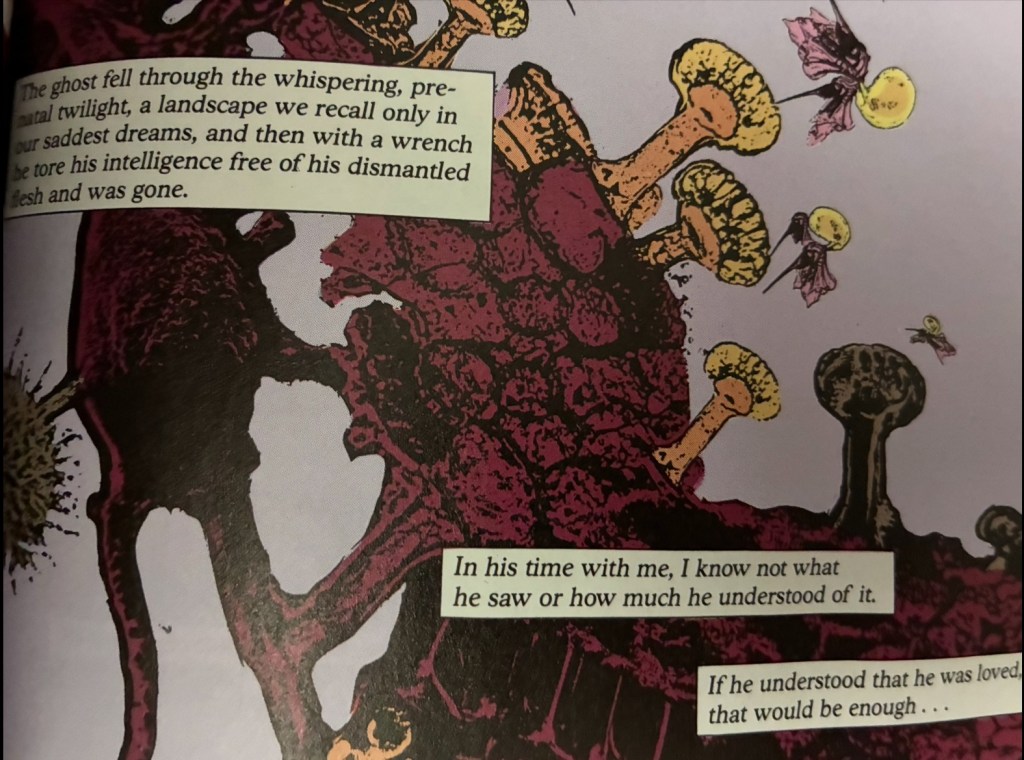


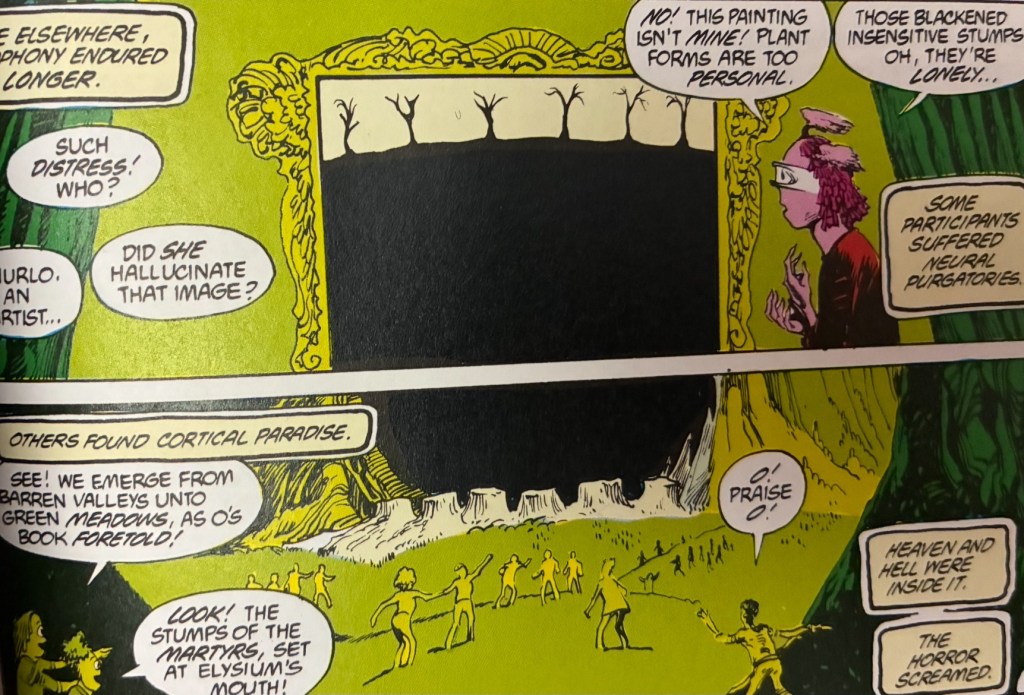
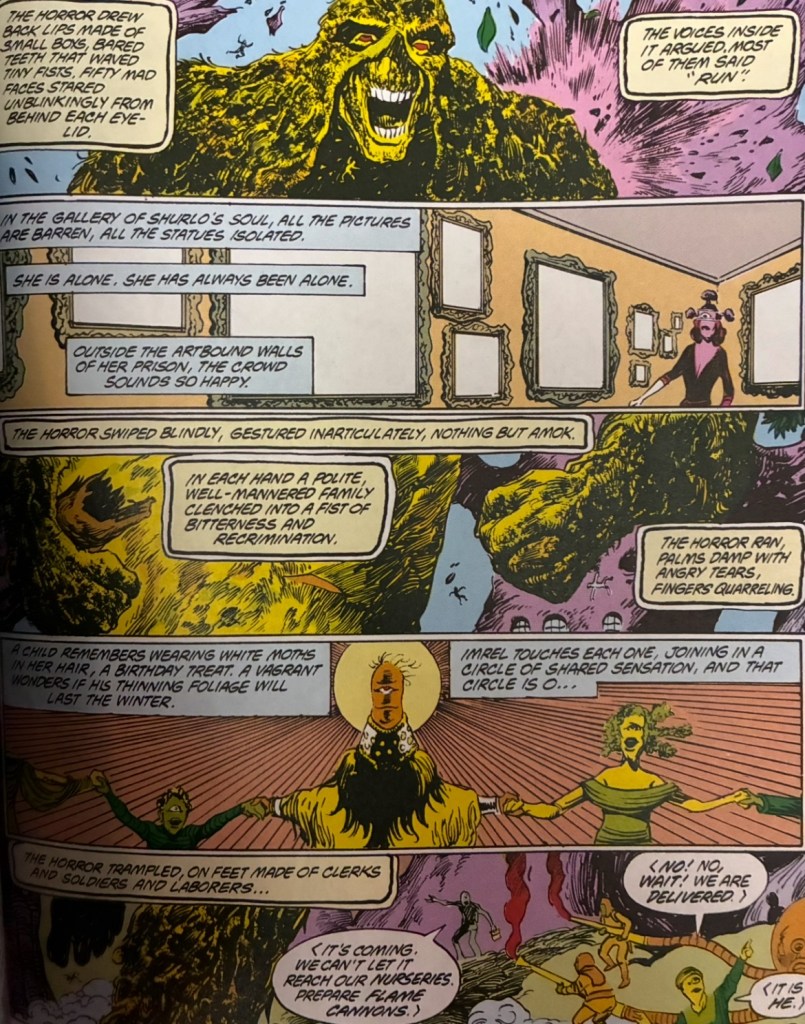


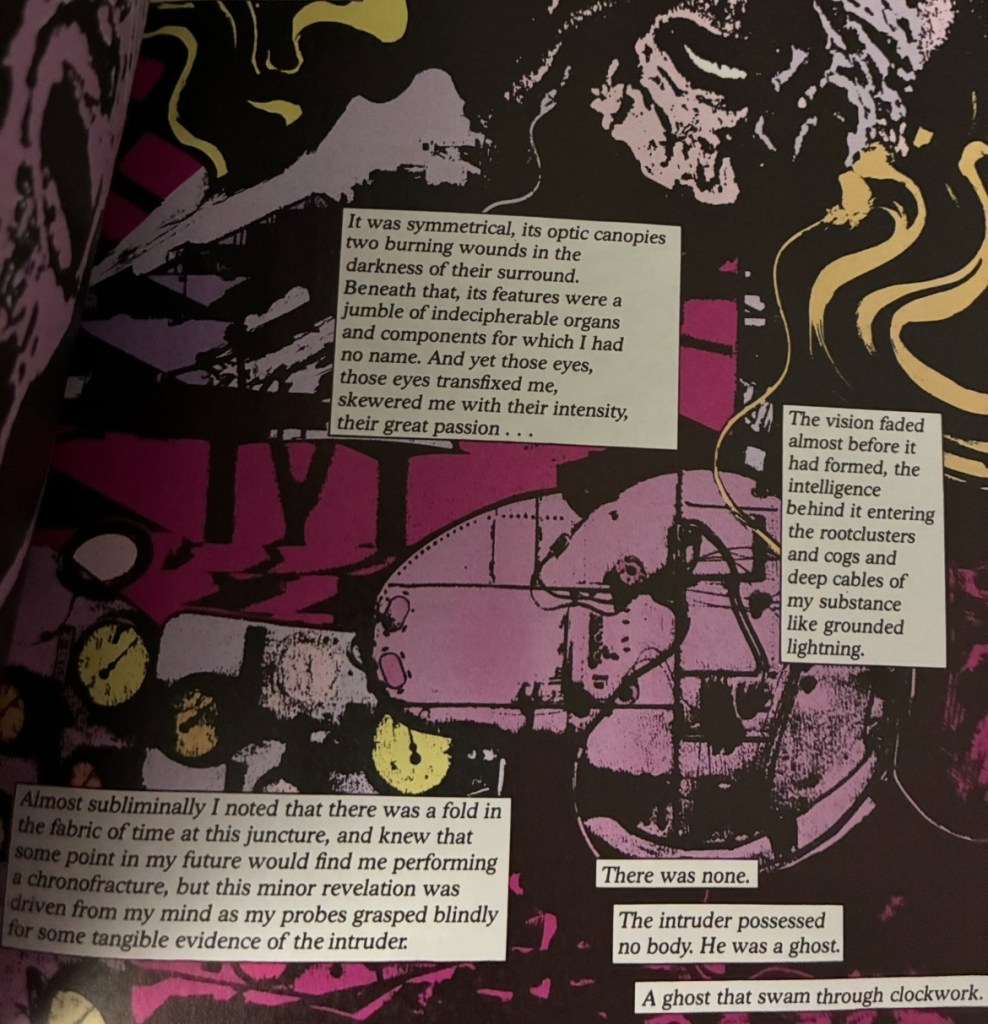
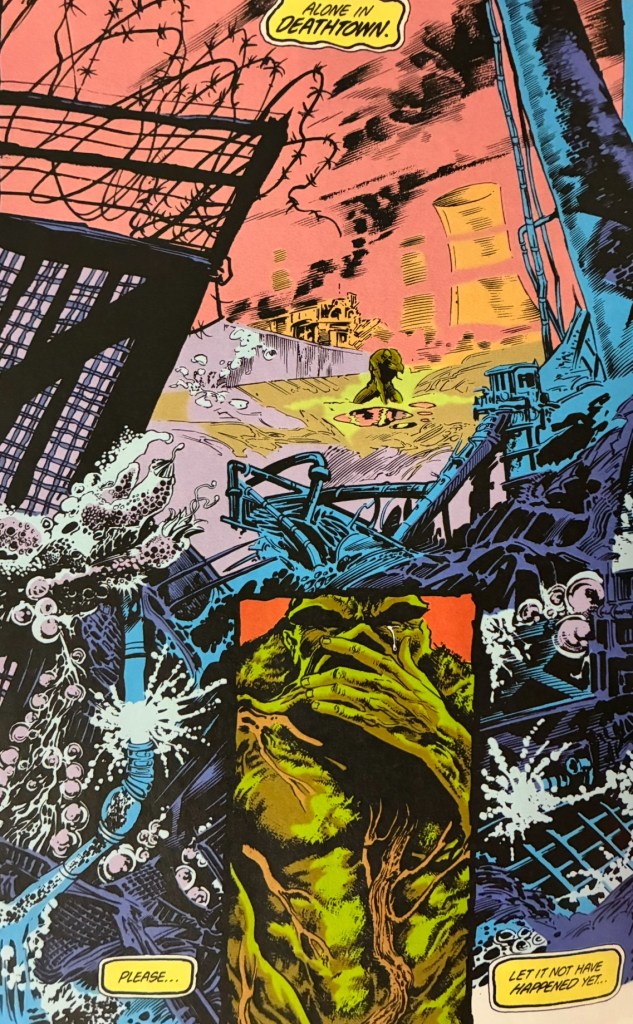
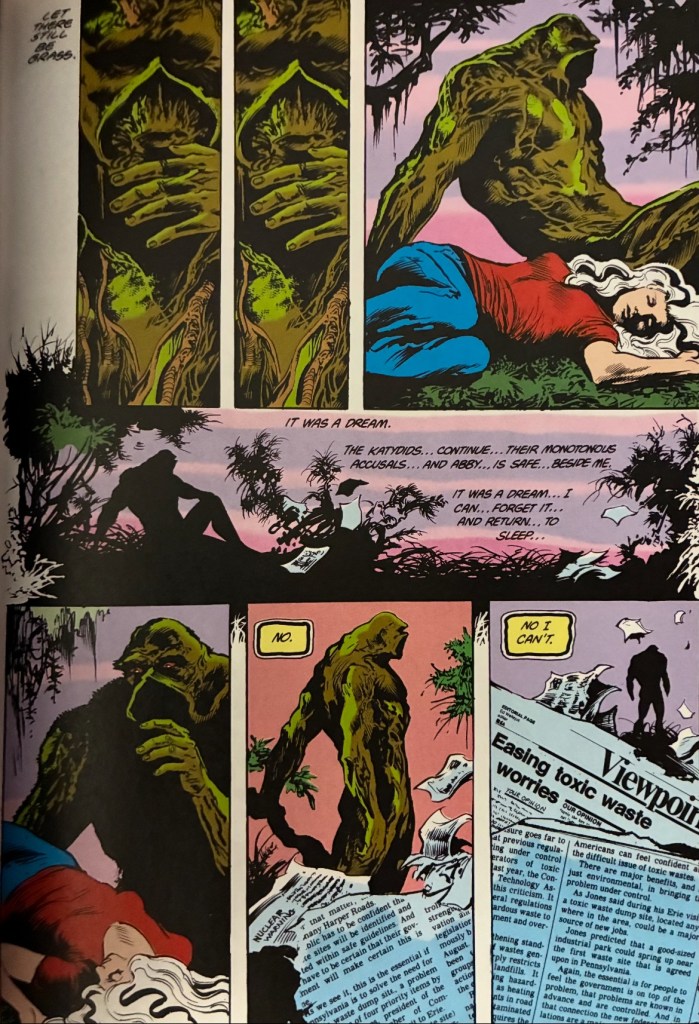

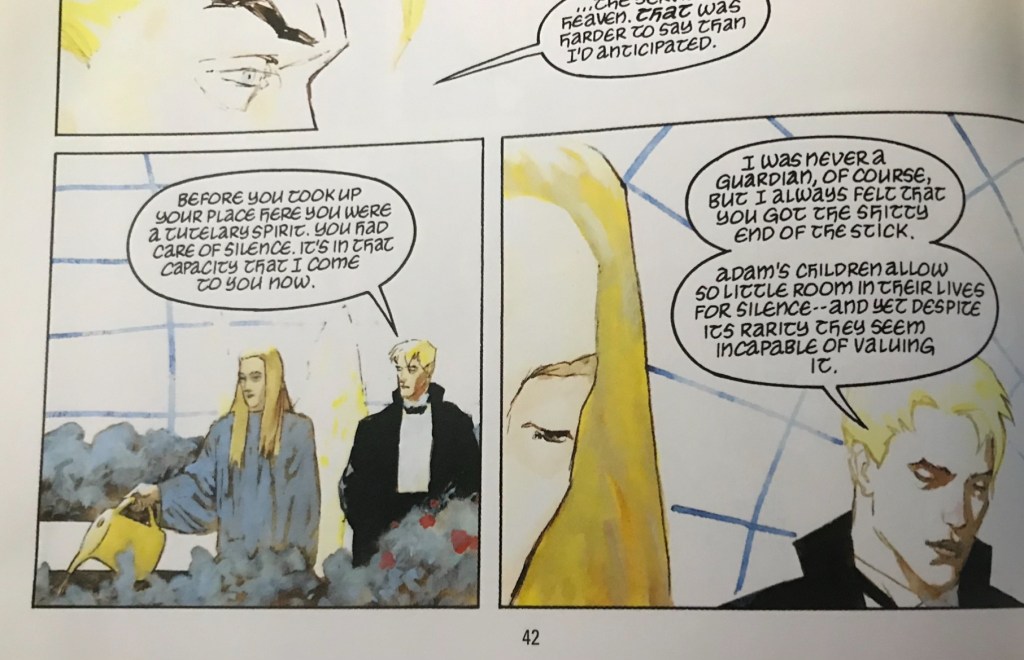

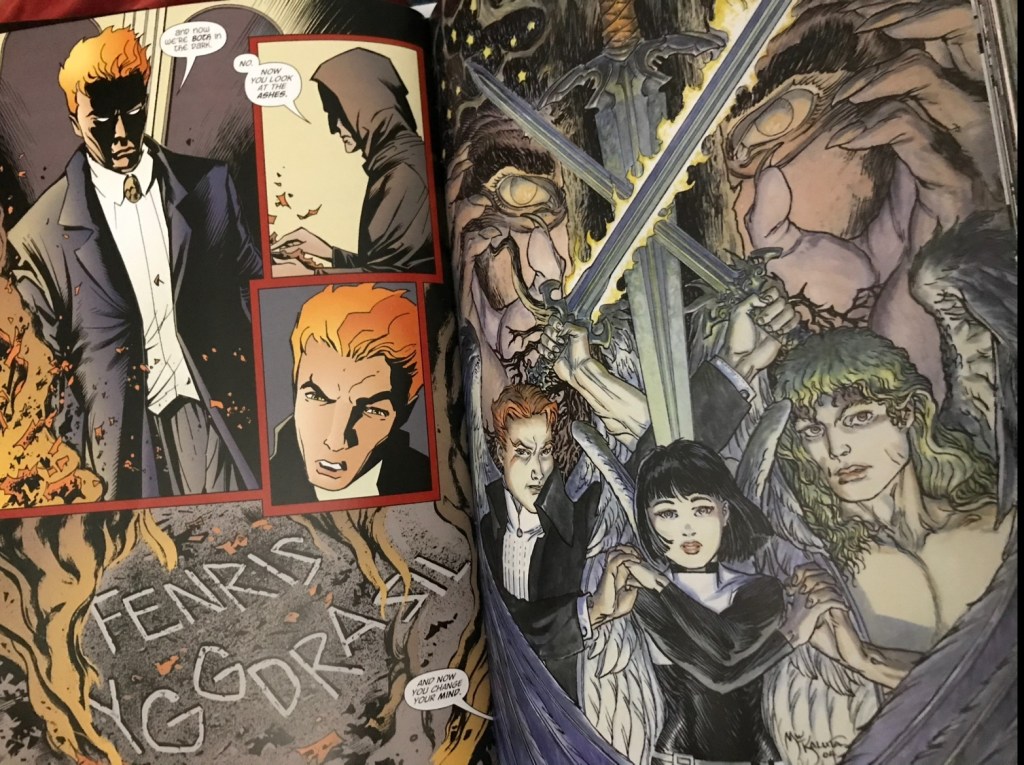

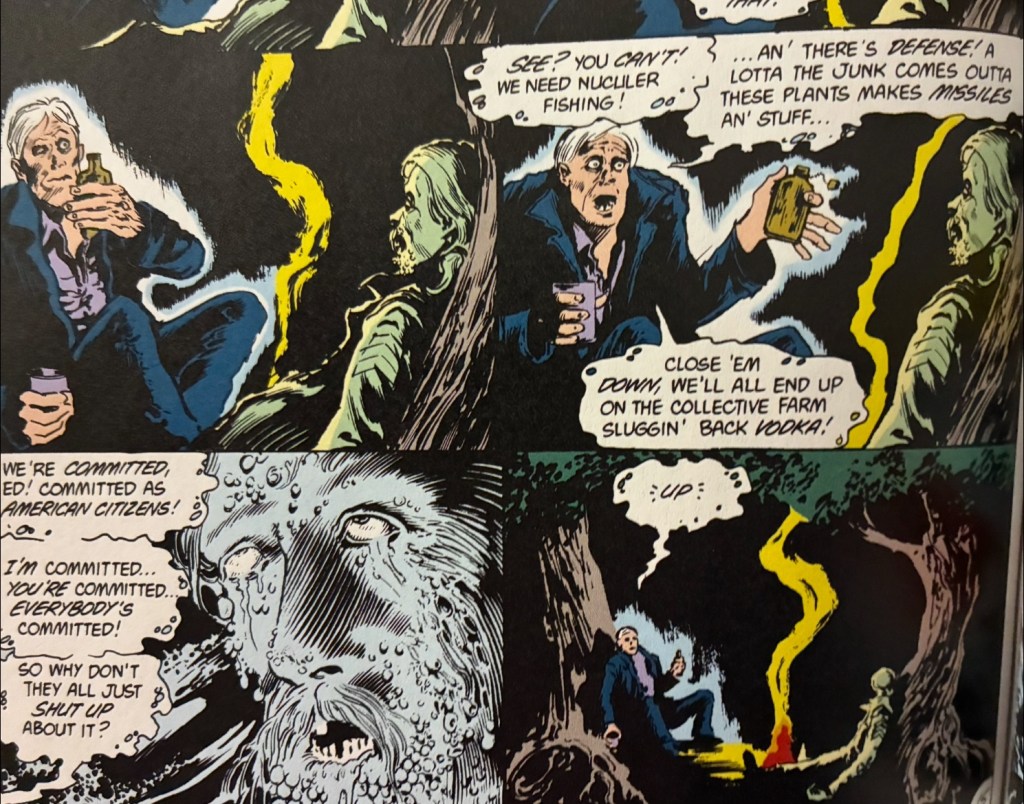
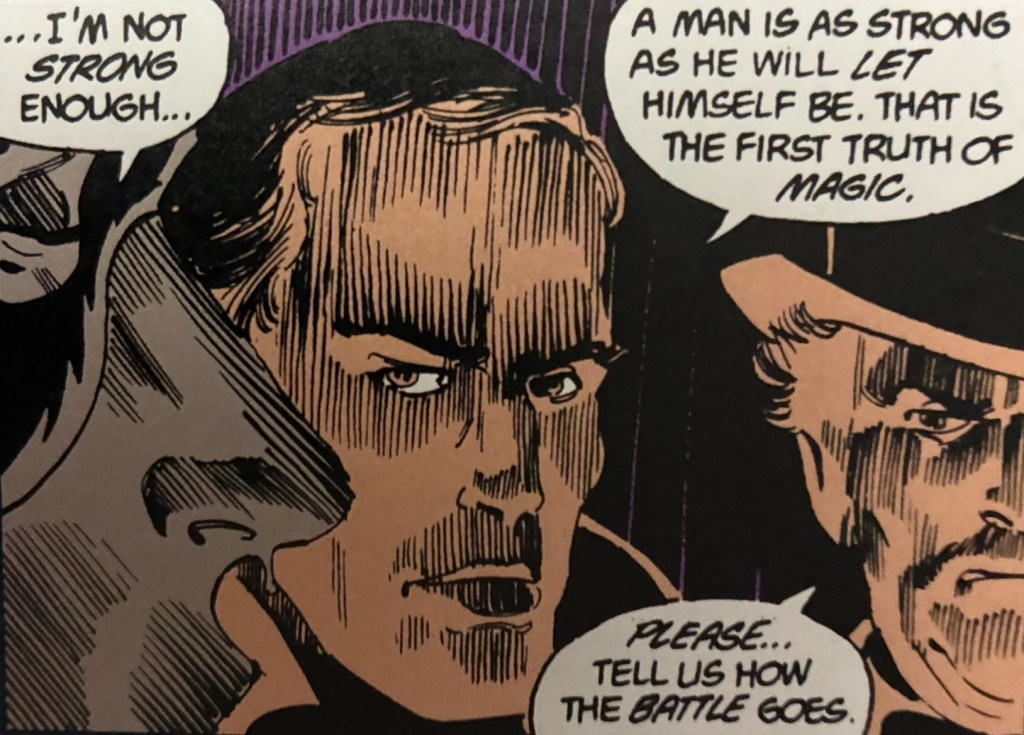

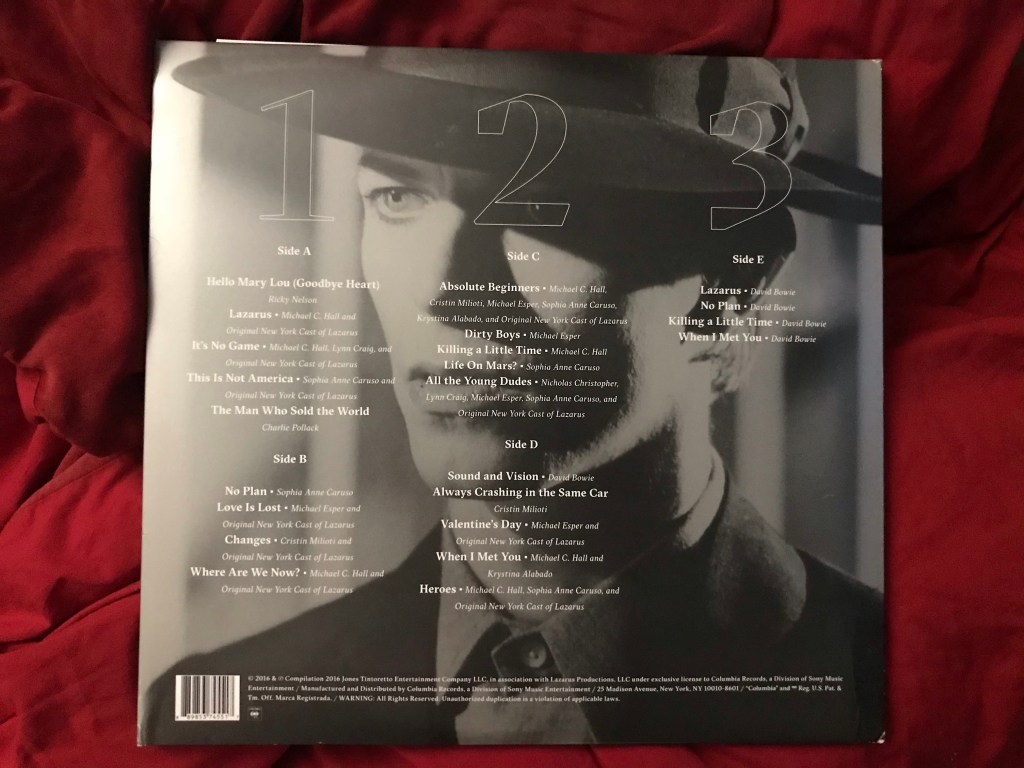
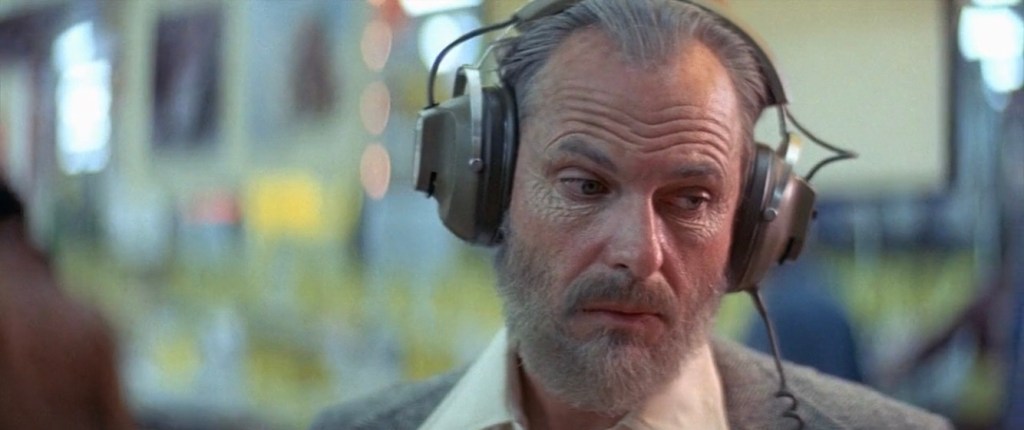
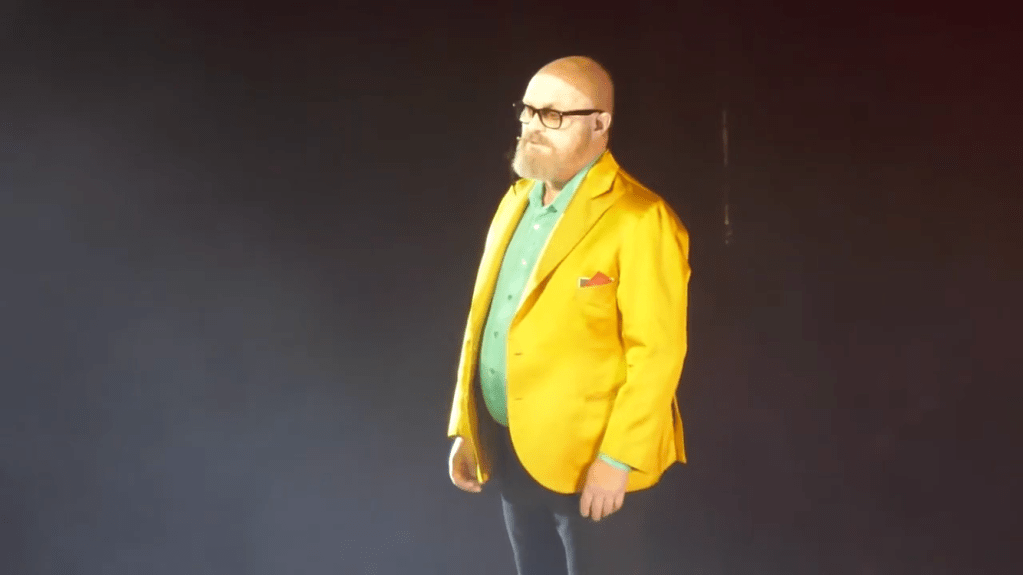


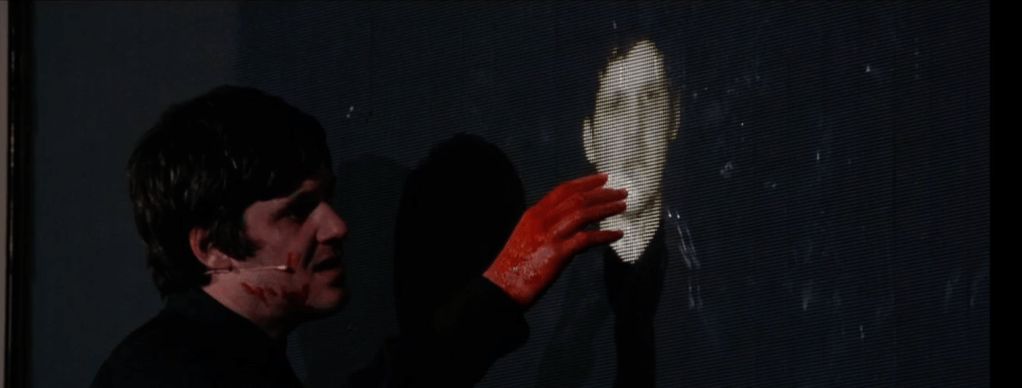


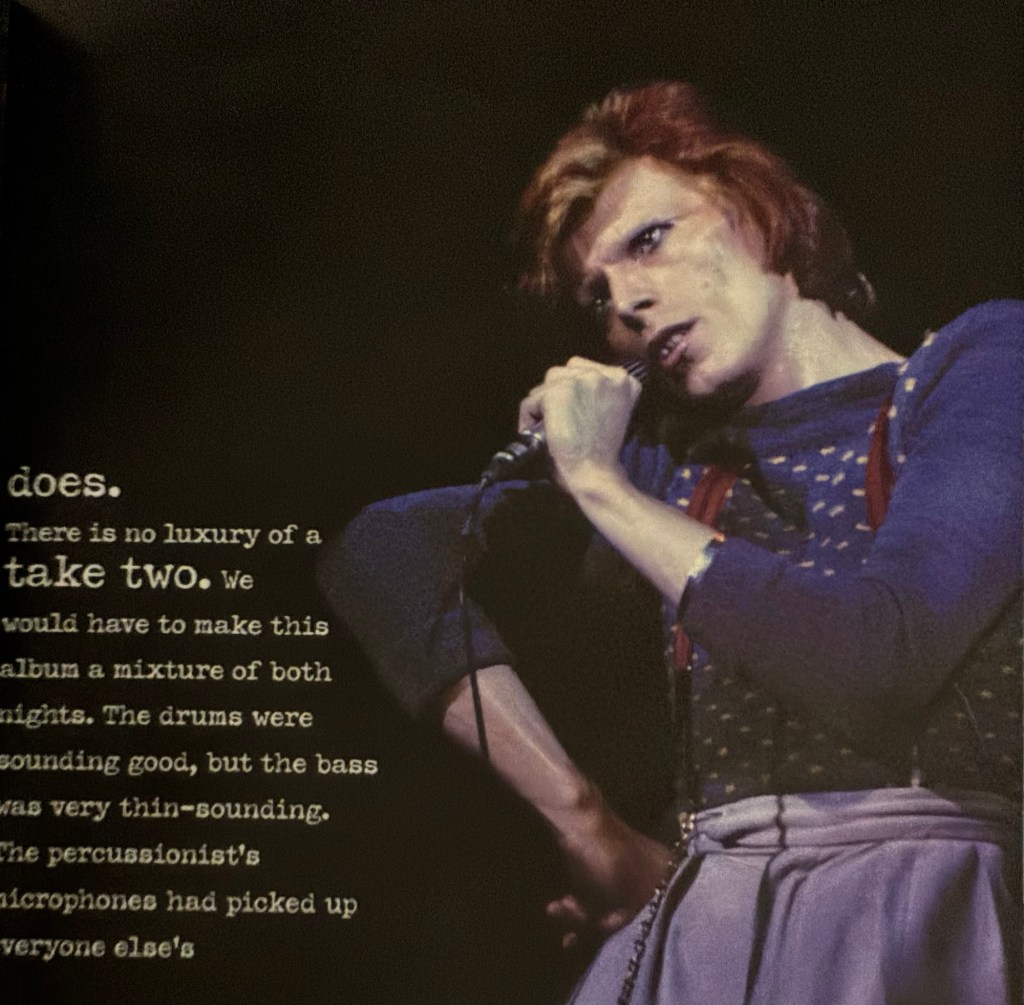


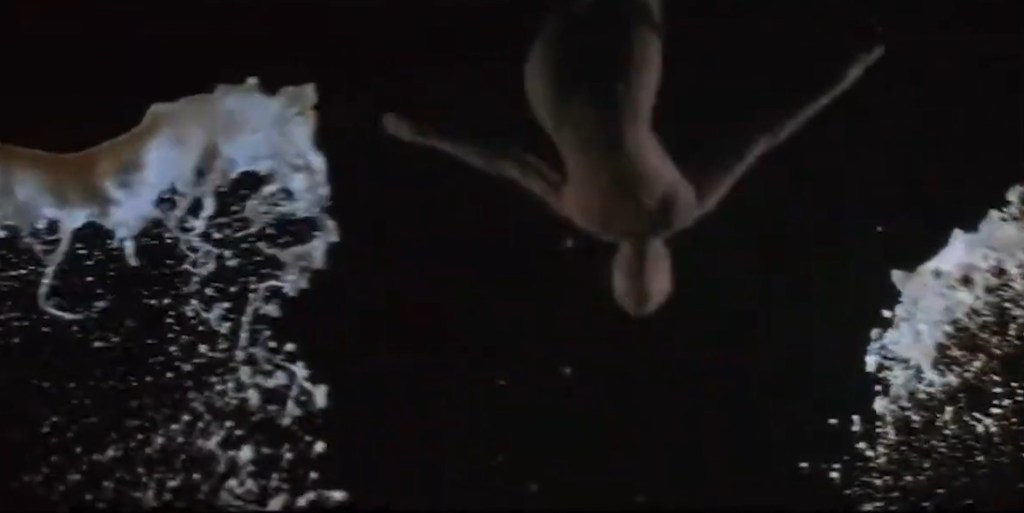


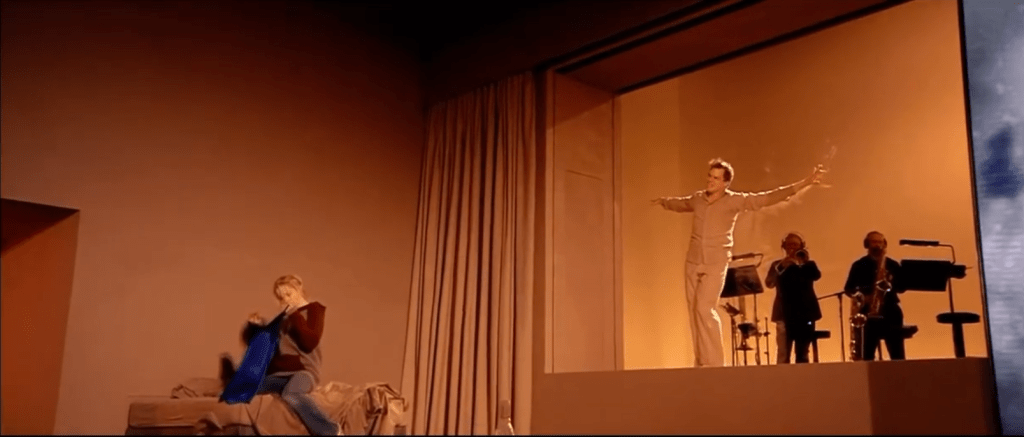


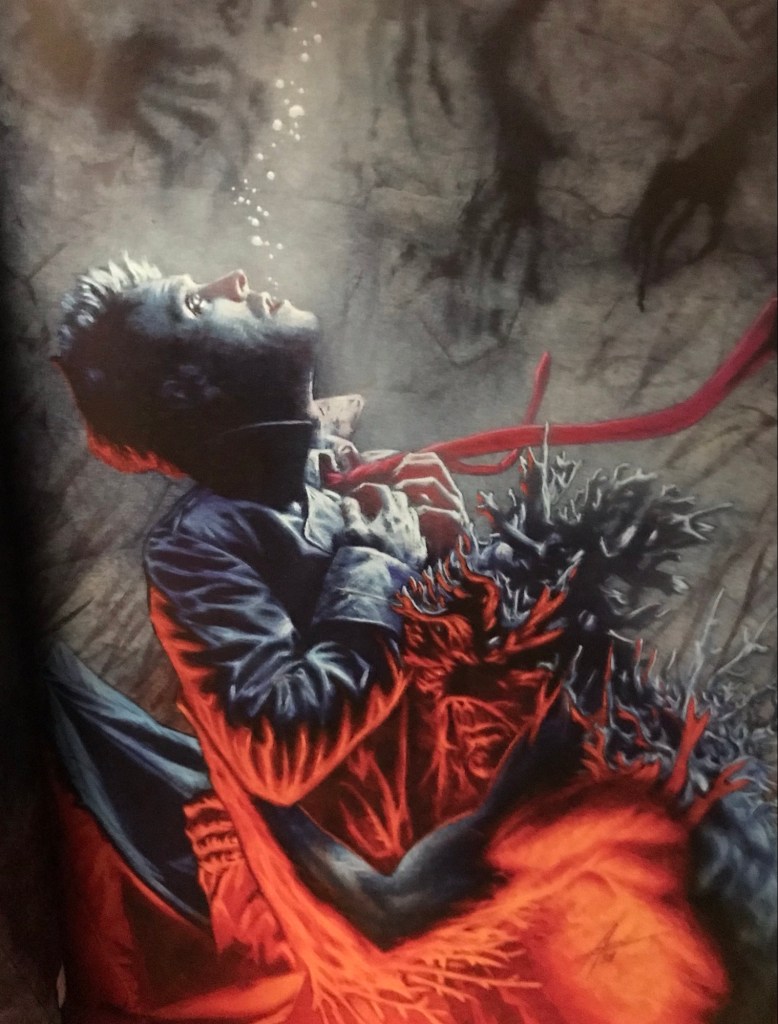


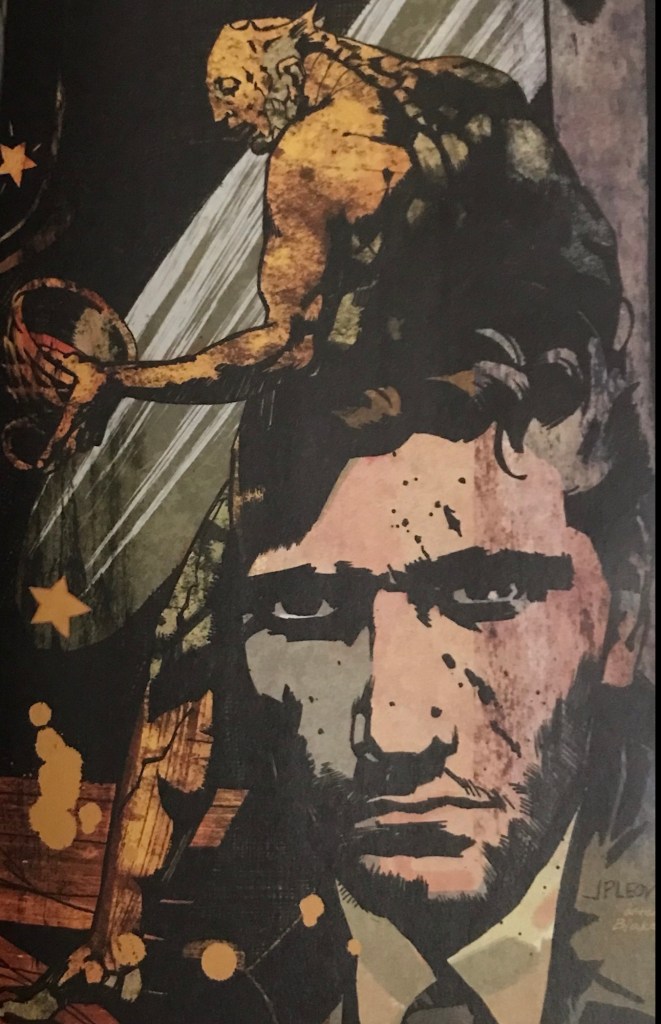
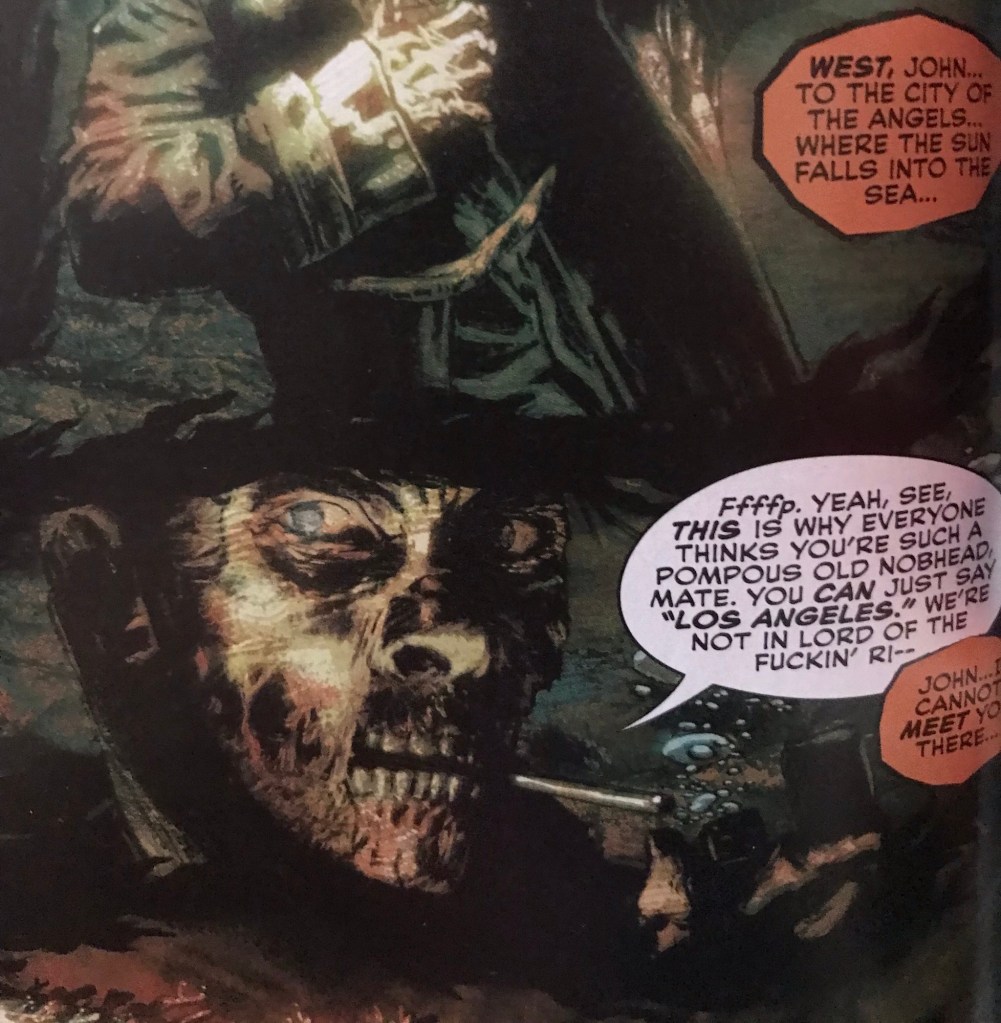

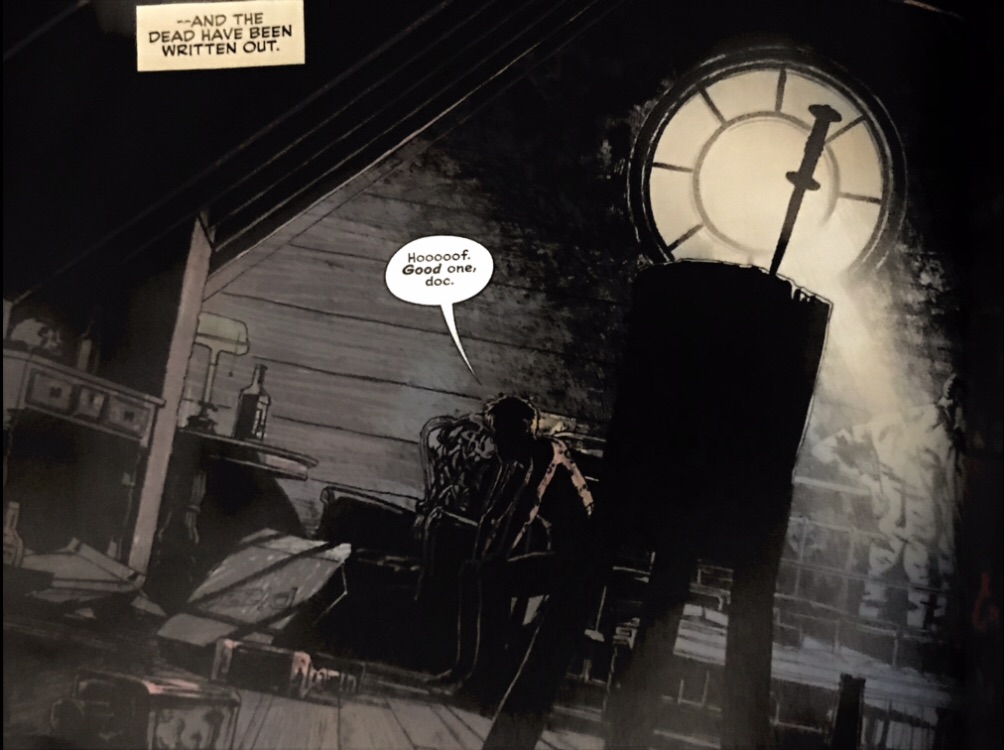
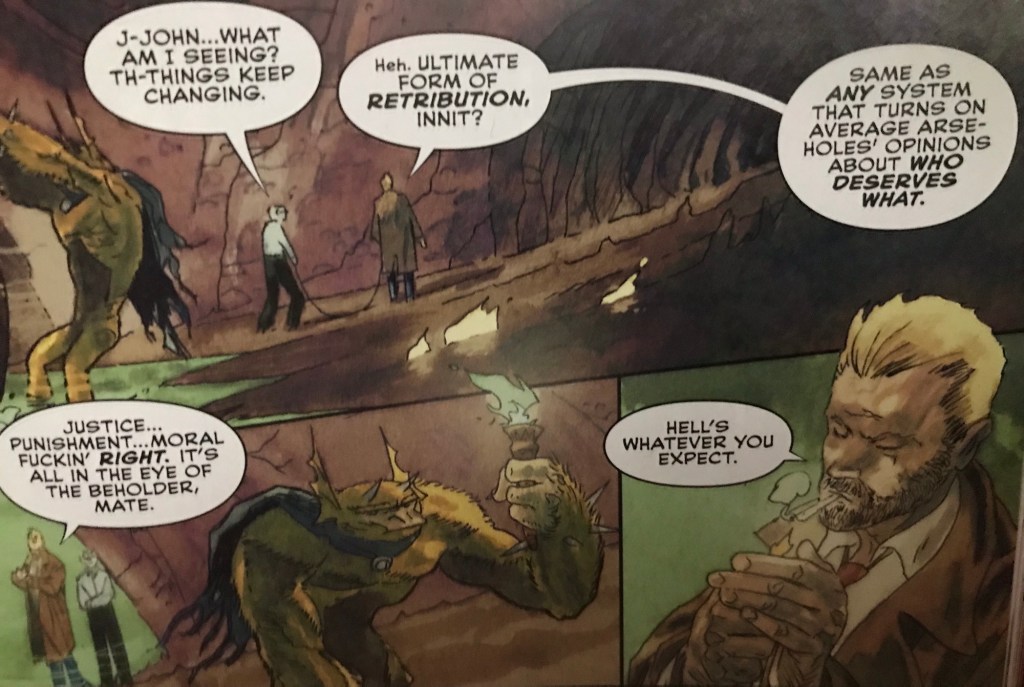


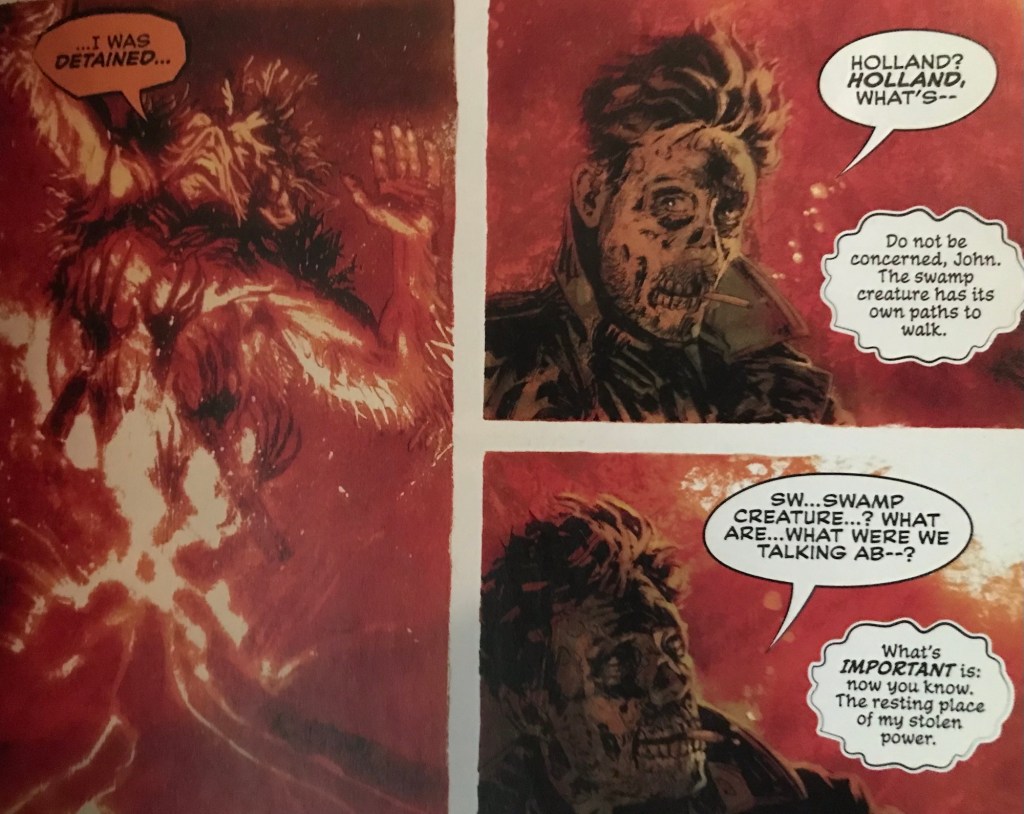














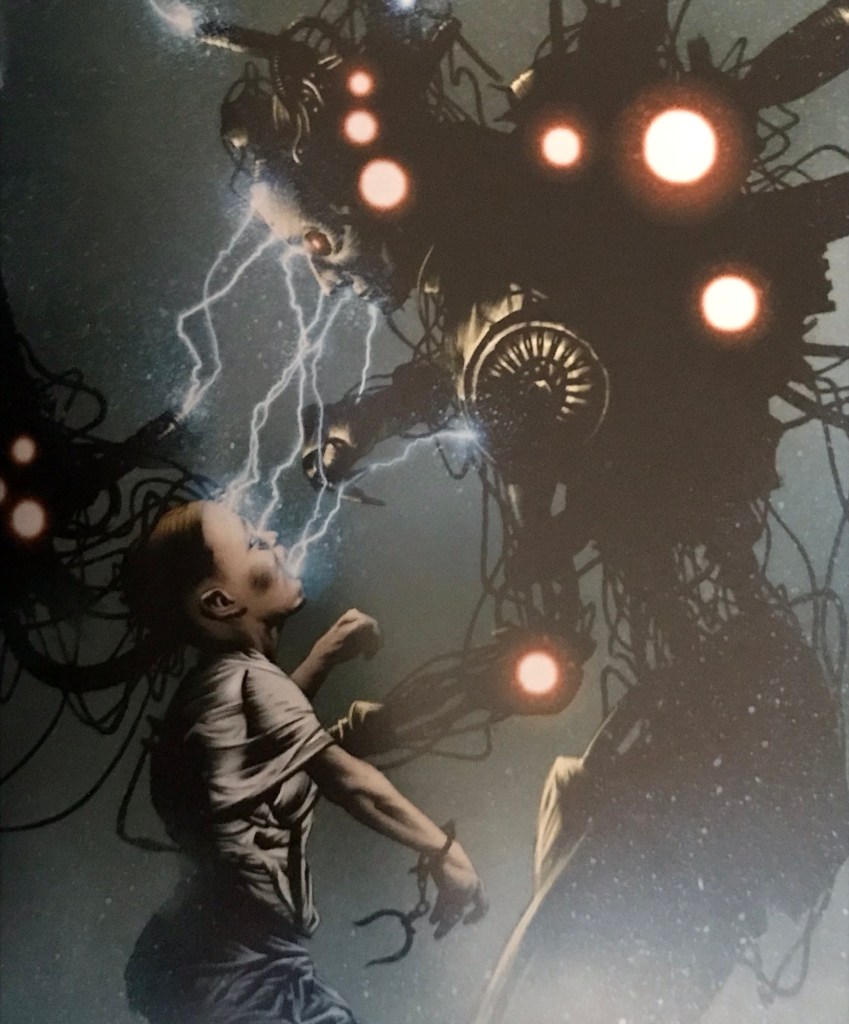
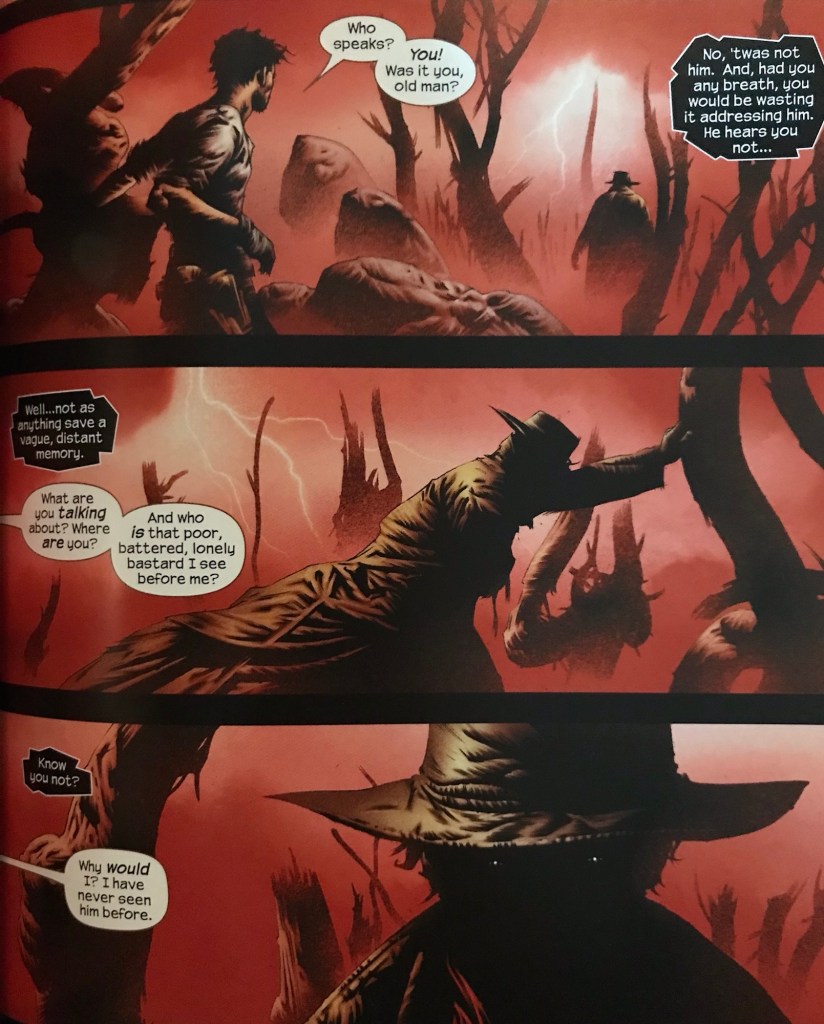

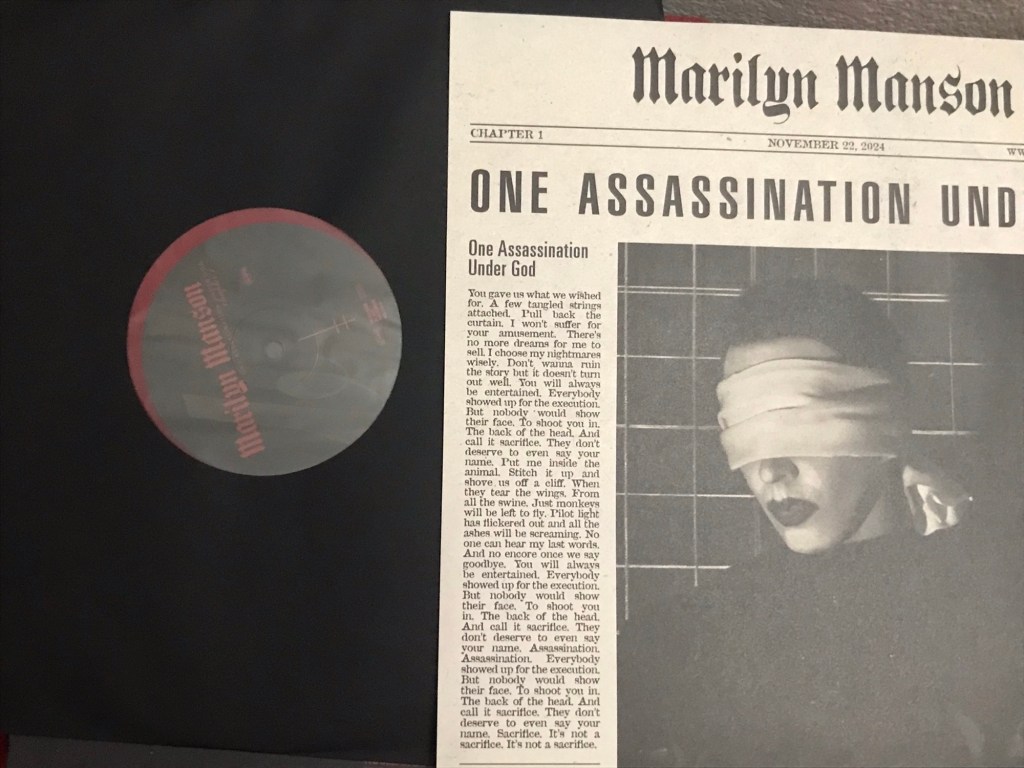
















 AilixChaerea