Swamp Thing: the ancestor of The Sandman and Lucifer

There are a handful of factual reasons why this is true. Neil Gaiman grew close to Alan Moore in the early eighties, having recently discovered one of these very comics. Gaiman even worked on supplemental prose in Moore’s Watchmen. The more fun reasons, though, come through within Moore’s ’84-’87 run on Swamp Thing (titled The Saga of The Swamp Thing for the first year, even though the six volume collection of Moore’s four year run is also sold under the same name).

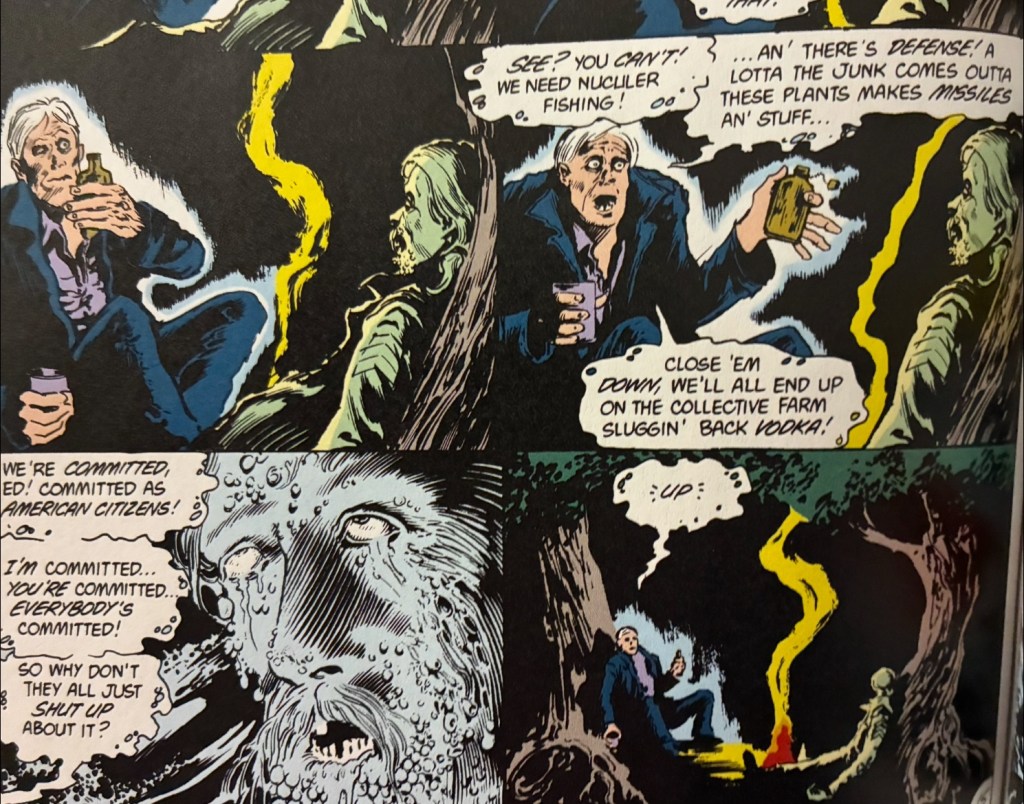
The Bogeyman, from the cereal convention in ‘The Doll’s House’ Sandman story? He started out as a Swamp Thing character. This person believes they killed the actual bogeyman and therefore inherited the chance to fill the role. Swamp Thing kills the successor, in the end. That wouldn’t stop someone from taking up the moniker afterward, though- just like he did.

Before Matthew Cable dies, he manifests the power to make dreams and imaginings real. When he dies, he receives a mysterious reassurance of a purpose waiting for him beyond the veil. Perhaps a cawing, eye-ball-gulping purpose.

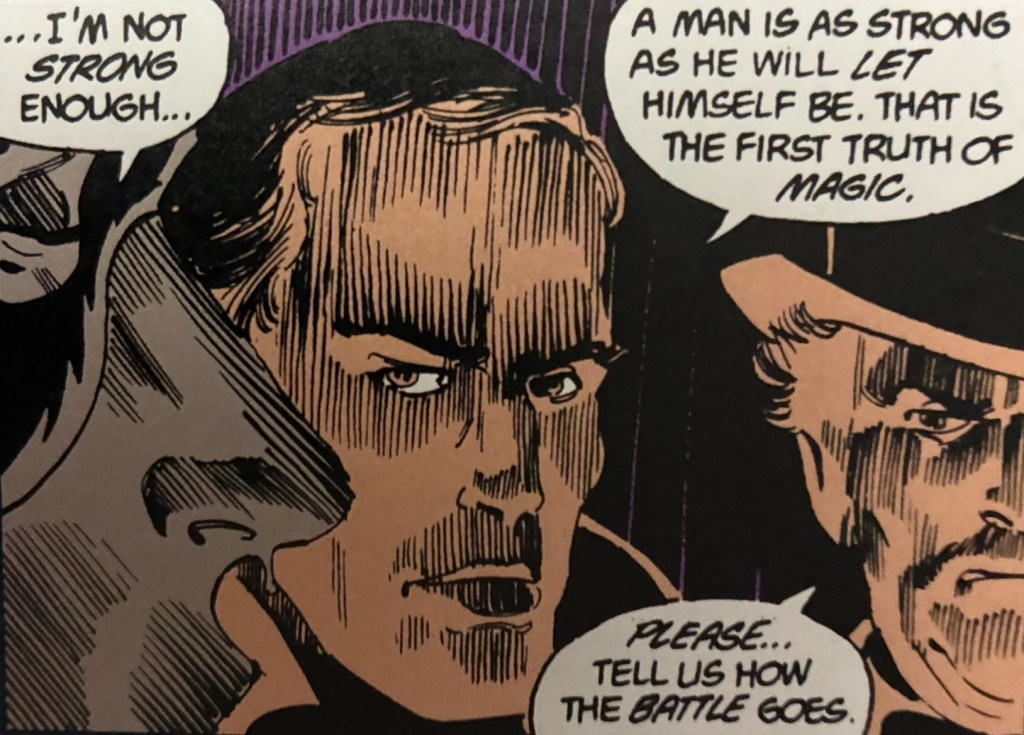
Yes, Cain and Abel in their twin Houses of Secrets and Mysteries existed in the world of D.C. comics before then. But a fan of the original Sandman would recognize them exactly in Swamp Thing. Their appearance and behavior are identical…which meshes with something that’s been on my mind since I read Promethea and Sandman: Overture. The mother of the Endless- Night -looks almost exactly like a being called the Lady in Promethea. Considering the role of these figures in both stories and the closeness of Alan Moore and Neil Gaiman, I find it hard to believe that the resemblance is coincidental.

(Speaking of: there is a brief Swamp Thing story about aliens aboard a ship which they named Find The Lady. This usage of the word ‘lady’ refers to a planet)

In Swamp Thing, Cain and Abel dwell in a collective psychic space between worlds. Travellers between different planes sometimes encounter Cain and Abel. Cain and Abel are also capable of perceiving cosmically significant events before they make contact with the material world (even if they bicker over it like a homicidal sit-com duo).

Another piece of relative common ground: the Phantom Stranger, Boston Brand, Etrigan and John Constantine. Constantine and Etrigan are the only direct Sandman links out of those four but Neil Gaiman’s Books of Magic is directly adjacent to The Sandman. Both Constantine and the Phantom Stranger are major characters in Books of Magic. Dr. Occult, Boston Brand / Dead Man, Zatana, Zatara, Baron Winter, Doctor Fate and the Spectre also appeear in both Swamp Thing and Books of Magic.

To say nothing of the importance of John Constantine in both of those and The Sandman. What’s funny: I originally had the desire to read Moore’s Swamp Thing run because I had just finished the SU story Hellblazer: Dead in America. What do I find? The first ever appearance of John Constantine as a fictional character. In a story arc which ‘Dead in America’ echoes very closely.

Alan Moore basically invented Constantine to connect Swamp Thing with the wider plot threads in the American Gothic arc. My wife recently showed me the early nineties TV show. I vaguely remember that my mom used to watch it but nothing about what it was actually like. I also suspect that the TV show was addressing an audience with a broader awareness of the character than mine. I just read the Alan Moore stuff. Before the early eighties, Dr. Arcane was a big enough re-occurring villain for him to be filed away as the obvious big bad. The early nineties show also decided to make Dr. Arcane British and gave him a few lines making vegetible jokes. Swamp Thing and John Constantine have this romantic American / snarky Brit dynamic…which they couldn’t have been trying to shift onto Swamp Thing and Arcane…could they?

Arcane definitely matters in the Alan Moore stuff but mostly by the consequences of previously depicted actions. His pro-active involvement in Moore’s Swamp Thing starts when he manages to rope Abigail Cable into Hell, sending Swamp Thing on a Divine Comedy-like journey. Like Timothy Hunter, Swamp Thing’s quest across dimensions puts him in touch with both Boston Brand (in the realm of the recently dead) and the Phantom Stranger (in Heaven). Etrigan, of course, shows up in Hell.

The long, interdimensional treks are some of the more chaotic and interesting moments in the comic and the Divine Comedy themes are never altogether gone from that point forward.

Like Dante and Beatrice, a lot of the astral travel (at this point and elsewhere) is catalyzed by the romance between Swamp Thing and Abby Cable. It’s interesting to me how often the journey of the Orphic pilgrim is prompted by the need to find someone- usually a lover, even if Hans Christian Andersen did his best to blunt those edges in The Snow Queen.

Alan Moore did a sympathetic version of The Creature from the Black Lagoon decades before The Shape of Water. The Dantean themes add something to this. Regarding the woman whom he modeled Beatrice after, Dante said that he wanted to write about her in a way that no woman had ever been written about.

I just remembered- there are three prolonged journeys across dimensions in Moore’s Swamp Thing. The first is rescuing Abby from Hell, the second is confronting the menace at the heart of the American Gothic story and the last is a long, hard journey toward reunion after a painful separation. Three journeys across worlds, like the Divine Comedy. Also like the Divine Comedy: the last one happens mostly in space.

Or, at least, you could be forgiven for thinking Il Paradisio happens in space. He describes Heaven as a bed of stars, surrounding a central light. Different souls are like planets unto themselves. One travels between stars and planets by looking at them.
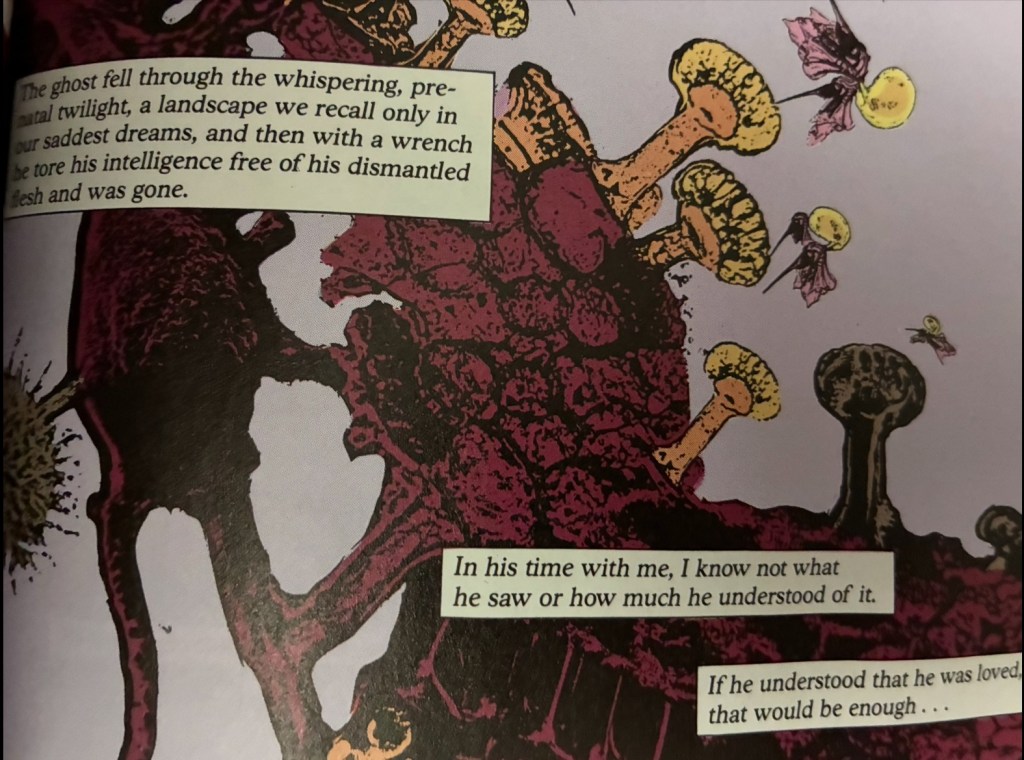
Before entering Heaven, Dante must drink from the waters of Lethe, to cleanse himself of his human fallibility, which causes a fundamental shift in his perspective. He romantically loved Beatrice while she was alive but in Heaven spiritual love reaches full maturity and the mortal perspective is removed by Lethe.
Swamp Thing is driven from Earth by a weapon devised by Lex Luthor. Yes, he is a plant elemental with the ability to manifest anywhere that plants live (Swamp Thing, I mean). But what Luthor’s weapon did was separate his subjective point of view from Earth’s plant life, forcing Swamp Thing to look for a manifestation vector outside of Earth.

He makes a few different stops before he is able to manifest long enough to set out for Earth. The love between Swamp Thing and Abby deepens. This is, however, far from pleasurable. Swamp Thing wrestles with the prospect of total separation. Abby goes through the same thing and a mysterious encounter with John Constantine occurs.

I wondered if this related to the entanglement referred to throughout ‘Dead in America.’ That, it turns out, occurred after Moore’s work on Swamp Thing.

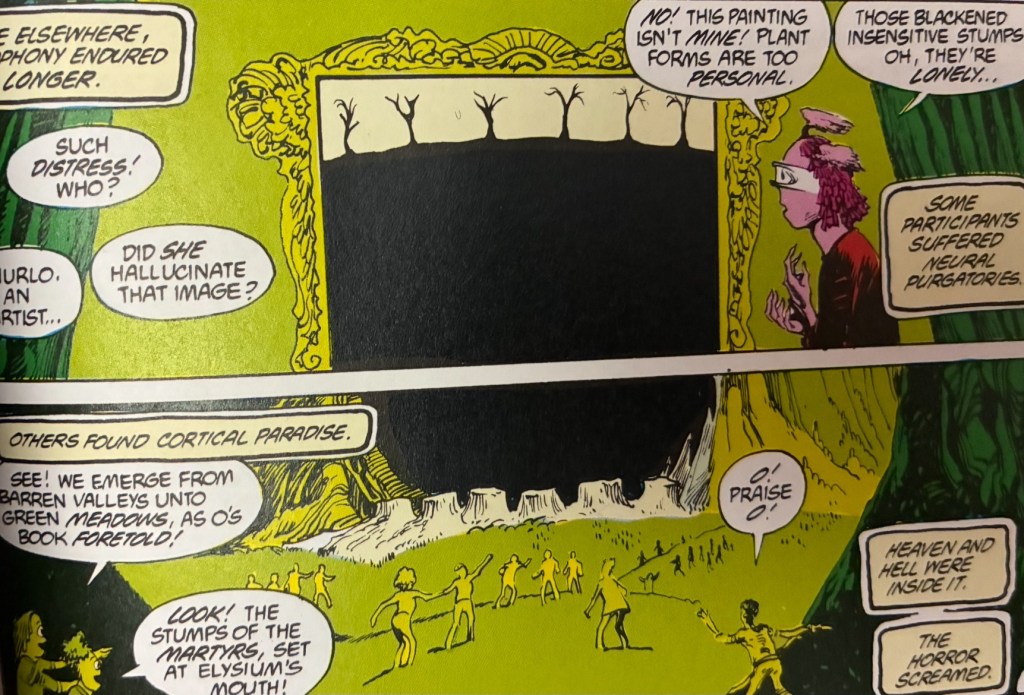
Swamp Thing and Abigail both experience an interrogation of their love. Swamp Thing tries to abolish the whole thing from his memory, then tries to embody a museum of nostalgia on another world, including his own lifeless recreation of Abigail.

A demonic echo of Abigail’s uncle- Dr. Anton Arcane -briefly reaches out to her from Hell. Because of his psychic contact with Abby, Arcane turns into a blocky, Frankenstein’s-creature-type-wight embodying Abby’s buried and sublimated feelings toward various masculine figures in her life.

With all the older, male, broad-shouldered remembrances, it is difficult not to notice the subtle resemblance to Swamp Thing. As if Abby is beginning to shake off her “daddy issues” and is now re-evaluating her relationship. In the end, she finds that her love and loyalty are still justified.

This really reminded me of the 2019 Alejandro Jodorowsky comic Angel Claws, which tells a similar story with more dream logic and sex.

Relationship problems were not the only way in which Dream of the Endless echoed Swamp Thing.

I wondered if, given the range of Swamp Thing’s abilities and domain, Dream must necessarily have some connection to him. This is demonstrated in Moore’s run on the Swamp Thing comics but it was made explicit and canon in the recent Hellblazer story ‘Dead in America’.

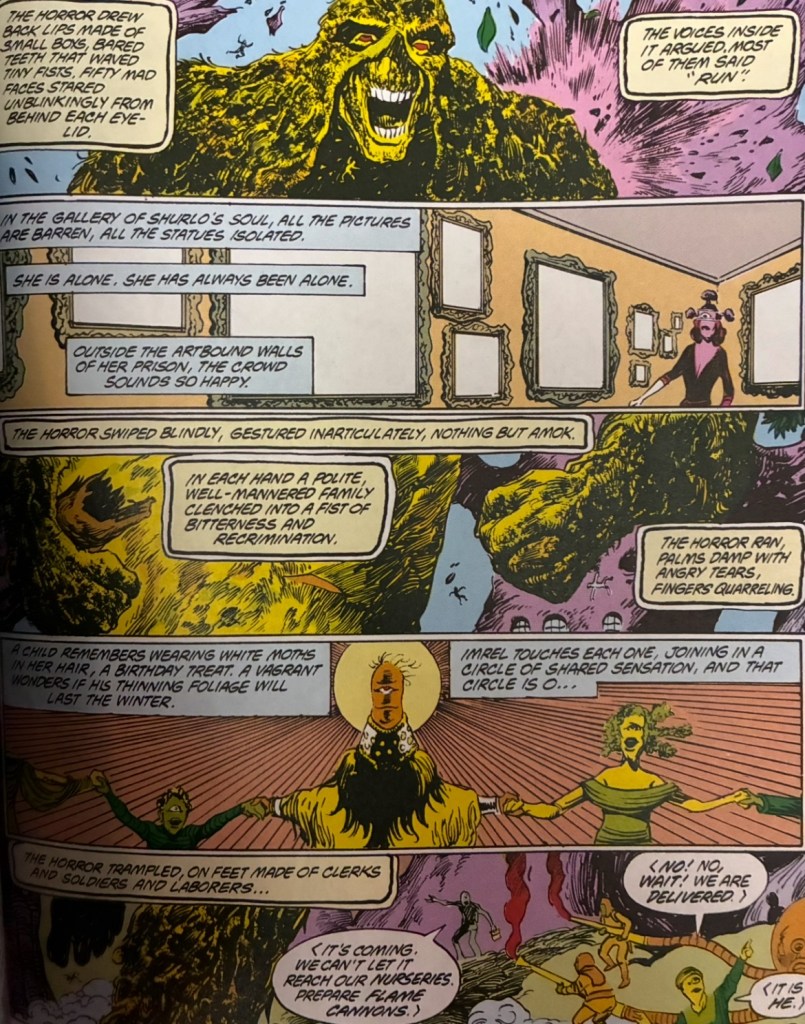
As expressed in ‘Dead in America’, Dream rules over dreaming sentience (the Dreaming) and Swamp Thing rules over dreaming non-sentience (the Green). The living non-sentience Swamp Thing communes with are (obviously) either plant life or things directly adjacent to it, like mycelial networks.
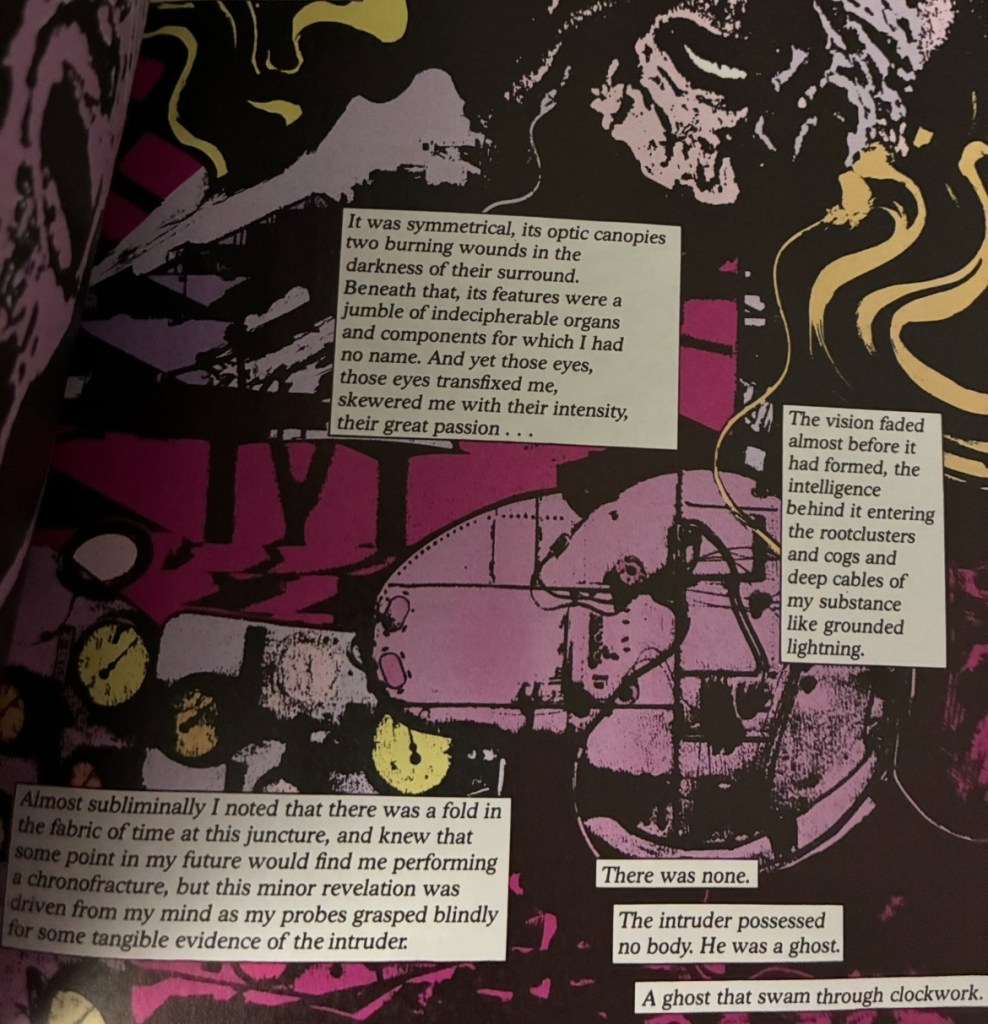
At the very least, there’s got to be some aspect of the Green that overlaps with the Dreaming and some aspect of the Dreaming that overlaps with the Green. I find it easy to think that they are different emanations of one another, perhaps like how the shape of an Endless depends on who is looking. Swamp Thing may literally be Dream in the plant world.

There are serious differences in perspective, though.

Dream is a monarch, with duties set in stone, as a perpetual condition of his existence. Swamp Thing exists within the same holistic network as all plant life and this connection compels his love and loyalty to the planet. He defends it as a champion and is capable of preventing outside threats. He feels obliged to take a protective stand when necessary but does not identify completely with his custodial authority, as Dream does.

I wonder if a lot of those existential ‘purpose’ questions disappeared with the realization that he is his own being, rather than Alec Holland.

Also on the overlap between Dream and Swamp Thing: Swamp Thing’s protective duty to the planet carries him all the way through the American Gothic arc, leading up to the confrontation with the primordial darkness outside of creation, charging into battle alongside the Phantom Stranger and Etrigan. It is important enough for Swamp Thing to bet his life and his sanity on it.
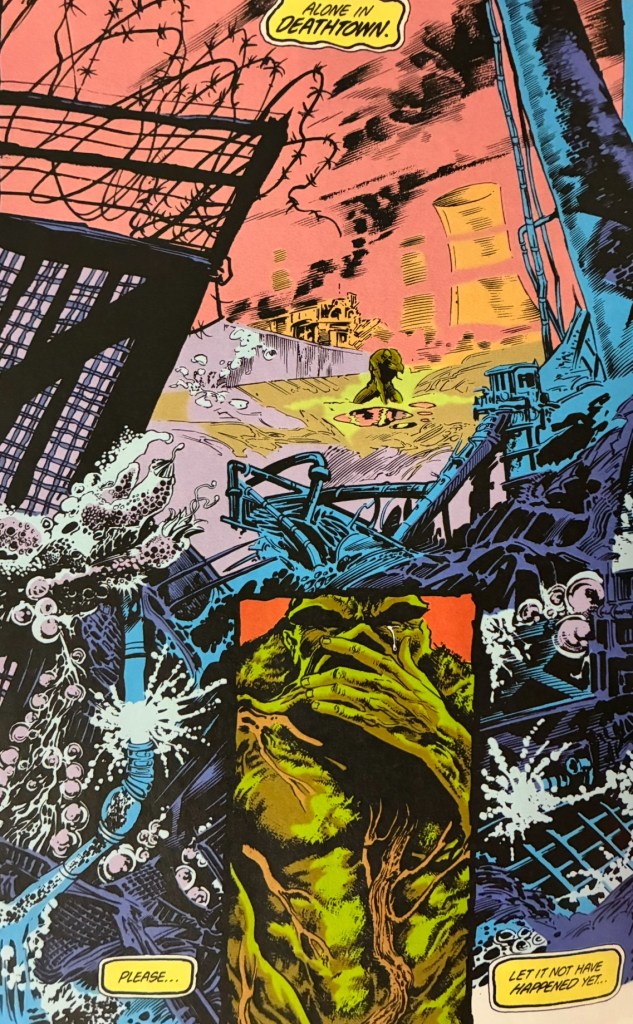
However, Abby Cable re(?)entered Swamp Thing’s life after he realized he wasn’t Alec Holland. He fell in love with Abby at the same time that he was coming to terms with his true nature. Her love has anchored much of his stability, up until that point. The loss of this anchor is also reminiscent of Dream’s mortal relationships in The Sandman. Swamp Thing is different, though, in that he never flinches from the long, hard road toward reconciliation.
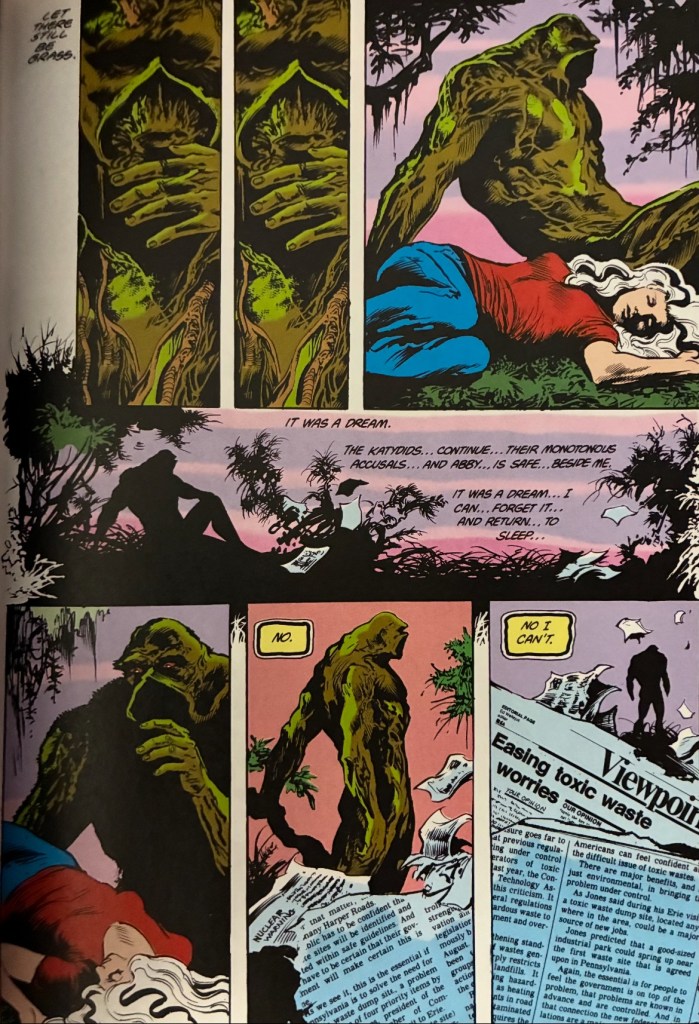
This split in loyalties does not haunt or paralyze Swamp Thing like it did Morphius. What haunts and paralyzes Swamp Thing is losing Abby. Morpheus will agonize over an ex but his priorities are always crystal clear: the Dreaming above all.

The ending of the American Gothic arc also makes me wonder about the cosmological relevance of Lucifer.

This is going to get into the weeds of my interpretation of Mike Carey’s run on Lucifer. The story begins with the Silver City approaching Lucifer with a big payment for a big favor: get rid of an emerging deity.
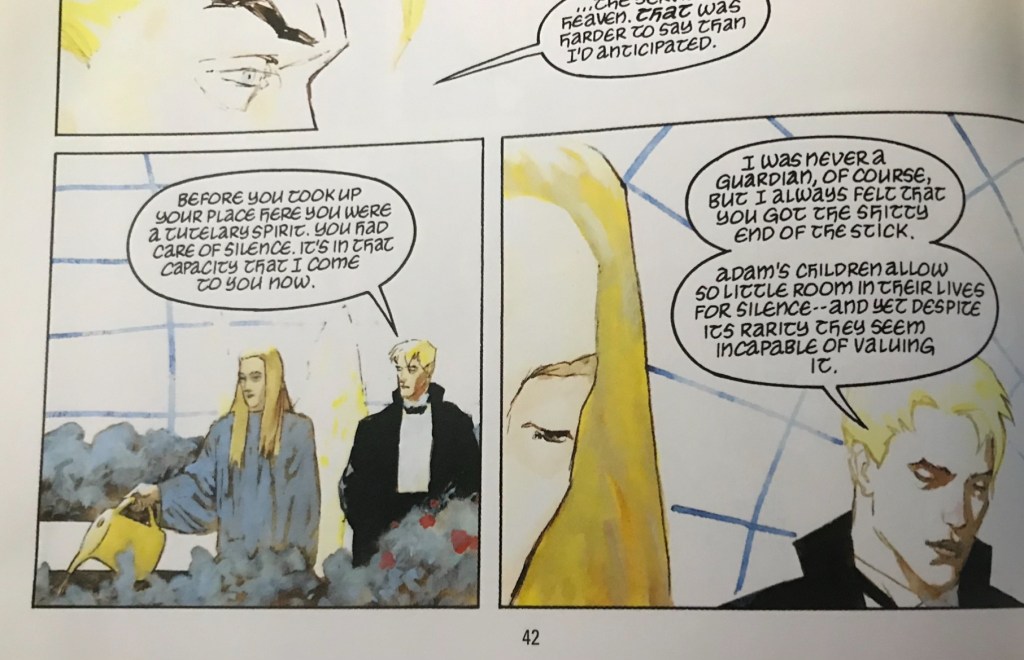
This being once belonged to a pantheon called the nameless gods. These are divine spirits that respond to non-specific or non-linguistic prayers. The ones who respond to spirits reaching out with no point of linguistic contact.

Later, another group of beings enters the plot: the Jin En Mok, who were the deities that remain from an earlier universe, who typically see our universe as an obstruction or an enemy. One group are the survivors of a defunct pantheon and the other are the gods of those with none in particular. Those sound like two groups that could easily overlap- potentially two societies within the same race.

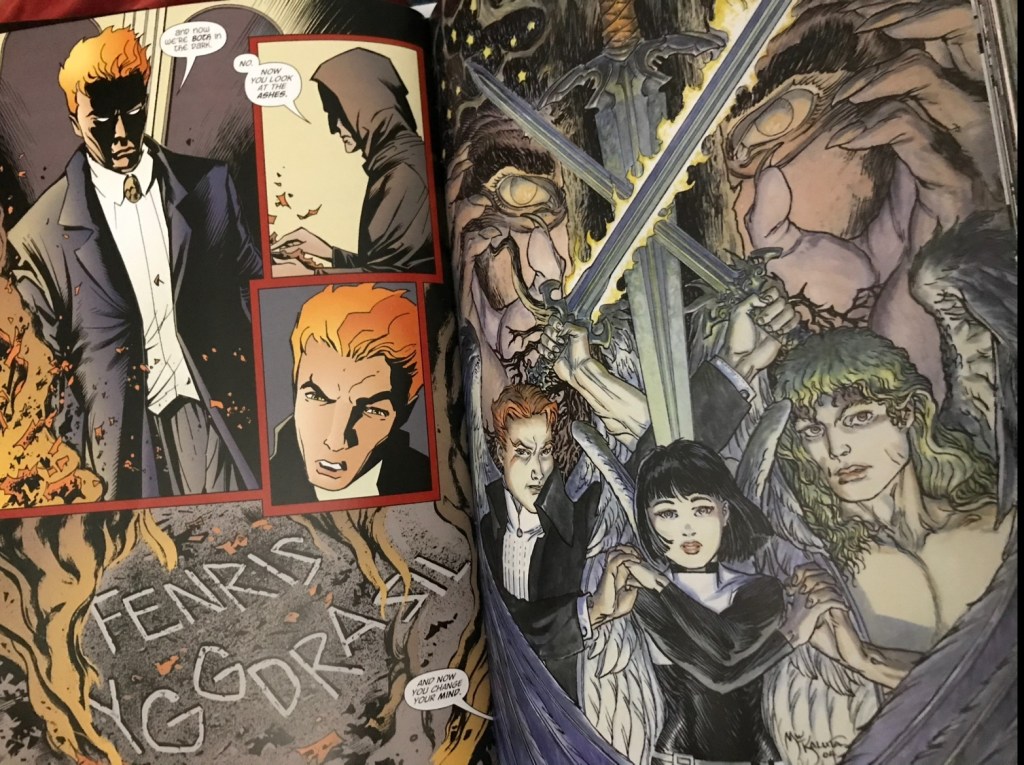
The latter arc of Mike Carey’s Lucifer concerns a character called Fenris Yggdrasil. Fenris entered existence as the Fenris from Norse mythology. Since Lucifer takes place within the continuity of The Sandman, we can assume that this Fenris is an emergent dream-construct, like the deities throughout both The Sandman and American Gods. In other words, he sprang from the oneiric energy of believers, from when his existence was more widely credited. By the time he shows up in Lucifer, Fenris is trying to tear down the multiverse. If he ever succeeded at doing that, it would make him a refugee from another universe like the Jin En Mok.
The human family that the nameless god from the beginning of Lucifer incarnated into begins and ends Mike Cary’s story, what with Lucifer holding the destiny of the soul of the nameless deity over one of the members of the family he incarnated in (Rachel Begai).

At the culmination of American Gothic, Swamp Thing, Dead Man, Etrigan, Phantom Stranger and other astral combatants meet the darkness outside of creation in battle.

This was the opening of a cosmic floodgate, enacted by the Brujeria. This is the darkness outside of creation encountering existence for the first time. Existence and definition. It learns to identify as evil, from the blandishments of Etrigan and Phantom Stranger. Swamp Thing recalls the words shared with him by the Parliament of Trees: “Where, in all the forest, is evil?” Swamp Thing tells the darkness (after being absorbed by it) that evil is the best and most nurturing companion of good, which makes an impression on the young mind.

Smitten, it turns to embrace its cosmic opposite. A giant finger rises from the astral battle field, bringing with it a great, dark hand, reaching out in affection to a golden hand of light.

The menace represented by the primordial darkness was described, by Constantine, as a threat to the multiverse. It existed before creation, being either the space that creation was built within, the substance of which it was made or perhaps both. The origins and manifestations remind me of both the Jin En Mok and the silent gods.

Then…there’s my ususal stalking horse with anything connecting to the Sandman universe.
Both The Sandman and Books of Magic take place within the same multiverse. Punctuated, as usual, with things like timeless regions- ‘soft spots’ and skerries of the Dreaming. The Dreaming itself is beyond space and time. Both Sandman and Books of Magic also include monsters that reach across planets and timelines. I’ve talked a lot on this blog about my theory that the mad star from Sandman: Overture also includes the extradimensional region called the Gemworld mentioned in Books of Magic. As in: they are different facets of the same infernal, eldritch conglomerate.

It seems possible, to me, that this conglomerate might also include the primordial darkness from Swamp Thing. Given the behavior and origins of the Jin En Mok in Mike Carey’s Lucifer run, it is fair to assume that they share interests with the conglomerate. Then there’s the second camp (or another name for the same one, if you prefer- I do)- the nameless gods. They are the quiet layers of divinity sensitive to inarticulate prayerful yearning. The primordial darkness in Swamp Thing behaves a lot like a divinity that has either never learned to talk or was never before able.
All that is incidental to how great these comics are, though. The chemistry between Moore and Gaiman was such that their works do not feel like they have the derivative relationship that they must necessarily have. The common ground is seamless enough to feel like the same continuous, simultaneous creation.

Alan Moore himself, contributing to Sister Anne-Marie’s permanent nose-wrinkle amid the “filthy Soho night clubs that stank like toilets”.

Text-aware TV reboots (Watchmen & Hannibal)

Warning: casual disregard for spoilers, as usual 😛

For the last few months a close friend of mine has been showing me Hannibal, which they describes as their favorite TV series. I read the Thomas Harris books Hannibal, Silence of The Lambs and Hannibal Rising as a teenager and, in the second and third season, a very interesting relationship with the texts of those works is established.

It may also be helpful to mention that, when the first three seasons of Hannibal were shot, the creative team did not have access to the rights for Clarice Starling or much of the Silence of The Lambs material.

So, going into Hannibal, it has every appearance of being a prequel. After all, the story is before Will Graham’s capture of the title character. However, the writing of the show demonstrates an awareness of Clarice Starling as being a moral, logical opposite equal to Hannibal Lecter’s amorality and freedom from logic. This is present in Silence of The Lambs but it is at the center in the novel Hannibal. The novel is structured as a collision between the separate worlds of Clarice and Hannibal. And this alleged prequel show takes its name from that book.

Hannibal the TV show puts separation and conflict between subjectivity and objective reality in the foreground. In the first two seasons in particular, there are moments that seriously tempt you to wonder what is objectively going on and and what is an imaginative, non-literal construct.

Late in the first season, Will Graham has a drug-addled exchange with Abigail Hobbs and then there’s a slam cut to Will being somewhere else. What the cut was meant to imply was that Will blacked out and can’t remember what happened. What it at first looked like, though, is Will waking up from a dream. Then there’s a cut back to Abigail talking to Hannibal. At first, it looks like the show is cutting back to the dream Will just woke up from where stuff is still going on even though he’s awake.

In all fairness, what the cut is meant to signify (doubling back in the timeline before Will’s blackout) is not at all obvious. This might look like careless editing, but the dialogue and other sequences are so tightly written that I can’t get around thinking that the occasional blurred meanings are probably nothing short of deliberate. The line is especially easy to blur given the frequent usage of dreams and hallucinations.

Near the end of the second season, it becomes increasingly difficult to maintain the impression that Hannibal is a prequel. Mason and Margot Verger appear at this point, characters originally from the novel Hannibal who only enter the chronology of the books at the later stage.

The appearance of these characters, in and of itself, does not necessarily call anything into doubt. We’ve already met other characters from later in the chronology, like Frederick Chilton. But many of the events from the ending of the novel Hannibal happen, with dialogue from both the novel and the film.

Hannibal is taken to be fed to Mason’s pigs and he makes the same remark about how one of his handlers must smell “almost as bad” as his dead brother. Later, Will and Hannibal recreate a well-known exchange that he originally had with Clarice:

“Given the chance, you’d deny me my life, wouldn’t you?”

“No, just your freedom.”

Honestly, when Hannibal was rescued from the pigs, I was expecting Will to say “Do right and you’ll get out of this alive,” with Hannibal’s reply: “Spoken like a true Protestant.” They didn’t use that dialogue, but it would have worked.

So there is enough of Clarice’s transplanted dialogue in Will’s mouth, combined with the conversational cat and mouse with Hannibal, to make Will Graham look like a substitute for Clarice Starling. With the Clarice dialogue from the books and the movies, he seems almost like a literal gender flipped re-interpretation of Clarice like Freddie Lounds and Alana Bloom (both males in the source material).

This whole topic of which character is channeling Clarice Starling is exacerbated even more when we see Hannibal fleeing on a plane in the company of Dr. Du Maurier, which seriously mirrors Hannibal eloping with Clarice at the end of the book.

So. The broken sequence of events tells us that Hannibal the TV show is less of a prequel and more of a ground-up re-imagining of the whole story. Clarice Starling getting split in half between Will and Du Maurier goes smoothly with the idea of a radical re-telling as well. Another word commonly used recently for this kind of re-telling is a reboot.

Lately I have also been watching the new Watchmen adaptation from HBO. Although Damon Lindelof, the producer and writer, has insisted that his version of Watchmen is not a reboot, it beats a lot of reboots at their own game.

One way that both Watchmen and Hannibal achieve this is through writing that clearly reflects a thoughtful reading and exchange with the source material. In fact, you could almost argue for the possibility that both of those shows contain a version of the original text within themselves.

Lindelof’s Watchmen definitely does, but you could also make a case for the same thing occurring in Hannibal. Dialogue from the novels are constantly used and the re-arranged chronology reflects a careful awareness of those novels.

Many of the events of the show are re-organized content from the books; the main innovation that Hannibal brings is the frank discussion of subjectivity versus objectivity. It dwells on tension between perception and forensic analysis- if you wanted to go full lit-crit, you could say that it’s about seeing or, perhaps, reading.

The relationship with the source material in Lindelof’s Watchmen, though, is far more lucid. As someone who absolutely adores the original graphic novel by Alan Moore and Dave Gibbons, this delighted me. Watchmen the graphic novel is all about language and how belief, popular wisdom and the idea of documented fact is explored. In other words, how language and perception shape reality.

There are multiple texts-within-texts, many of which are placed between chapters. There are excerpts from Hollis Mason’s memoir, psychiatric medical documents relating to Rorschach, in-world academic papers, in-world interviews and a whole other in-world comic. The intertextual nature of the world building is emphasized even more with how Rorschach is originally positioned as a narrator and how the reader comes to doubt his reliability. In fact, his narrations are nothing but excerpts from his journal, another in-world text.

One way that Damon Lindelof’s adaptation preserves this literary device- while simultaneously connecting that device to the show’s relationship with the graphic novel -is an in-world TV series called American Hero Story.

American Hero Story is, quite simply, a representation of the graphic novel within the TV show. For example, only very few people in the graphic novel knew about the romance between Hooded Justice and Captain Metropolis, almost no one. In the new adaptation, it is frankly spelled out in American Hero Story. This strongly suggests that the average person in the world of the TV show knows about this. In another episode, a young FBI agent with a passion for the history of the Minutemen, casually relates the story of Laurie Juspeczyk’s parentage. The reveal of the identity of Laurie’s father was a huge dramatic event in the book but, like the relationship between Hooded Justice and Captain Metropolis, is common knowledge in the world of the TV show.

This all adds up to tell us that the average person, in the TV show’s fictional universe, knows everything that a real-life reader of the graphic novel would. So the events of American Hero Story function as a representative of the original graphic novel within the show…and that graphic novel had multiple in-world documents within itself. Yo dawg… 😛

There are other more understated, thematic bells and whistles, such as Hooded Justice being inspired, in part, by a Superman comic. Then there are more overt reminders of the present of the TV show being inspired by its past, the comic. There is a white supremacist terrorist network inspired by the words and example of Rorschach. They are not just inspired by his publicized actions- they actually quote from his journal, which itself constitutes text from the original comic.

Between the manifested legacy of Rorschach embodied by the Seventh Kalvary and the portrayal in the graphic novel, though, there are fascinating gray areas. For example, the character called Looking Glass. He wears a reflective mask which no other character equates with the Rorschach mask and he regularly pulls up the lower half to talk and eat, something readers of Watchmen the comic will instantly recognize as typical of Rorschach.

However, there is no reason why the characters in the TV show would know that. They have American Hero Story and Rorschach’s journal is circulated among white nationalists, but there is no reason why that particular mannerism of his would be known of.

Meaning that, while the world of the TV adaptation knows the general plot points of the original, we also see reflections of things they shouldn’t know about. Rorschach probably never wrote about his unshaven mouth and love of canned beans in his journal, after all. So there is one level of intertextual exchange- the popular wisdom of the TV show’s world -and something less meta, a connection that the characters know nothing of, but the writers and viewers do.

There are more explicable examples of the gap between text and reader as well. We get a glimpse of a scene from American Hero Story where Hooded Justice is outed as queer and forced to remove his mask, revealing a white actor. Later, the viewer learns that Hooded Justice was originally a black man.

Then there is the use of the colors black and white as a thematic device. In the racial sense as well as the abstract sense. This immediately reminded me of the graphic novel’s chapter called Fearful Symmetry, which made frequent use of panels with alternating color patterns. The character Sister Night says, early on, that if any bit of yolk is allowed into egg whites, the whites are ruined. She even tells her son, Topher, that people like to fill the world with all kinds of fake colors but she and him both know that the only colors are black and white.

This kind of dialogue smacks of Rorschach, which I found ironic. When the first trailers dropped, we saw a brief glimpse of Sister Night in a police station saying she has a guy in her trunk. The casual police brutality, combined with what looked like a face paint domino mask, made me wonder if this was a re-imagining of The Comedian. Then in the TV show, we receive more visual cues equating her with Nite Owl. The riffs on Fearful Symmetry continue in the episode when we see the original Hooded Justice receive face paint around his eyes and nose bridge to make it look like he’s white under the hood.

I guess one question this begs is…what exactly does this kind of sensitivity to the text add? The biggest gain I can think of is more reverence for the source material and more freedom to explore one’s own interpretation of it. You can do more while acknowledging the authority of the originals than you can with a straightforward, note-for-note adaptation.

And by reverence I mean…acknowledgement of the influence while maintaining a respectful distance. The original ideas are present and influential, but still have a distinct degree of separation from the derivative product allowing for interpretive freedom. If the reader or the viewer can perceive the influence of the original while understanding that the current interpretation is not a literal,word-for-word recreation, more room for imagination opens up. You could almost call it a more frank display of the dialogue between the original text and its readers.

Promethea review (spoilers as usual)

Welp, here it is at long last. For the sake of efficiency I’m going to make this an informal reaction like the rest of the reviews on this blog. I make that distinction because Promethea could easily reward a more in-depth and systematic analysis but I’m at a point in my life where I want to enjoy things at my own pace. Not to mention a close friend of mine recently gave me a book she wrote and I want to get started reading that for a possible review.

Since this is going to be a personal reaction post, I’m necessarily going to have to describe certain things in very broad strokes. Let us start with the reputation of Promethea. A common criticism of this story is that it is not so much a proper novel as it is a prose vehicle for Alan Moore’s personal and academic studies of philosophy and spirituality. There’s definitely room for that interpretation and Alan Moore makes absolutely no bones about the didactic nature of Promethea, but the dude is too playfully garish and genre savvy not to have fun with it. The Promethea comics are opened with a fictional, in-world introduction explaining the comics as the latest in a startling pattern of literary coincidences beginning with a late eighteenth century poet and ending with pulp sci-fi novels, all starring or at least involving the same semi-divine heroine. This introduction contrasts richly with other more banal aspects of the beginning.

Apparently banal, anyway. Alan Moore is typically big on atmosphere but there is a certain bald quality to our first few moments with Sophie Bangs. I mean, there is that little prologue thingie with the original mortal Promethea, but to me that seemed like a very typical opening section of a fantasy comic or cartoon and wasn’t that distinguishing. When I call the opening atmosphere of the New York of Sophie Bangs banal, I mean word choices that look a little lazy. Sophie and Stacia refer to the college they go to as “the college”. When I was a university student, I never, ever heard anyone call it “the college”. On the surface it looks like phrasing of someone who has never been anywhere near a North American university or its students and doesn’t care enough to do a minimal amount of research to figure out what real American vernacular sounds like. It’s possible, maybe even likely, that this is a passive reference to groups in the ancient world referred to as “the college” (Hellenist, I believe?) but it really just seems awkward. However, I think part of this is a deliberate style choice. As I said, Alan Moore is big on atmosphere as well as world building and intricate linguistic patterns.

George R.R. Martin said that many prose writers can be divided into architects and gardeners. An architect plans everything out from the beginning and a gardener plants seeds and watches how they grow on their own. Alan Moore is a quintessential architect. I mean, look at the annotations at the back of From Hell, the years he spent writing Jerusalem or even just his rigid plotting in general. So I think it’s likely that, when the presentation appears bald in the beginning, it may be meant to appear bald. One effect this has is creating a sort of equal footing with the fake introduction. Sophie Bangs and her search for Barbara Shelley seem almost like an innocently organic, surface level reaction or outgrowth of the false introductory text. As if we really had read a real piece of literary academia at the beginning and are now experiencing a lay person’s follow-up.

This is a charming way to start and it also sets the precedent for interplay between different literary styles within this story. Moore also has a hard time keeping his hands off of classic lit devices for philosophical writing like the dialectic used by everyone from Plato to Lucretius to Nietzsche, with large sections being dedicated exclusively to dialogue between two characters. The long and colorful sexual encounter between Promethea and Jack Faust, for example, or Sophie’s early conversations with the different incarnations of Promethea that preceded her. These largely explicatory exchanges make up the bulk of the story, by the way. Like I said, though, Alan Moore is too flamboyant and genre-savvy to have the explication stop at the surface and there’s constant dialogue with other perspectives within the bigger framing device of the story.

Many of the alchemical, Cabbalistic and Tarot iconography and language have in-world, fictional interpretations and meta-reactions by other characters. Some of these are peripheral, such as where specifically the demons in the beginning and middle of the story come from. It seems implicitly clear that Asmoday and Legion are potentially native to Geburah, the fifth sphere of the Tree of Life, when Sophie and Barbara arrive there. Asmoday is frankly identified with the mythological Hebrew demon Asmodeus and he shares some personal feelings about that story. There are other demons, though, or perhaps different perspectives within the being called Legion, who will use Old English phrases (“Jesu’s Teeth!”) which would imply a link with the divided Christian and Islamic Prometheas from the Crusades, but is never fully explained. Nor does it need to be, since nothing especially important hinges on it; it’s just interesting. That’s just one of the more fun peripheral interplays between different sections and style choices. There are more fundamentally important ones, such as the Painted Doll’s meeting with Promethea at the very end.

Before that moment, we have heard a million times and a million different ways that the subjectivity of sentient beings is our only interface with the wider world. One of the central implications of this explored throughout Promethea is that our subjectivities can be a glorious window on each other and our endless potential or a miserably isolating cell. I’ll be getting back to that since it’s kind of a big deal, but moving on, the text has told us repeatedly that our consciousness is all we really have. And then, near the very end, a being that has been alive for less that a few hours is frankly identified with the reader when the Painted Doll says he thought he was either a character in a comic or a person reading a comic. The Painted Doll is actually one of an army of identical homicidal robots that are revived one at a time, with a single shared memory, in order to create the experience of being a single person. At the end of the story, all the Painted Dolls are woken up at the same time. Perhaps naturally, when one of them meets Promethea he says he doesn’t know if any of his memories actually happened. Promethea reassures him that they’re as real as reality itself, that personal identity and all methods of ascertaining the value of things hinge on the stories we tell ourselves and our belief in them.

The identification between the reader and the Painted Doll is bottom-lined by a few panels with images of their own page in a lower panel and even a brief meta glimpse of both Alan Moore and J. H. Williams III. This is probably as close as Promethea gets to being a truly didactic text, of being a direct non-fiction missive between Alan Moore and the reader, and even that involves conflating the perspective of the reader with the Painted Doll and some other characters. This is also where the story is at it’s most frankly Jungian- Promethea even frankly says that the reader, while they are reading any story, embody all characters, like the dreamer embodies all characters in their dream. Naturally this takes us back to the bigger theme throughout the story of consciousness either being a window or a prison and what it means to be alone with your subjectivity.

Promethea’s way of presenting this question began to resonate with me near the end of the first graphic novel all the way through the rest of the series. I realized I was connecting with this when the character Bill explained the mystical significance of pentacles (AKA coins) after the other explanations of cups and swords. In the Tarot, according to Alan Moore, cups represent compassion and swords are reason. Cups are sustenance and nourishment and receiving. Swords are reduction, discernment and penetration. And yes, the sexy-time version of that is fully explored as well. Speaking of sexy-time and Tarot symbolism, Sophie’s best friend Stacia ends up in a relationship with Grace, the incarnation of Promethea that explained swords to Sophie.

Pentacles, meanwhile, are the value of life. Pentacles, as explained by Bill, are the things that tempt us with their value such as money, sex, human affection, anything material or sensual that we crave. Pentacles are also a transitional symbol, as coins are needed to pay the ferryman to cross the Acheron, both in Greek mythology and also later in this story, when Promethea, in the company of Sophie and Barbara, pay Charon to ferry them to the houseboat on Styx (said houseboat is called The Nancy Nox. Not important at all, I just thought that was cute). Genuine desire is always a transitional exchange, to truly savor life is to be at peace with it’s eventual end. This, for me, tied together something of the central theme about the power of subjectivity. To truly be yourself and love life is also to touch and embody your own limits.

While we’re talking about Sophie’s conversation with Bill, this is also where we first meet the lady and the snake. The snake is matter and the lady is imagination. This first meeting with the lady and the snake is illustrated by Jose Villarruba, while the second encounter, at the beginning of book three, is drawn by J.H. Williams III. J.H. Williams III also illustrated Neil Gaiman’s The Sandman: Overture for which he drew the mother of the Endless herself, Night. Night looks almost identical to the lady with the snake. The lady’s word balloons have bold white borders and Night’s word balloons have thin white borders, but the blank space inside the balloons are both dark blue and the white lettering looks almost exactly the same. Night also has a more mature, plus-sized physique whereas the lady is thin, but in comics, especially those by Alan Moore and Neil Gaiman, word balloons are often treated as identifying features unique to specific characters. I was basically gaping in disbelief when I got to that part. And both the lady and Night appear against a bed of stars with the lighted sections of their bodies appearing dark blue and the shaded parts of their body as blank starscape. With both women, the blank spaces in the word balloons are also the same color as their lighted skin, and both Neil Gaiman and Alan Moore are very, very enamored with the impact language has on identity and perception.

What I’m saying is that, if this is simply a friendly wink between authors relayed through the same illustrator, I’d be surprised. The shaded and lighted skin and the word balloons are more than just a passing resemblance: they’re basically fat and thin versions of the same woman. But, like…if it’s the same character…whattheactualfuck? Are we supposed to be thinking about the cosmology and the continuity of both stories? I mean, as much of an architect as Moore is, I don’t think he would make Neil Gaiman swear a blood oath to have his version of the character stay faithful to Moore’s. Or…like…if it even was written after Moore’s? Neil Gaiman had been thinking about and writing The Sandman: Overture throughout the nineties and lost his opportunity to publish it near the run of the main Sandman story solely because of publishing and scheduling decisions made by Vertigo DC Comics. So Promethea got published first. Soooo…..even, like, the whole question of who is riffing on who is a mess.

However, this is a bit like the demon question mentioned earlier. Nothing fundamental about our understanding about Promethea depends on this, so long as we limit our analysis to the Promethea comics alone. But, um….um…what the actual fuck!? Are Promethea and The Sandman taking place in the same universe???? With, like, the Endless and the First Circle and the Silver City and everything????

For the sake of not getting hung up on this and drawing this review out with a big crazy digression I have to leave that mystery there for now, but I’m definitely gonna get back to it in a later post, especially since I read some other Neil Gaiman comics lately that have interesting implications for The Sandman. I had to get that out of my system though O_O

So. Moving on. While Promethea is definitely a philosophical and spiritual treatise within a narrative framing device, the way that the different writing styles and character perspectives interact with each other is so fun that active reading becomes a genuine temptation and indulgence. That being said, there are some weaknesses. In a documentary that tends to float around YouTube called The Mindscape of Alan Moore, he makes vague references to scientists “on the cutting edge of particle physics” that describe information as a “super weird substance” which implies an objective, material dimension to consciousness, potentially suggesting a soul that is distinct from the body. This, to me, seems to be an echo of the so-called “Copenhagen interpretation of quantum mechanics”, which posits that quantum mechanics only behave classically when they are observed.

I may be conflating things or misremembering, but I believe Schrodinger’s Cat is typically used as a metaphor to explain this. Feel free to correct me in a comment or a message if you know better. But, according to the kitty metaphor, sub-atomic particles often function as if the spectrum of possible configurations are all happening at once. This spectrum of possibilities is called a sub-atomic super-position. The super-position in general is treated as a static reality until it is observed to be otherwise. I feel like I’m butchering that atrociously, and even if I’m making the correct associations, I’m probably being very, very reductive and simplistic.

With those caveats out of the way, that’s what I understand the Copenhagen hypothesis to refer to, and I can’t think of anything else Alan Moore might be referring to. If there is anything else in physics that involves treating subjective observation as a materially influential phenomenon, by all means correct me. But as far as I know, Alan Moore seems to be talking about the Copenhagen hypothesis. I also want to make it clear that my own understanding comes form fragmented memories of high school and college, personal conversations, YouTube videos and the book Waking Up by Sam Harris. It’s actually Waking Up that I take most of my understanding of this from as well as the one glaring weakness of how the Copenhagen hypothesis has been implemented by the New Age movement. In Waking Up, Sam Harris writes that the hypothesis’ use of the word “observation” is not lucidly defined and most spiritual interpretations of the hypothesis overlook or ignore this gray area. Put simply, the assertion that your mind reaches out from your brain to sculpt things outside of it is an interpretation based on a blank area.

Unfortunately, there are moments when Promethea relies on the New Age rendering of the Copenhagen hypothesis. In the text, this happens frankly at the very end when Promethea says that modern scientists have reached agreement with historical mystics with privileging consciousness over the things that appear outside of it. At other moments throughout the story it’s hinted at, but one instance in particular strikes me as problematic. Sophie needs to learn more magic, Jack Faust agrees to teach her, in exchange for the chance to have sex with Promethea. For the sake of clarity, Sophie is a teenage girl and Promethea is a developmentally mature, eternally young woman no matter what body is channeling her, and yes your body physically changes into Promethea when you channel her. Still a bit of a squick factor, though.

Anyway, Promethea and Jack Faust are doing it and Promethea remarks that describing the whole universe as an inevitable and knowing journey toward the development of consciousness seems a little egocentric and naïve. Jack Faust, or the spirits Jack Faust is channeling, reply that it’s absurd to think that the universe randomly came together in just the right way to create sentient life, as if consciousness is so integral to the creation of the universe that some sentience must have guided it to our sentience. This is no different from the argument from design that Christian apologists use and it ignores a basic empirical fact: while the universe, from our perspective, is so vast as to be endless to us, and is constantly expanding, nothing ever springs fully formed out of nothingness.

Did I mention Lucretius earlier? I’m pretty sure I did. Didn’t Lucretius outline something like this in one of his own dialectic treatises? If all the parts are there to begin with and will remain there forever, then every possible configuration must necessarily happen, no matter how rare. I remember being in a freshman level philosophy class where we discussed religious objections to the conclusions of the Miller-Urey experiments in the nineteen-fifties. What those experiments proved was that it’s possible for volcanic activity and lightning and amino acids to interact with each other in a way that would set amino acids on the path toward evolving into complex life forms. The religious nay-sayers of the day claimed that the probability of that chemical interaction was just too rare and coincidental to have happened…in spite of the fact that our planet has actually spent most of it’s existence thus far without complex life. On a long enough time line, all possibilities, however rare, will inevitably happen.

I said that Promethea relies on this interpretation of the Copenhagen hypothesis (and the association Moore makes between it and the argument from design) at times. In general, I do not see it as integral to the coherence of the story. It’s still unfortunate, though, and all the more so as it was not a necessary thing to include and since Alan Moore is typically so good and thorough about research and intellectual honesty. Laziness and oversights always sting worse when they’re done by people who should know better. Since these wrinkles only appear occasionally and contribute nothing necessary, though, one could sympathetically read them as a component in the dynamic mixture of literary styles and perspectives, especially since there are already a few instances of literal, explicatory ideas becoming ambiguous and at times morphing into things like attitudes and even characters. Case and point, Grace- the vehicle for Promethea that embodied the essence of cutting, decisive, uncompromising reason, seen in the Tarot as swords.

There are two major visionary journeys within Promethea, the first of which consists of Sophie getting acquainted with all the previous women (including Bill, who is a transwoman) who channeled Promethea, the second to track down Barbara, the avatar before Sophie who recently died and left behind the astral island shared by the former Prometheas (and yes, that totally puts us in the literary stomping grounds of Orpheus, Aeneas, Dante and Gerda…so on top of the dialectic philosophy bells and whistles we’re also dealing with the mythical pilgrim archetype). When Sophie meets Grace for the first time, she serves as an explicatory mouth piece to map out the symbolic importance of swords within the Tarot and the role of reason within the identity of Promethea, alongside compassion and commitment to the sweetness of life’s finitude.

Grace starts out as a minor character in Alan Moore’s fake introductory text and then becomes a didactic literary device. Later, when Sophie brings Stacia to the Immateria (the ethereal plane where dreams and myths are real…perhaps like the Dreaming, if we wanna go there…lol jk), Stacia is delegated the responsibility of channeling Promethea in Sophie’s absence while she goes after the ghost of Barbara. Upon exiting the Immateria and beginning her shift as the vessel of Promethea, Stacia finds that she has the best rapport with Grace, the champion of reason. The ghost and the human begin to fall in love and even start having sex. The pair are so deeply united in their love for one another and their commitment to the duties of Promethea that they become possessive of the role and refuse to relinquish it when Sophie returns from the Immateria. Essentially, Grace went from being a detail in a literary device to a literary device in her own right to a supporting character to a major character with motivations that put her at odds with the main story.

The presence of traditional super hero archetypes in Promethea go through a similar journey. One of the more snarky instances of authorial presence is Alan Moore’s irreverence for and disenchantment with the super hero genre. Alan Moore, at first, appears to be using the medium of a comic because it’s his oldest, most well worn hat and he simply wants to put his best foot forward. The guy is a drama queen, though, so he can’t resist making digs at parts of the medium even while it starts out as peripheral. This happens in Promethea’s version of traditional super heroes and villains, here known as science heroes and science villains. Science people occupy a place in the fictional world not unlike rock stars and actors (oh yeah and there’s also rock stars in this to lol). The public follows them with the same light-hearted interest that we follow celebrities in real life. The two rising stars on this scene are a team of science heroes called the Five Neat Guys and a science villain called the Painted Doll. Yes, the same Painted Doll that the reader is tempted to literally identify with, as an in-world meta-representation of oneself, near the end.

The Five Neat Guys and the rest of the science people started out as a bit of fun-poking at common hallmarks of comic books and slowly take on bigger and bigger thematic and plot functions as the story unfolds. Sooo…..as disappointing as the stuff with the Copenhagen hypothesis and the argument from design are, one could conceivably see them as subject to the same changes that all the other didacticism goes through in these books. That would be stretching the limits of intellectual honesty a bit, but there is definitely room for that interpretation. It’s because of this lateral exploration of language as well as the more philosophically compelling heart of this story that I think those particular weaknesses are not much more than occasional eyesores.

It’s because of this playful experimentation with meaning that I still think Promethea is a story in spite of Alan Moore’s plainer, didactic intentions. It’s possibly the most fun philosophical narrative treatise that I have ever read, and it certainly cheered me up a few times when I badly needed it. Promethea moved me emotionally in ways that V For Vendetta, Watchmen, From Hell and Batman: The Killing Joke never came close to and I’m a little surprised it took me this long to get to it. It does not quite succeed in elevating my opinion of Moore to that of Neil Gaiman, but it definitely comes closer than anything else he’s written and is definitely my new favorite out of his bibliography.