

As the cover art and the name suggests, this is about Aerith and Tifa. If you’re looking for a character study of the two FFVII heroines, you’ll get what you came for. An unfamiliar reader would look at this and probably infer that this is a kind of flashback anthology about two women talking and bonding. Just as advertised.
The stories have substance but rely strongly on the source material. It’s nowhere near as self-sufficient as the FFXV novel.
For a fan of the original story, though, the beginning is awkward. This may be a consequence of the centrality of Cloud’s story about his past and the reality behind it. A reader approaching this story in isolation might not have this problem. A lot could turn on how much the final vignette reconciles with the loose ends…which is more suggestive than explicit. The cover of the book says it’s a novel, and since the bulk of the story is dominated by one single narrative theme (Aerith and Tifa reminiscing), it’s as much of a novel as any. But the frequent use of suggestion, rather than directly connected plot points, could make it feel a bit more like an anthology.
The first vignette is about Tifa’s past, which is enmeshed in Cloud’s past. Kazushige Nojima even solidified the connection.
To get some basics out of the way: two of our Final Fantasy VII main characters, Tifa and Cloud, come from the same sleepy village nestled in the foot of a mountain, called Nibelheim. Something happened there that left it’s mark on their minds and bodies. Nojima decided not to depict this event, which is understandable if not satisfying. A central plot thread of the base game depends on both the event itself and Cloud’s first flawed telling of it.
There are a number of late-game character beats that depend on Cloud’s misrepresentation being exposed. Since Square is retelling the story with the Remake trilogy…and because Final Fantasy VII is such a reliable cash cow…they are probably hesitant to draw too much attention to the Nibelheim incident. Especially since FFVII Rebirth covers the part of the story with Cloud’s first garbled telling of the Nibelheim event.
Anyone who has played the original PS1 game knows what parts of his story are not accurate and why. But the Remake trilogy is reimagining this with an eye toward updated social dynamics. If Cloud’s first telling is meant to come off as “true” so it could be contradicted and corrected later…I don’t know how that would shape out. Maybe they’ll make it obvious that Cloud didn’t tell the whole truth and they’ll repeatedly draw attention to little things that reveal the falsity of his version.
It’s hard to read the first half of Traces Of Two Pasts and not think about this. Obviously, Nojima didn’t want to talk about the Nibelheim incident in detail so as to avoid stealing the thunder of the recent game (Rebirth).

At the same time…the event is central to the story of Tifa’s youth and early adulthood, which is the first half of this book. The vignette is divided between her younger years in Nibelheim and her early adulthood in Midgar. The Nibelheim incident connects both of these halves, which Nojima made even more explicit.
If I were reading Traces Of Two Pasts as a standalone novel, the beginning of Tifa’s story would feel like a normal beginning. The narration cuts between Tifa’s memories and the conversation she is having in the present with Aerith. The past and the present contrast in ways that suggest something important is waiting just around the next corner.
She also discusses the childhood social dynamics of Nibelheim and how being one of the few girls in a one horse town made male friendships uncomfortable. She had three male friends with Cloud lurking on the edge of their periphery. For most of her teenage years, she gets used to the experience of brushing off frequent attempts to flirt. Even her three regular buddies do this off and on. She remarks on how a few of her childhood friends truly wanted to marry her in the long run and her awareness that she wanted nothing of the sort.
Cloud, as a child, made his own earnest-yet-awkward bid for her affections which, to Tifa, felt ambiguously different from all the other passes made by the local boys.

During the subchapters set in the present, it’s clear that adult Cloud is travelling with them. I know that kind of narrative contrasting between a past-version and a present-version of a character doesn’t have to be foreshadowing but a lot of people will read it like that. I would have, if I had no prior knowledge of Final Fantasy VII. Combined with the allusions of some important reunion with Cloud, it starts to feel even more like foreshadowing. She then drops a few hints of some mysterious connection between her reunion with grownup-Cloud and the dark, mysterious Nibelheim incident.
During this connecting event, Tifa sustains a mortal injury. Before that point, the person who injured her has received a lot of ominous build-up. Tifa mentions, very specifically, the look on her assailant’s face. This person, Sephiroth, is referred to by name in Tifa’s vignette but has little to no references outside of it. If you want to treat this character as a fixture of the world-building beyond the narrative, there are ways to do that. But you shouldn’t tie it directly to the central narrative thread. In my opinion, the anthology vibe would have been stronger if there was at least some version of the Nibelheim incident depicted. That would have concluded Sephiroth’s role in Tifa’s story which would allow the reader to move passed it when the next story rolls around. Instead (again, assessing this as a standalone novel) it just feels like a loose end.
What happened at Nibelheim is something that powerful people want to cover up. They go out of their way to hide the deaths that happened. Tifa would have been one more incriminating corpse to worry about, so they rushed her to a clinic in Corel and then for long term physical therapy in Midgar. Everyone in Midgar knows that people who expose secrets don’t live very long. Tifa learns this lesson and keeps quiet about it.
Before moving on to the strengths of Tifa’s story there is another world-building concern I need to mention: cosmology. Especially since it comes up again in Aerith’s part of the book.
In the original Final Fantasy VII, there is a concept called the Promised Land. President Shinra & friends believe it is an actual, physical place with bottomless mako energy to pump. According to Aerith, the Promised Land was a non-literal, metaphysical concept of the Cetra.
This adds a touch of religious fundamentalism to Shinra’s ordinary greed. Especially since President Shinra himself is a vocal believer in the literal existence of the Promised Land. One of the Honeybee Inn sequences in the PS1 original even featured the President dressed as a wizard in a private room conducting a kind of ceremony. His body guards complain about the President’s need to do this and, in his ceremonial recitation, talks about a harbinger of the Promised Land who is covered in black with a long sword. At that point, it almost sounds like there’s some kind of freaky high-roller cult that venerates Sephiroth.

In Tifa’s half of Traces Of Two Pasts, one of the conversations that drew Tifa to Avalanche is depicted. Jesse begins her explanation of the Lifestream by talking about the transmigration of souls. Tifa says that Shinra somehow proved that there is no non-physical state after death which Jesse says is propaganda.
To say nothing of the conflict with prior world-building…only the most far-gone, ideologically-motivated atheist would make a claim like that. No atheist I ever met personally would say something like that. Life after death in laboratory conditions is like God in laboratory conditions. It can’t be falsified and therefore can’t be tested, let alone “proven” one way or another.
Not that history doesn’t have it’s own examples of this. In Eastern Europe and Asia, militantly atheistic fascist governments have suppressed and persecuted religion with inhuman brutality. A historical tally puts events like that in the minority against religious oppression- but atheistic tyranny is still documented. But if you’re writing a story where powerful people are motivated by a literal interpretation of ethno-religious folklore, like Final Fantasy VII, maybe try not to have the source of that power lean into radical atheism. Going straight to see screenings of ideological films after that conversation also gives her induction into Avalanche a hint of cult-recruitment.
Later, in Aerith’s story, Tseng says that Shinra’s inner circle are motivated by their belief in the literal truth of the Cetra scriptures.
Not gonna lie, this annoyed me. First, Shinra is radically atheist, appearing to contradict the source material. Next, they believe Cetra legends are literally true.
Before moving past these weaknesses, I want to emphasize that it’s still internally possible for both portrayals of Shinra in Traces Of Two Pasts to be true. At least, according to an extremely strict reading of the text.
For many people, the concept of life after death is inseparable from religion. On an abstract basis, this association is not necessary. There are sects of Mormonism which believe that the second coming of Christ will usher in a physical, corporeal Kingdom of Heaven. As in, those who are saved will have immortal, physical bodies and unlimited material wealth. There are also strains of Islam and Judaism in which the final, permanent era of creation includes the resurrection of physical bodies. In these cosmologies, the everlasting life of the faithful is not continued existence after death so much as it is a physical reversal of death.
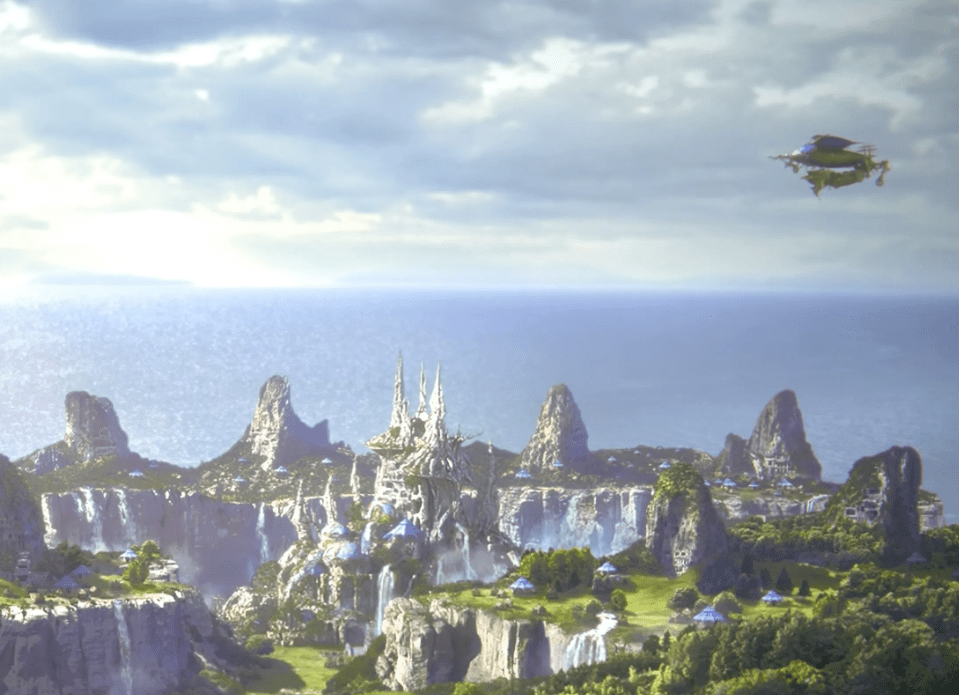
As this is set in the Remake continuity, this concept of a tangible, physical Promised Land might remind us of Shinra’s VR presentation from the first PS4/PS5 game. The VR portrayal of the Cetra definitely emphasizes material comfort and scientific sophistication. Appealing to a belief in an idyllic, lost past or state of grace is a common propaganda angle, and maybe Shinra’s portrayal of the Cetra is that simple. Or maybe the VR presentation is depicting what Shinra actually aspires to be- the Cetra with more technology.

The world-building can be held together by these fine points….but they are fine points that require a careful reading while we’re also dealing with the absent Nibelheim incident (which included the adult reunion with Cloud and Sephiroth’s attack). The rest is an appreciable and reasonably complete short story.
If you saw the cover of this book and are solely interested in character studies of Tifa and Aerith, you will not be disappointed.
Tifa experiences the inability to acknowledge the worst thing that’s ever happened to her. On more than one level. She is trapped in medical debt in a strange place where she is nearly homeless. I don’t think any of these things can be shrugged off as trivial. Least of all the thing that they all have in common: talking doesn’t help.
The people she wakes up to after surgery in Midgar emphasize that, if you go around saying you were mortally wounded by a Shinra icon like Sephiroth, someone will make you disappear. Tifa is then guilt-tripped into an existence of paying off the massive medical bill that resulted from Sephiroth’s assault. All the while making ends meet in a place where abductions and trafficking are common. This may have been what Shinra intended by leaving her in debt-servitude; she’s a loose end of the Nibelheim incident, after all.
Studying the written lessons of Zangan is her only outlet, which narrows her focus to simply existing, from one moment to another. Existing reliably and implacably, with no other resource but her strength.

Perhaps these factors can paint a more humane picture, if equally pessimistic. There is such a thing as truly informed belief leading to belief-driven actions. It’s not all channelling emotion into unrelated things for psychological reasons…but for a lot of us, those messier motives are a big part of things.
Other than whittling her debt away, little by little, this is a period in Tifa’s life where she has relatively little but herself and her belief in her strength. From her point of view, Jesse, Wedge, Biggs and company are probably the first people she met who offered companionship with no obvious strings attached. That’s a powerful thing, if you’ve never encountered it before. Personal loyalties are formed by personal encounters but personal encounters also have a huge impact on bigger, more abstract loyalties.
In other words: Tifa may have joined Avalanche for no better reason than that a few members showed her kindness at the right time and social osmosis. Then again, there are a lot of soldiers in a lot of armies for no other reason than a firm sense of belonging.
Political and religious groups know this dynamic. Religious conversions are common in prison because, when everyone abandons you, it’s easy to end up bonded to the first people who don’t abandon you. Especially during a time when your personal strength is your only assett.
My recent play-through of the original VII reminded me of what strength meant in Cloud’s juvenile mind, as revealed in the Lifestream. If many newcomers to the Final Fantasy VII universe are frustrated with Square’s tendency to leave the context implicit rather than explicit…we can at least be thankful that they err toward consistency in those patterns. If the context is established internally from one multimedia story to another, then the original PS1 game tells us that Cloud and Tifa both had a period of isolation with only the hope of their personal strength. We can assume that this a thematic connection.

If such a connection is both understated and likely to be intentional, then the understatement appears more significant. This is a picture of a time where Cloud was gone from her life, with no apparent reason to expect to see him again. In her recent memory, this early period in Midgar is as ‘Cloudless’ as it gets. At no other point did Cloud’s promise at the water tower appear more broken.
When they feel most distant from one another, they behave similarly.

Aerith’s vignette contains its own analogue of the original story. In the PS1 game, Aerith is hunted because she is the last Cetra. In Traces Of Two Pasts, she is hunted for a more idiosyncratic reason: wrong place, wrong time. Twice.
For better or worse, first impressions are powerful.
Aerith spent her early childhood in the Shinra Building, with her mother, Ifalna, surrounded by Hojo’s medical-laboratory staff. One staff member has a son named Lonny, whom is brought to work, so Aerith has the (ocassional) company of a child her own age.
Then, with the help of a lab tech named Faz, Ifalna and Aerith have the chance to make their escape. Before Ifalna became too ill to walk, the plan was to meet Faz at the Sector 5 church.
Aerith and Elmyra mirror each other in a way that is similar to Tifa and Cloud in the last story. Elmyra’s husband, Clay, was expected home from his Wutai deployment a long time ago and she has been lingering near the Sector 5 train station on a regular basis. There, she eventually finds Aerith, calling out for a doctor while Ifalna lays quietly dying on the platform. They do not live together long before (like Tifa and Cloud) the same problem they both have drives a wedge between them.

Much of the story provides context for the retelling of Aerith’s childhood that Elmyra gave in Remake. Aerith felt the passage of Clay’s soul, as he returned to the planet, bound for his next incarnation as the experiences that made up his prior life nourish the Lifestream. In both Remake and original, this anecdote is tinged with both sorrow and wonder. In Traces Of Two Pasts, Elmyra bristled at this statement. Aerith was less than eight years old and was only speaking frankly: she felt Clay pass and wanted to assure Elmyra that the “self” of Clay’s prior lifetime was everywhere and would be with her forever.
What the original FFVII and Remake do not mention is that Elmyra blew up at Aerith, following this. They eventually reconcile but, afterward, Aerith is wary about mentioning any of her interactions with the Lifestream voices or premonitions with Elmyra.
This thread is understated but important. Aerith rescues the life of a childhood bully by remote-viewing his location after he ran away, later to end up mortally injured. Aerith informs Elmyra and the boy is saved. There are sinister murmurings around the neighborhood about his family and Elmyra’s. Someone eventually starts thinking “Isn’t it funny that Elmyra knew where to find him and gave zero explanation as to how?”

Because of these suspicions, Aerith confides the role of her vision to a friend of the family, Carlo. Long story short, word gets around to Marcellus, the boy at the center of everything. He pays Aerith a visit when they were both around thirteen to express his heartfelt thanks and the spiritual stirrings the event left him with. Marcellus gets a little too chatty and one part of his entourage urges him away. Before they do, though, he manages to let slip to Aerith that Shinra put Sector 5 off limits, as well as the areas between Sector 5 and anywhere else. This happened in response to a gang war that broke out, between the different syndicates that Shinra contracts with in the slums. The consequences of another previously depicted event begin to manifest.
Tseng, of the Turks, made a housecall when Aerith was a child, on behalf of Shinra. Tseng says that Shinra will leave them in peace if Aerith can tell them where the Promised Land is. Aerith insists that she has no idea what he is talking about and he believes her; but she also admits to hearing otherworldly voices. Tseng and Elmyra come to an agreement: Aerith clearly knows nothing that Shinra would want but- if any of those voices do fill her in on anything interesting -Elmyra will let Shinra know. In Elmyra’s telling of this to Aerith, she assures her that she’ll never tell Shinra anything even if she does start hearing voices again.

And now Marcellus just told her that Shinra locked down Sector 5 and the surrounding areas to keep Aerith out of harm’s way during a long-lasting, intermittent gang war. Aerith, now a teenager, has lately tried to get a job. Before she could take a single step, Elmyra got her hired at an orphanage, immediately outside of their property, as a teaching assisstant / baby-sitter. Aerith cannot avoid connecting the lockdown with the visit from Tseng, all those years ago. Maybe Shinra isn’t kicking Elmyra’s door in, just now, but they are clearly willing to clamp down on the general area even if they’re waiting for Elmyra’s word, which she promised Aerith she would never give.
Aerith, at that age, had developed a relentless sense of responsibility. At least part of this came from Elmyra’s parenting. Elmyra is a single, first-time parent, who never anticipated having kids. That means a lot between her and Aerith was worked out on the fly. To Elmyra’s credit, she did her very best not to be overprotective of Aerith but she also had no illusions of what Shinra was capable of in their pursuit of the Cetra. Her brutal honesty and practical values meant that things were discussed in direct, personal terms. No one had ever before made Aerith feel so independant.
Or valued so independently of anything else, since Ifalna died at the Sector 5 train station. The only time Aerith ever knew Elmyra to direct untoward anger to her was after her vision of Clay. And now, at the age of thirteen, she is wondering why Elmyra has tried so hard to keep her from leaving Sector 5 and Aerith only learned of the lockdown because another preteen told her on accident. Said preteen did this because of how her gifts involved her in his life. At first, she fears that Elmyra is keeping her contained for Shinra’s benefit. But whether Elmyra is playing her or not, Aerith starts to wonder if she’s maybe put Elmyra through enough. It doesn’t help that Aerith is around thirteen and had, in her own words, gone into full “moody teenager mode.”
Although Ifalna’s decision to flee the Shinra Building with her daughter was the biggest transition in Aerith’s living memory, Elmyra was probably the biggest transitional personality. Whenever possible, she tried to prioritize Aerith’s preferences and feelings and wellbeing, which is a new experience. Receiving presents is a new experience. So are decisions like (temporarily) choosing a new name to avoid detection. Along with this new elevated independence, Elmyra is also a hard-bitten veteran of slum life who was spared no emotional barb. She spares none with Aerith and often talks to her in a way more typical of how an adult addresses an adult. She has no apparent awareness of how adults typically mask their vulnerability around children. When Aerith accidentally pushes Elmyra’s personal boundaries, Elmyra responds almost in the same way that she would if an adult had done the same thing on purpose.
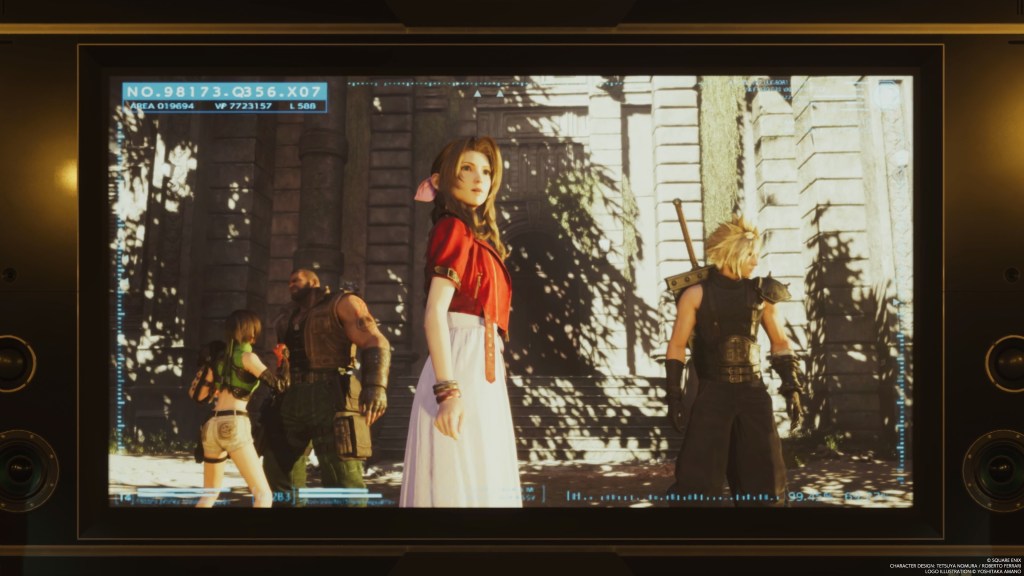
At the same time, Aerith’s life with Elmyra cannot be normal. There is a brief experiment with an alias and she spends a lot of time housebound, so she doesn’t get abducted. Tseng makes his agreement with Elmyra, which offers a bit of wiggle room but Aerith herself is hardly inclined to trust it. The specter of Elmyra keeping her contained for Shinra’s eventual benefit is more of an implication in her mind but the thought is so haunting that an implication is enough.
After the blindside of Elmyra’s brand of independence, that implication puts her limits in an uncomfortably familiar light. Betrayal from Elmyra feels plausible. The tension of the mixed messages (“you are your own person” vs “you will never be free”) expesses itself in Aerith’s teenage-brained solution to the problem: running away. If the lessons of helplessness are older than the lessons of responsibility, a developing brain can split the difference as “everything is my fault.”
Especially if all this seems to repeatedly spring from her Cetra inheritance. The very reason Shinra kept her and her mother as captive research specimens.
After guilt-tripping herself into running away from Elmyra’s home in the middle of the night, she makes decent progress for a while. She encounters neither Shinra troopers nor gang members. Instead, she runs into Faz: the lab tech that helped her escape with her mother.
Like Aerith and the boy who was saved by her remote-viewing, Faz is swept up in the “why”s.
See, he’s been hung up on a “true love” kick ever since he helped smuggle Ifalna and Aerith to freedom. He appears capable of distinguishing between Aerith and Ifalna at first. He mentions a house he obtained for she and her mother to use and talks about it in terms of “us”. When Aerith asks for clarification, he starts calling her by her mother’s name and says that he and her (Ifalna) will live their forever.
At first, Aerith wonders if he’s a ghost. She’s seen ghosts before and they often wear clothes that they wore around the time of their death. She wonders if he died while waiting for them at the Sector 5 church, since he’s still wearing lab scrubs (what with the internal guilt trip). She entertains the idea that he was haunting that location because she and her mother never met up with him, as planned (also: guilt trip). When it becomes clear that he’s not a ghost, she realizes what he actually is: a stalker who fell in love over a decade ago due to a chance meeting.
At that time, Aerith thought she was a terrible person who used up and spat out everyone who ever tried to help her. The life-and-death urgency forces a different conclusion, though: she’s cornered by a dangerous adult because she was in the wrong place at the wrong time. Once when she and her mother first met Faz and again when she crossed paths with him as a teenager. Nothing more. Elmyra’s practicality plays a role in this and it involves how Aerith became proficient in polearms.
Obviously, I like Aerith’s vignette a little better than Tifa’s. There’s also a role that Aerith’s sublimated feelings of responsibility play in the last little story in the book: a coda called ‘Picturing The Past’.

When Aerith was still a little girl in the Shinra Building, Hojo relied on her for one talent in particular: remote viewing, which often manifested while she was drawing. The locations that came through the most clearly were selected for others to study and locate in the real world. These remote-viewed places would then be surveyed for mako-accessability. Aerith, evidently, has a gift for detecting mako-rich areas, where Shinra would immediately build a mako reactor. She is so accurate, in fact, that she has a reputation among Shinra surveyors.
Hojo tells her that mako-surveying is a dangerous gig and that- if she is not as accurate as possible -people may die.
This is definitely manipulative, regardless of any amount of truth in it. When she tells this to her friend Lonny, though, he sees it as pure fabrication. Lonny thinks that- if she could only mess up on purpose -she’d wash out of the program and be home free. Aerith is afraid to do anything other than what she is told, though. Lonny therefore takes the lying into his own hands and dictates a drawing for Aerith to make: an image he vaguely remembers from a travel magazine cover. Lonny ends up in possession of at least one copy.
A lab technician, Geddie Bach, eventually pays Lonny for one of them.
Geddie ends up on a mako reactor survey team, on a helicopter bound for Cosmo Canyon coordinates. Once he and the pilot are alone together, Geddie bribes him into taking him to another location: Mideel, which he believes he recognized in the drawing that Lonny and Aerith came up with together.
Also: ‘Picturing The Past’ might be narrated by a Whisper.
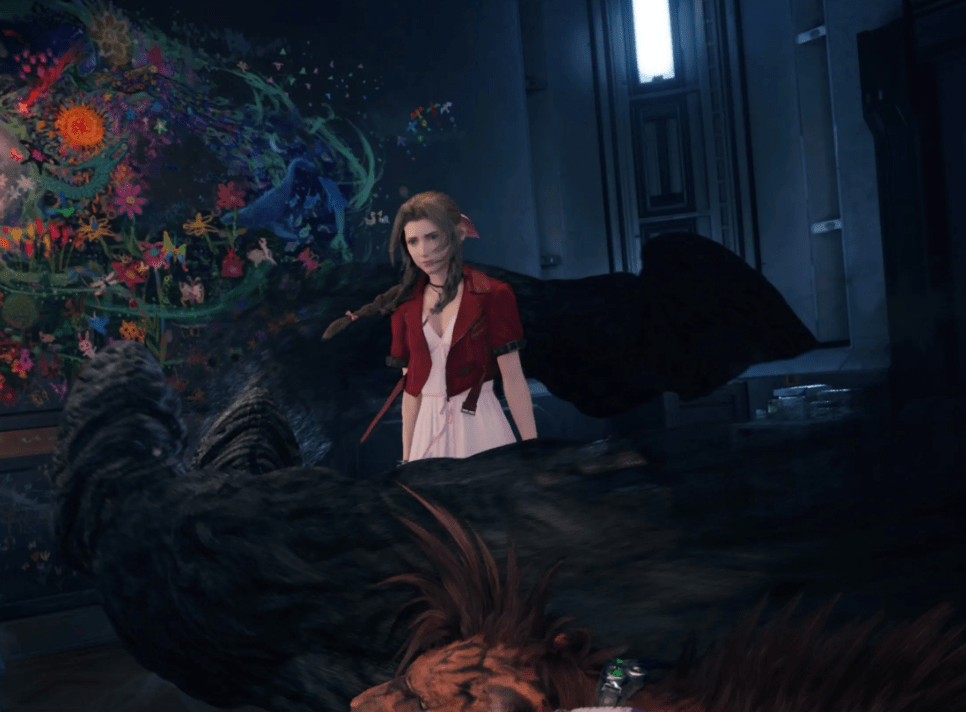
For the non-gamers: in this retelling of FFVII, Whispers are beings which, at first glance, appear to be ghostly enforcers of destiny. Later events, such as Whispers having silent narration in the voices of specific characters, imply that these are more like ghosts that originate from other timelines, attempting to sculpt the timeline they find themselves in to create circumstances that will let them incarnate. For example, if a Whisper could orchestrate the events of their own conception and childhood, they would find a way to do it. This drive includes influencing things in their present location to conform to their original timeline. In VIIR, they create physical impediments, resurrect the dead and exert telepathic influence to bring their current timeline closer to the one they came from.
The word ‘Whisper’ is never used in ‘Picturing The Past’. But we do know that the majority of characters were probably all nonconsensually dosed by Hojo.

Dosed with what, you ask? cell-samples from a shape-shifting, alien colony organism. Upon arriving on the planet Gaia, she began to integrate herself with the Cetra. As far as anyone knows, this is the beginning of the usage of the name ‘Jenova’. It is commonly theorized that the name derived from a Cetra woman- perhaps her very first shape-shift on Gaia.
I’m making with the lore bomb because it adds a lot of context that this book takes for granted. We’ve already been over a lot of these problems in the Tifa vignette, I know, but it keeps coming up.
After the fake remote-view, a ghostly figure attempts to strangle Aerith, like a living shadow with a whispy, robed appearance. This apparent ghost soon turns into a woman, whom the other lab techs promptly subdue and sedate, while calling her ‘Lilisa’.
‘Lilisa’, we learn, was a newly-graduated Shinra trooper. Lilisa went through basic training with three friends: Joann, Glen and Geddie (same one from earlier- the amount of overlap with the Shinra military and these lab personnel is never directly commented on).
Joann and the two G’s are placed on a mako-reactor surveying team. Lilisa is not. The night before everyone ships out, Lilisa drunkenly confesses her love for Glen…and both Glen and Lilisa end up with near-fatal, debilitating mako poisoning by the end of the night. Joann and Geddie are safe and are also the only two people who barely ate. The intuitive assumption is that Lilisa attempted a possessive murder-suicide. Claiming that he wants to sacrifice his own career for his lifelong bestie Glen, Geddie then steals his identity. He gains access to Glen’s Cosmo Canyon coordinates, which is at the end of a scheduled list of drops. Once he is alone with the pilot, he tells him to make for a different set of Mideel coordinates.
Geddie, apparently, poisoned the two others. Glen was on his list simply for being the last on a drop schedule. Lilisa was only targeted to make it look less like a coordinated hit on Glen. Lilisa’s drunken confession of love was, for Geddie, a lucky break.
While grown-up Lonny is reeling over what his false remote-view led to, he decides to seek out Aerith, whom he learns regularly sells flowers on the upper plate. Aerith briefly indicates that she knows who he is but never speaks a single word to Lonny as the whole tale spills out of him.

Nearly every main character encounters traumatic mako poisoning. Geddie gets mako poisoning while surveying in Mideel under Glen’s name. Glen himself and Lilisa get it with food mixed with mako-based machine slag.
Joann remains involved with them through her caregiver role with Lilisa. Each of these three sometimes go on long, unpredictable walks and have lately acquired black cloaks. She tells Lonny that, even before then, it wasn’t uncommon for people in the slums to go missing for a while and turn up later, mako-poisoned, incommunicado, numbers tattooed on their shoulders and wearing a black cloak. Lonny remembers, from his childhood, that the numbering scheme was used by Hojo.
The narrative payoff is the revelation of the lengths that Geddie Bach went to in order to survey Mideel because of Aerith’s drawing. But I can’t help but notice that, after Shinra R&D gets ahold of mako-poisoning patients (under the pretense of experimental treatment of a historically terminal condition), they usually end up acting like the robed cell-carriers from the game. If Lilisa, Glen and Geddie manifest the robes, it’s probably because they were injected with Jenova cells. Usually, the robes don’t come out until they’re hearing the voice of someone through the communal telepathic network. Sephiroth and Jenova herself are the only two who ever exercise telepathic dominance.
And Aerith never verbally acknowledges the main character, during their adult reunion. She makes a face, which indicates to him that she recongizes him, but acts as if all she can do is listen. Almost as if she’s communing with a ghost- or a Whisper. This is the upper plate where Aerith sells flowers- we see her surrounded by Whispers there in Remake.
If Aerith sees Lonny as a Whisper, there can be a few reasons. I’ve already entertained the idea that any soul looks like a Whisper if it ends up in a separate timeline. If the cell-carriers only start wearing the robes after they’re summoned, though…where to start, with that?
Maybe one reason why someone might see a Whisper is because someone else in another timeline passed by a dimensionally porous area. At the same time, those summoned by Sephiroth or Jenova emulate the appearance of interdimensional travellers. A few cell-carriers, like Lilisa, can even assume the shape of Whispers.
There’s no place in ‘Picturing The Past’ where Lonny could have been visibly dosed. Then again, most mako-poisoning patients within reach of Shinra R&D are implanted with Jenova cells on principle. Lonny was not simply ‘within reach’: his mother was a staff member and he had regular, extended visits to Shinra R&D to keep a valued research specimen company. Just because he can’t remember being dosed doesn’t mean that he wasn’t.
It adds up: one is a psychic colony organism that can integrate into other bodies. Another is mentally and physically debilitating poisoning from an experimental energy source. Soner or later, someone is going to connect A to B. Especially if there is an established practice of using remote-viewers to find Lifestream swells.
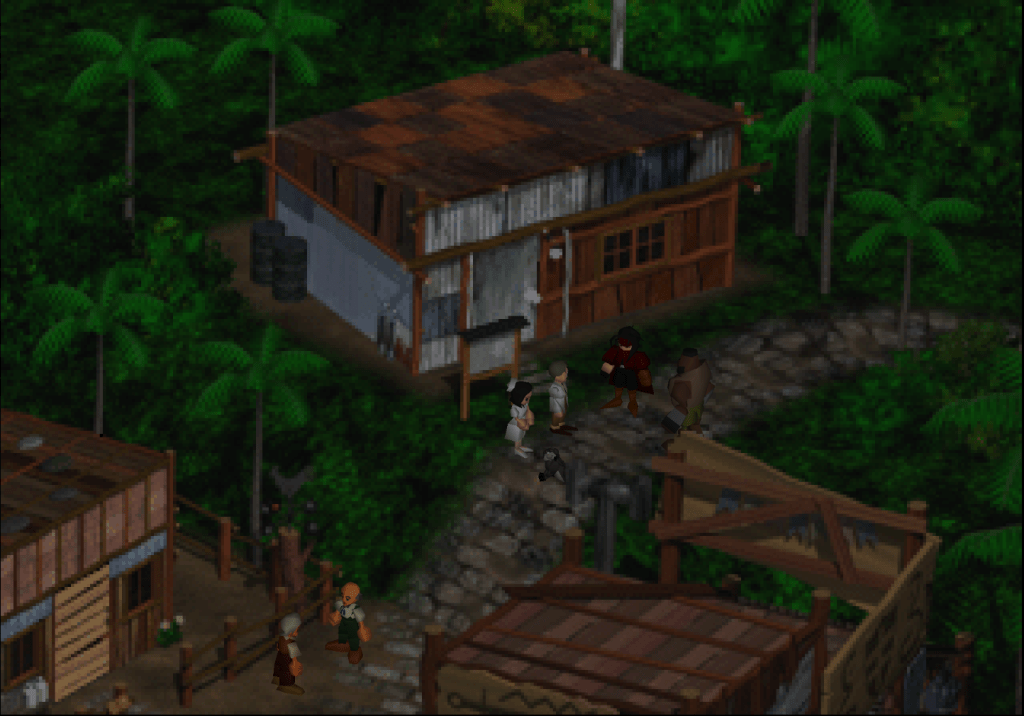
Then there’s the fact that Geddie encountered mako poisoning from a Lifestream swell in Mideel. Evidently, the fake remote-view led to a real mako-rich area in spite of itself. Dangerously mako-rich.
Mideel is also the site of a huge Lifestream swell in the original Final Fantasy VII. There’s even a paralell figure with a mysterious identity turning up there with traumatic mako poisoning.
Lonny, meanwhile, might resemble a Whisper to Aerith’s eyes because he’s crossing a dimensionally porous zone or Jenova cells or both. Whichever, it seems that Lonny (this Lonny, let’s say) is not from the original continuity. Maybe just one timeline over from the branch the party travels in Rebirth and Remake. Considering how the dialogue at the end of Aerith’s vignette syncs up with dialogue in Rebirth, I don’t know how closely to judge it’s relationship to that specific timeline.
The end of Aerith’s spoken tale matches the Rebirth dialogue but the next few lines seem different. That could easily be just me, though. I consume a lot of media in French to maintain my fluency and, although I am well into a third play-through of Rebirth, I have not yet played Rebirth in English. I read this book in English, though. For all I know, the English voice acting might line up perfectly. In the book, they consider talking about “boys”- just in general -before Cloud and Barret show up. In the French script, Aerith says she wants to talk about her “first love” when the boys interrupt. I don’t know if this is supposed to be an innocently “equivelant” wording or if the difference matters.



 AilixChaerea