Promethea review (spoilers as usual)

Welp, here it is at long last. For the sake of efficiency I’m going to make this an informal reaction like the rest of the reviews on this blog. I make that distinction because Promethea could easily reward a more in-depth and systematic analysis but I’m at a point in my life where I want to enjoy things at my own pace. Not to mention a close friend of mine recently gave me a book she wrote and I want to get started reading that for a possible review.

Since this is going to be a personal reaction post, I’m necessarily going to have to describe certain things in very broad strokes. Let us start with the reputation of Promethea. A common criticism of this story is that it is not so much a proper novel as it is a prose vehicle for Alan Moore’s personal and academic studies of philosophy and spirituality. There’s definitely room for that interpretation and Alan Moore makes absolutely no bones about the didactic nature of Promethea, but the dude is too playfully garish and genre savvy not to have fun with it. The Promethea comics are opened with a fictional, in-world introduction explaining the comics as the latest in a startling pattern of literary coincidences beginning with a late eighteenth century poet and ending with pulp sci-fi novels, all starring or at least involving the same semi-divine heroine. This introduction contrasts richly with other more banal aspects of the beginning.

Apparently banal, anyway. Alan Moore is typically big on atmosphere but there is a certain bald quality to our first few moments with Sophie Bangs. I mean, there is that little prologue thingie with the original mortal Promethea, but to me that seemed like a very typical opening section of a fantasy comic or cartoon and wasn’t that distinguishing. When I call the opening atmosphere of the New York of Sophie Bangs banal, I mean word choices that look a little lazy. Sophie and Stacia refer to the college they go to as “the college”. When I was a university student, I never, ever heard anyone call it “the college”. On the surface it looks like phrasing of someone who has never been anywhere near a North American university or its students and doesn’t care enough to do a minimal amount of research to figure out what real American vernacular sounds like. It’s possible, maybe even likely, that this is a passive reference to groups in the ancient world referred to as “the college” (Hellenist, I believe?) but it really just seems awkward. However, I think part of this is a deliberate style choice. As I said, Alan Moore is big on atmosphere as well as world building and intricate linguistic patterns.

George R.R. Martin said that many prose writers can be divided into architects and gardeners. An architect plans everything out from the beginning and a gardener plants seeds and watches how they grow on their own. Alan Moore is a quintessential architect. I mean, look at the annotations at the back of From Hell, the years he spent writing Jerusalem or even just his rigid plotting in general. So I think it’s likely that, when the presentation appears bald in the beginning, it may be meant to appear bald. One effect this has is creating a sort of equal footing with the fake introduction. Sophie Bangs and her search for Barbara Shelley seem almost like an innocently organic, surface level reaction or outgrowth of the false introductory text. As if we really had read a real piece of literary academia at the beginning and are now experiencing a lay person’s follow-up.

This is a charming way to start and it also sets the precedent for interplay between different literary styles within this story. Moore also has a hard time keeping his hands off of classic lit devices for philosophical writing like the dialectic used by everyone from Plato to Lucretius to Nietzsche, with large sections being dedicated exclusively to dialogue between two characters. The long and colorful sexual encounter between Promethea and Jack Faust, for example, or Sophie’s early conversations with the different incarnations of Promethea that preceded her. These largely explicatory exchanges make up the bulk of the story, by the way. Like I said, though, Alan Moore is too flamboyant and genre-savvy to have the explication stop at the surface and there’s constant dialogue with other perspectives within the bigger framing device of the story.

Many of the alchemical, Cabbalistic and Tarot iconography and language have in-world, fictional interpretations and meta-reactions by other characters. Some of these are peripheral, such as where specifically the demons in the beginning and middle of the story come from. It seems implicitly clear that Asmoday and Legion are potentially native to Geburah, the fifth sphere of the Tree of Life, when Sophie and Barbara arrive there. Asmoday is frankly identified with the mythological Hebrew demon Asmodeus and he shares some personal feelings about that story. There are other demons, though, or perhaps different perspectives within the being called Legion, who will use Old English phrases (“Jesu’s Teeth!”) which would imply a link with the divided Christian and Islamic Prometheas from the Crusades, but is never fully explained. Nor does it need to be, since nothing especially important hinges on it; it’s just interesting. That’s just one of the more fun peripheral interplays between different sections and style choices. There are more fundamentally important ones, such as the Painted Doll’s meeting with Promethea at the very end.

Before that moment, we have heard a million times and a million different ways that the subjectivity of sentient beings is our only interface with the wider world. One of the central implications of this explored throughout Promethea is that our subjectivities can be a glorious window on each other and our endless potential or a miserably isolating cell. I’ll be getting back to that since it’s kind of a big deal, but moving on, the text has told us repeatedly that our consciousness is all we really have. And then, near the very end, a being that has been alive for less that a few hours is frankly identified with the reader when the Painted Doll says he thought he was either a character in a comic or a person reading a comic. The Painted Doll is actually one of an army of identical homicidal robots that are revived one at a time, with a single shared memory, in order to create the experience of being a single person. At the end of the story, all the Painted Dolls are woken up at the same time. Perhaps naturally, when one of them meets Promethea he says he doesn’t know if any of his memories actually happened. Promethea reassures him that they’re as real as reality itself, that personal identity and all methods of ascertaining the value of things hinge on the stories we tell ourselves and our belief in them.

The identification between the reader and the Painted Doll is bottom-lined by a few panels with images of their own page in a lower panel and even a brief meta glimpse of both Alan Moore and J. H. Williams III. This is probably as close as Promethea gets to being a truly didactic text, of being a direct non-fiction missive between Alan Moore and the reader, and even that involves conflating the perspective of the reader with the Painted Doll and some other characters. This is also where the story is at it’s most frankly Jungian- Promethea even frankly says that the reader, while they are reading any story, embody all characters, like the dreamer embodies all characters in their dream. Naturally this takes us back to the bigger theme throughout the story of consciousness either being a window or a prison and what it means to be alone with your subjectivity.

Promethea’s way of presenting this question began to resonate with me near the end of the first graphic novel all the way through the rest of the series. I realized I was connecting with this when the character Bill explained the mystical significance of pentacles (AKA coins) after the other explanations of cups and swords. In the Tarot, according to Alan Moore, cups represent compassion and swords are reason. Cups are sustenance and nourishment and receiving. Swords are reduction, discernment and penetration. And yes, the sexy-time version of that is fully explored as well. Speaking of sexy-time and Tarot symbolism, Sophie’s best friend Stacia ends up in a relationship with Grace, the incarnation of Promethea that explained swords to Sophie.

Pentacles, meanwhile, are the value of life. Pentacles, as explained by Bill, are the things that tempt us with their value such as money, sex, human affection, anything material or sensual that we crave. Pentacles are also a transitional symbol, as coins are needed to pay the ferryman to cross the Acheron, both in Greek mythology and also later in this story, when Promethea, in the company of Sophie and Barbara, pay Charon to ferry them to the houseboat on Styx (said houseboat is called The Nancy Nox. Not important at all, I just thought that was cute). Genuine desire is always a transitional exchange, to truly savor life is to be at peace with it’s eventual end. This, for me, tied together something of the central theme about the power of subjectivity. To truly be yourself and love life is also to touch and embody your own limits.

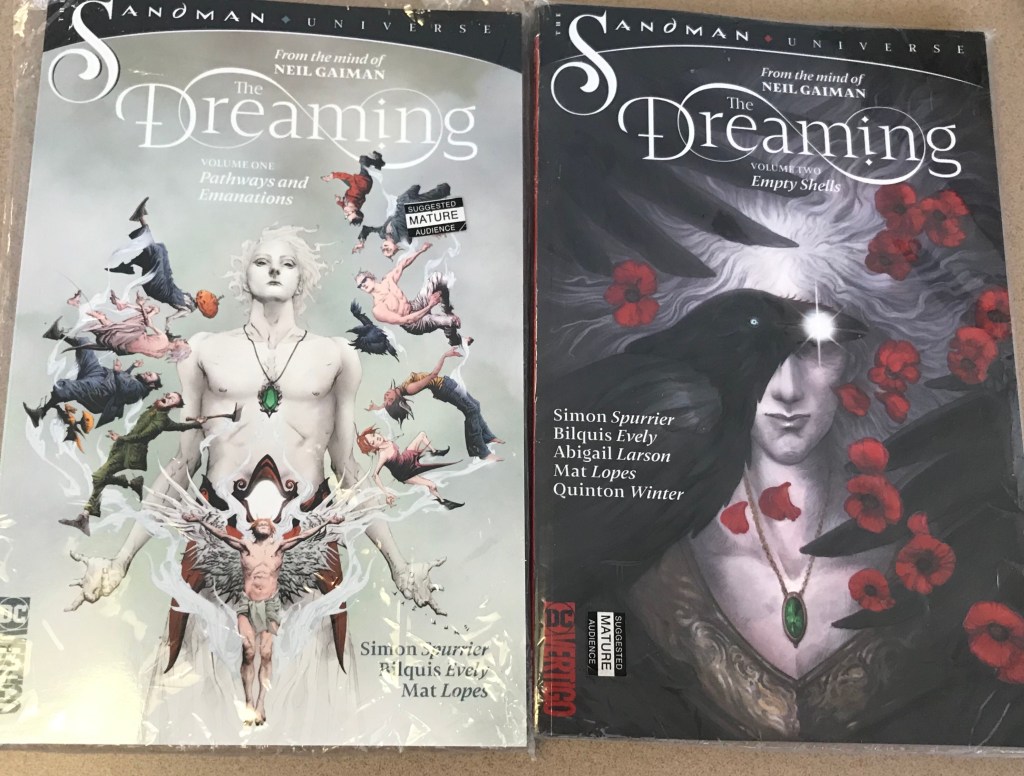
While we’re talking about Sophie’s conversation with Bill, this is also where we first meet the lady and the snake. The snake is matter and the lady is imagination. This first meeting with the lady and the snake is illustrated by Jose Villarruba, while the second encounter, at the beginning of book three, is drawn by J.H. Williams III. J.H. Williams III also illustrated Neil Gaiman’s The Sandman: Overture for which he drew the mother of the Endless herself, Night. Night looks almost identical to the lady with the snake. The lady’s word balloons have bold white borders and Night’s word balloons have thin white borders, but the blank space inside the balloons are both dark blue and the white lettering looks almost exactly the same. Night also has a more mature, plus-sized physique whereas the lady is thin, but in comics, especially those by Alan Moore and Neil Gaiman, word balloons are often treated as identifying features unique to specific characters. I was basically gaping in disbelief when I got to that part. And both the lady and Night appear against a bed of stars with the lighted sections of their bodies appearing dark blue and the shaded parts of their body as blank starscape. With both women, the blank spaces in the word balloons are also the same color as their lighted skin, and both Neil Gaiman and Alan Moore are very, very enamored with the impact language has on identity and perception.

What I’m saying is that, if this is simply a friendly wink between authors relayed through the same illustrator, I’d be surprised. The shaded and lighted skin and the word balloons are more than just a passing resemblance: they’re basically fat and thin versions of the same woman. But, like…if it’s the same character…whattheactualfuck? Are we supposed to be thinking about the cosmology and the continuity of both stories? I mean, as much of an architect as Moore is, I don’t think he would make Neil Gaiman swear a blood oath to have his version of the character stay faithful to Moore’s. Or…like…if it even was written after Moore’s? Neil Gaiman had been thinking about and writing The Sandman: Overture throughout the nineties and lost his opportunity to publish it near the run of the main Sandman story solely because of publishing and scheduling decisions made by Vertigo DC Comics. So Promethea got published first. Soooo…..even, like, the whole question of who is riffing on who is a mess.

However, this is a bit like the demon question mentioned earlier. Nothing fundamental about our understanding about Promethea depends on this, so long as we limit our analysis to the Promethea comics alone. But, um….um…what the actual fuck!? Are Promethea and The Sandman taking place in the same universe???? With, like, the Endless and the First Circle and the Silver City and everything????

For the sake of not getting hung up on this and drawing this review out with a big crazy digression I have to leave that mystery there for now, but I’m definitely gonna get back to it in a later post, especially since I read some other Neil Gaiman comics lately that have interesting implications for The Sandman. I had to get that out of my system though O_O

So. Moving on. While Promethea is definitely a philosophical and spiritual treatise within a narrative framing device, the way that the different writing styles and character perspectives interact with each other is so fun that active reading becomes a genuine temptation and indulgence. That being said, there are some weaknesses. In a documentary that tends to float around YouTube called The Mindscape of Alan Moore, he makes vague references to scientists “on the cutting edge of particle physics” that describe information as a “super weird substance” which implies an objective, material dimension to consciousness, potentially suggesting a soul that is distinct from the body. This, to me, seems to be an echo of the so-called “Copenhagen interpretation of quantum mechanics”, which posits that quantum mechanics only behave classically when they are observed.

I may be conflating things or misremembering, but I believe Schrodinger’s Cat is typically used as a metaphor to explain this. Feel free to correct me in a comment or a message if you know better. But, according to the kitty metaphor, sub-atomic particles often function as if the spectrum of possible configurations are all happening at once. This spectrum of possibilities is called a sub-atomic super-position. The super-position in general is treated as a static reality until it is observed to be otherwise. I feel like I’m butchering that atrociously, and even if I’m making the correct associations, I’m probably being very, very reductive and simplistic.

With those caveats out of the way, that’s what I understand the Copenhagen hypothesis to refer to, and I can’t think of anything else Alan Moore might be referring to. If there is anything else in physics that involves treating subjective observation as a materially influential phenomenon, by all means correct me. But as far as I know, Alan Moore seems to be talking about the Copenhagen hypothesis. I also want to make it clear that my own understanding comes form fragmented memories of high school and college, personal conversations, YouTube videos and the book Waking Up by Sam Harris. It’s actually Waking Up that I take most of my understanding of this from as well as the one glaring weakness of how the Copenhagen hypothesis has been implemented by the New Age movement. In Waking Up, Sam Harris writes that the hypothesis’ use of the word “observation” is not lucidly defined and most spiritual interpretations of the hypothesis overlook or ignore this gray area. Put simply, the assertion that your mind reaches out from your brain to sculpt things outside of it is an interpretation based on a blank area.

Unfortunately, there are moments when Promethea relies on the New Age rendering of the Copenhagen hypothesis. In the text, this happens frankly at the very end when Promethea says that modern scientists have reached agreement with historical mystics with privileging consciousness over the things that appear outside of it. At other moments throughout the story it’s hinted at, but one instance in particular strikes me as problematic. Sophie needs to learn more magic, Jack Faust agrees to teach her, in exchange for the chance to have sex with Promethea. For the sake of clarity, Sophie is a teenage girl and Promethea is a developmentally mature, eternally young woman no matter what body is channeling her, and yes your body physically changes into Promethea when you channel her. Still a bit of a squick factor, though.

Anyway, Promethea and Jack Faust are doing it and Promethea remarks that describing the whole universe as an inevitable and knowing journey toward the development of consciousness seems a little egocentric and naïve. Jack Faust, or the spirits Jack Faust is channeling, reply that it’s absurd to think that the universe randomly came together in just the right way to create sentient life, as if consciousness is so integral to the creation of the universe that some sentience must have guided it to our sentience. This is no different from the argument from design that Christian apologists use and it ignores a basic empirical fact: while the universe, from our perspective, is so vast as to be endless to us, and is constantly expanding, nothing ever springs fully formed out of nothingness.

Did I mention Lucretius earlier? I’m pretty sure I did. Didn’t Lucretius outline something like this in one of his own dialectic treatises? If all the parts are there to begin with and will remain there forever, then every possible configuration must necessarily happen, no matter how rare. I remember being in a freshman level philosophy class where we discussed religious objections to the conclusions of the Miller-Urey experiments in the nineteen-fifties. What those experiments proved was that it’s possible for volcanic activity and lightning and amino acids to interact with each other in a way that would set amino acids on the path toward evolving into complex life forms. The religious nay-sayers of the day claimed that the probability of that chemical interaction was just too rare and coincidental to have happened…in spite of the fact that our planet has actually spent most of it’s existence thus far without complex life. On a long enough time line, all possibilities, however rare, will inevitably happen.

I said that Promethea relies on this interpretation of the Copenhagen hypothesis (and the association Moore makes between it and the argument from design) at times. In general, I do not see it as integral to the coherence of the story. It’s still unfortunate, though, and all the more so as it was not a necessary thing to include and since Alan Moore is typically so good and thorough about research and intellectual honesty. Laziness and oversights always sting worse when they’re done by people who should know better. Since these wrinkles only appear occasionally and contribute nothing necessary, though, one could sympathetically read them as a component in the dynamic mixture of literary styles and perspectives, especially since there are already a few instances of literal, explicatory ideas becoming ambiguous and at times morphing into things like attitudes and even characters. Case and point, Grace- the vehicle for Promethea that embodied the essence of cutting, decisive, uncompromising reason, seen in the Tarot as swords.

There are two major visionary journeys within Promethea, the first of which consists of Sophie getting acquainted with all the previous women (including Bill, who is a transwoman) who channeled Promethea, the second to track down Barbara, the avatar before Sophie who recently died and left behind the astral island shared by the former Prometheas (and yes, that totally puts us in the literary stomping grounds of Orpheus, Aeneas, Dante and Gerda…so on top of the dialectic philosophy bells and whistles we’re also dealing with the mythical pilgrim archetype). When Sophie meets Grace for the first time, she serves as an explicatory mouth piece to map out the symbolic importance of swords within the Tarot and the role of reason within the identity of Promethea, alongside compassion and commitment to the sweetness of life’s finitude.

Grace starts out as a minor character in Alan Moore’s fake introductory text and then becomes a didactic literary device. Later, when Sophie brings Stacia to the Immateria (the ethereal plane where dreams and myths are real…perhaps like the Dreaming, if we wanna go there…lol jk), Stacia is delegated the responsibility of channeling Promethea in Sophie’s absence while she goes after the ghost of Barbara. Upon exiting the Immateria and beginning her shift as the vessel of Promethea, Stacia finds that she has the best rapport with Grace, the champion of reason. The ghost and the human begin to fall in love and even start having sex. The pair are so deeply united in their love for one another and their commitment to the duties of Promethea that they become possessive of the role and refuse to relinquish it when Sophie returns from the Immateria. Essentially, Grace went from being a detail in a literary device to a literary device in her own right to a supporting character to a major character with motivations that put her at odds with the main story.

The presence of traditional super hero archetypes in Promethea go through a similar journey. One of the more snarky instances of authorial presence is Alan Moore’s irreverence for and disenchantment with the super hero genre. Alan Moore, at first, appears to be using the medium of a comic because it’s his oldest, most well worn hat and he simply wants to put his best foot forward. The guy is a drama queen, though, so he can’t resist making digs at parts of the medium even while it starts out as peripheral. This happens in Promethea’s version of traditional super heroes and villains, here known as science heroes and science villains. Science people occupy a place in the fictional world not unlike rock stars and actors (oh yeah and there’s also rock stars in this to lol). The public follows them with the same light-hearted interest that we follow celebrities in real life. The two rising stars on this scene are a team of science heroes called the Five Neat Guys and a science villain called the Painted Doll. Yes, the same Painted Doll that the reader is tempted to literally identify with, as an in-world meta-representation of oneself, near the end.

The Five Neat Guys and the rest of the science people started out as a bit of fun-poking at common hallmarks of comic books and slowly take on bigger and bigger thematic and plot functions as the story unfolds. Sooo…..as disappointing as the stuff with the Copenhagen hypothesis and the argument from design are, one could conceivably see them as subject to the same changes that all the other didacticism goes through in these books. That would be stretching the limits of intellectual honesty a bit, but there is definitely room for that interpretation. It’s because of this lateral exploration of language as well as the more philosophically compelling heart of this story that I think those particular weaknesses are not much more than occasional eyesores.

It’s because of this playful experimentation with meaning that I still think Promethea is a story in spite of Alan Moore’s plainer, didactic intentions. It’s possibly the most fun philosophical narrative treatise that I have ever read, and it certainly cheered me up a few times when I badly needed it. Promethea moved me emotionally in ways that V For Vendetta, Watchmen, From Hell and Batman: The Killing Joke never came close to and I’m a little surprised it took me this long to get to it. It does not quite succeed in elevating my opinion of Moore to that of Neil Gaiman, but it definitely comes closer than anything else he’s written and is definitely my new favorite out of his bibliography.

Marvel 1602, volume one

Sooo I read my first Marvel comic not so long ago! I gotta say I was way more impressed by Neil Gaiman’s Marvel 1602 than with the relatively new re-imaginings of older properties in recent film. And yes, as is typical of me, I won’t be taking any particular care to avoid spoilers.

(Correction: I read the Marvel adaptation of Stephen King’s The Dark Tower, before then. At the time I wrote this Marvel 1602 review, I don’t think I thought of The Dark Tower as a “Marvel” story because it’s such a very specific IP with it’s own expanded universe)

Granted, some of these characters I knew nothing of prior, other than their names and certain details of their back stories. I remembered enough of that one Iron Man movie right before The Avengers to know who Nick Fury was and I briefly dated a guy who was really into Dr. Strange (he once said something about Dr. Strange comics being one of the first in the industry to involve Eastern religion).

Those were the characters I knew the least about, though. As someone who was in first grade during the early days of Cartoon Network, I was sometimes able to catch episodes of the older Hannah-Barbara Fantastic Four cartoon. Around the same time, the Fox Kids Saturday morning block was getting off the ground with contemporary animated versions of Spider-Man and X-Men.

(If I may stop for a silly digression, idiosyncratic usages of punctuations are funny. Especially when you know a given punctuation choice is supposed to entirely be a matter of personal preference with no relationship to grammar. I mean, I can’t think of a whole lot of superheroes just now that use hyphens in their names. Just now, I really can’t think of any others except Spider-Man and the X-Men. There. It’s out of my system now)

I enjoyed both but Spider-Man held my interest a little more, possibly for no other reason than that Peter Parker’s double-life in a large urban setting and occasional brooding reminded me a little bit of Batman: The Animated Series which, in my opinion at the time, made it slightly better by association. More recently, I’ve been hooked by the Netflix Marvel shows, particularly Daredevil and Jessica Jones. In high school I knew a few fans of the Punisher but learned virtually nothing about him until the movie came out. At that point I decided he’s a completely impoverished catch-all of Batman tropes. The Punisher is a blandly moralizing serial killer whose rejection of a wider moral context, in and of itself, is awkwardly framed as compelling (punishment versus justice). Essentially, he’s the Joker without humor, Batman without morality and Two-Face without character development. Oh yeah, and he’s fascist-friendly. So the Netflix Daredevil show scored points with me by making him the villain of the second season.

This was my frame of reference coming to Marvel 1602, which I was originally interested in when a random Wikipedia link led me to a Daredevil elseworld page. I read a little more and the re-imagining of the X-Men characters piqued my interest. I read a little further and found that Neil Gaiman was the author of the story arc that constitutes the first graphic novel and it then became mandatory reading. I can nit-pick a few of his novel-length prose stories and his short stories range from so-so to delightfully clever, but the man is absolutely unparalleled with it comes to comics. When I finally write my Promethea review, that will be a nice segue toward the specific genius of Neil Gaiman’s contribution to graphic literature (it contrasts with Alan Moore’s writing style and Promethea contains departures from Moore’s typical MO that makes the contrast relevant). For now, though, I’ll just say Neil Gaiman continues to be my favorite graphic lit writer.

Anyway, my first proper narrative encounter with Dr. Strange seems to bear some resemblance to Dr. John Dee, an enigmatic and potentially mythic figure who is sometimes presented in fiction as a court magician of sorts in the employ of Queen Elizabeth. John Dee is still somewhat fresh in my mind from the brief mention in Alan Moore’s prose novel Voice of the Fire within the vignette called Angel Language, so I was tickled. To my delight, Renaissance-era Daredevil appeared in fairly short order after the opening scene, as did a charming re-imagining of Peter Parker as Peter Parquagh, a young dogsbody and student under the tutelage of Sir Nicholas Fury.

Close on the heels of this is a fictionalized version of Virginia Dare, the first European child born in America after European colonization began in earnest, who is travelling in the company of an…apparent Native American named Rojhaz. Who is blonde haired and blue eyed. Later, in conversation with Queen Elizabeth, Virginia says that blondes among the Natives testifies to the possibility that the Welsh landed in America before the Spanish and started families with those that received them.

Okay okay okay okay okay I get it. He’s Captain America. Fine. This is a Marvel story, after all, and there’s no other likely candidate and the dude’s name was originally Steve Rogers so it fits. Still, as a Native American, watching white people do Native stuff gets old really, really quickly. Does Rojhaz’s role in the story’s denouement make up for it? Not really, but it was still cool enough to ease the burn. When Rojhaz is revealed to be none other than the original Steve Rogers himself, sent back in time and causing a temporal paradox that threatens the universe, it ties together a big thematic element. The resolution of the paradox also helps this along.

Captain America says he wants to make the future inhabitants of the continent proud to be Americans- minutes before getting knocked unconscious by Nicholas Fury. While the conclusion of this story didn’t quite push me in that direction, it did offer a forgiving interpretation of the meaning of the so-called New World in the European mind at that time, and even ties it into a bigger philosophical question about the nature of possibility and hope.

At the beginning, Virginia Dare and Rohjaz set out for England hoping to persuade Queen Elizabeth to offer more financial support for their colony at Roanoke. At the end, Sir Nicholas Fury is an enemy of the Crown for having disobeyed the newly ascendant King James of England and Scotland, Carlos Javier and his gifted students are fleeing the wrath of the Spanish Inquisition with former Inquisitor Enrique (Renaissance Magneto) and his own followers in tow, all bound for America, empty-handed and exiled.

On the shores of the American continent, the witchbreed students of Carlos Javier begin to hope for a home in which they can be themselves openly and without fear of persecution, while also dreading the imminent arrival of Enrique and the Brotherhood of Those who will Inherit the Earth. Banner, an agent of King James taking Peter Parquagh as a captive and reluctant informant, is also fast approaching. Virginia’s father begins to despair of the future of the colony without Queen Elizabeth or any support from the British Crown and also has to reconcile himself with newcomers who may bring more trouble in their wake. After Clea Strange forces Rohjaz to reveal his true identity, he begins to fantasize about a new America that he would help along through his inability to age. And then he gets sent back to his own time retroactively, permanently closing off most of the effects of his resulting paradox. The colony at Roanoke, abandoned by the Crown and helpless without the meta-humans, is now doomed to vanish. The stark Roanoke disappearance will not happen immediately, but it will happen.

This is framed well by the commentary of Strange’s alien connections, called Watchers. The young Watcher who relayed the news about the paradox through Strange to the meta-humans is instantly consumed with shame. Watchers are a people who, normally, are destined only to watch and appreciate the whole universe objectively. The objectivity of their Watching is implicitly linked to an appreciation for the universe as something that is both ever-changing and also whole and complete unto itself. The young Watcher called Uatu, who assisted Stephen and Clea Strange in resolving the paradox, is heart-broken over the newly emergent possibilities being shut down. For a Watcher, it is a tragedy that any possibility should be foreclosed, as per the simultaneous flux and completion of the universe. The fact that this one particular chain of events needed to be retroactively taken out to preserve the wider universe is undeniable, but that does not prevent one from mourning the loss of the newer and stranger possibilities that almost happened.

While this has all the bombastic sci-fi bells and whistles you could ask for, what with aliens and time travel and paradoxes, it’s still a rather subtle look at what we think of as being possible and how that shapes the scope of our aspirations. It’s subtlety can be detected in that it involves the eventual obliteration of the characters that shaped our perspective as readers, how they navigated the world and what they understood as inevitable facts of life. Our protagonists are oppressed by the cumulative menace posed by the Inquisition, Count Otto Von Doom and King James in the beginning. At the end, they know that they will soon be wiped from existence and their last few moments of subjective life are gravely limited. We nonetheless end with a touching hint of friendship and intimacy between Virginia Dare and Peter Parquagh. In the last few panels, Peter is bitten by a spider and Viriginia says “it’s not the end of the world.”

Each step into the future is a step into a vacuum, it can either be an explosion of possibility or oblivion itself, but one only ascertains which by taking existence moment by moment, forming our dreams in the shelters of our minds and the love of those around us. Very typical of Neil Gaiman, really. It reminds me of what Stephen King wrote in his introduction to the graphic novel World’s End, that in Neil Gaiman’s stories there is a fundamental good will that applies to everyone, that everyone is deserving of shelter, perhaps the shelter at the end of the universe featured within World’s End. Marvel 1602 is also a clear expression of this kindly humanism.

There’s a lot more in this story that I appreciated, but that’s the big one I wanted to get out of the way. I particularly liked the parts of this tale concerning the Renaissance-era X-Men, but unfortunately the high point of that also ties into the low point.

One of our early character viewpoints on the students of Master Carolus Javier’s Select College For The Sons of Gentlefolk is a mutant named Werner, known commonly as Angel, who quickly develops a romance with young Master John Grey. Anyone who follows Neil Gaiman knows that he is, in general, very queer friendly and female friendly and typically pulls absolutely no punches in this regard. As the romantic chemistry blossoms between the two witchbreed youths we begin to see jealous outbursts from Scotius Summerisle (our version of Cyclops), which reminded me of the jealous lover from the first live-action X-Men movie. Not only are there queer characters, but it also looks like a queer romantic subplot is developing and it ties in with previously established nuances of the mythos. I was absolutely over the moon about this for awhile. And then John Grey turns out to be a woman disguised as a man. Like I said, Neil Gaiman normally does not pull punches with LGBT characters. I find it very easy to suspect executive meddling of one kind or another. It’s disappointing, but there you go.

All in all I very much enjoyed this book and can easily see myself re-reading it soon. A very nice way to lose one’s Marvel Comics virginity 😀

How fashy is Batman?

Eventually when I branch out more with the books and movies I discuss on this blog I’m going to date myself even more than I have with my commentary on video games.  One way in which my perspective is hugely dated, as someone born in 1988, are my thoughts and feelings about comics.

In mid-childhood I read a few comics derived from Jurassic Park, Sonic The Hedgehog and occasionally Batman.  I believe my first run-in with Bruce Wayne with panels and word balloons had to do with my grandparents from the lower forty-eight (what we Alaskans call the rest of the States) who had sent me a package of presents.  I don’t think they had any way of considering what my tastes at the time were- they appeared to have sent me things that my dad (their son) would have liked at my age.  This included several comics that, to my six-year-old mind, looked blandly unattractive.  The only character I recognized was Batman, as I had seen Spielberg’s Animated Series and my uncle had taken me to see the Joel Schumacher films which were new at that time.  I read a brief story about the Bat and a female accomplice fighting some technologically animate zombies and that was that.

When I actually began reading comics in earnest as a teenager, ordinary super heroes were nowhere on my radar.  A close friend of mine had turned me on to Neil Gaiman’s The Sandman and a brief look at Watchmen at another friends’ home put Alan Moore on my list of authors to check out.  For the most part, though, The Sandman was the first comic that I was truly grabbed by and even now, at age thirty, it remains my favorite comic period. I also briefly followed mangas like Angel Sanctuary and Dragon Ball Z (although I saw the DBZ anime first on Cartoon Network’s Toonami block).  Every now and then my dad would share Heavy Metal comics with me.

I briefly encountered the world of Gotham again in Gaiman’s Black Orchid story and inevitably I found Moore’s The Killing Joke.  Rather predictably, the Christopher Nolan movies were the first time I actually dwelt on those characters and their mythos in a very long time.  In recent history I’ve also gotten hooked on Fox’s Gotham (I actually enjoy watching Robin Lord Taylor as Penguin more than I enjoyed Heath Ledger as The Joker).

Lately, though, I was away from my hometown for job training and had the chance to explore in what, for me, was a large comic book store.  I knew vaguely that I was interested in reading something that involved Jason Todd as Red Hood.  Eventually, I settled on the New 52 story The Joker: Death Of The Family.

Fairly early in the story we find drug-addled Gothamites attracted to a cult of personality revolving around The Joker.  This seems like it was sparked somewhat by a recent public demonstration.  In Batman’s narration, he makes it clear that legally protecting the rally under the freedom to assemble was a terrible idea.  Later in the story we learn that a sort of “Joker gas” is causing much of this chaos but there are other nuances.  After we see a few people getting drugged there are some subplots that involve gangs of Joker copy-cats who seem to be systematically plotting kidnappings and bombings which the drugged victims seemed too frenzied to slow down for.  An otherwise lucid and calm psychiatrist in Arkham is drawing Joker-influenced doodles on a piece of paper in a way that tempts the reader to think he is part of the movement of Joker emulation.  Evidently, this isn’t all because of the Joker gas and many ordinary citizens are truly smitten with The Joker.

This reminded me of a conversation I had with the same friend that pointed me in the direction of The Sandman when I was younger, regarding the film The Dark Knight Rises.  My friend said that the movie portrays ordinary people as too fickle and unstable to govern themselves and require a stern, authoritative personality to keep them in place.  I don’t know if she mentioned the way in which Nolan modeled the rioters and followers of Bane after the Occupy movement, but I do remember that being brought up in more than one review.  I said that Selena Kyle was a kind of audience insert- that in the context of The Dark Knight Rises Selena represents the everyperson, and why an ordinary woman or man would be disappointed with the status quo and wish for revolution.  My friend insisted that Selena was nowhere near present enough for that narrative layer to be apparent to the audience.  I hesitantly took her point; Selena’s presence was diminished somewhat near the middle and the end of the film.

Now I understand that, unless you have some sort of academic credential, talking about things like archetypes can seem murky and abstract to the point of being meaningless.  In this case, though, I think there’s something to be said for a pattern expressed in more than one way through several different creative minds.  In both the Christopher Nolan films and Death Of The Family, ordinary people are totally mindless know-nothings who can’t survive without a firm hand from authority.  I don’t think I would be going too far to say that the zeitgeist in which the first Batman story was published, America at the beginning of World War II, cast a shadow over the concept.  There was even an issue of Superman in which the Man of Steel went to Germany to lay some hurt down on Hitler.  It would probably be more surprising if the classic DC stories and characters exhibited no pre-occupations with fascism.  Even then, though, there are still more consistent indications of fascism within Batman.  When Frank Miller wrote Holy Terror in the wake of 9-11, a comic about a super hero taking down Al-Qaeda, he originally wanted it to be a Batman story (the original title was Holy Terror, Batman!).

What also complicates this are differences between archetypal, subconscious influences, and open and frank discussion.  In Alan Moore’s Watchmen, for example, we see mob violence happening for a variety of reasons.  There are protesters who feel like super heroes have compromised everyone’s safety by making the police go on strike and emboldening criminals.  There are people called Knot-Tops who may at times express specific ideological motivations or might just erupt in a spontaneous bloody frenzy.  Rorschach submits his diary for publication to a radically conservative ‘zine and Ozymandias markets toys and perfume based on himself and other superheroes.  Both the people who inspire the masses and the masses themselves are shown to have a diverse array of motivations which are all shown in sympathetic and unsympathetic ways.  It makes sense to say that Watchmen discusses power fantasies in those who feel powerless.  When consistent attitudes express themselves through innumerable different writers over several decades, though, there is probably something going on other than simple authorial intent.

The possibility that Batman channels a subconscious attraction to fascism is not the same as saying that the story and anyone associated with it are fascists, though.  If anything, discussing things like this can make the expressions of subconscious fascination more fruitful.  I always thought that an essential function of villains like Ra’s Al Ghul, Azrael, Red Hood and The Phantasm is highlighting a fundamental insecurity in Batman as a fictional person: is he a force for good or is he a moralizing thug?  The presence of actual moralizing thugs like Red Hood and Azrael makes questions like this inevitable and makes characters who experience conflict over them more compelling.