
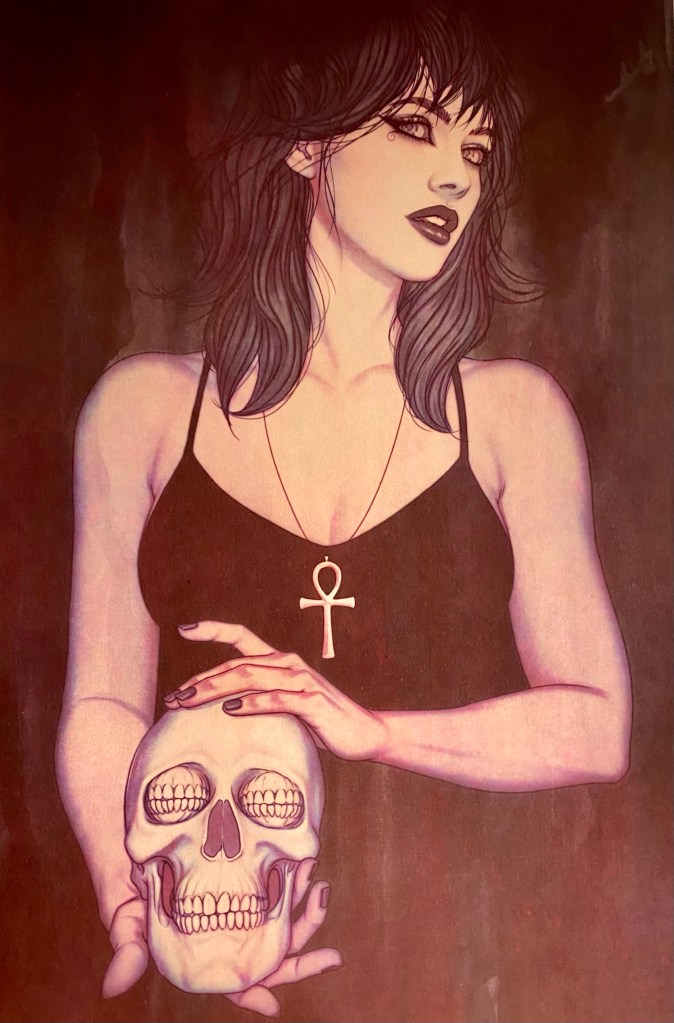
The first volume of Nightmare Country riffs on the old enmity between Dream and Desire. The story turns on a struggle between the wealth of dreams and the desires that furnish their creation. Not unlike the wave-breaks against the Corinthian as he wades into the Shores of Night.
Volume one begins and ends with souls who are tortured by thwarted desire, with a strained relationship with dreams (of any kind).
Both of them are presented with mysteries. Madison Flynn is an artist haunted by a persistant hallucination of a large, gelatinous figure with mouths for eyes, which she interprets in various states in her art. Jamie is commissioned to write a screenplay about a mysterious, legendary murder.
Flynn names her mystery the “smiling man” and her interpretations make an impression on one of her flings. Said fling falls asleep at her place and dreams about the pictures. While this is happening, we learn he is a regular victim of the Corinthian in his nightmare state. The usual havoc is about to ensue when the Corinthian notices the pictures.
Jamie’s mystery is a murder victim who turns out to be Flynn. The first one runs its course before our (ahem) eyes. The second mystery is almost immediately noticed by someone else: Thessaly, from the original Sandman, currently living under the name Lamia. Under any name, though, she never suffers obfuscation.
Lamia decides to save Jamie some legwork and channels a necromantic link through which he can speak directly to Flynn. When he asks her how she died, he sees a vision and bursts into flames. A moment before, he saw the eye of Desire bracketed by two uncanny faces: a gimp mask and a mutilated smile that would have been at home in some recent Batman comics. The faces are succeeded by the hook that is Despair’s sigil and a final image of an angel.
Jamie, it seems, is the latest in a number of victims. Taking Lucien’s word for it, Jamie is the sixteenth target in a particular series of attacks.
When Lucien brings it up, though, the body count rests at fourteen. Lucien discovers a book is missing from the Dreaming’s library and tracks it down: in the posession of the Corinthian who is, at that present moment, sitting in a diner with Flynn after finding her in the waking world.
Like a lot of awkward situations, it “wasn’t what it looked like.” The Corinthian was, in fact, talking to Flynn about her paintings and why his face is in them. The activities of the first Corinthian in the waking world, though, give Lucien reason to be vigilent. In his first flawed incarnation, the Corinthian became a menace- a mythic archetype among serial killers who eventually became one. The elder Dream of the Endless, Morpheus, uncreated him. The Corinthian had been a favorite creation of Morpheus, though, so he eventually recreated him- taking pains to ensure that the new Corinthian would not have the weaknesses of the old.
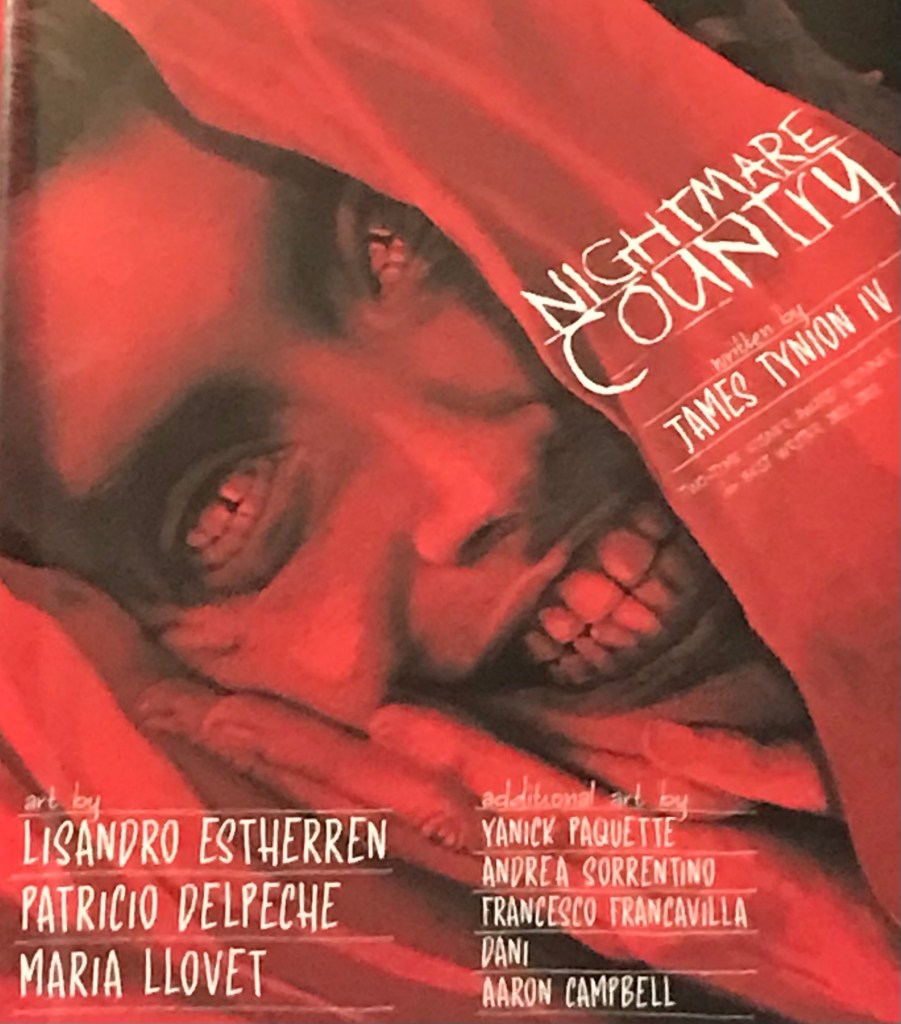
Certain activities in House of Whispers notwithstanding, the younger Corinthian has not pushed boundaries (the boundary around killing humans for fun, anyway). Nonetheless…the whole comic revolves around the fear of his appearance, what with Flynn being our major viewpoint character and her visions of the smiling man. The cover of volume one is the Corinthian’s face with a red filter, all three mouths grinning and bearing their teeth like angry chimps.
In ‘The Kindly Ones’, though, the younger Corinthian goes on a long, eventful fetch-quest that involves rescuing a baby. Morpheus sent Matthew with him but the Corinthian eventually returns alone, bringing the child safely to the Dreaming unsupervised. If this is the nightmare that launched a thousand serial killers, it’s not quite the same nightmare.
As likely as it may have been in the hands of another writer, the Corinthian is not the big bad of this story. Madison Flynn may be the most direct point of empathy for the reader but our perspective is divided largely between Flynn and the Corinthian. They’re basically the two main characters.
A good story does not say everything at once, though, and this is only the first volume. The identity behind the curtain might not even get us very far.
This agency is first seen in the apparent killers of the unwritten Corinthian texts: Mister Ecstasy and Mister Agony, who are quietly followed at all times by the same smiling apparition that haunts Flynn. They are, respectively, also the bearers of the grotesque smile and the gimp mask seen by Jamie before his death.
Although we are never told, explicitly, who is directing Agony and Ecstasy, we do see something happen, after the pair take an early victim. Mister Agony produces a pocket watch, which speaks to him when opened: “Madison Flynn. Age 20. Brooklyn, New York.” Given what we know of Flynn’s inclusion among the unwritten authors of the Corinthian, the equation is clear: Madison is the next author on the list. We know, at least, that the power above Agony and Ecstasy has an awareness of the Dreaming. More specifically- one of its natives.

At first, I thought these were the same characters from ‘A Hope In Hell’. Tiny, fey-like demons can be seen during the challenge for Morpheus’s helm, referred to as “the twins”- Ecstasy and Agony. The appearance of an angel seems to confirm an association with Hell…but not for this reason. Daniel recognizes Agony and Ecstasy as “(b)ounty hunters, trained at the Unseen Cathedral”. Shortly, they’re both seen in the Threshold- the throne of Desire, whom they call their “employer”. In ‘Three Septembers And A January’, Desire employs an undead servant called the King of Pain.

Also in ‘Three Septembers And A January’, the King of Pain began existence as a gambler that committed suicide over his debts. In his reanimated state, he has a frozen smile like Mister Ecstasy. When Daniel is summoned by the Corinthian, he says that the bounty hunters of the Unseen Cathedral used to be human and may, in some way, remain so. Maybe Desire has a pattern of using undead servants.
Let us not forget their third companion- the same “smiling man” that haunts the restless mind of Flynn. Flynn has not dreamed since childhood, which almost creates an association between the smiling man and a sleep-deprivation hallucination. In the world of The Sandman, dream-kind such as gods and nightmares are known to psychically manifest as hallucinations or entities in one’s dreams. If the smiling man is a nightmare or some other dream-kind, then maybe his resemblance to the Corinthian is more than skin-deep.
Even if he is dream-kind, though, he is obviously more aligned with Desire than Dream. And, presumably, to be aligned with Desire is to be aligned with Despair. Despair’s sigil was emphasized, in Jamie’s fatal vision, equally with Desire, hir servants and an ambiguous angel.
Ambiguity is rather the trouble with identifying angels in the Sandman universe. Angels bound to the Silver City have delicate, cursive lettering. The Silver City’s stewards of Hell are known to acquire similiar lettering to Lucifer but not quite the same.
At least, they do in the new Sandman Universe comics. Remiel kept his cursive writing until the end of Gaiman’s Sandman and even into Mike Carey’s Lucifer comics. During the SU Lucifer reboot with Dan Watters, the angel lettering in general began to resemble Lucifer’s.

I remember, when I first read the original Sandman comics, thinking that Desire and Lucifer had some of the most interesting lettering. I noticed they were similar but- in my mind, at least -they were impossible to confuse with each other. As an adult, I’m less certain. Possibly because the cursive angel lettering got phased out a long time ago. I suspected there was a vague thematic association going on in the Dan Watters Lucifer. Like, maybe Remiel’s lettering is changing because he is becoming acclimated to being the steward of Hell, and therefore more “of” Hell than the Silver City. For whatever reason, though, Lucifer’s lettering hasn’t been completely unique for years and now here we are. During the original Sandman, the lettering of Desire and Lucifer resembled each other but no one else.

Lucifer’s ‘e’ looks like a crescent moon with a line through the middle. Desire’s ‘e’ looks like a backwards 3. ’h’, ‘t’, ‘f’ ‘y’ and ‘a’ are also different. In general, though, Lucifer’s lettering looks like faux-Hebrew and Desire’s lettering is faux-Hellenist. Desire’s lettering also has more resemblances to the typical comic font.
So it looks like the angel in the pages of Nightmare Country could be said to have the post-Watters lettering. Which means that the lettering alone will not tell you which angel. My guess, right now, is that the Nightmare Country angel is an original character.

And while the angels, in the SU, are a homogonous group, Desire is one of the Endless. Maybe the post-Watters SU emphasizes Lucifer’s nature as an angel more than his uniqueness. But the lettering of the Endless is always distinctive. If their voices issue from a source with no apparent connection to them, there almost must necessarily be a hidden connection.
Speaking of: Agony and Ecstasy. I hyperfocused on the lettering because it seemed like an avenue that could either confirm or deny the connection to ‘A Hope In Hell’. At the end of the first volume of Nightmare Country, Agony and Ecstasy are revealed to be former humans. Even before then, though, I overlooked an even more fundamental reason why Ecstasy and Agony cannot be demons: they have the same lettering as Dream. The first Dream, meaning Morpheus.
Dream of the Endless is connected to every dreamer and dream-kind but each singularity is not, necessarily, identical to him. Morpheus was also known to “store” his power in enchanted objects. One such stone, an emerald, ends up in the hands of Daniel Hall. Evidently, Dream put enough of himself into the emerald to regenerate his soul, giving us our second Dream. The undead husks of Agony and Ecstasy could be similarly invested. Sandman: Overture reveals that Desire would go at least as far for infiltration and espionage.
The Corinthian’s internal narration in Nightmare Country touches on his faint memories of his earlier existence; his defeat at the hands of Dream, at the serial killer convention. Mention is made of Morpheus’ parting curse: may none of the attendant serial killers ever succeed in ignoring who they are and what they’ve done. His curse was the withdrawal of a dream, exercised by the power of the Dreaming. Perhaps Ecstasy and Agony were once human serial killers who were somehow shaped by that expenditure of dream magic. One cursed by separation from the Dreaming would probably find the perfect outlet by serving Desire. In his mental narration, the Corinthian is also very aware of the differences between the current Dream and the Dream he once knew.
When Jamie asks Flynn who killed her, she reveals five images. Agony, Ecstasy, Desire and the mystery angel. And the sigil of Despair. Come to think of it, the smiling man resembles Despair almost as much as he resembles the Corinthian.
 AilixChaerea