
Unrestrained spoilers for all four SU Lucifer volumes and the original Sandman
Cernunnos and Herne are frequently confused with each other.
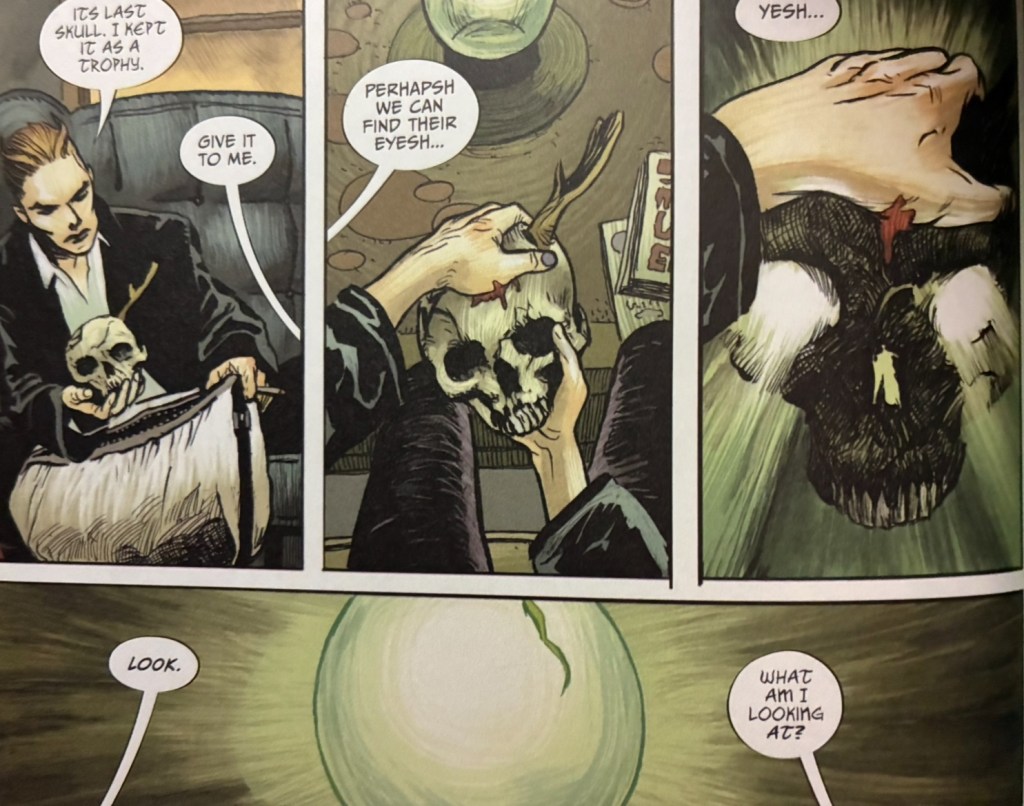
No textual source for Herne dates back further than Shakespeare’s The Merry Wives of Windsor; in the mouth of Falstaff. It is often presumed that Shakespeare could have been riffing on actual, existent folklore about a huntsman, who led the king’s hunt in his preserves. Once, when the king’s party was charged by a buck, Herne threw himself between the king and the deer. Herne managed to kill the deer with a blade on his person but was left critically injured. He recovered but his talent appeared to have vanished. The king soon dismissed Herne and he committed suicide by hanging himself from a tree. After his death, a magic man resurrected Herne by affixing the antlers that gored him to his head. What rose from the cot was a voracious, nocturnal monster with horns, at times retroactively equated with the Wild Hunt.
The other figure, Cernunnos, is historically attested to at the dawn of Christianity which could imply older bodies of thought. In the eighteen-hundreds, a pillar was excavated from the Ile de Cite in Paris, dating back to the first century. On its surface is a bas relief image of a horned being, who is seated with a ram-headed serpent in one hand and a semi-circular status symbol in the other. This pillar, called both the Pillar of the Boatmen and Nautae Parisiaci, is the only historical source of Cernunnos’ name.
Mostly.
‘ERNUNNOS’ is clearly legible. Before those letters there is a mark that has commonly been interpreted as a ‘C’. If this being was called Cernunnos, then we might consider the Gallic phoneme ‘cern’ which means horn or antler. On contemporary art and artisanry of the Gothic world, there are other depictions of a horned figure placed between images of Apollo and Mercury. This has prompted some scholars to theorize that the common pre-Christian meanings of serpent imagery (shedding, renewing, consistency through time, not to mention a totem of Apollo) and the pre-Christian meanings of ram imagery (fertility, strength) are simply combined in the ram-headed serpent held in Cernonnos’ left hand. The apparent syncretism belies a common Roman propaganda angle: equating local deities with Hellenistic deities to make assimilation easier, which the Romans were known to employ in other occupied lands.
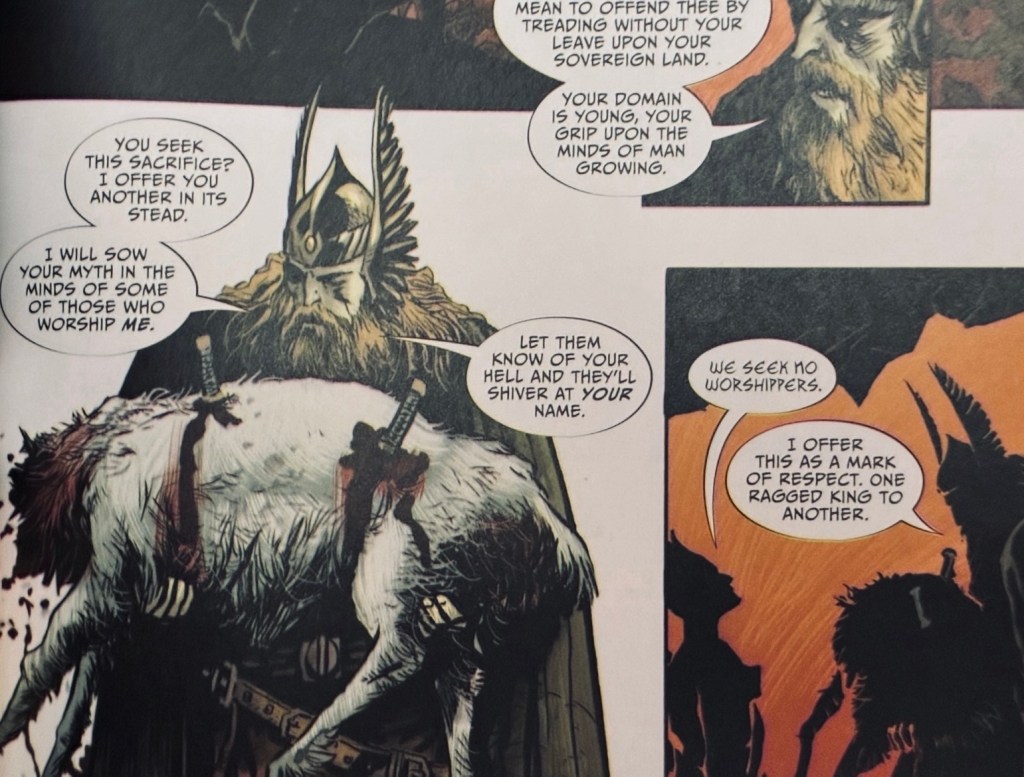
In the first century, Christendom did not associate the demonic with an antlered humanoid. The confusion is exacerbated by the incidental resemblances between Cernunnos and Herne, as the Christian rendering of Satan could have been a factor in Shakespeare’s telling. Cernunnos, Herne and Satan all resemble each other but a resemblance is not the same as a causal or associative link. There is no reason to posit a literal, historical through-line between these figures but their resemblance to each other makes it hard for the western imagination to resist equivalencies.
What makes the confusion even more rich: the humanoid stick-figures with horns drawn all over caves during the stone age, commonly interpreted as a shaman wearing a mask. Various scholastic and spiritual movements connect the horned-shaman-stick-figure to the dawn of abstract thought and language, achieved with psychedelics.
In other words: no one knows what Herne, Cernunnos or the paleolithic horned stick-figures are but- because of modern Satanic imagery -everyone feels like they know.
In the cosmology of the Sandman, Night, Time, the Endless, Lucifer and his creator are the oldest beings in the universe. Lucifer was not born of a myth like a dream-kind deity. Like the universe itself, though, mythology has a way of growing around things and absorbing them.

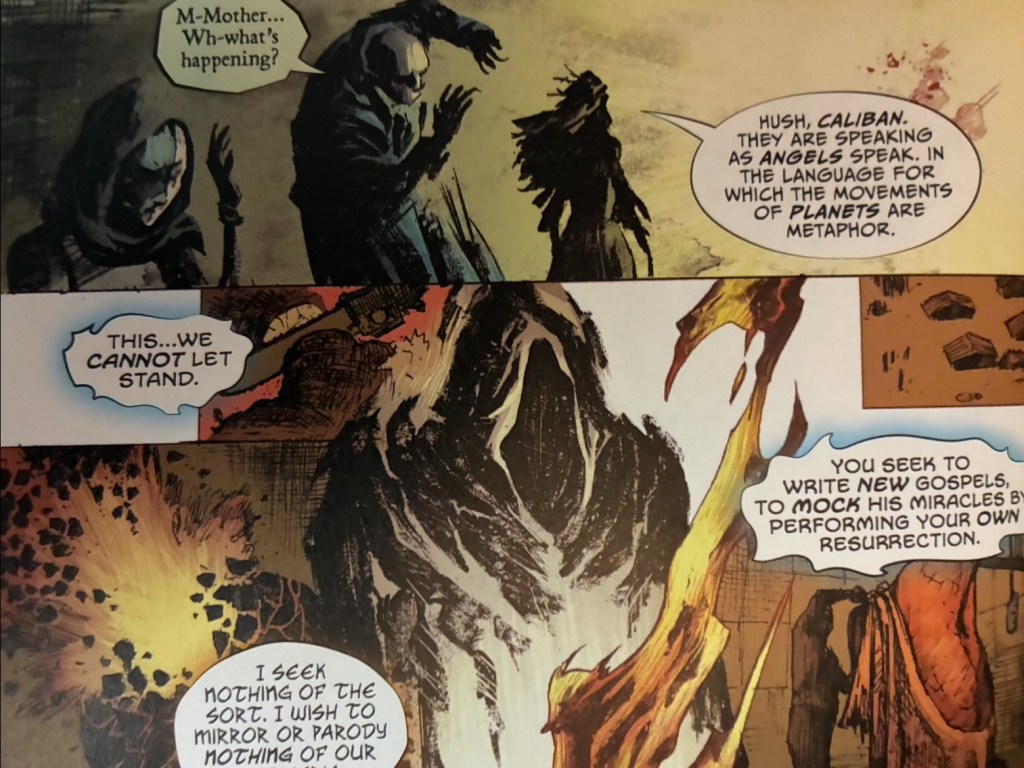
The application of these themes to Lucifer himself doesn’t materialize until the ‘The Wild Hunt’ and ‘The Devil at Heart’. The first two volumes (‘The Infernal Comedy’ and ‘The Divine Tragedy’) nonetheless acquainted us with them. Much of those first two comics revolves around the mythic entanglements of the only mortal family Lucifer ever had: his ex lover Sycorax and their son, Caliban. As Lucifer repairs his relationships with Sycorax and Caliban, Sycorax grows appreciative of her myth but no more attached to it. Caliban had even less warmth for his body of myths than Sycorax and even less of a reason to care. They escape the web as Lucifer enters it.
In the Sandman story ‘The Kindly Ones’, the Cluracan pays a visit to Dream. He is instructed to keep to the path laid out for him in the heart of the Dreaming. Instead, he wanders. He sees visions of what appears to be Dream, garbed in white like Daniel. The Cluracan then vomits a fully mature male deer that bounds away. Raw, creative dream energy appears to have either a complimenting or contrasting reaction to stimuli. With the Cluracan, it went for a contrast and he accidentally created his nemesis.
In both The Sandman and the first iteration of The Dreaming, this being is known as either The Bane of Cluracan or The Wild Hart. The original Dreaming canonically ended that sub plot but…
I think the Wild Hart is the Hunted God. I also think Lucifer is the Hunted God.
An ageless, immortal being doesn’t play by the same temporal rules: their existence entails neither a beginning nor an ending. Lucifer’s family drama with the fall from grace and the war in Heaven occurred before creation. The probably matrix of the created universe simply is not designed to accommodate his ending- certainly not his assimilation. If Lucifer was ever to get caught in the web of the universe, the probability range of an ending or a new beginning would have to exist simultaneously with his immortal self. It would manifest, perhaps, as a separate being capable of subsuming the space occupied by Lucifer.
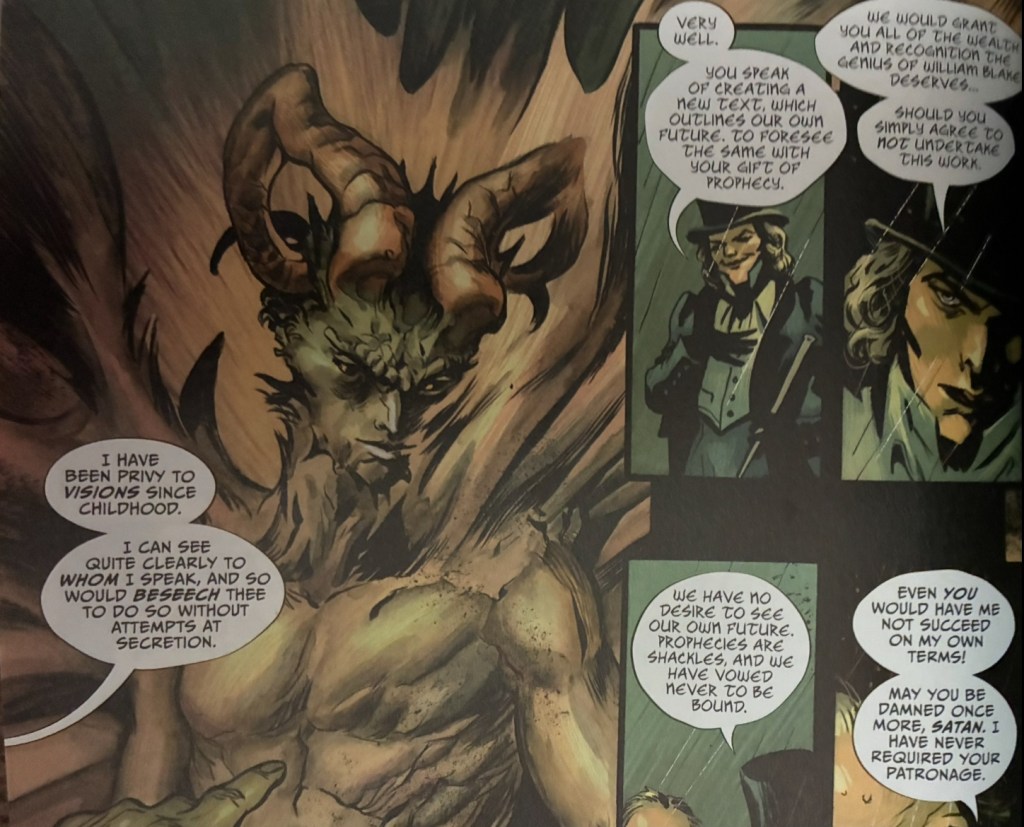
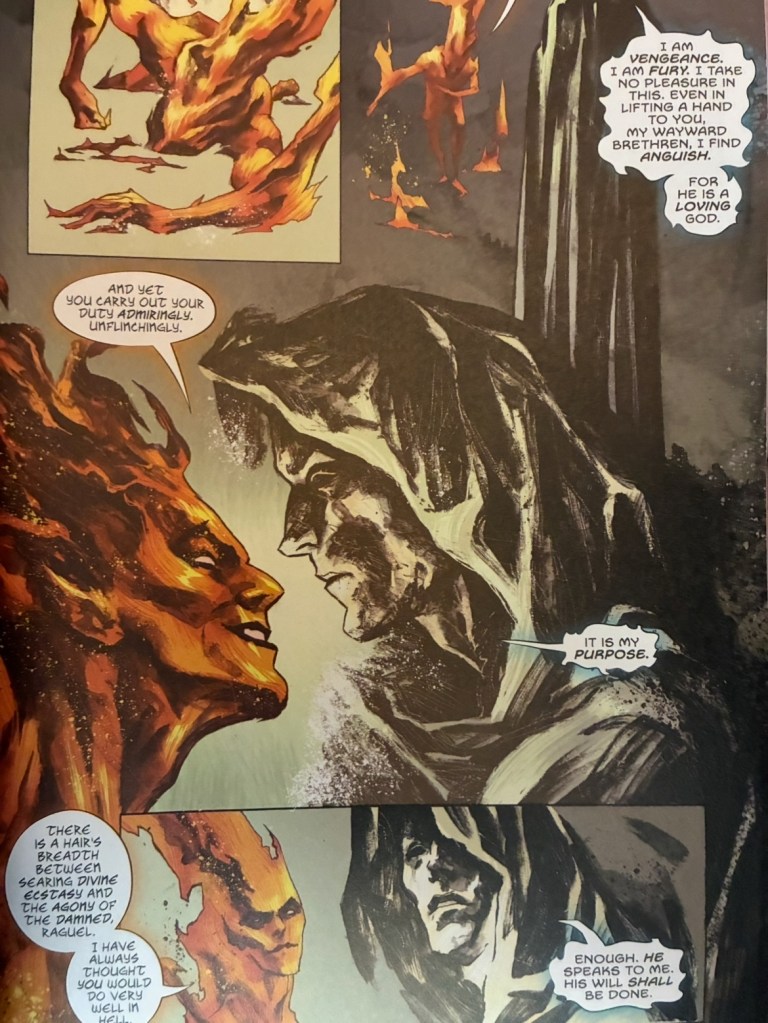
I think the Hunted God is the dimensional shadow of Lucifer’s destruction through an eternity of attrition. It occupies a dimensional cross-roads between annihilation and rebirth- both micro and macro Lucifer. It is also a potential avatar of survival; a means to escape from God’s control and cyclical design. To annihilate the Hunted God is to confine Lucifer to a limited set of possibilities based on God’s previously given role for him: the ruler of Hell. What are we to think at the end of ‘The Wild Hunt’ but that Lucifer was, in the end, the “hunted” in the language of the story?
As a dimensional hybrid, the Hunted God necessarily partakes of both Lucifer’s myth and things that are close to him. Ravens, for one, as well as the body parts in volume four.
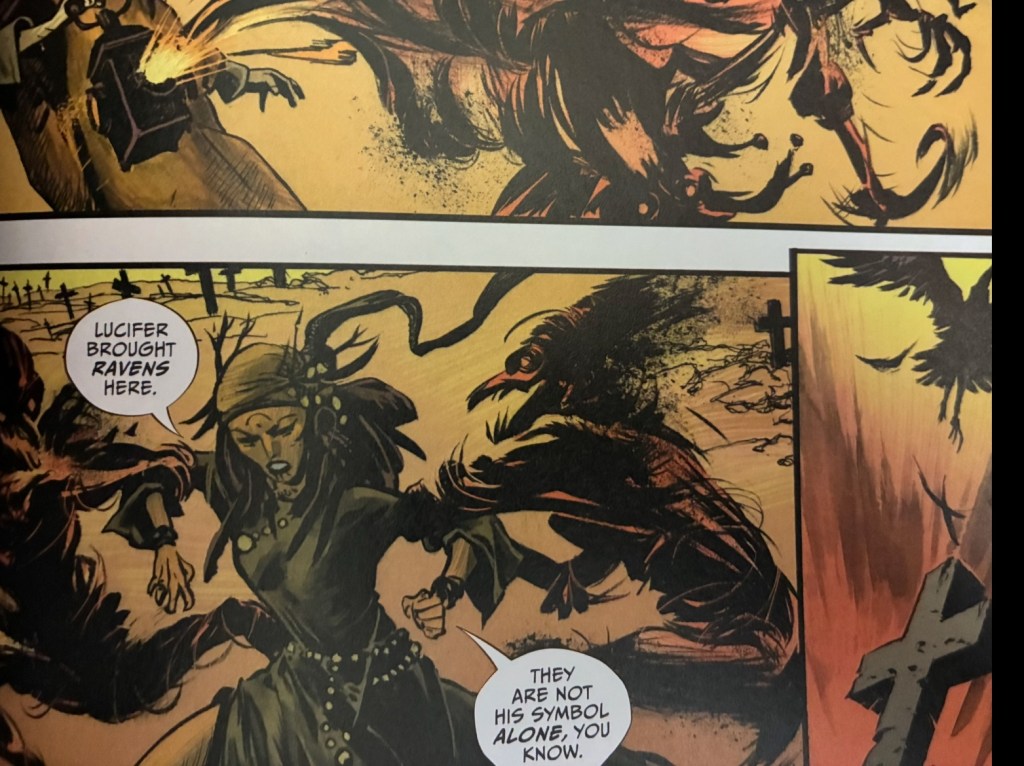
I wondered if the bird that spoke to Matthew in the prologue was the crow that eventually completed Lucifer in ‘The Devil at Heart’. Turns out that can’t be- that was a raven that Lucifer permitted to leave, on the grounds that ravens are not just Lucifer’s symbol. Perhaps the Luciferian black bird is not just a raven (or a crow, for that matter).
The last bird that Lucifer grabs in the prologue hears him say “(w)here you go, you must take no hope.” In this panel, Lucifer’s mouth is covered in black feathers. Maybe that was the bird that flew to Remiel and reconstituted Lucifer. Evocative of the Francisco Goya story in ‘The Devil at Heart’, concerning the painting ‘Saturn Devouring His Son’.
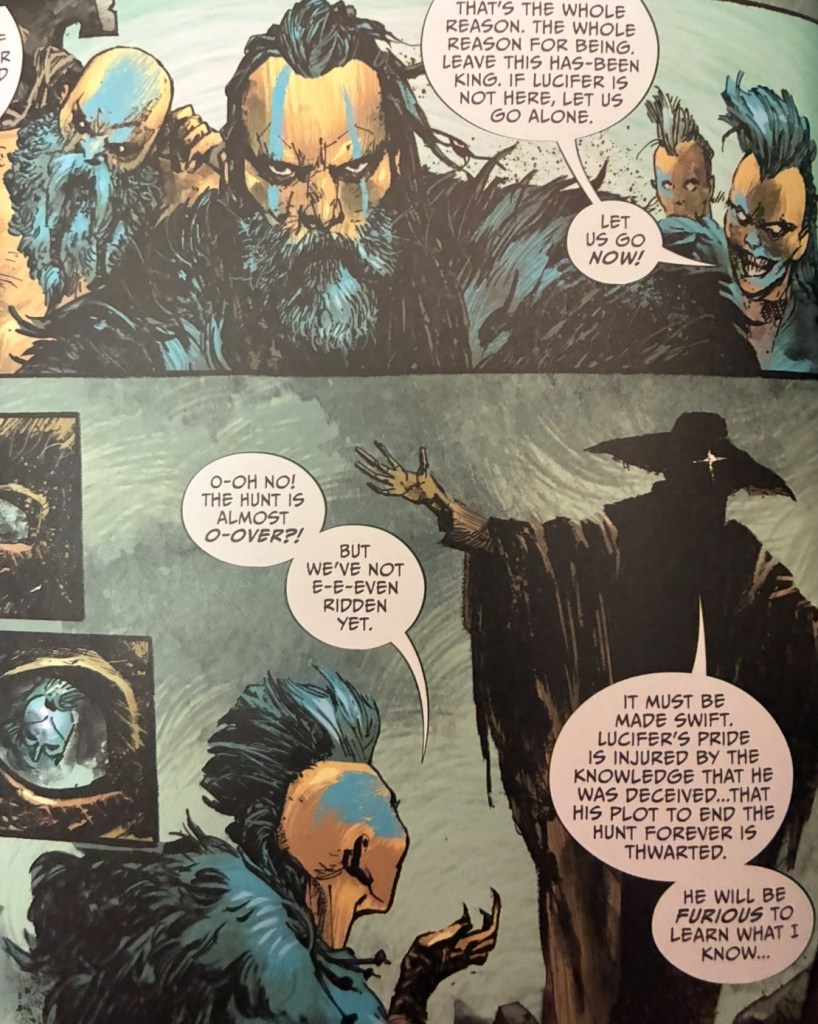
As for whatever form Cluracan’s shape-shifting nemesis would take once escaping the Dreaming- I don’t think it likely that they would have filled the void of the Wild Hunt. The story takes pains to emphasize that the Wild Hunt are beings only slightly younger than the universe itself. That would leave the other half of the equation: the Wild Hart, aka the White Stag, aka the Hunted God.
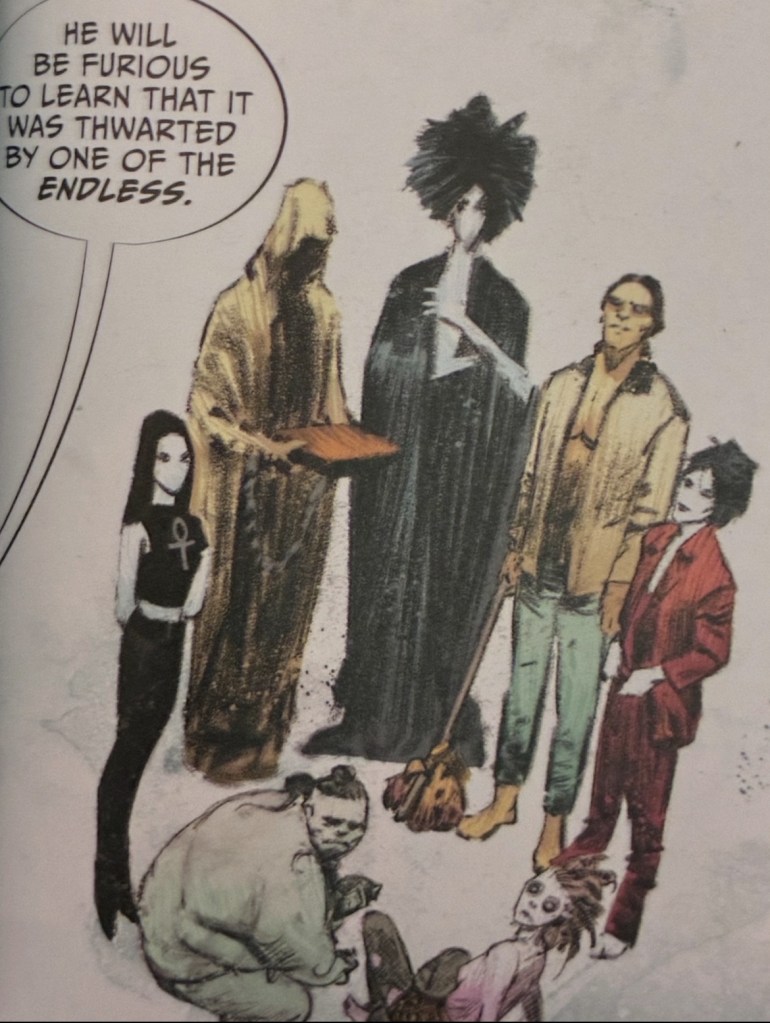
One possible consequence of Lucifer being permanently returned to Hell? The return of the tithe that Faerie paid to Hell, which ended when Lucifer gave Dream the key. Cluracan entered the foreground of the original Sandman during ‘Season of Mists’ in order to ensure the end of the tithe. Cluracan’s nemesis: check. Lucifer’s demise set in motion by one of the Endless, as asserted by Odin within ‘The Wild Hunt’: check.
Lucifer made good his escape from Hell in the original Sandman and was putting down roots on Earth at the time that Cluracan created his nemesis in Dream’s castle. With Lucifer’s departure from Hell, Lucifer becomes less of the dark reflection of God and more of his own being.
The Hunted God embodies the possible defeat of Lucifer along with the things that partake of Lucifer’s myth but have vitality outside of it. It makes sense that the Hunted God would then have to exist on some level. Maybe as a sliver of their soul that’s barely distinguishable from a normal human soul.
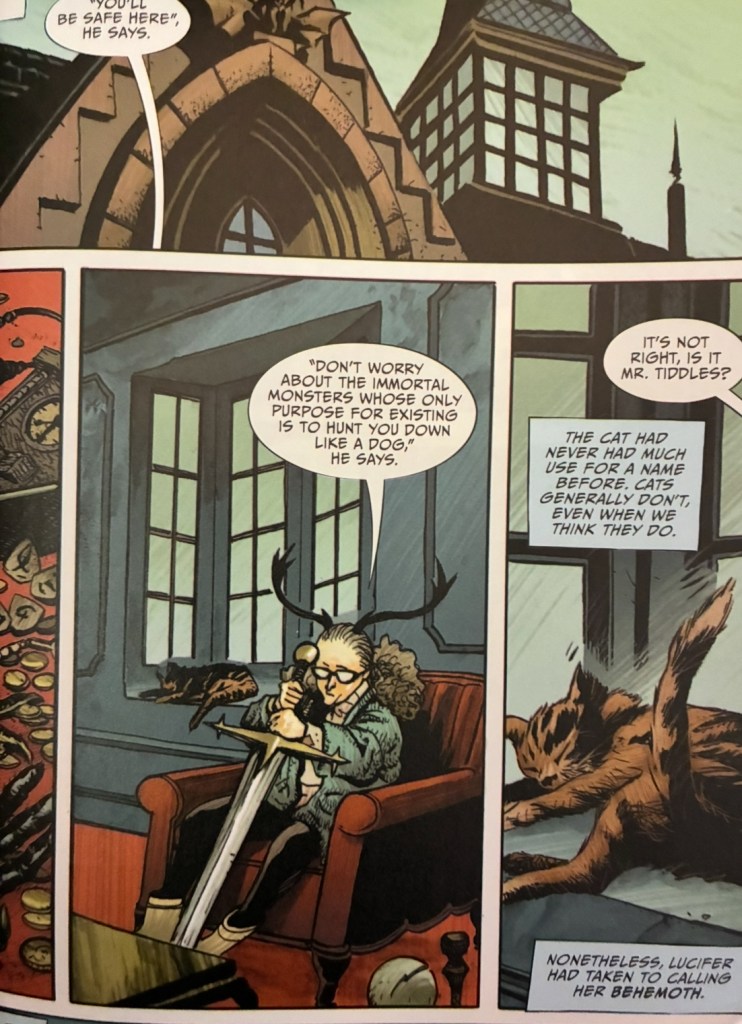
Remiel getting rushed by cannibalistic angels provides the causal occasion for Lucifer’s return, along with the black bird and the beings that housed his various body parts. In Lucifer’s goodbye letter to Mazikeen, he says that he expects that he will be dragged back to existence. For a brief intervening period, though- the Devil will have never existed and people will be unable to avoid the root of evil within themselves.
Lucifer wrote that he expects to return to existence. Yet the reborn Lucifer has the same generalized angel font as Remiel. There is text from Lucifer’s writing, in the Lucifer font, beside Remiel “becoming” Lucifer while retaining the angel font. I’ve spent way too much time wondering about what that may or may not mean. What we know is that Lucifer removed himself from the time flow at the beginning of ‘The Devil at Heart’. He walked into Destiny’s garden, grabbed Destiny’s book and removed every mention of himself.
Off topic but-
That’s the third time Destiny got bullied by an angel, right? And the second time by Lucifer himself? The first time was the angel Meleos: potentially the first being outside of God to pursue artistic inspiration. Meleos said that he studied the book of Destiny but Destiny does not offer to show people things. He won’t even turn a page backward or forward for any reason other than his reading in the moment. He may, if circumstance demands, recite words that he read. If Meleos studied the book of Destiny on his way to creating the Basanos, he would have had to have done so by force. The second time was when Lucifer set the book on fire. The ashes floated to the ground, forming letters that send Lucifer off to the next plot point, then the book reconstituted in Destiny’s hands.
Anyway-
Either Lucifer’s second attack on Destiny and his book sticks harder than the first or it lined up better with Destiny’s plans. Lucifer managed to retroactively edit himself out of the history of the universe in order to avoid being sent back to Hell.
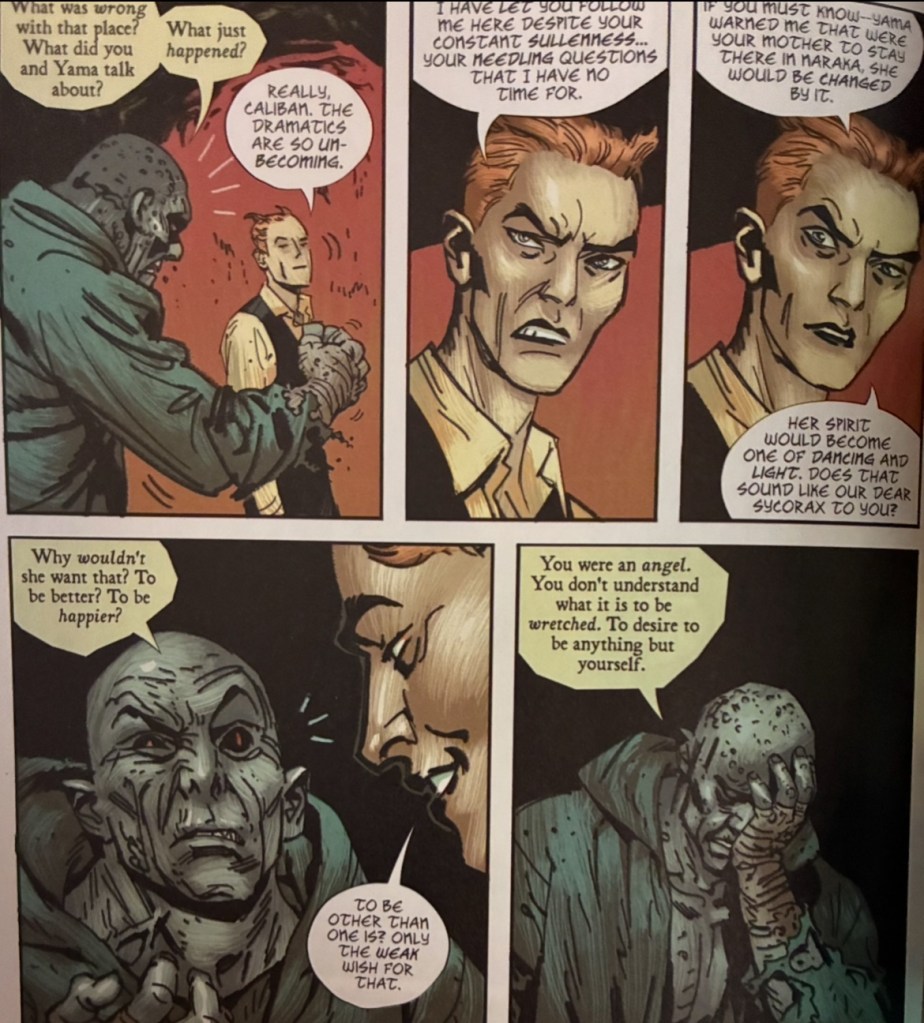
This of course has a number of consequences. Various historical and personal events happen differently. The whole universe acknowledges the shift. Outside of the universe, in the Silver City, it feels more like a distinct “event” happened lately. The angels can no longer hear the voice of God and both their life force and magical influence are in decline. A short time ago, though, Caliban tasted the flesh of a dying angel which made the Silver City instantly aware of his location. Someone repeats the experiment and finds that consuming the flesh of another angel allows them to hear the voice of God again, if only for a moment. Remiel and Duma receive word to return to the Silver City where they are instantly attacked. Duma is quickly devoured and Remiel runs for it. Various beats of the original battle in Heaven are echoed. Michael’s spear pierced Lucifer’s wing and the ground beneath it, immediately before his fall. The same spear thrust and the same break in the ground happen while Remiel is fleeing.
Remiel and Duma have some of the most interesting arcs in ‘The Devil at Heart’. In one timeline, Remiel and Duma are charged by God with claiming and managing Hell under the authority of the Silver City, once Lucifer left the key with Dream. Dream hands it over willingly enough and Duma is the one who accepted it. Remiel was too busy seething about the injustice of God’s decision.
In another timeline, the angels Remiel and Duma are wandering, half-crazed amnesiacs. Duma knows the key he wears around his neck belongs to one of his brothers…he’s just not sure which one. He soon gives it to some random humans who told him they would make sure his brother gets it. Then their siblings from the Silver City tell them that it’s time to come home.
Hell and the Silver City are outside of the universe and the time-space it occupies. At the start of this book, Duma and Remiel are in Hell- safely outside of the time flow. The stewards of Hell likewise notice that something is off and set out to investigate, entering the universe and are thus effected by the timeline shift.
The Silver City is still outside of time. No continuity change per se but a distinct event still happens: the disappearance of God’s voice from their minds.
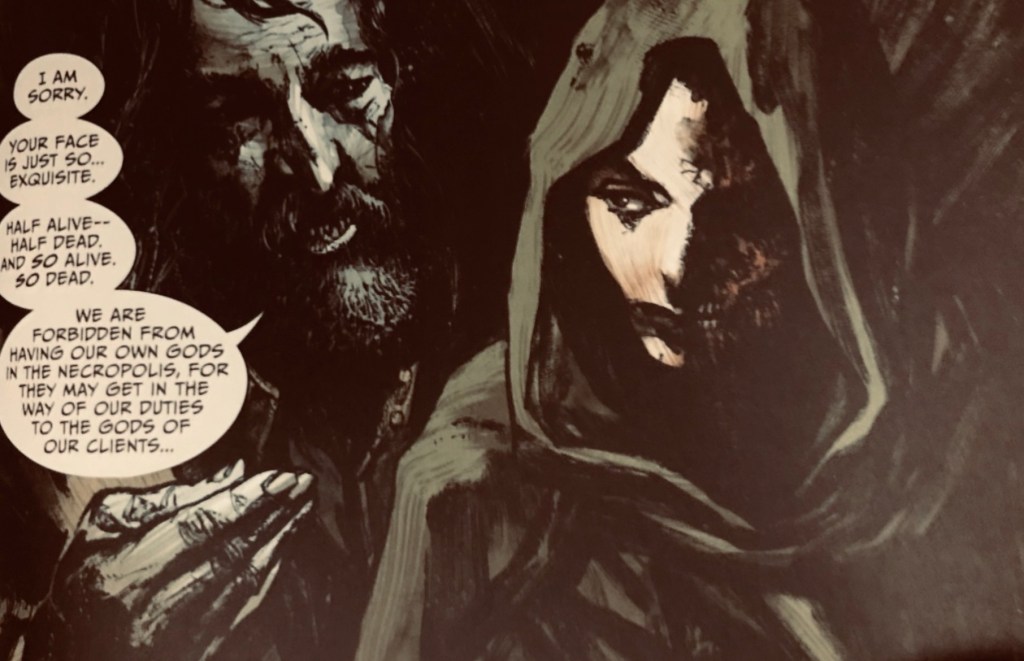
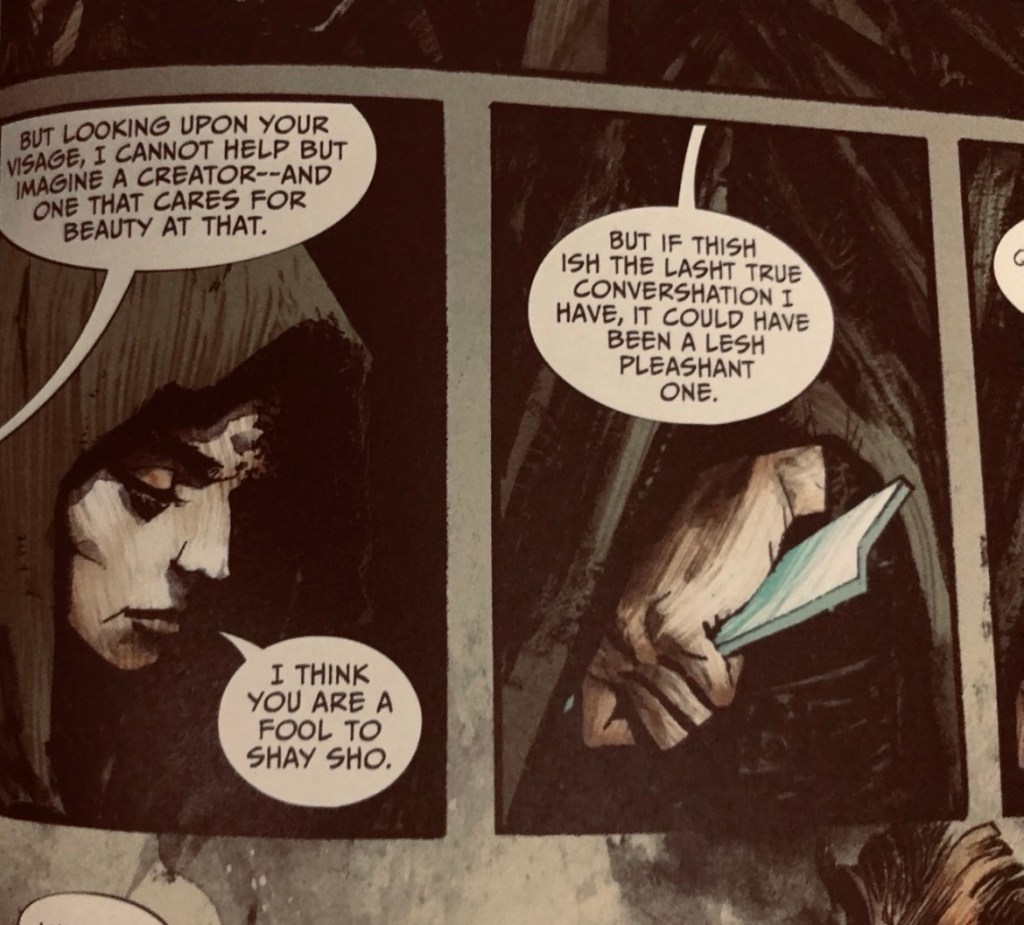
Mazikeen has also been on both sides of this wall. Unlike Remiel and Duma, though, her perspective has remained constant.
Unless I’m forgetting something from Mike Carey, Mazikeen’s initial appearance at Lucifer’s side has never been portrayed. Context from ‘Season of Mists’ suggests that she simply rose through the infernal ranks. Immediately before Lucifer’s departure from Hell, his court appears heavily militarized. Orders and protocol are clear and direct. At some point after the Lilim assisted in the construction of the Silver City (one of my favorite Mike Carey contributions) and were scattered elsewhere…Mazikeen must simply have been a Lilim warrior who eventually fought under one banner or another in Hell. Millennia past, her prestige grew and she eventually became both Lucifer’s body guard and consort.
She was a soldier, at her post. It was that simple. Then Lucifer turned everyone out, locked the gates and gave away the key and she simply didn’t have it in her to leave his side. In the absence of protocol, her feelings came through.
If we treat the Mike Carey Lucifer comics as canonical coverage of what happened between ‘The Kindly Ones’ and the new Sandman Universe run…Mazikeen defaulted to military protocol as a matter of course, much of the time. Even after the Basanos changed her face into an intact, symmetrical human face- a wound whose depth Lucifer didn’t seem to appreciate -she remained at his side, ready for anything. Eventually, Lucifer restored her face but he took his sweet time about it.
Then, during first two SU Lucifer stories…Lucifer jeopardized their life together. By risking exposure to Heavenly wrath. Because he wanted to put his son back in touch with his mother. At the end of ‘The Divine Tragedy’, she snaps and force-feeds Caliban angel flesh, drawing the eyes of Heaven directly to them.
Lucifer later accuses her of jealousy. Mazikeen does not argue.
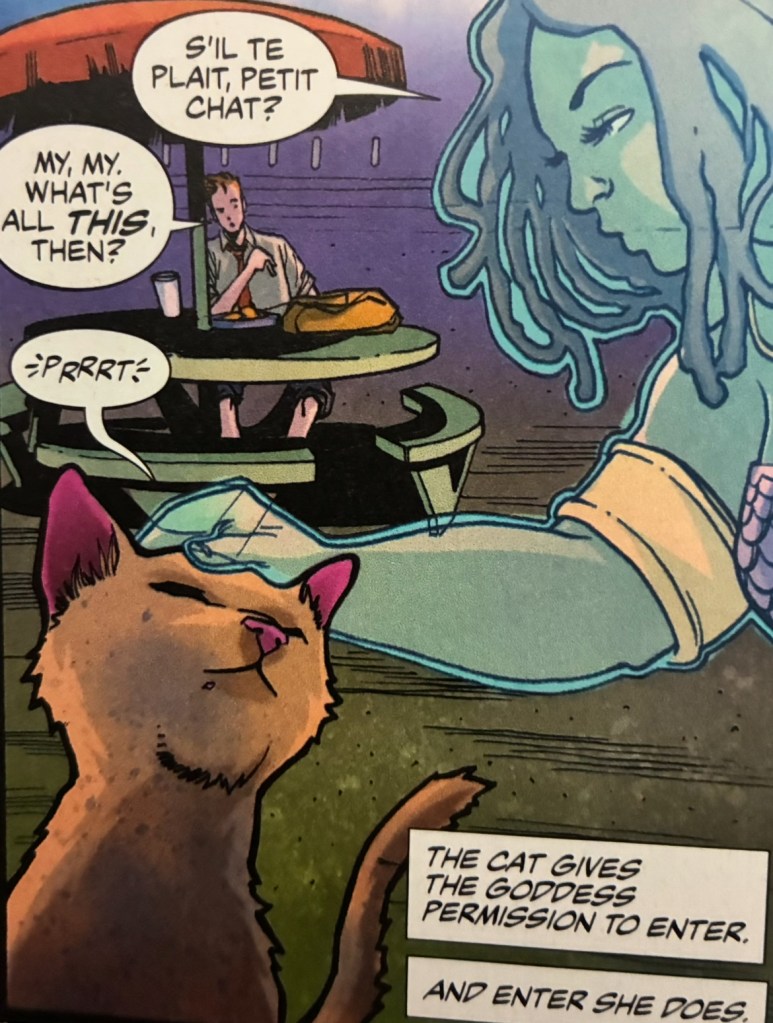
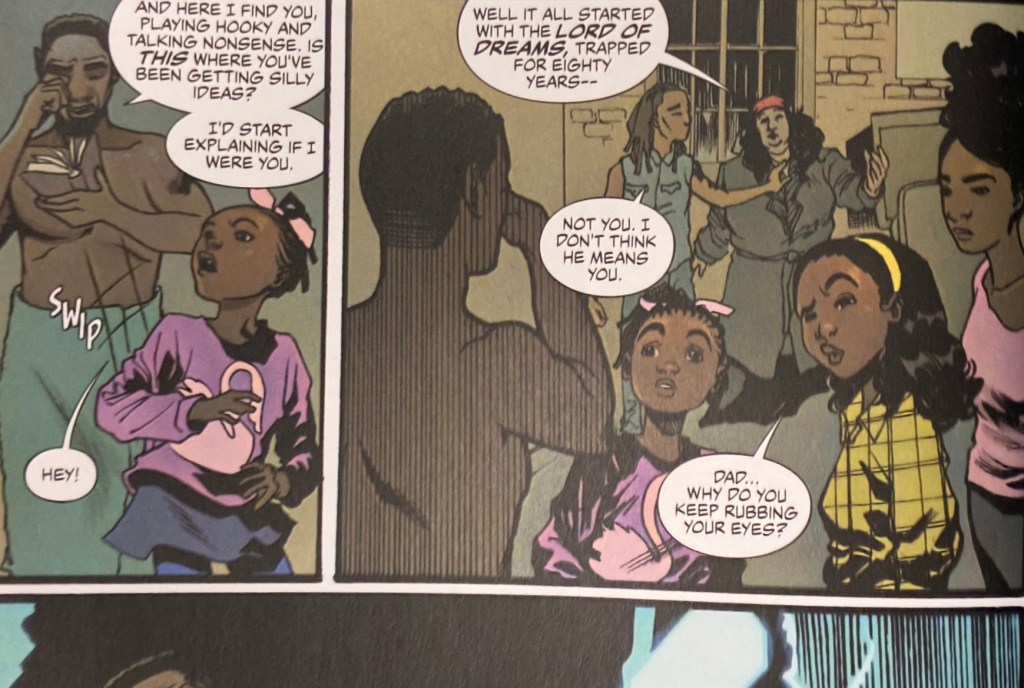
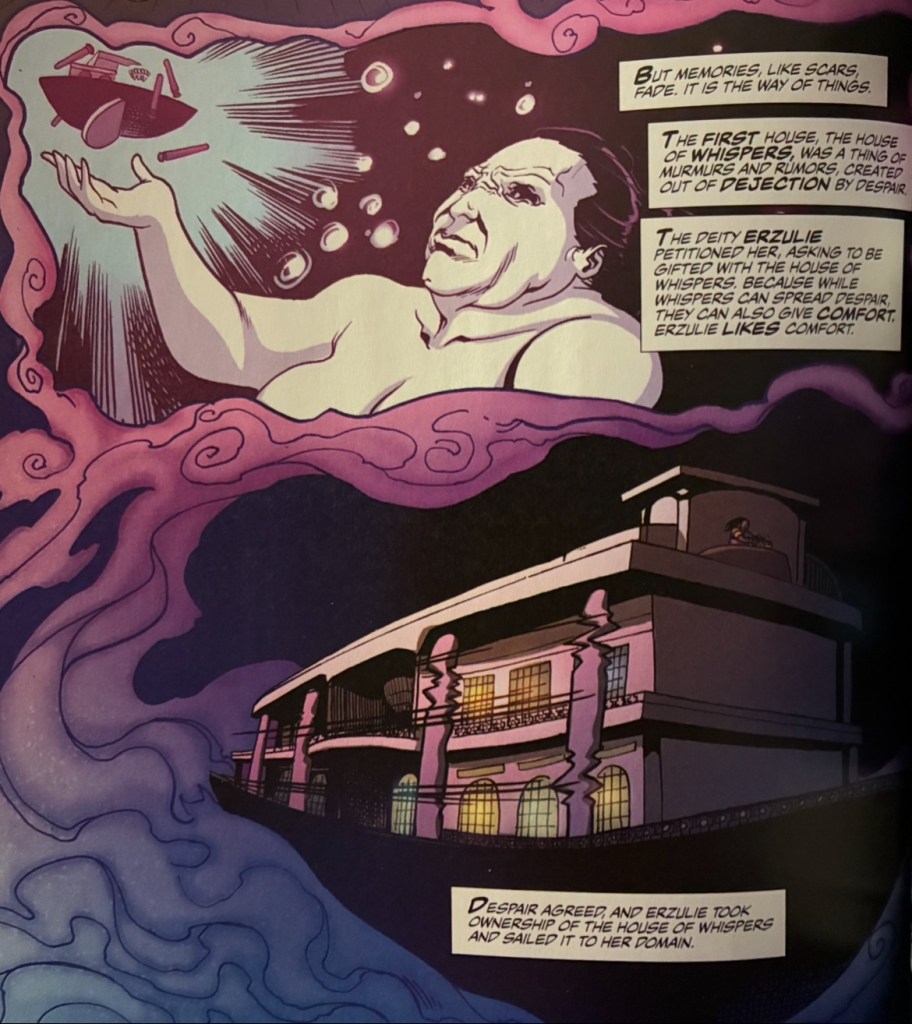
This may have been catastrophically petty but it is also one-hundred percent consistent with how these beings operate in that universe. Timeless beings, to be exact. The Endless throughout these stories and the loa as portrayed in House of Whispers are no different. They feel things immediately, react immediately and move on.
From a third-dimensional perspective, this appears as deadly simplicity. Yet three-dimensional beings appear just as simple to them. If something thinks or feels at all then they can be confused and overwhelmed. Simplicity is not the same as harmony or perfection. Rather, the timeless are acclimated to their own level of complication.
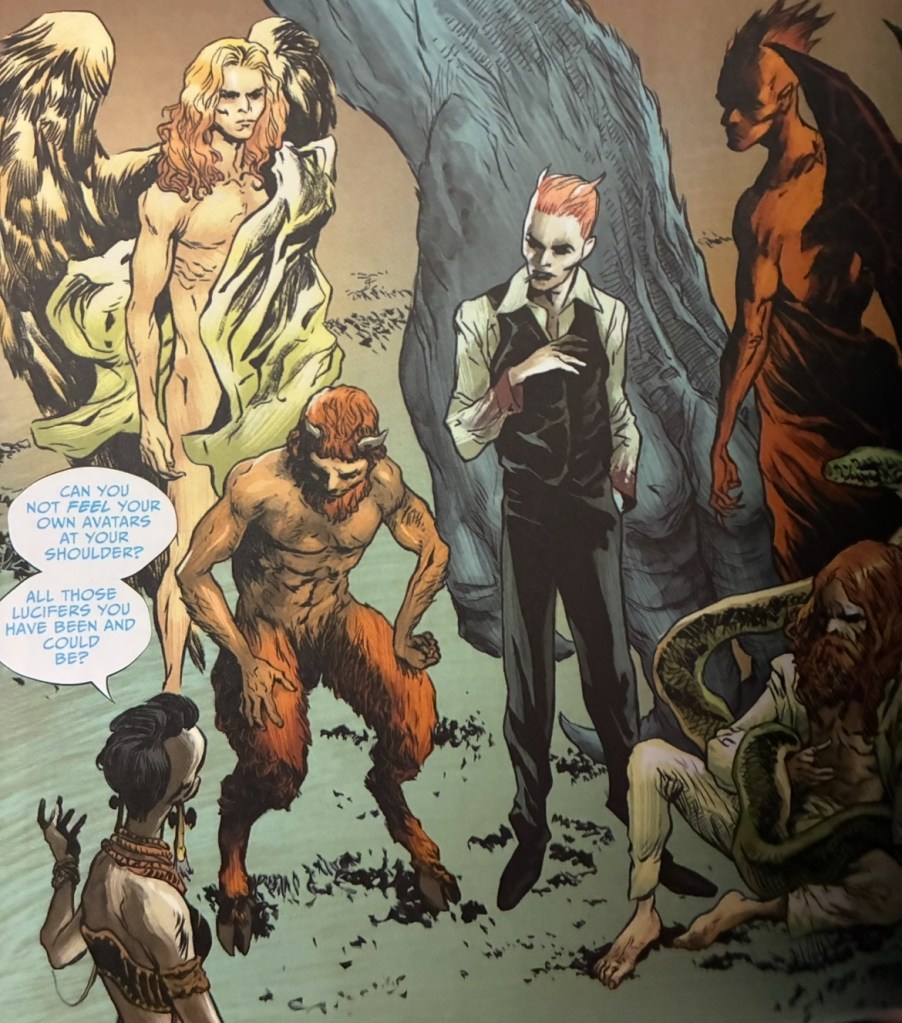
There is even something of a metafictive equivalence between Mazikeen and the reader, within ‘The Devil at Heart.’
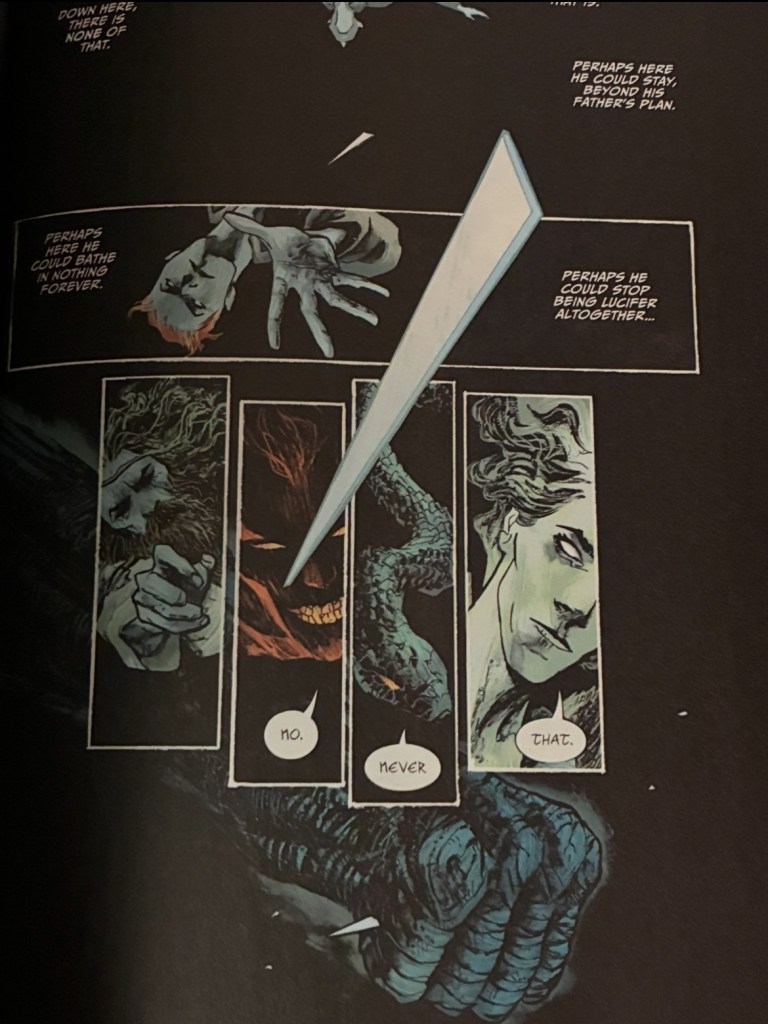
I wrote that the mythic interrogation of Sycorax and Caliban happened in the first two volumes opposite the interrogation of Lucifer in the last two. Mazikeen is arguably the main, orienting viewpoint in ‘The Devil at Heart’. This means that the gathering of threads into a coherent perspective is largely reserved for her alone, just as she is the sole recipient of Lucifer’s letter.
The carriers of the body parts, of course, remember things both before and after the change but Mazikeen was there from the beginning. Mazikeen also remains unaffected while the angels grow erratic and sickly. Mazikeen acquires the enchanted, silver tongue which clears up her speech once she leaves Lucifer at the end of ‘The Divine Tragedy’. Mazikeen even knows the location where Remiel falls to Earth.
This timeless simplicity was also evident in the earlier harmony between herself and Lucifer. Total, uninhibited freedom itself made Mazikeen and Lucifer compatible with each other. Things only got complicated once morally demanding externalities got involved.
No, it is not all about the love story…but it’s such a huge point of empathy. Mazikeen’s awareness of where Remiel was landing was also a source of confusion, for me. It felt like Remiel had to have been transfigured into the Lucifer we know. But no such thing is spelled out. In Lucifer’s goodbye letter, he sounds like he anticipates a personal resurrection. During his visit with the Hindu pantheon, he explicitly rejects the comfort of oblivion in favor of his selfhood.
This reminds me-
We have absolutely no idea what the stewardship of Hell even looks like in the latter Sandman Universe comics, except that Daniel Dream has undermined it on a few different fronts. I think the mystery at the end of ‘The Devil at Heart’ is one of those questions that luxuriates in not being answered. It feels right not to know if Remiel, in his fallen state, remains himself or not.
Still…Morpheus Dream once said that Lucifer was one of the most powerful beings he knew of. Both Lucifer and Remiel remaining off camera from ‘Marks of Woe’ through Nightmare Country feels ominous. Like a still surface, revealing nothing of what’s happening below.