
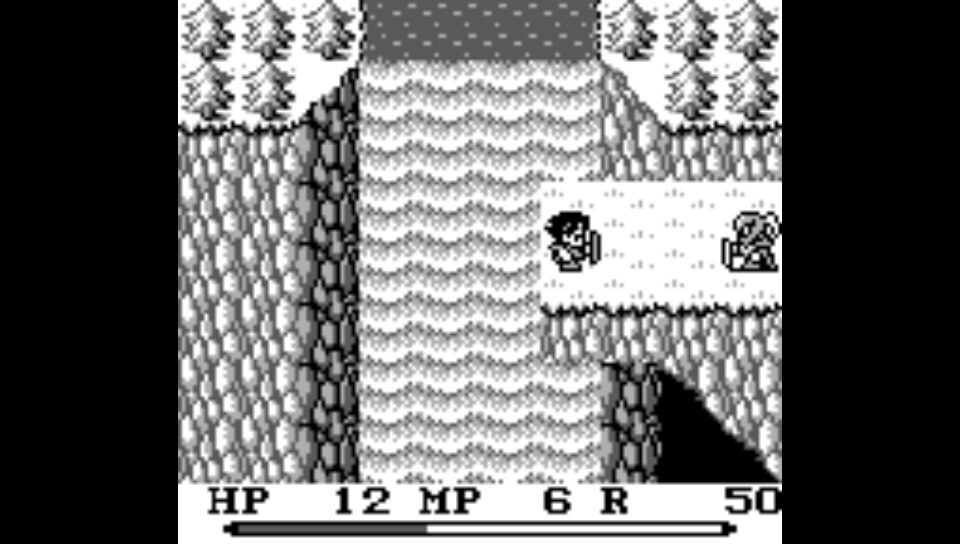
As a truly relentless Final Fantasy fan girl, I couldn’t resist a recent opportunity to grab a copy of Final Fantasy Adventure to play on my old-ass Gameboy that I got for a birthday present when I was like nine. I go through little fits and starts with that particular handheld, largely with regard to the LoZ Oracle games. The plot for those games are such that I don’t feel lost after taking a long break, at least with Ages: the side quests between dungeons are so hard and involved that I don’t think you’re meant to approach the game with any sense of dramatic momentum in different parts in the story, not even the open-ended, episodic kind between the side quests in Majora’s Mask. Before that, the last Gameboy game that really grabbed me was Metroid II: Return of Samus, which could potentially be the best economic usage of the Gameboy’s limited information space for visual storytelling- possibly the most carefully designed thing that I know of for the Gameboy, followed by LoZ: Link’s Awakening.
Final Fantasy Adventure is not carefully designed by any standard. Especially when compared with other games for the platform (Metroid II for instance) that have a careful way of directing your awareness of your surroundings and their possibilities. As a child, most of the video games I obtained without help from my parents were from garage sales, which meant that I had a ton of games but no instruction manuals or any other supplemental material it was meant to be packaged with. Over time, this made me good at determining how successful a game was based entirely on it’s ability to present itself. Link’s Awakening has a very plain story progress route and there’s almost no way to mistake what the next step in your journey is. Metroid II is tough but fair: it gives you everything you need to figure it out on your own, even if it takes some extra effort and patience, kinda like the better Tomb Raider games.
Final Fantasy Adventure is just awkward. And it’s not like the first NES Zelda game where the confusion typically comes from not having the game manual and the map it’s packaged with. I sorta thought it would be, though: the online vendor I got my FF Adventure copy from packaged it with the manual and an officially licensed map. That map can be helpful at times and even potentially necessary: I don’t think I would have figured out that the axes can be used to cut down trees if it wasn’t for the explanations of different items, spells, etc. on the back of the map. But some situations and story junctures just don’t offer any way for you to figure them out on your own. Like walking figure 8’s around palm trees to get to the Oasis Cave: was there actually a common gaming convention that led people to do this on their own in the early nineties? Like, was there some reason why it would be an intuitive thing to try on your own? There’s that kid in the village who gives the “palm trees & 8” hint but there’s just no puzzle like that before hand that would prompt you to be thinking about that.
The route to the Dwarf Cave is almost as bad (what is it with FF and doing frustrating things that involve dwarves? FFIV, much?). At that point you’ve had the axe for awhile and, if I remember correctly, the item description doesn’t actually tell you that you can chop down trees, and there’s nothing about the route to that area or the nearby village that would prompt you to experiment with the axe. Which is where the map packaged with the game comes in handy with the item descriptions, or, you know, online forums.
Those are pretty much the only two serious flaws in the story sequencing, but there were other problems. Because those problems only interfere with your progression now and then, it’s fair to call them mere oddities. Such as the dead ends in some of the dungeons. Some of the levels have multiple floors with pits that drop you down to the floor below. The floor you get dropped down into may be filled with monsters or some other slap on the wrist for your carelessness. In my head I took to nicknaming those rooms murderholes- I think I gleaned that phrase from a book. I’m pretty sure they were holes in castles that could be used for unleashing molten lead in the event of an invasion? Or a pit with animals in it? The phrase murderhole had something to do with a trap, anyway. It’s probably just a google search away but nevermind.
Anyway, I assumed a few of the dead end rooms in dungeons were murderholes. And sometimes they were. But usually they were just dead ends. Period. Were they put there as misdirection to add to the challenge? Maybe, but I sorta doubt it. The possibility has both odd and oddly amusing implications. I mean…it’s clear, at a glance, that this game borrows heavily from earlier Zelda games, and like early Zelda games, you are taught early on to test blank walls for breakable sections (using disposable mattocks, rather than Zelda-style bombs). If you find a dead end that doesn’t have pits on a higher floor dropping you down, and if the number of explorable directions aren’t numerous enough for a dead end to be confusing from a navigation stand point, then…are they supposed to trick you into thinking they connect somewhere else through a breakable wall? Is that supposed to be the nature of the misdirection? Are they banking on you being an avid late eighties’ Zelda gamer?
I mean, I know that game was popular and deliberately inverting popular mechanics is a way in which influence shows itself (see some of today’s Dark Souls derivatives). But if the mechanic that you’re trying to turn inside out is that specific…well…it’s just odd. And it happens several times throughout the game. If the dead ends aren’t there to throw off your sense of direction, not murderholes that you get dropped into from an upper floor and not attempting to mislead you with strangely specific suggestions of breakable walls then…well…then they seriously start to look like authentic dead ends. Which is either lazy or guided by some principle that I just can’t account for. Maybe they have some other function that I haven’t figured out. But they sure do look pointless.
Then there are the narrative glitches. Only one of these really bothers me, though, and it’s why Dr. Bowow has a robot in the submerged Dime Tower while he talks about it as if it’s this mysterious, lost thing that no one has found since it’s disappearance. I mean, that’s the only way to make sense of him giving you cryptic hints about where it is- that he does not actually know. But the robot says Dr. Bowow put him there…so…yeah. I’m also choosing not to dwell on the fact that his name is Dr. Bowow, seeing as it’s probably a script with a clunky Japanese to English translation from the early nineties.
There are also parts of the explanations from Cibba that seem a little incomplete. I mean, when you get to the parts of the game where he’s telling you what to do, he’ll get you from point A to point B easily enough, but the reasons why his suggestions are true are not very obvious. I mean, it seems apparent that you need to excavate the ruins of the ancient Vandole civilization because 1. Julius and Fuji are at the Mana Tree and 2. the Vandole empire were the only humans to ever make contact in the past. So using the route that they built (via Dime Tower) is simply the most straightforward way of getting to the Mana Tree and thereby stop Julius’s influence over it. But that’s never spelled out in so many words. No character appears to make that connection on their own. It is 100% implied. As far as I can tell, it makes perfect sense, and it ain’t no crime to make the player think a little about what’s going on- I rather like that -but the implication is done so awkwardly that I don’t know for sure if it’s intentional.
While the progression route, dungeon design and script have problems that range from lazy to surreal, though, I have to say I enjoyed Final Fantasy Adventure more than I’ve enjoyed any Gameboy game since I was a teenager getting wrapped up in Metroid II. Part of this has to be nostalgia. I remember visiting out of state relatives with my mother as a five year old, some of whom were teenagers, and I would watch one of the older girls play a Gameboy over her shoulder. Within seconds of booting up Final Fantasy Adventure, I was almost positive this was the game I had watched my older cousin play. I also started gaming in early childhood way back when, so the appearance of early nineties video games is bound to tug on my heart strings in and of itself. But the game has genuine strengths of it’s own, though.
The thing that hit me first was how fun the exploration is (at least when the obtuseness of the next necessary step wasn’t driving me crazy). Maybe nostalgia has more to do with this than I’m consciously aware of, but I don’t think so. I’m pretty sure there were a ton of things that were done very well in video games in the late eighties and early nineties that a few modern developers are having real problems with. Like open world.
I never played Skyrim and some of my friends never fail to remind me of what a luddite trog I am because of it. And I have no reason to doubt that it’s reputation for a good open world game is justified. I’m sure it is. But some other developers like Square Enix (oh, how the mighty forget) seem to be choking in their effort to keep up with it’s popularity. I mean…they destroyed the pacing of FFXV by totally shoe-horning the open world quality. You’re literally tempted to break off the main story whenever you damn well feel like it. And there’s not much in the story that hinges on exploration, so it just comes off as a distraction. Which is strange and annoying since, back in the nineties when Square developed FFVI, the whole second half of the game was open world and the majority of the possible exploration was linked directly to the story arcs of the main characters. Once you have your second airship could either go straight to Vector and fight Kefka, or you could explore a whole other half of the game that develops a ton of back story and motivation for most of the characters. Square anticipated the modern fascination with open world before they even made the switch to 3D graphics and then utterly failed at it, while Western developers are making the sub-genre their own.
*huff* Anyway! Let’s try to keep the ranting to a minimum. I think the joy of exploration was something that old school JRPGs were really good at, whether it’s open world in the same way as FFVI or if it’s something like FFVII or Pokémon where you end up navigating an overworld even though the progression route is linear. Or even like the first Zelda game, which most of us fell in love with through random exploring and deduction. For the most part, Final Fantasy Adventure offers fun exploration in the same way. Another thing I liked about this game also has to do with a facet that might turn off a lot of modern Final Fantasy fans: it really doesn’t feel like a Final Fantasy game most of the time. That’s probably because our assumptions of what an FF game is are tied up with things like turn based combat and multiple playable party members. Kinda like FFXV (DLC notwithstanding), you only get one playable character with NPCs backing you up at times. Maybe this says things about the sort of mind that I have, but if something looks intriguing enough, I don’t care if it breaks consistency with other things that it’s supposed to be a part of. If it’s done well, the broken consistency makes me more interested. And since that aspect reeled me in, the other wrinkles that do relate to other Final Fantasy games are both uncanny and fun.
This is true of the FF hallmarks within Final Fantasy Adventure in general, but it’s especially true of the usage of certain boss monsters. Like Lich and Iflyte. Lich was one of the four elemental Fiends in the very first FF game, and when the original development team got together for one last hurrah with FFIX, they brought back the four Fiends as guardians of the keys that unlock the ancient, extra-terrestrial vessel containing the souls of Terra (can you still call something extra-terrestrial if they come from a planet called Terra? *looks lost*). The usage of Lich in FF Adventure is kinda similar to IX- it’s guarding the spell that let’s you access the Vandole ruins…which in turn leads you to the Dime Tower. Both Adventure and IX use the Fiend(s) as guardians of either a lost race of ancient aliens or a lost race of ancient humans. Does it necessarily mean anything? Maybe. Probably not. But I think it’s cool and it makes my little lore loving brain spin. Also…Iflyte looks like a rather typical devil. Sorta like Ifrit…a common summon monster in most FF games and one with lore significance in XV. Lore significance that ties into an ancient founder race. And Iflyte/Ifrit is guarding the Sword of Mana, which is itself a key to the ruins…connecting this creature to the same gate-keeping function as Lich, Fiends, etc.
Again, it probably doesn’t mean a damn, but I still find it fun to think about. The whole thing with the Tree of Mana being on this unreachable place that’s close to the sky also makes me think of both FFIII (floating world in there), FFIV (the moon) & FFXIII (Cocoon). It even seems to be an inverse parallel to things like Meteor in FFVII and Pandemonium (the vessel of the Terran souls) in IX. It’s just an interesting development in a central and re-occurring part of the common mythology that echoes between many of the FF games. My curiosity is also tickled a little by the fact that FF Adventure was retro-actively included in the Mana series as it’s first game. Does this mean that Fuij, as the last gemma capable of becoming a Mana Tree when the prior one dies, is the final Mana Tree period? She has no children, and it seems like the heirs to the Mana family are born before they transform into the Mana Tree. And if the subsequent Mana games build on that mythology, does that mean that the whole Mana series is situated at the end of it’s own mythic timeline? Like an apocalyptic or post-rapture sorta deal? You don’t usually see things like that in a lot of mainstream fantasy stories. One of the reasons I’ve gotten attached to Hollow Knight, lately. Then again, I haven’t played any other Mana game to completion ( I did briefly poke around with Secret of Mana, though) so I don’t know. I could be totally off base with that.
The music can be uneven in Final Fantasy Adventure, but it gets better as the game progresses and starts to add a certain gravity near the end. I’m a sucker for music- no other art form captures my emotions quite as fully. And the music helps to give the ending it’s sneaky pathos. Sumo defeats Julius in the end, but his effect on the Mana Tree and the world are irreparable. Fuji becomes the new Mana Tree, and as the end credits roll we see Sumo having these little silent interactions with other NPC’s that look almost like he’s saying good bye. It all ends with Sumo bringing his chocobo back to the wild. It’s not a huge deal, but…well…the chocobo has mechanical body parts from Dr. Bowow replacing his broken limbs. One of them appears to be a steel plate on his face. Yet the chochobo goes back to it’s own kind. As if everything is going back to normal except Sumo. No particular plot point is effected by this, but I appreciate how understated and melancholy it is.
This is one hell of a messy game, but still a fun and rewarding one in the end. It’s very clunky and awkward and very retro, but for me there’s enough happy coincidence at work to make those qualities add to the memorability of the game, along with it’s genuine strengths.
 AilixChaerea