This is a rogue-like, such as Diablo. Also like Diablo, it appears to include a small community outside of an apparently unique ladder of progress- leading either up or down. This game also has a first-person perspective, which I don’t think I’ve encountered in an RPG outside of Shin Megami Tensei and Persona.
Subtitles indicate offscreen voices in the opening cutscene. These voices are talking about sedatives and simulations and whether or not someone is conscious. We are left with the impression that the span of time we keep groundhogging over and over again is what they mean by “simulation.”
About that last part-
Baroque has recognizable RPG mechanics. Level-and-EXP-based progression with stat-building, equipment collections, implied “role-play” what with the first-person POV (nineties versions) and our self-named protagonist.
Little of which has any bearing on the player progress data recorded by the game, other than the “suspend” function. Without “suspend” (quicksave) there is no way to maintain progress in the Nerve Tower between sittings. Which places all of the onus on a complete trip without a single death.
There is a separate category of save data called “arise”, which starts you at the beginning of your most recent pass through the loop.
That’s our rogue-ladder, by the way. Diablo has the pit below the cathedral, Azure Dreams has the Tower of Monsters and Baroque has the Nerve Tower.
One of your first acquaintances on the “ground floor” urges you to hurry to the Nerve Tower before saying anything else. A moments’ distraction or idleness is paid with by either HP or VT, so you might decide to hurry up on your own out of a vague sense that doing expected things has positive results.
No one ever says so, in so many words. But it’s an intuitive assumption.
With some effort, it bears out this time. Setting foot in the Nerve Tower, alone, does nothing. Relief is eventually offered by monsters called “grotesques.” Upon death, they turn into little white spheres, along with any other item drops. The spheres are what keep things somewhat comfortable, as killing grotesques for spheres regularly is the only way to keep VT topped off.
To start with the familiar-
HP is, of course, hit points. You want them as far above zero as possible and taking hits make the number go down.
So long as you don’t get poisoned, HP counts slowly toward its upward limit, based on leveling. This slow recovery happens as long as VT is above zero and VT ticks away, roughly, with the seconds. Running out of VT will cause your HP to drain rather than heal. Without a quick infusion of VT, this drain can kill you.
So the solution is killing grotesques whenever possible. While you’re grabbing the VT orbs and trying not to take hits, it also pays to make prompt use of any restoratives you come across. If either HP or VT is full, they usually bump up your upward limit.
Conservation is best saved for after you’ve KO’d a few times. By then, you should be a little more acclimated to how long-term play works.
Speaking of- levels and stats do not carry over between KOs. Neither does your personal inventory but items can be secured in a kind of dead-drop.
A bit of a grind, really. But people who play through the second quest of LoZ Outlands for their blogs don’t get to complain about difficulty.
With care and repetition, it becomes apparent that the tower is only so long. Or…I guess…its successive basements so deep, since that seems to be the direction we’re heading. If you have a few hours and are willing to roll with some trial-and-error, you could, conceivably, clear the whole basement in one sitting.
One must not count their chickens before they hatch. It pays to see through sticky situations. A recent favorite of mine is running low on both VT and HP surrounded by grotesques I couldn’t possibly kill in the time in takes to survive contact. Like many rogue-likes, Baroque has randomly generated floors. Strategizing must therefore happen in somewhat broad strokes.
It is possible to survive those situations but it is also possible to die because of HP/VT. The random level-generation accounts for a lot of stuff like item drops. A little bit of patience can be surprisingly rewarding.
So things get punishing. What’s actually going on, though?
Rather soon, you realize that you begin the same time loop over and over again, with each death. In some loops, there are unpredictable cues and statements about how the particular loop you’re in right now relates to the other loops. Clustering, usually, into A. it’s different this time or B. it’s never different.
My first death occurred in the Coffin Man’s “training ground”. This triggered a cut scene of a coffin-like suspension chamber. With the context of an earlier cut scene, it makes sense to assume that the player character is inside it.
If you managed to talk to the Archangel before that point, he says that, at “this time”, he exists where he stands and, simultaneously, somewhere else. He says that this “is because this is not the real world”. He goes on to say that, eventually, the player character will awaken to a reality where such “illusions do not exist”.
After dying during the training of the Coffin Man, the Archangel treats you as if there is nothing to say or explain. He appears surprised as he notes that you are, apparently, struggling to speak, and have lost your memory.
A background observation slips through before your muteness and memory loss are apparent. The Archangel says that, if that’s the only problem you have than you’ve been lucky. He realizes it is not the only problem when he observes your (somehow) apparent memory loss.
If, at that point, we are truly free of the simulation and have entered the real world for which the sim was a model…it would make sense if things happened suddenly that were not expected to those who appear to be in charge. Accidents happen in real life. It may or may not be relevant to note that this is the first time I’ve encountered one of his most well-known lines: “(t)here is significance in you using it”, as he hands off the Angelic Rifle.
(The Angelic Rifle will level any grotesque you encounter but it only has five shots and I have not seen any ammunition item drops)
At this point, I have a few questions. One of them is how many of these events happened because of something I did, immediately prior? Did I get the second suspension chamber cut scene because I died in the lair of the Coffin Man? That had also been my first death. Could the second suspension chamber cut scene simply be triggered by your first death?
Neck Thing, one of the NPCs clustered outside of the Nerve Tower, says that the Coffin Man makes him sick by profitting off of the catacombs. This tempts me to attribute the recent change of circumstances to dying under the roof of the Coffin Man. During the second suspension chamber cut scene, one of the off-screen voices asks if “he” just died. Two contrary opinions follow: “this one is garbage to” and “it’s off the charts!”, as if two people saw the same thing and had opposite reactions.
Less defensible but I can’t help but wonder: the suspension chamber cut scenes imply that the simulation is created in concert with your unconscious mind. If the oneiric projections are the basis for representations in the simulation, then consider this: there is a figure for whom you feel instinctive discomfort. You have no idea whether he is a human being or not or what his life and thoughts consist of. Regardless of his humanity or lack thereof, he is one of those whom the Archangel calls “distorted ones”.
Their lives and thoughts must consist of something, though: however incomprehensibly “distrorted” they may be, they are obviously sentient.
Yet for no reason that you are aware of, you give this person a wide berth. He carries a coffin on his back. He is both dangerous and duplicitous and appears to enjoy a kind of power. This I think is implicit in his ability to somehow profit from what happens in the catacombs.
One thing your subconscious might be wrestling with is what just happened, immediately before going under. Perhaps you were compelled to step into the suspension chamber yourself. Maybe you volunteered for it. It entailed a degree of risk, which your subconscious would also necessarily be aware of.
The whole notion of what just happened could make a menacing impression on an unconscious and suggestable mind. You may have thought, before losing consciousness, that this suspension chamber could well be your coffin. Something like the Coffin Man would make sense as a projection of your unconscious mind. If that happened, then such a projection might be something that the simulation drapes one of its NPCs in. Especially if this NPC has some sort of direct link to the life-support or a background program for the narcotic sleep control. Something not so different from the renegade programs portrayed in The Matrix: Reloaded and Revolutions.
An association between the second suspension chamber cut scene and the Coffin Man seems likely. A simulation-based one writes itself.
This is not the only possibility but it is easy to dwell on. At this point, you are aware that dying in the Nerve Tower and repeating the loop all over again is the most basic game play experience. Whatever else happens, whatever may be true about the context of your plight, that much has proved reliable. Being locked in a simulation would accomodate this.
As eternal as the time loop may be, though, the locals do not appear unanimous on it.
Repeated passes through the loop will also eventually draw your attention to a number in the lower right corner of the inventory screen, when hovering over the (so far) changeless presence of an item called “myself”. When you start off, the number next to your “self” is -1. With each death in the Nerve Tower or complete passes through it, the number increases to 0 and onward. The opening cutscene features a montage of images including a black screen with a large ‘-1’ in the lower right corner.
On the subject of whether every pass is unique or every pass is the same, this stands out. It is the only thing that is visibly changed with every pass through the loop. The dialogue of the distorted ones change as well but with each fresh loop it’s almost as if the prior loop might not have happened. Each floor below the Nerve Tower is randomly generated. The growing number of “selves” is the only clear evidence of consistent, long term progress on the “arise” memory card data (other than wherever the NPCs are in their dialogue trees).
There are other ways that long term progress can manifest, if one is bold, observant and persistant. With the ability to make multiple passes through the Nerve Tower with no relief but the “suspend” quicksave, you encounter things called Sense Spheres. On the original Sega Saturn version of Baroque, items tossed into Sense Spheres would appear around the last one on the sixteenth basement floor. I am, however, doing this on the PS1.
The PS1 features its own unqiue distorted one: Thing Thing. Thing Thing normally tells us about how he collects things that get spat out of a Sense Sphere just outside the Nerve Tower. Yes, it was always there- but nothing draws your attention to it early on, except its relative closeness to the Archangel (or his projection or bilocated presence). Anyway, deck Thing Thing in the face and he will offer to return up to five articles you previously threw into the lower Sense Spheres.
With a lot of care and maybe some luck, Thing Thing enables a way to add some cumulative progress to successive passes through the Nerve Tower. With adroit judgement of the things you send to the surface, you can leave yourself equipment to start your journey with or power-ups that buff said equipment or even level you up before setting foot in the Nerve Tower.
Nightmare Country – ‘The Glass House #1’ 1:50 variant cover by Yoshitaka Amano Speaking of: as a Final Fantasy fan girl, I’ve always wondered what it would be like if Amano did another full-length Sandman story collaboration, like he did with Dream Hunters
Other Sandman Universe comics have met high qualitative bars close to the original.
Two, at least, in my opinion. The Dan Watters Lucifer comics are some of my favorite stories in the pictures-and-word-balloons format. House of Whispers tells a story set in the same world but with its own catalyzing circumstances. It nonetheless features some familiar sights, like the Dreaming and the Corinthian. Even the rebooted Books of Magic and The Dreaming, with their visible weaknesses, succeed in other areas. The recent Dead Boy Detectives reboot hit some careful notes with subtle, thematic callbacks to the ‘Season of Mists’ arc.
Reiko Murakami, variant cover for ‘Glass House #6’
What distinguishes Nightmare Country is relatively familiar circumstances. Obviously we have classic power players like Desire and Despair, but the plot dynamics and the world building unfold like a 90s Sandman comic. With the usual caveats, of course.
The new Sandman Universe comics are situated, roughly, as one big sequel series to the original. Thessaly and the Corinthian are our central viewpoint characters in NightmareCountry and the plot is a few turns of cause-and-effect removed from the original.
‘Thessaly Special #1’ variant cover by Jasmin Darnell
Thessaly stepped in at the end of the first book and her after-the-fact discoveries keep the relevant data points united in one character’s mind. Flynn, embodied as a dream-kind cat (like Matthew is a dream-kind raven), has a deeper perspective but her agency is limited in the waking world. The Corinthian, tasked with her protection by Dream, is the muscle. Thessaly has more freedom to pursue her own ends.
The Corinthian and Flynn are immediately evocative of his trip with Matthew in ‘The Kindly Ones’. The overall dynamic also fits within the tendency the 90s Sandman had toward “odd couple” plots. Corinthian plus Matthew, Rose plus Fiddler’s Green, Dream plus Delirium, etc.
Speaking of unlikely bedfellows, Nightmare Country book two brings back a character whose only prior appearance was as peculiar as it was short.
The King of Pain: last seen in ‘Three Septembers and a January’, during the competition for Joshua Norton’s soul in the nineteenth century. The contenders were Desire, Despair, Delirium and Dream. Desire attempts to dominate Norton with a supernatural visitation and an offer to fulfill any sexual wish. Her/his envoy in this was a walking corpse, who was once a gambler who committed suicide over his debts. Whoever he was during his lifetime, he now introduces himself as the King of Pain.
‘Three Septembers and a January’
Norton brushes him off and he slinks back outside to a carriage where Desire and Dream wait. The King of Pain then starts slavishly fawning over Desire while the siblings argue over Norton.
I suspected he might show up after the first Nightmare Country collection. From the beginning, we are acquainted with a pair of undead assassins, loyal to Desire, called Mr. Agony and Mr. Ecstasy. It’s easy to forget one character from a massive comic with many short story anthologies…but if you happen to remember him, he is a clear precedent.
Mr. Ecstasy, Mr. Agony and the King of Pain all attest to Desire’s pattern of using undead servants. The similarities may stop there, though: Mr. Agony and Mr. Ecstasy are “bounty hunters, trained at the Unseen Cathedral”. The King of Pain is not a warrior.
He could very well be something, though.
As in the last book, there are ideas that can draw the wrath of Desire’s assassins. Last time, the targets appeared to be people who are inspired (consciously or not) to write books about the Corinthian. In book two, ‘The Glass House’, the deadly ideas include books “about” the King of Pain.
What remains the same: those who have the deadly ideas claim to never dream and regularly hallucinate a fat, naked, smiling man with Corinthian-like eye-mouths.
Our present inspired-uninspirable is Max Lee. Like Flynn and Jamie, Max doesn’t dream. Also like them, Max exists in a state of perpetual, unsatisfied yearning. Flynn’s friends did not respect or acknowledge one of the largest parts of her life: art, inspired by the Smiling Man. The guy she hooked up with in the beginning only listens to her long enough to sleep with her. While he dreams, he expresses contempt for her while talking to the Corinthian. Jamie has perpetual imposter syndrome and is terrified that everyone is barely tolerating him.
Between them, Max has more in common with Jamie. All three of them live as if acceptance is conditional. If all validation necessarily requires compromise and submission from you, it implies that you- on your own terms -would basically just be “in the way” for everyone else. In a scene where Max says he hasn’t dreamt since childhood, the shape of his body is a white void in the panel.
One notable difference with Max: as alienated as he is, he does fall in love with Kells, who is paired with him by Azazel. His unspeakable itch that he needed to go to a demonic nightclub to scratch: to cuddle, talk and exchange earnest affection. Something we haven’t seen any other inspired-uninspirable achieve.
The specific content of the deadly ideas may be less important than (or equal to) the people who have them. Late in the book, Dream mentions an inverse-echo of the regular dream vortex events, such as the one that swept up Unity Kincaid and Rose Walker.
The dream vortex seems to require a sentient anchor to latch onto, at first. In the late stages of a vortex, the initial anchor can be subsumed in the conglomerate of blended souls but it at least starts with one dreamer (Sandman: Overture).
Flynn, Jamie and Max all resemble one another and they all see the Smiling Man. At the same time, the words and behavior of the angel “Morrie” imply that there is a part of this that is less bound to one person.
Each iteration of the deadly idea accumulates from the older versions. In the beginning, the inspired-uninspirables had ideas to write books about the Corinthian.
An oddity about Ecstasy, Agony and the Smiling Man: they all have the word balloons and lettering of Morpheus. The late elder Dream, as opposed to the current Dream that grew from Daniel Hall. Black word balloons, wavy boarders with soft white letters. In the world of The Sandman, the lettering of the Endless is absolutely unique. They only appear for a single character. If the speaker is not the given Endless than the given Endless has either shape-shifted or has invested something/someone with their soul.
In ‘The Glass House’, we learn that the demon Azazel has been carrying the blood of Morpheus ever since he was captured in ‘Season of Mists’. That is, blood shed by Morpheus in their brief fight. With the blood of Morpheus, Azazel had something of a private stash of dream-magic, with which he plies mortals with their most depraved and violent fantasies in exchange for their souls.
Fear and Loathing on the astral plane
Morrie the angel, meanwhile, snorts dream sand, presumably from the same pouch that Morpheus once tracked down with John Constantine.
If this was about a demon and a renegade cousin of the Endless running an infernal fly-by-night operation, the possible uses for dream-magic would be evident. Yet the Morpheus lettering coming from the Smiling Man suggests that the good luck of a few soul-hawkers is not the only reason why we’re finding dream-magic tucked out of the way.
Especially since Dream (Daniel) wipes the memory of the Corinthian when he fails to convince him to abandon the mystery voluntarily. Dream also convinces Max, Kells and Flynn to stay in the Dreaming. After the manner of his predecessor, Daniel is implacable in his duties. To one of the new (potentially permanent, never to reveal any secrets) residents of the Dreaming, Daniel says that he suspects some kind of reverse dream vortex.
Which brings us back to the hidden stashes of dream-magic that seem to keep coming up. Azazel, with his soul-hustling, has a good enough reason to want dream-magic. But what about the Smiling Man and the deadly ideas?
I suspect that the content of the deadly ideas are not completely incidental. Morrie says, at one point, that a story touched by Dream of the Endless is more powerful than any other story.
Now…whatever was initially going on in the first Nightmare Country, with the Smiling Man, Madison Flynn and the fourteen other people who died before her…Dream got dragged in at the end, by the Corinthian. And, as we know, Dream saved Madison Flynn from death by turning her into a dream cat. In other words, the story of Madison Flynn is now touched by Dream of the Endless.
Jamie got involved- in all likelihood -because he was an inspired-uninspirable, who saw the Smiling Man. This, alone, seems to put him on the hit list of Agony and Ecstasy and therefore Desire.
Now, though, it appears writing a screen play about Madison Flynn has the same effect that writing about the Corinthian used to. Ditto the King of Pain. If Morrie’s plans require stories touched by Dream, commissioning a movie about Madison Flynn makes sense.
Yet there were already fifteen dead people (counting Flynn) who were inspired by the Corinthian. The fact that they may all have been interpreting the Smiling Man seems relevant. Thessaly attempts to cut through the obfuscation by pretending to be Jamie with a finished screen play.
Thessaly, “pretending” (artist is Reiko Murakami, variant cover for Thessaly Special #1, roughly in the middle of ‘The Glass House’)
If the inspired-uninspirables all see the Smiling Man, then is the tendency to imagine art/stories/etc. of the Corinthian pure coincidence?
If Morrie requires stories touched by Dream, then one way to make something happen with Dream is to target someone in his neighborhood. Too close a confidant could be a liability. It would have to be someone close to him- someone with Dream’s ear -who is not constantly at his side. It would also help if this person’s feelings are not always in agreement with Dream. The Corinthian wouldn’t be a bad target.
One possibility: the whole point was to make something happen that involves Dream. Once you have a thing that happened, you have something to talk about. Or, in other words, a story.
‘Endless Nights’
In could be that simple. That could explain why Azazel’s demonic playground is called ‘The King of Pain’. Who is that person, in this world, except someone who did something with the Endless, once? If all you needed were scraps of Dream-related history, it’s the kind of thing you might cling to.
The Smiling Man appears to be able to locate an inspired-uninspirable at any given moment. And they, of course, can locate him. But don’t the words of the lesser mouths have the lettering of Dream? Just like Ecstasy and Agony?
If the Smiling Man can find the inspired-uninspirables, perhaps the Smiling Man can consume them. Or consume whatever he detects in them: something to do with Dream.
Could the inspired-uninspirables all be manifestations of the inverse vortex? Unlikely, since Dream is apparently at ease housing two of them (Flynn and Max) in the Dreaming. The vortices are not normally harmless.
If the dream vortex unites dreamers in a voracious psychic mass…maybe the new vortex pulls something toward them? Haven’t we met (a round, naked, smiling) someone who is good at finding and absorbing things?
‘Three Septembers and a January’‘The Glass House’ #1 1:100 variant cover by Jenny Frison- beautiful rendering of the younger Dream but also sort of reminds me of Lestat
Definitely recommended, if you liked ‘Season Of Mists’ from the original Sandman.
While Lucifer may have been the break out character of ‘Season of Mists’, Charles Rowland and Edwin Paine had an equally pivotal role in that story. Neil Gaiman even included Edwin Paine in the epigraph: “You don’t have to stay anywhere forever.” Paine and Rowland are also the ones to bring the self-determination theme into the foreground.
Lucifer, of course, was open about how Dream inspired him to abandon Hell but both of them have their own frames of reference with regard to freedom and duty. Charles Rowland and Edwin Paine systematically “figured out” self-determination due to a lack of any other options.
‘Season Of Mists’ spoilers incoming-
Hell is a separate plane of existence most easily accessed by untethered souls- the dreaming and the dead. When Paine and Rowland end up there, they have uncanny, disturbing experiences that fit in with Hell but undeniably resemble nightmares. At the same time, Hell has its residents and natives, with their own agency. While Dream is trapped on Earth, one of his former captors barters Dream’s helm in exchange for protection. Presumably, there was someone on the other side to barter with. Among the residents, though, are deceased souls that simply feel a sense of belonging to Hell. After Lucifer abandons his throne, many of those souls continue their eternity in the same way: wallowing in the echoes of their mortal suffering and guilt. Then there were the ones like Rowland and Paine, who were trapped by the Hell “insiders”, with no desire to continue business as usual.
The same bullies from 1915 who murdered Edwin get booted out like everyone else. Once they start terrorizing (and eventually killing) Charles, they make him endure a rant: they spent their short lives sacrificing animals and smaller children to Satan, hoping for super powers or whatever. They appear furious that they got nothing in return, other than importing a few unwilling souls to Hell through ritual sacrifice. In the words of one of them, “Nobody in Hell gave a toss!” However cheated they feel, though, they continue behaving the same way they always have.
If Hell attracts Hellions through psychic resonance, then it’s subconscious. When Hell is emptied, many of the ghosts are as conflicted as the dead 1915 bullies. By the end of this chapter, Charles Rowland concludes that this is because they are convinced they have no other choice. When Charles broaches the topic of running away, Edwin is hesitant at first: his bones are still in the attic of the boarding school where the chapter takes place. Charles, who is more recently dead, says “Well, so are mine. Not to mention my flesh and hair and stuff.” Not long after, Edwin comes around with his “(y)ou don’t have to stay anywhere forever” line.
This is the ‘Season Of Mists’ nuance that the new SU Dead Boy Detectives incorporates: the things that others persuade you to believe about yourself.
Also cool: it picks up where volume one of Nighmare Country left off with Thessaly. Like, exactly. We even see the Dead Boys version of Nightmare Country‘s last panel: Thessaly, answering a knock at the door, wearing yellow over white, holding a knife behind her back, with a garbage bag visible on the left. Immediately after she allowed Jamie to ask his one question.
Evidently, Thessaly’s involvement in this story is connected to the Madison Flynn drama.
Beings like dream-kind, who are native to a psychic/astral environment, are sensitive to psychic vibrations. Nightmare Country book one ends with Jamie asking Flynn who killed her. They “feel it” when Flynn squeals from beyond the grave and they notice that Jamie was the one who heard her. Hence the spontaineous combustion. While Thessaly is sweeping up Jamie in a dust pan, she begins to think that the deadly gaze that found Jamie could easily have found her as well. Then there’s a knock at the door.
If the connection is that direct, then the brains behind Ecstasy and Agony empowered an amateur magician to take her off of the playing field.
The “cretin” who knocked on Thessaly’s door wanted to resurrect his daughter. Amateur necromancy is extremely precarious and Thessaly refused. So he gets himself a kumanthong collection (kumanthongs being a Thai spirit embodied in a stillborn male fetus painted with varnish and gold leaf).
Kumanthongs derive their power from the innocence of dead babies. They are powerful but they have limits. Swarming a three-thousand year old witch in broad daylight and kidnapping her should be beyond those limits. In this, Thessaly sees the mysterious force that incinerated Jamie.
The grieving Thai father tries his luck with his imperfect understanding of ceremony and superstition. He starts with a collection of kumanthongs which are far more powerful than expected. He then proceeds to hold Thessaly captive and force her cooperation.
The metaphysics of ghosts happen according to different spiritual practices which means there are cultural differences. With the inherent chaos of amateur necromancy combined with the transplanting of a Thai ghost from one place to another, there is a lot of risk involved. The forces that empowered the father to capture Thessaly are maneuvered into a committed position: Thessaly cannot oppose them directly but she can take advantage of the role they chose, in the father’s necromancy. What’s more: the necromantic spell wants to stay active.
The kumanthongs and the binding circle they form around Thessaly are empowered by outside forces. She effectively harnesses the momentum of those forces.
Variant cover by Alex Eckman Lawn for The Sandman Universe: Dead Boy Detectives #5
The man’s daughter returns as a krasue: a dangerous, nocturnal Thai ghost. The krasue’s head separates from her body at night to hunt victims, organs hanging from the neck. The narration tells us that the krasue is “the most savage, terrifying, and vengeful ghost of all.” During the day, she “lives as normal.” For a grieving parent, half of a reunion is better than none at all.
Because the kumanthongs are compelling Thessaly’s participation and containing her, they are something of a foundation stone for the whole spell. Which means the outside influence that made them stronger also empowers the spell and its consequences.
Since ghosts are shaped by mortal beliefs and practices, Paine and Rowland appear to have a unique asset that they take for granted: the ghost roads.
To the other ghosts, the boys look like they can teleport at will, anywhere they want. This isn’t wrong but it isn’t the whole picture. When Rowland and Paine do their instant-travel trick, they are moving through something that they call the ghost roads. For the boys, this is little more than a brief in-between state while travelling in spirit form. To the Thai ghosts who eventually follow them through it, it’s gruesome to the point that they prefer to close their eyes and be led by Paine and Rowland.
This mode of travel is usually reliable except for a few moments in the new Dead Boy Detectives when they are jerked to a separate destination, without warning.
The ghost roads, for those who linger long enough to take it in, are a panorama of ghosts, melted together into the surrounding landscape, forever monologueing about the memories of their living agony. A longtime Sandman reader may be tempted to compare this to the suicide forest, glimpsed briefly in Hell, until another connection is made plain.
A kumanthong in its “ghost road” state
The faces of the suffering ghosts, embedded in the landscape of the ghost roads, all look something like this. The first time we see such a face separate from the ghost roads, their body shape looks a lot like the kumanthongs. Specifically: the state the kumanthongs were in when they abducted Thessaly. This absolutely matters but consider the word choice in the panel above: among the Endless, isn’t there someone who knows suffering, inside and out? Whose mind frequently returns to the imagery of a pierced eyeball?
If the kumanthongs are the foundation for the botched resurrection spell…and if they can snatch Rowland and Paine directly from the ghost roads…could this tell us anything about the mysterious, external force that caught Thessaly off guard?
If this force was connected with Despair of The Endless, then it would line up with the role Desire played in Nightmare Country. Desire and Despair are frequent collaborators, after all, not to mention twins. If Desire and hir thralls are the “operators” then maybe Despair is the “backup.”
Speaking of Nightmare Country– the Corinthian keeps a notebook filled with his favorite memory-fragments from his first life. One of his favorites involves a mirror, rather like the mirrors that surround Despair in her own realm. If Desire’s servants (Ecstasy and Agony) are systematically killing the would-be authors of works about the Corinthian, it looks even more like the Corinthian is attached to some middle-ground between the machinations of the Endless twins. The Corinthian, by the way, was one of Morpheus’ favorite creations because he functions as a ‘dark mirror’ for humanity.
The Nightmare Country version of a scene glimpsed in one of Despair’s mirrors in ‘Brief Lives’Or not…? This is the image from ‘Brief Lives.’ The hair is different, they’re wearing a shirt and they have a fork. No evidence of Corinthian features either but teeth eyes can slip through in a background detail like this. The figure in this image appears to have gouged one eye out, which has at least a passing resemblance to the boy feeding his fingers to his eyes. Maybe the visual similarities are closer to a reference rather than a direct connection. I wouldn’t be surprised if Nightmare Country was going for an uncanny resemblance
As cool as this is, though, another aspect of Despair is more relevant to the current Dead Boy Detectives story. Whenever anyone looks into a mirror in a state of despair, their reflection is visible in Despair’s realm, who looks back at them. In the total alienation of despair, all you have is yourself and despair has a way of diminishing even that. Despair warps your self-image and her cold gaze is the only one looking out at you from the mirror.
Even the symbolism of the kumanthongs relate to this: stillborn fetuses, painted gold, their innocence ceremonially bottled for later use. They derive their strength, in part, from the pure simplicity of that innocence. Such power, though, is not easy to wield. It is very simple and its momentum is unidirectional. Such is the power of a permanent, unchanging state of being.
Dom, a psychic who briefly cares for the Thai ghosts appearing in the wake of the spell, thinks something similar. He believes that these ghosts are especially vulnerable because they are children. In his mental narration, their innocence was “cut short”, like stunted beings for whom change is death.
Both Rowland and Paine have been children for decades. Paine only recently cleared his first century. When Rowland falls for a living friend, though, he begins to realize what permanent childhood could mean. Paine sees this as well and believes the solution is to narrow the scale of their activities. What Paine and Rowland have always done together was solve mysteries: that must suffice. The prospect of losing Rowland, though, awakened him to his own discontent with the narrow scale.
Similar frustrations with static existence come through in all of the Thai ghosts but Jai and Melvin stuck with me, in particular. Jai believes her parents moved to America to pursue shallow and mistaken values, which she equates with a generalized tendency of adults to accept comfort over thriving. She fears this, more than anything. Melvin, a loud chlid whose short life taught him the defensive value of a big personality, is perpetually haunted by stereotype threat. When faced with his own despair, he protects himself with fury and a drive toward retribution.
Like the kumanthongs, the energy of despair is unidirectional and gravitates toward itself. More than anything else, despair tempts you with the illusion of inevitability. Not unlike the magnetism between Hell and Hellions, in ‘Season Of Mists’. This dynamic and the realizaiton that you don’t have to stay anywhere (or remain in the same state) forever is the emotional core of this book, which is one thing that I do not want to spoil.
Mini-print of Death holding Corinthian’s skull by Jenny Frison ♥️ (packed into the hardcover edition)
The first volume of Nightmare Country riffs on the old enmity between Dream and Desire. The story turns on a struggle between the wealth of dreams and the desires that furnish their creation. Not unlike the wave-breaks against the Corinthian as he wades into the Shores of Night.
Volume one begins and ends with souls who are tortured by thwarted desire, with a strained relationship with dreams (of any kind).
Both of them are presented with mysteries. Madison Flynn is an artist haunted by a persistant hallucination of a large, gelatinous figure with mouths for eyes, which she interprets in various states in her art. Jamie is commissioned to write a screenplay about a mysterious, legendary murder.
Flynn names her mystery the “smiling man” and her interpretations make an impression on one of her flings. Said fling falls asleep at her place and dreams about the pictures. While this is happening, we learn he is a regular victim of the Corinthian in his nightmare state. The usual havoc is about to ensue when the Corinthian notices the pictures.
Jamie’s mystery is a murder victim who turns out to be Flynn. The first one runs its course before our (ahem) eyes. The second mystery is almost immediately noticed by someone else: Thessaly, from the original Sandman, currently living under the name Lamia. Under any name, though, she never suffers obfuscation.
Lamia decides to save Jamie some legwork and channels a necromantic link through which he can speak directly to Flynn. When he asks her how she died, he sees a vision and bursts into flames. A moment before, he saw the eye of Desire bracketed by two uncanny faces: a gimp mask and a mutilated smile that would have been at home in some recent Batman comics. The faces are succeeded by the hook that is Despair’s sigil and a final image of an angel.
Jamie, it seems, is the latest in a number of victims. Taking Lucien’s word for it, Jamie is the sixteenth target in a particular series of attacks.
When Lucien brings it up, though, the body count rests at fourteen. Lucien discovers a book is missing from the Dreaming’s library and tracks it down: in the posession of the Corinthian who is, at that present moment, sitting in a diner with Flynn after finding her in the waking world.
Like a lot of awkward situations, it “wasn’t what it looked like.” The Corinthian was, in fact, talking to Flynn about her paintings and why his face is in them. The activities of the first Corinthian in the waking world, though, give Lucien reason to be vigilent. In his first flawed incarnation, the Corinthian became a menace- a mythic archetype among serial killers who eventually became one. The elder Dream of the Endless, Morpheus, uncreated him. The Corinthian had been a favorite creation of Morpheus, though, so he eventually recreated him- taking pains to ensure that the new Corinthian would not have the weaknesses of the old.
Certain activities in House of Whispers notwithstanding, the younger Corinthian has not pushed boundaries (the boundary around killing humans for fun, anyway). Nonetheless…the whole comic revolves around the fear of his appearance, what with Flynn being our major viewpoint character and her visions of the smiling man. The cover of volume one is the Corinthian’s face with a red filter, all three mouths grinning and bearing their teeth like angry chimps.
In ‘The Kindly Ones’, though, the younger Corinthian goes on a long, eventful fetch-quest that involves rescuing a baby. Morpheus sent Matthew with him but the Corinthian eventually returns alone, bringing the child safely to the Dreaming unsupervised. If this is the nightmare that launched a thousand serial killers, it’s not quite the same nightmare.
As likely as it may have been in the hands of another writer, the Corinthian is not the big bad of this story. Madison Flynn may be the most direct point of empathy for the reader but our perspective is divided largely between Flynn and the Corinthian. They’re basically the two main characters.
A good story does not say everything at once, though, and this is only the first volume. The identity behind the curtain might not even get us very far.
This agency is first seen in the apparent killers of the unwritten Corinthian texts: Mister Ecstasy and Mister Agony, who are quietly followed at all times by the same smiling apparition that haunts Flynn. They are, respectively, also the bearers of the grotesque smile and the gimp mask seen by Jamie before his death.
Although we are never told, explicitly, who is directing Agony and Ecstasy, we do see something happen, after the pair take an early victim. Mister Agony produces a pocket watch, which speaks to him when opened: “Madison Flynn. Age 20. Brooklyn, New York.” Given what we know of Flynn’s inclusion among the unwritten authors of the Corinthian, the equation is clear: Madison is the next author on the list. We know, at least, that the power above Agony and Ecstasy has an awareness of the Dreaming. More specifically- one of its natives.
‘A Hope In Hell’
At first, I thought these were the same characters from ‘A Hope In Hell’. Tiny, fey-like demons can be seen during the challenge for Morpheus’s helm, referred to as “the twins”- Ecstasy and Agony. The appearance of an angel seems to confirm an association with Hell…but not for this reason. Daniel recognizes Agony and Ecstasy as “(b)ounty hunters, trained at the Unseen Cathedral”. Shortly, they’re both seen in the Threshold- the throne of Desire, whom they call their “employer”. In ‘Three Septembers And A January’, Desire employs an undead servant called the King of Pain.
‘Three Septembers And A January’
Also in ‘Three Septembers And A January’, the King of Pain began existence as a gambler that committed suicide over his debts. In his reanimated state, he has a frozen smile like Mister Ecstasy. When Daniel is summoned by the Corinthian, he says that the bounty hunters of the Unseen Cathedral used to be human and may, in some way, remain so. Maybe Desire has a pattern of using undead servants.
Let us not forget their third companion- the same “smiling man” that haunts the restless mind of Flynn. Flynn has not dreamed since childhood, which almost creates an association between the smiling man and a sleep-deprivation hallucination. In the world of The Sandman, dream-kind such as gods and nightmares are known to psychically manifest as hallucinations or entities in one’s dreams. If the smiling man is a nightmare or some other dream-kind, then maybe his resemblance to the Corinthian is more than skin-deep.
Even if he is dream-kind, though, he is obviously more aligned with Desire than Dream. And, presumably, to be aligned with Desire is to be aligned with Despair. Despair’s sigil was emphasized, in Jamie’s fatal vision, equally with Desire, hir servants and an ambiguous angel.
Ambiguity is rather the trouble with identifying angels in the Sandman universe. Angels bound to the Silver City have delicate, cursive lettering. The Silver City’s stewards of Hell are known to acquire similiar lettering to Lucifer but not quite the same.
At least, they do in the new Sandman Universe comics. Remiel kept his cursive writing until the end of Gaiman’s Sandman and even into Mike Carey’s Lucifer comics. During the SU Lucifer reboot with Dan Watters, the angel lettering in general began to resemble Lucifer’s.
‘Endless Nights’
I remember, when I first read the original Sandman comics, thinking that Desire and Lucifer had some of the most interesting lettering. I noticed they were similar but- in my mind, at least -they were impossible to confuse with each other. As an adult, I’m less certain. Possibly because the cursive angel lettering got phased out a long time ago. I suspected there was a vague thematic association going on in the Dan Watters Lucifer. Like, maybe Remiel’s lettering is changing because he is becoming acclimated to being the steward of Hell, and therefore more “of” Hell than the Silver City. For whatever reason, though, Lucifer’s lettering hasn’t been completely unique for years and now here we are. During the original Sandman, the lettering of Desire and Lucifer resembled each other but no one else.
‘A Hope In Hell’
Lucifer’s ‘e’ looks like a crescent moon with a line through the middle. Desire’s ‘e’ looks like a backwards 3. ’h’, ‘t’, ‘f’ ‘y’ and ‘a’ are also different. In general, though, Lucifer’s lettering looks like faux-Hebrew and Desire’s lettering is faux-Hellenist. Desire’s lettering also has more resemblances to the typical comic font.
So it looks like the angel in the pages of Nightmare Country could be said to have the post-Watters lettering. Which means that the lettering alone will not tell you which angel. My guess, right now, is that the Nightmare Country angel is an original character.
‘Nightmare Country’
And while the angels, in the SU, are a homogonous group, Desire is one of the Endless. Maybe the post-Watters SU emphasizes Lucifer’s nature as an angel more than his uniqueness. But the lettering of the Endless is always distinctive. If their voices issue from a source with no apparent connection to them, there almost must necessarily be a hidden connection.
Speaking of: Agony and Ecstasy. I hyperfocused on the lettering because it seemed like an avenue that could either confirm or deny the connection to ‘A Hope In Hell’. At the end of the first volume of Nightmare Country, Agony and Ecstasy are revealed to be former humans. Even before then, though, I overlooked an even more fundamental reason why Ecstasy and Agony cannot be demons: they have the same lettering as Dream. The first Dream, meaning Morpheus.
Dream of the Endless is connected to every dreamer and dream-kind but each singularity is not, necessarily, identical to him. Morpheus was also known to “store” his power in enchanted objects. One such stone, an emerald, ends up in the hands of Daniel Hall. Evidently, Dream put enough of himself into the emerald to regenerate his soul, giving us our second Dream. The undead husks of Agony and Ecstasy could be similarly invested. Sandman: Overture reveals that Desire would go at least as far for infiltration and espionage.
The Corinthian’s internal narration in Nightmare Country touches on his faint memories of his earlier existence; his defeat at the hands of Dream, at the serial killer convention. Mention is made of Morpheus’ parting curse: may none of the attendant serial killers ever succeed in ignoring who they are and what they’ve done. His curse was the withdrawal of a dream, exercised by the power of the Dreaming. Perhaps Ecstasy and Agony were once human serial killers who were somehow shaped by that expenditure of dream magic. One cursed by separation from the Dreaming would probably find the perfect outlet by serving Desire. In his mental narration, the Corinthian is also very aware of the differences between the current Dream and the Dream he once knew.
When Jamie asks Flynn who killed her, she reveals five images. Agony, Ecstasy, Desire and the mystery angel. And the sigil of Despair. Come to think of it, the smiling man resembles Despair almost as much as he resembles the Corinthian.
Final Fantasy XVI attempts something simple: a classic FF story- like one of the first five games -with cinematic realism.
With the creative direction Square Enix has been going in for the last few years, a turn-based game was never likely. FFXV and VIIR mainstreamed the action-RPG for Final Fantasy.
Meanwhile, in the gaming landscape in general, turn-based RPGs are thriving in niche communities. My favorite recent examples of this are the newer Persona games and a curveball from UbiSoftthat I want to review here sooner or later called Child of Light.
Classic turn-based RPGs still have their place, but Square hasn’t relied on them in awhile.
We knew that FFXVI was going to be an action-RPG. Which is not the Final Fantasy a lot of us grew up with. Final Fantasy has always been a blend of gaming and storytelling, though. This is where it gets classic.
The centrality of the storytelling makes FFXVI feel like a hyper-cinematic game like Life Is Strange.
Not the same genre at all but the focus on story is equivalent. The hyper-realistic cut scenes and the limiting of the scope to immediate relevance and plausibility has a cinematic effect. I would recommend this game more to a fan of Life Is Strange or Heavy Rain, so long as they also like action-RPGs.
So if you’ve heard there’s a ton of cut scenes and it’s linear, you heard right. This involves something else that the fan base appears split on: the lack of a party. The player controls Clive directly for most of the game, which limits the audience perspective to one character.
Square Enix obviously wanted to embrace the button-mashing freedom of solitary melee. This was likely the influence of Devil May Cry developer Ryota Suzuki who worked on FFXVI. The closest basis for comparison, for me, would be the Salt games from Ska Studios and Vigil: The Longest Night.
Lots of freedom with one character and no player-identification with any other can make a narrative-focused game feel isolated. At the same time, the other characters appear more autonomous and therefore more real. The boundary between Clive’s agency and everyone else is firm, which builds immersion.
This is especially evident when a looming catastrophy hasn’t happened yet and appears preventable. The clash with Garuda felt very reminiscent of the Eikons at Phoenix Gate.
Both Benedikta and Ifrit creep into danger. When Ifrit brutally pulverized Phoenix, I kept wondering if I did something wrong to make that happen. Benedikta is both in and out of control. She is the head of Waloed espionage and is capable of far-sighted manipulation. At the same time, she is caught in a crossfire. Her duty to keep the second fire Dominant captive is the only reason things escalate at Caer Norvent. She has a duty; but after her first battle with Clive, he instinctively saps her dominance over Garuda. The agony of this loss is visceral. At that point I wondered ‘Was any of this ever necessary?’
Of course it was. Benedikta was operating under a clandestine plan between herself and Barnabas to unite the Eikons and their Dominants, by force if need be. She is duty-bound and she is uncomfortably aware of it.
Before her first clash with Clive, Benedikta attempts to recruit him. She makes the same offer to her old flame, Cid. The player has already seen her emotionally and sexually manipulate both Hugo Kupka and Barnabas Tharmr. We know she’s a puppet mistress. After her dominance over Garuda is stolen, though, these repeated offers have the same effect as Clive’s ultimatum.
Benedikta never would have handed over the second fire Dominant and Clive never would have joined Waloed. After she noticed the absence inside of her, I wished one of those things had happened anyway. Her repeated offers tell us that she was aware of her lack of autonomy in all of this. She cannot do otherwise; her only hope is that someone else can.
In an earlier post during my blind play-through, I mentioned the dissonance between Clive’s conviction that he must have killed Joshua, as the Dominant of Ifrit, and the circumstantial evidence indicating that it’s not that simple. This tension is exacerbated by Clive’s prior thirteen years as a warrior-slave. For thirteen years, he had nothing but brutality and grief. As Clive’s only connection to the past, his grief became all-important. Living for one thing, and one thing only, is precarious. The highest hope is that the one all-important thing never changes.
Clive’s realization that he’s the Dominant of Ifrit changes the one all-important thing.
Without his place in his world, the full weight of all that trauma and grief comes crashing down and Clive starts to wrestle with suicidal ideation. When this happens, Cid does his best to reason with him but that only goes so far. To Clive, Cid is a reliable and good man, but still a stranger. Clive only attempts to think logically once he is able to talk to Jill. When Clive and Jill return to Rosalia, the suicidal ideation sits uncomfortably beside his growing emotional awareness. I wondered if he was really going to walk into his own death just as he’s beginning to understand his feelings.
That sense of teetering risk was magnified by Clive’s exclusive connection to the player. On one hand, it can’t happen; that would be an awkwardly short game with an awkward ending. But Square has conducted bizarre experiments before. At the same time, Clive’s feelings weigh strongly in that direction and he has only lately, tentatively, begun to think of alternatives.
This tension, for me, was more interesting than the quest for revenge was. After we learn that Clive will not imminently commit suicide-by-monster/other-Dominant/Echo, his commitment to the Hideaway is a breath of fresh air.
Maybe this is nothing more than my interpretation. What makes me think it might not be (or, at least, not just my interpretation) is that it sets important reference points for some of the most powerful scenes afterward.
The storytelling is absolutely central to this game. It’s not an even split that relies on visual and circumstantial storytelling, like Metroid or Bloodborne. Like I said, think Life Is Strange. Or, better yet, Vampyr with more action-RPG emphasis. The division with Final Fantasy XVI is closer to sixty-percent story and forty-percent game. That’s something that will either make or break it for a lot of people.
Plot isn’t everything but- if you want a story that carries its own weight -then plot has work to do. Like other Final Fantasy games, there are plot points that depend on the player’s inferences. The more important the plot point, the more important it is to express it. If an important plot point is communicated by implication, then the circumstances that imply it must succeed.
There are genre conventions that address this. A well-written detective story depends on the reader observing things while they happen and connecting dots before the mystery is solved. A number of Final Fantasy games have attempted this. Their biggest success was with the original FFVII. There are certain details in XVI, though, that are built up by understatement that can be easily missed. Many of them set up the story’s final act.
And the storytelling, like I said a million years ago, is where we find the deconstruction of classic Final Fantasy.
As far as I can tell, most of the lore precedents for XVI were established before VII. We got crystals, summon monsters, ancient founder civilizations, elemental magic, corrupt institutions and moral reversals. All of which were Final Fantasy touchstones before the jump to 3D. This short list of old standards are the main ingredients.
In the west, many gamers associate games with alternating mechanics with JRPGs. Many westerners likely encountered combat screens and birds-eye exploration screens for the first time with JRPGs.
Like I said at some length in an FFVII post, these divisions had a basic appeal to the imagination back then. The combat screen is not a literal depiction of a battle. Things like active time bars and experience points don’t have any diagetic existence within the fictional worlds. When I first got hooked by VII, I used to wonder if the Dorky Faces and Hellhouses are literally real or are representations for things like hauntings. At that point, we also know that summoning Bahamut in VII doesn’t literally lift the ground beneath your foes and vaporize the floating island in midair. Summoning Ifrit in X won’t leave regular craters in the ground behind you.
As the most cinematic Final Fantasy, XVI does not have this separation between representation and reality. Shifts in proportion are implimented as cinematic themes.
One of the most memorable cut-away cinematics focuses on the ongoing war between Sanbreque and Waloed and their respective Eikons: Bahamut and Odin. Sanbreque has just lost ground in a border war and Waloed is marching inward. Odin steps in and is met by Bahamut in a battle that probably would have been depicted a million different ways in older FF games, especially from the player’s perspective. With as much abandon as summoning Knights of The Round in VII or Ark in IX for sheer amusement. There were comparable moments like Phoenix Gate and Caer Norvent but our first look at Bahamut and Odin goes further. That was the first time I felt like I was watching a cinematic version of what battles between summon monsters would look like from an earlier game.
Other details of the event draw your attention to other differences of scale. These two Eikons are the totems of nations, with armies behind them. The entrance of a single Eikon into a military battle is a stretegic decision. As we saw earlier with Shiva and Titan, two Eikons is a gamble for both sides. After winning the strait of Aurtha, it was worth it for Odin to press the advantage on behalf of Waloed. Sanbreque can continue to fight with an army and get wiped out by the giant flying kaiju on a giant flying horse…or they could try to hold their ground the only way they can: with their own Eikon. So Bahamut manages to keep Odin at bay and shortly afterward receives word of civil unrest at home. Prince Dion won’t leave the field because- once he does -Barnabas can turn into Odin and destroy the Sanbrequoi army. Barnabas would never leave the field for the same reason. Meanwhile, riots at home have struck close to the Sanbrequoi capital.
Sir Terrence adds, with worry, that they will not be receiving any previously-requested reinforcements. Those forces are needed at home. Meanwhile, Sanbreque is playing defense with a dwindling army and an Eikon.
The haplessness of Prince Dion adds to the dramatic scale. So does the worldbuilding forces at work in this scene. Clive’s own battles reach greater proportions later with Titan and Bahamut. But the confrontation between Clive and Barnabas in Waloed is different. It made me feel that, for the first time in the story, Clive was approaching the level of Eikon mastery that Dion needed to hold his own against Odin. This is built up by a moment of dialogue that implies that there has never been a question of royal succession in Waloed: Barnabas is corporeally ageless and has ruled his country for eons. When Barnabas and his mother first landed on Waloed’s shores, there were cities and territory to conquer, so I hesitate to say that Waloed has only had one king…but it definitely looks like it.
In any case, Clive only rises to the level of a divine combatant once he is pitted against an ageless human who has lived with his Eikon for mutliple human lifetimes.
If it makes sense to talk about a Dominant, with an Eikon, literally becoming a god of their nation, then Barnabas has done it. In a ‘might is right’ paradigm, Barnabas is the most ‘right’ and epitomizes what Clive and Cid’s Hideaway are fighting against.
If the narrative use of graphics and proportion is a strange thing to dwell on, consider how rare it actually is in Final Fantasy. Even XV couldn’t have every explosive spell or Astral summon leave a permanent mark on the continuous map. Which is not a problem: it’s rational game design. We don’t need to see a literal, in-world consequence of every mechanic because we understand we’re playing a video game. All of which is why XVI is so different for not allowing the player to do anything that’s not directly explicable in-world. When exceptions materialize, they have exceptional consequences, such as Clive being the only Dominant to control more than one element.
In my own writing, I try to remain aware of something I think of as plot economy. Everything a storyteller introduces is something that an audience will notice. Every innovation has consequences that can either help or hinder the body of work. The uniqueness of Clive is a good example of this. The crux of its economic value is introduced almost immediately. Just before Lord Murdoch is killed by Ifrit, he says that there is only one Eikon for each element. Cid confirms this. Another Dominant, Benedikta, can create lesser emanations of her Eikon Garuda. The Eikons Shiva and Odin both are accompanied by semi-divine companions: Torgal and Sleipnir. Conversely, Ifrit and Phoenix can combine into a single Eikon.
The doubling, splitting and combining is introduced by Clive and it’s never far from him. This is introduced beside the pivotal use of visual storytelling: the uniting of the Eikons.
Bahamut is usually portrayed with multiple floating blades, but in FFXVI it’s reminiscent of Garuda’s doubling with the Chirada monsters
As the absence of open world exploration accommodates a set narrative, it’s worth talking about the gameplay that is present. This is, obviously, the most combat-oriented Final Fantasy ever made.
Other than the Dissidia games, of course. Among Square Enix RPGs, though, XVI is the most combat-oriented. Yet not without precedent: both Crisis Core and Type-o were heavily combat-focused with limited narrative freedom. What distinguishes XVI is the possibility for new combat builds with each Eikon absorbed by Clive.
Things hit a sweet spot once every Eikon is unlocked. Eventually, you can even ‘master’ the circle button moves which leaves the range of move-sets pretty wide open. My usual is a fast/aerial combat set based on Garuda with preference given to airborne Eikon abilities in the other two builds (up to three can be socketed). I made a range-fighting build using Ramuh and Bahamut abilities. I nicknamed it the Mega Man build but the combat is still more action-RPG than run-&-gun. Ramuh’s circle ability, Blind Justice, is a good slow-burn strategy against foes with high defense.
Blind Justice consists of launching electric projectiles that cling to the target and explode the next time you use an R2 Eikon ability with square or triangle. This delay means that you have a chance to launch as many as your patience will allow for maximum impact. This also brings the skill requirements back to my usual speed/rogue preference.
Shiva’s Cold Snap ability with its temporary paralysis might feel like a good fit but don’t do it. The amount of time needed to launch a few Blind Justices is better served by enemy cool down time and distance. And Cold Snap requires melee distance.
Cold Snap is a better neighbor for melee abilities that need a hot minute to charge. It’s a dash/leap variant that allows you to pass through enemies while briefly freezing them, which works great in conjunction with a “rogue”-styled move set. With Cold Snap mapped to the circle button, my two favorites for the square and triangle slots are Rook’s Gambit and Upheaval.
The best of the mixing and matching only opens up late in the main scenario, though, with most of the experimentation happening in ‘Final Fantasy mode’. Combat is the central game play mechanic and the tougher post-game battles with late-game enemies showing up earlier give the biggest incentive for experimentation. That being said…the trial and error experiments don’t usually take long to wrinkle out in the first half, before Clive takes over the Hideaway.
While combat may be the central mechanic, it’s not the only one. Even if a game play-centered review might not consider the cinematic cut scenes, story beats or lore text…it should be obvious that just as much effort was spent on these details as the game play. Even if not directly relevant to game play, those details were clearly intended as an equally significant part of the overall experience.
Case and point: side quests. Many of which are pretty common tropes in RPGs. In FFXVI, the game play in side quests will consist of interacting with NPCs, fetching, fighting and light exploration. A roster of bounties for boss-tier monsters ocassionally intersect with some of these jobs. With these familiar side quests, everything else has to do more work, such as gameplay, graphics and the exceptions to the rule.
The plot gets in on the action: after the death of Cidolphus at Drake’s Head, Clive becomes the leader of the Hideaway and the current bearer of the Cid moniker. He is at the heart of the community’s leadership, which makes him responsible for the people who depend on the Hideaway for protection. This gives the side quests something that they should have more often in other games: a point. It makes sense for him to be intervening in the matters of others and it makes sense for the people of the Hideaway to expect this.
There are also chapters of the mainline story that resemble side quest-like activity, such as travelling the world map and looking after material needs and political relationships of the Hideaway. These demands of infrastructure and problem-solving restore part of Clive’s birthright. He may not have the title but he definitely lives the life of a Duke with subjects.
There are side quests that flesh out the world of Valisthea. Most frequently: the lives of Bearers under the increasingly brutal crack downs. At the same time…there are far more random fetch quests, running stuff back and forth and hunting monsters. Many side quests just aren’t very rewarding, in terms of gameplay or worldbuilding. This seems like the kind of problem that could have been easily solved if Square Enix just spent a little more time developing Final Fantasy XVI. Many gamers complain about Square’s long development cycles but this is one instance where they should have taken longer.
This is the problem with XVI’s side quests: Clive, once he inherits the name Cid and assumes leadership of the Hideaway, has more of a reason to do “side quest stuff” than most RPG protagonists. Clive has an authortitative title and it comes with the messier responsibilities of leadership. In this way, the “side quest stuff” has direct relevance and it makes sense for Clive to address them whenever he can…and whenever you can is how side quests work. But the side quests needed more actual game design, which lets down the perfectly good ficitonal set-up.
Another concept that depends on the harmony of graphics, writing and gameplay is the dungeon experience. You’ll be moving the story a lot just from walking around between different regions. There are also smaller, more limited infiltration gigs that involve destoring the Mothercrystal in this or that country or rescue missions. The only time I really felt like I was entering a “dungeon” in a typical RPG sense was when the Ash continent and its ruling country of Waloed were finally unlocked.
Two continents with one being mostly dead reminded me of Final Fanasy XV. As the “open world” FF, XV missed an opportunity by putting Niflheim on rails. XVI is far more linear but it’s desolate “final dungeon” actually felt liberating. In XV, Noctis is connected to a wider world of context (at least as a young adult, before the flash-forward). When Noctis and his retinue show up in Niflheim, they have context from reliable, institutional sources. When they see how suspiciously empty Niflheim is, there are a few reasons the player could imagine based on the geopolitics experienced by the main characters.
In XVI, Clive embodies something of an institution himself: he leads the Hideaway. XVI is also set in a world without the (twentieth century) media infrastructure of XV. Waloed is also more comfortable with naked aggression than Niflheim. Niflheim, of course, had a long history of warring with Lucis. But in the continuity of XV, Niflheim is at a crossroads. There is a militaristic ploy hidden in their final act of diplomacy which sits uncomfortably beside knowledge that Niflheim is gambling with it’s very last diplomatic opportunity.
Waloed waved bye bye to all that a long time ago and are secure in the knowledge that they are no one’s friend. Monarchies in Valisthea are typically held by the bloodlines of the Dominants. Many Dominant-monarchs hesitate to take to the field of battle because, on one hand, the ability to transform into the giant, kaiju-like Eikons is a major military assett. On the other, the Dominants are hereditary rulers and it’s not easy to bet your monarch. The Dominant bloodlines and their control over the Eikons appears to serve a function similar to nukes in our world: a deterrent rather than a serious option. Barnabas Tharmr, the King of Waloed, regularly fights alongside his army as Odin. Dion, the prince of Sanbreque, is seen as uniquely brave for transforming into Bahamut and meeting Odin on his own terms every time. Waloed is clearly willing to cross lines of traditional conduct that other Valisthean nations are not.
Waloed openly buys up resources in other countries after exhausting their own and their espionage apparatus is relentless. In the present of the story, any connections Waloed has to other nations are secret, such as the collaborations with Dhalmekia and the Crystalline Orthodox. In polite society, Waloed is a pariah state. Benedikta, Cidolphus, Sleipnir and Barnabas gather a lot of intrigue simply by being from Waloed as well as the fact that none of them say anything about it. Benedikta or Barnabas wouldn’t talk because one’s a spy and the other is the head of state. Sleipnir is a supernatural being; a kind of familiar for the Dominant of Odin (Barnabas). Cidolphus is a defector, though, and presumably has no love for the homeland that made his life and his duty impossible. The only reason Cidolphus would keep quiet would be personal plans of his own and/or a visceral avoidance of the memories. Waloed therefore has more of a mystery to explore than Niflheim.
It may not have been the total exploration feast I wanted it to be but the Waloed segment also had the most satisfyingly complete ‘party formation.’ I know I know: that’s not what this game does. If it did, though, the most complete party would be when Clive, Joshua, Jill and Torgal all go together as a party toward the enemy’s home turf. This is also, like I said, when Clive’s mastery over all the Eikons is at its most satisfying during the vanilla play-through.
However familiar we become to Clive’s unique powers, though…it remains a mystery in the world he lives in. A mystery with consequences for the other more familiar worldbuilding details.
Like ancient technology and their metaphysics. Mothercrystals (at least some of them) are close to porous dimensional veils. Clive has a handy dandy game mechanic enabling fast-travel through the obelisks which, in-world, would have to be teleportation using old technology. The shortest distance between two points stops being a straight line with space-time warping.
This makes more sense when we see Dominants lose control near the Mothercrystals. It is also common for Dominants to lose control when the astral presence of Ultima is nearby. This happens with Clive, at sixteen years old, during the asualt on Phoenix Gate. His deranged rampage as Ifrit happens immediately after glimpsing Ultima. The astral presence of Ultima also appeared to be a factor during the Sanbrequoi frenzies of both Ifrit and Garuda. Ultima was physically present when Dion rampaged. There are none of the typical signs of Ultima when Hugo snaps but Hugo’s progressive madness is triggered by Clive and his growing power in the world. When Hugo truly loses it, he physically devours the Dhalmekian Mothercrystal to absorb its power and defeat Clive. Cid, the Dominant of Ramuh, dies when he attempts to shatter the Drake’s Head Mothercrystal while channeling his Eikon. Afterward, we get our first glimpse of Ultima’s true shape, like a sacrifice was offered to open a gateway.
The autonomy of NPCs become more believable when they are made to act before thinking. Slowly but surely, we learn that the madness of the Dominants is the sanity of Ultima: our antagonist. I hesititate to say ‘villain’ since that word is usually thought of as a more human force motivated by human reasons. Maybe that’s nothing more than an antagonist with a personality. Ultima, though, is closer to the monster in a monster movie.
Square Enix has done both kinds of antagonist before. Villains like Kefka and Sephiroth are some of the most beloved Final Fantasy characters. On the other end of the spectrum, there is Orphan and Barthandelus in XIII, who are non-human puppet masters. Ultima may be closer to Orphan than Kefka but he still has a few character beats.
Near the end, Ultima delivers a lot of explication about things that only he was around to see firsthand. Lots of things, such as the insanity of the Dominants around either Ultima or Clive, are explained in his words. Because there are so few other sources that contradict him, we are tempted to take Ultima’s words as authoritative.
Fair warning: the following includes my personal inferences and interpretations.
The meaning of Ultima’s words is so important to the plot that it can overshadow more subtle, adjacent details. Por exemplo- he only tells his side of it. He mentions events where he acted unilaterally but makes no comment on whether or not he was alone. And we’ve seen the Fallen ruins so many times throughout Valisthea that they might fade into the background. He says he was once part of a non-human, non-corporeal society that only found itself in Valisthea after the fall of their homeworld. He also says that the (apparently few) other immigrants he arrived with became the Mothercrystals, offering their magical bounty to the world of Valisthea to shape it into the place that will produce a being called Mythos. Known to us as Clive Rosfield.
Ultima sees Clive as his eventual physical vessel. Clive, meanwhile, destroys the Mothercrystals and absorbs the powers of the Dominant bloodlines. In the end, this is confirmed as a means of “releasing” Ultima’s peers. Only into one body, though, to be subsumed by one personality.
Either Ultima betrayed his own people…or his people were always a colony organism to begin with. What clarified this, for me, was the revelation that Ultima crafted the Eikons based on a common model: Ifrit. There were, apparently, eight original Ifrits which were chanelled, through the Mothercrystals, into the eight Eikons. This makes for a total of sixteen (ta-da!) different Ifrits.
If there’s something from Clive’s childhood that he never forgot, it was his mother’s rejection. Why did she reject him? Because he wasn’t the Dominant of Phoenix and his mother Anabella comes from a bloodline known to be able to create Dominants. Clive was her first child with the Rosalian Duke but, without the Eikon Phoenix, Clive could not inherit the throne. Joshua, instead, became the Dominant of Phoenix. Before the disaster at Phoenix Gate, no one had heard of Ifrit. Just like, in the normal course of things, no one ever sees a prototype. Humans might start out as fetuses but no one you know is a fetus.
The Ifrit mold, it seems, is derived from what Ultima originally was before the “fall” to Valisthea.
I’m tempted to stop here and just do a mythic dive into that but instead I’ll just remind you of a few things: Barnabas believes all human effort is doomed to failure and only through the grace of a higher power do we have any hope. Hugo Kupka is a manic alpha male who constantly bristles but won’t change his behavior to nurture the loneliness that makes him worship the ground Benedikta walks on. As far as Hugo is concerned, no one loved him but Benedikta and once she’s gone there is no one else. Benedikta herself is trapped between knowledge that her future depends on authorities that will never change and she believes that if she could just say the right thing at the right time someone might see reason. Cidolphus helped build a monster, lived to regret it and dedicated himself to a life of good works in a desperate attempt to make amends. Dion is trapped between holding the Sanqrequoi frontier against Barnabas and a father that could undermine his life’s work with bad judgment. Clive barely survives thirteen years of trauma.
The only Dominant that is absolutely, rigidly sane, almost every time we see her, is Jill, the channeller of Shiva. And Jill spent just as much time off camera as Clive did, during the thirteen year flash-forward at the beginning, doing much of the same thing. Clive knows this and even prolongs the raid on the Crystalline Orthodox’s Mothercrystal for Jill to reap her revenge against her former slavers. Clive’s self-image went through several black and white shifts before Jill’s empathy helped him even out. Clive knows this and is dedicated to supporting Jill better than he was supported.
If cracks in your worldview and self-image are how Ultima “wakes up” in the mind of a conflicted Dominant…Clive is committed to not letting that happen to Jill. Unfortunately this also gets into one of the few moments in the story when I truly did feel like calling bullshit: leaving Jill out of the final battle.
The more I think about it the more I think there are in-world occassions for this. Providence, the “space ship” that Ultima is bound to, is suspended in the air. A winged Eikon of some kind, like Phoenix, is necessary. Dion, capable of channeling the dragon Bahamut, also tags along. If Clive can ride on one of their backs, so could Jill. But it’s posible that no one survived the final battle.
Personally, I hope that the attack on Providence wasn’t necessarily a suicide run. Joshua and Dion appear to die while Clive clearly dies. You know what? This is the second part where I call bullshit.
The ambiguity of the ending made me cling to other possible interpretations (ending spoilers incoming). We spent a whole game getting to know someone who is learning to make peace with being alive. But he dies anyway. Clive’s whole arc is about the discovery that the world isn’t just a giant cesspool of evil after all and that it’s worth it to keep going. Ending the story with a noble self-sacrifice feels dead wrong.
The lore precedents are not kind about this, though. If Ultima and his people were a psychic colony organism then they were, in a way, one being. It’s why Ultima planned for Clive to destroy the Mothercrystals and absorb the Eikons. This implies that, in order for Ultima himself to die, any body that could channel him must die to (kinda like Jenova in VII).
This interpretation at least leaves room for a more mysterious fate for Jill. She consensually allowed Clive to sap her Dominance over Shiva because it was the only clear way to avoid the destructive fate of a Dominant. Is Jill a loose end for Ultima to reappear through or did Clive close that door when he absorbed Shiva?
Either way I don’t like it. Maybe lore consistency requires Clive’s death but it felt backwards to the overall thrust of the story.
There is some genuine ambiguity here, though. Before the ending, certain characters express the fear that Valisthea may be doomed no matter what. If the Mothercrystals were introduced by the ‘Ultima race’ specifically to cultivate Valisthea…then it’s possible that the Mothercrystals have become existentially necessary. A few characters even speculate whether or not killing Ultima alone would destroy the world.
Post-credits, we get our biggest flash-forward yet. A household of children are enamored with a book called Final Fantasy by someone named Joshua Rosfield.
Joshua’s death in the final battle appears certain. If Joshua survived it could not have been because of anything on-camera. Yet he was somehow able to write the story of his adventures. If the world ends and people you know are still doing things anyway then maybe the new world succeeded the old. If Joshua reincarnated, other characters may have as well.
I know everyone’s saying Dion and Terrence are the first LGBT Final Fantasy characters…but I remain convinced that the honor belongs to Fang and Vanille in XIII. Even in V, Faris refers to himself in a ways that imply that his male presentation is not /just/ a means of escaping life as a princess and becoming a pirate.
Dion falling in the final battle is also repugnant. LGBT characters are sacrificed for cheap pathos way too often. Like Clive, the lore appears to put Dion on the losing side of this equation. Out of all the Dominants to break down upon contact with Ultima, Dion’s encounter is the worst: he lives to see the consequences of his rampage. His aspiration toward redemption compells him to join Clive and Joshua. Dion wants forgiveness but he also understands that turning into a dragon and going on a killing spree in the middle of your own kingdom is not easily forgiven. The prospect isn’t good. After we’ve seen Clive turn away from suicide-by-duty, it stings to see it happen again so late in the story.
Every other Dominant driven mad by Ultima dies because they think they’re hopeless and then make themselves hopeless after a massacre. Dion stops just short of that. He experiences something none of the victims of Ultima do other than Clive: the struggle to go on, afterward. Dion may not expect much for himself but he does believe in the struggle. He sends his lover and his most trusted knight, Sir Terrence, to look after a mysterious child that nursed him back to health after his deadly rampage. From that moment afterward, he considers nothing but reparation and redemption.
Dion’s post-rampage arc is built by moments like his meeting with the “medicine girl” and his last meeting with Terrence. The hard truth and the duty it leaves him with are established. We know the depth of what Dion is experiencing because we’ve seen Clive go through it.
It’s not as reprehensible as the double-standard of Cecil and Golbez in IV. Cecil had a long and miserable journey toward expiation and all Golbez had to do was admit he was possessed. Maybe Cecil’s journey is supposed to soften us to Golbez but if so that needed to be better established. But the double-standard between Clive and Dion is still pretty bad. Obviously, the “succeeding world” interpreation with different incarnations for the same inhabitants is more attractive, if only because Joshua and (conceivably) Dion and Clive might still make it.
If the successive world is a world without Ultima, in which the whole epic is known only as a fictional novel, then it makes sense that Joshua (and whoever else) would be ordinary people. When the book and its author are revealed, it evokes the very beginning of the game with it’s mysterious narrator. My intuition tells me that narration was reading from the book and the voice was Joshua’s. The opening narration refers to in-world sources like Mors the Chronicler. To the people reading Final Fantasy by Joshua Rosfield, are these references just world-building or are they historical sources? It isn’t clear.
The problem with the succssive world theory is how to deal with the characters who do survive. If the post-credit scene takes place in another world then it follows that everyone in Valisthea died after the final battle and everyone reincarnated in the next world. Which would wash everyone’s hands anyway.
This successive world could furnish a lot of DLC possibilities, since Square Enix is considering DLC for XVI at this point. My preference for DLC would be something centered on Dion in which he gets his happy ending with Terrence. A story in the successive world about Clive would also be a good idea, if only to complete his “don’t kill yourself” arc.
XVI’s developers have also said that Clive and Dion were designed as thematic and aesthetic opposites. Dion spends much of the game keeping Waloed and Barnabas at bay. If Clive is Dion’s opposite equal and Barnabas is Dion’s enemy, it could be fun to imagine alternative timelines where the three serve different roles. Maybe in one of them Dion is Mythos, Rosaria is the seat of Ultima and Barnabas is the tragic Dominant living under an oppressive pall of remorse.
If the DLC is going to be a character-centered piece, like the first season of DLC for XV, I want that character to be Dion. If that one standard is met, I’ll probably be pretty happy with it. Beyond that…the fandom has ben uanimous on their desire to hear more about a mysterious Eikon called Leviathan the Lost. If they address that mystery from the ancient lore of Valisthea, it may be convenient to include other historical events…such as what exactly happened with Waloed to get it where it is.
Mid, with her combined Cid/Celes vibesNot a parallel situation at all but this shot of Benedikta reminded me of Celes, in the opera, in VILook at that FFVI-style Ultima spell
My parents were politcal opposites for the entire time they were married. My mother leaned left and my father leaned right. Their beliefs had something deeper in common, though: fear of tyranny. Both of them believed (as they do now) that a person is smart but people are stupid. From this it follows that institutions are zombies animated by the collective subconscious. A zombie is dependant on the magician who raises them. If such a creature is composed of more than one being, then control gets difficult for the magician (who is only one person). If the magician is subsumed by their creation, then the leviathan is bound only by the currents and eddies in the minds of its sleeping vessels.
Another way to put it:
Institutions are not evil. They are only tools. Yet there is a conflict between the ends and the means. It makes sense to want a stronger tool to do a better job. Often, institutions become more complicated as they grow stronger. The strongest institution is therefore the best tool and the hardest to grasp.
My parents had this in common because my mother was a member of the Green Party and my father was a Libertarian. Both perspectives fear the excesses of unchecked institutions. I tried to point this out to them more than once and they never agreed with me.
According to my dad, my mom made the mistake of thinking that one rogue institution can be checked by another. According to my mom, my dad made the mistake of thinking that the dream of a better world (or, let’s say, the social imagination) itself was the path to zombie institutions.
Skip a few decades and grown-up Ailix is still puzzling over this. If there is any love in America for zombie institutions…it can’t be said out loud. To say that an institution can take care of society’s every need, like the parent of a perpetual child, is to invite the accusation of authoritarianism. I agree. A modern American self-identified socialist would not (if asked) agree that social safety net institutions should be run on a non-democratic, top-down basis, as in the former Soviet Union.
My dad, in his characterisation of the left, often quoted Hilary Clinton’s “it takes a village to raise a child” statement. No matter what Hilary Clinton believes herself, she would never win another election for as long she lived if she said, out loud, that “individual autonomy is bullshit and we need institutions to run everything.” Maybe she believes that, maybe she doesn’t, but no one would vote for her again if she said so.
For another oddity, self-proclaimed Libertarians who enter American politics typically end up as doctrinaire Republicans in all but name. For all of their rugged individualism and Ayn Rand quotes, they almost always bend the knee to the right wing corporate and religious prerogative and almost always welch on matters of individual liberty that align with the left.
Libertarianism is the closest thing that exists to a national American ethic; and a societal ethic is more subtle than a political philosophy. Americans in general believe in individual autonomy. No American who wants a political career would openly deny that the thriving individual is the ground on which democracy is built. At the same time, those who espouse individualism the most treat it like a downer of a grown-up who doesn’t understand just how cool capitalist feudalism and theocracy are.
Asking a conservative about this often produces the answer that libertarianism is a perfectly good political philosophy but it can only be the letter of the law. Social conservatives believe in a separate but equally necessary spirit of the law.
Asking a liberal about this often makes them look at you like you’re crazy…while standing on the bedrock of libertarianism to resist conservative overreach. Social liberal values, like social justice, depend on a libertarian ethic. In a world where everyone is entitled to all the happiness that they can claim for themselves without disenfranchising or abusing others, there is no reason to marginalize differences simply for existing.
Like art and architypes, the gap between the American ethic of libertarianism and the realities of American politics is huge.
As someone raised by a liberal and a conservative who both internalized the libertarian ethic, I’m frustrated by the popular wisdom that the American duopoly is permanent. Many conservatives hate the RNC and many liberals hate the DNC. Many of those same conservatives and liberals also think that the Republican and Democratic parties are unstoppable and that the lesser of two evils must always be tolerated.
To paraphrase Victor Hugo’s Les Miserables: Machievelli was not an evil genius- he was only the voice of fact divorced from truth. Hugo wrote that wisdom is the reconciliation of fact with truth. That reconciliation can only come from exposure and dialogue and the conflicts that may arise from it. It depends on contact which depends on patience, compassion and intellectual curiosity.
You probably don’t need one more person telling you that social media is dividing everyone by keeping us in our echo-chambers. But withdrawal from contact ironically makes you dependant on others. An isolated group that acts on a single unquestioned perspective will function exactly like a zombie institution. The hard edges of fact are banished completely and truth is reduced to consensus. Meanwhile: “Doesn’t it just suck that we’re stranded with this duopoloy that no one wants?”
After Clive commits himself to the cause of the Hideaway, things move fast. The creeping, environmental menace of the Blight has been present since the beginning. Both the rising power of Sanbreque and her victims have been affected by it. Once Clive and Jill return from Rosaria, Cid offers the first actual speculation on the Blight.
As with Final Fantasy IV, V, and IX, the Mothercrystals seem to function a lot like weather control / energy devices left behind by an ancient, technologically sophisticated civilization. Since the crystals are like machines under human ownership, misuse is always just around the corner. The crystals in XVI interact with an ambient force called aether. In the long run, aether is naturally replenishing but in the short run it can be exhausted. When aether is running thin, the environment starts a downward spiral. This, in Cid’s estimation, is what the Blight is, and it is why the Mothercrystals must be destroyed.
The attack on the Drake’s Head Mothercrystal brings us back to the remnants of the Fallen, Final Fantasy XVI’s founder race. Along with adding the historically familiar (within FF) link between the crystals and ancient technology, we see more Bombs, Iron Giants and Liches. As established in Clive’s return to Phoenix Gate, these kinds of ruins follow a pattern like the Cloister of Trials and and the Aeons in Final Fantasy X.
Sure enough, the Drake’s Head Mothercrystal is protected by the Eikon Typhon. We then encounter a being that looks like they may be an Eikon themselves. They have fluid telepathy and interaction with both humans and Eikons. Joshua seems to have bound himself to this creature as a means of surveillance. This, of course, is Ultima.
This leads to a number of lore-matches. It’s not uncommon for Final Fantasy summon monsters to play a role similar to gods, bodhisttva-like spirits or magical totems. Summon monsters in one game may be summon-adjacent in another, like Omega, Chaos or Doom Train. Ultima is a frequent member of this gray area. Summon monsters are linked with the in-world mechanics more than almost any other game play mechanic, except (arguably) crystals. IV included diagetic functions for other game play mechanics, like combat spells. VII basically turned Holy and Meteor into titanic, cosmic forces. Like I was droning about in a prior post, the link between summon monsters and an ancient founder race goes back to Final Fantasy Adventure on the Game Boy, if not further (the first FF has similar insinuations).
That last one is closer to what is going on in Final Fantasy XVI, but I’ve not yet unraveled Ultima’s role. I’ve only just reached the point where Clive and Bernard are looking for Hugo Kupka (channeler of the summon monster Titan) after the Waloeders rescued him.
Speaking Kupka and related topics, I could not have been more wrong about Benedikta. I think. Since I’m doing a loosey-goosey play through to get a read on what’s on offer, some details may have escaped my attention. I could probably edit prior posts in accordance with discoveries but I just like doing these little multi-post play through thingies. The mistakes add to the cumulative discovery, including false predictions.
Said all that to say: I may have missed some stuff. I remember the hooded figure appeared immediately before the fight with the Garuda emanations containing parts of Benedikta’s soul. I don’t know if he had any sort of…last minute intervention like he did with Kupka. If it was understated, it may have slipped under my radar. I kinda wonder if the hooded figure rescued Benedikta like he did Kupka.
Which brings us to the hooded figure. At first glance, it looks as if the hooded figure is Joshua but he’s clearly not just Joshua. This subtle difference was insinuated in the beginning with the cuts between the more shadowy, non-corporeal hooded figure and the corporeal hooded Joshua. Then, at the end of the Drake’s Head raid, we see Ultima for the first time through Joshua.
This clash ends with Joshua saying that he knows better than to try to kill him. The implication is that Ultima is incorporeal. Joshua has another idea, though. Much later, a Joshua says in a cut-scene that he knows what Ultima is thinking, which gives the impression that Joshua somehow contained Ultima with his own soul. Joshua also makes it clear that this containment does not stop him altogether.
Joshua has no clear reason to rescue Hugo Kupka from Clive. We also know that Joshua is not the only one who constantly wears a hooded robe and that Joshua is bound to at least two non-corporeal beings (Phoenix and Ultima).
In a cut-scene in Sanbreque, Anabella’s young son Olivier is given credit for winning Hugo Kupka over. Let us not forget that Anabella is also the mother of Joshua and Clive. If Ultima is haunting Clive, is partially bound by Joshua and can be channeled by Olivier, it looks like there is a connection with the Rosfield bloodline.
If such a connection exists, it adds weight to the possibility that Ultima is scooping up Dominants that get rekt by Clive. And here we’ve returned to my suspicion that Benedikta may still be waiting in the wings, somehow. I’ve been extremely wrong about her before, though.
Concerning game play: the statements from Square regarding a job system seems to have been referring to the move sets that Clive gains whenever he saps the Eikon of another Dominant. The Phoenix and Ifrit move sets are comparable to something like a warrior or berserker play style. The fire Eikons are good for going in swinging. Garuda’s move set is speed-based melee with an emphasis in aerial combat and is my favorite so far. Ramuh has a range-fighter move set and Titan has a high-defense / high-damage move set, similar to a corsair from Final Fantasy XIV or Barret from VII.
Many of the Phoenix abilities are part of your ambient combat options, regardless of whichever Eikon Clive is attuned to. Many of those include classic adventure game melee, which- combined with Garuda -appeals to my preference for dex builds in Bloodborne.
The dev team were, for sure, not lying when they said that FFXVI had one playable character. One could make an argument for Torgal being the only genuine “party member”, but I have a lot of fun coordinating Torgal’s attack patterns with my own. It even adds something to the side quests, since Torgal is the only party member that always comes with you when you deviate from the mainline story. Maybe this is just a cheap shot for the animal lovers, but I appreciate it. Clive’s deep alienation at the beginning makes me…I guess…weirdly grateful for a fine hound that never leaves your side. If this makes me a sap, I can be okay with that.
Speaking of side quests, that’s another strong point. Not that this game is free from some typical, silly side quests. I’ve recently discovered the Viva La Dirt League YouTube channel with their Epic NPC Man skits. Greg, the garlic farmer of Honeywood, captures a lot of the silliness that have become normal in JRPGs. Greg is constantly offering a quest to round up his sheep, who have “run amok.”
Just like many JRPGs…FFXVI is not immune to “my sheep have run amok” NPCs. Not nearly as many as XV, though (XV had the worst case of “sheep run amok” NPCs in the history of Final Fantasy).
Other than that, though, this game adds something to side quests that I don’t see as often as I would like: a point.
After the destruction of the Drake’s Head Mothercrystal, Clive adopts the mantle of Cid and continues his mentor’s life’s work (our Cid wasn’t even the first one to use the name).
As the new Cid, Clive is now responsible for the Hideaway, a shelter for formerly enslaved magic users. As the de facto leader, it makes sense for Clive to be involved in the different levels of administration and providing. These aren’t a bunch of randos whose sheep ran amok; they’re desperate and Clive has accepted the responsibility of a provider. Clive himself was once enslaved and branded, with other Bearers.
Even before then, Clive’s branding is tied into side quests. Early in the game, while you’re away from the Hideaway, randos outside the Hideaway will recognize Clive’s facial brand and will make obnoxious, condescending demands, offering rewards which you are instructed to “pass on to your master.”
This stops happening after the attack on Drake’s Head, but it sets up the character significance for Clive adopting the role of Cid. He’s not just a provider; he’s a provider for his own people.
More to come. If you’re reading this on the main page, keep scrolling for my older FFXVI posts. If you’re reading this in a link, click the arrow at the lower left of the screen.
The facial rendering and body language is only top notch during the cut-scenes. During typical game play, they range from FFXV quality to just above VIIR. Just above VIIR is, admittedly, pretty good though.
Concerning the narrative-
Clive’s level of responsibility in the fatal clash between Joshua as the Phoenix Eikon and the Ifrit Eikon.
I’m still not finished with the game so there is still room for this to be solved. I’ve only just reached The Veil, during Clive’s attempt to locate Jill and Cid behind the Sanbreque border.
As things stand now, though, I am not altogether clear on why the apparition of Ifrit at the Phoenix Gate necessarily means that Clive killed Joshua. The implication seems to be that an Eikon can only manifest through their current, corporeal Dominant. If Ifrit manifests during the lifetime of Clive, it may follow that Ifrit must necessarily manifest through Clive. That’s my best effort at trying to deduce why Clive would feel that his guilt is unavoidable.
The battle between Phoenix and Ifrit is watched by Clive, as a teenager, immediately before he was enslaved by the Imperial military. If Clive simultaneously watched the fight while participating, that would be some pretty hardcore dissociation.
However…I don’t specifically remember Clive on the sidelines during the fight. During the fight, the player is rooted in Joshua’s perspective. It just sort of feels intuitive that Clive is watching. We also hear Clive’s screaming as Ifrit pounds Phoenix into a bloody pulp.
Then again, the two giant Eikons do a serious amount of dodging and flying. They probably moved a fair distance away, which would call the screams of Clive into question. If his screams can’t be heard from where he was originally standing, then we must be hearing them for another reason- such as Clive being rooted in Ifrit the way Joshua was rooted in Phoenix.
Yet the apparition of Ifrit is only triggered by the mysterious hooded figure. If Clive went apeshit because he was suddenly forced into an unfamiliar, primal, non-human perspective…it was clearly triggered by a third party. That’s why I don’t buy Clive’s guilt.
It’s also possible that the player is meant to feel this dissonance, and that Clive’s guilt is important only in his individual character arc. In that case, the dissonance would serve as a motivating instinct leading the player to the correct conclusion.
There’s a lot that can go wrong with that setup but there is also a lot that can go right. Worst case scenario, the player/viewer/reader feels alienated from the viewpoint characters. When a story’s point of empathy is abruptly shut down, it’s hard to bounce back. Best case scenario, you feel intimately connected with the viewpoint character.
In the context of the rest of Final Fantasy, a split or reversal in the arc of the main character is often associated with the two layers of crisis in my earlier post.
Put simply: the archetypal Final Fantasy story rests on two layers of crisis. The first one is often social or institutional. The second, deeper layer is more mysterious but often intertwined with the first one.
It is also normal for this shift between two layers of crises to occasion a shift in the main character, which usually changes their motives. Cloud’s altered memories in Final Fantasy VII is probably what most people think of first, in this regard. IV introduced a dramatic moral reversal in Cecil that goes further in the opposite direction when the second layer of crisis starts to emerge. Every single playable character in VI (other than Umaru and Gogo) has their motives changed or influenced in the World of Ruin.
This, I imagine, is what is happening with Clive in XVI when he begins to think that he killed his own brother in a magical altered state.
When he starts to believe this, Clive begins seeing visions of a hooded man in a cloak, like the figure he originally believed was the Dominant of Ifrit before realizing it was him.
The hooded man never appears to be truly, physically close, which implies that Clive might be the only one who can see him. Then Cid makes it clear that he sees the figure as well. In that moment, Cid is probably saying what the player is thinking. I, at least, felt like it was firmly established that the appearance of Ifrit is conjured by a third party, even if he does manifest through Clive.
Not everyone will carry this baggage going in, but the hooded figure has a vague resemblance to the updated version of the Sephiroth clones in FFVIIR. While this might be my own subjective problem, it still felt like the game was taking some risks, between resembling Cloud’s psychic torment a bit too much on one hand and the dissonance between Clive’s beliefs and the perspective of the player on the other. A dissonance that could either alienate the player from the viewpoint character or create an immersive sense of isolation beside the viewpoint character.
When the alternative possibility is not immediately accepted by the protagonist, or appears fake at first (if it turns out to be real), I find that it works better.
A protagonist who accepts the alternative possibility as soon as it’s presented to him is a greater risk. As a writer, I would almost always choose to have the protagonist wrestle with the possibility before judging it one way or another. It does not take long for Clive to decide, however, that he is responsible for the death of his brother Joshua.
This begs the question: are there any apparent reasons why Clive may make this judgment easily?
One of them is simple and quiet enough to be overlooked: Clive was a slave-soldier for thirteen years in the Imperial army. The conditioning of that experience is hinted at immediately after the thirteen-year flash forward. When he realizes that his unit is fighting with a company of Bearers that includes Jill, Clive’s immediate course of action is not at all obvious until he starts to act. His choices are absolutely binary: watch another loved one die and keep his future, or lose his future to save her life. In that moment, Clive seems to realize that a life with that guilt is not worth clinging to and tries his luck with a rescue.
His most decisive act, after thirteen years of slavery, probably happened through a self-destructive impulse. In conversation with Cid, he says that the hope of vengeance was the only thing that kept him going as an enslaved soldier.
This is where things start to get interesting. Jill recovers from her injuries and swaps stories with Clive of their suffering in the last thirteen years. When Clive mentions his discovery that he is himself the Dominant of Ifrit, he frankly states his belief that he killed Joshua in a frenzy. The concept of suicidal guilt is always just one little step away from being mentioned but is rarely addressed directly. Only one line from Cid appears to do that.
It’s possible that Clive’s suicidal ideation is a subconscious pressure behind his eagerness to classify himself as damned and deserving of punishment. One reason why I loved the scene where Cid accepts the help of Clive and Jill in Sanbreque is because it’s only then that Clive appears relatively free of the wish to die.
The walk between Cid’s Hideaway and The Veil actually feels cathartic- for the first time, the story is tinged with hope. At that point, I realized my feelings were involved. Not a bad place to be, in a story.
I also think I’m vibing with the combat system. It’s an adjustment after FFVIIR, but it’s just so fun after awhile. I’m actually enjoying the tougher enemies and the trial and error with the different Eikon abilities and strategies. I find myself thinking things like “I might not get out of this alive but let’s do it anyway.” That’s a good sign in my book.
I’ve never been particularly averse to the action RPG direction the series has been headed in since XV. It’s normal for each numbered Final Fantasy to add their own unique game play. Personally, I’ve always felt like story archetypes and world-building was what made Final Fantasy itself, anyway.
Which is something the fan base has been debating, lately, with regard to XVI. The only time I started to ask that question was with XV, since the ending in the base game goes for both tragic love and teenage wish fulfillment. Rather than developing outward, the main character curled inward. The canonical ending was originally planned to appear at the end of a second season of DLC. It got cancelled, so that canonical ending now exists only in the Jun Eishima novel The Dawn of the Future. It’s a decent little story collection, but the only ending that was ever offered in video game format was the one seen in the original FFXV, excluding possible insinuations in Episode Ignis or Episode Ardyn.
As FFXV exists now, it still has it’s first ending, which is the biggest deviation from the archetypal Final Fantasy story in a mainline title.
Another recurring idea in the Final Fantasy series: ancient magical founder races or ancient aliens. It’s interesting to me that Zelda is also getting into stories that involve advanced aliens interacting with a swords-and-sorcery world.
Rather like XV, many of the classic Final Fantasy monsters (Iron Giants, Bombs, etc.) appear exclusively in cave-adjacent ruins of an ancient, technologically sophisticated society. I therefore couldn’t help noticing that one of the mini-bosses in the ruins below Rosaria is called Lich, like the Four Fiends in the 8 bit games or IX. Even the ancient tower of the Vandole founder race in Final Fantasy Adventure on the Gameboy feels like an adjacent concept. Final Fantasy Adventure (later rebranded as Sword of Mana) even associated the summon monsters with the Vandole founders. The sword that permits Sumo to enter the tower is guarded by a firey being called Iflyte in the Gameboy original and Ifrit in subsequent remakes.
Finding our way back to the Four Fiends, a gateway to another plane of existence called Memoria in FFIX happens directly above the Iifa Tree, which is itself an ancient piece of technology. Creatures resembling the Four Fiends guard the means to activate some of this technology. Deep in Memoria, the party fights the Four Fiends repeatedly, as if the monsters in the outside world were physical “versions” of them. After those versions are no more, their backup data still remains in Memoria. Finding Lich inside of the Fallen ruin below Rosaria makes sense.
This association between the Fallen and the classic Final Fantasy monsters also makes me excited to get to FFXVI’s new game plus. It is, apparently, called ‘Final Fantasy mode’ and, along with a higher difficulty scaling, also includes monsters like Bombs and Iron Giants in different places and behaving differently.
Further posts to come. Hit the left arrow at the bottom of the screen navigate back to my first post on this play-through. Or keep scrolling, if you’re reading this on the main page.
The facial rendering is the best I’ve seen since Vampyr on the PS4. Not even Final Fantasy VII Remake or FFXV matched Vampyr’s facial rendering and body language. Similarly, this game has also got me to do something that no other recent game has- persuade me to go easy on the analogue stick because I felt like it.
I’ve played several games that require different kinds pressure on the analogue stick at different moments. Some of them convince you to do it strategically, usually survival horror (most recent one for me is The Callisto Protocol). But FFXVI was the first game for which it just feelsright, sometimes.
A part of it is just how beautiful and lifelike everything is. If you’re in the middle of a crowd or have someone following you, it actually feels more natural and courteous for the same reason it would in real life.
I wouldn’t say FFXV or VIIR failed at that, exactly, but it’s easy to forget sometimes. Which can lead to some interesting situations. Like when I got bored in XV and decide to wander off the beaten path. After I chose a random direction and started wandering, I would notice the body language of the main characters. At a normal clip of with moderate pressure on the analogue stick, Noctis has this self-assured jog. You could imagine him saying something like “Just a little longer, guys!”
While you’re just randomly exploring. In the middle of the woods, at night. I used to giggle at that.
This level of immersion says something about how carefully the graphics are being used. As new as the action RPG format may feel for an old school Final Fantasy lover, Final Fantasy XVI is attempting something very simple and familiar.
The overall premise is not very different from the classic 8-16 bit Final Fantasy games. The main departure is hyper-realistic/cinematic proportions. In particular, the gap between the world-building and the non-diagetic game play has never been so close. Early on, we see magic-wielders use their powers for the kind of mundane, practical uses you would expect in a society with magic. People do things like conjure fireballs to light dark spaces and use conductive crystals to generate water for goblets.
This is emphasized by the early segment when the game places you in the perspective of Joshua, the Dominant of the first fire Eikon.
I’m aware that the developers have stated that you only control one character for most of the game. But the early Joshua segment felt a lot like the beginning of FFIV, in which the party was joined by overpowered class specialists who would usually die quickly or otherwise drop from the foreground. The point of this was to allow a comfortable range of exploration with the different class functions, to learn strategic footing by the time one of the permanent party members reaches the higher levels of specialization.
I’m still early in the game so there’s a lot I don’t know. I’ll probably do another post when I finish. But for now, it looks like the point of the Joshua segment was to give the player a frame of reference when abilities like his become more accessable later.
Then there’s the perspective shifts to Benedikta, acting against the player character Clive. It’s common for Final Fantasy games to confine the scope of the perspective to “party members.” Both VIII and XIII had continuity shifts to other characters who appeared to be outside of the direct plot, only to bring them in at the last minute. VIII did this with Edea and Laguna and XIII did it with Fang, which also illuminated the motivations of Vanille. There’s plenty of game left to prove me wrong on this, but if this were any other Final Fantasy…the presentation of Benedikta would signify that she’s going to be a party member.
Other than world-building and apparent story structure, Final Fantasy XVI has a few themes that are so specific that they’re almost references. When Clive, Torgal and Cid are en route to Lostwing, Clive’s overall motivation is made explicit. Clive witnessed the death of his younger brother, who was a child, while he himself was a teenager. After the murder, Clive was conscripted into an invading army of enslaved Bearers. Years passed which only compounded his grief and trauma with rage.
The unpacking of this loss in the forest surrounding Lostwing felt a lot like the introduction of Cyan in Final Fantasy VI, whose arc begins with a devastating loss and shortly transitions to the Phantom Forest. Granted the resemblance to the scene in XVI is thin, but the rays of light shining through the canopies over the streams felt a lot like the Phantom Forest.
Then there’s the X-factor character: the Dominant of the second fire Eikon. Final Fantasy games often begin with one layer of societal or institutional crisis. The pressure might come from a government, a religion, a corporation or anything else, so long as it’s institutional. The first layer is often subverted by a second crisis. To name a few examples of this, VII has Shinra for the first and Sephiroth for the second, VI has Gestahl and Kefka, X has Yevon and Jecht, XIII has Barthandelus and Orphan, XV has Niflheim and Ardyn, etc.
In XVI, the institution is Waloed combined with the influence of Benedikta. If Benedikta is the source of the first layer of crisis, then the second layer (at this early point in the story) looks like it’s going to come from the Dominant of the second Fire Eikon.
Click the right arrow at the bottom of the post for part 2.
Light spoiler warning for the original Final Fantasy VII
In an August 2021 Washington Post article, Hironobu Sakaguchi and Nobuo Uematsu discussed their work on Fantasian, which was about to receive its final update. Although Fantasian was an online IOS game, the collaboration allowed Sakaguchi and Uematsu to reconnect with their original approach to making RPGs.
Sakaguchi and Uematsu are two of the oldest and most important influences behind the Final Fantasy series. Both were involved in the first three entries on the NES (‘87-‘90) and both were present and active all the way through Final Fantasy X (2001).
Gamers who were hooked in those early years probably noticed a few common elements. No early Final Fantasy story was sequential with any other but there were many recurring story elements. Storytelling shared the foreground with gameplay. Since Final Fantasy was the most visible face of the Japanese RPG in America, many Americans associate Final Fantasy with separate battle and navigation screens. There was something else, though, that’s not so easy to summarize.
When FFIV came out on the SNES, the chibi art style probably excited little comment. It made sense that Square would rely on its last reference point from the NES. FFV still had chibis, but now the chibis had facial expressions and body language. Mega Man and Mario pulled off huge visual rehauls with the jump to 16 bits. Final Fantasy played it safe, with the increased graphical capabilities used to build on what came before. The simple sprites became more doll-like, with facial features reminiscent of anime. IV, V and VI used the 16 bit graphics for enemy sprites and backgrounds during the combat screen, which looked either painted or drawn. All of your player characters were still chibi dolls. These specialized uses of complimenting art styles even lasted until the move to the PlayStation. Between VII and IX, the battle screens were filled with polygons, along with the “overworld” section. The exploration screen now had polygon characters against a more detailed pre-rendered background.
Many of those qualities disappeared after X, when Nobuo Uematsu and Hironobu Sakaguchi began to step back.
From the Washington Post article
In the Washington Post article, Sakaguchi and Uematsu discuss Fantasian as a return to their JRPG roots. This game was developed in 2014 and the contemporary software was once again used to build on their traditional approach to JRPG storytelling.
Hand-made diaramas were photographed for environments containing the doll-like, polygonal characters. When talking about his recent play through of FFVI, he compared the art style of early FF to a puppet show.
Think about the tone of some of those early to mid FFs. Particularly IV and VI. Themes of wartime atrocity, mental illness, suicide and the end of the world stand side by side with moon rabbits looking for their calling and a pun-loving octopus. Whimsy and tragedy co-exist easily in non-literal storytelling. The same flexibility that enables erratic tone shifts also enables some unexpected emotional blindsides. Final Fantasy VI was the first to deviate from the traditional swords-and-sorcery subject matter but Final Fantasy VII brought the puppet show into 3D.
Final Fantasy VIII had a futuristic story with a heavy anime influence. IX played it safe with a Jim Hensen/Henry Selick-like fantasy world. X was a meeting between the old and new guard. Final Fantasy VII was a fifty-fifty split between the traditional puppet show aesthetic and the later variations.
The world-building of VII is only slightly more daring than VI. The main variation is in its complexity. VII is also less interested in a traditional fantasy origin story: human society, in VII, is divided on how to interpret history. Which made it feel a little more modern than VI. FFVII had whimsy but nothing on the level of Namingway in IV or Ultros in VI.
The use of the chibi-doll polygons against the pre-rendered backgrounds brought a level of surrealism. When I first played FFVII on the PC around 2000, there was a glitch in the opening FMV and one of the chibi train attendants was briefly superimposed over the crowded streets of Midgar. As the camera rose over the cityscape, the train attendant who looked like a doll ran offscreen.
The glitch put one of these guys over the birds-eye view Midgar panorama
At first, I thought this was intentional. I had played Super Smash Bros. recently which revolved around a magical glove that brings toy Nintendo characters to life. Toy-based metafiction was precedented in game design, even before Smash. The glitch never repeated, but it did suggest to me that there were actual human characters here represented with symbolic toys. Other things, like the combat system (which is obviously not a literal representation of what is going on) backed this up.
From the Washington Post article
The varying art styles in the FMVs are a major reason why the Washington Post article rang true to me. Fully animated cut scenes have no function other than supporting a narrative. Their purpose is identical to flavor text. In a high-stakes move to a new platform with an unprecedented Western ad campaign, Square was limited only by their imaginations and hardware. The decision they made was to have some cut scenes with chibi dolls and other cut scenes with more realistically-proportioned characters.
I’ve always remembered the scene with Barret comforting Tifa after Cloud falls through the suspended structure over Sector 6. It has an almost Rankin/Bass stop-motion quality. Tifa’s escape from Junon to the Highwind also had chibi dolls.
There were also interesting moments when the dialogue boxes fleshed out details of more intimate moments. Things that couldn’t be depicted with the chibi dolls, like Jessie rubbing the soot off of Cloud’s face or Barret’s whiskers scratching his daughter when he cuddles her. The normalization of these smaller, non-literal emotional beats establishes believability for more serious moments later on, such as the Nibelheim flashback. Even the more comically awkward scenes like Cloud’s cross-dressing infiltration benefited from this.
This also strengthened the immersive quality of the dialogue boxes: it’s easy to hear the character’s voices in your imagination when you’ve already accepted that there are more intimate, human events that exist whether or not you see them. The pathos of the non-literal character interactions also brought dramatic weight to the story’s larger-than-life scale.
Critics of remaking FFVII across multiple games overlook this. The puppet show’s distance from reality opens a wider scope for storytelling. By using graphics to establish symbols rather than direct representations, there is less of a need to let the ordinary unfolding of life and physics bog down the narrative. If Final Fantasy VII was ever going to be remade as a modern video game with realistic or cinematic graphics, it would have to be a very different story…or find another way to convey its scope. To tell a story with a realistic sense of scope, breaking the story into multiple games is the best way to cover every point of faithfulness and give it all room to breathe.
But none of those cinematic, hyper-realistic games will have the same tone. Motion-capture and granular texturing directly effect how the tone informs the scope of the story. Everything would rely on a sense of human physical proportion.
The way in which the puppet show aesthetic exploited the intersection between tone and scale even has a relationship with the literary genre referenced in the name.
Let’s get some basics out of the way:
Final Fantasy is set in a fictional world subject to fictional conditions. Magic is abundant. This, by most standards, makes it fantasy. A looser standard (but no less prevalent) is that a fantasy story has magic.
The influence between tabletop RPGs and the modern JRPG video game is apparent. Dungeons & Dragons is a widely invoked similarity. D&D is obviously the most prevalent tabletop RPG. It wouldn’t surprise me if Hironobu Sakaguchi, Yoshinori Kitase or Kazushige Nojima were regular DMs among their friends when they were young. It’s also easy to be reminded of D&D during combat in the 16 bit Final Fantasy’s, what with the artistically-rendered enemies and the chibi doll player characters (are they chibis or are they miniatures?).
The Hobbit and The Lord of the Rings enjoyed American popularity during the sixties. Obviously Tolkien was a foundational fantasy writer. The ubiquitous medieval settings, orcs, elves, halflings and wizards of modern fantasy were also shaped by the popularity of Dungeons & Dragons, though. Tabletop RPGs have been a popular hobby since even before Gary Gygax got in on the action. Like LotR, it was big in the sixties (let us not forget that the first three FFs used a magic system resembling spell slots).
I know there are innumerable different opinions on what constitutes any genre. But I believe that fantasy is defined by a relationship with mythology. More than swords and sorcery, more than treasures of the elements and magic swords, more than races of supernatural creatures. The power of fantasy is channeled through mythology.
J.R.R. Tolkien, C.S. Lewis, Lord Dunsany, J.M. Barrie and every other foundational fantasy writer were all aware of this. H.P. Lovecraft was aware of it and tried to incorporate this mythic influence into his own work. Tolkien, Dunsany and Lovecraft were so smitten with the desire to capture the language and tone of ancient texts that they became famous for being dry. In high school, I had a classmate who said that The Fellowship of the Ring was accessible as historical fiction, The Two Towers felt like historical fiction with heavy ancient world atmosphere and The Return of the King was “the Old Testament.”
While Tolkien emulated the tone of ancient poetry and epics, C.S. Lewis coordinated his relationship with mythology less directly. He insisted that The Chronicles of Narnia was not a Christian allegory: it was a depiction of a world that ran parallel to his Christian world view. Aslan was not a symbolic representation of Christ; Aslan was literally Christ in the world of Narnia. To use a concept from a separate religious tradition, Aslan could be described as an “emanation” of Christ. Lewis’ Space Trilogy dealt with other worlds that exist before and after their respective Falls from grace in their respective Edens.
Lovecraft wanted to capture a sense of classical authenticity denying us cosmic validation. A voice from the past informing the present that the search for meaning is doomed to fail. While Hans Christian Andersen wrote fairy stories from his imagination, his work reflected the influence of both European folklore and Christianity.
Even Dungeons & Dragons includes (both then and now) a ton of mythic creatures and phenomena. If imagination is the playground of the role playing game, then there is no excluding folklore.
I’ve always suspected that fantasy storytellers are motivated by a personal relationship with mythology. And mythology is our oldest storytelling tradition of dealing with the unknown and what matters most. At the same time, they are not reducible to an allegory or a metaphorical treatise. The first humans to hear the first creation stories did not think that they were listening to imagination or metaphor. Many modern fantasy readers and writers (like myself) don’t think the value of fantasy can be reduced to anything pragmatic. A good artist works with the outside world, so it makes sense to incorporate things like social commentary and matters of personal belief and observation. Those are things that people relate to and they are some of the building blocks of good storytelling. But no single one of those dimensions captures the essential value.
On some level, we still hear literal truth within mythology.
Or, perhaps more accurately, we hear experienced truth, and no experience is reducible to a single specific meaning. Meaning is an effect of experience, not a cause.
Many ancient myths, to modern readers, are simple stories. Things can be deep and powerful while being simple. A good pop-rock musician can make three to four minutes do a lot of work. Simplicity is probably one of the oldest qualitative benchmarks in the history of creativity.
High artistic benchmarks usually have a high failure rate, though. And fantasy is simultaneously one of the most beloved and most derided literary genres. Opinions tend to cluster into child’s play, garbage or the highest of the high.
Final Fantasy itself is a good example of what can go wrong. One of the most common criticisms of the series is that things get complicated. I have nice things to say about the story of XIII, which might put me on thin ice to begin with, but not even I can reconcile the world-building between XIII-2 and Lightening Returns. The story and the cosmology of the first XIII game worked well together. The world-building of the next two games completely ignored each other’s continuity.
World-building minutia can create a sense of authenticity and immersion. But it can just as easily derail the tone of the main story.
FFIV also has cluttered world-building. But it didn’t excite the same western exasperation that XIII did. The graphical difference between the first SNES Final Fantasy (IV) and the first PS3 Final Fantasy (XIII) necessarily effects the tone. The tonal impact of the graphics is one reason why the science-fiction aesthetic of XIII grated on me the way it did. While scrolling between the stats of your party members, a picture of the relevant character will appear with brief facial movements. The intent was to create the effect of a face seen on a security camera recording immediately before someone “pauses” it. Whenever something happens that resembles magic, there are usually musical cues signaling a tone shift from the futuristic atmosphere. XIII also had a relentlessly serious tone. A dark or dour tone won’t break a story on it’s own but when it’s stacked on top of extremely detailed world-building, the risks add up. In addition to the tone and the world-building, the graphics of the PS3 entangles its sense of physical and emotional scale with human bodies, faces and voices.
It could be argued that a technology-heavy, futuristic setting does not have to draft detailed renders of human characters into a less fluid tone. Wall-E was a computer-animated movie about a sentient AI cleaning robot which kept the tone as whimsical as anything else Pixar did, like Toy Story. Wall-E also waited until the second half of the movie to introduce human characters, though. The robots, with their wildly varying shapes, were allowed to set the tone by being the only characters in the first act.
FFIV may have had a long and complicated story but it also took itself less seriously. Or maybe it’s overall aesthetic made it more approachable.
The game starts with Cecil, a military commander in the fictional nation of Baron, having just raided a village under orders from his king. When he questions the morality of these orders back home, he is punished with a menial delivery task. Upon arrival, the object he was told to carry turns into a magical weapon of mass destruction and levels the surrounding city. Cecil realizes that he has been trapped in a “blood in blood out” arrangement. His opinion no longer matters because he has already shared the guilt of his comrades. In spite of this, the plight of a young girl who was orphaned by his unwitting attack causes him to defect.
He leaves the scene of the carnage with her because he knows his fellow soldiers will likely sweep the area looking for survivors. She fights him and hates him every step of the way. Soldiers of Baron soon try to take both Cecil and the girl, Rydia, into custody, and he fights them off. This is the moment that changes Rydia’s mind about him.
There are a few different ways to take this. Rydia’s mother was not killed in the same wave of destruction that destroyed her home. Rydia belongs to a people called summoners who have symbiotic relationships with magical beings. Before entering the village, Cecil was attacked by a dragon which he succeeded in killing. This dragon was in an entangled symbiosis with Rydia’s mother. Because of Cecil, her mother was dead before he even set foot in her village.
Most people would not easily forgive the person who kills their mother. It also must be said that Cecil did these things unwittingly. He had no way of knowing that the dragon was anything but a dragon or that the package he was delivering would basically explode. On the level of conscious intention, Cecil is innocent, but intentions do not ameliorate trauma. Trauma can also narrow perspective with panic. While fleeing Nazis in WWII, it’s safer to travel with a defecting Nazi than a Nazi true believer. Or maybe the example of his violent insubordination actually convinced Rydia of his commitment to protect her.
Since this is all happening with chibi dolls, it’s easy not to react the same way as you would with a live-action portrayal. The tone doesn’t try to force your empathy. This is not the same as saying it doesn’t matter anyway: there definitely would have been a wrong way to do it. Rydia’s initial hatred and resistance to Cecil makes her eventual acceptance more convincing. More so than it would have been if, for example, she never blamed him for anything. It would have rang equally false if Rydia leapt from her bed and ran to hug Cecil as soon as he fought off the soldiers who were sent to capture them.
The doll-like appearance of the character sprites do not invite visceral empathy or identification. It would have been easy to make it cartoonish. The simple presentation goes over better with more concise dialogue anyway. If your conversations need to be brief, it would be intuitive to lean into melodrama to extract the most value from the shortest amount of space. Instead, after fighting off the soldiers, Cecil tells Rydia that he wouldn’t dare to ask for her forgiveness or affection but he will still do everything he can to protect her. Her reply: “Promise?” This is the first non-combative statement she offers him.
I’m not saying Final Fantasy IV isn’t melodramtic or escapist. A lot of characters appear to die with maximum pathos who turn out to be alive again later. You travel to an underworld filled with dwarves and fairies and even end up on the moon. It’s as escapist as it gets. But FFIV is a better game than it would have been if it leaned into a cartoonish tone to compliment the cartoonish appearance. FFXIII made thorough use of the PS3’s graphics for both spectacle and grittiness. IV balanced it’s appearance with writing, whereas XIII’s writing accommodated the appearance. The result was that XIII appeared more melodramatic to westerners (at least) than the 8-16 bit games.
Balancing cartoonish graphics with text and scenarios that are not cartoonish is a win but it is not the sole strength of the puppet show. There’s something about a lack of physical realism that enables easier mental access to certain things. Anne Rice said that her supernatural novels enabled her to talk more directly about spirituality and philosophy than her realistic ones. The appearance of something like a puppet may be cute, quaint or artsy. They look like simple representations that allow for artistic freedom but not literal truth, so it’s easier for aesthetics to dominate the first impression. If you start with aesthetics, it is a short leap to imagination. With a little bit of emotional realism (rather than visual), non-literal representation can access vast potential.
This is why I find it so easy to be reminded of non-textual allusions throughout the first Final Fantasy VII for the PS1. The game starts in a city called Midgar with two horizontal tiers: the ground and the upper plate. At the beginning, it’s easy to overlook the fact that you are in a mako reactor immediately beneath the upper plate. After y’all blow it up, everyone escapes onto the upper plate and from there they catch a train to their hideout on the ground level.
This is one of only two glimpses of the upper plate in the whole game. And the story basically starts there. The opening cutscene starts with Aerith emerging from an alley in a crowded sidewalk beside an intersection where we briefly run into her after the bombing mission. The opening cutscene makes it visually clear that both Aerith and the route to the train station are on the upper plate but it’s easy to forget; especially since our starting player characters are so ideologically aligned with the people living under the plate.
I remember at least a few fans talking about a scene near the end when the player characters parachute onto Midgar from above as if it were the only time we ever see the upper plate. Apparently, more than one western gamer did not recognize the upper plate in the early bombing mission. Especially since your main task in the beginning is blowing up a mako reactor, which are tower-like structures between the two plates anyway.
While you’re there, though, consider the visual cues. Immediately after your escape, you crawl through a tunnel into an open indoor space with black and white floor tiles and destroyed statues. From there, you emerge into a street beside skyscrapers and strips. It’s still early in the game so it might not be obvious that you would only see things like this on the upper plate. The shadow play is directed by fluorescent streetlamps in the pre-rendered backgrounds. The general, pervading darkness is suggestive of a night sky. There are giant banners advertising a play called Loveless, a few of the footpaths are cobblestones and the cars look like they came from the forties or fifties. It has a New York-flavored, classic film atmosphere. After this brief passage across the upper plate, the party returns to the slums below by train.
Although the ground-level slums are very different from the upper plate, the disembarking on the train station below still maintains the atmosphere of nighttime urban romance. A young couple happily reunites beside you. You overhear them talking about a separate, abandoned train depot that’s rumored to be haunted. The girl is wearing a leather jacket and punk swag that could have come from the eighties. Cloud arrives at the Seventh Heaven with everyone else and reunites with his childhood friend, Tifa, who apparently got him involved in the bombing to begin with. Cloud and Tifa then share an extremely non-literal flashback.
We’re in the Sector 7 slums, under a plate, but a brief cut appears to take us near a water tower under a night sky. The adult chibi-dolls are soon replaced by child chibi-dolls. Another cut brings us back to the bar beneath the plate. The player learns, later on, that the flashback depicted something that happened on a separate continent.
During the moment where the setting of the flashback is inhabited by the adult characters, we’re not quite in the memory yet. We’re just seeing adult Cloud and adult Tifa talk about it. Basically, we’re being introduced to a psychological use of environments at the start of the game. Considering the role that belief and delusion play in the rest of the story, this has got to be intentional.
Before this early stage of the game, there are other indications of non-literal storytelling that could be easily overlooked. The game begins with a long credits roll, like a film. The starting screen does not have a logo. The only text are your two options: ‘New Game’ and ‘Continue.’ The only image is Cloud’s buster sword, angled with it’s point downward, surrounded by a spotlight. If you manage to get KO’d, you’ll see a game over screen with a broken strip of film and a film reel canister off to the side. If you see that screen before escaping from the reactor, the old-fashioned cars and cobblestones imply an even more direct classic film aesthetic. The only thing that stops me from making comparisons with noir is that there are too many colors (however subdued).
On this note- when development started on Final Fantasy VII, it was originally planned to take place in twentieth-century New York and would have told the story of a detective. The detective eventually made it into the final game, after many revisions, as the character Vincent Valentine. Square’s New York-based detective concept would later be used for Parasite Eve, which was released very closely to Final Fantasy VII. Parasite Eve was something of a survival-horror game and therefore had a darker tone than Final Fantasy. The police-procedural plot structure and the darker atmosphere landed much closer to noir than FFVII.
Maybe classic film (noir or otherwise) was an early influence in FFVII. Maybe not. I lean toward affirmative. Especially since discovering Vincent, the original detective character, will connect several plot threads. His entrance to the story functions as an arch-clue solving a number of mysteries. To say nothing of the WEAPON monsters later on, which are evocative of the Japanese kaiju movies of the sixties like Godzilla. That last part clinches it for me but I’ll have more to say about that later.
So. The torn film in the game over screen and the buster sword, spotlit as if onstage, are tucked into forgettable moments like losing battles and starting the game up. As out-of-the-way as they are, though, they point directly toward a kind of metafiction. When I first played the game on PC, the glitchy train attendant all but convinced me that FFVII was “acted out” with dolls, like Super Smash Bros. There are less direct indications, though, that also point to toy metaphors.
On the train returning everyone to Sector 7, Jessie shows Cloud a digital wire-frame model of Midgar, 1/10,000 scale. Later in the game, we pass by a physical diorama of Midgar in the Shinra Building. There is an odd set of collectible items called 1/35 SOLDIER that look like miniature train-attendant polygons. The Temple Of The Ancients is revealed to be the Black Materia and must be reduced to a size small enough to fit in one’s hand. Cait-Sith repeatedly refers to his body as a toy and that he can shift his consciousness from one toy to another. The instruction booklet for the PS1 FFVII says, in Cait-Sith’s character profile, that he primarily resides inside of the cat and the body the cat rides on is a toy moogle that he “magically brought to life.”
That last one feels directly analogous to Sephiroth’s consciousness shifting between carriers of Jenova’s DNA while his original body is sealed in the center of Gaia. It’s also hard to shake an association with Cait-Sith when Sephiroth, “possessing” one of his clones, refers to the “end of this body’s usefulness.” Then there’s Jenova’s only line of dialogue, telepathically addressed to Cloud, calling him a “puppet.”
One of the strengths of Sakaguchi’s puppet-inspired design is that it doesn’t immediately draft your visual mind into a literal emotional language. The emotional and psychological dynamics are furnished entirely by dialogue and situations. Depending on preference, this can either completely stop immersion or it could completely immerse you. I found it immersive but then again I’ve never thought it was necessary for video games to emulate film (not that they shouldn’t- modern video games can and do succeed at that; I only mean that it is not universally necessary).
In a lot of my gaming posts, I’ve talked about how the entire gaming industry jumped on board with voice acting, whether or not it was a good idea for all games. Rather like reading, I’ve always appreciated dialogue-boxes because it puts the voices of the characters directly in your head. For me, the puppet show succeeds in a similar way. Especially in moments like Rydia’s acceptance of Cecil in FFIV, when a few careful writing choices can get you across the distance of abstraction.
From the Washington Post article
I think a lot of the aesthetic references and allusions feel more direct because of the abstraction between the puppet show and the story it tells. It’s a reason why so many thematic bells and whistles in Final Fantasy VII are so close to the surface. It’s why I can’t play through that beginning part without being reminded of old detective movies from the forties and fifties.
BTW- if it seemed like I’m on a noir kick…it’s ’cause I am ^^
One particular trait of noir is relevant here: moral ambiguity.
To simplify the history of film a bit- German expressionism was a close cinematic cousin to noir. Expressionism freely incorporated abstractions on a few different levels- characters that embody and control things like gods and wildly creative painted backgrounds. Expressionist film establishes it’s own internal consistency rather than depending on real-world reference points. If expressionism is set in it’s own psychological world, noir is set in it’s own moral world.
This moral abstraction is most typically established by bleakness. Many detective movies, both then and now, are as gritty as the conventions of the day permit.
Both expressionism and noir depend on an internally-consistent world that attempts to support itself rather than bringing in literal outside reference points. Just like the fantasy genre. Early in A Song of Ice and Fire, George R.R. Martin made sure to include things like “to the Others with X” and “Others take X”. By replacing ‘Hell’ with ‘Others’, he used the structure of common English euphemisms to establish the internal frame of reference of the novels. It’s also evident in one common criticism of The Matrix trilogy: too much in-world jargon. One review said that the scene where the Oracle says that the Keymaker is with the Merovingian is like hearing someone say “the thing said you need the thing which is held by the thing.”
Building your own internal consistency which is separate from the outside world and relatable only by analogy is hard. And like any other art form, brevity and efficiency often have to co-exist with that. Removing the possibility of direct, external reference makes things really simple and, as in so many things, simple benchmarks are often the highest and most difficult.
While fantasy may share the abstraction of expressionism, Final Fantasy includes a noir-like flourish that raises the stakes. And it’s nothing new. It’s the thing that usually gives you something to pay attention to within stories, without which people will say “nothing happened”: conflict.
More specifically, a conflict of meaning. In the most memorable Final Fantasy stories, some conflict of meaning is explored. In IV, Cecil goes from a loyal soldier to a righteous deserter. In VI, Terra starts as an unwilling pawn and goes through a variety of paradigm shifts, including (but not ending with) abandoning the quest for a simple life of good works. Zidane starts his quest as a self-interested thief and Tidus begins as a hormonal teenager trapped between puberty and emotional abandonment. Neither of them end in those places. In all of those games, the moral stakes at the beginning are revealed to be the surface of deeper machinations.
The conflict is made specifically moral by a mistaken or misguided source of power. It could be a feudal monarchy, a religious movement, a political movement or a corporation. Final Fantasy begins with an underdog in a corrupt world and then moves on to the reality that the “corruption” is bending under. At that moment, the main character usually has to re-evaluate their motivations.










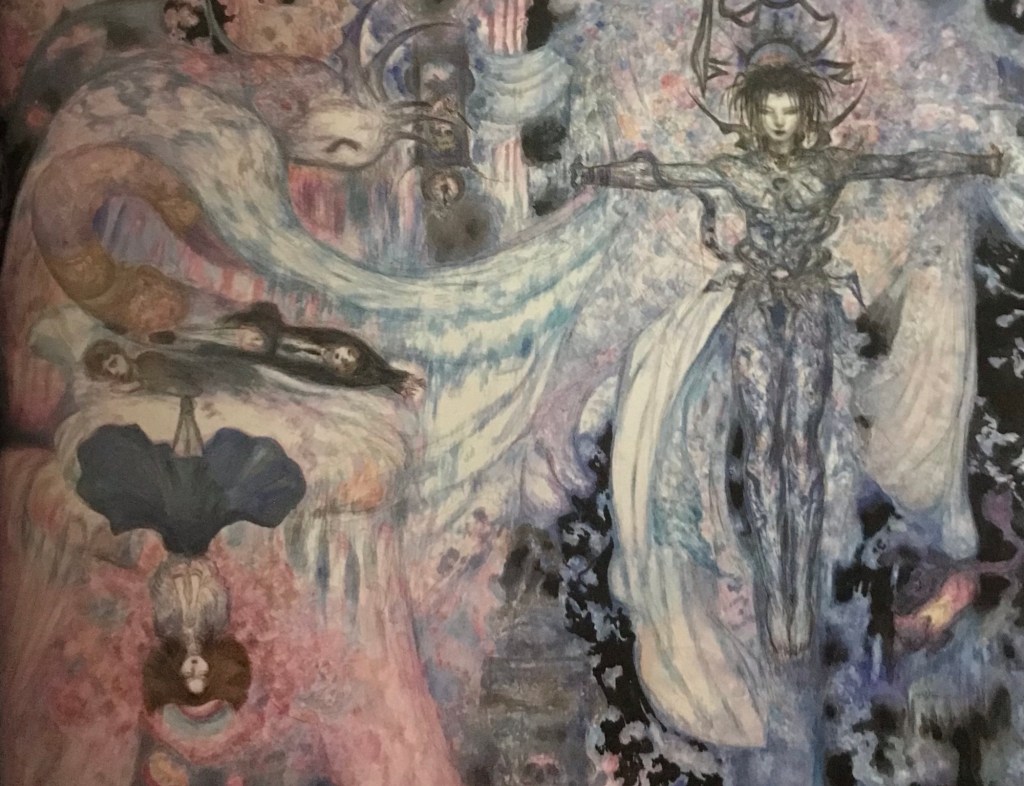


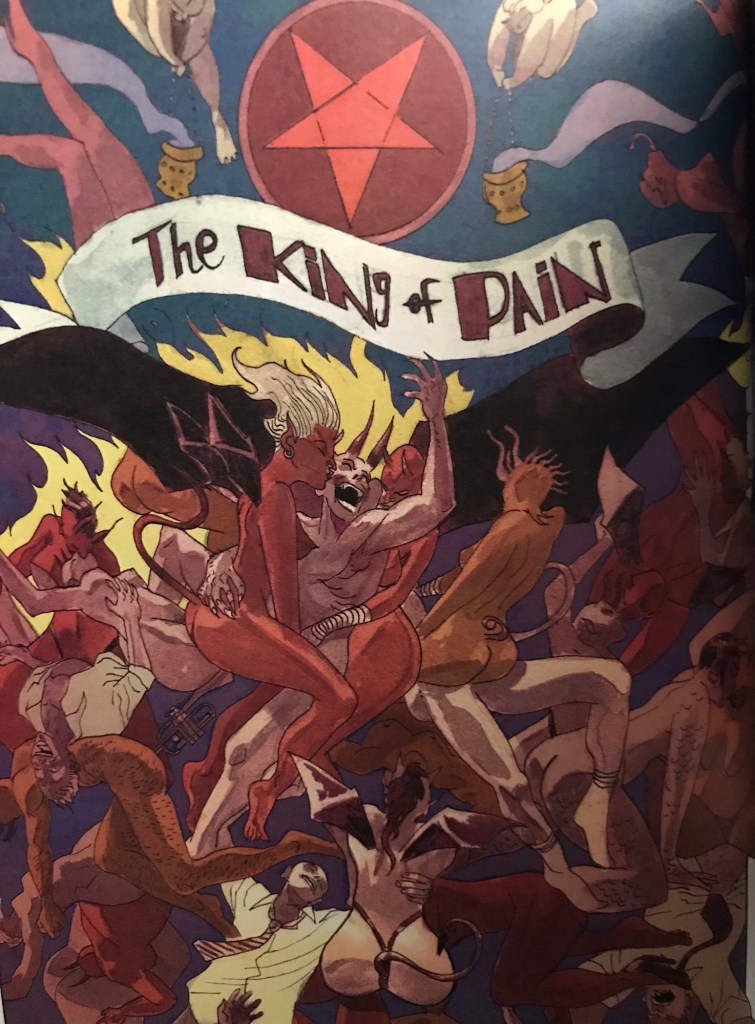
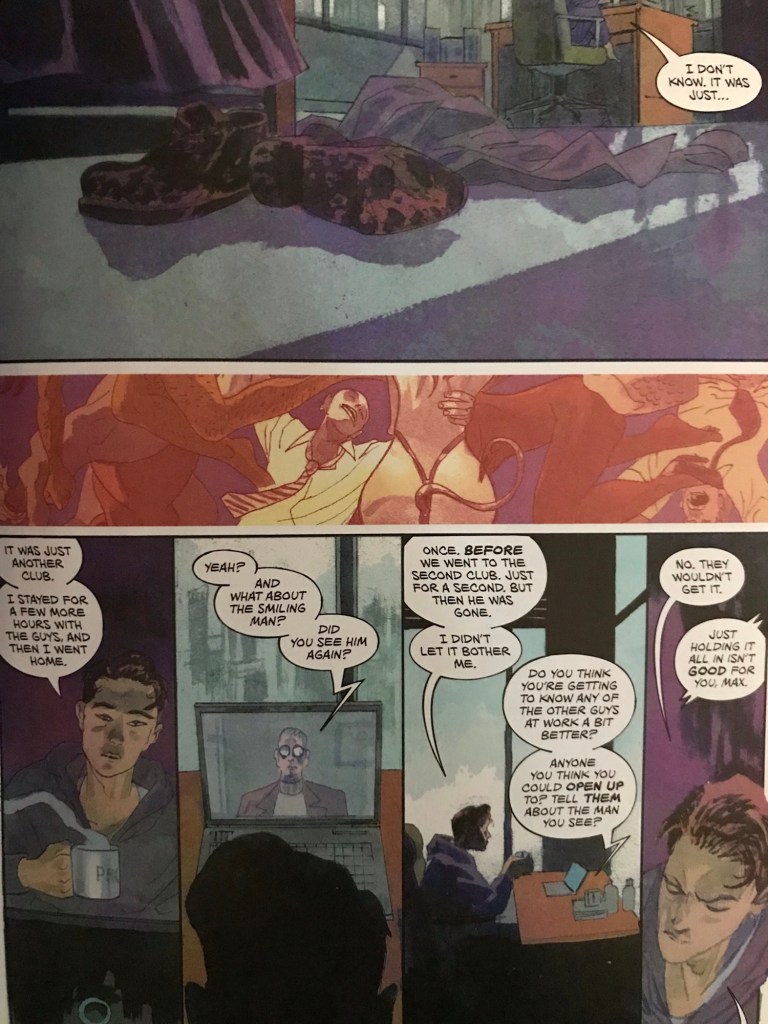

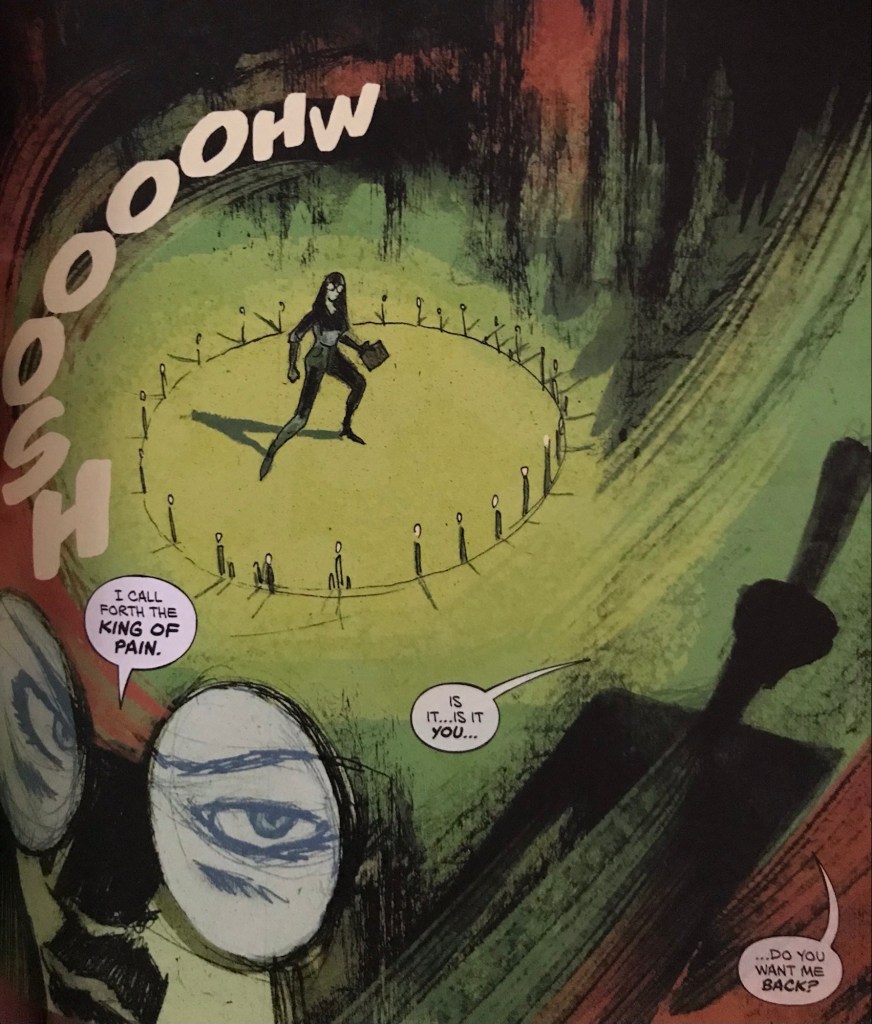
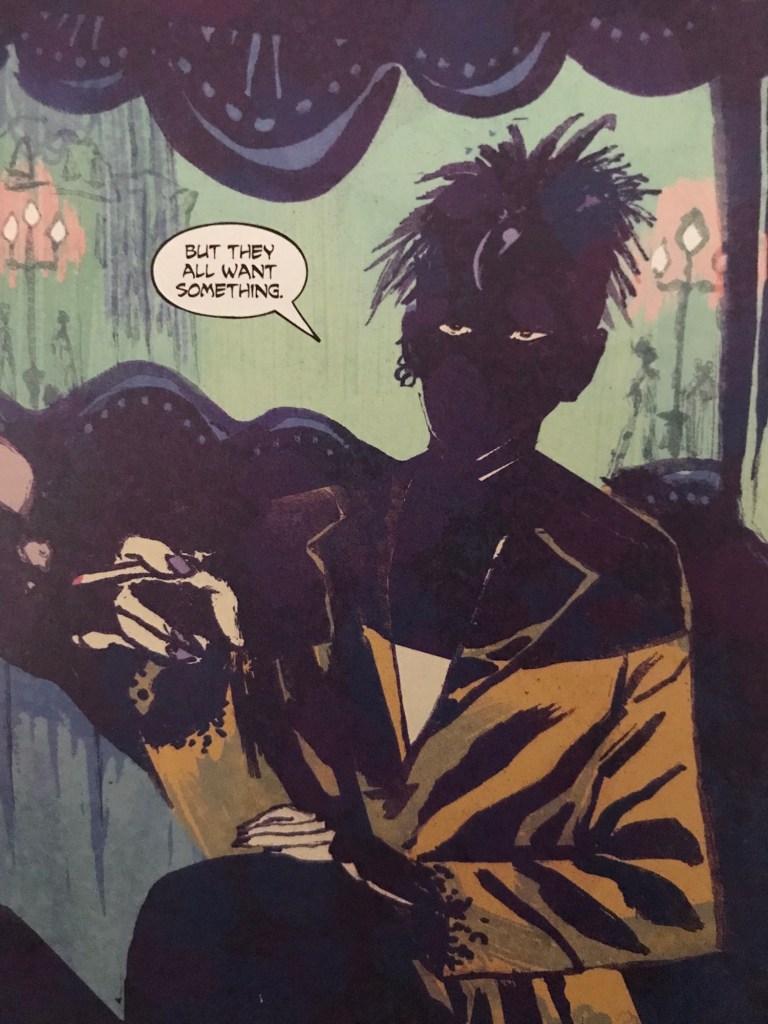
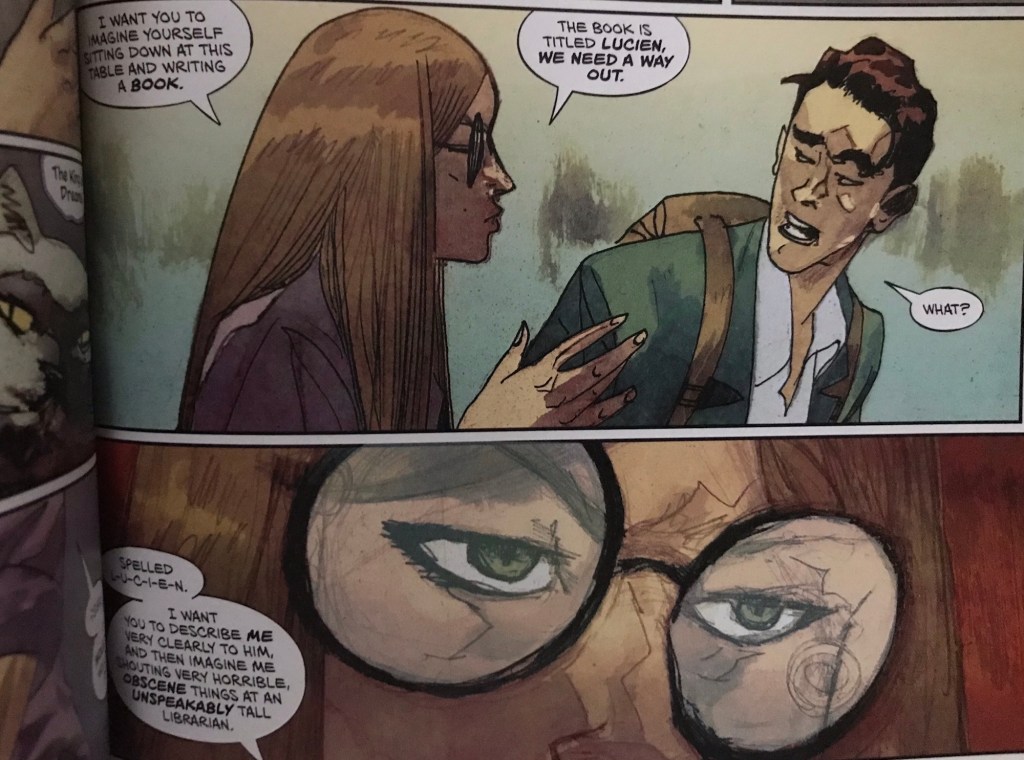
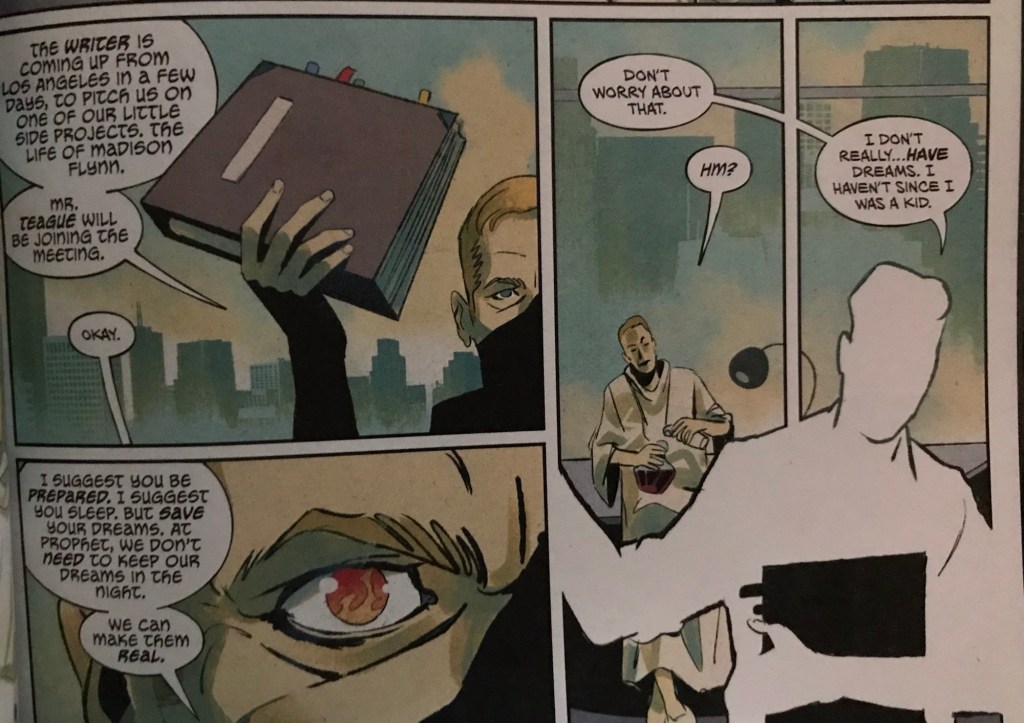
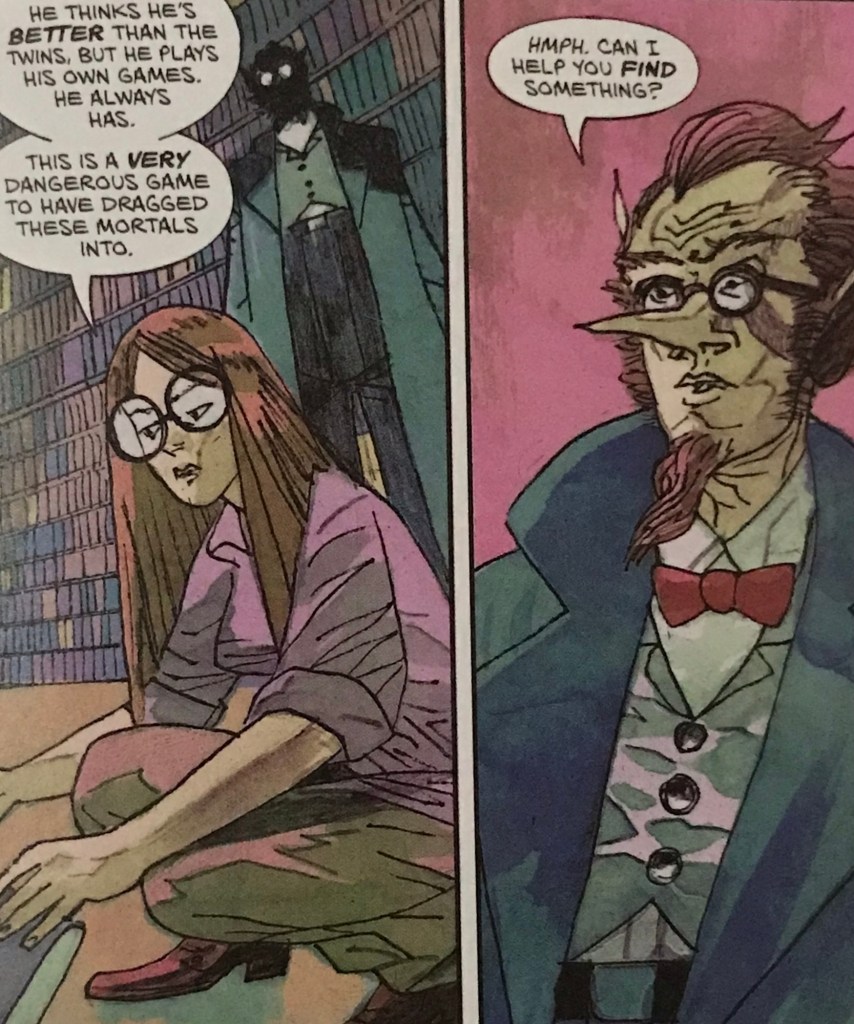
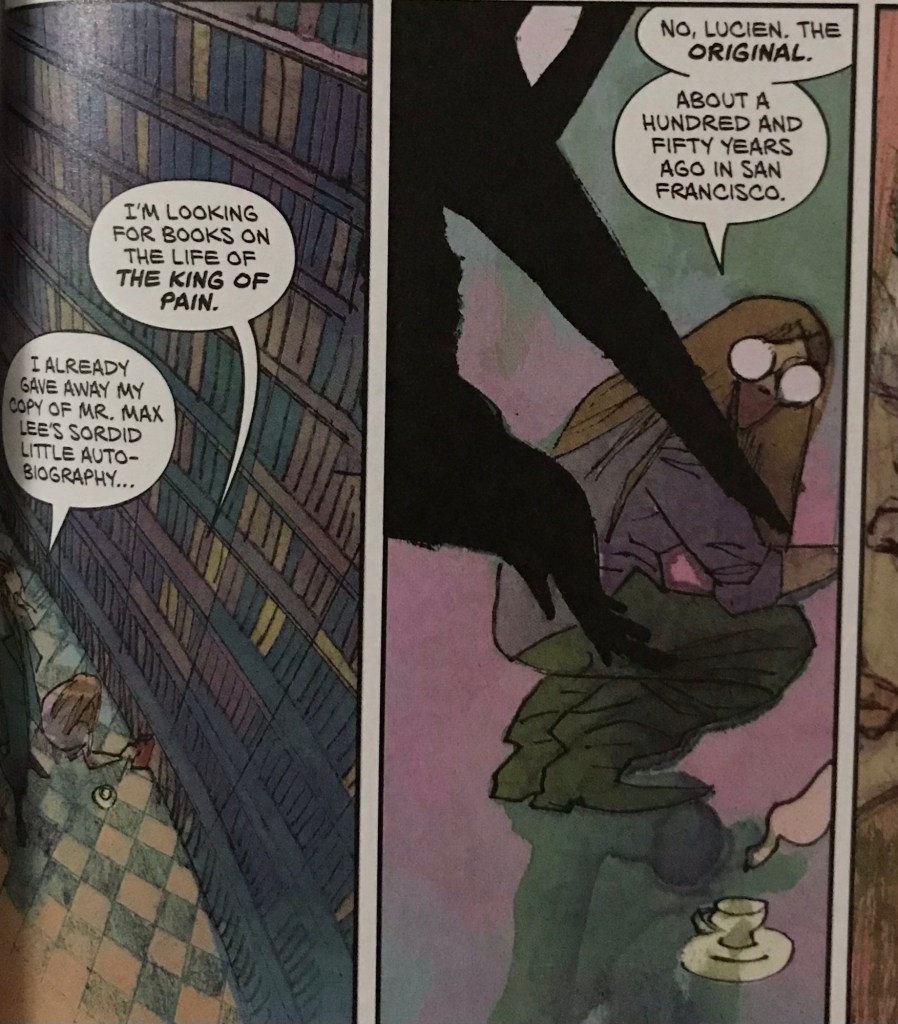

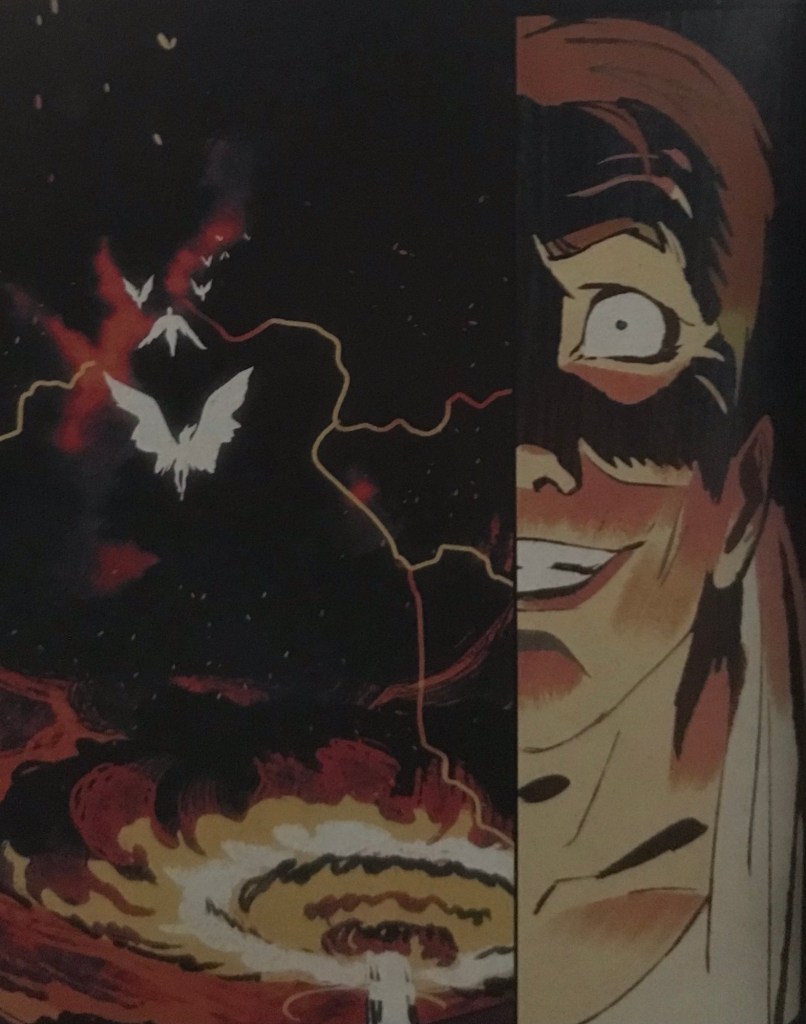


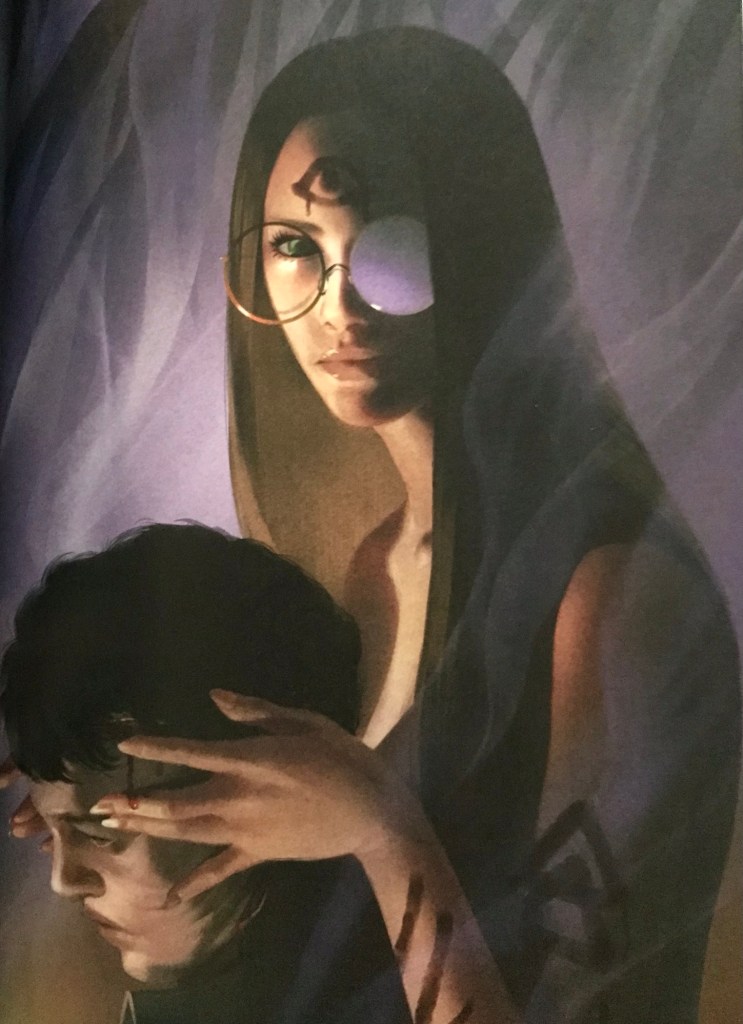

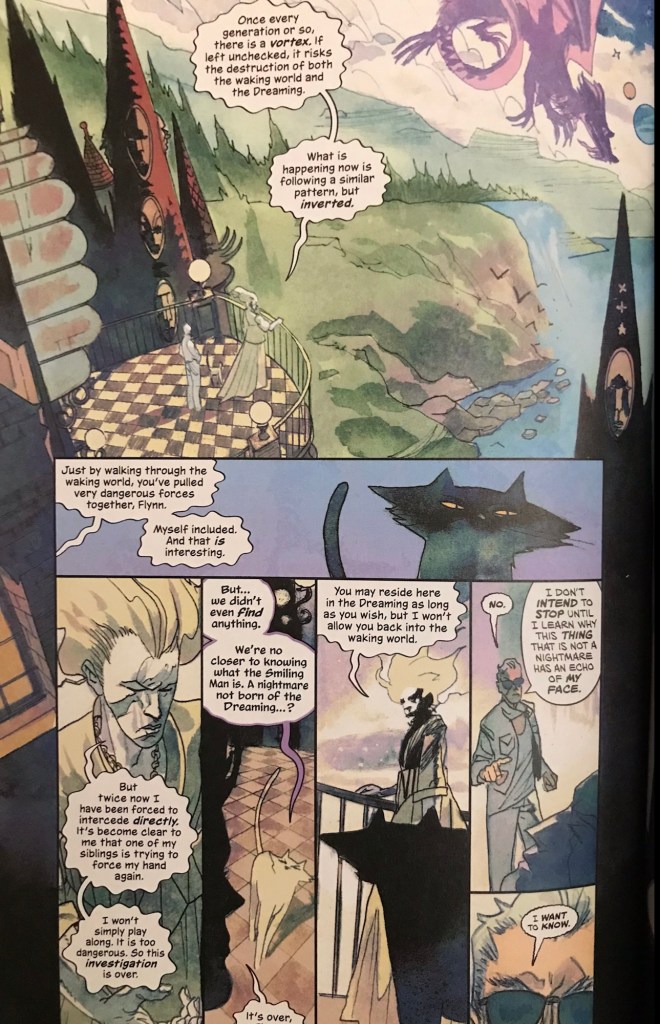

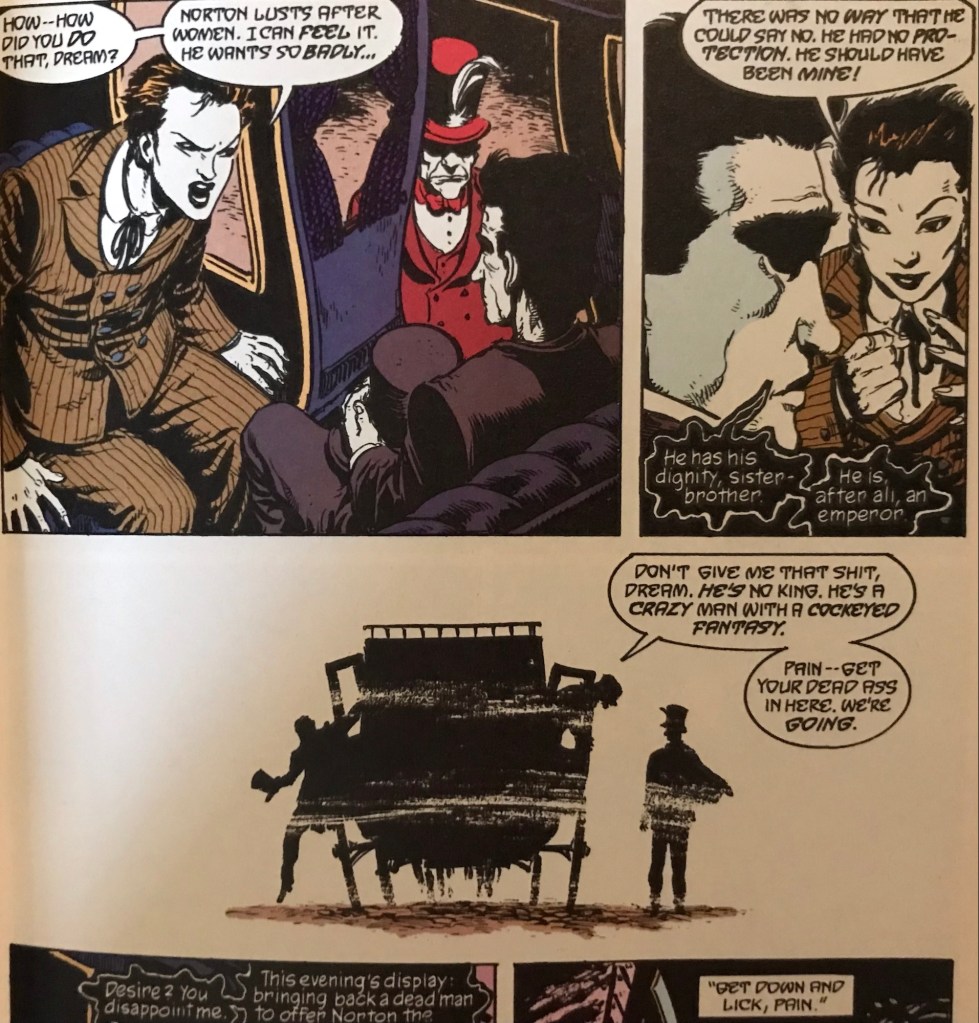
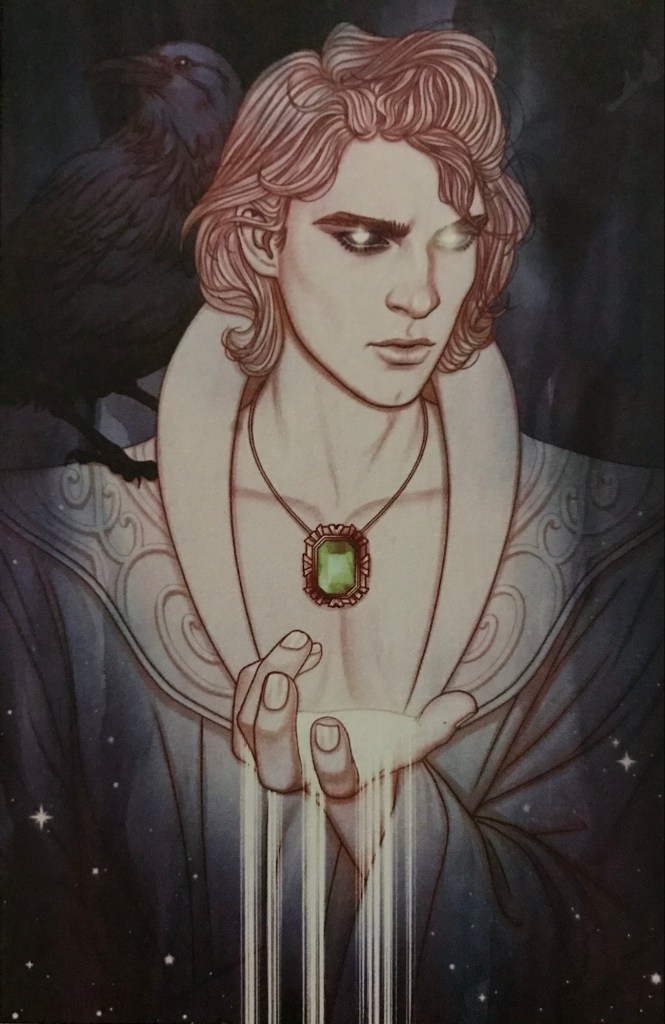
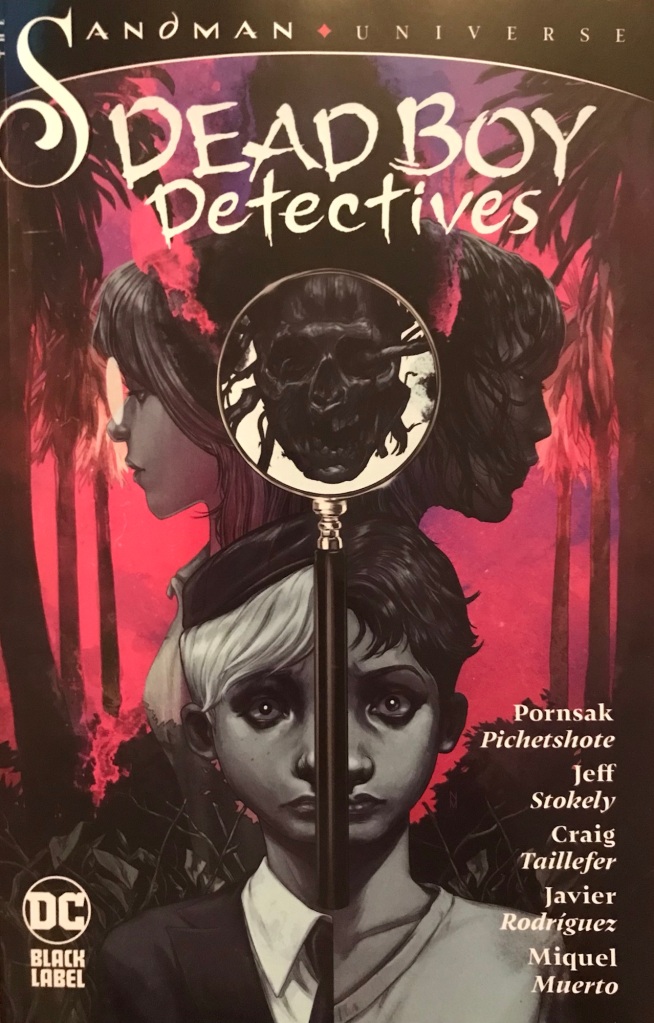
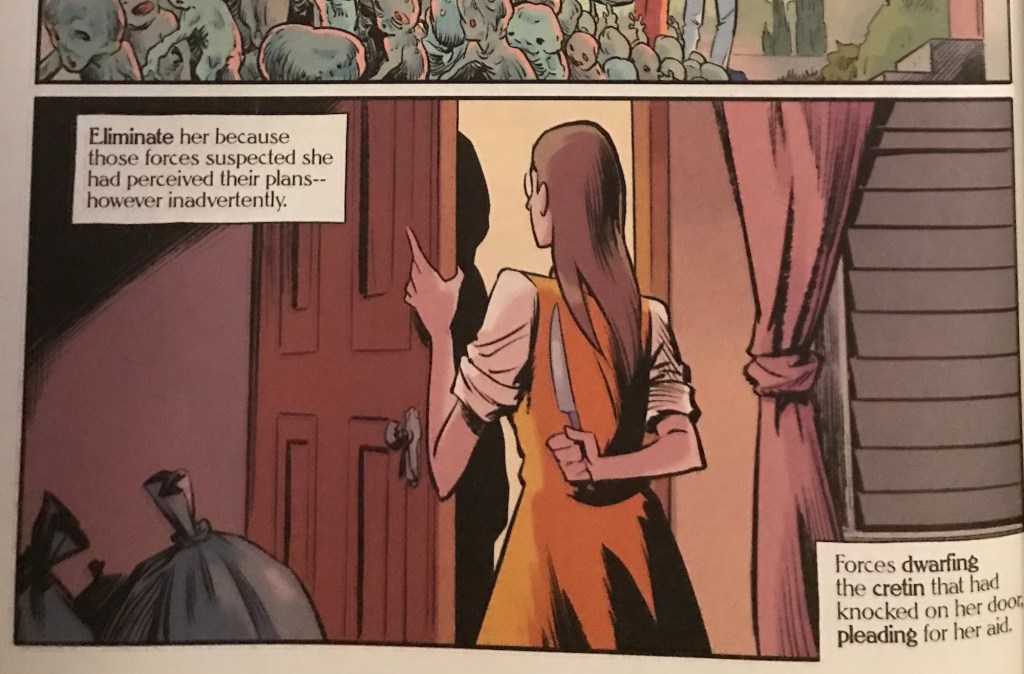
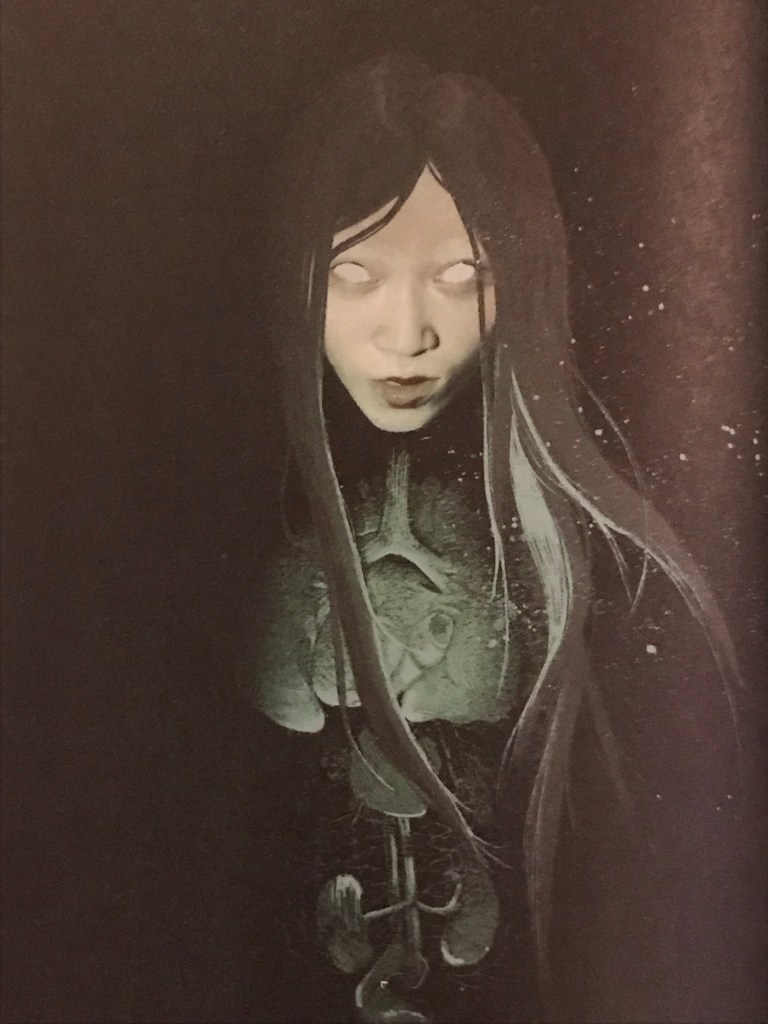


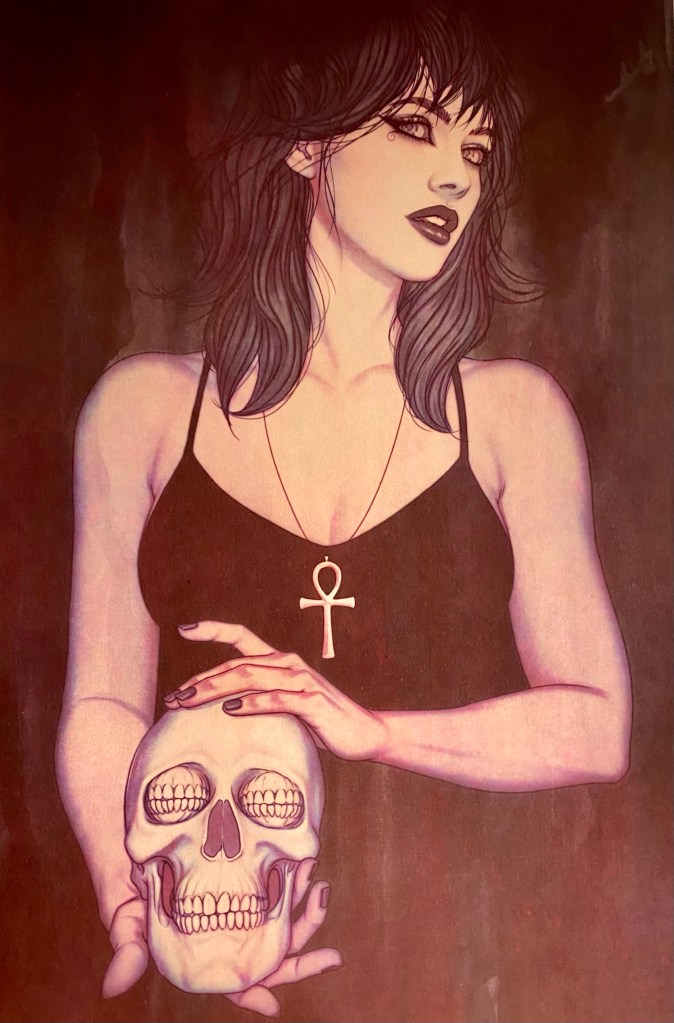
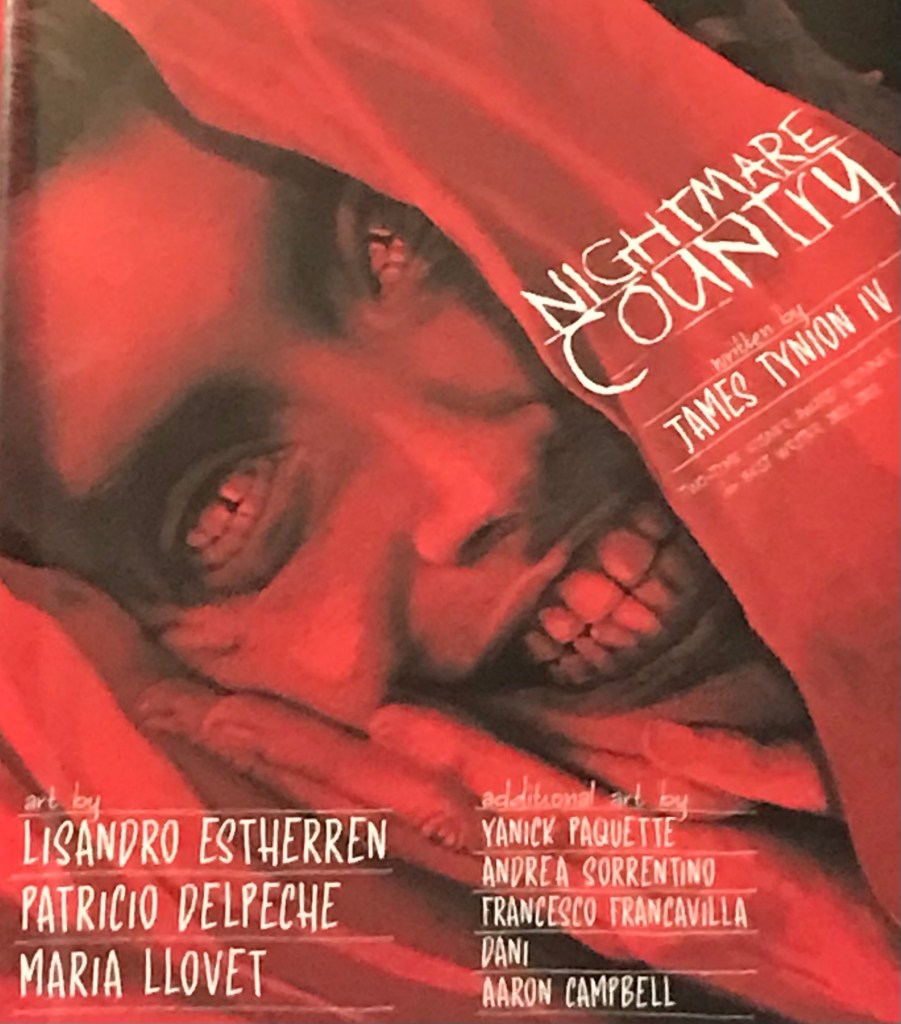


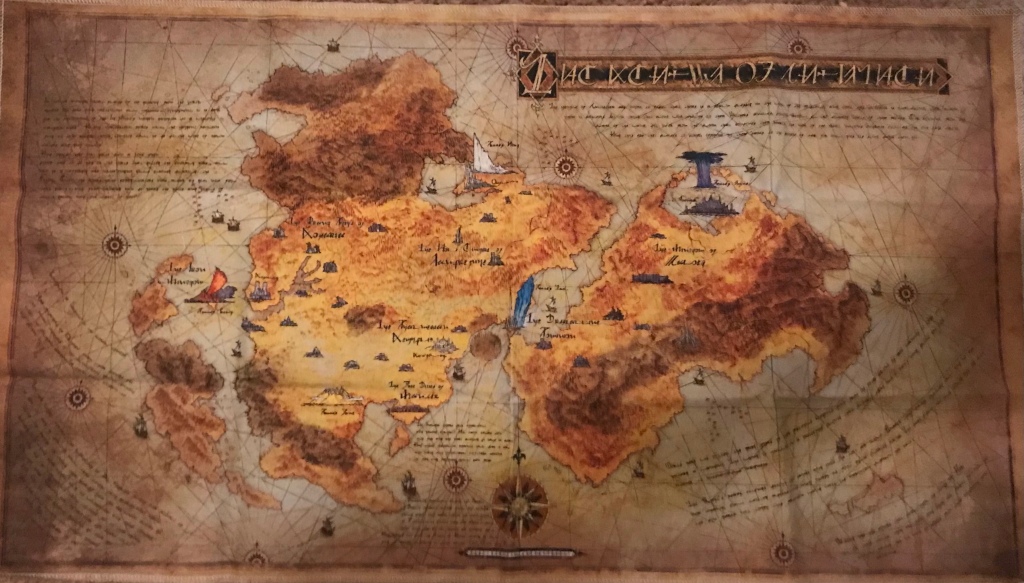






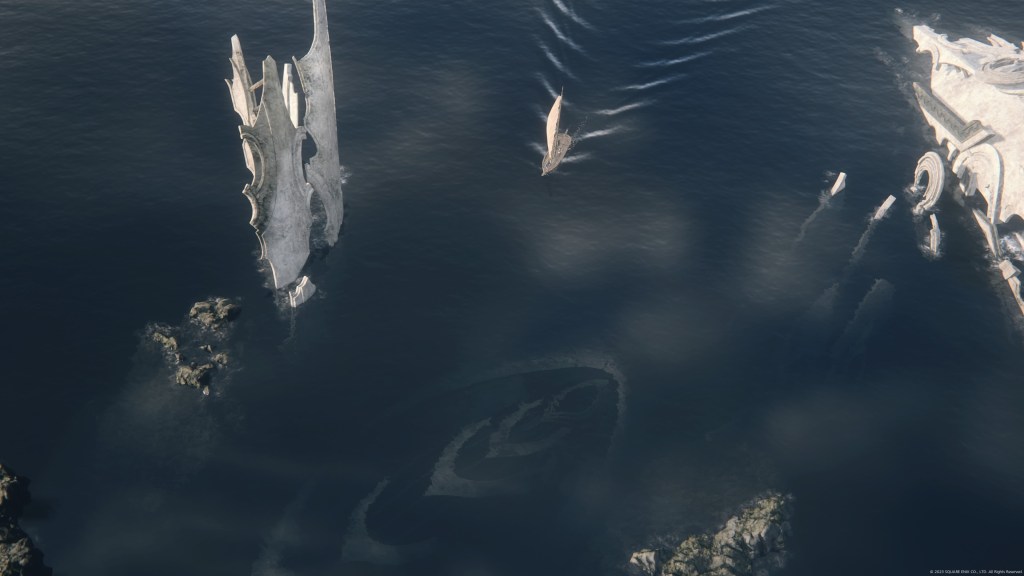


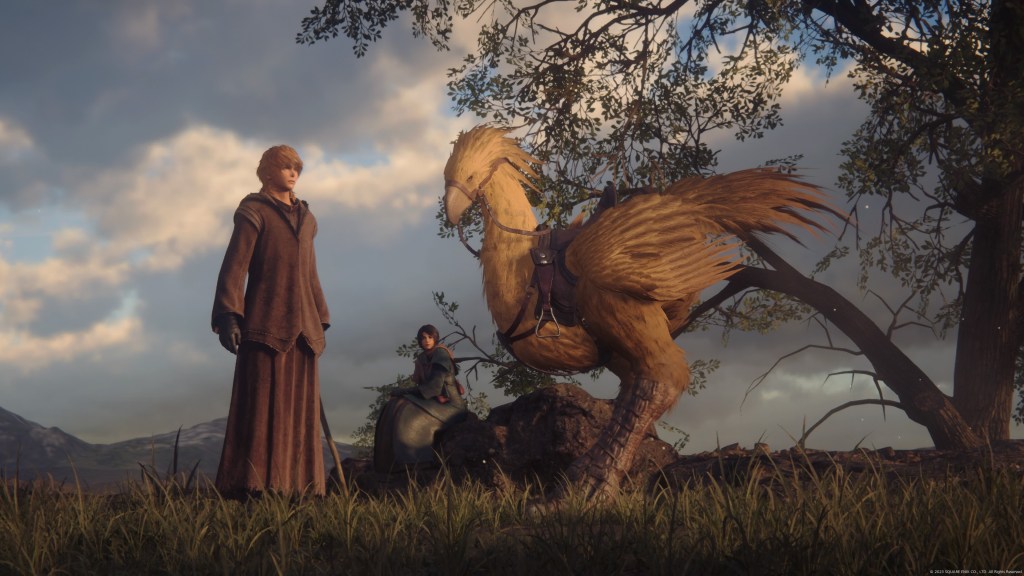


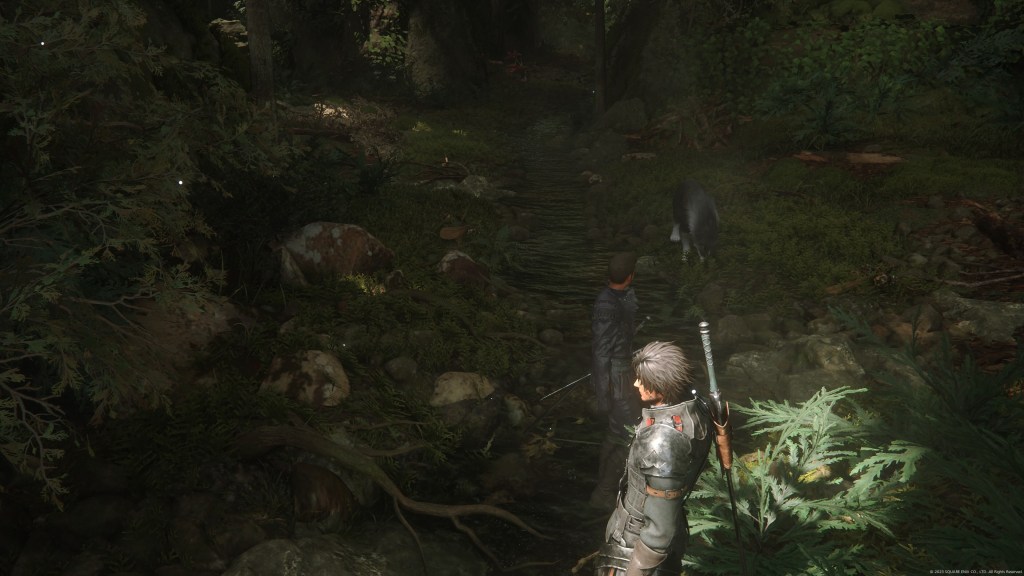

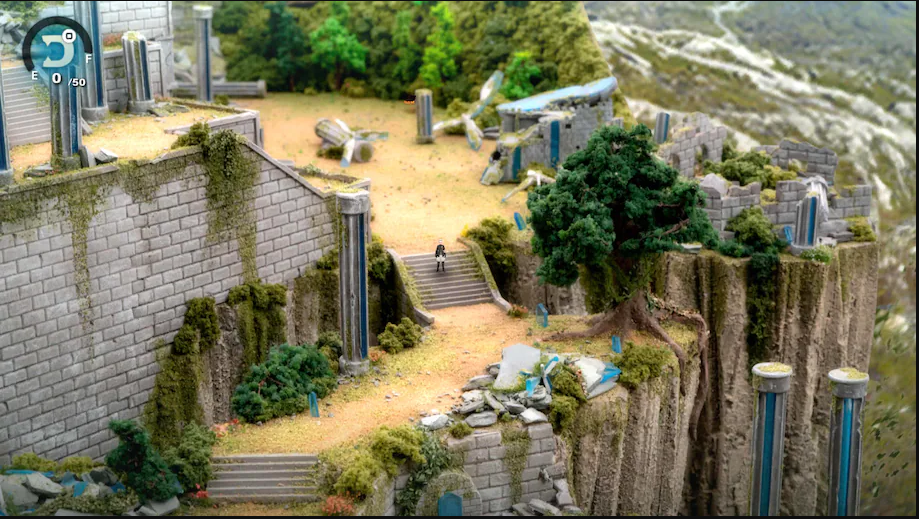
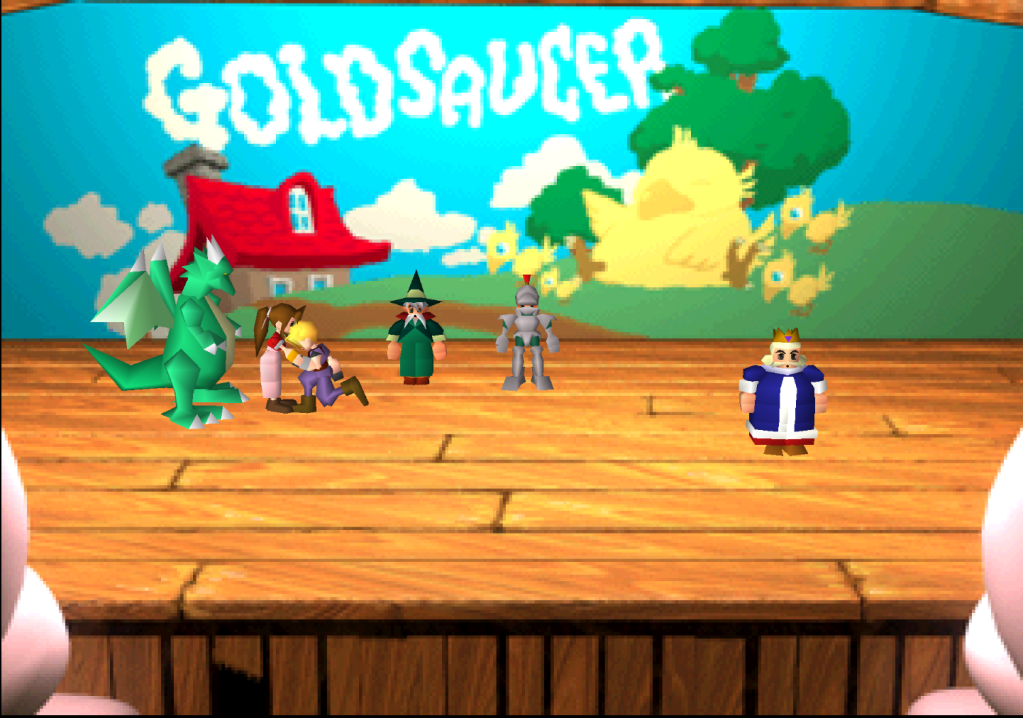


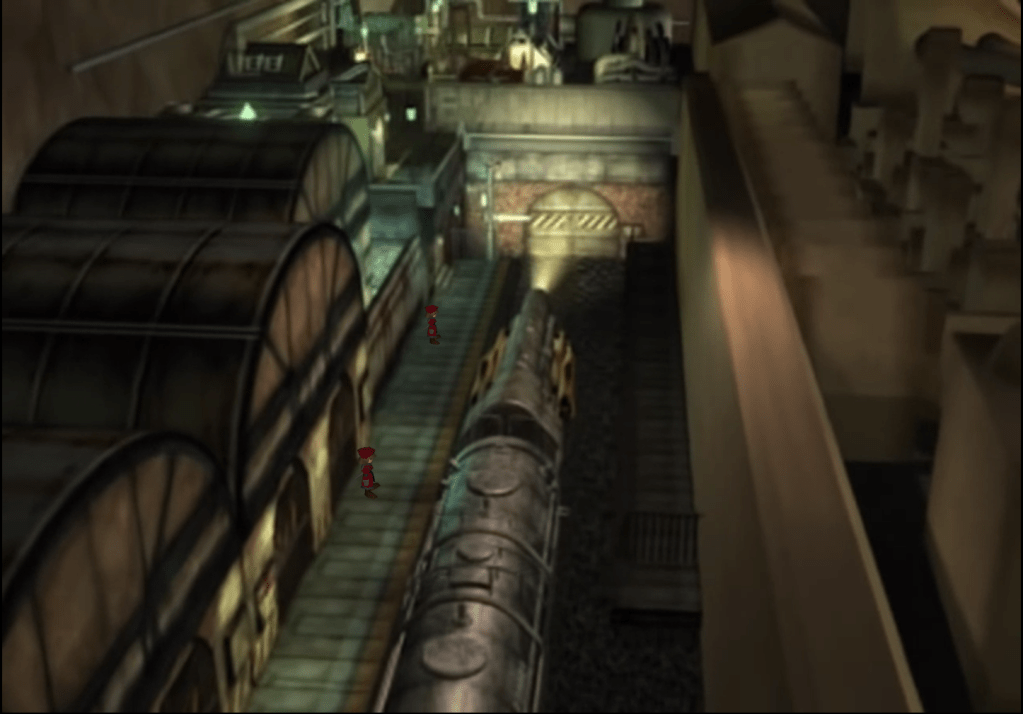






 AilixChaerea