
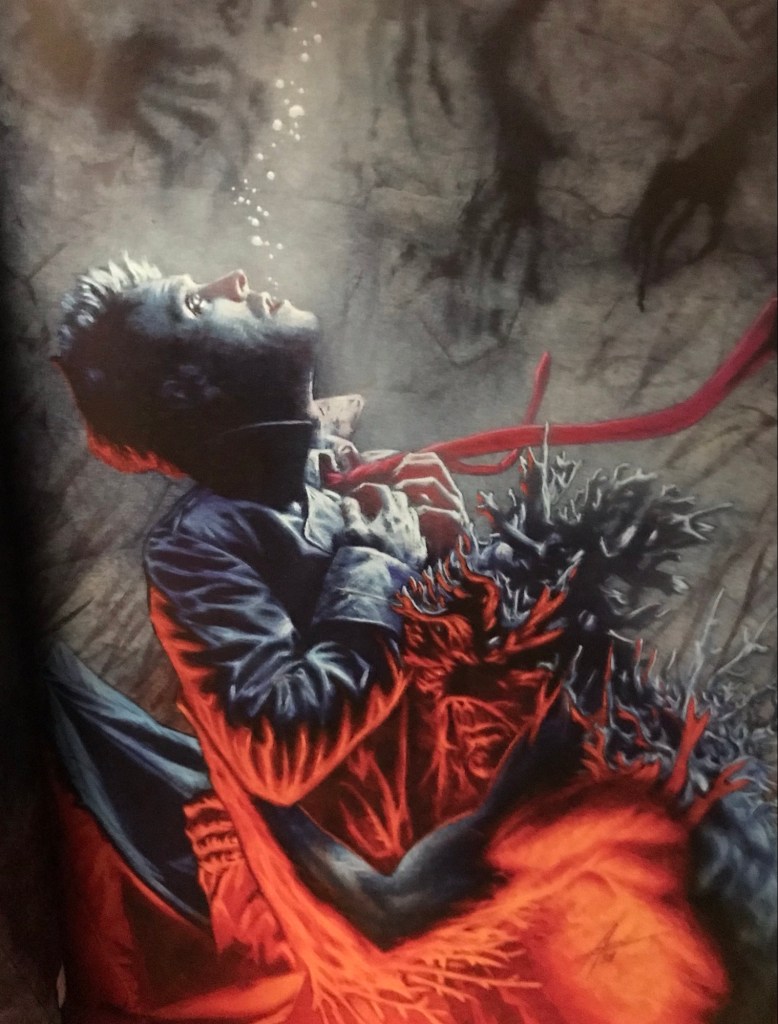
The 2020-2025 Hellblazer are the best stand-alone comics in the Sandman Universe run since the first four were cancelled.
(Big fat spoiler warnings for ‘Marks of Woe’, ‘The Best Version of You’ and ‘Dead in America’, btw)
Outside of the nexus stories like The Dreaming and Nightmare Country, the Dan Watters’ Lucifer is still my favorite. Right now, though, Hellblazer: Dead in America is tied for second place with House of Whispers.
‘Dead in America’ is only the third act, though.
Coincidentally, I started watching the Netflix Sandman series just as I was finishing the first two collected editions. One connecting moment stands out: Roderick Burgess commands his son Alex to take the three fetishes of Dream. John Constantine makes a similar demand of a trusting and vulnerable youth who is revealed to be his son.

Which is interesting, since this run of Hellblazer takes off from the far-future apocalypse of the Sandman Universe version of Books of Magic. In both the SU story and the original, Books of Magic is centrally concerned with Timothy Hunter’s life in another timeline, in which he became a world-ending monster. The SU Books of Magic thereby fell into an arc about stereotype-threat: Timothy is not as bad as he looks and has not had a chance to make his own mark.
SU Hellblazer sees John Constantine making an inverse journey. Unlike Timothy, John has had a chance and is every bit as bad as he looks.

The first run of Books of Magic began with a group of mages: The Phantom Stranger, John Constantine, Dr. Occult and Mister E. All four had knowledge of what Timothy would eventually become and- over the objections of of Mister E -they decide to educate him in the hope of heading off his reign of terror.
If the full story of evil Timothy has been written, I’d like to read it (That may be a reason for me to look into the rest of the old school Books of Magic). In the picture of things from the SU though, it seems John was part of the dwindling forces of good keeping supervillain Tim at bay.
In the story ‘Bad Influences’ (which appears within ‘Dwelling in Possibility’ from SU Books of Magic and ‘Marks of Woe’ from SU Hellblazer), John has just escaped from the far-future hellscape into a nearby timeline. In said timeline, Timothy Hunter is still a teenager.
At the time of the ‘93 Books of Magic, Timothy was approached by John Constantine, Phantom Stranger, Dr. Occult and Mister E. They launched from the ‘evil Tim future’ under different circumstances than Constantine at the beginning of ‘Marks of Woe’, however.
In ‘Marks of Woe’, John Constantine’s departure from the ‘evil Tim future’ is initiated by a being claiming to be himself from a different timeline: older, happier and without a soul. This apparition wants the soul of his younger self in exchange for safe passage to a version of Earth that’s not about to be vaporized.

The negotiation makes mention of innumerable people whom John has used as meat shields and bargaining chips, for innumerable reasons; both selfish and ethical. The transaction is, according to alleged ‘future John’, nothing more than the consequences of his actions (their actions, actually, since alleged ‘future John’ makes no distinction between his own spiritual destiny and ‘our’ John).
There is even an insinuation that such a transaction may not be the end. According to ‘future John’, “what better place” for the old “ghost” to go, other than back into the “family”? As if ‘future John’ is not dead yet and the soul could still have some time left (even if it would mean subjective annhilation for ‘our’ John).
These are the first actual Hellblazer comics I’ve ever read outside of his appearances in SU Books of Magic, SU Lucifer and a single volume of The Dreaming (to say nothing of the original Sandman). With both the Constantine film and a few animated stories in mind, I could believe that he has a pattern of using people up and spitting them out. This would cast a new light on some things, like John’s rendering of the situation to Morpheus in ‘Dream a Little Dream of Me’.
In any case, both John and the alleged time traveler take this past for granted. Once John takes the deal, we see the manifested proof of it in John’s broken life and relationships, upon his return to the relative “present” (2019). The few who have survived his companionship are done with his shit and want nothing to do with him.
In the world of comics, John Constantine and his moral ambiguity are well-known. A major strength of the Sandman Universe comic line is how well it has built its own continuity. Obviously you’ll get a lot out of it if you read the original Sandman but the SU line has deftly handled its macro-anthology structuring. The individual stories that make up the whole (for the most part) stand well on their own.

The SU comics, therefore, have their own self-contained set-up for Constantine’s moral arc. SU Books of Magic tells the story of Timothy’s vindication: his innocence and virtue are proven despite influences from the Supervillain Tim timeline. Thereby, the point of departure for SU Hellblazer is set up (even if Constantine had a brief appearance in another SU story in the meantime- more on that later).
Timothy Hunter is validated in the end because all he has to say for himself is his perspective. He cannot claim acts and identities that he never experienced: the fact that such happened in another continuity is beside the point. This works because SU Books of Magic shows us everything Timothy is aware of (which factors in some memory-wipes from prior comics but I digress). Timothy’s moral truth therefore unfolds before our eyes.
In the SU continuity, John Constantine’s moral arc has its own establishing beats. The past discussed by John and the time traveler, everyone hates him upon his return to normal life, etc. These are passive, retrospective moments, though- just as much happens in front of us.
‘Bad Influences’ is, effectively, our point of departure. John finds Timothy, fully intending to kill him with a book with poisonous, psychoactive pages. John still felt squeamish about killing a kid on principle, though, so he avails himself to a third party which can be bound and commanded. While Tim is under the influence, he is psychically suppressed and contained by the Vestibulan- an angel who refused to take a side during Satan’s rebellion. The Vestibulan belongs to the Aequiim- guardians of impartiality. Within the hallucinatory construct based on Constantine’s lie, the Vestibulan gives Timothy either / or moral scenarios. Between the certainty of Constantine and Tim’s paranoia, the construct changes. The Vestibulan starts showing Tim choices between equally repugnant scenarios. Incoherent Tim decides this is part of the test and psychically attacks the Vestibulan, shoving him out of his mind and into John’s smartphone.

More than that happened but those are the bullet points.
When faced with the illusion of his inevitable evil, Tim literally fought his way out of a spell-bound stupor. In John’s eyes, you can’t say fairer than that. It even rhymes with something the time traveler told John before sending him back to a “safe” timeline: just be the best version of you.
Following the time traveler’s advice and Timothy’s example, we see John simply behave the best way he can, in the moment, as circumstance allows. Explicatory dialogue has told us that John has treated lives and trust callously, but this is a clean slate, right? What better chance to prove your guilty conscience wrong?
John proves it right, in the end. In the course of his new adventures, John meets a young deaf man named Noah: his genetic child from a long-forgotten fling. John being John, he eventually welches on his soul deal.
The time travler wants the soul inside of John’s body, right? Noah is instructed to smash the phone at the moment of John’s death. The Vestibulan latches onto John’s body. From John’s body, the Vestibulan gets yoinked by the time traveler who sends it back to John. The Aequiim were condemned to Hell for their indifference. The Vestibulan is therefore hounded by demons as soon as the time traveler releases him. Since this is all rebounding back to John, the demons seize a nearby body for a possession vector. John telepathically orders Noah to kill the poor guy to stop the demons from emerging. This sacrificial lamb was a naive, well-meaning magician named Tommy Willowtree who idolized John Constantine and yearned to follow in his footsteps. The demons drag his soul to Hell while he cries out to John for help.
Meanwhile, the deal is still on: John’s real soul is nabbed by the time traveler who instantly rejects it.
I’ve spoiled a lot already but for the sake of keeping things neat: the time traveler is not John. They’re not even a corporeal being. They simply wanted a soul and John was chosen for his shame: he hardly believes he has a soul. John definitely doesn’t believe that he deserves anything in particular after death. His belief in his damnation was what made him such a perfect target. The irony: he made his son kill someone who was in the wrong place at the wrong time, which didn’t even keep his soul safe for much longer anyway.
Sorta.
See, compelling his son commit a futile murder tainted John’s soul. If the soul is a getaway car for the time traveler, this is basically like setting the getaway car on fire. Also, since John had to die for this to happen and no one claimed his soul in the end, John is now a walking corpse. A zombie with a personality.
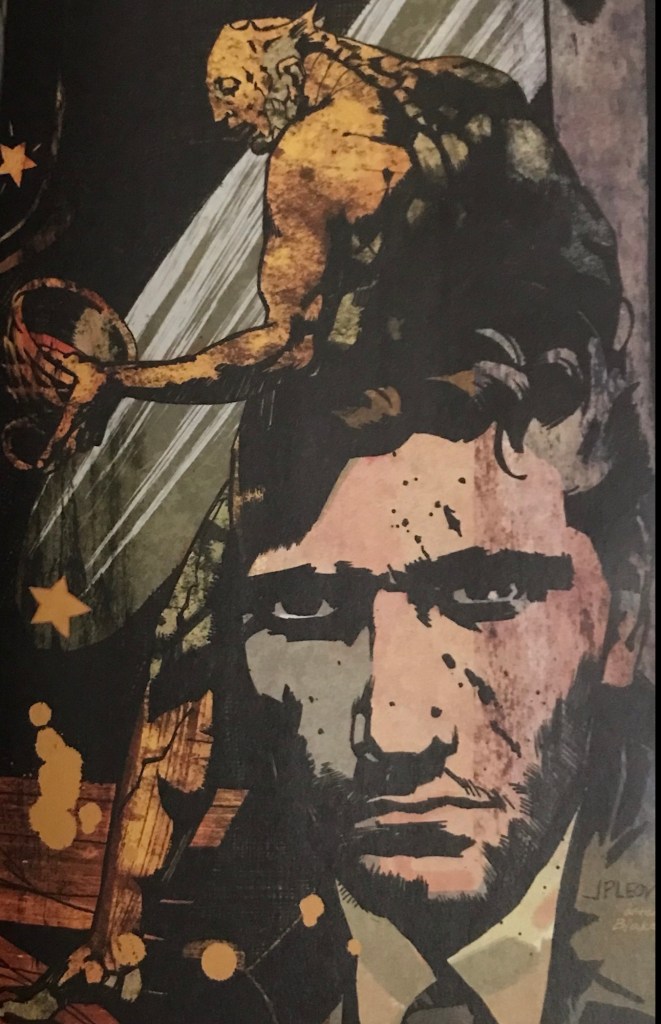
It is at this point in this long-ass intro that I am reminded of how the first two volumes initially hit me. They struck me as very straight-laced…and a straight-laced comic is like a straight-laced TV show. Establish the premise, then set a rhythm of self-contained stories. Episodic tales can intersect beautifully with linear threads, as seen in the original Sandman. Here, though, the sequences are direct. First John enters the new timeline, then he assembles a crew which includes Noah and a violent, manic Scottish woman called Nat. There’s a few short-lived events with common denominators, then the first macro-plot ends.
I didn’t post about these comics when they came out because I had attitude problems: the more novel-like SU stories were fresh in my mind and the more conventional comic structure caught me off guard. My interest was not immediately piqued. With that bias out of the way, though, I can’t say a word against either ‘Marks of Woe’ or ‘The Best Version of You’. Once the final chapter gets going, the plot threads come together and get good real quick. The ending was just fast-paced and chaotic enough with consequences that must necessarily last.
Now, finally, I can get to the story that made the SU Hellblazer my favorite stand-alone series since the first four SU arcs: ‘Dead in America’.
Early on, John Constantine meets an old acquantance in New Orleans: Clarice Sackville. In ‘Marks of Woe’, John reached out to Clarice by Vestibulan-phone, in regard to his problems with the time-travelling soul eater. John asks for help and is refused: Clarice has no desire to end up like most of his connections. Nonetheless, Clarice (a fellow traveler) is aware of various prophecies. John is both snarky and incredulous: he’s been around enough to know “vague, apocalyptic arsewater” when he hears it. Clarice insists that this is not the usual endtimes hype: these prophesies are specific and substantial. They mention the possibility of “the true and final death of John Constantine.” Clarice goes on to explain that she was responsible for a series of visions and psychic suggestions, leading Tommy Willowtree to the big bad himself. Clarice says that she knows better than to think that Tommy’s fate- corporeal or spiritual -will motivate John to do anything. She put Tommy on the breadcrumb trail because, in spite of his weaknesses, he could potentially solve the whole thing himself, which John’s ego could not bear.
John returned to the fray out of pettiness and then used the object of his envy as a human shield. In the final pages of ‘The Best Version of You’, we learn that John did die, even if it’s not stopping him. ‘Marks of Woe’ is such a fast-paced read that it’s easy to overlook John’s phone call with Clarice. After finishing ‘Dead in America’, I was forced to consider the scope of those prophecies. The Nightmare Country comics appear to take place after the events of the first three SU Hellblazer volumes. Nightmare Country is set in America and concerns a mysterious confluence of powers both oneiric and infernal. Three of the Endless (Dream, Desire and Despair) are involved. Most of Nightmare Country is set in Los Angeles in particular, which is where John, Noah and Nat part ways at the end of ‘Dead in America’.
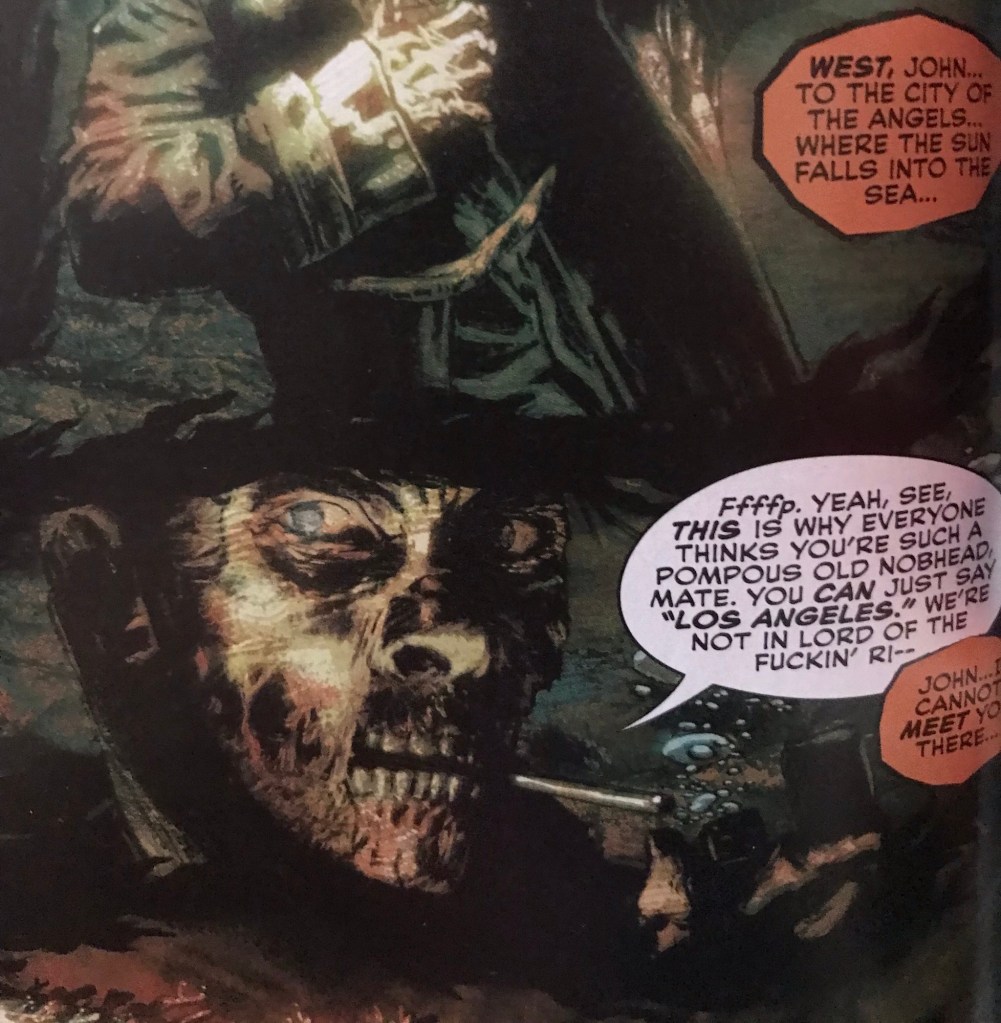
If the mysterious apocalyptic menace includes the Nightmare Country players…might it also have fourth-dimensional implications? Some needling little impulse is telling me that it may involve Supervillain Tim and the timelines where his influence has spread. It’s interesting to me that Neil Gaiman wrote the first Books of Magic around the same time that he began working on Sandman: Overture (even if it wouldn’t be published for about two decades). Glory of the First Circle appeared in print for the first time in Books of Magic, as did the mundane egg, which went on to play a pivotal role in the first three volumes of the Dreaming reboot.
Tying all these threads together in one tapestry would be bad-ass if it was done right. Remember, to, that season one of the Sandman miniseries included a scene from Overture in which Dream is attempting to confront the Corinthian in the late nineteenth or early twentieth century. The Corinthian has lately started taking human victims. Dream is about to uncreate him when he is suddenly transported, leaving the Corinthian to make his escape.
The first three SU Hellblazer stories succeed at something far more simple, though: John is a real anti-hero with real shades of gray. Protagonists on negative arcs have, of course, grown popular. Typically, these characters come off as either one-dimensional heroes with rough edges or one-dimensional villains with a little charm.
With 2020-2025 SU Hellblazer, it’s all about the ‘best version of you’ action. All you can do- all anyone can ask of another -is to show up and do your best. Most of us live our lives on those terms. Even when things are bad enough to consider cutting your losses, you always have the choice to continue placing one foot in front of the other. Guilt is a common experience and therefore so is the need to forgive oneself. “Showing up” and “doing your best” in the midst of shame and guilt is to hear a voice at all times, murmuring that you don’t deserve to “show up”. You keep doing it anyway because the point is not where you’ve been- it’s where you’re going.
We’ve all screwed up before but what else can you do after that, except keep going? And do better next time? John makes a rather normal and sympathetic first impression. The trouble is the “do better next time” part.
Like Lucifer in the new SU stories, John Constantine hates losing more than anything else. Many of his most remarkable and creative accomplishments happen under the fear of losing. He tends to look out for number one and not every opportunity to help has a tangible, constructive result. In ‘The Best Version of You’, a mermaid falls in love with an ugly, opportunistic shit of a human who exploits and brutalizes her. When John finds her and they both figure out what happened, he is honest: he cannot undo the damage. Payback, though? “Cheap as chips.” And payback is the only thing he can help her with, in the end (one of the better vignettes in that book, btw- there’s also an interesting one about the British royal family and horse-breeding).
Not every kindness has a productive consequence but life is chaotic: even the incosequential opportunities are not to be shrugged off. In the meantime, you take stock of the things you do have control over, such as yourself. Looking out for number one grows easier.
Then we have the ending of ‘The Best Version of You’, which provides the fundamental set-up for ‘Dead in America’: the interdimensional pride/shame monster wanted John’s soul. The pride/shame monster also wanted John to truly change himself for the better, in order to receive the best soul he can. John escapes because he blemished his soul on purpose, what with getting his son to commit a pointless murder. By the end of ‘The Best Version of You’, both John and Noah are marked for Hell. John’s central motivation in ‘Dead in America’ is getting his son out of the mess that he dragged him into.
Defining oneself through actions in the present is echoed in one of ‘Dead in America’s villains: Elliot Garner, aka Dr. Diablo. Dr. Diablo, as a DC supervillain, goes back far indeed but for now we need only concern ourselves with this particular version of him: an early-Hollywood-therapist-turned-cult-leader who inherited Dream’s pouch of sand from Ruthven Sykes.
Dream’s sand is the central McGuffin of ‘Dead in America’. Most of the story is spent reacting to it and looking for it. Once in America, John hunts down an old friend- Swamp Thing, who has access to a collective psychic plant space called the Green. The Dreaming is the collective unconscious for sentient beings and the Green is the collective unconscious for everything else- one should be useful for revealing the negative space of the other. There are, of course, complications.
A few decades ago, see, Dream was laid low by three beings called The Kindly Ones. According to Etrigan the demon, The Kindly Ones began as rebel angels beside Lucifer. “Angels of hate”, to be exact. For awhile, in Hell, they were the gatekeepers. From here, they carved out a niche for themselves as The Furies from Greek mythology.

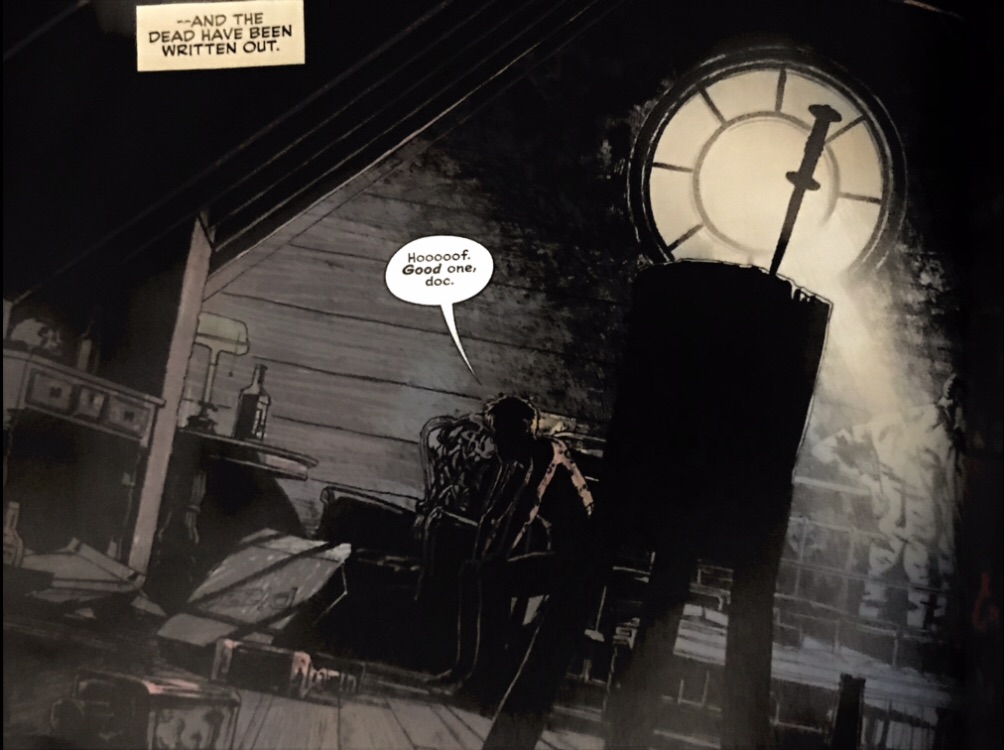
So. After their clash with Dream, in the mid-nineties? They scour the Earth for Dream’s left over magical influence, slowly invading and occupying mythic space. Dr. Diablo has since fed grains of Dream’s sand to his clients, some of whom became Hollywood screenwriters. This means that the magic of Dream is part of their new infrastructure. When they finally realize what happened and why, they seek out Dr. Diablo.
Yes there is sand left and yes Dr. Diablo knows what he did with it- he just walled it off in his mind, to stop anyone else from getting it. So The Kindly Ones attacked him and dragged part of his soul to Hell- the part that remembers. Unfortunately, Dr. Diablo’s decision to hide the remaining sand depended on other factors in his life, going back to how he loosened the cord on the pouch to begin with: human sacrifice. His own infant son. Since these events go that far back, there is basically a whole separate half of his memories that are currently languishing in Hell.
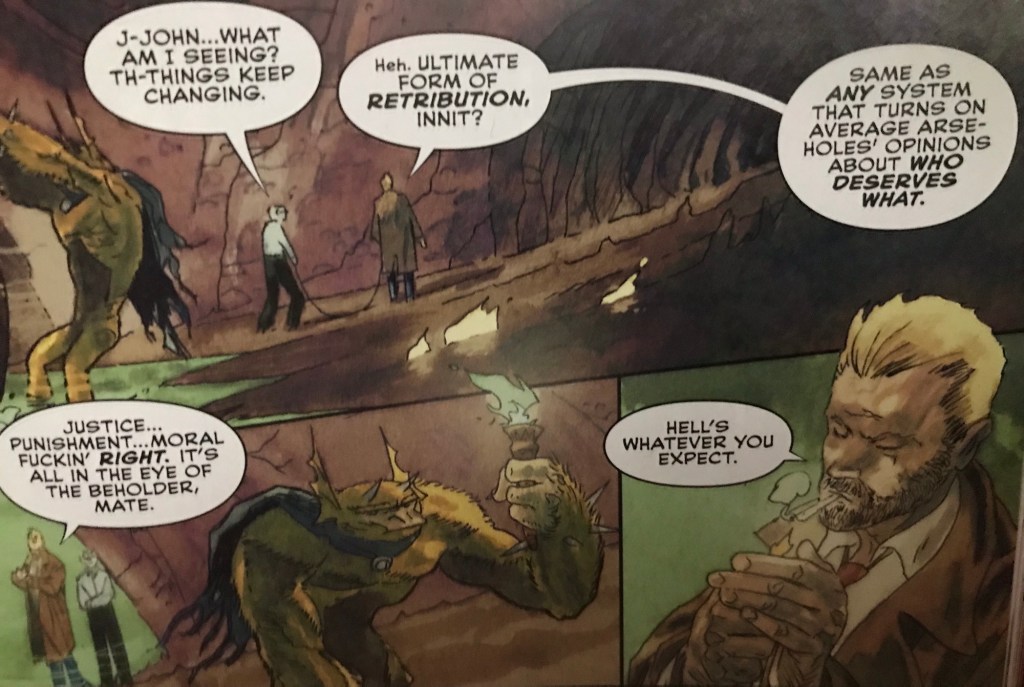
In the present, Dr. Diablo is a ghost with half of his identity missing. He retains close to nothing of the past and does (little to) no harm in the present. Actions still matter though and forgetting is not the same thing as innocence, as John himself knows. John and Dr. Diablo know a few things in common. Didn’t John himself loosen the cord of Dream’s pouch? As revealed in the 1980s Sandman story ‘Dream a Little Dream of Me’?
There are other thematic tabula rasa analogues. The pride/shame monster from the first two books is another: all he wanted was for John to feel redeemed for a little bit so he could grab a soul with some mileage left in it. He attempted this by pretending to be something that John himself might fantasize about but never actually hoped for: himself, older, content and at peace with the past. John’s first impression- that his happy, older self has no soul -is a misunderstanding…but a potentially important misunderstanding.
You know that theory I floated, a million years ago, about the foreclosed timeline of Overture being the Gemworld from Books of Magic? What if one makes psychic contact with other timelines through ‘what if’ thought junctures where your timeline would have branched off into the other? Oh and that foreclosed timeline? It’s held together by a rampant dream vortex- a psychic mind that absorbs other minds into an ever-expanding dream.
In other words: a dream vortex (or the mad star it turns into) prefers itself over everything else. If Supervillain Tim was Tim’s bridge to the Gemworld…maybe the pride/shame monster is John’s bridge?

I still don’t know if I’m all-in on that Gemworld theory yet but it only ever seems to grow more probable. I also can’t help wondering about these moral layers because of my first prolonged meeting with John Constantine- and it wasn’t ‘Dream a Little Dream of Me’. That was a short story. His appearance in the SU Lucifer is likewise short-lived. The first comic I ever read which treated Constantine as a major character was the original Books of Magic, in which he is one of Timothy Hunter’s mentors. Not only was he an instructor of a young magician but he was one of his more humane, well-intentioned and trustworthy instructors.
I basically “got to know” Constantine originally as a young person’s teacher. In the SU Hellblazer, he starts out willing to kill the young person simply to wall off the timeline he might create…then decides not to. John exhibiting genuine darkness was new to me.


The social commentary in ‘Dead in America’ is another unambiguous win. I remember being nervous about the social commentary in the early volumes of the Dreaming reboot because Neil Gaiman himself struggled a little with it in the original Sandman.
If ‘Dead in America’ had no humor and took itself seriously every step of the way…there would be a lot of opportunities for melodrama, what with the vengeance angels taking root in the American subconscious. To be clear, ‘Dead in America’ shoots straight with seriousness when it matters. To paraphrase one of the more memorable one-liners: Americans can’t stand things being given away for free. Absolutely central to what is being done to the American subconscious.
For John himself, though? The Kindly Ones are imposing a rule-set and a rule-set can always be hacked. One of the more fruitful consequences of irreverence and humor is lateral thinking.

That whole speech, above? It’s directed toward Swamp Thing, in the background there. Now focus only on the bold letters: they start with me us blame betterment, which has thematic relevance but lacks specifity. Next, though: monsters culture cross-polination really good dirt. The message gets more specific near the end, as John wipes saliva from the mouth of a demon and wrings it out on top of a dead flower. Earlier in the book? Swamp Thing reconstituted his body by taking root inside of a vampire (decomposing bodies are good for fertilizing plants, etc.). John is basically telling Swamp Thing to pollinate the flower soaked in demon spit. Maybe Constantine can be reductive and petty but his pettiness ironically enables him to think around corners.

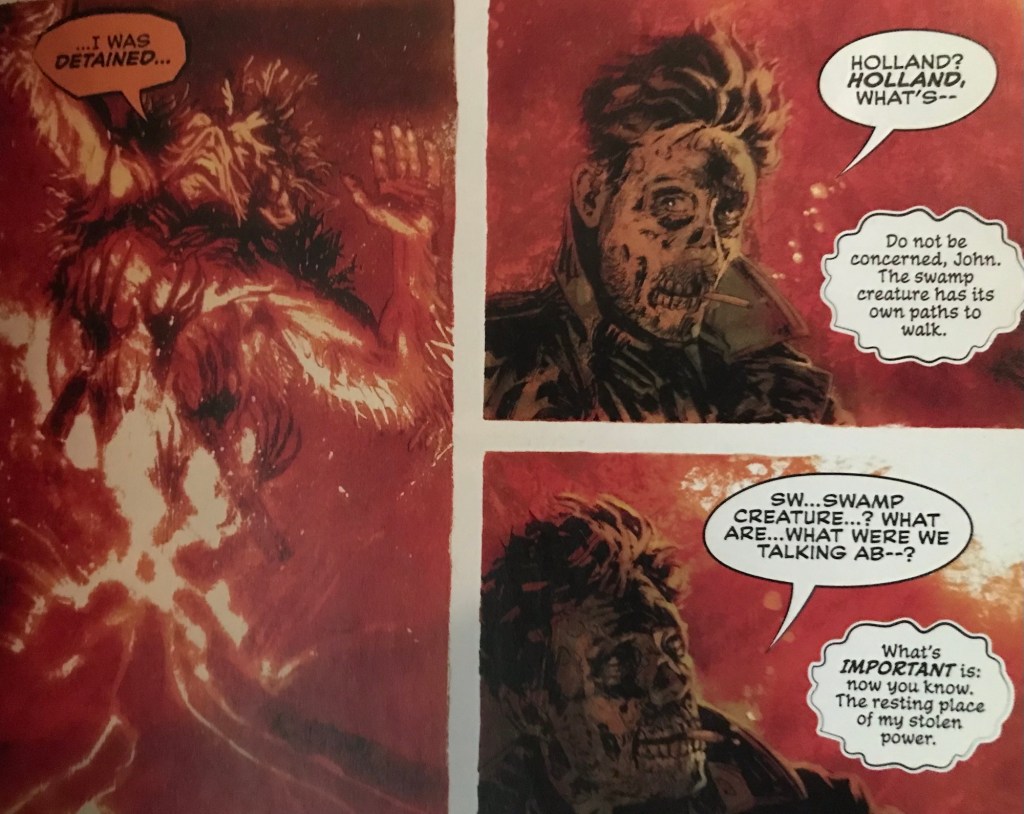
Oh hey- earlier, Swamp Thing tells John that his normally efficient travels through the Green were interrupted. In the new Dead Boy Detectives comics, Charles Rowland and Edwin Paine also get derailed in their own psychic space. ‘Dead in America’ establishes that Swamp Thing was intercepted by Dream. The Dead Boy Detectives story strongly implies that Rowland and Paine were intercepted by Despair. This absolutely smacks of the Dream-Desire-Despair entanglement going on in Nightmare Country. John does right by Noah in the end but we still don’t know where Noah and Nat actually ended up, save that it has to do with the film industry in SoCal. A film production outfit in California is also one of the major forces at work in Nightmare Country.
 AilixChaerea