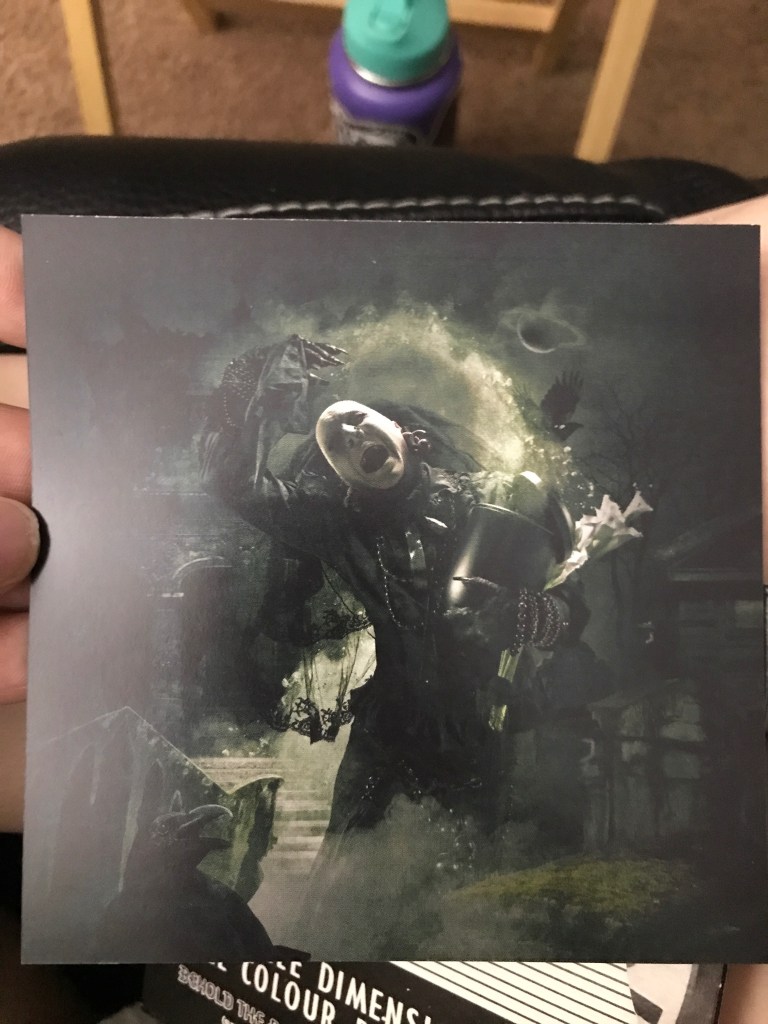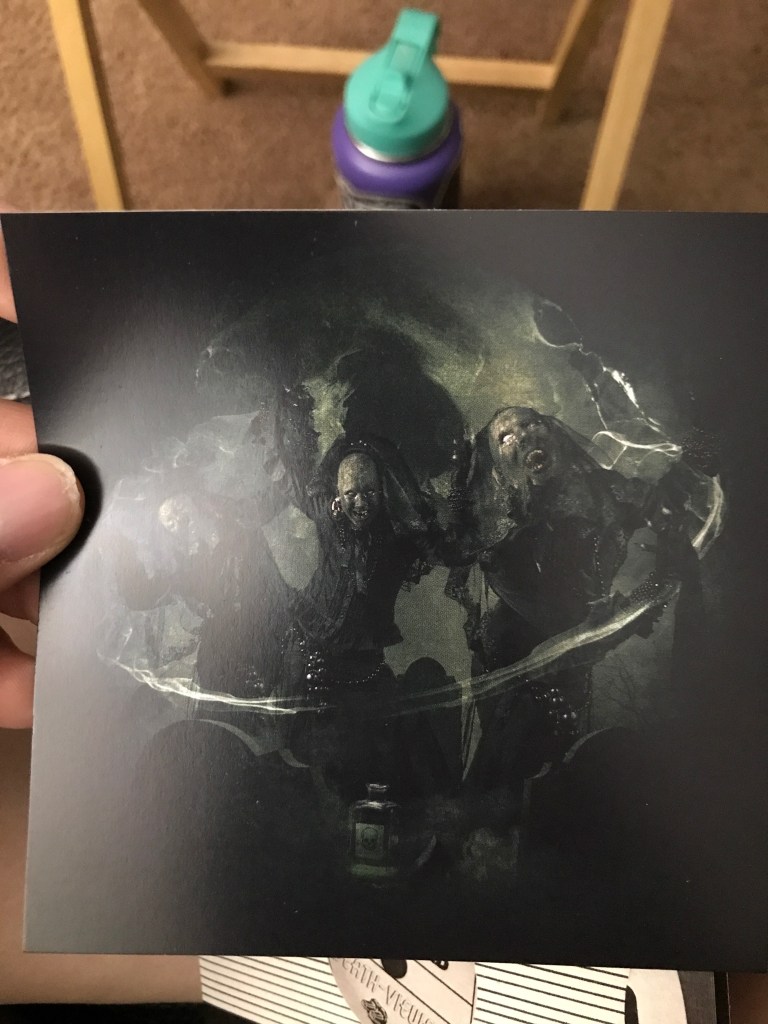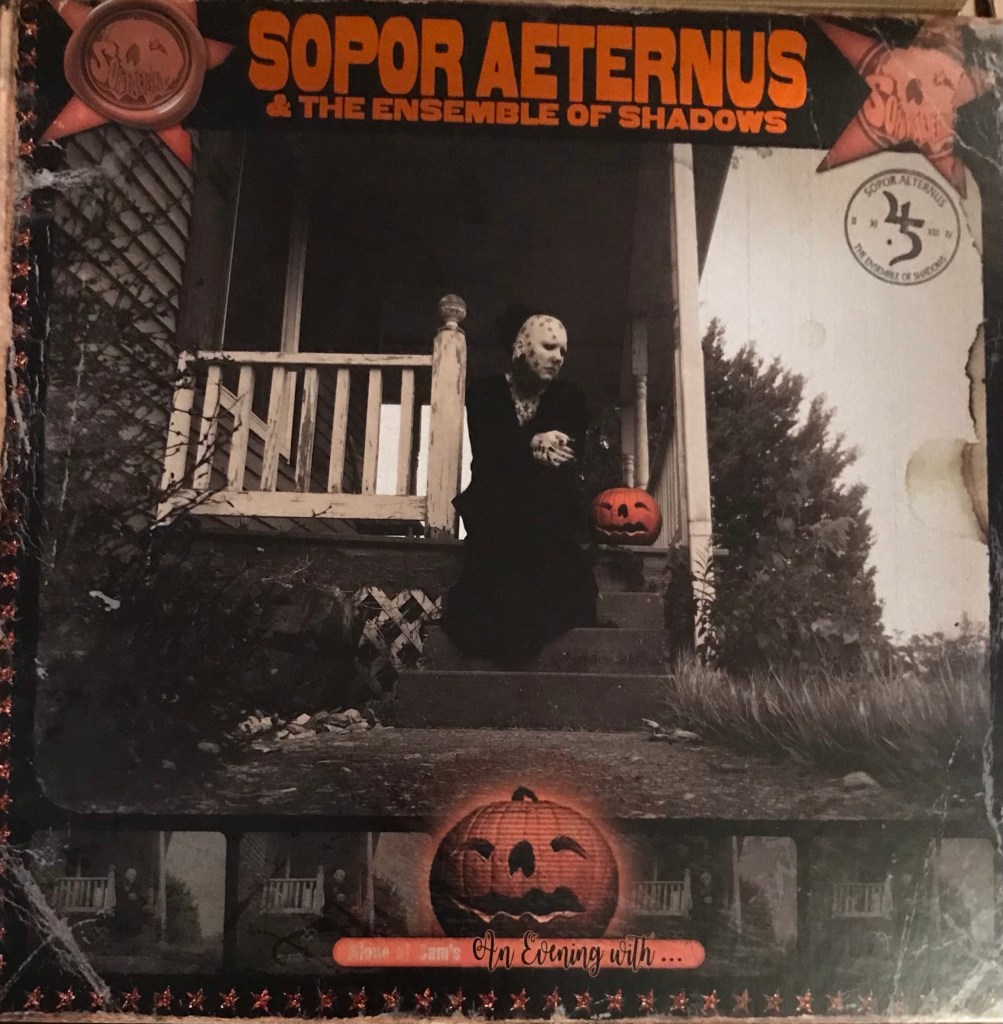
Alone at Sam’s – An Evening With… + The Colours (album review)

The abstraction of the lyrics are poetic.

So is their non-abstraction. Just like Island Of The Dead and Death and Flamingos, the writing is more conversational and direct than in a lot of older Sopor Aeternus material. In the opening track ‘Evening’, the only lyrics are “Hello children, we are Anna-Varney…and you are not!”

One similarity to older Sopor lyrics comes through, though. On my vinyl copy of Ehjeh Ascher Ehjeh, the lyrics of ‘Watch your Step’ look a lot like something you would see on a sign in a national park: “Please, don’t take anything with you, except for maybe some photographs, and please don’t leave anything behind, save your own footprints in the sand.”
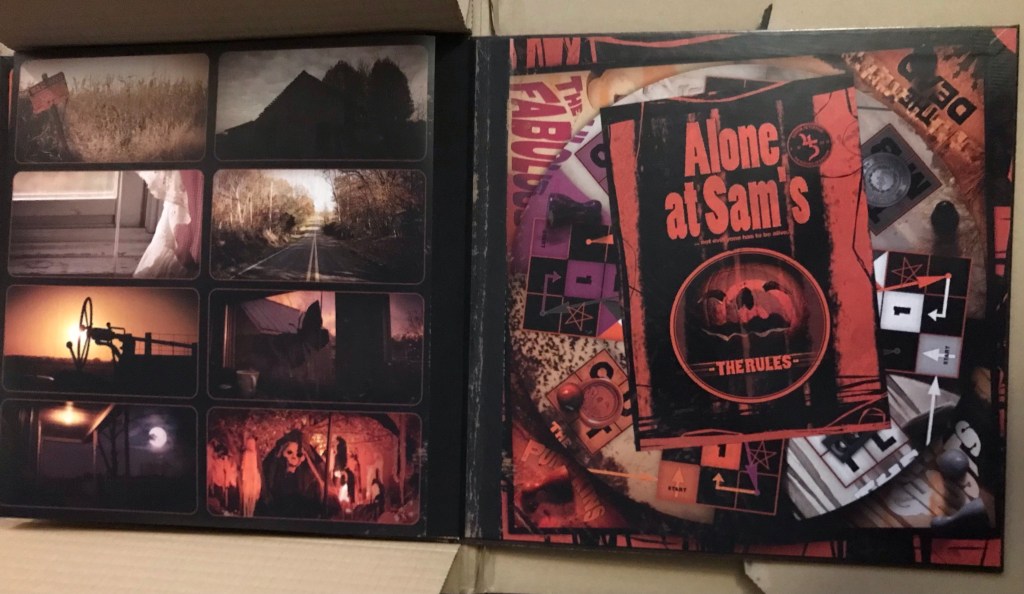
Alone at Sam’s uses similar double entendres with official-sounding language. On this album though, the models for inspiration are board game instruction booklets from Anna’s childhood. Lots of pieces with rules for moving in this or that direction and what their roles are in regard to one another and dice rolls. Since this is a longer body of work than Ehjeh Ascher Ehjeh, a little more author’s presence comes through than on ‘Watch your Step’. In the middle of all the pieces and boards and rules, there are also souls and bodies with all the dice numbers and space numbers and instructions. The use of Roman numerals on the four sides of the LP lead me to wonder about the song ‘Column’, in particlar, which deals with a game where no two pieces can occupy the same space.

A few months before this album dropped in October 2023, Anna-Varney posted a blog entry about rediscovering a rare collection of surviving toys and games from childhood. These survived, to hear Anna tell it, because of their obscurity. This means that the survivors were toys that they specifically did not care for as a child. Only the least appreciated and most mistaken gift ideas continued to represent what toys were to them as a child. They ended the post with a small phonograph which they would use, mostly, to listen to records of spoken-word stories with (at least with the Disney records) background music. Their mother threw away their childhood record collection. Last sentence of the post: “Well, I make my OWN records now. :)”

This emotional journey is present on the album.

As for the music- this is not a specific genre exploration like Death and Flamingos or a discrete palette of genres like Island of the Dead. If I had to look for a basis of comparison from the Sopor Aeternus discography, I find myself seeing similarities with Children of the Corn, The Spiral Sacrifice and- suprisingly for me –Mitternacht.

Mitternacht is a beautiful album but it is painfully intense for me, which is ironic. Anna said in an interview that the prior album, POETICA: All Beauty Sleeps ended on too dark a note for them to be at peace with. I found the opposite to be true for me. POETICA has been my favorite Sopor Aeternus album for awhile now. It’s like a well of imagination. It’s my favorite Sopor album to write to. To me this makes sense, given the role that the work of Edgar Allen Poe has played in their life. The energy exchange between their music and the poetry of Edgar Allen Poe would likely not permit it to resemble anything else in their discography. It has a sense of place and size that is unlike anything else by Sopor Aeternus.

Other Sopor albums have a sense of place and size, obviously; just nothing like POETICA. Mitternacht has those things to. Anna has described POETICA as an exploration of dreams while Mitternacht was that dream-realm transitioning into the waking world. Maybe Mitternacht hit me too emotionally for me to think about it clearly or critically…but I believe Anna intended to portray a shift to waking wisdom or maturity. To value someone else’s happiness over your own pain. It’s a tall order and it’s worth doing but the ending feels masochistically fair. The point of view, at the end, endeavors to be equitable and forgiving to all involved. Yet the pain of the loneliness, rejection and self-loathing still come through in that ending, in their voice, even while their words are reaching further.

Yes I’ve been in comparable situations and yes it can be every bit as bad as that. It can be worth doing, under the right circumstances. Yet I find my experiences have made me less forgiving to the prospect rather than more.

Perhaps a similar realization unleashed the venom of Island of the Dead and its staunch reclamation of personal agency.

The sense of place and size of Alone at Sam’s– the emotive world-building -can be most readily compared with Children of the Corn. Children of the Corn is- obviously -filled with allusions to horror tropes, in multiple lyrics and song titles. The alternation between the songs with Anna’s voice and the instrumental songs introduces something like an AB pattern. Like with Bowie’s Blackstar, the alternating gives Children of the Corn a sense of intimate, procedural immersion. Almost as if each sung piece is a character-encounter or monologue and the instrumental pieces are connective action.

This comes through most powerfully in the ending. ‘To walk behind the Rows’ is like a moment of spoken audio-drama. Anna’s voice is quiet, earnest and determined and they are clearly embodying a character, in a place, doing things. The subject matter evokes, for me, lots of very specific references to transfeminine dysphoria and its potential to wall you into a pit of futility…and what release from that futility can feel like. ‘Harvest Moon (Cornflowers II)’ conveys that release. To date, it is my favorite instrumental Sopor Aeternus song. Children of the Corn is set in an inhumane and inhospitable world. The unrequited desire, horror allusions and overall tone give the ending the release of fully submitting to destruction and coming out the other side. The sweet ineffibility of the ‘other side’ is expressed far more beautifully as an instrumental than it could have been with lyrics. Part of me softens when I hear ‘Harvest Moon (Cornflowers II)’. It evokes the ghost of a sob…but it is a relieved, joyous sob: the weight of permanent misery falling away.

There is an emotional nuance in Alone at Sam’s that hits me as hard as Mitternacht yet contains some of the bottomless peace of ‘Harvest Moon (Cornflowers II)’.

The first time I tried to listen to Alone at Sam’s, I stopped after the first two songs. Track one, ‘Evening’, is our moment of induction. I don’t know which specific Disney audio drama records they listened to as a child…but the musical cues, here, somehow feel like the background music for such a record. ‘Come and Play With Us’ can be thought of as the “post-intro” beginning. Perfectly strong, perfectly good point-of-view / character introduction. Then, at the end, there is a line that is sung repeatedly: “You don’t have to be alone”. Simple lyric. Yet something about the poetic language of games and rules beforehand invests it with…something. I tend to remember this line as “you don’t have to play alone”.

I recently heard of an alien abduction account, in which an old woman sees a younger man, on a couch, lying asleep, who then appears to rotate as if the couch and the wall were now a one-dimensional background and he was magically rotating in three dimensions. The woman was so shocked by what she saw that she began banging her head on the floor.

That line, “you don’t have to be / play alone” triggers a similar response in me.

At present, I am in no way ‘alone’. Whatever feelings ‘Come and Play With Us’ addresses in me are likely decades in the past. But the implied pain is so deep and the potential relief so acute that it feels cruel to bring it up. To mention it is to do so in vain…but what if it wasn’t? What if such a thing could be said with confidence?

So much sweeter and so much worse, at the same time. That is why I listened to this album once, three years ago when it came out, then never again until today.

Now that I have, I wish I hadn’t waited so long.

Like Children of the Corn, there is an alternating / procedural format but it is less of an AB pattern. ‘Evening’ through ‘Column’ can be classified as the first half, in which Anna’s narration is front-and-center and most songs contain their voice. Anna is both a narrator and an ever-present arbiter. In the second half, the centralization budges. The narration still speaks largely in double-entendres that sound like outdated board game rules but instrumental digressions become more common and more vivid. ‘The House of Poe’ has sparse lyrics that merge the narrated perspective with the non-verbal, procedural one, which is followed by ‘Squares of HA!’- an instrumental that seems to echo ‘Tanz der Grausamkeit’. After this comes ‘The Beast’: a vocal song describing gaming rules which are similar to ‘Column’. While ‘Column’ and ‘The Beast’ are on different sides on the vinyl version, their lyrics are beside one another in the gatefold. Correction: ‘Column’ is above ‘The Beast’ (no overlapping, remember?).

These lyrical themes continue in the final act. ‘The Spell’ returns to the recurring sixes of the die-rolls. If you show up having already rolled a six, the spell loses its hold on you- yet no bonus roll for you.

Showing up without one and continuing to roll a six will maintain the hold of the spell. “Moobs” seem to be non-player pieces that can be deployed to take the hit of a bad roll for you. Each player only has so many and they tend to come in groups of two (lol).

“When you are under a spell,

and you come to a square of HA!,

you must follow the sign,

no matter what colour you are”

(It may be appropriate here to remember the resemblance shared between ‘Squares of HA!’ and ‘Tanz der Grausamkeit’, which in English means ‘dance of cruelty’)

The ‘Colours’ represent four different players: purple, black, white and orange. The accompanying EP, The Colours, is instrumental except for one song: ‘Orange’, which builds on the last line of the song called ‘The Colours’ on the LP:

“Purple: queer and fabulous.

White: mostly insane.

Black: alone and a little sad.

Orange: the spirit of the game.

The sole lyrics on the Colours EP describe ineffible blank spaces between ceremonial associations (“the cult of pumpkins / is what you might call / The true spirit of / Halloween”). ‘Orange’ also shares motifs with ‘Squares of HA!’, creating another association in addition to ‘Tanz der Grausamkeit’.

The thematic references of Alone at Sam’s are as ever-present as those on Children of the Corn but are less on-the-nose. The narrated album is the gameboard and the narration is the rules. Players do not speak on this level; they are spoken to. The Colours is more action-driven and therefore less verbal.

Since the centralizing voice on the LP backs up a little in the second act, I wonder if the “player perspective” is more relevant in the second act. The last words spoken by the narrator of Alone at Sam’s are in the song ‘Counter: Spell’. If, while moving backwards, you encounter another spell square “then the spell you’re under is reversed / by the magic of a counter-spell.” You roll your die again “but now you move forward, / like you used to do. / Roll your die again, / but if you roll a six, / there’ll be no gift for you!”

The sparse appearances of the narrator in the second act, combined with the less-verbal player perspective in The Colours, create an association between references that shines brighter than the associative references on Children of the Corn. Both of them contain references with easy resonance for many Western listeners yet with enough semantic drift to make you wonder if this is really the same mythic landscape you remember. If so, it is a remote and wild corner of it, bordering a completely different country.

A Sopor Aeternus playlist experiment!

Image culled from the Sopor Aeternus Instagram account

Anna-Varney Cantodea crafts albums that are distinct bodies of work. Any given Sopor Aeternus album (excluding compilations…like the one I’m about to list in this entry) has its own internal context. So the whole idea of a Sopor Aeternus playlist is either impossible or, optimistically, experimental.

Consider this my run at the experiement:

Soror

Always Within the Hour

Spellbound

At Sunset Through the Fields Aflame (version from The Spiral Sacrifice)

Anima I

Hades’ “Pluton”

The Sleeper (version from POETICA: All beauty sleeps)

Do You Know My Name? (version from Ich tote mich…)

Children of the Corn

Beautiful Thorn

Baptisma (1989 demo version)

Beautiful

Eldorado (version from POETICA: All beauty sleeps)

Day of the Dead

Abschied

End of hypothetical “first disc” and the beginning of a “second disc” (Why yes, I am pretentious, I highly recommend it if only for fun 😀 )

To walk behind the Rows

Harvest Moon (Cornflowers part II)

Anima II

Coffin Break

Leeches & Deception

Poison

The Conqueror Worm (version from Flowers in Formaldehyde)

Into The Night

Sopor Fratrem Mortis Est

A Strange Thing to Say

Bitter Sweet

Consider This: The True Meaning of Love

Nightbreed

Tanz der Grausamkeit (version from Ich tote mich…)

Dead Souls

Helvetia Sexualis

Do You Know My Name? / What Has Happened While We Slept?

Island Of The Dead by Sopor Aeternus

While I’m significantly late on this it is now time to review Island Of The Dead!

This album was released almost a month ago but, because I’m a purist idiot, I refused to listen to it digitally until I had my hard copy. All of these pictures were taken after letting it sit for three days after it came in the mail. You know, because of the now global pandemic.

Individually numbered….!!!!! ❤️❤️❤️❤️❤️❤️

I can’t describe how happy this made me when I finally opened it. The happiness over receiving an individually numbered CD copy also brought my attention to other aspects of the presentation and delivery. I don’t know all the specifics of this, but hard copies of Sopor Aeternus albums tend to only be available through the band and record label’s website around the time the album in question is to be released. I read that Sopor Aeternus worked briefly with John A. Rivers who, in the world of goth music, is a fairly big name, having produced albums for the likes of Dead Can Dance, Love And Rockets, Daniel Ash, etc. As far as I know, I don’t think Sopor has ever come any closer than that to approaching major label representation.

In fact, when I search for Apocalyptic Vision Records online, it seems that Sopor Aeternus and The Ensemble Of Shadows constitute the majority of their output. This goes back to early albums like Ich tote mich…, Todeswunsch and the earliest known version of Es reiten die Toten so schnell, which makes me suspect that Anna-Varney Cantodea herself must have some kind of personal involvement with Apocalyptic Vision Records. Maybe I’m way off base, but if they were working with Sopor Aeternus since the very beginning then I think her personal involvement is likely. If the production and release of Sopor Aeternus music is Anna-Varney’s own personal labor of love, then it makes sense that hard-copies of their work would only be made in proportion to purchases if, perhaps, money needs to be saved for studio time, production costs, studio muscians, etc. So little things, the amount of detail put into the physical object itself…reflect a much more personal and deliberate touch. Which is why a hand-written 878 in front of the /1000 warms my heart.

Now for the actual music and lyricism: there isn’t a specific and obvious genre affiliation like there was with the death metal album Death & Flamingos but modern touches are distinctly present. Songs like Poison, DeathHouse, Saturn Rising and Nightbreed have noticeable new-wave and new-romantic influences. This shift in creative direction happens along with the preservation of the personal, memoir-style lyricism from Death & Flamingos. The lyrics here are very direct and have very personal \ conversational word and sentence construction and the vocal delivery has the same rawness as the previous album. Minotour has a conversational delivery similar to Kinder Des Teufels from Death & Flamingos, You Cannot Make Him Love You from Mitternacht and Something Wicked This Way Comes from Songs from the Inverted Womb.

The closing song, Goodbye, is very lyrically streamlined: when you read the lyrics in the booklet it looks like a personal note between two individuals, like something meant for someone to read. When Anna begins singing, though, the cadence and rhythm of her voice is perfectly musical. The same goes for Mourning, The Void, Saturn Rising and Cold. Mourning struck me as a little challenging at first- I actually didn’t listen to this album all at once, as a single body of work, the first time I heard it. Which will definitely effect the impression of each song. Anna-Varney Cantodea makes albums that are whole, distinct bodies of work, meant to be taken in as a whole. Now it feels like one of the most important songs on the album. Not least of all because of the lyrical stream lining mentioned earlier. The use of verbal repetition is different on this album- in fact, I don’t think lyrical repetition is used quite the same way in anything else by Sopor.

On Mourning, repetition is used in a way comparable to the function served by a chorus in an ordinary rock song, but still gives the rest of the more conversational lyrics room to define the overall tone. The longer instrumental sections also provide necessary atmospheric breathing room for the song to work. As a kind of orienting “center” to the album, this generous use of space is very justified.

Saturn Rising, while just as streamlined overall, is more of an equal split between conversational and conventionally rhythmic lyricism. The alternating slow and fast pacing and the use of electric guitar give the song a recognizable alternative-shoegazey feel. In fact, all of the electric guitar usage on this album reminds me of shoegaze.

The lyrics of Burial Ground are more rhythmic than conversational but retains the shoegaze flavor. Poison, DeathHouse and Nightbreed all riff on shoegaze but go a bit further into the land of straight up gothic rock. On that subject, Nightbreed is particularly satisfying. Very cheeky and angry and contains one of my favorite personalized lyrical bitch-slaps on the album:

I’m not your pal, your aunt or your mother!

You asshole, I’m your FRIEND!

But if all that is too much to ask for,

Then, please…don’t pretend.

If you don’t care to have me

In your busy and happy life,

Then don’t you dare

Say that you love me!

Go and

Tell that shit

to your wife

I love love love how she spits the words “Go and \ tell that shit \ to your wife” ❤

The new familiarity with direct, memoir-style lyricism and rock experimentation on both this album and the last one seems significant. Death & Flamingos and Island Of The Dead both sound more like direct and personal statements from Anna herself, as opposed to Dead Lovers Sarabande or Songs from the Inverted Womb which employed less literal narrative devices. This, in addition to the release of one album a year for three years so far makes these new works seem like an important moment in her artistic career.

After the release of The Spiral Sacrifice in 2018, Anna did an interview with the German LGBT magazine Seigessaule in which she said that The Spiral Sacrifice will “probably” be her last album. This made sense in that interview, as she described the 2018 album- which was in fact a reimagining of her 1997 album The Inexperienced Spiral Traveller -as a journey through time and a stock-taking. This made The Spiral Sacrifice sound like a grand, finishing statement, to say nothing of the fact that Anna is in her sixties and could hardly be faulted for slowing down.

Not only did Anna release new music in 2019 and 2020, but look at the contrast with the 2018 album. The Spiral Sacrifice is almost luxuriously introspective, poetic and slow-paced. I listen to it often while writing or drawing, as I do with Poetica and Ich Tote Mich. The Spiral Sacrifice was constructed with room for the listener’s mind to occupy the material alongside Anna’s presence. In the last two albums, Anna herself dominates all the space and is singing literally about herself in lyrics that make you hear her as both an artist and a private person. So far from being a final album, The Spiral Sacrifice appears to have marked the beginning of a unique chapter in the life of Sopor Aeternus and The Ensemble Of Shadows.

If ever I have the chance to have a hard-copy made of any book I write or video game I design in the future, this is the kind of personal touch I would want to add ^^
This image and the next one both give me a distinct Dead Lovers Sarabande vibe

Death & Flamingos by Sopor Aeternus

Last October, I became a huge fan of Sopor Aeternus and The Ensemble of Shadows when a close friend linked me to Sopor Fratrem Mortis Est on YouTube and the playlist continued with A Strange Thing To Say.  So I couldn’t help but be super hyped when Anna Varney-Cantodea released another Sopor album last February.  I read about it some weeks before it was due to be released and I instantly coughed up the fifty-odd dollars for a hardcopy to shipped to me from Germany as soon as it was available.  A lot happened between then and now, though, both with my living situation and (apparently) with the package itself.  After getting forwarded from another place, I finally got my hands on my beautiful, textured hard copy of Death & Flamingos.

I felt nervous about this album at first because this was to be Anna’s first frank step into rock.  Black metal, specifically.  She’s definitely did loud music before.  I mentioned A Strange Thing To Say and I found some more rhythmic, electronica-infused material that was originally supplemental to La Chambre d’Echo (currently available in the huge anthology called Like A Corpse Standing In Desperation).  I’ve also found that I really enjoy drawing while listening to her debut album, Ich Tote Mich, which has the original version of Do You Know My Name, which you might, arguably, compare to lo-fi industrial.  Might.  I also went through a phase of really enjoying Les Fleurs Du Mal, which was a stark departure from most of Sopor’s MO for a few reasons.  It’s definitely a loud album and her lyrics are way more light-hearted, snarky and raunchy than usual.  At the time that I heard it, I would have called it the Sopor album with the most “drag” or camp influence.

I suppose….it still might.  If Les Fleurs Du Mal hasn’t lost that title to Death & Flamingos, then the two albums are closely sharing it.

Not only does Death & Flamingos whole-heartedly embrace electric guitars and rock drumming, but it’s also very snarky and very conversational.  In the liner notes, Anna writes “This album is based on an interview.”  And it definitely shows.  Being the tactile weirdy that I am, as soon as I received this album in the mail I immediately took it out of the shipping box and carefully inspected the booklet, which is itself the CD case (thick card-stock cover, backing and spine, with a disc sleave at the end).  At first glance, the lyrics don’t even read like song lyrics so much as snatches of conversation.

The song Spellbound starts with the words “Ideally…well, obviously” and Kinder Des Teufels starts with “I never had my  tonsils removed”.  One of my favorite points of contrast here is one of the songs that I find particularly re-listenable, Coffin Break.  Opening lines: “I do take offense / I won’t excuse this point today / it’s such a hurtful thing to say”.  It’s instantly (well…almost?) obvious that this is framed as a response to something that was said by someone else earlier.  But it actually flows really well.  The Boy Must Die also has a few lines that sound “stream of consciousness” that actually turn out to flow quite naturally once Anna starts singing.

And I’ll get to the other songs soon enough, but for now, Coffin Break: the subject matter is, in a strict sense, a simple topic that I think a lot of queer people could relate to.  This being the lifelong messaging, both overt and understated, that we are diseased and insane and the lifelong struggle many of us have with it.  Speaking personally, I’ve lived with suicidal ideation as a regular fact of life starting from age thirteen or so until maybe about two years ago.  When a thought pattern sticks with you that long, it wears deep paths in your head and it’s influence can be felt long after the problem goes down in its intensity.  A certain kind of combative self-talk can be tempting for this reason, and sometimes, in the right circumstances, can even be helpful: if the whole natural world is against you and needs you to die, then why not stand your ground and kill everything else?

It’s not the least understandable thing to think if you’re trying to resist a lifetime of conditioning with little to no resources.  And the song Coffin Break is pretty much about that, exactly.  The use of camp is really successful in these lyrics as well.  As with most of the album, there are some really blunt rhymes.  Intentionally blunt, probably, and intentionally contrasting with Anna’s more expected poetric lyric construction: “Why should I put a bullet / in my beautiful head? / why not get rid of the vermin / and kill everyone else instead?!”.  Talking about putting a bullet in her “beautiful head” makes the subject matter approachable through a little bit of camp while also personalizing it: an idiosyncratic word choice that sounds unique to a person lends credence to the “I” in “why should I”.

Anna fleshes out the thought with:

If I had the power,

I would create the quiet earth

I would erase all human life

From this and every other universe.


On any given day

I’d push that button most happily…

Then Anna drops her singing voice and says, conversationally: ” ’cause I’m a homosexual.”  I’m sure this could be read very differently, but stuff like this really sells the blunt, memoir-like format of the album to me.  The snarkiness of that tone shift does what many other singers couldn’t do with a guttural metal roar.  The song (to say nothing of the album) is definitely a blood-letting, but this kind of humor enables her to show ownership (or mastery) of her pain while at the same time bluntly validating the whole reason for the internal dialogue.

This effect is also achieved in the first song with singing in it, Kinder Des Teufels, which is a pretty direct telling of a story many fans have heard Anna tell in one context or another: a traumatic and possibly dissociative out of body experience she had as a child while being anaesthetized.

In order to achieve the honesty that quality memoiring demands, one needs to be absolutely at peace with their vulnerability.  It’s best to lead with, not only the most painful thing, but potentially the most discrediting thing.  And the two tend to go together.  Often our most powerful experiences, both agonizing and ecstatic, are things we have a very hard time describing to other people.  And if you pull off the godlike task of describing it, then you’re faced with the more horrifyingly gigantic prospect of legitimizing it.  I hope you weren’t burnt out from all that self-interrogation you did just to be able to open your mouth about this, because we’re only just getting started.

The words that precede our first taste of the chorus seem to address this very anxiety.  After an outline of the surgical out of body experience, she says “I’ll tell you something far more interesting / childhood is a fleeting thing, / but trauma stays”.  She expects not to be taken seriously and uses this as an opportunity to emphasize why it is serious.

While this album is abundantly snarky, it’s not without earnestness.  The song Van Dem Tode Traumen Wir has some superficial sonic resemblances to a few different moments from Mitternacht, which has got to be the perfect opposite-equal to Death & Flamingos, being open and earnest in exact proportion to the combativeness of Death & Flamingos.  Tode Traumen Wir is a simple meditation on how your internal validation of yourself is more real than any outside validation, which moves on to album’s final songs, Death Waltz, Charnel House and Mors Ultima Ratio (to only name the songs that have lyrics).  All of which deal with the more angsty side of cosmic and social indifference.  Death Waltz and Mors Ultima Ratio are particularly tongue-in-cheek and campy about it, though, which is consistent with the album’s use of humor to take ownership of pain and anger.  I also just love that I now own an album that has the line “worms will eat your face” 😀

All in all, I’m very happy with this album, both on its own and as an elaboration in Anna Varney-Cantodea’s body of work.  Before I got this CD I was regularly listening to POETICA- All Beauty Sleeps, which sets the poetry of Edgar Allan Poe to music, while writing.  POETICA is also a very earnest album, so the difference of this new release hit me particularly hard.  Luckily, though, in a good way 😉

Sopor Aeternus & The Ensemble Of Shadows

The last few weeks have been a little rough on me.  I have ADHD and Borderline Personality Disorder, which means I have to be a little extra vigilant with monitoring my mental health and self-care.  And let us not forget Puberty Round Two, close friend and confidant of any transsexual in their first years of hormone replacement therapy (I’m going on year four but, erm, still.  My dosage was recently adjusted as per blood work).  Receiving my signed copy of Blood Communion in the mail caused a brief spike in excitement but didn’t really effect my mood in the best way.  I saw things in the characters Benedict and Rhoshamandes that made me dwell uncomfortably on bad decisions I’ve made in past relationships.  A close friend sent me a link to a song on YouTube, though, that cheered me up for the first time in days.  That little emotional bump was probably the spark I needed to write my big’ol text brick of a review for Blood Communion.  And that bump is named Anna-Varney Cantodea, mastermind of Sopor Aeternus & The Ensemble Of Shadows.

You know something speaks to you in the right way when you start to return to things you normally enjoy.  That is, when you regain your ability to feel mental pleasure and satisfaction and you realize how deep your anhedonia actually was.  What specifically happened was that my friend linked me to Sopor Fratrem Mortis Est, and the playlist went on to A Strange Thing to Say.  I then proceeded to immerse myself in the brilliance of Anna-Varney when playing Bloodborne with the sound on the TV turned all the way down.  For the last week, Sopor Aeternus has been my go-to band, with occasional digressions into Cake Bake Betty and Francoise Hardy.

You also know you’re something of a special cupcake with extra special frosting when Sopor Aeternus, of all bands, opens a floodgate for your emotions and makes everything feel okay.  For those who don’t know, Sopor is popularly associated with sub-genres like dark-wave, dark cabaret and neoclassical and it is said that the memory of Rozz Williams of Christian Death was on Anna-Varney’s mind while writing the Dead Lovers’ Sarabande albums. Sopor Aeternus also takes strong direction from medieval European music and can run a gloriously chaotic mental, emotional and spiritual gamut.

I’m fascinated and often blindsided by the easy overlap of camp and earnestness.  In It, the character Richie Tozier has a moment of internal dialogue where he reflects on the thin line between what is funny and horrible.  It’s kind of like that.  I think part of that is, as a queer in a small rural community, self-loathing has often been very close at hand.  Especially for a transsexual.  Even now that I’m an adult who has been frankly out as trans for years with a supportive family.  Maybe I only feel like this because I’m pre-op, but gender dysphoria seems like something that’s always going to  be there, at least a little bit.  Do I actually believe that?  I try not to…I try hard.  Perhaps the delicate segues between self-celebration and self-effacement, humor and horror, also speaks to the thin divide between humor and anger.  Recognizing these things in another mind can be a vital safety valve.

This makes Anna-Varney Cantodea a new hero as both an artist and a fellow transperson.  To say nothing of the fact that the music of Sopor Aeternus is like an on switch for my mind.  As soon as I put on Es reiten die Toten so schnell or Mitternacht I’m probably seconds away from pulling out the journal to brainstorm or vent.  Es reiten die Toten so schnell is immersive and otherworldly, easing you in and out at the beginning and end and has a consistently elaborative emotional nature.  It’s very self-contained and each song builds directly on what came before it.  Mitternacht, though, is more manic and, to my ears, more personal.  Beautiful, La Prima Vez, Confessional, You Cannot Make Him Love You and If You Could Only Read In My Mind all gave me chills.  The alternating energy between the short and long songs and the long melodic sections with the louder parts also give the whole body of work a comfortable dream-like framing.  The dream-like nature is also supported by Mitternacht‘s covers of Bang-Bang and Into the Night.  For some reason, Anna’s rendition of Into the Night has a way of reminding me of the parts in Stephen King’s Dark Tower novels with Mia and Susannah holding palaver on the allure of Castle Discordia.

However, I heard those two albums along with The Spiral Sacrifice after I had heard the EP A Strange Thing To Say and I almost don’t know if I can go back to it.  Anna-Varney pulls off visceral camp exquisitely but there’s just something about her longer and more emotional albums that I just can’t stay away from.  Maybe it’s because so much of what she does comes from situating things within a specific body of work.  Each album is self-contained with a beginning, middle and end, which speaks to the novelist in me.  Which can make digressions like A Strange Thing To Say a little awkward to return to, as much as I love that EP.   I especially liked the video for the title track and how it elaborates on the song’s metal sensibility (her music is only occasionally inflected with metal).

I also plan on checking out Poetica (All Beauty Sleeps).  Anna-Varney Cantodea may be the first artist I’ve encountered to use the Edgar Allan Poe poem The Conqueror Worm, which I particularly like, as direct inspiration.

I think I’m also gonna end up having my will power challenged as I’m a total sap for owning hard copies of music and books.  I don’t shy away from the digital market but there really is nothing like holding a copy of something in your hand, and Sopor Aeternus puts together gorgeous bundles.  This is more special with musical artists that cultivate a direct relationship with fan communities as the more obscure acts are wont.  There is this unknown punk band in Pennsylvania called Gash that self-published an EP called Subspace a few years ago and I still have the packaging that it came in, with the hand-written address.  Granted it has my dead name, but there’s nothing quite like that personal touch from an artist you love.  Anna-Varney, similarly, cultivated support for the latest Sopor Aeternus album through Patreon with rather cool rewards for supporters.  So my crazy little collector’s soul will have to be reigned in before it bankrupts me 😛

I feel like a total groupie fan girl for adding this last part, but I love Anna-Varney’s presentation in interviews and her reflections on herself.  Por exemplo, she tends to get asked why specifically she devotes herself to the Hellenic deity Saturn and always refuses to answer.  This rings true to me: spirituality and devotion, when it’s part of an authentic journey of one’s soul, can be a deeply intimate and personal thing.  As someone who was raised with traditional ethnic spirituality, I can identify with this.  To make myself look like an even bigger fan girl, I’m impressed by the fact that she is, as of this writing, sixty-six years old.  As a transgender queer, the world can often seem like a treacherous and inhumane place.  Anna-Varney Cantodea has been living that life longer than twice the amount of time that I have, and at her age she seems so powerfully confident in her presentation and gender.  This warms my queer little heart to no end.

So thank you Anna-Varney Cantodea for being the hero that you are, in this world of Caitlyn Jenner, Laverne Cox and insane anti-trans bullshit in the gutters of the internet, in the mainstream of American thought and in the White House.