

Let’s get the rough stuff out of the way first:
The facial rendering and body language is only top notch during the cut-scenes. During typical game play, they range from FFXV quality to just above VIIR. Just above VIIR is, admittedly, pretty good though.
Concerning the narrative-
Clive’s level of responsibility in the fatal clash between Joshua as the Phoenix Eikon and the Ifrit Eikon.
I’m still not finished with the game so there is still room for this to be solved. I’ve only just reached The Veil, during Clive’s attempt to locate Jill and Cid behind the Sanbreque border.
As things stand now, though, I am not altogether clear on why the apparition of Ifrit at the Phoenix Gate necessarily means that Clive killed Joshua. The implication seems to be that an Eikon can only manifest through their current, corporeal Dominant. If Ifrit manifests during the lifetime of Clive, it may follow that Ifrit must necessarily manifest through Clive. That’s my best effort at trying to deduce why Clive would feel that his guilt is unavoidable.
The battle between Phoenix and Ifrit is watched by Clive, as a teenager, immediately before he was enslaved by the Imperial military. If Clive simultaneously watched the fight while participating, that would be some pretty hardcore dissociation.
However…I don’t specifically remember Clive on the sidelines during the fight. During the fight, the player is rooted in Joshua’s perspective. It just sort of feels intuitive that Clive is watching. We also hear Clive’s screaming as Ifrit pounds Phoenix into a bloody pulp.
Then again, the two giant Eikons do a serious amount of dodging and flying. They probably moved a fair distance away, which would call the screams of Clive into question. If his screams can’t be heard from where he was originally standing, then we must be hearing them for another reason- such as Clive being rooted in Ifrit the way Joshua was rooted in Phoenix.
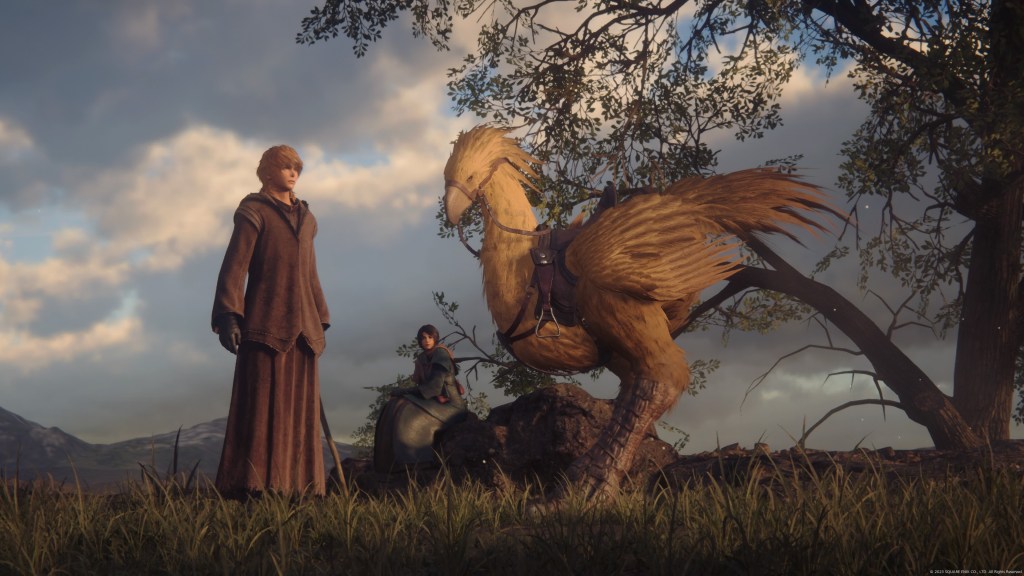
Yet the apparition of Ifrit is only triggered by the mysterious hooded figure. If Clive went apeshit because he was suddenly forced into an unfamiliar, primal, non-human perspective…it was clearly triggered by a third party. That’s why I don’t buy Clive’s guilt.
It’s also possible that the player is meant to feel this dissonance, and that Clive’s guilt is important only in his individual character arc. In that case, the dissonance would serve as a motivating instinct leading the player to the correct conclusion.
There’s a lot that can go wrong with that setup but there is also a lot that can go right. Worst case scenario, the player/viewer/reader feels alienated from the viewpoint characters. When a story’s point of empathy is abruptly shut down, it’s hard to bounce back. Best case scenario, you feel intimately connected with the viewpoint character.
In the context of the rest of Final Fantasy, a split or reversal in the arc of the main character is often associated with the two layers of crisis in my earlier post.
Put simply: the archetypal Final Fantasy story rests on two layers of crisis. The first one is often social or institutional. The second, deeper layer is more mysterious but often intertwined with the first one.
It is also normal for this shift between two layers of crises to occasion a shift in the main character, which usually changes their motives. Cloud’s altered memories in Final Fantasy VII is probably what most people think of first, in this regard. IV introduced a dramatic moral reversal in Cecil that goes further in the opposite direction when the second layer of crisis starts to emerge. Every single playable character in VI (other than Umaru and Gogo) has their motives changed or influenced in the World of Ruin.
This, I imagine, is what is happening with Clive in XVI when he begins to think that he killed his own brother in a magical altered state.
When he starts to believe this, Clive begins seeing visions of a hooded man in a cloak, like the figure he originally believed was the Dominant of Ifrit before realizing it was him.
The hooded man never appears to be truly, physically close, which implies that Clive might be the only one who can see him. Then Cid makes it clear that he sees the figure as well. In that moment, Cid is probably saying what the player is thinking. I, at least, felt like it was firmly established that the appearance of Ifrit is conjured by a third party, even if he does manifest through Clive.
Not everyone will carry this baggage going in, but the hooded figure has a vague resemblance to the updated version of the Sephiroth clones in FFVIIR. While this might be my own subjective problem, it still felt like the game was taking some risks, between resembling Cloud’s psychic torment a bit too much on one hand and the dissonance between Clive’s beliefs and the perspective of the player on the other. A dissonance that could either alienate the player from the viewpoint character or create an immersive sense of isolation beside the viewpoint character.

When the alternative possibility is not immediately accepted by the protagonist, or appears fake at first (if it turns out to be real), I find that it works better.
A protagonist who accepts the alternative possibility as soon as it’s presented to him is a greater risk. As a writer, I would almost always choose to have the protagonist wrestle with the possibility before judging it one way or another. It does not take long for Clive to decide, however, that he is responsible for the death of his brother Joshua.
This begs the question: are there any apparent reasons why Clive may make this judgment easily?
One of them is simple and quiet enough to be overlooked: Clive was a slave-soldier for thirteen years in the Imperial army. The conditioning of that experience is hinted at immediately after the thirteen-year flash forward. When he realizes that his unit is fighting with a company of Bearers that includes Jill, Clive’s immediate course of action is not at all obvious until he starts to act. His choices are absolutely binary: watch another loved one die and keep his future, or lose his future to save her life. In that moment, Clive seems to realize that a life with that guilt is not worth clinging to and tries his luck with a rescue.
His most decisive act, after thirteen years of slavery, probably happened through a self-destructive impulse. In conversation with Cid, he says that the hope of vengeance was the only thing that kept him going as an enslaved soldier.

This is where things start to get interesting. Jill recovers from her injuries and swaps stories with Clive of their suffering in the last thirteen years. When Clive mentions his discovery that he is himself the Dominant of Ifrit, he frankly states his belief that he killed Joshua in a frenzy. The concept of suicidal guilt is always just one little step away from being mentioned but is rarely addressed directly. Only one line from Cid appears to do that.
It’s possible that Clive’s suicidal ideation is a subconscious pressure behind his eagerness to classify himself as damned and deserving of punishment. One reason why I loved the scene where Cid accepts the help of Clive and Jill in Sanbreque is because it’s only then that Clive appears relatively free of the wish to die.
The walk between Cid’s Hideaway and The Veil actually feels cathartic- for the first time, the story is tinged with hope. At that point, I realized my feelings were involved. Not a bad place to be, in a story.
I also think I’m vibing with the combat system. It’s an adjustment after FFVIIR, but it’s just so fun after awhile. I’m actually enjoying the tougher enemies and the trial and error with the different Eikon abilities and strategies. I find myself thinking things like “I might not get out of this alive but let’s do it anyway.” That’s a good sign in my book.
I’ve never been particularly averse to the action RPG direction the series has been headed in since XV. It’s normal for each numbered Final Fantasy to add their own unique game play. Personally, I’ve always felt like story archetypes and world-building was what made Final Fantasy itself, anyway.
Which is something the fan base has been debating, lately, with regard to XVI. The only time I started to ask that question was with XV, since the ending in the base game goes for both tragic love and teenage wish fulfillment. Rather than developing outward, the main character curled inward. The canonical ending was originally planned to appear at the end of a second season of DLC. It got cancelled, so that canonical ending now exists only in the Jun Eishima novel The Dawn of the Future. It’s a decent little story collection, but the only ending that was ever offered in video game format was the one seen in the original FFXV, excluding possible insinuations in Episode Ignis or Episode Ardyn.
As FFXV exists now, it still has it’s first ending, which is the biggest deviation from the archetypal Final Fantasy story in a mainline title.

Another recurring idea in the Final Fantasy series: ancient magical founder races or ancient aliens. It’s interesting to me that Zelda is also getting into stories that involve advanced aliens interacting with a swords-and-sorcery world.
Rather like XV, many of the classic Final Fantasy monsters (Iron Giants, Bombs, etc.) appear exclusively in cave-adjacent ruins of an ancient, technologically sophisticated society. I therefore couldn’t help noticing that one of the mini-bosses in the ruins below Rosaria is called Lich, like the Four Fiends in the 8 bit games or IX. Even the ancient tower of the Vandole founder race in Final Fantasy Adventure on the Gameboy feels like an adjacent concept. Final Fantasy Adventure (later rebranded as Sword of Mana) even associated the summon monsters with the Vandole founders. The sword that permits Sumo to enter the tower is guarded by a firey being called Iflyte in the Gameboy original and Ifrit in subsequent remakes.
Finding our way back to the Four Fiends, a gateway to another plane of existence called Memoria in FFIX happens directly above the Iifa Tree, which is itself an ancient piece of technology. Creatures resembling the Four Fiends guard the means to activate some of this technology. Deep in Memoria, the party fights the Four Fiends repeatedly, as if the monsters in the outside world were physical “versions” of them. After those versions are no more, their backup data still remains in Memoria. Finding Lich inside of the Fallen ruin below Rosaria makes sense.
This association between the Fallen and the classic Final Fantasy monsters also makes me excited to get to FFXVI’s new game plus. It is, apparently, called ‘Final Fantasy mode’ and, along with a higher difficulty scaling, also includes monsters like Bombs and Iron Giants in different places and behaving differently.
Further posts to come. Hit the left arrow at the bottom of the screen navigate back to my first post on this play-through. Or keep scrolling, if you’re reading this on the main page.
 AilixChaerea