

After Clive commits himself to the cause of the Hideaway, things move fast. The creeping, environmental menace of the Blight has been present since the beginning. Both the rising power of Sanbreque and her victims have been affected by it. Once Clive and Jill return from Rosaria, Cid offers the first actual speculation on the Blight.
As with Final Fantasy IV, V, and IX, the Mothercrystals seem to function a lot like weather control / energy devices left behind by an ancient, technologically sophisticated civilization. Since the crystals are like machines under human ownership, misuse is always just around the corner. The crystals in XVI interact with an ambient force called aether. In the long run, aether is naturally replenishing but in the short run it can be exhausted. When aether is running thin, the environment starts a downward spiral. This, in Cid’s estimation, is what the Blight is, and it is why the Mothercrystals must be destroyed.

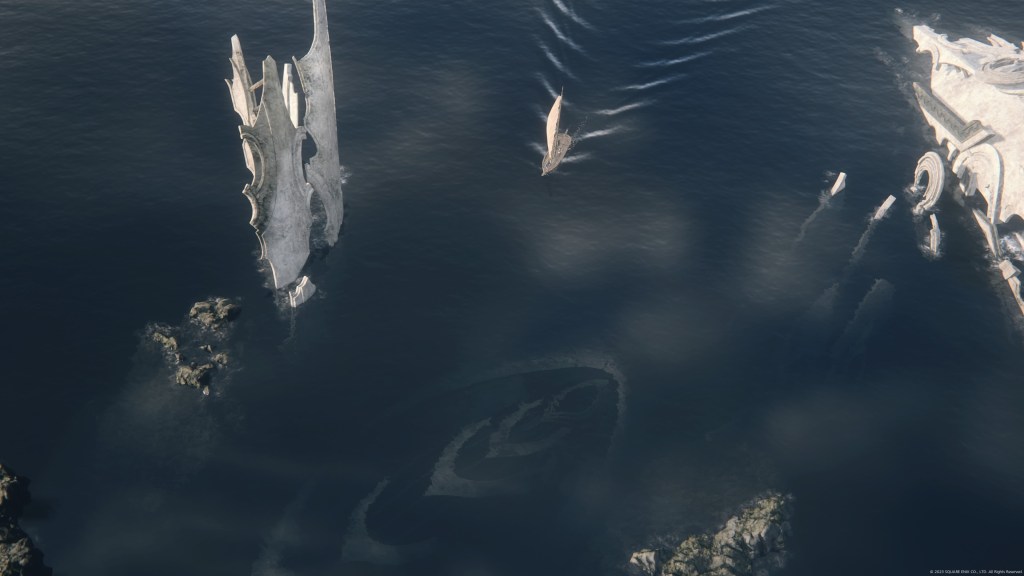
The attack on the Drake’s Head Mothercrystal brings us back to the remnants of the Fallen, Final Fantasy XVI’s founder race. Along with adding the historically familiar (within FF) link between the crystals and ancient technology, we see more Bombs, Iron Giants and Liches. As established in Clive’s return to Phoenix Gate, these kinds of ruins follow a pattern like the Cloister of Trials and and the Aeons in Final Fantasy X.
Sure enough, the Drake’s Head Mothercrystal is protected by the Eikon Typhon. We then encounter a being that looks like they may be an Eikon themselves. They have fluid telepathy and interaction with both humans and Eikons. Joshua seems to have bound himself to this creature as a means of surveillance. This, of course, is Ultima.
This leads to a number of lore-matches. It’s not uncommon for Final Fantasy summon monsters to play a role similar to gods, bodhisttva-like spirits or magical totems. Summon monsters in one game may be summon-adjacent in another, like Omega, Chaos or Doom Train. Ultima is a frequent member of this gray area. Summon monsters are linked with the in-world mechanics more than almost any other game play mechanic, except (arguably) crystals. IV included diagetic functions for other game play mechanics, like combat spells. VII basically turned Holy and Meteor into titanic, cosmic forces. Like I was droning about in a prior post, the link between summon monsters and an ancient founder race goes back to Final Fantasy Adventure on the Game Boy, if not further (the first FF has similar insinuations).
That last one is closer to what is going on in Final Fantasy XVI, but I’ve not yet unraveled Ultima’s role. I’ve only just reached the point where Clive and Bernard are looking for Hugo Kupka (channeler of the summon monster Titan) after the Waloeders rescued him.
Speaking Kupka and related topics, I could not have been more wrong about Benedikta. I think. Since I’m doing a loosey-goosey play through to get a read on what’s on offer, some details may have escaped my attention. I could probably edit prior posts in accordance with discoveries but I just like doing these little multi-post play through thingies. The mistakes add to the cumulative discovery, including false predictions.
Said all that to say: I may have missed some stuff. I remember the hooded figure appeared immediately before the fight with the Garuda emanations containing parts of Benedikta’s soul. I don’t know if he had any sort of…last minute intervention like he did with Kupka. If it was understated, it may have slipped under my radar. I kinda wonder if the hooded figure rescued Benedikta like he did Kupka.
Which brings us to the hooded figure. At first glance, it looks as if the hooded figure is Joshua but he’s clearly not just Joshua. This subtle difference was insinuated in the beginning with the cuts between the more shadowy, non-corporeal hooded figure and the corporeal hooded Joshua. Then, at the end of the Drake’s Head raid, we see Ultima for the first time through Joshua.

This clash ends with Joshua saying that he knows better than to try to kill him. The implication is that Ultima is incorporeal. Joshua has another idea, though. Much later, a Joshua says in a cut-scene that he knows what Ultima is thinking, which gives the impression that Joshua somehow contained Ultima with his own soul. Joshua also makes it clear that this containment does not stop him altogether.
Joshua has no clear reason to rescue Hugo Kupka from Clive. We also know that Joshua is not the only one who constantly wears a hooded robe and that Joshua is bound to at least two non-corporeal beings (Phoenix and Ultima).
In a cut-scene in Sanbreque, Anabella’s young son Olivier is given credit for winning Hugo Kupka over. Let us not forget that Anabella is also the mother of Joshua and Clive. If Ultima is haunting Clive, is partially bound by Joshua and can be channeled by Olivier, it looks like there is a connection with the Rosfield bloodline.
If such a connection exists, it adds weight to the possibility that Ultima is scooping up Dominants that get rekt by Clive. And here we’ve returned to my suspicion that Benedikta may still be waiting in the wings, somehow. I’ve been extremely wrong about her before, though.

Concerning game play: the statements from Square regarding a job system seems to have been referring to the move sets that Clive gains whenever he saps the Eikon of another Dominant. The Phoenix and Ifrit move sets are comparable to something like a warrior or berserker play style. The fire Eikons are good for going in swinging. Garuda’s move set is speed-based melee with an emphasis in aerial combat and is my favorite so far. Ramuh has a range-fighter move set and Titan has a high-defense / high-damage move set, similar to a corsair from Final Fantasy XIV or Barret from VII.
Many of the Phoenix abilities are part of your ambient combat options, regardless of whichever Eikon Clive is attuned to. Many of those include classic adventure game melee, which- combined with Garuda -appeals to my preference for dex builds in Bloodborne.
The dev team were, for sure, not lying when they said that FFXVI had one playable character. One could make an argument for Torgal being the only genuine “party member”, but I have a lot of fun coordinating Torgal’s attack patterns with my own. It even adds something to the side quests, since Torgal is the only party member that always comes with you when you deviate from the mainline story. Maybe this is just a cheap shot for the animal lovers, but I appreciate it. Clive’s deep alienation at the beginning makes me…I guess…weirdly grateful for a fine hound that never leaves your side. If this makes me a sap, I can be okay with that.
Speaking of side quests, that’s another strong point. Not that this game is free from some typical, silly side quests. I’ve recently discovered the Viva La Dirt League YouTube channel with their Epic NPC Man skits. Greg, the garlic farmer of Honeywood, captures a lot of the silliness that have become normal in JRPGs. Greg is constantly offering a quest to round up his sheep, who have “run amok.”
Just like many JRPGs…FFXVI is not immune to “my sheep have run amok” NPCs. Not nearly as many as XV, though (XV had the worst case of “sheep run amok” NPCs in the history of Final Fantasy).
Other than that, though, this game adds something to side quests that I don’t see as often as I would like: a point.
After the destruction of the Drake’s Head Mothercrystal, Clive adopts the mantle of Cid and continues his mentor’s life’s work (our Cid wasn’t even the first one to use the name).
As the new Cid, Clive is now responsible for the Hideaway, a shelter for formerly enslaved magic users. As the de facto leader, it makes sense for Clive to be involved in the different levels of administration and providing. These aren’t a bunch of randos whose sheep ran amok; they’re desperate and Clive has accepted the responsibility of a provider. Clive himself was once enslaved and branded, with other Bearers.
Even before then, Clive’s branding is tied into side quests. Early in the game, while you’re away from the Hideaway, randos outside the Hideaway will recognize Clive’s facial brand and will make obnoxious, condescending demands, offering rewards which you are instructed to “pass on to your master.”
This stops happening after the attack on Drake’s Head, but it sets up the character significance for Clive adopting the role of Cid. He’s not just a provider; he’s a provider for his own people.

More to come. If you’re reading this on the main page, keep scrolling for my older FFXVI posts. If you’re reading this in a link, click the arrow at the lower left of the screen.
 AilixChaerea