
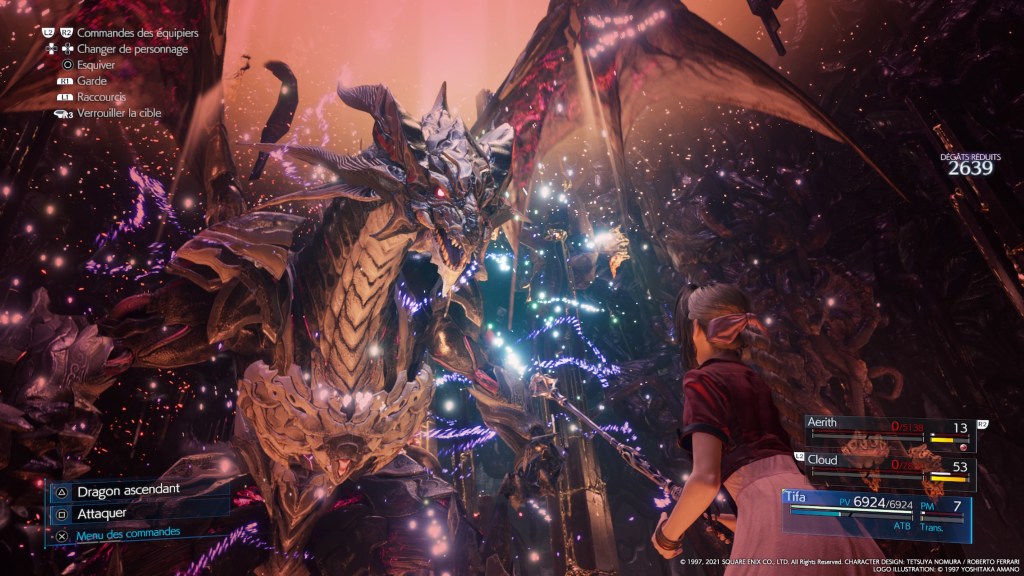
(spoilers for original VII, Crisis Core, Remake and Rebirth)
A lot of Final Fantasy VII fans (my age and older) have been overthinking it for a long time. In case this seems like an inordinate amount of thought to put into a video game analysis.
Anyone who played Final Fantasy VII in the late nineties or early 2000s probably remembers the GeoCities and AngelFire fan communities. I could probably write an entire post on those websites. One of them contained a long narrative poem describing the entire game from Sephiroth’s perspective. On an ‘about’ page, the author declared that Professor Hojo was her soulmate. Many of these revolved around gaming urban legends, like the surprisingly common belief that Aerith could be brought back from the dead (not that there was any lack of online guides on chocobo breeding or beating Emerald and Ruby WEAPONs). Many of these websites ended up discussing lore and the grounds for various interpretations.
For example: one prevalent myth about resurrecting Aerith was that there was some hidden way to throw a phoenix down into the pond Cloud lowers her body into. On my own favorite among these ancient websites (link below), the blogger Seraphim debunked a number of theories before getting to his own. When he came to the phoenix down chestnut, he explained that a phoenix down does not actually bring anyone back from the dead. When a character’s HP hits 0, it symbolizes becoming too weak to continue fighting. In a lot of online conversations between fans, the symbolic meaning of the mechanics were a common topic. Another one was the relationship between the battle screen and what was literally going on during combat.

For Seraphim, this mattered because it emphasized the true nature of the dilemma. Aerith is not conked out; she’s actually dead. The nit-picky exhaustiveness of these discussions had some funny foundations. No one would resurrect Aerith because it could not be done…which only drove the search further into the margins. Some bloggers tinkered around with the GameSharkPro and found ways to trigger Aerith’s dialogue for points in the game she’s not alive for, which was taken as confirmation by some.
What actually happened was that Square was going to script at least one permanent character death: Barret or Aerith. They based their decision on play tester reactions which led to the situation we have now.
Brief digression- This proves what a happy accident Final Fantasy VII was. Big name video game developers and film studios make a lot of creative decisions by committee.

Getting back on topic-
Aerith’s dialogue for the last two-thirds of the game was cut, but since the game was originally scripted to have everyone for the whole thing, the dialogue was still there in the code for data miners to find.
The real reason why Aerith had cut dialogue occurring after her death was not confirmed by Square until a few years had gone by. If the fans were determined to find their own answers, though, you couldn’t blame them. Especially since so many of the events depicted within the game depend on interpretation.
Massive spoiler warning for the original game.
The planetary force called Holy barely manifests in time to stop Meteor. When I first completed the game, years before the Advent Children film or any of the additional games and novels that flesh out the lore, it appeared to me that Midgar did not survive Meteor. But the planet, Gaia, did survive.

After this planetary near-miss, we get the ending credits followed by a cut to the relatively far future. The character Nanaki belongs to a species that is extremely long-lived. Although he is over forty years old in the period where the game takes place, that only puts him on the level of a teenager. Presumably, in the succeeding decades, he matures more. Nanaki appears to have cubs in the flash-forward, with whom he is hunting/exploring/playing with. He follows his cubs to a cliff overlooking the remains of Midgar which is completely overgrown with plants and wildlife. Gotta admit, that looks like a conclusive statement on the fate of Midgar.
Our last post-credit scene is a brief cut to the opening cinematic, where Aerith’s face fades in over an apparent starscape.

In the absence of any direct explication within the base game, both of these moments rely on some active reading. These may be the most mysterious scenes in the game- but they’re not the only ones that rely on inference or interpretation.
The crowd that was determined to resurrect Aerith latched onto a few of these smaller mysteries. If you manage to get back into Midgar’s ground level late in the game, there is a ghost of Aerith in the church in the Sector 5 slums. Aerith’s polygon flickers for a moment and vanishes before you have the chance to approach her. In Wall Market, at the beginning of the game, Cloud has an uncanny hallucination of a doppelgänger in the Honeybee Inn which has no clear in-world explanation.

Many of Cloud’s hallucinations are telepathically directed by Sephiroth or Jenova…but not all of them. Cloud has a moment in the opening bombing mission where he freezes and a voice in his head says ‘this isn’t just a reactor’. This is, in all likelihood, a trauma-response like PTSD triggered by memories of the Nibelheim reactor. Cloud’s trauma surrounding his hometown Nibelheim is frequently used by Sephiroth and Jenova as a point of entry for their psychic manipulation. But that trauma still exists irrespective of them.

In light of the story in general, this feels like an intuitive way to make sense of Cloud’s episode during the bombing mission. But there is no direct comment on it within the script. Cloud’s hallucinatory doppelgänger in the Honeybee Inn, however, has no implicit explanation furnished by Nibelheim, Sephiroth or Jenova. Presumably, the doppelgänger hallucination is an organic event.
It feels funny using the phrase “active reading” in reference to playing a video game, but it’s hard to get reeled in to Final Fantasy VII without some active reading.
While the nineties gamers determined to resurrect Aerith would necessarily be disappointed, they were on to something essential.

Final Fantasy VII is about death. A lot of it is, anyway. Two of the main characters exert massive influence on the plot after they die: Aerith and Sephiroth. These two are also deeply enmeshed with Cloud, our viewpoint character.
Seraphim pointed me in the right direction here. My favorite part of his analysis was his assertion that the real main character of Final Fantasy VII is Aerith and that Jenova is the real villain.
Seraphim categorizes Cloud and Sephiroth as victims but he does not offer any comment on Cloud’s function as the viewpoint character. If Jenova and Aerith are the real plot-movers, then Cloud’s place in the foreground is more of a way of orienting the perspective of the player/audience. Cloud is the lens through which we see the story but not a major character within it- almost like a narrator.
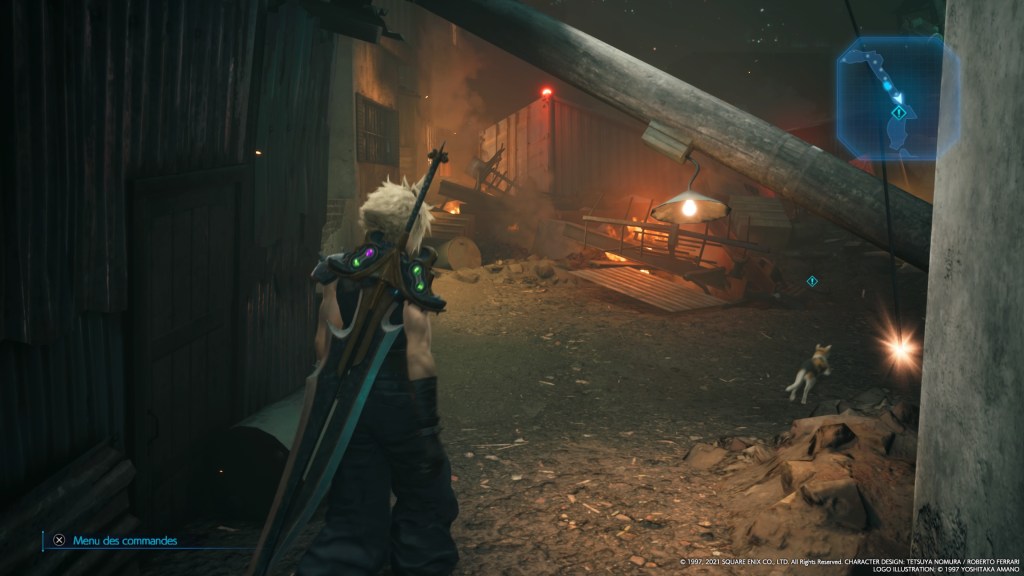
Placing Aerith as the main character is not as much of a reach as it might sound. Especially considering one of the most important recurring plot elements in Final Fantasy: the paradigm shift. I ended the intro post the way I did for a reason.
In the intro, I mentioned Cecil, Terra and Zidane. Terra lived much of her life as a mind-controlled war slave. The story of Final Fantasy VI effectively starts when Terra regains control of herself. Cecil begins his quest as an unflinchingly loyal soldier and Zidane as a petty thief. None of them are the same in the end.
The plot of many Final Fantasy games rests on two layers of crisis. There is an earthly antagonistic force which is empowered by the influence of a deeper event. This second layer is often exposed half way through the story and can cause (directly or not) a basic re-evaluation of motives in the main characters. This almost always includes the protagonist. This is the paradigm shift I was referring to.

Final Fantasy X and Final Fantasy XIII situate the paradigm shift within a conflict of free will and determinism. Final Fantasy XV was also about the clash between destiny and autonomy but FFXV was not able to portray their version of the paradigm shift before the second season of DLC was canceled. As the game’s existent material stands, it appears to depict the return of an old paradigm rather than learning to live in a new one. You could reasonably disagree with that, as Square’s plans for the real ending were expressed in the novel The Dawn of the Future. But none of the video game material communicates that ending.
FFXIII initially props up Lightening as the main character but in the end Fang and Vanille move the plot more than anyone else. FFX, XV and XVI examine doomed martyrs and their growing bonds with those they must leave behind. FFXV may not have had the chance to depict its paradigm shift as intended but a thematic echo survives in the arc of Noctis. All of these games were also flagship titles for the new consoles of their day. It makes sense that there might be influences behind them that are parallel or derivative from one another. Final Fantasy VII was also a flagship release for a new console.
The paradigm shift within Final Fantasy VII happens on a number of different levels and story junctures. One such connecting moment is the party’s exit from Midgar. And, of course, the occasion for it. Intriguingly, Final Fantasy VII Remake follows the story up to this same plot point. Final Fantasy VII Rebirth picks up from there.

This early glimpse of the paradigm shift happens when the second crisis absolutely T-bones the first. The automated systems of the laboratory are dead, including the locks on your cell doors. President Shinra is dead. A ghostly sword vanishes from his body and Palmer swears he saw Sephiroth kill him.
In roughly 1 & 1/2 scenes, one big bad is eclipsed by another. Before this, the moral paradigm of the story was plain: a small handful of rebels versus a powerful establishment. Now, there is something that both the party and Shinra are equally threatened by.
Cloud (ever the strong, silent type before now) suddenly starts talking. He is the only one offering answers, however flawed or psychologically filtered. This puts his memory and testimony squarely in the foreground.
If not the main character, Cloud is definitely the viewpoint character. This viewpoint is mostly consistent across the paradigm shift and is consequently shaken by it.
Not many other Final Fantasy games tie the audience point of view so specifically to one character. Final Fantasy X did it. In VIII, the cuts back and forth through time at first appear to be some kind of direct reflection of Squall’s mind. XIII has an omniscient narration that later turns out to be the voice of Vanille. None of them pushed it as far as VII, though.
This transitional moment between Midgar and the rest of the world is also when the (eventually) two dead characters draw closer to the center of the story. The rescue of Aerith draws the party to the Shinra Building and the apparition of Sephiroth takes them out of it.
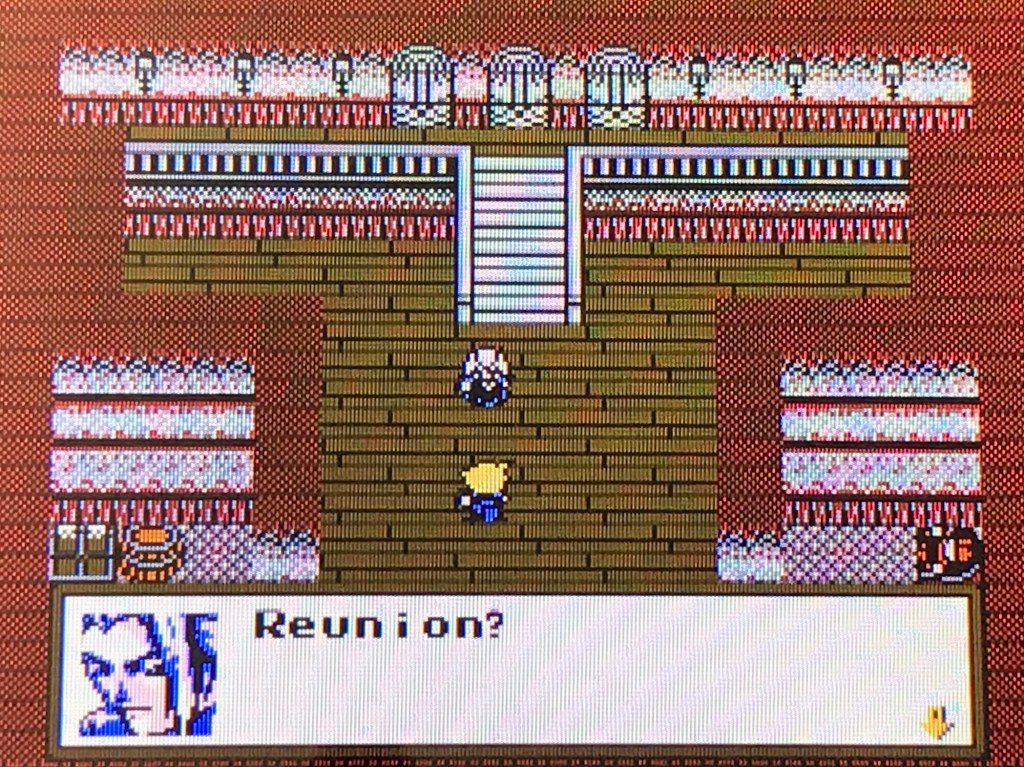
Let’s flesh out the thematic function of those two as “dead people” a bit more.
Aerith is kind of a no-brainer. Her greatest influence on the plot is exerted after her death and she seems to anticipate that something like death will be necessary before she can summon Holy. Sephiroth is a bit more tricky.
As is typical of Sephiroth, Cloud is directly affected. This is one of the reasons I’ve been at such pains to establish Cloud’s function as a narrator. This also relates to the fact that Cloud does not belong to the same “dead” category. But he’s not really like anyone else, either.

The transition between the two crisis layers is intimately tied to the shifts in Cloud’s mind. This creates an association between Cloud’s mind and the story structure. The link is preserved through his mental collapse and the summoning of Meteor. After that, Cloud disappears beside Sephiroth’s frozen body and resurfaces in Mideel, incapable of speech or any other outward expression. His reintegration into the party requires Tifa to join him in his mental solitude.
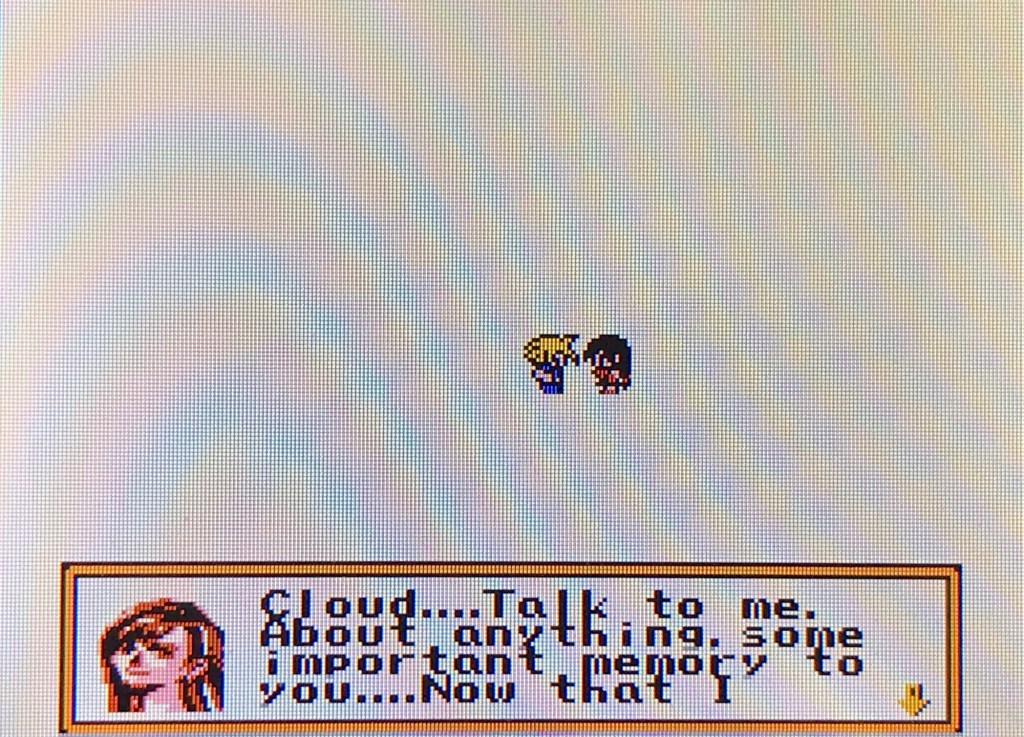
This is important for a few reasons. One of them is balancing Cloud’s point of view with the outside world. This then has to reconcile with the rest of the story, in which Cloud’s point of view dominated the foreground. The weight of the outside world is clear when Cloud himself has to accept it. The scope of the story gets bigger than Cloud once he “gets over himself.”
Sephiroth’s place in Cloud’s mind changes as Cloud himself does. With that in mind: excluding the blurring of Cloud’s stories and memory dynamics, what actually happened to Sephiroth?
He fell into a mako reservoir. Because of Cloud. Put simply- Cloud killed him. Along with everything else Cloud lied about and ignored…Cloud has also been carrying the private knowledge that he killed Sephiroth. And that, to the best of his knowledge, Sephiroth has been dead for five years.
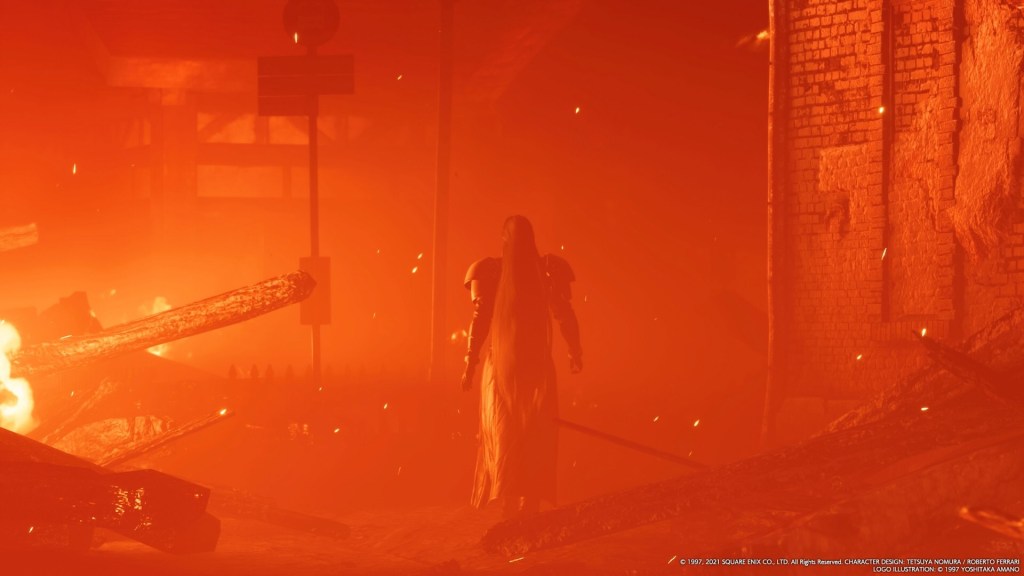
Five years later, his reappearance is not unlike a haunting. Before Sephiroth began sending his consciousness through a telepathic network of Jenova cell carriers, he existed in his original body. That body was pushed into a mako reservoir by Cloud, and ghosts often haunt their killers. Just like Barrett conjectures in Final Fantasy VII Remake, Sephiroth’s body ends up in the center of the planet, from which he and Jenova project their hauntings.
The psychoanalytic theme of suppression is emphasized by Cloud’s retelling of the Nibelheim incident garbled with his neurotic identification with Zack. One of the subconscious functions of this identification appears to be avoidance or disguise. The pain implied by this avoidance easily matches something very Freudian.

In Frued’s outline of the Oedipal complex, the castration anxiety at the dawn of the genital stage of psychosexual development is suppressed by rejection of the opposite-sex parent and identification with the same-sex parent. Cloud’s rejection of his own weaknesses prompts a sort of denial within himself which compels him to blend his self-image with male identity models, like Zack and Sephiroth.
If Zack’s example provided Cloud with a story that he would choose over his own memory, then Cloud’s stated motive (later in the original game) of neurotic shame makes sense. It makes just as much sense, though, when one considers only the truth of the Nibelheim incident without any stated motive in the present. We have already seen Cloud state his admiration for Sephiroth and his desire to be like him as a child, during the flashback with Tifa at the water tower. Watching your hero lose his mind and massacre your hometown is a blow…but so is killing your hero with your bare hands.

Many of the psychoanalytic themes become clear at this point. Cloud’s character arc rises and falls around how he crafts his identity. In his formative years, he preferred to deny his emotions and emulate others. In psychanalysis, one’s shadow self is a version of yourself containing every trait you wish you didn’t have. Zack and Sephiroth gave Cloud’s juvenile mind identity models that he used as an escapist fantasy. If Cloud was ‘escaping’ the weakness he perceived within himself, then identification with Zack and Sephiroth is determined more by what Zack and Sephiroth are not rather than what they are. Cloud only drops Sephiroth off the mako reactor catwalk after Sephiroth goes on his rampage.
Sephiroth and Zack represent power fantasies to Cloud but they are also the absence of his self-repulsion. When Sephiroth reveals himself as repulsive, the emotional betrayal is visceral. This anguish would have been present when Cloud made his suicidal, single-minded effort to kill Sephiroth. Cloud also spent most of his life wishing he was Sephiroth, which would continue to be part of the backdrop of his mind after the panic and agony of the moment was over. Responsibility for Sephiroth’s fall would not be easy to accept.
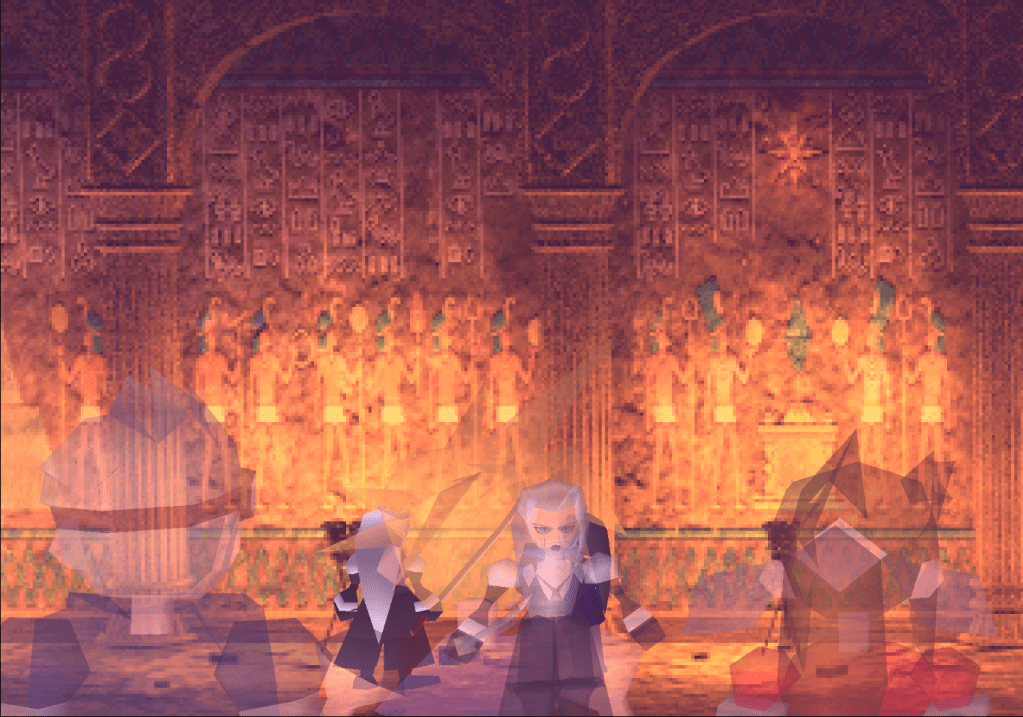
Meanwhile, all the psychic projections into the bodies of Sephiroth clones and SOLDIERs are proving that Sephiroth is not dead after all.
The metaphysics of souls, transmigrations, the uncanny and the parallels between a body and a puppet still matter…but before moving on from psycholoanalysis, I want to spend some time on the differences between Cloud’s memory of Sephiroth and Cloud’s memory of Zack. The memories of both figures furnished subject matter for Cloud’s delusions but I do not think they are equal. Final Fantasy VII Rebirth takes pains to emphasize this difference.

Consider two levels of power fantasy: one is that the world comes second and everything is about you. Others barely exist and when they do it’s for your benefit. The second level is to be valued by others.
Since Rebirth concerns the events between Midgar and the Forgotten Capital, Aerith’s place in the love triangle is foregrounded. Meanwhile, in an adjacent timeline, Zack managed to survive his last stand outside Midgar and jumped forward to the present of the main timeline. It looks like Zack has wandered into a world with no place for him, with a comatose girlfriend and bestie. On the other side of the wall of destiny, Cloud the bestie is subconsciously emulating Zack and growing close with his ex-girlfriend. One begins to wonder if the original love triangle (Aerith-Cloud-Tifa) matters as much as the new one (Zack-Aerith-Cloud).
A Freudian assessment comes easily to mind. Within his cluster of subordinate timelines, Sephiroth is omnipotent. In VIIR, Sephiroth’s Whisper-conglomerate contains multiple timelines worth of Gaias. The universes within (which haven’t been devoured yet) all have skies with a massive light-phenomenon called the rift in the sky. Zack may be in VIIR because he happened to be outside of Midgar when the wall of destiny appeared but it is just as likely that Sephiroth wanted him. In Rebirth, Marlene tells Zack that- unless Cloud wakes up soon -a “scary man” with long white hair will kill Aerith. Zack looks over his shoulder at Cloud and I found his facial expression difficult to interpret.
If we assume that this situation is constructed by Sephiroth, then maybe the Zack-Aerith-Cloud triangle was also Sephiroth’s doing. In my Rebirth theory (check the ‘Final Fantasy’ section in the menu for the whole thing), I entertained the possibility that VIIR’s extra-dimensional Sephiroth came from his own timeline, separate from the one we all know as well as the slightly different one that Zack ended up in. There are circumstances in Rebirth which made me wonder if Cloud had a special role to play in extra-dimensional Sephiroth’s timeline of origin- an essential ally.
In Rebirth‘s Kalm-narrative, Cloud remembers the death of a soldier who accidentally fell into the rapids of Mount Nibel. Later, he seems to recall that this person had been Zack. Also in Rebirth, Cloud remembers Tifa’s death at the hands of Sephiroth. As Cloud tells this version of things in Kalm, it feels almost as if Tifa was why he stopped his story when he did. Her death is a painful memory that he would rather not dwell on, at the same time that Tifa is sitting right in front of him.

This made me wonder if Cloud’s role in extra-dimensional Sephiroth’s original timeline depended on a personality change that was brought about by the deaths of Tifa and Zack. In Gongaga, extra-dimensional Sephiroth tries to convince Cloud that Tifa is dead and that the Tifa seen in the present is a shape-shifted cell-carrier.
As a traveller between timelines, extra-dimensional Sephiroth understands that any other Cloud he meets will probably not be the same as ‘his’ Cloud. He may therefore decide that, if he ever wants ‘his’ Cloud back, he would have to create him. As in- find Cloud in another timeline and make him viscerally experience the deaths of Zack and Tifa.
At the same time, there is blossoming romantic chemistry between Cloud and Aerith. Love for Aerith was also the threadbare hope carrying Zack through much of his arc in Rebirth. An acrimonious love triangle in which Cloud kills Zack out of jealousy would play into extra-dimensional Sephiroth’s hands. Perhaps more so, if Zack’s jealousy was aroused first and Cloud was forced to defend himself.
In classical psychoanalysis, suppressed jealousy and suppressed desire are inexorable forces. This story doesn’t play out that way, though, and I think that matters.
Since Square Enix has encouraged an association between Crisis Core: Final Fantasy VII Reunion and the VIIR project, the Crisis Core plot is relevant to this. There’s a decent chunk of the latter half of Crisis Core that consists of a kind of escort mission: Zack escaping Nibelheim with Cloud.
Owing perhaps to a difference in tolerance between SOLDIER graduates and everyone else, the concentrated mako bath within Hojo’s lab hits Cloud harder. He is inert and incommunicado for the entire time he is on the road with Zack. Yet Zack always addressses him and otherwise behaves as if Cloud is lucid and mentally present. Cloud could not express himself and was completely dependent on Zack. With Zack’s allowances for Cloud’s presumed perspective and interests, it’s almost as if Zack is exteriorizing two sides of a conversation. This is done, specifically, as Zack’s means of determining and caring for Cloud’s interests. Later, Jenova uses Cloud’s projections upon Zack as material for false memories.
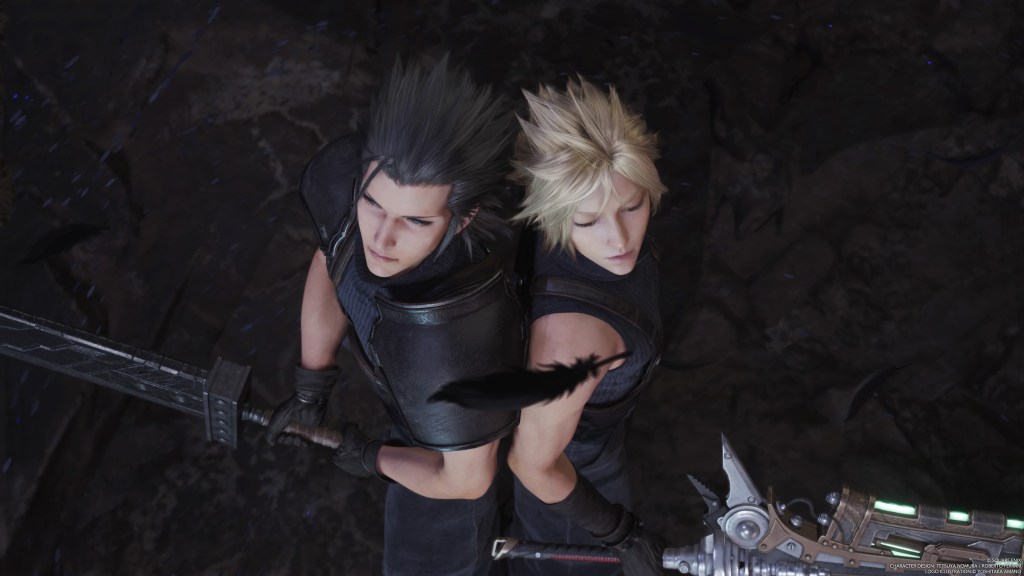
We know that Jenova has been using cracks in Cloud’s self-worth for psychological leverage. Feelings of unworthiness can furnish morbid envy…but the Crisis Core story introduces an essential difference between Cloud’s memory of Zack and his memory of Sephiroth.
Given Cloud’s perspective as a Shinra tropper, we can imagine that the visibility and status of Zack and Sephiroth would be enviable. Zack did something that Sephiroth never would, though: carry him out of love and try to understand and care for him in spite of the communication barrier.

No, this is not (as far as I know) discussed in the open. The inclusion of CCReunion into the VIIR canon means that it still matters, though. Barring future lore elaborations, I wonder if it is never discussed on purpose: these would, for Cloud, be memories of silence and vulnerability.
(During the times he was conscious, anyway. Cloud’s reaction to Zack’s death implied that he was aware of his immediate surroundings and situation at least some of the time.)

In the timeline where Zack finds himself in Rebirth, both Cloud and Aerith are rendered mute and motionless by mako poisoning. Once Aerith’s surrogate mom Elmyra enters the picture, she fully takes charge of Aerith’s care, leaving Cloud in the hands of Zack, just like the Crisis Core roadtrip. Sure enough, Zack continues to talk to Cloud, in the way that he always has (not to mention talking to Aerith). A few different scenes start from Cloud’s alternate timeline POV in the wheelchair (above), which plays well when the scene immediately follows Cloud taking a nap, as though he’s dreaming of the other timeline.
In other words, Rebirth shows Zack caring for mute and helpless Cloud…while Cloud in another timleine is emulating Zack with uncanny, The Talented Mr. Ripley-like ease, as sparks fly between him and Zack’s ex.
Between the two identity models (Zack and Sephiroth), Sephiroth telepathically urges Cloud to take any delusiory short cut to make things fit in the present. Whether or not Cloud is emulating Zack just as cynically is an unspoken question in Rebirth. Then the final battles start crossing dimensional boundaries and Zack and Cloud find themselves pitted against the same foe. After they are separated again, two different alternating scenes play of Cloud and Zack reciting the same oath with the Buster sword.
What really establishes the differences between the two identity models, though, is that Cloud cannot beat Sephiroth alone. After the dimensional rifts happen during the final battle, Cloud fights first alongside Zack and then with Aerith.
And, of course…those of us who played the original know that Cloud and Aerith were never meant for each other, anyway. All of this makes it difficult to think that Cloud could ever wish to steal Zack’s life no matter how Jenova takes advantage of his feelings.

And now, back to metaphysics and the soul.
In the intro, I spent a lot of time on the aesthetic motivations behind Final Fantasy character design leading up to and including VII. Hironobu Sakaguchi has explained that, up through VII, characters were modeled after puppets in dioramas. Since the influence of Dungeons & Dragons is all over Final Fantasy, I’ve occasionally wondered if they were also modeled after miniatures on a map. Especially given how the combat screens from the 16 bit games retained the chibi-doll character sprites whereas the monsters looked hand-drawn or painted. VII used the symbolism of non-literal chibis to acquaint the player with non-literal imagery in general, to build a foundation for a larger-than-life story.
I cannot help but wonder if the role of bodies, souls, hauntings and transmigrations in the plot is a knowing elaboration on the metaphorical language of puppets. Both Jenova and Cait-Sith talk about toys and puppets in a metaphysical context.

The metaphysics of the soul in FFVII also mark a central event in any other fantasy story: the unveiling of the cosmology. Lord of the Rings depends on our knowledge of Middle Earth history and the role played by Sauron. In FFVII, we get little snippets of cosmology throughout. But the metaphysics of the soul, projection, transmigration, haunting and the like are when the player/audience sees the cosmology- free from explication- in the present of the story.
Fantasy typically relies on an internal consistency to establish its own rules. That is why cosmology matters so much. In other words: fantasy depends on a central myth. Through explication, we hear a lot about Lifestream, mako extraction and Jenova. But we only see the central myth at work through Cloud, Aerith and Sephiroth. Mostly, we see it through Cloud- even when Cloud is seeing Aerith and Sephiroth.
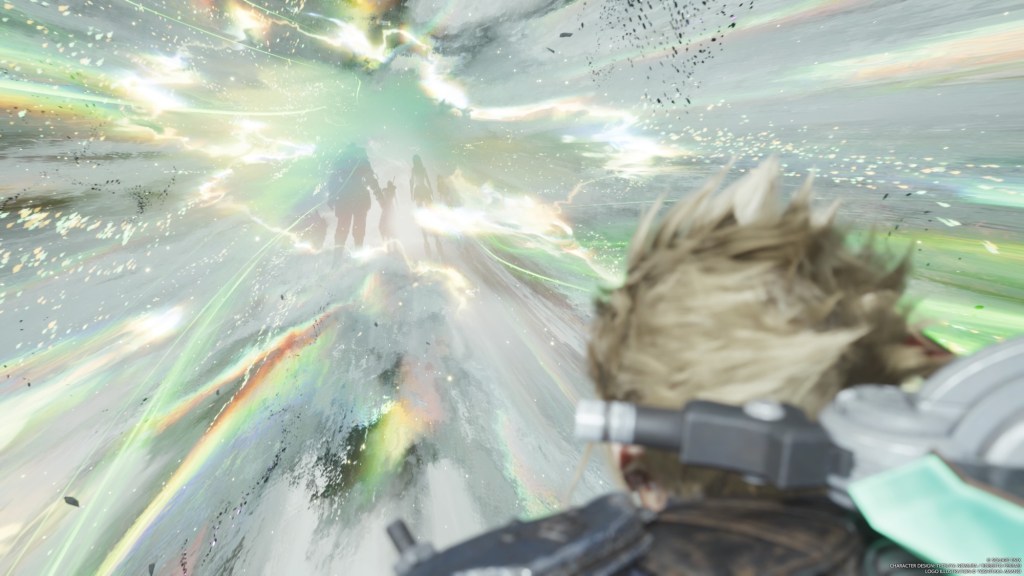
If Cloud has visions of the afterlife and the “true nature of reality”, then he appears to embody the mythic archetype of the pilgrim. And he resembles one pilgrim from world literature, in particular. One who, “midway along the journey of our life”, woke to find himself “in a dark wood”, having “wandered from the straight path”, who is then guided through Heaven and Hell by two separate guides. Both are deceased souls. One of them was an inspirational identity model of his youth. The other was a woman who elevated his romantic yearning to spiritual wisdom.
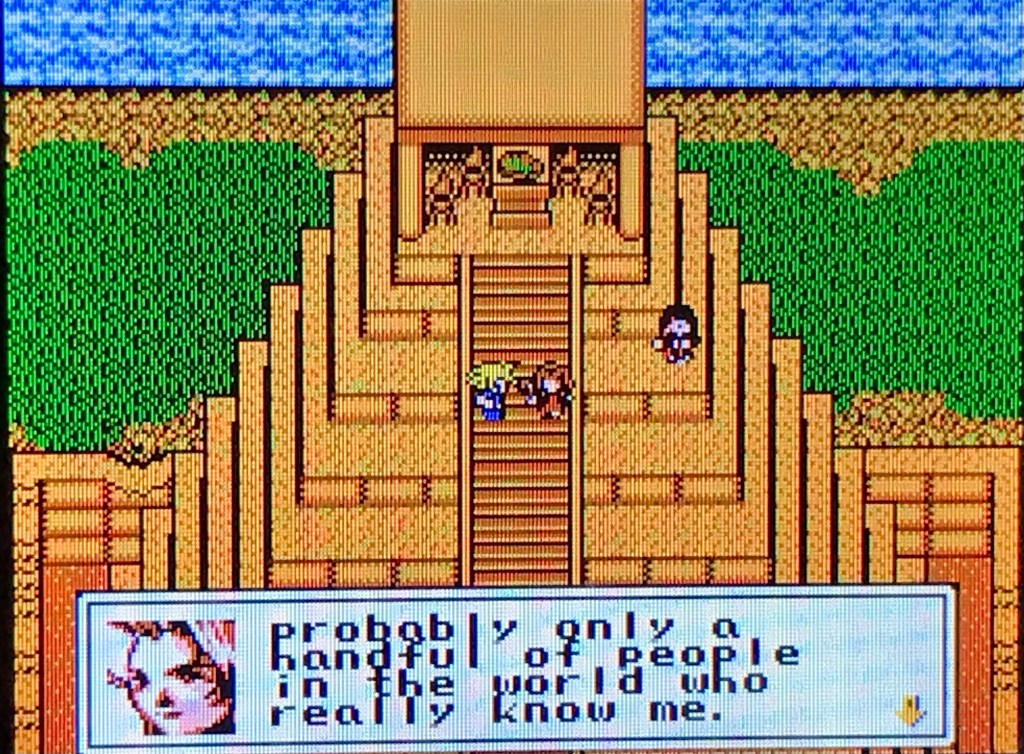
Even the love-triangle subplot of FFVII plays into this. Dante Alighieri modeled Beatrice after a woman he had fallen for. He avowed that he would write about her in a way that no woman had ever been written about.
If Cloud is an archetypal pilgrim, then he gets the literary fantasy treatment. He is not just a mythic pilgrim, he is Nojima and Kitase’s (to say nothing of Sakaguchi’s) version of a mythic pilgrim. He was also the last Final Fantasy main character to have the chibi-doll design. A design pattern that Sakaguchi felt was evocative of a puppet show.
The layering of the soul-investiture and puppet themes indicate the central myth. Cloud, the pilgrim, sees the world beyond the tangible. In the end, he masters his fear and grief and is less daunted by death. Not unlike Gerda from The Snow Queen or Dante.
Yes, all that explication about the Lifestream and mako and Holy still matters. But something told through explication just doesn’t shine as bright as a dynamic that unfolds through the course of a story.
Not that there’s any conflict between one or the other in this case. The major emphasis of the world-building is the transmigration of souls. Holy is a cumulative spiritual force embodied by souls en route to their next life. The exertion (or will) of this force is what people in FFVII are talking about when they say “the planet.” This holistic divine will is what is invoked with the white materia and the plot depends on it.
The central myth concerns the afterlife and its relationship with the rest of the world. Anything beyond that point is a matter of interpretation. That being said, I think there are a number of probable interpretations. The frequent use of psychological imagery depends on a distinction between literal and non-literal. References then stand out even more.

References to World War II are particularly hard to miss. Heidegger is named after Martin Heidegger, the German philosopher that collaborated with the Nazis and had a few of his students sent to concentration camps. Professor Hojo is also clearly modeled after Josef Mengele and the Cetra have an ancestral legend of a place called The Promised Land. The first Cetra victim of Hojo we see is Aerith, who is one of our two dead main characters.
Sephiroth has been initiated into a zero-sum game by Jenova. Among the cell carriers, Sephiroth is the dominant personality beside Jenova herself. In the Northern Crater, Jenova attacks the party in her original body for the first time (Jenova-SYNTHESIS). After defeating her, the first clash with Sephiroth (Bizarro) has two separate torsos, as if the body is split between two occupiers. In Sephiroth’s next incarnation (Safer), he has clearly come out on top. The extraterrestrial being is still the same except now it’s named Sephiroth instead of Jenova. After Safer-Sephiroth goes down, he tries to jump ship into Cloud’s body.
Sephiroth strives to absorb the Lifestream transmigration nexus into himself. Aerith, meanwhile, is attempting to channel the planetary will, shared by all in the transmigration nexus, for their own benefit.

The first allegorical Jew of the game lays down her life to preserve the divine and familial (one might say “brotherly”) harmony between all souls.
There are two basic concepts from Hinduism which also appear in Bhuddism: Atman, the individual soul, and the greater universal tapestry to which in belongs, called Brahman. Interpretive traditions like Advaita Vedanta maintain that the wholeness of one depends on connection with the other. This is evocative of the Bhuddist concept of interbeing: the irreducible essence of the individual is nurtured and cultivated by the outside world. One necessitates the other.
In Final Fantasy VII, a soul grows and matures during the mortal journey and takes that accumulated vitality with them when they die. The soul passes into the Lifestream transmigration nexus, where the maturity of that soul will diffuse among all others and nurture them, before starting the cycle over again in the next life. This also analogues the indivudual / collective unit of the Jenova cell carriers. Some fans theorize that a being like Jenova is what happens to a Lifestream once it’s excised from a planet.
Then there’s the combined Semitic and Christian symbolism of Aerith. A few years ago, I replayed the original FFVII with a close friend. During the last psychic exchange between Aerith and Cloud in the Sleeping Forest, my friend commented on the similarity with the Agony in the Garden of Gethsemane: the kiss of Judas by which the Romans knew Jesus.

Cloud as an archetypal traitor makes too much sense for comfort. I remember, when I first played through the Temple of the Ancients, I was horrified when Sephiroth’s mind control took hold. A different, child-like segment of Cloud appears to separate from his body, and then he beats the shit out of Aerith.
I guess this is one of those moments in which the puppet show either works or it doesn’t. In my opinion, it was uncomfortably successful. That scene, along with the first two scenes with the ‘Who…Are You?’ scoring, were nightmare fuel to me as a preteen (pretty cool reimagining of that song in Rebirth, btw, which somehow didn’t make it onto the commerically released sondtrack).
I’m tempted to read that implication as more relevant to Cloud’s feelings about himself at that moment, than anything else. All of Cloud’s guilt- all of his worst thoughts and feelings about himself -have accumulated into a perfect storm by the time the party arrives at the Northern Crater. Sephiroth then goes for the psychological / telepathic jugular by erasing his sense of self and convincing him that he’s a botched Sephrioth clone.
The gradual, layering use of non-literal and psychological imagery allows the historic, literary and religious allusions to rise to the surface without speaking too loudly. This is, pretty much, why I’m confidant that the commercial and cultural engineering of upper Midgar has a soft 1940s influence. That, in turn, creates a close degree of association with the cinematic themes I mentioned in the intro. I thought that cinematic expressionism was a close relative of literary fantasy to begin with since they establish internal consistency using very similar narrative cues. More than anything else, though, I find it easiest to associate the early 1940s-ish imagery of the original’s beginning with the two most visible nuke analogues: mako reactors and WEAPONs.

The analogues between mako reactors and fossil fuels and nuclear anxieties are apparent. The WEAPONs are a bit less obvious, though. WEAPONs are ageless beings originally conjured by the planet to fight Jenova. Since Jenova’s cells have been dormant for thousands of years, so have the WEAPONs. Once Meteor is summoned, the primordial kaijus start waking up.
Kaiju movies showed up just after WWII. Nuclear fallout creates giant monsters that level cities. The kaiju cultural footprint has become ubiqitous enough to lose any specific association with the post-war era but the rest of the original FFVII makes the WWII themes difficult to ignore. The WEAPONs may not have been created by human meddling but they are summoned by it. They were originally created to fight a hostile alien and humanity- in late FFVII -has made itself equivalent to hostile aliens. Human meddling didn’t create them: it was just the last straw.
When Shinra goes completely off the rails, there is no one to say no to Heidegger, Scarlet and Hojo. Scarlet and Heidegger build a giant mech called the Proud Clad which has no in-world model other than the WEAPONs, as if Scarlet and Heidegger saw them and thought “that looks cool, let’s do our version”. Heidegger and Scarlet build their own WEAPON while Hojo is using every reactor in Midgar to power the Sister Ray and blow the seal off of the Northern Crater. The kaiju born of human meddling only appears when the most powerful humans lose their minds. After that, the world has seven days until Meteor and barely makes it by the skin of its teeth.

Then VIIR and Crisis Core introduce the possibility that Midgar has never been in a period of peace. After the ceasefire with Wutai, Shinra experiences a rash of SOLDIER desertions and defections. Rebirth tells us that at least a few of them (not depicted in Crisis Core) joined Wutai, such as Glen Lodbrok (even if he’s little more than a Sephiroth finger puppet like most of the cell carriers).
In the VIIR games, AVALANCHE is a global, decentralized guerrilla network with ongoing operations against Shinra. To the chagrin of Barret and the Midgar cell, AVALANCHE also has interests in common with Wutai and collaborates with them.
So Shinra declared victory against Wutai and has still never known peace. Since Hojo’s work on the SOLDIER program, there just hasn’t been an incentive for peace. The military apparatus of Hojo, Scarlet and Heidegger has become a self-perpetuating institution. The historical parallels are apparent.
Seraphim’s page:
http://elbryan.tripod.com/FinalFantasyVII.html
Other stuff:
 AilixChaerea