
Content warning: R and Nazism
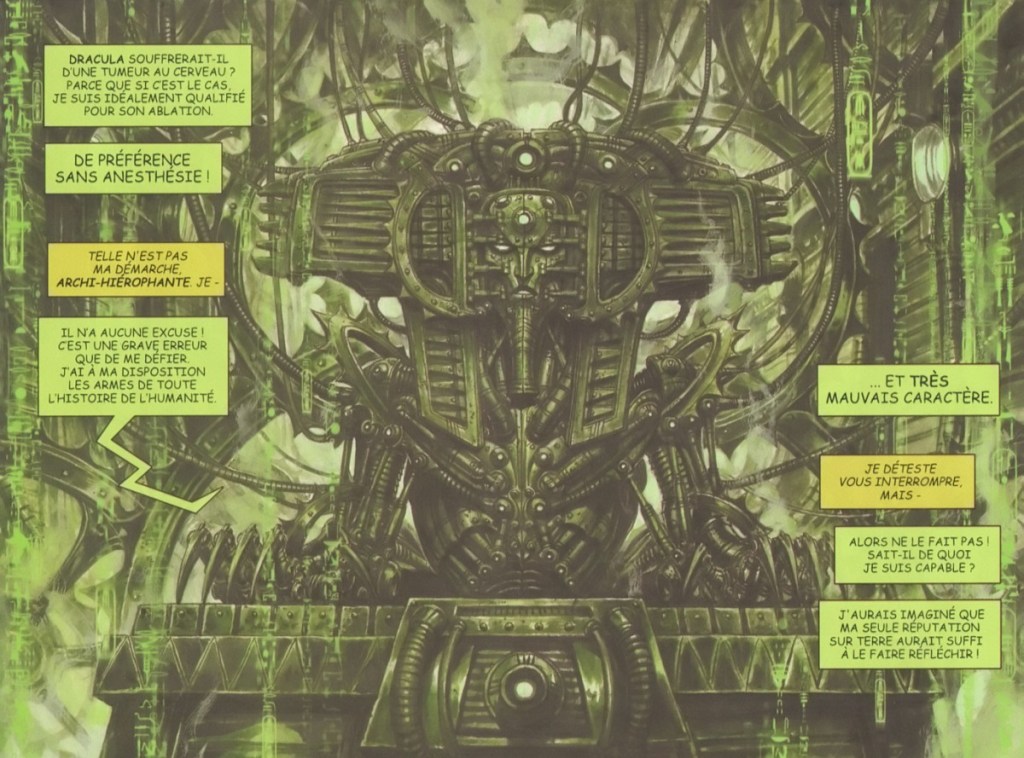
Four volumes in, we know that realms analogous to different planets in a solar system exist in Resurrection. Yet going from planet to planet does not necessarily entail regional departure. At a glance, each named location in Resurrection potentially has its own version of interstellar space. This also seems to be the medium through which different vessels pass. To travel from Necropolis to Lemuria may be equivelant to entering a different galaxy.
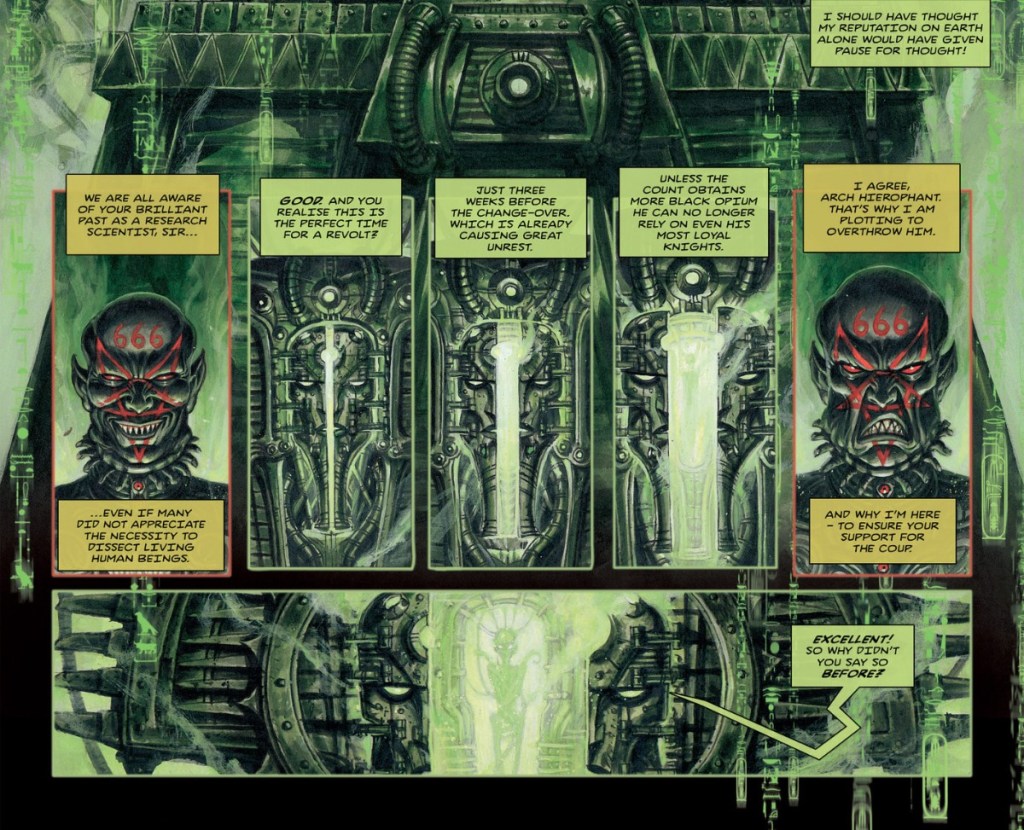
As Rebecca intimated in volume one, different transmigrants end up in different places in Resurrection. Rebecca herself went to Lemuria, where we see both variable weather and daylight. Unlike the vampires of Necropolis, who see Resurrection as a shot at eternal life, a vampire hunter in Lemuria looks forward to ending their stint and transmigrating elsewhere. Often, they are assigned a specific vampire or group of them, whose deaths will allow them to trasmigrate beyond Resurrection. Because they look forward to a next step, they have no interest in establishing permanent settlements like the vampires or establishing new, Resurrection-based identities. Lemurians frequently discuss their human lives and bond with other dead people over their shared humanity, which raises questions about the ghouls.
Like vampires, ghouls have settled territory in Resurrection and intend to hold on to it, perhaps explaining in part why the ghoul pirates are historical enemies of Necropolis. Ghouls intend to settle down as permanently as vampires, without the crafting of a secondary identity. They swap stories of their human lives and bond over them, like the Lemurians, but ghouls mostly dwell on how injustices suffered in life made them what they are. Constantly refreshing their anger and bitterness from their human lives seems to give them a parallel edge to the vampires. If combat, to Necropolitan vampires, represents a carnal indulgence- a battlefield packed with victims with new Resurrection bodies circulating perfectly edible blood -then for ghouls it is a cathartic indulgence. Vampires simply enjoy drinking blood and holding on to their territory. Combat has the easy mental access of pleasure-seeking. For ghouls, it has the easy mental access of releasing long-suppressed rage.
When extra-dimensional rifts open in Resurrection, many are happy comb through the Earthling wreckage for technology and then destroy the remaining evidence. Necropolis have a whole professional caste dedicated to this called Archeologists, who understand this as both a duty and a natural law: Resurrection has a backward time flow. There is probably some truth to this, since vampires appear to age backward (unless they die in battle or suffer intrigues at home, in which case their soul may be either annihilated or go back to Earth, potentially to arrive in Resurrection again, like our main character). Cryptos, after all, is a creepy little ancient baby that reminds me of Garlic Jr. from Dragon Ball Z. Vampires worry about suffering the “senility” of becoming a teenager, child or infant again. Another sign that Resurrection stands beside the Earthly time flow is the spectrum of weapons which Necropolis has hoarded and reverse engineered: everything from far-future lasers to firearms to swords and maces.
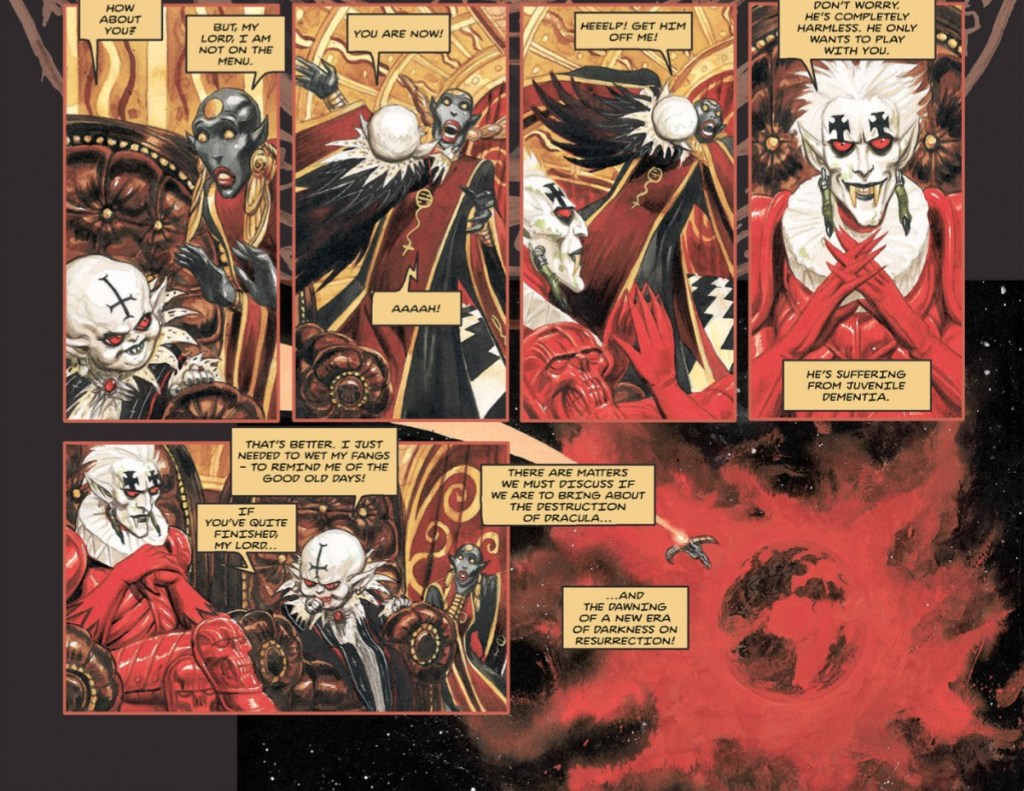
Despite the ubiquitous fear of growing young and the visibility and power of Cryptos…it’s hard not to wonder about the whole truth. Early in volume one, Otto tells Heinrich that the fragments of Earth that show up through the dimensional rifts are “uncreated” by the backward time flow. That, at least, appears to be a lie, since the duties of the Archeologists include burying all traces of the fragments of Earth from different eras and timelines after looting them. If not a strict lie, than a cultural / institutional construct, since the disappearance of the Earth fragments is enforced.
Then…in the company of a recently transmigrated vampire, Otto says that the same cosmic tide that causes these rifts will also attract demons and dragons all over Resurrection. These cosmic tide / wave events require everyone to barricade themselves and wait it out.
Just like vampires, vampire hunters and ghouls…this usage of ‘demons’ and ‘dragons’ has specific in-world meaning. They are manifestations of negative emotions from sentient beings. Demons and dragons serve beings we’ve heard about a few times but have heard nothing specific about until now: the gods of Limbo. Otto explains further than the gods of Limbo are extra-dimensional beings that cannot be perceived from the third dimension. From the dimensional vantage point of Resurrection, they are some of the most deadly beings in that universe.
Parallels with the collective subconscious emerge and an insinuation that Resurrection is directly adjacent. Close enough for the puncture of one to two barriers to make all the difference. We’ve encountered other claims about the cosmology, though, such as the backward time flow. One wonders how much of the apparent ‘collective subconscious’ is organic and how much may be either misunderstood or institutionally enforced. There seem to be ordinary gaps between perception and understanding, as in real science.
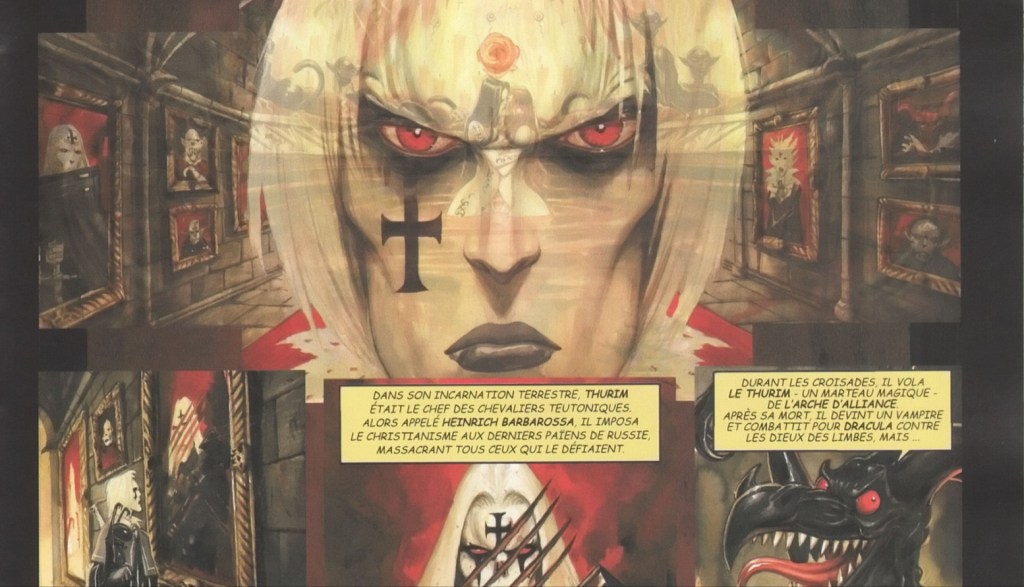
The possibility of a timeline of these discoveries is intriguing: on one hand, Resurrection clearly exists outside of the time flow that contains the three-dimensional point of view. The diversity of the relics taken by the Archeologists indicate that Resurrection is, in fact, independent of any timeline or era. Yet institutional behavior and the intrigues and vendettas of the Necropolitan court tell us that Resurrection must have its own, subjective time line. Once upon a time, when the soul called Thurim had only just transmigrated from a lifetime as Heinrich Barbarossa, the vampire Nero annoyed him with his music. Nero took offense, challenged him to a duel and got his right arm chopped off. Since Nero ranked higher in the court, Barbarossa Thurim was tortured to the point of apparent obliteration by Nero. When the soul of Barbarossa returns as Heinrich Requiem, who became an SS officer and died on the Eastern Front during an attempted rape…memories start returning. Heinrich Requiem realizes it is essential that neither Nero nor Dracula ever learn that he carries the soul of Thurim.
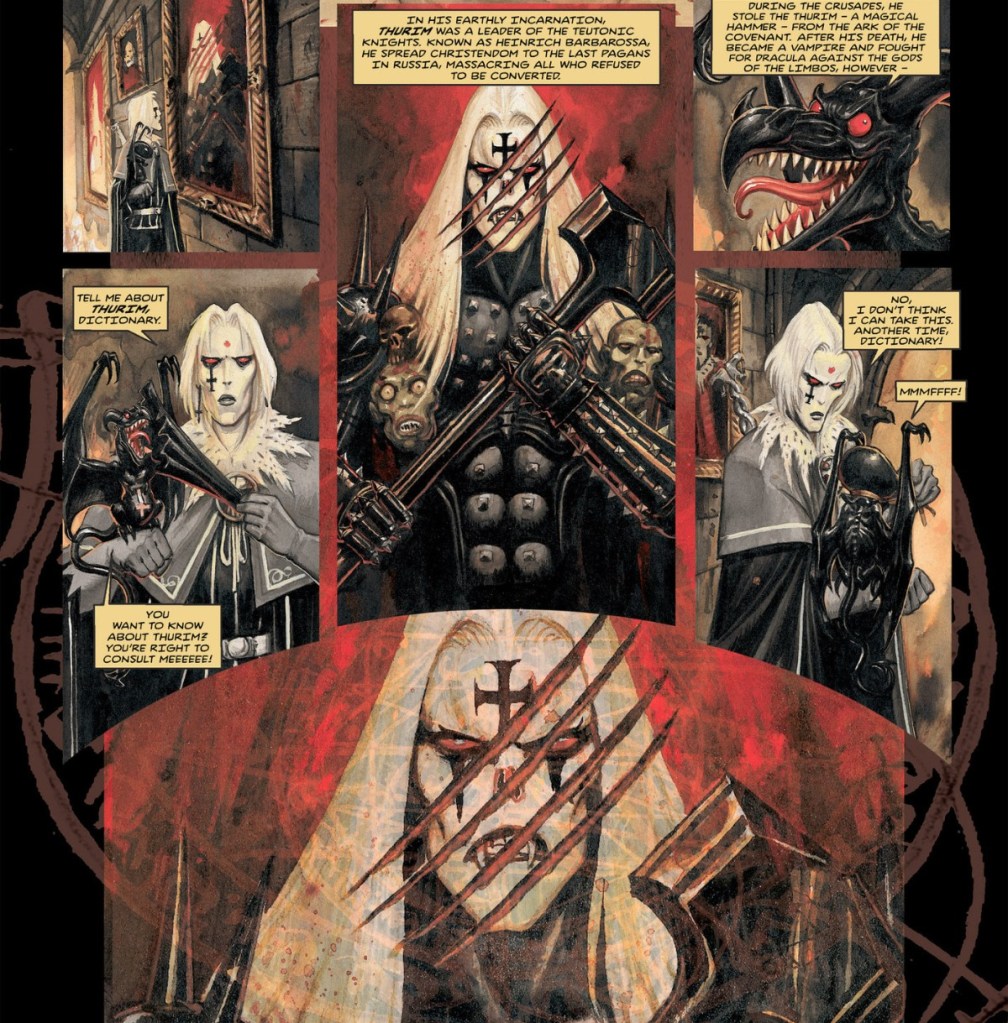
Like the relative differences in progress between institutions in Resurrection, the existence of these vendettas also prove that Resurrection has its own hermetically-sealed time flow (whichever direction it goes in).
During the second half of volume four, Heinrich Requiem experiences his first conflict between duty and conviction. When Requiem was a living Nazi, he hid a Jewish lover in his personal estate. This woman was Rebecca. Eventually, Requiem himself is the one who rats her out to the Gestapo: he simply became a Nazi of conviction after a while.
Yet he is still dwelling on Rebecca’s memory and punishing himself for it just before dying on the Eastern Front. He mourns for the death and destruction he caused but cannot resist renewing his damnation when he encounters a Russian woman who happens to resemble Rebecca. As his soul descends to Hell for the second time, all illusions flee from him: all he ever did was take victims for his own benefit. He is a soul-deep predator and he refuses to look his after-death destiny in the face without accepting that fact. That acceptance made him a vampire in Resurrection (reminder: vampires are souls who were aware of their evil and are unrepentant).
Rebecca, having been dead for some time, is now a Lemurian vampire hunter. She tells him, telepathically, that if he kills his first vampire companion (Otto), then he can leave Resurrection with her when her time comes. He cannot bring himself to do this and once again they are separated by his inequity. All done already, in the past, never to be negotiated with.
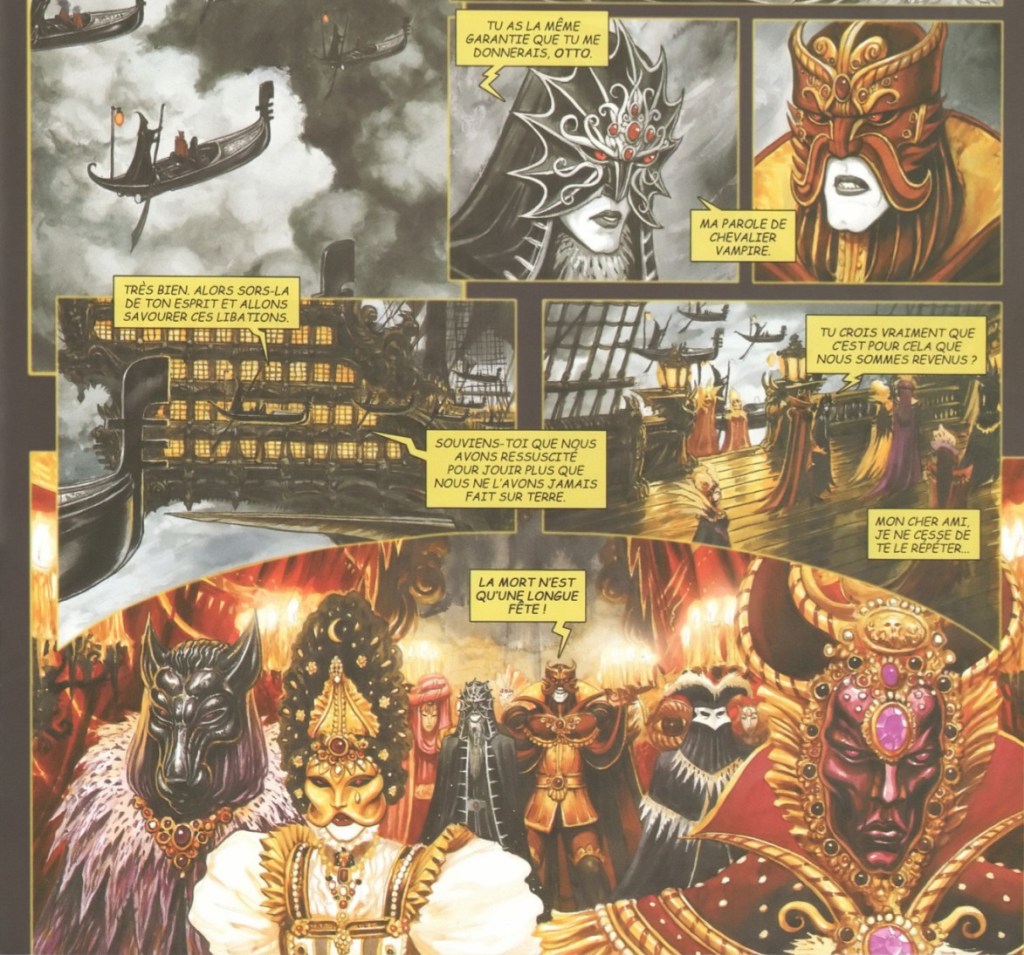
Otto informs him that this is the healthy path for a vampire: the destruction of human identity and the establishment of an infernal one. The destruction of one’s mortal self is equated with the authenticity and credibility of their vampiric self. Part of this is black opium, harvested from a world in Resurrection called Atlantis. Black opium is used, by every vampire, to keep memories and feelings from their human lifetimes permenantly suppressed.
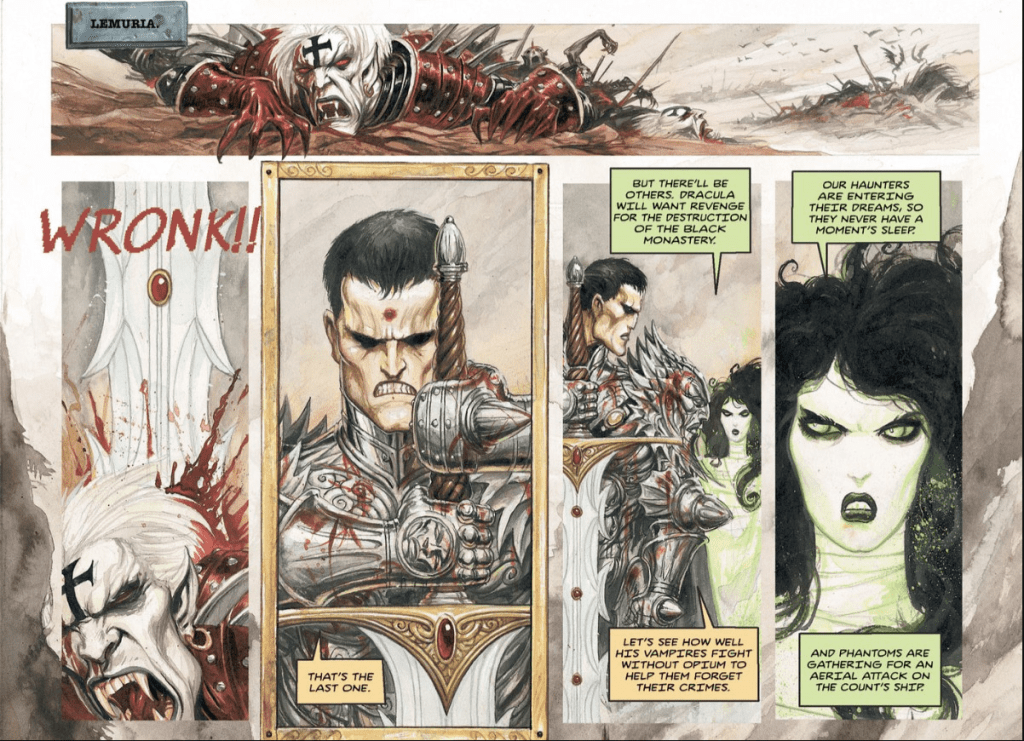
After Atlantis is surrounded by anti-Necropolis partisans, Dracula is forced to consider other options. As a temporary stop gap measure, he launches a victim raid on Lemuria to soften the blow with more blood to go around. We are soon in the company of Rebecca and a new Lemurian flame: Sean, who lived and died in a different era. Rebecca and Sean get the jump on a company of vampires and- as Sean is running a massive sword through one of them -says “Let’s see how well his (Dracula’s) vampires fight without opium to help them forget their crimes.”
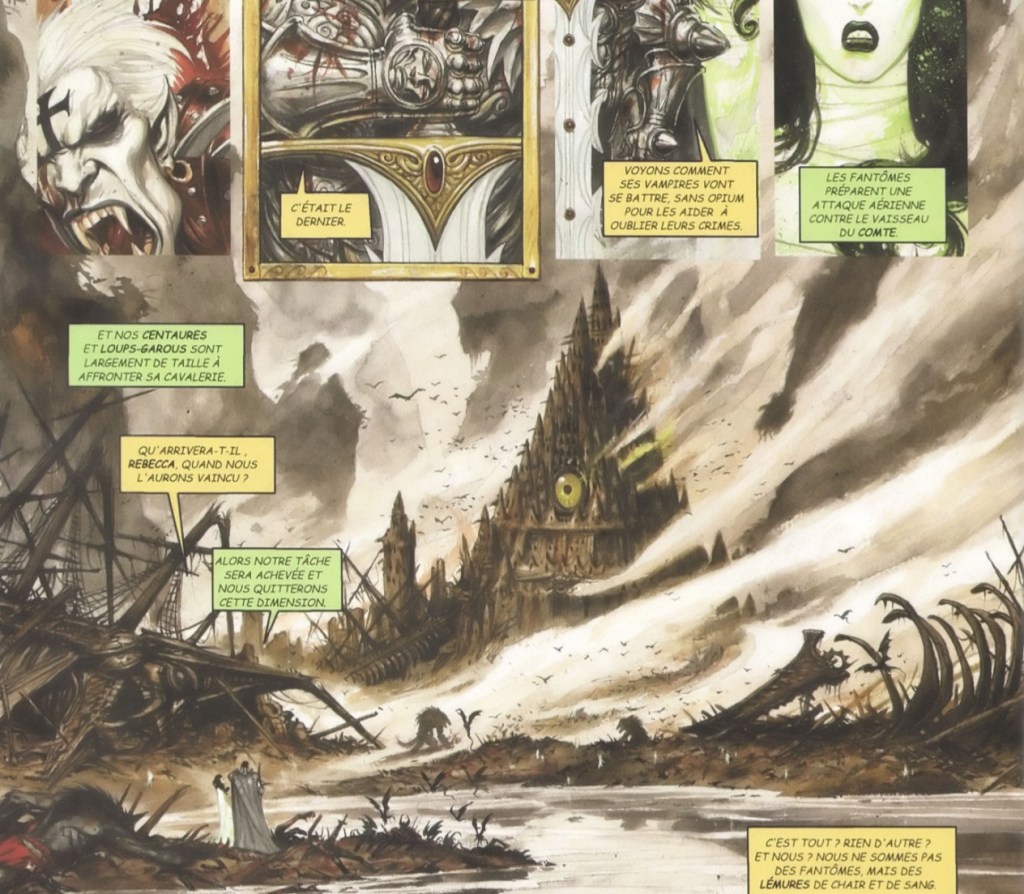
The regular use of the black opium is a genuine preference for most vampires and maybe most of them do it for the reason Otto said. Yet like the time flow, one wonders if there are other factors beyond the obvious. That early instance of Sean butchering a vampire implies that the black opium has another role that is more functional and less indulgent. Is it possible that the whole taboo around maintaining your human identity was engineered specifically to control vampires in the best way possible: lead them around by the nose.
Throughout all this: Heinrich and Otto are two peas in a pod. Neither one seems to have a closer friend in Necropolis than each other. They even knew each other as humans: both were SS officers. Otto seems to be taking Heinrich in hand as simply a “younger vampire”…yet if their identities are meant to be wholly separate from your human self…maintaining human relationships (even ones that pushed you further toward evil) sounds iffy.
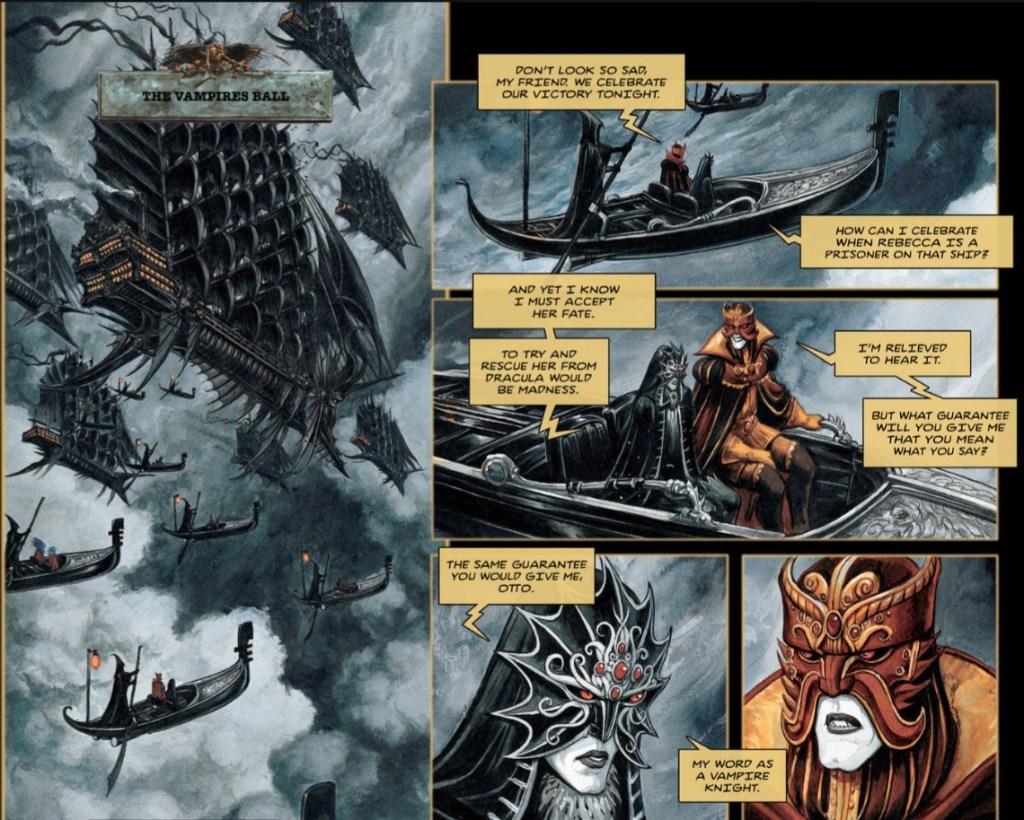
I’m doing my usual thing where I go through a comic / book / video game / whatever at my own pace and post as things occur to me. I like figuring things out and even the twists and turns of misunderstanding have their charm. I get that there’s online lore sources I could easily check this against. From where things stand now, though…it would not surprise me if Otto recognized Thurim for who he was, immediately. In that event, all he would have to do to ingratiate himself to the Necropolitan court would be to hand the soul of Thurim over to Nero and Dracula. What Otto may be doing is maintaining a private confidence between himself and Heinrich, in which one can express disloyal thoughts under the guise of one not knowing any better and the other correcting him. Otto is, by his own standards, undermining Heinrich’s vampire identity while creating a personal channel through which Heinrich may “leak” revealing information to him.
At the end of book four, Heinrich flees Necropolis with Rebecca, who was taken captive after the Lemurian raid. If Otto was surveiling and undermining Heinrich, his success or failure may soon be apparent.
 AilixChaerea