
We Are Chaos and both chapters of One Assassination Under God are among my favorite Marilyn Manson albums. There was material from the 2007-2017 period that I thought was solid (my favorite from that group would be The Pale Emperor). None of the ‘07-‘17 work, though, grabbed my feelings and imagination as powerfully as the Triptych. The next two bodies of work did.
Several themes and concepts from the past reappear with discrimination. The immediate elaboration of the older snake and bee imagery in a new context was part of what won me over to We Are Chaos.
As I type this, I wonder if that has played some role in the divided reaction among fans. Manson is aware of what he does best and how to build on it but he’s never been interested in retreading old ground. Retreading is usually what people want. Luckily, Manson never listens.
While he uses his prior body of ideas as stepping stones rather than the point itself…even those hoping for echoes of Antichrist Superstar won’t be disappointed. It just isn’t super-reverent or imitative. Depending on the listener, that may push it across the uncanny valley in one direction or another.
The biggest thematic similarities with Antichrist Superstar are cyclical time and awakening, which- when combined -gives us relative perspectives of time from different sides. Themes like that tend to piss people off. The reaction often feels like “Why is the author now acting like a character?”
Having listened to both chapters back-to-back once and chapter 2 thrice so far, I believe that chapter 1 is one side of the wall and chapter 2 is the other. I’ve already written a lot about the dream-within-a-dream/ladder-of-consciousness themes in my Triptych analysis (go to ‘music’ and scroll down to the ‘album as an art form’ list if you’re curious). The Triptych is a very procedural creation, though, in which one’s point of entry can effect how the overall panorama unfolds. It is meant to have multiple entrances and the story is busy.
That can also be true of One Assassination Under God but the two chapters give it a more direct symmetry. At the point of inception, it feels simpler.
Looking back over my chapter 1 review, the simple moments felt like some of the more uncomfortable ones. When it seems like an artist may stop creating and then continues…simplicity smacks of finality. You wonder if the blunt, right angles mark a precipice rather than a wall or a roof.
Chapter 1 wakes up inside of chapter 2…but chapter 1 had it’s own discussion of awakening. On Antichrist Superstar, the dream narrative haunts the waking narrative. The influence of the dream lasts long enough to reshape the dreamer in its image. The proven instability of one lays the ground work for the instability of the other. A monster wakes from a paranoid, self-demonizing dream. It ends with the question of whether the dragon is beautiful or terrifying. A listener likely understands that they can be both but who knows if that particular dragon did.
One Assassination Under God builds on this. The first three songs of chapter 1 reminded me of the first three songs on the three Triptych albums. A place (title track), the people (No Funeral Without Applause) and the person (Nod If You Understand).
The fourth song, As Sick As The Secrets Within, feels so lucid as to make the prior three fantastical by contrast. It is when we get our earliest personal look at our viewpoint character. Much of the lyrical imagery in both No Funeral Without Applause and As Sick As The Secrets Within remind me of the ACSS transition from Dried Up, Tied And Dead To The World to Tourniquet. In a story as manic and black-and-white as Antichrist Superstar, that transition is one of the most gray, tender and complicated moments.
The lucidity of As Sick As The Secrets Within roots us in a viewpoint character but without the character names to let us know what aspect is positioned relative to what. Because of lyrical themes that have been present throughout Marilyn Manson’s career, I found myself referring to this viewpoint character as House Face in my notes.
House Face wakes up, has a few direct, waking observations and then starts to choke on what he is waking up to. The last song on chapter 1- Sacrifice Of The Mass -was one of those scarier, simpler notes that made me wonder if House Face just ran off of a cliff.
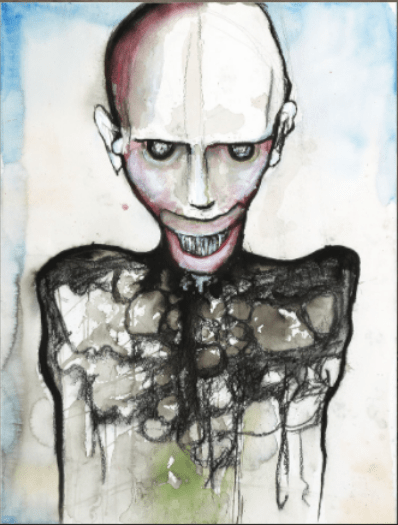
Around the release of chapter 2, a new section of the Marilyn Manson website appeared: a sort of virtual art gallery (with a spatial interface that reminded me of the White Enamel ARG website) featuring paintings associated with each song and some brief remarks on their composition. The environment is movie theater-like and brutalist. Equidistant to a theater, a university and those stoney public ashtrays that used to be everywhere and now mostly huddle around DMVs and police stations.
When I first heard chapter 1, I thought the speaker of ‘Nod If You Understand’ was meant to articulate that phrase to someone else. In his commentary, Manson says the song is written from the perspective of one to whom it is spoken. The lyrics come from behind that silence and the associated painting is a figure whose slit throat looks like a second mouth with more teeth.
In the Triptych one-two-three beats, Nod If You Understand would normally have marked the viewpoint character. Upon awakening, the place, the people and the person are like ephemeral archetypes. Dream images that get shaken off. Sacrifice Of The Mass then felt like House Face’s own vulnerability, as though he were a dream to be shaken off by the rest of the world.
Manson has lately stated that chapter 1 was contemplative and chapter 2 is active. I myself see both of those present throughout. Chapter 1 does have a noticeable familiarity with personification and dream imagery but chapter 2 seems stylistically self-aware; proud of its own constructed nature (as anyone must be if they don’t want to curl up and die).
In the website’s new annex, Manson said that the name of Sacrifice Of The Mass came from a thin, black book which his father obtained in the course of his life in the Catholic Church (I may be misremembering but I thought– in the website commentary -he described the book as being somehow ‘Catholic’?). This flows with the last rites lyrical themes and puts a funerary bow at the end of chapter 1. Chapter 2 makes it plain that the funeral was not the end. The ceremony is over and the body is buried, yet the book does not stay closed.
Manson described As Sick As The Secrets Within as a process of outsmarting your demons. to “unhaunt” oneself. If chapter 1 woke up inside of chapter 2, then the existence of House Face persists as a haunting and his grisly, toothy smile is the only one he has.
Sacrifice Of The Mass was dour, dramatic and final. Chapter 2’s opening song, Unalive, has the musical character of a sudden, panicked awakening; whatever it was you intended to leave behind has followed you.
We begin with the same sing-song rhythm as the title track, this time channeled through the guitar riff that Manson sings over.
The three opening beats of the Triptych albums are a zoom-in. This awakening zooms out but the very large has a way of mirroring the very small. The execution imagery of the title track has receded and coalesced into something less civilized and more personal. Not the spectator sport of execution but decimation: ten newly-fledged soldiers draw lots. The loser gets stabbed by the other nine.
You are then bound together: to be otherwise is to admit that the sacrifice was in vain. Loyalty becomes a question of desperate insecurity. The charge goes on, like House Face off the cliff. The stakes get higher.
Something about this makes me think of my early misunderstanding of the Red, Black And Blue lyrics: “set fire to the Tree of Life / love or death / just to watch the suffering”. The “love or death” part was what I misheard the first time and I still hold to it as a kind of head canon. My mind may be acting on an association between “get high on the smoke and dance / in the ashes / this arrangement is deranged / imagine us engaged in flames” and “Hold hands around your fire / Burn you like a church / get higher than God / You won’t rise again / And we’ll rejoice”.
‘Unalive’ can look like an uncertain little word. Yet fear on this album holds hands with abstraction (“eyes may cry but I’ll never weep”). Is it prim avoidance or literally descriptive of one dangling from the edge of existence?
The haunting imagery comes together as a poltergeist in Don’t Answer The Door. We spent much of chapter 1 on the inside of House Face. In chapter 2, we are in the room with him. In the first few lines, we “Unscrew the lightbulbs / In your eyes / Let my darkness inhale you / Can you hear my voice when you breathe out”.
The familiar, Mansonian cluster of voices has come back to us, clearly embodied in a single being rather than a mysterious revolving door. We are immersed in the insanity of a haunting. The insanity is awareness of each separated part, feeling each other and pulling together. It’s not a slow or quiet song but the band definitely steps back for Manson’s voice to take the foreground and I’m pretty sure I’m more convinced by this character-affectation than any other he’s attempted in decades.
I get that this is supposed to be more direct and personal than a lot of his previous work but someone like him can’t keep imagination out any more than I can. In any recording there are always blank spaces wherever a cut happens, however seamless they may be. Those blank spaces are the skeletons of some of the best art that I know of.
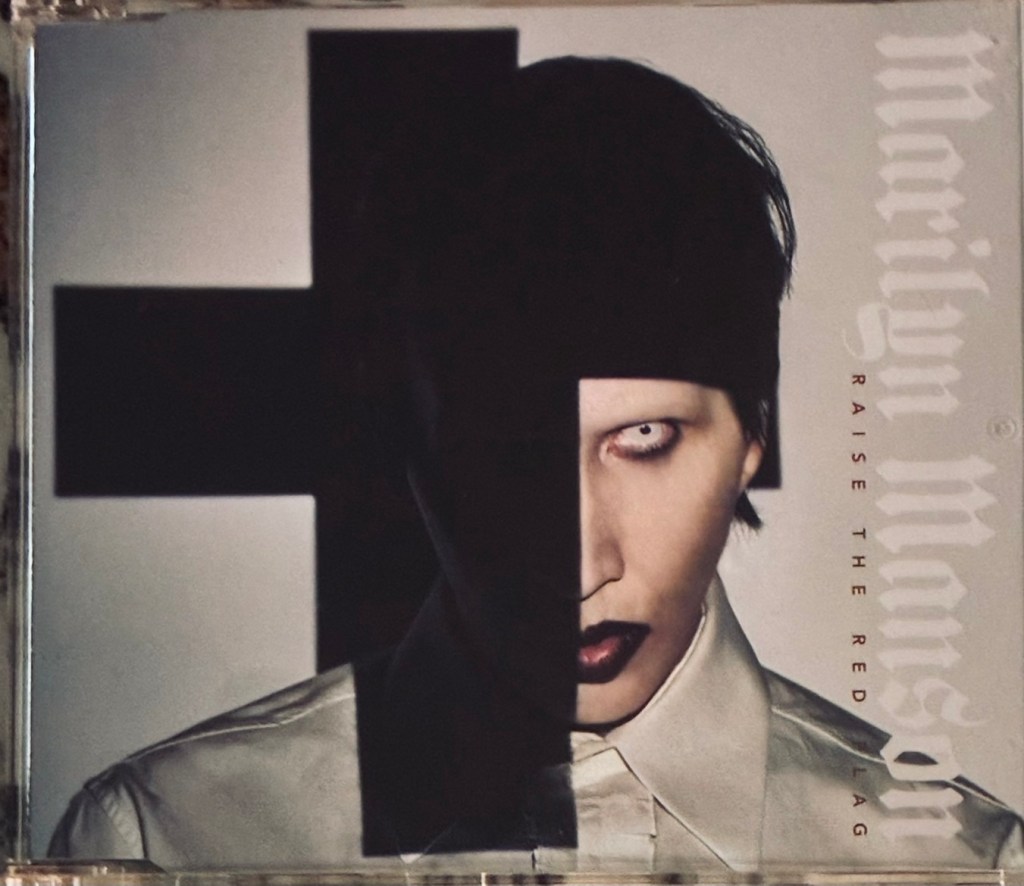
Front Toward Enemy flirts with the color associations of Red, Black And Blue. House Face unhinges his jaw and swallows his enemies. This song is also way more convincing in the context of One Assassination Under God chapter 2 than it was on the Raise The Red Flag single from 2024. Re-positioned as a single from this album, it reaches par with the single power of Sacrilegious.
Sacrilegious was a different kind of single than Front Toward Enemy but I think I detect an energy exchange between those two songs. One thing they have in common is the unambiguous emergence of personal certainty.
My entire life…I’ve had strangely specific ideas about my personal power and influence. Even in early childhood. Often, I’ve felt that not using it at all is better than using it destructively or frivolously. This dovetails with a kind of popular wisdom: “People aren’t stupid. They don’t need your opinion or guidance.”
At present…that could not be more wrong.
Ironically, I find myself way less afraid of my own power now than ever before. Which for me is a dizzying stock-taking.
All The Vilest Things is definitely more sonically layered and gentle than the first two singles from chapter 2…but I think it could actually do some heavy lifting beside some of Manson’s older, more complicated songs that ended up as singles, like Coma White (frequent contender for my favorite Manson song beside the 1999 live acoustic version of The Last Day On Earth) and Overneath The Path Of Misery.
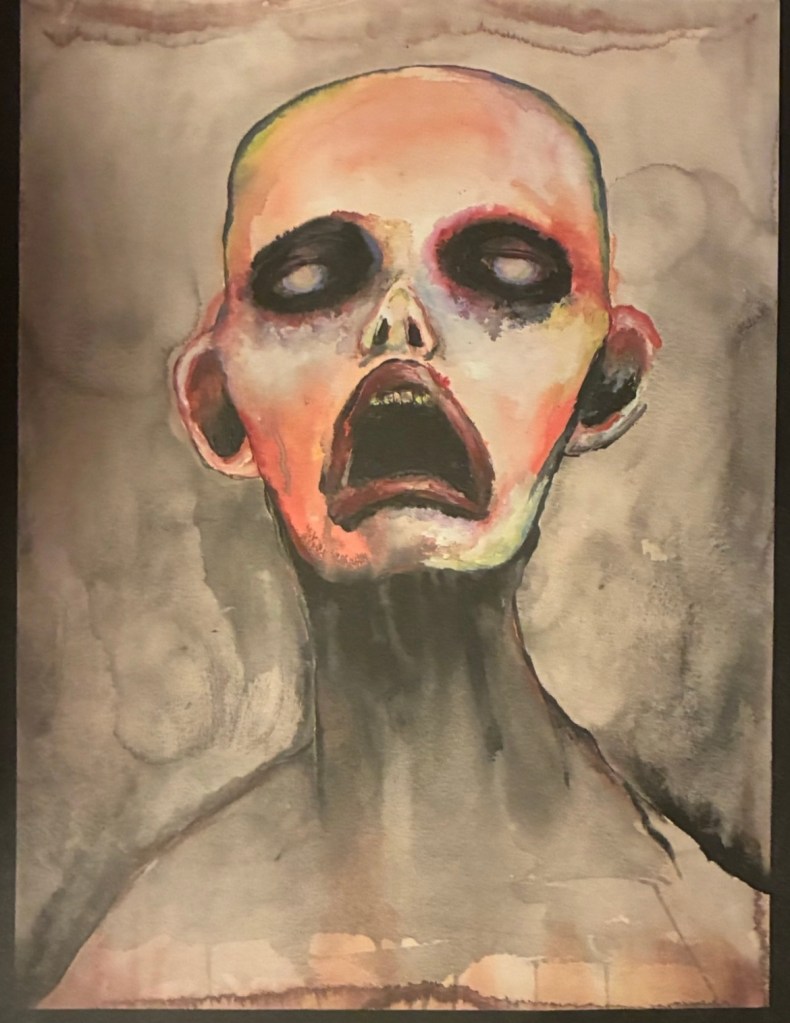
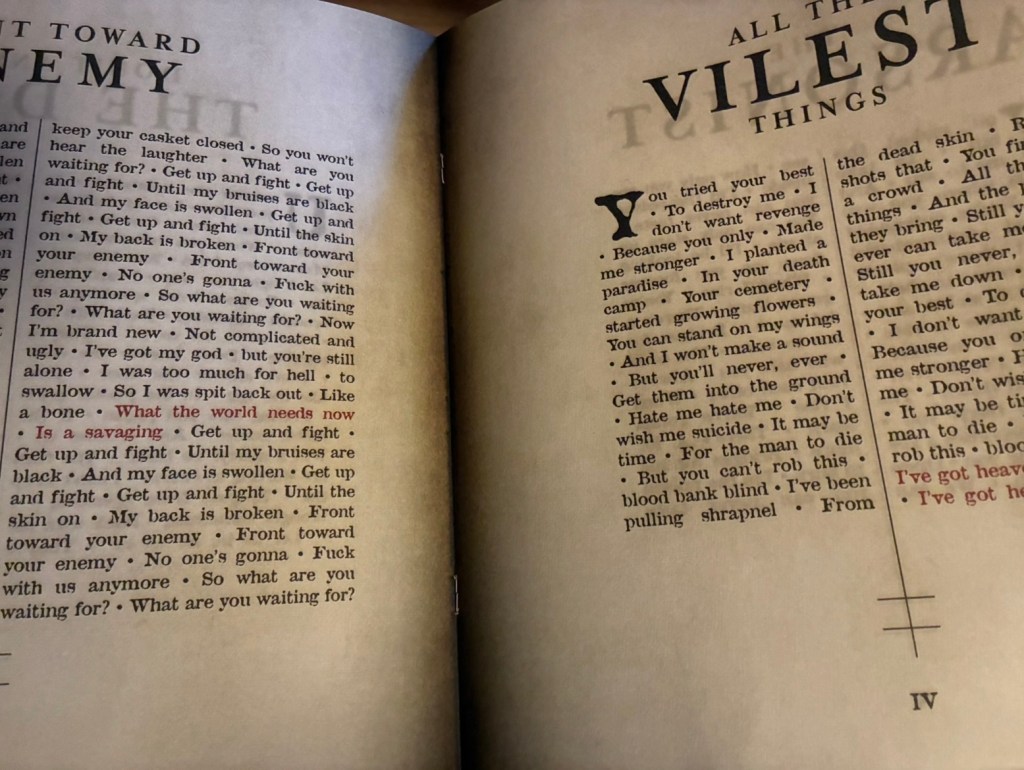
The accompanying painting on the website is called Cotard’s Syndrome and appears in the back of the vinyl booklet, opposite the lyrics of Enantiomorph.
Cotard’s Syndrome is a condition in which one is convinced that they are dead or do not exist. Such a one may also believe that they have lost body parts.
In my own therapeutic treatment for Borderline Personality Disorder, similar combinations of words come up. Obviously- with BPD -the experience is more tied up with mental and emotional influences whereas Cotard’s Syndrome is more typically associated with literal belief.
During this treatment (now almost a decade in the past) I often articulated it as being afraid that I do not have a soul. In retrospect, I was living with the reality of my soul every waking and unwaking second. I could never have done otherwise.
“I’ve been pulling shrapnel
From the dead skin
Reckless shots that
You fired into a crowd
All the vilest things
And the pain that they bring
Still you never, ever can take me down”
Going to war with someone who was dead and dismembered for a while isn’t like going to war with anyone else.
The language of House Face now describes our situation and the song called The Arsonist is the haunting presence that enters. The song describes a shared glance between two perspectives, one up and one down and the tension seems blended with terror and squirming desire.
There are similar lyrical themes to Apple Of Sodom, what with “I’m the poison you can never taste.” Considering the “(g)o back in time” lyric, the use of use of Antichrist Superstar font on some parts of the album and a still from the Beautiful People video on an encased t-shirt in the Front Toward Enemy video…I think this might not be “just me”.
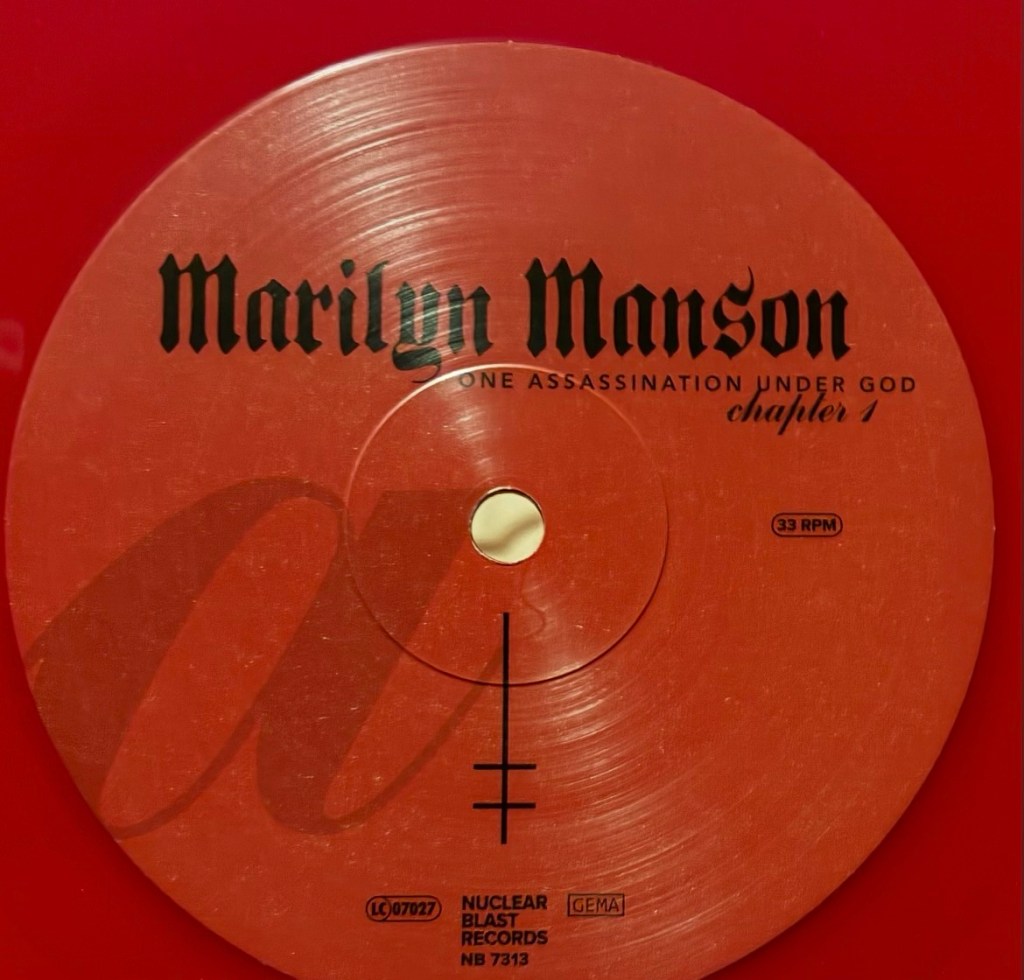
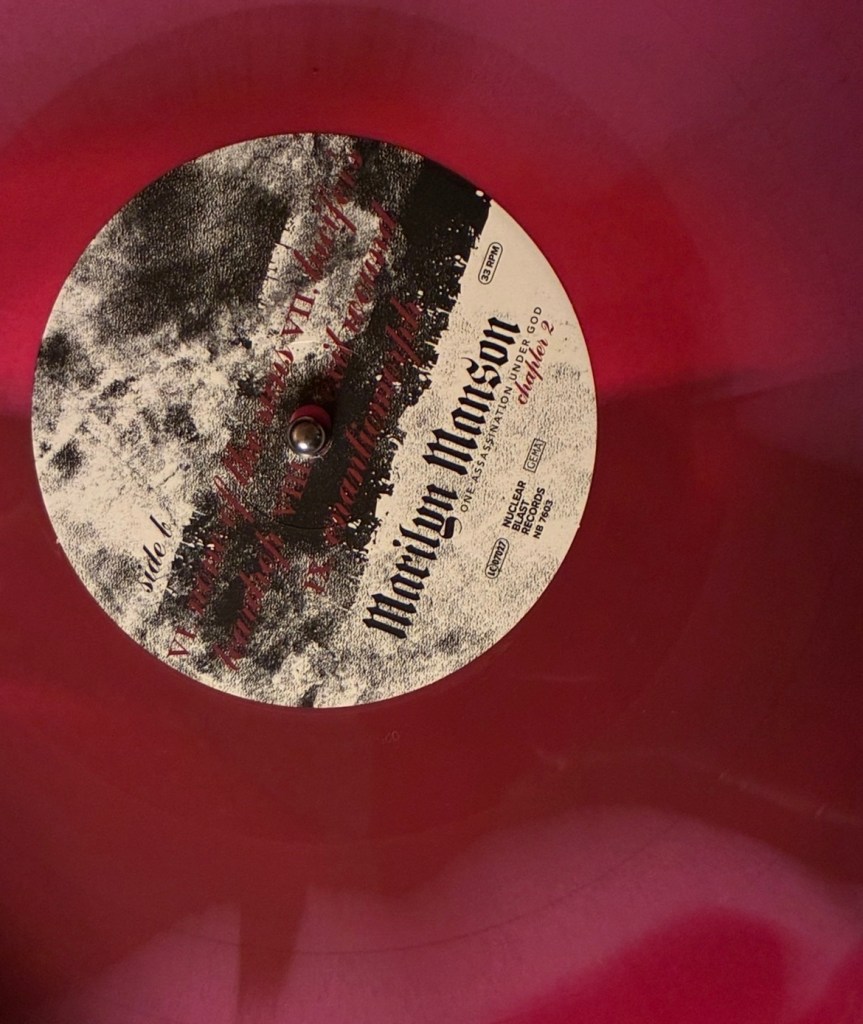
None of the Suns could be a great single and a great live performance. It’s comfortable in the new romantic end of post-punk, like Don’t Chase The Dead. I like it better than that, though.
Lucifer’s Teardrop introduces us to the world beyond House Face- also rather new romantic; kinda reminds me of She Wants Revenge. This song marks my favorite character moment from the album and the transition from None of the Suns to Lucifer’s Teardrop is my favorite new romantic moment from either chapter of One Assassination Under God. The ending of chapter two may be the sweetest sweet spot from the overall body of work.
Exit Wound (like Front Toward Enemy) sounds way better in context than out- it even builds musically on Lucifer’s Teardrop. In the website commentary, Manson said that the ending chant of Sacrilegious (“coming back, coming back baby”) was a deliberate callback to the ending chant from Mister Superstar (“superstar, superfuck, baby”). Similar callbacks are noticeable between Exit Wound and Kinderfeld. There is a “Coroner ventriloguist” speaking through the exit wound of ‘blood in, blood out’.
“I’m the one who lives
Inside of the tongue
Tells the altered boys what to say
Ballerina bayonets
Slice us up with pirouettes
Mouth is shut on hand grenades”
Lyrical themes and attitudes are reminisicent of Little Horn and Saturnalia as well.
The associated painting is called The Necromancer (also the cover of chapter 2) and Manson made explicit the Ingmar Bergman Seventh Seal influence from Death Is Not A Costume. Turtles all the way down, until it’s not. Death is not a costume, yet it hangs from you.
Mythically speaking: you know who loves costumes? Death. The Seventh Seal, the Twilight Zone episode about the old southern lady who is obsessed with not dying, etc.
Then…we got Enantiomorph. Last song. The spoken word intro is not printed in the vinyl booklet like Red, Black And Blue and track 99 from Antichrist Superstar. Even at this final and dire stage, new voices always find their way in.
This feels like a Rorschach moment that’s too precious to spoil. A brief personal reaction: no one ever tells you about the black swan. You can panic or you can try to let the next thought come.

