IX, at the very end of Memoria, outside of creation ❤️
2. Best chocobo theme:
Also IX
3. Moogle theme:
Good King Mog from XIV! (never actually played it but wifers showed me)
4. Best airship theme:
Looking For Friends from VI! That’s the song you hear on board the Falcon.
(The Hilda Garde music from IX also has a tendency to worm its way into my head. Like, all the time, and once it’s in it stays for awhile)
5. Best character theme:
I feel a lil conflicted there. It would either be Coin Song from VI or J-E-N-O-V-A from VII.
6. Best town theme:
Kids Run Through The City- VI
7. Best overworld theme:
Something from VI. Either Terra or Dark World
8. Best dungeon theme:
Another World Of Beasts from VI.
And I’ve always liked Phantom Forest from VI and Lurking In Darkness from VII. Neither one of those appear exclusively in dungeons but both are used in dungeons occasionally.
I kinda have to mention the Collapsed Express Way from the VII Remake. All the music from Shinra HQ in the remake could also merit honorable mentions.
9. Best battle theme:
Don’t Be Afraid- VIII
10. Best boss battle theme:
The Decisive Battle- VI
11. Best victory theme:
Out of the variations of the traditional I’d go with the version from VI. Out of the different ones, it’s XIII.
12. Best end boss theme:
Dancing Mad- VI
13. Best ending theme:
Credits’ roll from VII
14. Best mini-game theme:
Vamo Alla Flamenco- IX
15. Best in-game arrangement:
Opening – Bombing Mission, from VII. I’ve heard different orchestral versions but they always make it sound like it came from a Batman movie. Which I think is all wrong. The version from the VII Remake works for what it is, but it has a different character from the original.
16. Best piano arrangement:
Ahead On Our Way from the VII piano disc ❤️❤️❤️❤️❤️❤️❤️
The Main Theme from VII on that album is also exponentially more beautiful than the original
17. Best remastered track:
The Nightmare Begins from the soundtrack remaster for the PC version of FFVII. The most atmospheric version of that song.
18. Best orchestrated track:
Seven Seconds till the End- VIIR
19. Best non-Uematsu track:
Crimson Blitz from Ligthening Returns. That would be Masashi Hamauzu. Born Anew is also really cool (also by Hamauzu, in the first XIII game).
20. Best song from a game you haven’t played:
Final Steps of Faith (Nidhogg’s theme from FFXIV. I still gotta get started on that sooner or later)
21. Best song from a game on first console:
Mmmmm I’ve already covered a lot of VII-
HEY WAIT the title screen music from the PS1 Anthology version of V!!!!
22. Best song from a game you don’t like:
All of the cutscene music from Type-0
23. Song that makes you feel nostalgic:
Voices Drowned By Fireworks- VII
24. Song that makes you feel sad:
Other Side of the Mountain- VII
25. Song that makes you feel pumped:
Fight On!- VII
26. Song that makes you feel relaxed:
Dali Frontier Village- IX
27. Best track from mobile exclusive:
I never played a mobile exclusive unless you count IV: TAY? I played the Ultimate Collection for the PSP but TAY at least started as a mobile exclusive. I enjoyed the music from IV in general but I don’t remember if TAY had any original music? I didn’t finish it either but got to the final dungeon and found out I was pathetically under-leveled and trapped there
I meeaaan I have played through FFVII a bunch of times because I’m just persistently obsessed but just to shake it up- Salt and Sanctuary!
4. A game in your favorite genre:
I’m not even sure what my favorite genre even is…probably RPGs in general. I also appreciate RPGs with a little bit of puzzle box / dungeon crawling. And I’ve been playing a crap ton of action RPGs with a crazy maze Metroidvania thing going. Or just distinctive dungeon-design in general.
Let’s go with…Chrono Trigger?
5. A game in your backlog:
The Dishwasher: Vampire Smile
6. The game you’ve put the most hours into:
Outside of Final Fantasy in general, it’s gotta be Bloodborne. All the trophies and everything ^^
7. A game you’ve never finished:
Rise of The Tomb Raider (fingers crossed for getting that off the list soon)
8. A game in third person:
Most of what I play? Let’s say Diablo
9. A game in first person:
Sacrifices Must Be Made! Review forthcoming!!!!
10. A game you’ve replayed:
Final Fantasy VII Remake ^^
11. A game you play to relax:
Other than my PS1 FFVII port…almost any Pokémon game. LoZ: Ocarina of Time also helps me wind down.
12. A game that gets you excited:
Vigil: The Longest Night
13. A game from your favorite developers:
I don’t know if I have a specific favorite? I would love for Ska Studios to do something new sometime soon.
14. Your favorite indie game:
Salt and Sanctuary (speaking of ❤️)
15. Your favorite AAA game:
Bloodborne
16. Your favorite board game:
Chess!
17. Your favorite multiplayer game:
Hehe…Bloodborne…the PS4 port of the original Dark Souls also gets way more fun with partners
18. Your favorite single-player game:
FFVII
19. Your favorite game series:
FF
20. Your favorite game from childhood:
First NES Zelda game!
21. An overrated game:
Dark Souls
22. An underrated game:
TheSpace Between
23. Your guilty pleasure game:
World of Final Fantasy. It’s an utterly barefaced Pokémon clone but it does things that a lot of monster hunter games don’t, like interacting with multiple monsters in your party simultaneously without feeling cluttered.
24. A game based on a movie:
Mighty Morphin’ Power Rangers: The Movie! (Yes that is also a review currently in the works)
I’m pretty sure this is gonna annoy or piss off nearly everyone.
In both the 2016 and 2020 presidential elections here in America, there were widespread expressions of shock. Many Americans began to see a near-majority of us as being demonstrably evil. Or, at the very least, the other half sees evil as a tolerable state of normalcy.
I chose to use the meme above because of how confrontational it is. To forgive mistakes and to see the good in those that are guilty of evil feels very different now. Nearly impossible.
Nor am I exempt from this. Lots of queer people like myself get used to people-pleasing because we are so deprived of acceptance that any price might seem acceptable. I won’t belabor this point but I’ll say that, in order to reverse this destructive psychological tendency, I swung hard in the other direction.
I essentially adopted a policy of zero expectations from others and license to do whatever I want, without explanation or justification. Pure fairness.
This belief is also embodied in a well-known adage from Anton LaVey’s Satanic Bible: “If your happiness or success is offensive to someone, DESTROY THEM”
This continues to be one of my favorite quotes and I’ll probably embroider it on a homey lil doorway decoration that all cute, quaint little houses seem to have.
I believe in my lived truth: I cannot do otherwise. I know what it is like to learn the value of dignity the hard way. But even if the specific point of contact between lived truth and objective reality is difficult to perceive, it must be grappled with.
This would be true anyway, but the COVID-19 pandemic has made it unavoidable. The new, resilient and even more contagious strain that originated in the United Kingdom is now in America, and even before that we’ve fucked up our response so badly that we got travel-banned by the EU. Our negligence, as private individuals, is now pushing the limit of our healthcare, administrative and scientific infrastructure. Those who did not take the first lockdown seriously are now saying that we should have followed the order better the first time around. Reality has become so negotiable that we see it as our due when we make exceptions to break quarantine. Across America, hospitals are being filled to capacity and dead bodies are quickly and efficiently removed because of the need for more hospital beds. Our belief in our right to ignore the needs, humanity and mortality of others has enabled this pandemic to become what it is here.
There is, though, a less obvious but equally pressing need for greater unity. A society that values democracy as an aspiration will not change without minds being changed. Minds do not change without conversation. The portrayal of civility above as a naïve attempt to marry an unstoppable force with an immovable object is a lived reality in many respects. I have no desire to sit down with people who do not think I am as human as they are, or that the historical trauma of my ancestors was an acceptable price to pay for the proliferation of Western culture. But there is no other way forward.
In an adversarial duopoly such as the one America is subject to, there are convenient and practical reasons not to believe this. We are shown that the side opposite our own will stop at nothing to defeat us, including sabotage, deception and potentially even violence. We often feel that to play by the rules under those circumstances is a mistake. A friend of mine once said “When you try to be reasonable with unreasonable people, you get played.”
If you were not alive for it, then consider what racial integration in public schools must have looked like when Lyndon Johnson decided to enforce it with the military. At that time, it must have seemed like a question with a diversity of opinions on both sides and to claim that you are right and so many others are wrong would have sounded like sweeping arrogance. Yet we now take racial integration in society for granted. Democratic change happens through exposure to other ideas and sometimes that exposure must come through confrontation. A first blow needs to be struck sooner or later. When the abolitionist John Brown was publicly hung, a young solider named John Wilkes Booth was in attendance who would go on to assassinate Abraham Lincoln. Meanwhile, other contemporaries of Brown equated his willingness to die for the greater good with the crucifixion of Jesus Christ. The early skirmishes preceding change are always seen in the most polarizing and combative lights. If these necessary challenges to popular wisdom are to last, though, conflict cannot be the end even when it must be the beginning.
If not sooner, conversation must happen later. And the prospect makes my blood boil, at times. I grew up practicing a marginalized religion and my Christian neighbors spent both my childhood and their own trying to convert me and convince me that Western conquest could not have been that bad if Natives got Christianity out of it. The various rounds of bathroom panic create an expectation that myself and those who share my gender identity are sexual predators and that we are obligated to explain how we are not. Transphobia and stealth racism have become fashionable brands and a method for washed up political figures and celebrities to renew their cultural relevance. I have dated people who saw me as racially inferior and my gender identity as false and I simply took the time to civilly engage them in conversation about it when I could. And it has never gone well. I detest the prospect of nobly taking one on the chin for the moral edification of others for the rest of my life.
On the other hand, I could not have made it this far in my life and achieved this much success and happiness if I thought everyone who demonized me and people like me were demons themselves. This admission, though, must co-exist with the point of contact between lived truth and objective reality. What would such reconciliation actually look like?
I once had a traumatic encounter with someone who was released from prison mere weeks beforehand, having been jailed for victimizing others the way he did me. Might I, potentially, be required to shake that person’s hand, or the hands of those like him? During the few occasions where he approached me in public afterward, I could not even bring myself to make eye-contact with him. When he was seen around my mother’s workplace a few years later, I ended up binge drinking for days.
Perhaps there is a border to the territory of forgiveness. If so, I don’t know definitively where it is and I doubt anyone else does. I would also like to clarify that I am not equating violent people with those who give voice to bigotry. We are all familiar with the conversational slope of “what about”-ism, though. I am only relating that memory as my only experience that could furnish a worst-case scenario of forgiveness. Yes, someone who enables or condones evil might not be an evil person- but what about those who have committed predatory acts and have an established pattern of it? If conversation is necessary in the long run, then the scope of necessary engagement will probably include some painful conversations. If all movements for positive change start as a marginalized effort, though, then the fear of a bad outcome cannot stop us from trying.
There is a concept that has degraded from misuse by bad faith pundits in the last decade. This is the free market of ideas. Without those harrowing conversations, we cannot say that we have given the range and applicability of public discourse it’s due. The free market of ideas cannot be dismissed as a dishonest ploy from hipster commentators if there are ideas that have not entered the market for fear of bad company.
The true, ethical imperative of civility and dialogue can lead to frightening responsibilities and confrontations. It frightens me. But what alternative exists? If we see those who disagree with us as monsters in human form, what would the application of this belief look like? If we cannot deign to associate with them at all, then we cannot claim to be the victims of unfairness when they accuse us of being tribal and unreasonable. As potentially terrifying and mysterious as such negotiations may be, a pandemic in which our healthcare system is bursting at the seams is not the time to experiment with disposing of civility.
At the same time, though, we need to be able to recognize other common-sense needs. We need our Lyndon Johnsons and our John Browns and those who are willing to use their power unapologetically for the greater good. I absolutely support the push for Progressives in Congress to force a vote for Medicare for all and a greater stimulus effort because the health care system and our profit-driven society simply have not left us prepared to face things like a long quarantine during which we can’t work in person (or at all). Civility must be weighed in balance with external demands, but the degree to which other people create external demands means civility will keep coming up.
Other contemporary events, such as civilian violence, may also be attributable to others who feel driven by necessity. This has the appearance of an impossible and escalating gridlock. I acknowledge that it is possible, but I do not think it is necessary. Not only does civil discourse need to be weighed in balance with circumstantially necessary action. It must remain possible at roughly the same time (whether intermittently or perpetually).
This will not be easy. Yet when we are driven to act unilaterally, we can at least be honest about why. Those reasons being laid bare enables others to speak to us on the level at which we need to be heard.
After all this time, I have finally played and finished this game. And I went into it with a negative bias: with as much as I love the original Final Fantasy VII, I was bound to play it sooner or later but we all know the odds with later elaborations on cool stories (that do not necessarily need any). There is a lot that can go wrong. So I was not expecting it to come as close as it does to perfect. Perhaps it is perfect, for what it is.
The only problem I had with the game (if it ever qualified as a problem) was the kind of action RPG that it is. I think Crisis Core adheres to some sort of handheld action RPG formula that is also prominent in Final Fantasy: Type-0 which is my least favorite FF. Both Type-0 and Crisis Core have constant access to missions with varying degrees of relevance and irrelevance to the mainline story. At any given point in both games, one can access mini-raids that do not advance the story at all and you will sometimes be strongly pressured to do them.
A few times in Crisis Core, there are story beats with no obvious path forward. You will likely do a lot of these missions because it is easy to suspect that, since nothing appears to be happening, that the missions might trigger the next thing. Eventually, you realize it doesn’t work like that and then explore and trigger the next story event on accident. Since the PSP was a potential commercial risk for Sony, maybe they thought designing games that you can easily tune in and out of would be a way of playing it safe or appealing to “casual” gamers. Random fetch quests and random battles do not have a huge structural need for continuity.
For that reason, it is easy to spend lots of time playing either Crisis Core or Type-0 doing a lot of stuff with no cause and effect relationship with the story progression. This seems to be an emergent genre, and it is also a prequel and prequels have a little bit of reliance on the base game. This is what I mean when I say that Crisis Core: Final Fantasy VII may be perfect for what it is. It happens to be in a genre that I often find boring unless it has some other strength going for it. Luckily, Crisis Core does.
What I liked most about FFVII was it’s story. So it was bound to be something I would be looking for here. One of the reasons I was interested but not quite eager to play Crisis Core back when it first came out was a story concern. According to a few sources, there were now two more characters that were infused with Jenova cells as fetuses.
While Sephiroth is still basically just “possessed” by Jenova like all carriers of her cells, he is still somehow different. Even though all carriers are controlled by Jenova, it often looks like Sephiroth is the vehicle and enforcer of her will, up to and including exerting his own will through the clones. The original Final Fantasy VII offers Sephiroth’s fetal exposure as something that could set him apart from the rest of SOLDIER. With that understanding, adding more characters that were changed as fetuses would undermine the plot of the original.
There are degrees of this procedure, though, which creates specific differences between them. In the first two experiments, a woman named Gillian who had been infused with Jenova cells was the source of the experimental DNA. Genesis had Jenova cells generated by Gillian’s changed body mapped onto him as a fetus. This was done surgically with a donor mother. Angeal, then, was conceived by and birthed by Gillian.
This does not necessarily need to subvert the plot of the original, though. By the time of the mainline Final Fantasy VII, Sephiroth is the only remaining fetus-hybrid anyway. Additionally, his closeness to the Lifestream nexus point of transmigrating souls in the core of the planet constitutes his real usefulness to Jenova.
At the same time, Crisis Core has a story that does make distinctions between different kinds of fetus-hybrids. If Crisis Core was the only FFVII story I ever encountered, I would be forced to assume that the enigma of Sephiroth’s unique nature would be clarified somewhere else. Crisis Core ends with Genesis’ inert body being mysteriously carted off by SOLDIER. This, at least, made it clear that Square wanted loose ends to lead into other installments in an expanded universe (at that time, anyway).
But if you played the original, you know that the only word on how Sephiroth was exposed to Jenova’s cells in the first place is that it was while he was a fetus. In light of the additional lore in this prequel, though, being infused as a fetus can mean different things.
Is this a serious narrative weakness, though? I don’t think so. Not even a weakness, really, more like a complication. The only real consequence it could have is whether or not all Genesis and Angeal carriers are eradicated. There are a lot of them for all three of the fetal experiments. The plot of Advent Children relies on three Sephiroth carriers surviving by simply falling through the cracks during the Jenova Reunion. Assuming, for now, that there are no more Angeal or Genesis carriers isn’t that much of a big deal. And if Sephiroth’s real usefulness to Jenova is his location at the Lifestream transmigration nexus, that leaves the plot of the original game intact.
So in the end, there is nothing about Crisis Core that really contradicts or subverts the original, in terms of plot or lore continuity. Crisis Core does more than simply not fail, though.
Whether or not Crisis Core starts off on an easy path is a matter of interpretation. Zack Fair, our protagonist, is super stoked to be in SOLDIER and to fight for the global dominance of Shinra. For a fan of the original, in which Shinra is an unambiguous force of evil, this is jarring. Then again, all armies have their propaganda and their own true believers. Warriors on all sides always think they are right- so Zack being a warrior of conviction actually makes a lot of sense.
This is hint one that Zack is gonna have an arc that goes from naïveté to maturity. But for a while he plays the role of the big bouncy Boy Scout a little too well. Zack never gets as annoying as Snow from FFXIII but walks up to the line occasionally. Being a guileless and trusting recruit at first, Zack’s ideals are larger than life and quickly slide from white to black (musing whether he is a hero or a monster, etc).
Zack becomes aware of necessary shades of gray when he is assigned to track and neutralize Genesis and Angeal once they defect. Hollander and Genesis have an exchange in front of Zack that makes it clear that Angeal and Genesis need Hollander and his Shinra-based procedure that staves off their cell decay. If certain death is the motivation for Angeal and Genesis remaining loyal to Shinra, then the possibility of a non-Shinra source of sustenance is life-changing.
In other words, the Shinra super-SOLDIERs fight because they have to in order to survive. Genesis’ mood swings could have a few different explanations, but the revelation that he doesn’t have to be Hollander’s dog forever seems like a contender. Angeal, who is also subject to the cellular decay, rebels also but tries to maintain his early values, such as protecting his old relations and innocents who get trapped in the crossfire. Genesis wants to start over and Angeal wants autonomy but still clings to his prior obligations.
The dialectic of balancing individual need versus wider complications is emphasized more by a conversation between Zack and Sephiroth immediately before the fatal journey to Nibelheim. Sephiroth tells him that he might defect from Shinra soon but does not offer any explicit reason. The only implicit reasons are the recent events with Angeal and Genesis. It seems possible that Sephiroth is also questioning (he says he may defect) whether or not he would die without Shinra support. This would mean that his personally-felt loyalty to Shinra is now irrelevant, since he’s learning he might be nailed down to it anyway.
A loved one of mine shared bits of the Crisis Core soundtrack with me a long time ago, including a song called The Price Of Freedom. That phrase captures the emerging thematic concern at this point in the game.
Crisis Core is a prequel and is fundamentally tied up in a relationship with the OG Final Fantasy VII. It would be an extremely weak prequel, though, if it had nothing but it’s connection to the source material going for it. This questioning of genuine commitment versus coercion leads us to a personal narrative about Zack, which kicks into overdrive when Zack is forced to act independently.
After escaping the grasp of Hojo and his lab tech, Zack is soon cut loose from Shinra. He has digital access to internal Shinra documents stating that both Zack and Cloud are dead. Then the word goes out that some important Shinra “fugitive samples” have escaped.
The game from this point resembles an escort mission: maybe the most emotional escort mission I’ve seen in a video game in a while. Zack has watched his heroes turn sadistic and homicidal and was forced to put down a few of them himself. Cloud looks up to Zack as a role model but, now that he is on the other side of the hero-worship he indulged in himself, Zack is more willing to treat Cloud like an equal than his own heroes were.
After the Nibelheim disaster, though, Cloud ceases to be a mere “kid brother.” Zack witnessed the importance of Tifa and Nibelheim for Cloud and the destruction wrought there by his own former masters. After the loss of Sephiroth, Angeal and Genesis, Cloud is now Zack’s only surviving fellow traveler. This also makes Aerith more than a long-distance girlfriend for Zack: she is the last part of his old life that remains good.
FFXV was lauded for its portrayal of platonic love between male companions. I think I gotta say that Zack and Cloud do this better. And it’s built up by a succession of smaller moments, like Zack carrying Cloud around and re-dressing him in new clothes. Final Fantasy is famous for being dialogue-heavy, but a lot of the pathos of this bond is built by being non-verbal. Cloud might not talk back to Zack post-trauma, but Zack still makes an effort to discern his feelings and needs.
Zack always addresses Cloud as if he is lucid and paying attention. At this point in the story, all institutional sources of meaning have, for Zack, been revealed to be treacherous. Zack’s only values need to be the ones that he embodies himself. The function served by Zack’s relationship with Aerith as a motivator is a little reductive but it works as something real for him to be invested in, after his other idols are discredited. Cloud, though, is a living embodiment of this.
Before wrapping this up, there is another gameplay element I wanna mention: the modulating phases. This was almost…kind of…subversive in a good way?
In lieu of normal experience points, we now have a slot machine mechanic that starts up after a certain length of time. This basically limits the rewards of combat to its’ length, which can achieve a lot of the same ends as an exp leveling system. Easy foes get done away with easily so there is no risk and no reward, since the battles won’t last long enough for the modulating phase. Most of the numbers correspond to materia slots and two or three numbers of a kind will level up the materia in that particular slot. Solid 7’s are how Zack himself levels up.
This creates a feeling very similar to more conventional RPGs. Enemies below your level are quickly done away with and have minuscule rewards: the real grinding needs to happen with monsters close to your own level. The modulating phase slot machine is also how special, hard-hitting attacks similar to limit breaks are triggered.
Near the end, during Zack’s last stand outside of Midgar, you are clearly overwhelmed and most of us knew how this would go anyway. But you keep getting thrown into playable combat against the vast Shinra hoard with frequent modulating phases that buzz with static and roll irregularly, as if glitching. The slots even have some of their character illustrations go white and fuzzy and the screen will white out without giving you a specific set of three numbers. The poignance of this portrayal of Zack gradually dying crept up on me.
I might also be stating the obvious by mentioning the similarities with the portrayal of Zack’s last stand in Final Fantasy VII: Remake. Both versions have Zack saying the words “(t)he price of freedom is steep” and some very similar “camera angles.” If Square continues to insist that Crisis Core is not cannon, we’ll just have to see how that bears out in part 2 of the remake.
After all these years, I’ve now learned that this is where the image of Sephiroth at the start of Advent Children came from
When we last left off, the plague in Maye Village had two possible origins: the mine and the flooded area. The unexpected time jump after the encounter in Death’s Destination caught me off guard and I didn’t want to miss out on any temporary events or side quests. Not knowing which path would advance the plot to the next beat and close any cool situational opportunities, I decided to start with the one that seemed the longest and most open-ended: the flooded area.
The Metroidvania sub-genre banks on the lure of exploration. There is, however, a way to either create an experience that feels the same but isn’t or to make a linear section more interesting before being truly turned loose. Final Fantasy Peasant nailed it when he said that Final Fantasy VII pulled off one of the greatest open-world fake outs by giving you a navigable world map after a rigidly linear beginning. Simply having the world map at all felt liberating after Midgar, but there are still terrain obstacles that can’t be crossed until later in the story.
Vigil accomplishes the same illusion in a much simpler way. Before I get into that, though, I want to emphasize that there is still enough exploration and hidden paths within the mine and the flooded area to have a lot of fun with. The careful control of the difficulty and it’s consistency with the character-building system frequently kept me engaged and interested in relatively small spaces, though. This often feels like lots of little frustrations that, once overcome, will make you feel like the incoming huge frustration is easily doable and you don’t realize how hard you are actually trying.
Again with those soft touches: the background scrolling immediately before Kelpie goes nicely with the droplets of water on the “camera lens”
Case and point: Kelpie. When this fight was first triggered, I was able to do enough damage with the same melee tactics that work for the random encounters in the area to make it feel potentially easy. More specifically, I’ve been cultivating a “heavy”, axe-weilding build. So axe-melee works for anywhere from 1/4 to 1/2 of Kelpie’s HP, then Kelpie burrows under the shore and begins a combination of range and heavy blunt-force attacks with limited hit box access. On attempt 2, I experimented with some spells and found that the short-range poison projectile that The Ancient Guard drops in Death’s Destination is very useful during the second half of the fight.
So here I am thinking I have a fool-proof strategy nailed down, but even with that you are never too big to fail. Like last time, I thought this would be easy and got lazy. Before I knew it, hours went by with repeated deaths and each and every time I was thinking it was gonna be easy. It pays to remember the little things: Like Bloodborne, never underestimate the advisability of rolling to the other side of huge monsters and spamming them from behind. Also, do not get so put off by the size and movement of Kelpie to forget that you can still do simple things like crouch and run out of range.
Stock up on negative status curatives and restoratives for stamina while doing all this and you’ll be fine. Upon defeat, Kelpie drops a key item called a Cubic Crystal & you now have access to a new, interconnected area. Almost like a palette cleanser, a bit of exploration beyond this point will bring you to the Gnawing Beast within the sewers, a substantially less challenging boss that drops the Arctic Ocarina. You know, like the Scarlet Ocarina that took you to Death’s Destination.
Sure enough, the guards back in Maye are talking about increased numbers of undead emerging from the cemetery and would like our assistance. Which would once again place us close to the Catacombs and the gateway to the other side, so it’s starting to look like another magical journey with the ocarina is just around the corner. But let’s check out some other leads first- such as the contagion’s possible origin in the mines.
Our old friend Hilda is found some distance beyond where we ran into her last time. She shares some lines from a song describing tree trunks with skulls embedded in them, just like the trees in the area.
From here there is some exploration to find the entrance to the mines, during which you could obtain the Flaming Magpie spell if you grabbed the stone from the hunters’ cabin earlier. Once we get there, though, the mines are a real platforming sweet spot.
Mine levels, like sewer levels, have a generalized reputation for being frustrating. Mystic Caves Zone from Sonic 2 comes to mind or the sewer section from the first Silent Hill game. Vigil, though, along with nearly every recent Metroidvania I’ve played, succeeds in avoiding this. As is typical of mine levels, there is mobile platforming. With enough attentiveness, you can navigate the pattern-memorization without needing to sacrifice health or progress. The mines reward effort but don’t hold you by the hand; like any well-designed game, you are never too big to fail.
The pre-boss combat is also tightly designed; enough small and moderate attackers simultaneously to make you think quickly but never overwhelming. Some of the monsters, like the one seen above, are familiar. The zombies that emerge from the ground and explode upon dying were first seen in the cemetery and the spikey dogs were first seen in the laboratory where Bruna was taken and transformed.
The nod to the cemetery underpins the possibility of revisiting the gateway to the other side, sooner or later. But this association is also blended with a new detail: miners who still look mostly human who also explode upon dying. Possibly a connection between the mining disaster and the antecedents of whatever is now going on in the graveyard? Maybe Dawn and those like her are right about the recent plague emerging from the mines after all. An eventual shortcut leading from Limestone Way to the flooded area also bears this up.
The boss fight, though, is probably the first easy one in Vigil. I appreciated the attempt to make the player exploit the spatial characteristics of the “arena”. The Erupting Flesh Cluster dominates the ceiling and sprays fire, forcing you to both hug the floor and climb platforms to avoid the streams of fire. If you have the Flaming Magpie spell, though, you can camp out at the rooms’ edges and spam arcane damage, since the Cluster’s hit box hardly moves and the Flaming Magpie can cross the whole screen.
After dispatching the Erupting Flesh Cluster and claiming the second Cubic Crystal, you might also elect to rescue some miners you encounter along the way. Soon, though, we rendezvous with Hilda who advances an interesting possibility on the origin of the plague. One begins to wonder if the Doctor in the plague mask back at the asylum is in fact the same person as the Professor from the beginning of the game, who experimented with Crimson on Bruna and Gram.
That the Doctor has contributed to the problem in any way- be it active or passive -appears credible. He cops to giving out placebos to placate the villagers. He also conveniently supplies a new possible origin for the plague at Bufonitte Lake when the flooded area and the mines are ruled out, which could potentially look like evasion.
During the placebo sub quest, I decided to give all of my sugar pills to the drunk, rich asshole in the tavern only to have Sillian kick me to the curb because of what it looks like ):
Bufonitte Lake and the process required to get there continue the upward quality of the platforming that began with the mines and the Ancient Battleground. En route, there are a ton of neat shortcuts and secrets to be discovered, often with the aid of the spell gifted to you by Hilda during her earlier visit. The lake itself has almost immediate access to a boss battle that yields a third Cubic Crystal. During the right-leaning vertical platforming necessary to reach Bufonitte Lake, it is also possible that you encountered this:
Evidently, they are a set of three, and are required to open this gateway. This also has a superficial consistency with an optional lore document at the lake that refers to a seal key divided between the Vigilant, the Shimmer Church and the Guard. When you return to the Doctor to check if the defeat of the scourge of the lake had any effect, though, he has moved onto another potential solution, requiring all three of the Cubic Crystals. Which he needs you to hand over. Because…you know…trust…right…?
This leaves us with three options: hand over the Cubic Crystals to the Doctor, play the Arctic Ocarina at the bottom of the Catacombs, or open the seal in the Giantwood Forest.
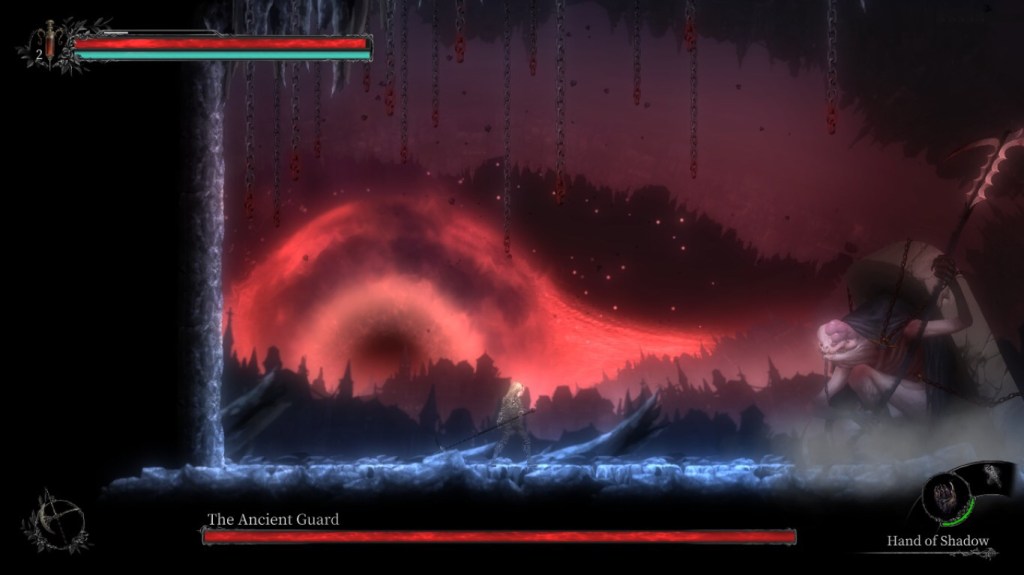
Here it might bear mentioning something that I should have done before I defeated the Ancient Guard earlier: utilize multiple save files. This time around, I got the memo before it was too late. What happens after this point should probably get its own blog post.
Some other odds and ends I wanted to mention-
Not knowing how quickly things might move once I dove back into the main quest line, I decided to mop up side quests and do some exploring off the beaten path. After rediscovering a passage I didn’t investigate very thoroughly the first time around, I pushed a little further and found this:
To my surprise, I wandered into the Saltand Sanctuary crossover event without even encountering the specific quest line. Other than the familiar face above, there are a few other monsters that look a lot like S&S creature design:
It’s been awhile since I last played Salt and Sanctuary, but I don’t think these particular creatures appear in that game. I mean…there is a superficial resemblance to the S&S Drop Spiders, but only in that they’re spiders. Beneath Lake Bufonitte, you encounter these beauties, which look like S&S creature design and are a bit closer to the mark:
They occasionally drop from the ceiling but still look distinctly different from Drop Spiders. If Ska Studios made original assets for Vigilduring the collaboration…I can’t help but wonder if there is more to the crossover than the brief monster hunting excursion that lands you the frying pan from S&S? I mean, a quest line, a familiar enemy and a weapon were all that the crossover announcement on Steam promised..but those spider creatures do look distinctly like the work of Ska Studios, right? I may also be wrong, here, but to my eyes the large spider enemies appear to be rendered in a very specific art style that stands out from everything else in the game.
Speaking of Vigil’s art style, I have to gush about how beautiful this game is. Much of the art looks like offbeat, slightly uncanny illustrations from a book of fairy tales. The background scrolling makes this imagery look a little bit like a surreal pop-up book. Situational zooming and lighting adds a subtle touch of realism which also breathes life into the otherworldly touches.
Especially, like the moment shown above, when a quick, transitional movement shows several dynamic textures simultaneously. The bright, early morning moon is visible when Leila emerges from the rock face on her way out of the mines. Then, as the camera moves with Leila on her way down a ladder, the moon disappears behind a structure and the mist-covered forest moves into the frame. Both can only be seen simultaneously as she crouches to begin climbing, and for barely a second. This is just the right amount of realism, like when you see something surprisingly beautiful and then you take another step or your car goes around a bend and it’s gone.
Understated photorealistic textures, like rain, add a lot to the sense of scale created with the situational zooming and lighting. I know this isn’t an option for every gamer but it really, really pays to play this game on a machine with a quality graphics card. I’m sure this all pops beautifully on the Switch and will on the PS4 whenever that adaptation is made.
Zeno’s paradox, for our purposes, can be summarized thusly: someone shoots an arrow and measures it’s progress by halves. While measuring by halves, one is constantly shaving off a half of the difference no matter how close or far the arrow is. While measuring in the halves of the closing distance, one could potentially keep measuring the relative halves down to subatomic increments and never actually record the impact.
Obviously, the arrow is going to hit something sooner or later. This is undeniable, but it is also possible to measure the progress in such a way that it cannot be perceived.
Since the American presidential election ended, I’ve taken a break from writing about political stuff. It simply wasn’t doing my mental health any favors. I was watching a video from the YouTuber called Thought Slime, though, about transphobes attempting to weaponize philosophical materialism. A commonly echoed point shared by this flavor of bigot is that A. trans people claim that gender is a social construct and B. social constructs are not real.
The analogous relationship this claim has to Zeno’s paradox is also uncannily relevant to the recent voter-shaming fad within the American left. To keep things sequential, though:
The gender-essentialist avenue of transphobia typically allies itself with a clash between philosophical materialism and linguistic fluidity. You know, the Jordan Peterson/J.K. Rowling types that hold that post-modernism is being turned against cultural institutions that are validated by human nature and tradition. Ergo, the notion of social constructs amounts to consensus reality and consensus reality empowers things that are not real.
This is easily refuted by both sociology and animal psychology. When pack animals are threatened by a separate species, they respond with the typical fight/flight response. When threatened by members of their own species, the fight/flight response becomes posture/submit. Pack animals typically try to signify victory or submission rather than engage in mortal violence. Naturally there are exceptions to every rule, but this is an observable and documented behavioral convention among pack animals.
Consciousness, famously, is an emergent phenomenon. The exact electrical/chemical process that gives rise to our experienced consciousness cannot be observed, yet we know enough about the electro-chemical dynamics of the brain to infer how it leads to consciousness.
An emergent phenomenon is where you know what goes in, you know what comes out but you don’t know the middle stage. In that situation, you can make educated inferences about the transformative phase based on the beginning and ending, but until you can observe it, an educated inference is as good as it gets.
Now…we own that humans are pack animals, and pack animals typically show behavioral evidence of shared psychological experiences. This is what people usually mean by the ‘herd instinct’. Since the expressed convention of the herd instinct predictably shows itself in a specific type of animal, it is likely that this behavioral pattern has a biological origin. This cannot be objectively documented any more than the emergence of consciousness itself, but the herd instinct’s ubiquity among pack animals is a strong sign that the herd instinct is not fabricated out of whole cloth.
This means that social constructs are almost certainly real. Social constructs and their predictable origins in the herd instinct cannot be observed, but to include it’s inscrutability in philosophical materialism leads straight to fallacy. Similarly, we understand that our eyes receive and compile refracted light: most of the things we take for granted, such as color, are not as literally real as we think. The color of an object is not an inherent, material quality; it’s just the color of the photons that pigmentation bounces outward into our eyes.
If things that are not literally, materialistically manifest are not real, then our eyeballs and their neurological interface with our brain are bullshit. I don’t know anyone who would actually commit to that chain of reasoning.
The falseness of the claim made by gender essentialist and gender critical feminism, though, still leaves a lot of room for uncertainty. Externally documented patterns with strong implications about things that cannot be documented leaves room for subjective claims on any side. Another common talking point is that lived experience does not validate anything outside the binary, ala J.K. Rowling. The evidence that Rowling and those like her advance is their own lived experience as cispeople and their belief in the reality of claims made by cispeople (ciswomen, most frequently). Those experiences may, absolutely, be real to the people who have them, but it does not advance their central claim about philosophical materialism. It does not even relate to anything beyond the feelings of specific people.
Having spent years trying to convince doctors and family members of my own dysphoria before being permitted to medically transition, I feel as if I will always be an outsider to the binary even though I’m a binary transwoman. I am a binary transwoman because my dysphoria is relieved by medical interventions that create feminine secondary sex characteristics. Yet I did not have the same childhood and early social conditioning as a ciswoman, nor did I have the same childhood as a cisman. As a child, I simply chose to express myself as “female-like” or girly as possible, up to and including frankly describing myself as a girl if anyone asked. This led to relentless teasing in elementary school and non-stop suicidal ideation for my entire adolescence and early adulthood, but simply “stopping” was never a genuine possibility.
On one hand, my medical transition fits within the binary. On the other, there are many experiential differences between my life as a transwoman and the lives of ciswomen and cismen. While I am a binary transwoman, I will never be a ciswoman. If I am a binary female only in the sense that I am a “binary transwoman”, one almost begins to wonder what the distinction between binary and non-binary even means. If anything, my lived experience has led me to believe in a third gender category at least.
Of course, I know that arguing this point against actual transphobes is probably pointless, since everyone has a subjective expeirence that backs them up. This is simply an expression of the frustrating social facet of Zeno’s paradox: there is almost certainly a biological prompting for a lot of our mental states, but our existence is still fundamentally rooted in our subjectivity. The two probably meet through cause and effect, but because we can only measure the distance relative to ourselves, we’ll never actually perceive the moment of impact. Lately, it seems like every social phenomenon lends itself to that analogy and it’s scream-into-the-void frustrating.
Like, remember when I wrote that Biden’s expressed commitment to trans rights, on it’s own, might have been enough to get me to vote for him in spite of the rest of his record? This has lately come back to haunt me. Since winning the 2020 election, Biden has elevated a few state-level transgender political leaders. To his credit, Joe Biden has also committed himself to rolling back the Trump-era executive orders regarding trans healthcare. Meanwhile, Lael Braenard and Tony Blinken are in line for cabinet posts in Biden’s White House, two of the most infamous forces of military intervention from Obama’s presidency. They are joined by Neera Tanden, who has given voice to the opinion that we should seize Libya’s oil as our due compensation for the resources we spent occupying their country. On one hand, American trans people are more protected, on the other, so is the American war machine.
Commitment to civil rights can be used with cynical abandon by politicians who want to launder their image while continuing business as usual. Business as usual, in this case, is proceeding apace in spite of the fact that we may be in the final decade in which we can still roll back the damage done to our biosphere. Republicans and Corporate Democrats relentlessly hit leftists with the “#whereisthemoney” argument, which we need to be able to respond to, clearly and loudly.
I believe the correct loud and clear answer is the dismantling of the military industrial complex: the American war machine spends money in proportion to the money it makes, which means it requires billions of dollars every year to continue functioning. By hitting the military industrial complex, we can begin to rehabilitate our image on the world stage while simultaneously liberating funds for a green new deal. While perpetual war is an apalling crime against humanity on it’s face, it is now standing directly in the way of America’s chance to ease away from the damage we are doing to the collective future of our planet. If this does not change, the conversation about the survival of our species may need to move from saving Earth to leaving Earth.
The incremantalist reading of these events is to take the wins when we can. Biden’s complicity with the military industrial complex might stop any effective action toward climate change, universal health care or any other pressing necessity, but at least he is nice to trans people. Trans equality is now further within the Overton window. The same incrementalists also claim that, while Biden’s expressed concern about perpetual war and environmental protection are lip-service, it makes the right choices possible in the future if not right now, irrespective of the ticking clock.
Increased safety and access to medical care for myself and people like me is an unambiguous win, but we are still dealing in the gold-standard of subjective values (societal ethics) without any consideration for outside pressure (the biosphere and perpetual war). This year’s presidential election was a passionate, psychologically harrowing experience for a lot of us, but so long as we measure things relative only to ourselves, the clash with the wider world must necessarily take us by surprise.
This is the long-awaited reinvention we’ve been waiting for and far past time for it.
There have definitely been hints of it before now. What made albums like The High End of Low and The Pale Emperor stand out was a willingness to embrace new ideas. But at last, Marilyn Manson has made a full, decisive step into new musical and atmospheric territory.
One of the strengths of We Are Chaos was beginning to show through on Heaven Upside Down, which exhibited Manson’s strongest and most consistent lyricism since The Golden Age of Grotesque back in 2003. We Are Chaos, though, is possibly more tightly written than anything else Marilyn Manson has done. Nothing sounds as lazily worded as Unkillable Monster or You and Me and The Devil Makes 3. In fact, every set of lyrics rewards attention.
The songs I’ve been listening to the most are Solve Coagula and Half-Way & One Step Forward. The latter has this cool, dreamlike, repeating piano riff that gives it an unexpectedly new romantic flavor. It goes into Infinite Darkness, which I am not nearly as inclined to listen to as other tracks. Half-Way & One Step Forward actually sets an atmospheric tone for Infinite Darkness that makes it far more interesting than it is on its own. Infinite Darkness has a similarly brilliant segue into Perfume, which was when I realized how well this all works together.
A key hallmark of a well-composed album is that each song feels like an elaborative step deeper into the body of work. The recordings made in the last decade that pull this off can, for me, almost be counted with one hand (names like Sopor Aeternus, Grimes and Gonjasufi come to mind). An adolescent part of my soul is happy to see Marilyn Manson finding his way back there.
While Solve Coagula and Half-Way & One Step Forward are my two earworm picks (Solve Coagula also hits the new romantic genre echo like Half-Way) every song between them navigates a musical and emotional bridge from one to the other. Sure enough, Solve Coagula sets the stage for Broken Needle, the last song, which connects its lyrical imagery with the first song. Manson hasn’t done something as elaborative, consistent and careful since the Triptych.
The Leonard Cohen reference was a little random but interesting.
Sorry for the long pause- I promise to get back to Vigil soon but for now I want to do something simple and fun.
I’m an early riser, my partner isn’t. So a lil while ago when I was putzing around in the morning on my own, I decided to grab Shadow of The Tomb Raider.
In general, I haven’t met a TR game I didn’t like. Tomb Raider: Chronicles being the exception that proves the rule, and even that one had some fun platforming and puzzle-solving. Fun can still be pulled off even if some of the potential for depth is mishandled.
The modern Tomb Raider games succeed at one of the major draws of the original series: exploration. Rise of The Tomb Raider and Shadow of The Tomb Raider always reward exploration off the beaten path. The placement of the player in the wilderness looking for hidden temples kinda makes it intuitive tbh. The modern games even have this nifty lil mechanic in the key item menu where you can rotate and zoom in on artifacts to examine them for clues. This is probably one of the best usages of modern graphics in these games. The modern games likewise succeed at tense, fast-paced combat that rewards situational awareness and careful management of consumable items.
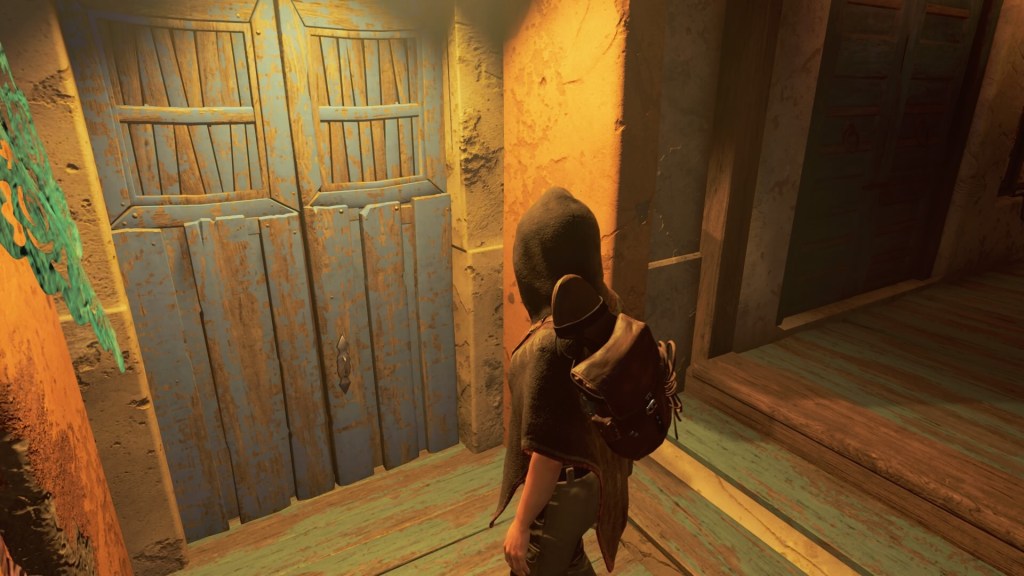
I actually called my partner over to the entertainment center to show her the peeling paint on this door because it looked so real Also: pretty leaves!
There was a second strength of the originals, though, that the modern TR games haven’t done so well: atmosphere. And modern graphics may have contributed to the misunderstanding that led to this.
Obviously, when the series first launched on the PS1, realistic human figures were pretty hard to pull off. As a series with a human being for a main character with a tone that (at least a little bit?) aims for believability, the developers for the first Tomb Raider games wisely chose to play it safe. For the majority of the first few games, you see Lara Croft more than any other human character.
With the normal human proportion box checked, freedom could still be had in other areas. Three levels in, you get dinosaurs. Other human figures are largely saved for the higher-quality cutscenes between gaming segments. If a human other than Lara did appear in the polygonal gameplay graphics, it would have to be occasional and be calculated to fit within or play on top of the atmosphere.
In the first two Tomb Raider games, this calculation was integrated wonderfully. The lack of precise graphics left room for two probable risks: comical weirdness or creepy, uncanny weirdness. The first humanoid figure you encounter in the first game is a mummy that’s just a little taller than normal with an unusual head shape. When you grab the first scion piece, the mummy falls forward with a moan.
By leaning into the potential for creepy, uncanny exaggeration with some choice musical cues, it makes you go “holyshitwhat’sthisI’mouttahere“. So you’re running your ass off from that room and you’re soon greeted by a living human shooting at you. Because of the brief shock from the zombie, you are almost relieved to see a normal human murderer. And soon after neutralizing the threat, Lara and the assassin start talking. Your attention goes from the combat to the dialogue.
The atmosphere and the importance of what is being spoken takes the burden of believability off of the graphics for that segment. But the player still arrived at that segment through a shift from a creepy, human-ish being to the “relief” of a more realistic human presence. The psychological “threat” of something not quite human is still intact, and comes back with a vengeance when you encounter undead and mutant humanoids later. This usage remained consistent in TR2 in addition to TR2’s increased implementation of large, dark, vertiginous spaces (under water, on floating islands, etc.).
This is the revamped mummy in the Tomb Raider: Anniversary remake of the first game. No way does this matches the creepiness of the original
The appeal of the Tomb Raider games has mostly been a balance between a power-fantasy of physical strength and the vulnerability of isolation. I’m totally on the positive end of agnostic about the modern entries maintaining that standard: it is totally possible and I would like to see them pull it off. They’ll just have to find a different way of doing it.
While it has been a few weeks, I still suspect I am in the beginning. I did not resolve every thread of the disappearance of Bruna and the nature of the involvement of Gram and the Professor before those events get “missed” (little x’s appeared next to the quests I didn’t finish).
If I have missed some stuff, it’s because I went straight to the Catacombs after finding Bruna in her transformed state. I did make an effort to find other “dungeon-length” areas but could not find much outside of the cemetery. “Note” discoveries tell us that Daisy, the Professor and others were last seen near there, so it’s simply an obvious thing to check out at that point. Some networking with Maye village residents will connect enough dots for Leila to discover that the arches overhanging the Crimson Ocarina are probably what the Lantern Keeper is referring to when she says Porta Avernus.
The detective work of this part of the story was a welcome balance against the action-packed platforming and combat. I particularly like how Thurber Sungi was involved. He is an outsider and (I think…?) a member of a foreign and marginalized religious group. Unless the royal government that he works for is the same one that Maye and the Vigilant warriors are subjects under. In that case, when Thurber says the word “heretic”, he probably means the same thing that other Goddess-worshipping villagers mean when they say the word. In that case, the villagers Chris and Gram are the only characters so far who do not practice the common religion.
The Professor, meanwhile, discovered a phenomenon called Crimson that is almost always deadly to humans. Tissue-growth can be achieved with Crimson if an appendage from one being is attached to another of a separate species. Lastly, there is a method of introducing Crimson neurologically, which has the most gradual and most mysterious effects. This appeared to have been going on with both Gram and Bruna. Sure enough, I have an item in my inventory called a Crimson Ocarina and a likely location to play it.
A brief musical note and a red flash later
At first this reminded me of Blasphemous. Then I noticed the more whimsical qualities, like the kaleidoscope city in the background and floating coffin platforms. Blasphemous is surreal and psychological, but those qualities are designed to accommodate a sense of religious dread. Lots of penance, self-flagellation, glorification of martyrdom, etc.
Blasphemous is set in a world where a scary, inhumane, autocratic religion is made effectively “real” by magic. Death’s Destination in Vigil, though, does not look like the creation of a control-seeker. The cityscapes kaleidoscoping in a spiral on the horizon, floating coffins and piñata fetuses are more chaotic than the dour, medieval, orderly nightmare in Blasphemous. In terms of atmosphere, Blasphemous has a nightmare of order and Vigil has a nightmare of chaos. Really, Death’s Destination looks almost like Earthworm Jim if it decided to go for horror instead of comedy.
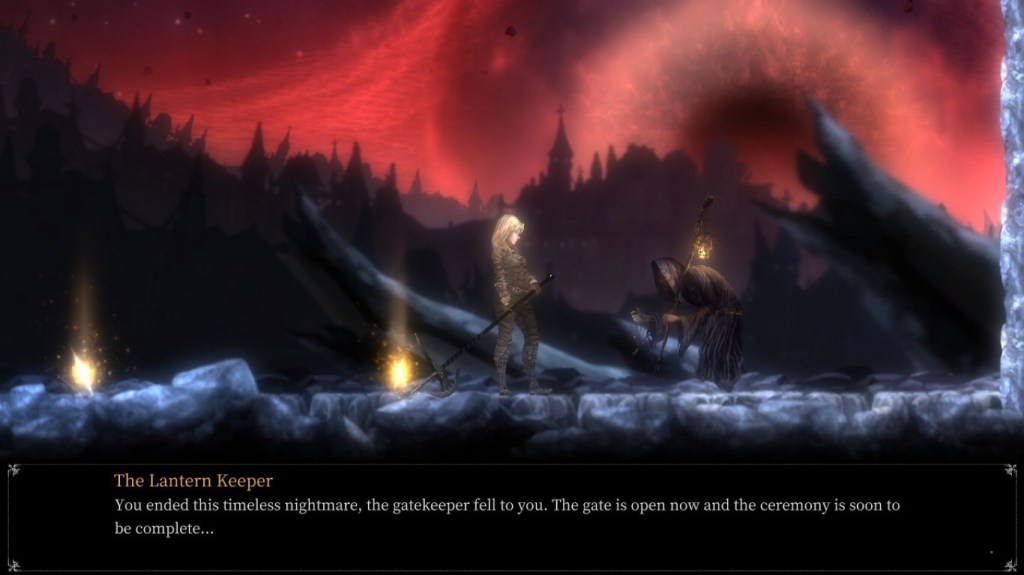
The boss fight in this area is not particularly challenging but it does require a modest amount of patience and, for a few levels, always seemed to be just within reach of being beaten. I actually spent a few days on this fight and did a lot of grinding for it without realizing the amount of time and effort I was putting into it. Maybe that’s good design or just a happy coincidence, but either way the Lantern Keeper soon shows up to tell us we have “ended the timeless nightmare”. Is Leila’s trial finished now? What does that mean, exactly?
“Soon to be complete”?
After some fun banter outdoors with two guards who don’t recognize you, you are taken back to Maye where a disease has taken hold and some time has gone by. Maybe? Leila soon finds her sister Daisy tending the afflicted in an asylum either built into a wrecked building or a wrecked ship.
Later discoveries reveal this to be a distinct possibility
Here, the game gives you the chance to pick up a smattering of quests, rather like our first glimpse of Maye. The loss of every owl statue checkpoint could also, arguably, support the possibility that a time jump has happened. There is no frank comment on how distant the era we came from really is.
We encounter various friendly faces, such as Daisy and the shopkeepers, who recognize us. Then there is August, at the library near the cemetery, who is clearly an adult (if not middle-aged) man who says he is a descendant of an ancient guard named Duran, whom we know from the start of the game. Both cannot be true and the plot must surely thicken. Maybe Leila could be an unreliable narrator after all?
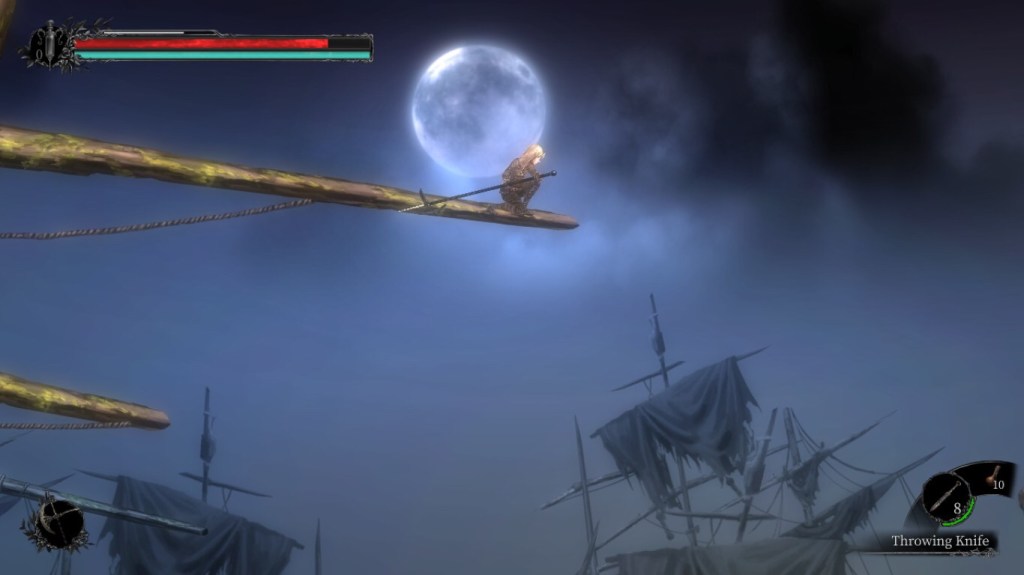
Speaking of lost time, a new naming convention involving different times of the year has proliferated while we were gone. The waterfalls to the East of Maye also appear to have gone through some kind of seismic or oceanic event, as it is now a vast wasteland of bog and wrecked ships. Whether this is due to a time jump, Leila infiltrating another timeline, Leila’s own mind or something else is not yet clear.
The way this change was expressed in the structure of Maye was also welcome. How to even implement towns in a Metroidvania has suffered some confusion in the past. Hollow Knight makes it so you can add more bugs to Dirtmouth village and shortcuts without by finishing different quests. Salt and Sanctuary simply makes the checkpoints the only place to encounter specialized support NPCs. Castlevania: Order of Ecclesia had places you could select on a menu-like world map that consist of static NPCs and non-horizontal doors and alleys you interact with by pressing ‘up’.
The original Castlevania: Simon’s Quest did a decent job by simply adding platforms and a nonstop day-night cycle to it. A town like Maye, with more platforming layers and accessible areas that are added over time, is a very welcome addition. What might be really neat later on is if the gradual downward progress of the town’s construction eventually leads to some important Norfair/Hallownest area.
Just an idea ^^
The creature design continues to be on point. I particularly appreciated the bear near the waterfall cavern where Hilda is found for the second time and the shadow beings found further into the ship’s graveyard. There were also beings at that place that looked a little bit like the shark people from Bloodborne’s Fishing Hamlet but other than some occasional unoriginality, more hits than misses so far.
The third volume of The Sandman Universe: Lucifer, subtitled The Wild Hunt, draws us closer to one of the more daring threads in the prior installment (The Divine Tragedy).
Within the second volume, there is a memorable scene involving Lucifer, Caliban and the ancient Egyptian pantheon. To gain an audience with the Egyptian deities, Lucifer must weigh his heart against the feather of truth with Anubis. The scales balance and Lucifer says “My heart is never heavy. I do as I will, and never otherwise.” To which Anubis says “Would that all had it that easy.”
Later, Caliban attempts to follow his father and his own heart cannot balance against truth. Obviously, Caliban has more in common with a lot of us than Lucifer. The majority of us have had to do at least some things against our will, or have been forced to. To many, an entire existence with no involuntary compulsion sounds mythic.
The quality that the society of witches revered within Sycorax was her total refusal to live under the rules of another. Thessaly, who voices most of this, says that she herself would not have been brave enough to refuse both the overtures of the Moon and Lucifer. Thessaly expresses that most people are so desperate for power and safety that they would agree to anything for it. Essentially, it is the coin that is always accepted and Sycorax, in the eyes of Thessaly, has turned her freedom into something so precious that no coin can buy.
Between freedom as a naturally occurring absolute (Lucifer) and freedom as something to be gradually embodied over time (Sycorax), the latter is just easier to relate to. At the end of The Divine Tragedy, Lucifer has begged every pantheon to shelter Sycorax from the eventual wrath of Jehovah and very nearly fails- what eventually happens to her is something she consents to.
If someone spends a lot of time bending over backwards for another person while claiming they only pursue their own ends, it sews tension. One begins to wonder how honest with himself Lucifer is, when he claims he cannot be coerced. This tension is the main dynamic within The Wild Hunt.
It also involves some character details last glimpsed in the original Sandman. Such as Lucifer’s tendency to sew the seeds of violence and disaster within humans without even noticing he is doing it. The crimes of passion or deaths by accident that Lucifer passively engenders have never really been unpacked until now, and even this unpacking can go unnoticed. We see it a lot in these pages (with almost comedic repetition) but it is never commented on directly. The implication is enough, though: the members of the Wild Hunt claim that if the Hunt is not called regularly, than a build-up of bloodlust will accumulate within all sentient beings which then spills over.
The individual identities of the Wild Hunt support this as well: Thirst, the eldest, appeared when the first being to ever kill felt that desire. Thrill and Fear then manifested and, lastly, Honor, the youngest, whose lot it is to make violence permissible. The Wild Hunt is a ceremonial release of primal, destructive energy that once kept the world in balance. Odin was the original leader of the Wild Hunt and was later supplanted by Lucifer. Lucifer, being both famously goal-driven and wed to his own infallibility, whittled the soul of the Hunted God each time she manifested until she appeared to stop. This leaves the Wild Hunt hanging until Odin summons them in our third volume of the new Lucifer comics.
So you have antagonistic characters claiming that, if the ceremonial Hunt does not occur, a deadly reservoir of violence will grow in the universe. Our protagonist, meanwhile, seems to provoke death and destruction without even noticing or caring and they are also the one that effectively “stopped” the Hunt a long time ago. The one who stopped this release now seems to have a knack for randomly provoking release in others.
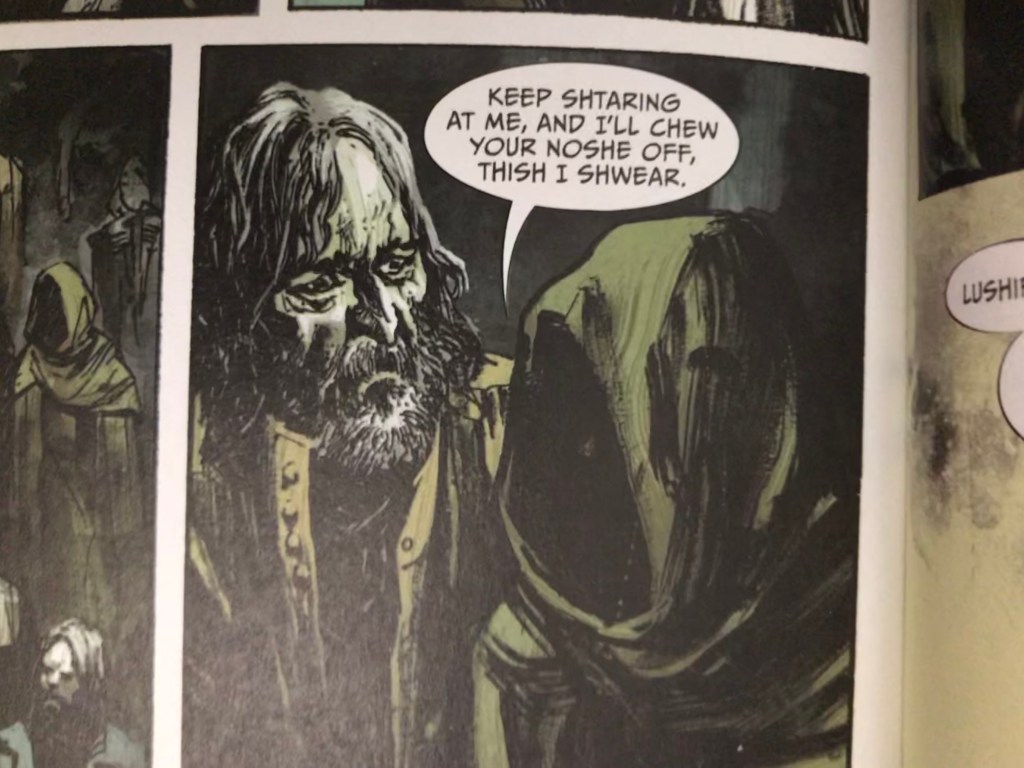
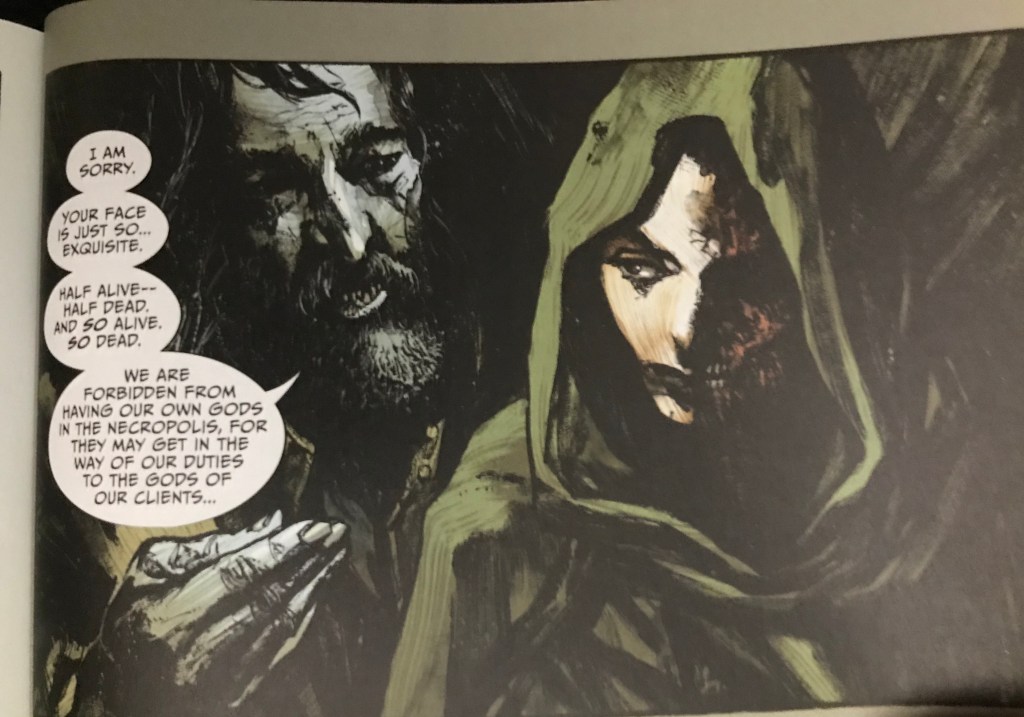
Lucifer’s long-protected fallibility is also highlighted in the opening pages. The opening narration says he was followed by Mazikeen (a daughter of Lilith, whose face has a living and a dead half) after abandoning Hell and eventually leaves him. Narrator says we wouldn’t quite dare to openly say that Lucifer was hesitating. And then, when words involving Mazikeen are uttered in the ancient Hellenist underworld of Hades, he is relieved. Odin says Lucifer is attempting to thwart the Hunt “for love.” The unspoken fallibility and dependence of Lucifer are a big deal in this story. To go light on the spoilers for once, whether he succeeds in this pursuit is left on the note of a genuine cliff hanger. This current story arc is not complete enough to be evaluated yet, but I really wanna know what happens next.








 AilixChaerea