After the example of the famous Chinese NES bootleg, this version was made to be a closer reflection of the PS1 original. These adaptations were made by Lugia2009 with patching and translation support from Lindblum, who also provided the English translation for the first Chinese version.
The 2005 Chinese “Famiclone” is widely credited to Shenzhen Nanjing Technology, which tempts me to assume that the game engine is original. There are however unmistakable resemblances to the first three Final Fantasy games, including reused assets. For the most part, it plays like an early FF as well. A notable improvement is that your party has armor, weapons and materia from the very beginning, which I’m happy with since I’ve recently dealt with FF1’s initial grinding slog.
Of course, when I say materia, what I mean is magic that works the same way as the spells you learn in shops in FF1. Each party member has a single piece of materia when they join you and each one will grow its own roster of spells as you accumulate AP. Each party member can only equip a single materia at a time. Perhaps that was the best way to reconcile the materia system with the early FF scaffolds- simply integrate it into the existing equipment mechanic. It also simplifies strategy- even streamlines it.
To an extent, anyway. It gives each party member a distinct function. This comes through in the mid to late stages of the game when more healing spells are likely to develop (excluding Aerith’s Light materia- the only one with healing magic enabled from the beginning). The majority of your strategic freedom concerns elemental affinities, which is accommodated by the ability to equip and unequip materia in your inventory mid-battle.
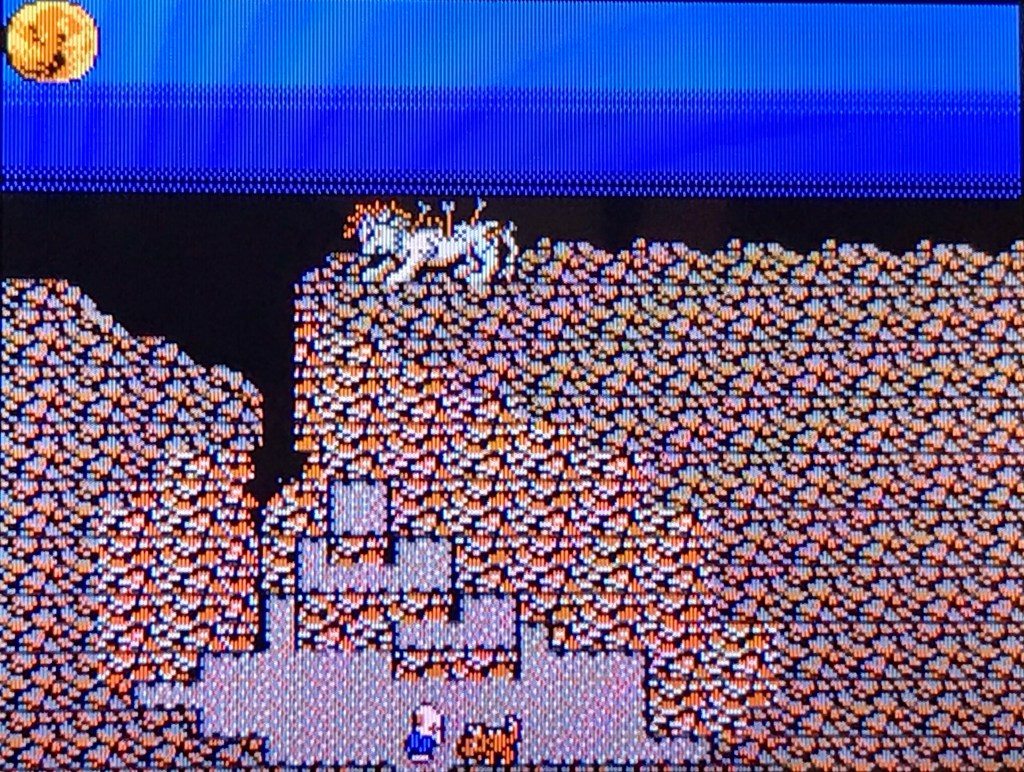
On the other hand…elemental affinities are infuriatingly difficult to keep track of. Especially since the whole range of random encounter monsters could potentially show up at any point. Like in the image above- you can run into Christopher and Tonberries and stuff as early as the bombing mission at the start of the game. Sometimes there are vague encounter patterns, but you could potentially run into any monster anywhere. Some reasonable consistency is still maintained by how tough they are, though, relative to location and progression route.
This rom-hack retains a few of the base game’s sudden difficulty spikes but, fortunately, not all of them. In an NES format it would be maddening.
After the unpredictability of the monster encounters, the next biggest combat annoyance is the scarcity of group healing magic. Even without Aerith, you’ll probably end up having one of your party members carrying her Light materia. Then again, you could simply cough up for a ton of group healing items, depending on whether you prefer to rely on magic points or money. The former can increase its max limit with usage and regular stops at “magic shops.”
Which brings us to another key mechanic change- materia and weapon enhancement. Your character builds will hinge on two point values: conventional “grinding” by winning battles and the frequency with which you use both weapon and magic.
EXP, of course, raises your level and therefore stats, etc. AP is accumulated every time you use a weapon or a materia-based spell. When you reach a given maximum limit, you’ll need to stop at either a weapon or materia enhancement station to move the ball forward. Neglecting this can make you feel extremely naked and challenged early on so luckily it doesn’t take long to put it together.
Stat + items are also dropped way more frequently than they were in the base game, which is interesting. 4-8Productions, on YouTube, has a video about the only non-finite source of stat+ items: using the morph materia on any monster in the crashed Gelnika. This is, naturally, a huge pain in the ass because that means whittling down a ton of really strong monsters to roughly below 10 HP so the morph ability can knock them below 0. However, if you’re patient and persistent enough, you can unlock a HUGE work-around the leveling system. (Yes I’ve done this and yes it’s every bit as grueling as it sounds)
This can either be good or bad. Good because it enables more character build freedom or bad because it makes a group of PCs that feel kinda same-y even less unique. As much of a fanatical Final Fantasy VII fan girl as I am, I still can’t help noticing that the combat system lurched between stilted and fluid to the point of emptiness. In order to notice and take interest in the subtleties of FFVII’s character build avenues, you would almost certainly need to like the story and the fictional world enough to pay close attention. While I’m one of those people, it’s still kinda sad that the character build experimentation was not more accessible.
Since this is an 8-bit, NES demake of Final Fantasy VII, it is necessarily shorter which means less time to stop and smell the mako. Which means the finer points of gameplay need to carry more weight. Perhaps the frequent stat+ item drops from monsters were meant to add an extra layer of build variability. This, like healing magic from non-Light materia, will likely be at its most noticeable near the end. Chiefly because you’ll have the ability to travel between the different land masses and observe which stat + items are dropped where.
Essentially, the progression route follows the original as closely as it can. Some of the music, early on, is a little tinny, but evens out once Cloud makes it to the Seventh Heaven. The chip-tuney version of Lurking In The Darkness was a pleasant and charming surprise, especially since it gets used in a few more dungeons. Those Who Fight Further was converted nicely which matters- in graphically simple turn-based RPGs, music carries a lot of weight.
As per the necessary shortening, certain musical cues are adjusted. During Cloud’s brief dream dialogue before waking up in Aerith’s flower bed, I was surprised to hear Listen to the Cries of the Planet (the music from the Forgotten Capital in the original game). Reunion is heard for the first time inside Gaia’s Cliff, which I appreciated. I realize that Reunion is basically Aerith’s Theme with a lower, mysterious-sounding key change. But I always thought it was unfairly overlooked.
One interesting consequence of the shortening was a new presentation of Cloud’s mental struggles. We simply hang out at the Inn room in Kalm as Cloud tells everyone. No actual flashback. Which means, when the party gets to Nibelheim, the player is seeing it for the first time. Unless you hang out nearby for the grinding, you won’t see it again until the illusion just outside of the Northern Crater. It’s a neat way to build tension; a series of small, gradual reveals that create questions about why Cloud told things the way he did.
Obviously there are far less side quests and stuff like Wall Market are pretty linear in comparison. I noticed some collision detection oddities on the world map (which, mechanically, functions no different from anywhere else) which made me wonder. I’ve been playing through the second quest on the Challenge Games Legend of Zelda rom hack, so I have been doing some compulsive wall-testing lately.
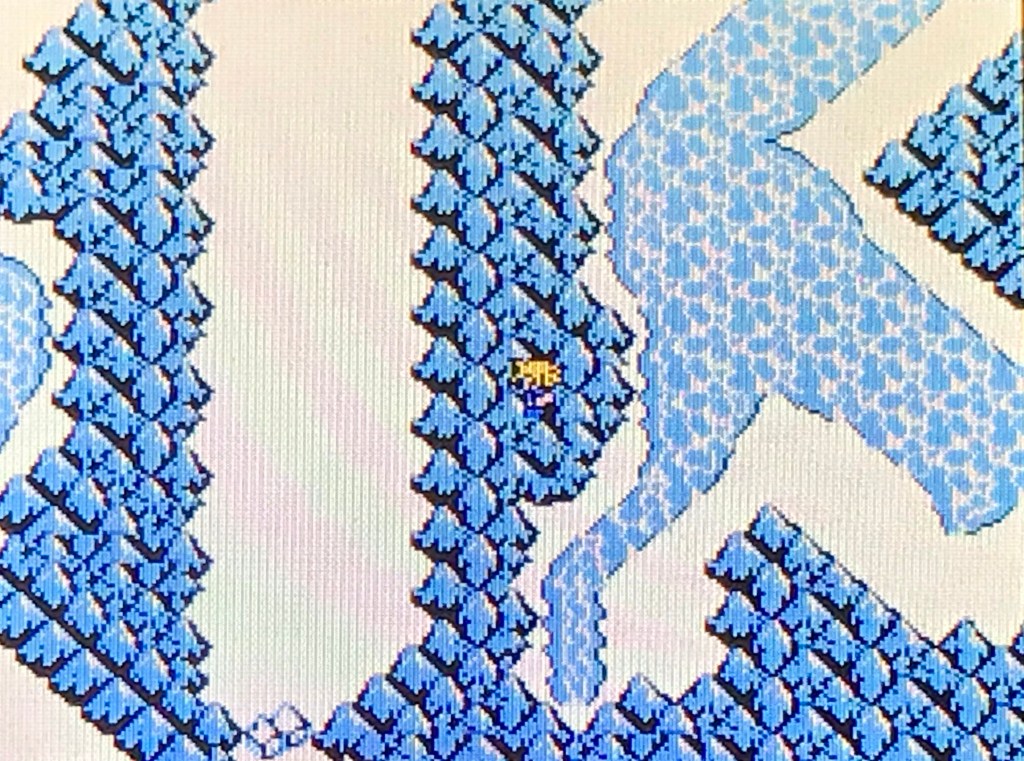
Maybe the Zelda hack is making me obsessive…but after I found a short length of mountain you can walk over in the Icicle area, I immediately doubled back and started testing other terrain barriers. Particularly around Wutai and the area between the Mythril Mines and the place where Fort Condor is in the original. You can see little entrances under mountain ranges and house sprites in inaccessible areas.
Like…you can see the entrance to the cave with the old miner who gives you the mythril key item in the original (to be traded for Aerith’s Great Gospel limit break). If you explore in the northern oceans, you can see a house that looks like it might be the home of the Chocobo Sage. On the southwestern continent, you can get a view of a circular pond collected from a waterfall that then feeds into a lake, like Lucrecia’s hideout.
Then again, the moogle construction site of Wutai was obviously there just to…pay tribute to the original and add a bit of cute, aesthetic consistency. Sort of a wink and a nod saying “Yeah, we get it, it should be there, but what do you expect? It ain’t like we got three discs!” Maybe the miner’s cave and the Chocobo Sage’s house are decorative, as well.
In an objective and qualitative assessment, this is equivalent to a streamlined NES-era Final Fantasy. Other than this one, I’ve played some of the very first FF and the very beginning of the second. This reimagining of FFVII has an intuitive and accessible combat system and some simple “high score” rewards that let you enhance your weapons and materia. The adaptation of the soundtrack from the original also adds to its stylistic distinction from other NES Final Fantasy games. But this second iteration of NES Final Fantasy VII doesn’t exactly “push boundaries.”
But for FFVII fans who also like retro gaming, this game is rather more than the sum of its 8 bits. Also like the original Final Fantasy VII, the storytelling is the main distinction here. The portrayal of Cloud’s background is significantly altered, as is the date with Aerith in the Gold Saucer. The location within the Northern Crater where Sephiroth’s original body is located, right next to Sapphire, Ultima and Diamond WEAPONs, is named “The Mako Tree” and the Prelude music is heard there, like the crystal chambers in FFIV and FFV. Since the original FFVII was such a huge tone shift from all others before it, I was both bemused and charmed to see this thematic tie-in with the older, “swords and sorcery” games.
The “tree” part is also an interesting touch. Especially given the shortening of Sephiroth’s name during combat. I know it’s an NES remake which means that menu commands, item names, monster names etc. get shortened sometimes, what with the limited information storage. But when you name the antechamber of Sephiroth’s stronghold “The Mako Tree” and you drop the “h” from the end of his name…it kinda puts the whole Tree of Life symbolism closer to the foreground. Maybe it’s not the biggest deal in the world, but I think it’s cool.
Joe Biden has claimed that he wants to bring morality back to the Presidency after the ethical abandonment of Donald Trump. He said this frequently on the campaign trail in 2020 and, during a closed-door meeting with civil rights leaders after his election, argued the point loudly.
In 2020, Biden was running against a candidate who could make the point for him simply by virtue of comparison. To his credit, Joe Biden has rolled back several pieces of anti-trans and anti-LGBT legislation imposed during the Trump administration. Perhaps naturally, the social conservative base that Trump was playing to with those policies are attempting to take stock- to find out what they are capable of under the new Presidency.
This, for a morality candidate, could be an opportunity to make good on that claim. Especially since so much of Biden’s political momentum was borrowed from Barack Obama by association. Now that Biden has profited from his comparison to Trump, however, he needs to start thinking how to build on his comparison to Obama.
This also could be a massive opportunity for Biden to validate his claims of being a moral reformer. In 2008, Obama ran and won on a negative comparison to George W. Bush. Repeatedly on the campaign trail, Obama promised to end our Middle Eastern occupation and close the Guantanamo Bay military detention center.
To Biden’s credit, he has recently made overtures toward closing Guantanamo Bay. His current plan for this involves handing over the remaining detainees to foreign governments and transferring whomever remains to American supermax prisons. While this is a relative step in the right direction, it also brings us to the moral crisis of the Democratic Party.
In a word: equivocation. Saying one thing, doing another and pretending that what you did matches or satisfies the original claim. After Obama was elected, America got interpretive about our Middle Eastern occupation. Mainstream news outlets started saying it was a bad idea to leave before establishing a Western-style democracy, which enabled us to set our own receding goal post for withdrawal. Guantanamo disappeared from the talking-head radar almost completely and warrants are issued for Julian Assange, Edward Snowden and Chelsea Manning. The Feds sic’d their thugs on those three for exposing Obama-era military attacks on civilians- including the “double tap”, when a pilot or drone circled back to bomb the emergency first responders.
Even the slaughter of civilians by the American military was somehow whitewashed by upper-middle class faux-leftist popular opinion. Fortunately for Biden, even this could be amenable to reparation. The Icelandic journal Stundin recently ran a story about Sigurdur Thordarson, a key source of the sexual assault charges against Assange, who now admits to fabricating these claims. Moreover, Thordarson was once again given the formal status of a witness against Assange in 2019 by the Department of Justice under the Trump Administration. This was while Thordarson was incarcerated for multiple sexual assaults against minors.
Alexandersson and Jonsson, the authors of the June 26th Stundin article, wrote that American officials updated the indictment against Assange in a London Magistrate Court. The legal entanglement between Assange and Manning could regain lost ground if Assange were guilty of felony-level crimes in Iceland. Kellen S. Dwyer, the deputy of Trump’s Attorney General appointee William Barr, offered Thordarson immunity from any crimes he admitted to in his testimony against Assange. Nor would any such admissions be shared with any other law enforcement agency. Thordarson now admits that he never had any position of standing within WikiLeaks nor was he ever instructed by anyone therein (let alone Assange) to do anything illegal.
With this now being a matter of public record, consider the opportunity that Joe Biden now has. Consider the moral contrast with Trump that got Biden elected- especially with Trump’s open hostility toward the American press. If Biden were to pardon Assange and Snowden and cease any legal machinations against them and Manning, imagine the support he would galvanize. Right now, we exist in an era where Neera Tanden’s confirmation is thrown off because she said mean thingson Twitter and not because she punched a journalist or fantasized out loud about seizing Libya’s oil as compensation for our military presence there. Being mean on the internet is treated like a more serious wrongdoing than actual war crimes. If Biden unconditionally pardoned Manning, Assange and Snowden, he will have set the moral foundation for a withdrawal from our Middle Eastern occupations.
By legitimizing Snowden, Manning and Assange as whistleblowers, he would be elevating the moral seriousness of war crime which would be the ideal set up to a full withdrawal. He would also alleviate some of the anxieties of leftists like myself who fear a return to the equivocation and apathy of the Obama era.
There would be no better way to differentiate himself from his former running mate than to cease the persecution of whistleblowers that Obama initiated. He would be sending a message that his would be a presidency of real change and real hope, instead of those words as kitschy slogans on a red and blue, pseudo-Warhol campaign image.
Joe Biden and the Democratic Party need to ask themselves what they want their legacy to be in the wake of Trump. The American left sees the Democratic Party as opportunistic and dismissive of their values. We feel like we are trapped between war-profiteering cultural reactionaries and manipulators. Leftists in America feel like the Democratic Party keeps claiming to share our values while insisting that they’ll set thought to deed in just a little while. Just a little while has been happening for over a decade.
Obama promised to end the militaristic puppeteering in other countries before he got elected…and afterward, somehow got the comfortable, complacent network TV demographic to embrace the proselytizing of Western democracy. Formerly, the moral justification for the Vietnam War. Biden wrote, in the introduction to Sarah McBride’s autobiography that trans rights are now at the frontlines of the Civil Rights movement. This last Pride month, he had many flowery remarks to share about the urgency to stop violence against trans women. There have already been suicide attempts in the Arkansas Children’s Hospital following the prompt cessation of hormone replacement therapy. Mary Bentley, an Arkansas Republican Representative, recently threw her weight behind a bill that would protect educators who wish to persistently misgender and dead name trans youth.
This is a mental health issue that has long suffered in mainstream opinion. It is difficult to communicate the hardship this inflicts to a cisgendered public. I could unload a ton of personal stories but it wouldn’t advance my point at all. This is an experience that teaches trans people that our feelings and mental health count less than everyone else’s. It is an experience that has taught many of us that, no matter how civil things become, we will never truly belong anywhere.
That is the depth of pain and alienation Biden would be addressing if his White House began an uncompromising reversal of the transgender policies of the Trump era. Many of us, perhaps for the first time, would begin to wonder what it would be like to have a president who was also our president.
If Biden’s claims of enacting a morally bold Administration are sincere, then now is the moment to prove it.
Update, 7/5/21: We have just left our biggest military base in Afghanistan. Credit where credit is due.
This album, for me, is in event. I have known Rachel- the frontwoman of dedbutherflys -for over ten years. We met online, when we were what the world now calls “eggs.” We bonded as we read each other’s online journals and later saw more of each other than anyone else may have, at that point in our lives. She listened to me talk about my stories and she told me how things were going with her current band at the time, 11:34. She taught me everything I know about sludge metal and introduced me to the music of Acid Bath and Cancerslug. We hit agonizing brick walls together and talked each other through. She sent me pictures when 11:34 opened for Otep, in Pennsylvania.
And here we are, then. Rachel’s first album, a solo effort under the name dedbutherflys, recorded in collaboration with Taylor Kouqj Bull of Seventh Wave Studio, in Harrisburg, PA (who is a musician herself- her own material is created under the name Kouqj). On to the music, then!
Catatonic Despair is an instrumental but not quite what I would call a normal intro. The opening notes sound like slow beats with gentle echoes between them. If you don’t pay attention to the track sucesssion, it sounds like an extended beginning to Back On Da Liquor, which is when we hear Rachel’s voice for the first time. Lyrically, Back On Da Liquor describes a world that refuses to listen to you melting into a silent and passive mental landscape, like a “natural habitat” of enforced loneliness. I also gotta mention that, during our long and passionate friendship, I didn’t get Rachel mad at me very often but…well…it’s happened before. She never went as far as yelling at me but I did learn to recognize a subtle build-up in her voice, just before it’s about to become elevated. This is my first time listening to Rachel sing and I never would have guessed how expressive that emotional build-up can be.
Back On Da Liquor is a slow burn of depressed ferocity which explodes to satisfying effect in Magic Murder Bag- if I’m ever able to see dedbutherflys or any of Rachel’s other bands live, this is one that I’ll be hoping for. This is the shit that headbanging was made for- an extended guitar part would make this delicious to be in the presence of. To say nothing of how beautifully the percussion comes out- which would be Rachel herself on drums and Taylor Kouqj Bull on bass.
(For the record, this album was assembled from multiple, separately recorded tracks. Rachel played every instrument except bass, which was played only by Taylor Kouqj Bull)
Also: “I’ll kill you just because I’m hungry / I’ll kill you just because it’s funny” sounds just like her.
Killer Clown keeps up the pace with delightfully manic syncopation between the percussion and guitar. Maybe I shouldn’t be as focused on this as I am but Rachel’s voice does an awesome job of supporting the bond between melody and rhythm in general. Is that to be expected, though? She’s been playing in various sludge metal bands in Pennsylvania for over a decade, largely as a percussive musician. If anyone would know anything about that, a drummer would.
Next is Mr. Bradley – Mr. Martin. If I didn’t already love this woman like my own flesh and blood, that song title would win me over. A fellow Burroughs lover :3 The song itself is a snare drum solo that’s just soft enough create an anxious build-up of tension. This leads us into Blowjobs 4 Satan, which is the first time we hear dedbutherflys reaching for the typical speed of metal drumming along with what I suspect is some layering of vocal tracks? The fast guitar makes this all add up to a “wall of sound” effect. That’s the phrase a lot of people use to describe it. I’ve always thought of it as being more of a watery effect, since it feels immersive when its done right (like it is, here). There’s a sudden sound sample that signals a guitar-driven key change with each electric note getting stretched longer and longer with distortion. After the dynamism of the “band-scale” sound combination, the electrical distortion outro has the right atmosphere to sustain and subtly shift the tone near the end.
The opening riff of The Chase reminds me of something Akira Yamaoka would compose for a Silent Hill game. Around fifty seconds, the rest of the tracks kick in with the drums taking a strong lead. The guitar slowly assumes the foreground as the song gets heavier. As I’m listing right now, The Chase is probably the most dynamic song on the album so far. The combination of Mr. Bradley – Mr. Martin and Blowjobs 4 Satan was rich and satifying and energetic, but this sounds like a journey through a hostile supernatural landscape. This is the second song that’s made me think of an imaginative “place” so I think this is seriously coming together.
Aaaaand what have we here??? Hermaphrodite Love!!! Can it be that my sludge metal musician friend is able to write large hypnotic instrumental segments that actually carry serious weight? I haven’t heard anything like this since I last listened to Hella or El Grupo Nuevo Omar Rodiguez-Lopez! Maybe this is just my erratic failure to follow genres closely, but this is actually pretty different. You normally only find this kind of comfort with experimentation with electric dream-poppy stuff but it combines beautifully with the sonic abrasiveness of metal. Actually…sludge metal is more atmospheric than a lot of metal sub-genres. Could it be that dream pop and sludge metal are fellow travellers? Am I profane idiot? This album might make me commit to that opinion.
Singing comes back with Rum is Gone. In a time where literally every fucking body is caught up in labels and wanting to look good…I am like, jump-up-and-down stoked about an MtF metal singer who ends a verse with “choke on my dick”! She also just now informed me that some of my word-associations made it into the lyrics ❤ Around the 3:30 mark is another key change that at first tempts you to think of it as a bridge. And what the fuck is going on with the guitar’s rhythm near the end? I suspect I’m discoverying a low-budget metal album that baits you with successive instrumental innovation in ways that you normally only get from avant-garde jazz and witch-house. I think this is why I was hesitent to call Catatonic Despair an “intro” track- because it isn’t. In light of the nature of the overall album, Catatonic Despair is actually the first song, if that’s not redundant.
Second to last track is another instrumental- Candyland Vampires! And I totally gave her that name! There, it’s out of my system. I have a running list of word association experiments. Candyland Vampires brings us back to the distortion-heavy ghostliness of The Chase. Somehow this feels warmer, coming off of Rum is Gone. For this she used an Earthquaker Afterneath pedal and it’s both haunting and euphoric at the same time. Perfect preparation for the opening of NB AF. From what I understand of the recording process behind this album, NB AF was intended as a bonus track but I think this should actually be the canonical end of the album. Rachel forcibly drags the foreground back to her voice and doesn’t fucking let go. Back to the syncopation sweet spot from Magic Murder Bag except there’s more of it. Another song I’d be thrilled to hear live!
Meat outside of the floor compartment. What would Dracula say D:
Since I’m playing through the second quest, I’m gonna exercise zero restraint on spoilers.
The first moments of quest one can be a little intimidating. But a modest amount of exploration will reveal that your sword is sitting there for the taking in the first dungeon. After that, a little lateral thinking will set you straight on how this rom hack differs from the original Legend of Zelda: run back and forth between dungeons, the “One way!” teleportation caves, etc.
Second time around, though…after the “New Adventure Awaits!” notice when you bump off the Thunderbird…it’s, uh…pretty tough.
Before now I never really stopped to consider what a security blanket the sword actually is, in a Zelda game. Being without it is pretty damn inconvenient, but on top of having to rely on bombs, the candle and the boomerang to kill and stun monsters…you just feel naked without it.
So you find ways to compensate. I stumbled across a cave with a moblin giving away rupees, early on. From there, the question is what to buy with the most possible utility, since no sword means you won’t be milking enemies for item drops as frequently as the first time around. Like an idiot, I went with bombs instead of the candle. Both the candle and the bombs can harm enemies and unlock hidden paths, but they also have different strengths and weaknesses. The bombs do more damage and the candle is easily replenished between screens. Coming and going from the screen next door to renew the candle is less of a test of patience than spending twenty rupees every time you run out of bombs.
Get ready for lots of THIS shit
Luckily, one of the early dungeons offers a solution: like-likes, who probably have the best item drops out of any monster you’ll have access to in the very beginning. Lots of money and bombs. With persistence and luck, you’ll be able to farm enough rupees for both the first boomerang and whichever of the two initial purchases you didn’t go with the first time around.
After that point…you’ll probably notice that the dungeons have letters instead of numbers. Meaning that the progression route will be even less linear than last time, perhaps? Less linear than the first play through that was distinguished largely by it’s non-linearity?
Like linearity itself, this has it’s own set of possibilities and limitations. We know, from our first quest, that an item obtained in one dungeon may unlock an obstacle in another, or elsewhere in the Outlands. Therefore, finding yourself with bombs, the candle, one boomerang or another and some occasional meat with no path forward in the “first” two dungeons is not a death sentence. It just means you have to keep looking.
As per the original Legend of Zelda and our first quest in the Outlands, the typical methods of revealing hidden paths include: pushing rocks, bombing walls, burning bushes, crawling with the ladder, sailing on the raft and playing the ocarina. That last part is an addition from GameMakr24 that I’m really happy with. It contributes to the exploration of what the lore of Ocarina of Time would be like if it were present in the first game.
So we dart all over burning things, blowing stuff up, pushing rocks and playing the ocarina. This process is narrowed by my lack of a power bracelet: only the plain, cubic blocks and the headstones can be pushed right now. After several failed bombings (hehe…sorry, I couldn’t resist) I remembered a pattern from the first quest: lots of breakable walls and very few flammable bushes. Maybe the distribution is reversed in the second quest?
Maybe a little less of a reversal, as it turns out. While breakable walls are in hiding so far, flammable bushes are only slightly more numerous…and they usually only have moblins who pay you to keep the secrets of their woodsy little holes.
(I know they’re called Goriyas in the NES games…but it’s hard for me to shake the resemblance they have to moblins. Like how the Wizzrobes look like Subrosians from Oracle of Seasons or potion vendors from A Link to the Past. My mind just seems to…have it’s own preference. And it’s not like we don’t call the armored foes Darknuts even though Nintendo canonically named them Iron Knuckles)
Rupees are perfectly good but they don’t really help, if you already have some of the early equipment. Excluding keys for dungeons, of course. Still haven’t found any amazing Goron shops with bows and stuff yet, though, so rupees aren’t high on my list. Given how open LoZ: Outlands is, though, I wouldn’t be surprised if there is a way to access it even at this point.
I found the step ladder in dungeon O. This opens up the territory beyond streams, which shows promise at first. If you can scrape together the rupees, you can pay a Subrosian for a hint. The cute, robed sorcerer makes it sound like the cemetery puzzle in the lower lefthand corner of the map can be solved in the same way it was in quest one. Until I realize that I need the power bracelet to see that through…
…X_x…
The systematic method can be seriously frustrating if you overthink things. Especially if you haven’t played the original Legend of Zelda in a while like me. See, earlier, when you get the ocarina from Zelda, she tells you to look for a hidden path in the Graveyard of Serenity. And you happen to have the step ladder which lets you access the lower-left cemetery. So…it…it almost starts to feel like the game isn’t playing fair…
Then I took a break and realized two, blatantly obvious things I’ve overlooked: the Graveyard of Serenity refers to a specific graveyard and the first quest had three of them. We’ve ruled out one. The other is on the other side of some water. And in the last paragraph, where and when did I say Zelda gives you the hint?
Oh. Right. When she gives you the enchanted instrument that’s used for revealing paths and warping. Thing is…I sorta wrote that off for the same reason I did the flammable bushes: it only ever seemed to unlock rupee moblins and a heart container. And the cemeteries are flooded with ghostly floor masters that I just can’t kill yet.
Back when I was trying to set all the plant life I see on fire, I usually had to clear the screen of moblins and scrubs before I could start testing the bushes one by one. And I didn’t want to keep spending money on bombs so I would come and go from the screen to keep reusing the candle. That requires waiting for them to get close to a wall so the fire can continue to burn them after it knocks them backward. And, if you want to spare yourself as many screen to screen refreshes as you can, you should probably camp out near a wall with the boomerang so you could stun and burn a whole group.
The lady said it was the Graveyard of Serenity, though, so off we go. And that means the floor master ghosts. Which, presumably, means a whole lot of dodging. And the floor master ghosts spawn every time you touch a tombstone. It’s a risk…but not impossible.
This was almost too much for me. Guess what’s in there? A rupee moblin. Just a moblin with more money. *eye twitches*
But did Zelda say to push aside a tombstone? And as much of a bust as the ocarina had been so far…it has unlocked secret paths in places without water before.
…
So. Not only is the path to level T unveiled but…
Oh Zelda. My orange-headed savior. I’ve never been happier to see you. At long freaking last, my A button is no longer useless!
I mean, yeah, other stuff happened before I got the sword but I had to get it out of my system
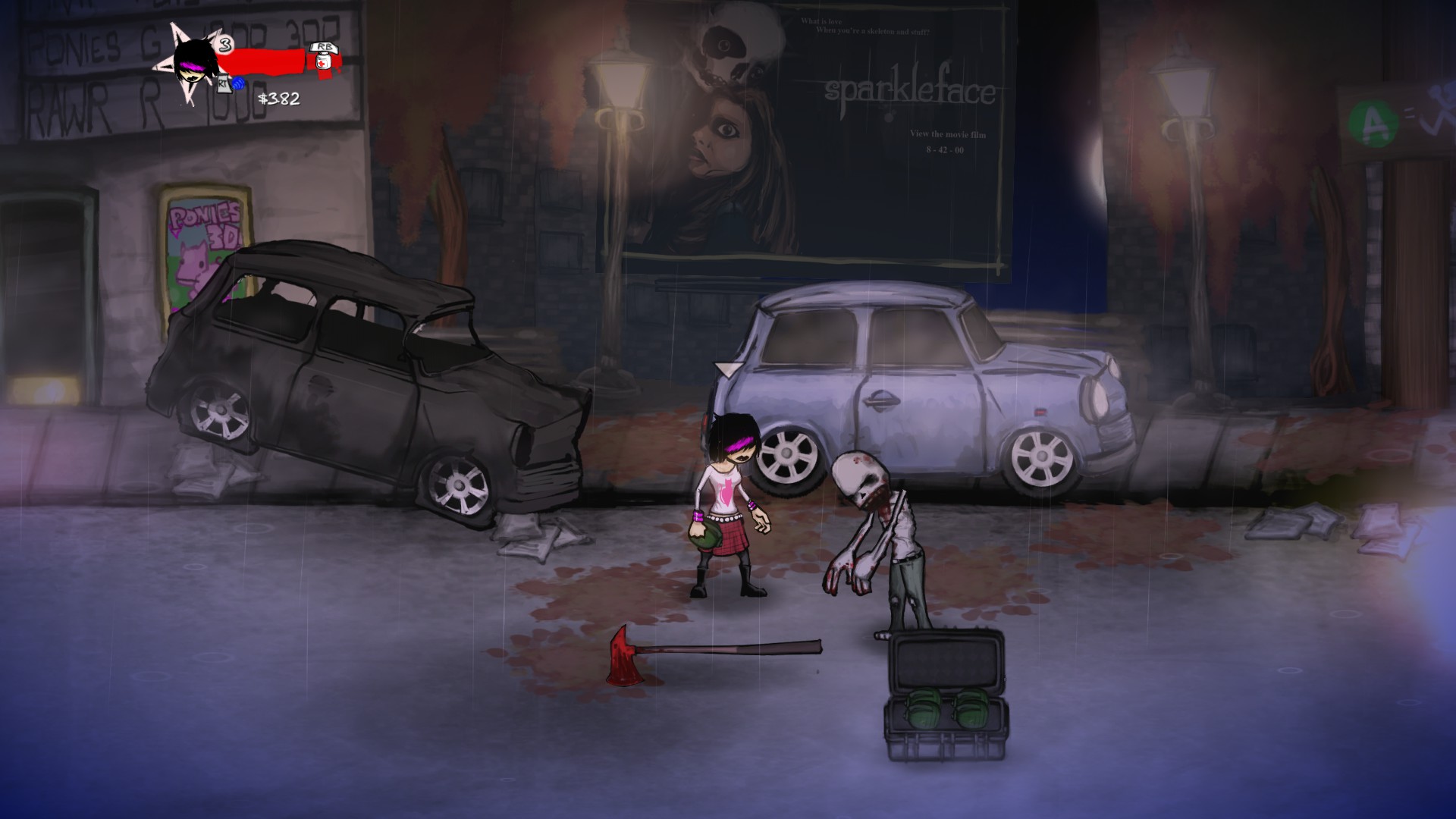
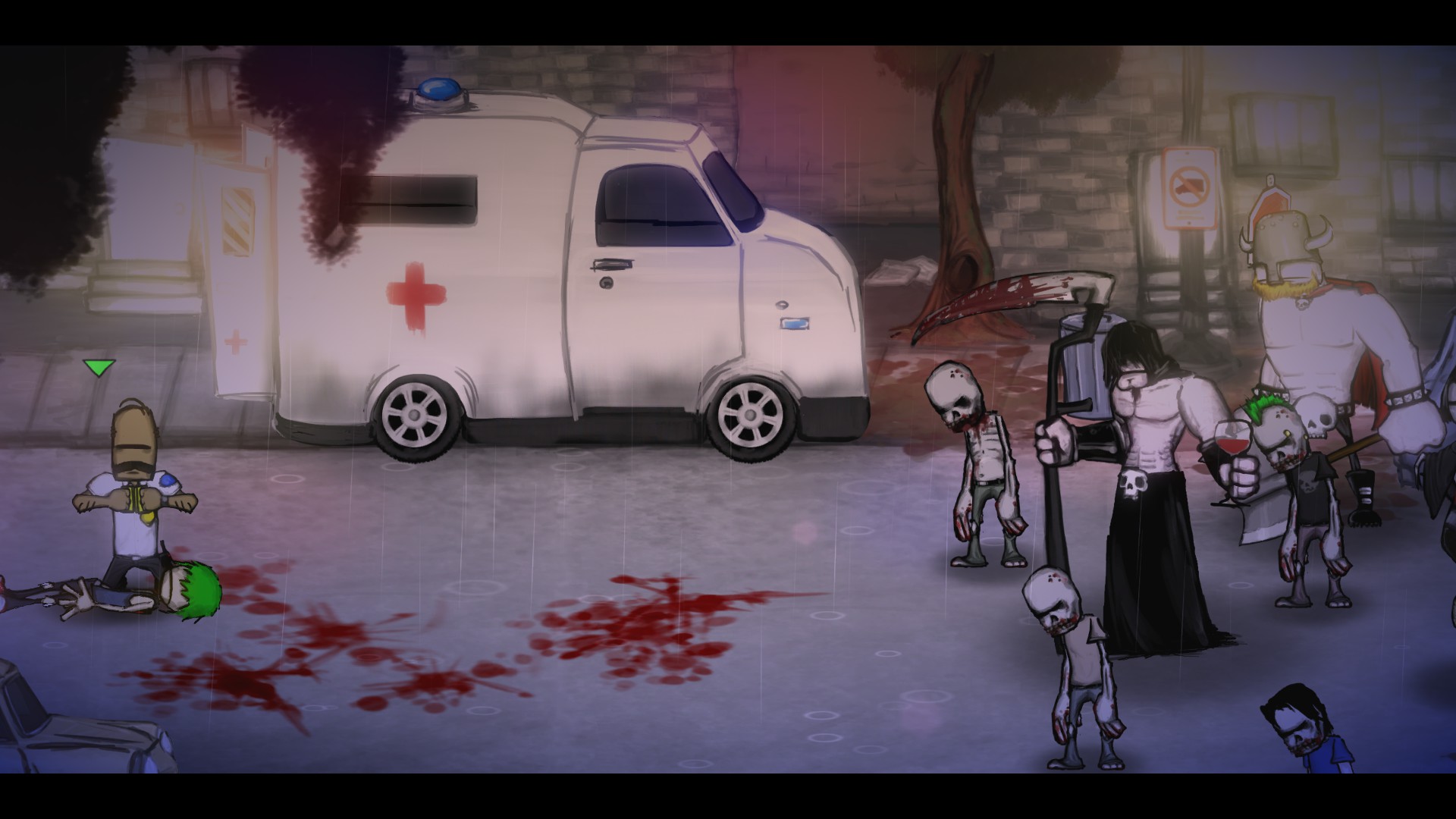
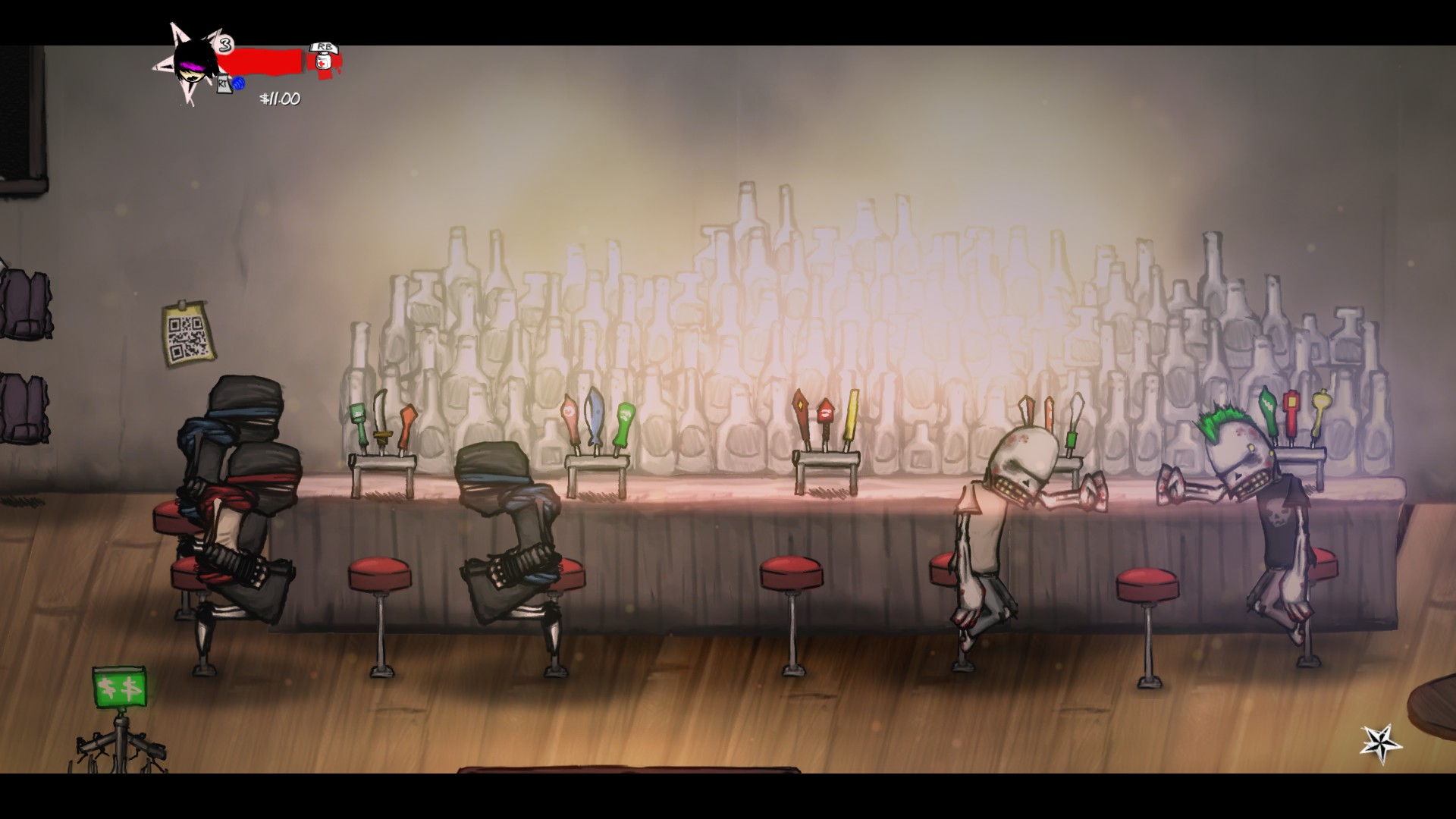
While Charlie Murder has a world map, character building and other RPG-lite mechanics, it mostly stays in it’s beat’em up lane. The progression route is linear and grinding like you would in an RPG may or may not help as much as you’d think. At this point, tackling a difficult battle the way your build already is seems to pay off more. The auto save feature is blessedly reliable and you usually pass through at least a few screens on your way to a boss or a melee obstacle.
With an auto save between screens, you’ll still be better off on your next respawn even if you do lose some resources after getting KO’d. I mean, so far exploration hasn’t been that big of a factor and that’s one of the things that helps grinding not be an abject chore. Like I said- the game mostly stays in it’s lane, with combat, rhythm games and rail-shooter segments taking up most of the foreground.
I love seeing stuff like this: the contact-damage obstacles in the cemetery clearly contained germs of the Whispermen and Hanged Men from S&S ♥️
In my mid to late childhood, gaming arcades were still common. Consequently, I got a few fond memories of pumping quarters into beat’em up arcade cabinets so I could keep trying to get passed a single, frustrating melee obstacle. Obviously, this is only one example of gamer rage, but it’s a kind of gamer rage that makes Charlie Murder’s design satisfying for me.
Speaking of the design- you have two different forms of EXP: pocket change and social media followers. I think the scrounging for pocket change as it drops from fallen zombies kinda makes the social media thingie less repugnant through association.
Yeah I get it: social media is not doing so hot when rolling zombies for quarters makes it look more comfortable through association. Think it through, though: aren’t social media accounts promoting content creation (*sits there innocently, totally not self-aggrandizing* 😇) more interesting than most of them? I’m not wrong 😺
It’s also delightfully random when your followers plunge to zero because you just leveled up ^^
So when we last left off, we learned that a jilted ex-band member was gonna be our primary antagonist.
After each boss fight, there’s a flashback to older Charlie Murder gigs where you play a rhythm game as whatever band member you’re playing as. After that, there’s a more conventional cutscene showing the anguish of ex-band member Paul before he takes his fatal steps toward becoming a supervillain.
Is it weird that this is more fun than the aerial combat in FFVIIR?
There are also swag shops immediately after boss fights allowing you to cash in your pocket change for stat buff booze, equipment shops and tattoo parlors. Earlier I compared the tattoos to the brands from S&S but it might be more accurate to say they’re kinda like limit breaks. The more you fight, the more you fill a blue energy gauge. When it’s full, you can hold down a button which lets you unleash special attacks bestowed by the tattoos in addition to your chi-blast death metal scream.
The rail shooter segments also become more common as your progression route leads you to obtrusive terrain, requiring you to drive, fly, grapple, etc. The one that made me spaz out enough for my wife to take pictures of me was the shootout with witches on broom sticks.
This plays exactly like Einhander or Defender which makes it simple from a gameplay perspective. But there’s just something really fun about witches on broomsticks pulling out automatic handguns and shooting at you, like a gang war. How the fuck has this not been used in The Magicians or something?
There’s stories like The Prophecy and certain Anne Rice books in which supernatural creatures are either confused or intimidated by human technology. With the right world building, that can work. But a lot of stories don’t bother with that, so why hold back? Prolly afraid to be compared to Underworld ‘cause it looks campy but there’s also a good way to do camp as well. I’m raving about how much I like this game, aren’t I?
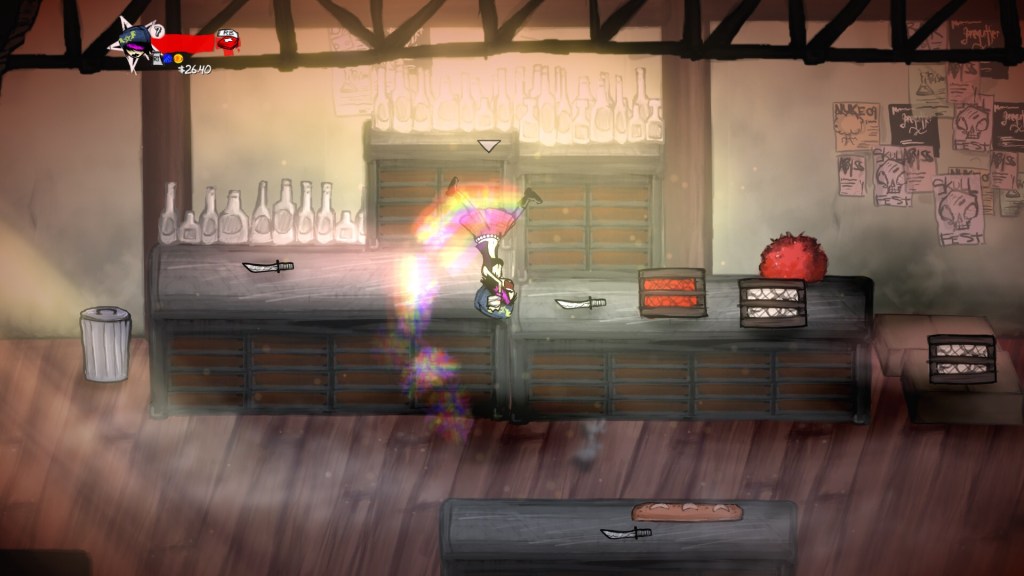
Maybe it’s just me and my witch-shootout fixation but just looking at this image almost makes me smile
After getting caught up on the progress of Paul’s rival band after his Faustian deal, we learn that he’s been present in the story every since we were resuscitated in the first level.
Alex Kane, in a May 25th article on jewishcurrents.com, wrote that the Biden State Department committed over five million dollars of aid to Gaza humanitarian efforts. Simultaneously, the State Department also accepted a 735, 000, 000$ offer from Israel in exchange for military support.
Kane writes that the State Department dispensed an export license to Boeing to carry out the American end of the purchase. This included Joint Direct Attack Munitions and Small Diameter Bombs: two varieties of laser-guided explosives used by Israel in an eleven day attack on the Gaza Strip which ended on Friday, the 21st of May.
Reporting earlier that month suggests an interesting dialectical process leading up to this point. On May 3rd, Axios reporter Rebecca Falconer published an article detailing remarks made by Hilary Clinton on a potential withdrawal of American military forces from Afghanistan. Clinton warned that such an event could cause a surge of Afghan refugees and give Jihadi militias a chance to regain lost ground. Two weeks later, the UK branch of The Independent reported that Trump sent a private memo to his Pentagon appointees, stating a wish to immediately withdraw from Afghanistan following his loss of the 2020 Presidential election.
The irony is hard to miss: Trump gets all furious and apoplectic after losing so he decides to punish his own base. So Mister “I love selling weapons to the Saudis” wants to take his ball and go home. Since the 2020 Presidential election and immediately afterward, all criticism of Trump is welcome on the left- even if it’s for things the left should be doing. This leaves the door open for Hilary to look after her own bottom line and look good doing it.
So on the 25th of May, we learn Biden sold laser-guided weapons to Israel for 735 million dollars while kicking five mil to Palestine for humanitarian aid. The dude is hedging his bets but it’s clear which one he expects the bigger return from.
You know how green infrastructure reform, universal healthcare and universal basic income are constantly shot down by people asking how we’re gonna pay for it? Do the outraged deficit hawks have nothing to say about the laundering of perpetual war? Is this what the big liberal rollback of the Trump administration looks like?
Numbers added for ease of navigation. If you want to go straight to my interpretation, scroll down to 5. What comes before that is my analyses of relevant sources and why I make the connections I do.
Content warning
1.
Marilyn Manson’s Triptych is an important work of postmodern musical storytelling.
“Theater” would have made that sentence less cluttered than “storytelling”, if less firmly defensible. Nonetheless, an argument could be made.
A concept album is not (necessarily) as esoteric or pretentious as the name may sound. Many concept albums are composed of nothing more than consistent lyrical and musical themes. This approach was employed by David Bowie, Leonard Cohen and Pink Floyd frequently (though not exclusively).
On the other end of the spectrum are albums that tell a literal story, like Tommy by The Who or the body of work that Emilie Autumn may soon incorporate into an actual work of musical theater (Opheliac, the 4 O’Clock EP and Fight Like A Girl).
Marilyn Manson has frequently voiced his admiration for Bowie and, in particular, Bowie’s early seventies glam-rock material. On our concept album metric, Diamond Dogs, Aladdin Sane and The Rise and Fall of Ziggy Stardust and The Spiders From Mars are closer to thematic concept albums than narrative concept albums. Yet they contain flourishes of imaginative, fictional events like aliens and global extinction. At the very least, Bowie’s glam trilogy experiments with narrative storytelling without going there in a literal sense.
This is the middle ground where we find Marilyn Manson’s Triptych. This body of work consists of three albums: Holy Wood(In the Shadow of the Valley of Death), Mechanical Animals and Antichrist Superstar. Each one contains distinct lyrical imagery with a small degree of overlap. If we listen to one of them from beginning to end, we will hear about characters like Jack, Omega, Coma White and the Worm. If one confines themselves to the lyrics, these names are usually contextualized as proper nouns.
The context for each phrase remains consistent enough for the proper noun status to be noticeable. At the same time, there is usually enough bluntly obvious or literal subject matter to have a single song make sense on it’s own. In a casual listening, this can convey social commentary with a little bit of word-play. An album-length listening will make the fictional characters and events difficult to not notice, though.
Please don’t think that I mean that the social commentary is a mere “hook” to generate interest with the narrative devices being the “important part.” The simultaneity of the different levels of meaning actually gives the fictional/poetic story the credibility it needs to be accessible and interesting. More so than it would have been if the Triptych was an outright literal story.
2.
This brings us to the “postmodern” part. The simultaneity of the social commentary and the poetic bells and whistles gives them an energy-exchange that is a lot like the exchange between observation and emotion. In fact, the character names and non-literal events usually have an emotional framing. Wormboy on Antichrist Superstar places this dynamic in the foreground.
The object of critique is apparent: vague, simplistic and abstract ideals are used by institutions to control and misdirect. Even the vagueness and the abstraction serve such a purpose: if the ideals of an orthodoxy lack the complexity and detail of lived experience, than lived experience can feel like it is just in the way.
Lyrics like “When you get to Heaven / You will wish you’re in Hell…when will you realize you’re already here” state this plainly, but the lyrics also contain less simple emotional dynamics. The more emotional lyrics also benefit from the successive atmospheric build of the running order of the songs until that point.
Antichrist Superstar is divided into three separate song suites. The second song suite begins with a mysterious, sudden, painful event in the first two songs. The third song in the suite is a visceral, blood-letting reaction to what just happened. Wormboy is the fourth song in the suite, immediately after the blood-letting of Deformography.
Little Horn, Cryptorchid and Deformography can be reasonably interpreted as the emotional low point at that part of the album (before the next low comes in the third suite). So after this visceral trauma, next comes Wormboy.
Early lyrics of the song imply an attempt by the speaker to distance themselves from their own spiraling rage: “So watered down / Your feelings are turned to mud / Love everybody has destroyed the value of / All hate has got me nowhere.” This is also an explicit return to the discussion of binary morality from The Beautiful People. The Beautiful People described alpha-beta, binary ethics as a terrifying and oppressive status quo. Wormboy describes alpha-beta ethics as the source of an inescapable gridlock that offers no satiation and is more trouble than it’s worth.
The succession of different moods within Antichrist Superstar make the emotional attitude of Wormboy more compelling than the speaker’s final, desperate bid for rationality. This furnishes a good example about how the context of the whole album creates different layers of meaning, but the importance of successive “moods” leads us to the reason why the label ‘triptych’ is even appropriate for this body of work.
It also leads us to why I used such a fat, clunky, unappealing word like “postmodern” in the first sentence of this entry. The succession of moods within the Triptych all have a sequential relationship with each other. Different moods that follow a sequential logic, in and of themselves, do not constitute a literal narrative: each one is compelling even without the whole. Yet the sequential order, when experienced from beginning to end, creates the feeling of sequential events or experiences. Events experienced by a single perspective that sequentially lead into other events is one of the defining characteristics of a story.
This is why it is so easy to listen to one of the Triptych albums and get a small, nagging feeling that there is something cinematic just under the surface. Any given song from the Triptych has an accessible emotional center and usually some kind of social commentary. These lucid “hooks” of content then lead deeper into the understated context.
3.
So. The actual word ‘triptych.’ It’s a set of three paintings that, when placed side by side, make up a single panorama. Each third is also, potentially, self-sufficient. If there is a linear, traditional story in this, it fits within three simultaneous and different perspectives.
The word also implies that two of those pieces may fit in to a third. This third would then contain points of departure for the two others. This third, for our purposes, is Holy Wood (In the Shadow of the Valley of Death). Within the story implied by the successive moods subsuming each other, Holy Wood contains two opportunities for a perspective shift.
This is where we get into the role of Manson’s authorial intent. Normally, I hesitate to give authorial intent too much credit. A well-crafted work of art should be comprehensible in and of itself. If it needs a SparkNotes guide to make sense, then that is a failure of the artist. Especially since the designation of ‘Triptych’ implies multiple, simultaneous levels of meaning.
Nonetheless, Manson himself offered a simple guideline during a fan Q&A before the release of Holy Wood(In the Shadow of the Valley of Death). It is not a terribly specific guideline but I think it bears mentioning. After all, the designation of these three albums as a single body of work called the Triptych was coined by Manson himself.
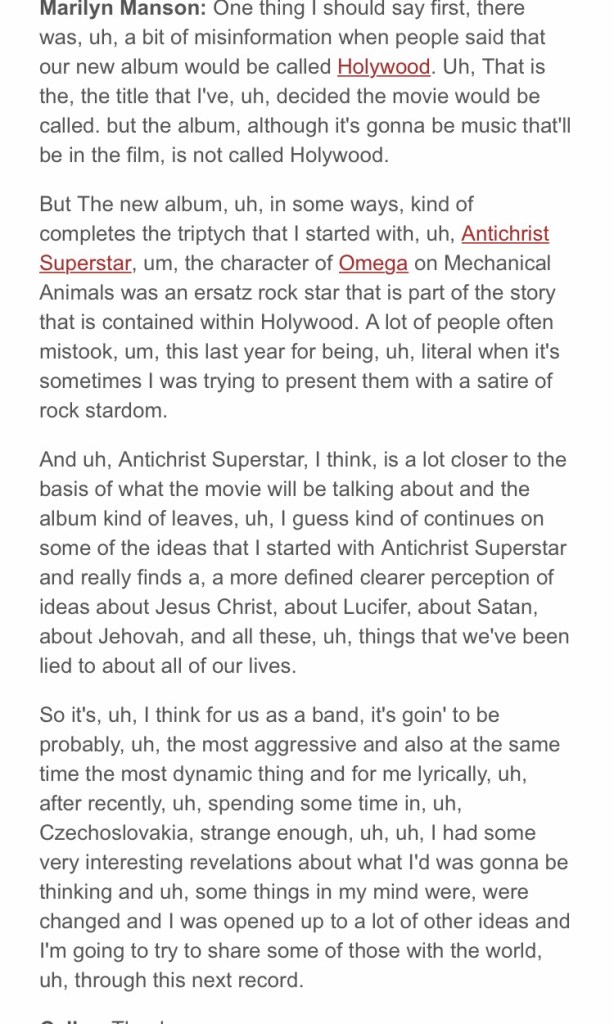
During the Q&A, Manson stated that his Triptych film project would adhere closer to Antichrist Superstar than Holy Wood. Holy Wood was then envisioned to be more of a context source for the film. He also said that the arc of Omega from Mechanical Animals would be part of the story contained within Holy Wood.
If the film would have bore a closer resemblance to the arc of Antichrist Superstar while the album Holy Wood would depict more of a set-up to that story, then we can draw a few conclusions. Manson also stated that, for a linear listening order, Holy Wood would come first, then Mechanical Animals and Antichrist Superstar would mark the ending.
With all this in mind, it makes sense to think that Antichrist Superstar proceeds directly from the end of Holy Wood. Yet popular wisdom among the Marilyn Manson fan community holds that the Holy Wood-Mechanical–Antichrist sequence is literal and canonical. Nick Kushner, who made analyzing the Triptych his archival labor of love on the Nachtkabarett, entertained the idea that Adam (the Holy Wood protagonist) attempted suicide in Count To Six and Die (The Valley). This failed attempt would then lead to the creation of Omega as a psychological alter ego.
From Gio Blush Design
I believe Kushner was on to something with this interpretation, but I do not agree with his sequencing of events. Manson’s statement that the appearance of Omega happens within Holy Wood and his remarks on his film idea point to a simpler possibility.
4.
Holy Wood contains four song suites: In The Shadow, The Androgyne, Of Red Earth and The Fallen. If you’ve seen the cover of Mechanical Animals, one of those names will jump out at you.
Both the lyrics and album art of Holy Wood contain numerous Tarot references. Hermetic mysticism has incorporated the Tarot into it’s symbolism and, in the present day, Hermetic mysticism has provided much of the contemporary, popular interpretations of the Tarot. If we’re going to pull back from the actual music (the “text”, as the feller says) we might as well acknowledge that Marilyn Manson has spoken openly about his interest in Hermetic magic.
After Manson contributed voice acting for the video game Area 51, he did a back-and-forth interview with David Duchovny, who also voiced a character in the game. Amidst the spitballing about Jack Parson and the memoir Sex and Rockets and alchemy, Aleister Crowly and his involvement in Hermetic magic came up as a mutual interest. Even if Marilyn Manson was never one for organized religion, there’s still no reason not to incorporate the mythology. The dude made no bones about doing it with Christianity, after all.
A major point of intersection between Hermeticism and the Tarot are the symbolism of cups and swords. One is concave and empathic, the other is rational and penetrating. Hermeticism often equates these symbols with femininity and masculinity. More recent pop-culture interpretations of Hermeticism, like Alan Moore’s Promethea comics, emphasize that each person (regardless of sex) contains both of these principles.
If any further evidence was needed to prove the relevance of Hermeticism to the Triptych, consider what Manson named his protagonist: Adam. After Adam Kadmon, a symbol of the Hermetic/Cabalistic ideal of a fully realized individual who is, at the same time, immersed in the collective subconscious of humanity. On a related note, this resembles the symbolic shorthand of classical psychoanalysis, which also pairs rationality with masculinity and the lyrical or chaotic with femininity. Jung, in particular, identified the subconscious with the vaguely feminine label anima.
This all narrows the specificity of the link between the Androgyne song suite and Mechanical Animals. The prominence of the Tarot in Holy Wood make the cups and swords motifs hard to ignore, along with their gendered symbolism.
The word ‘androgyne’ is basically a portmanteau of the Latin root words for man and woman. A thematic / associative link with the frank gender-bending of the Mechanical Animals era is clearly present. Marilyn Manson is also known for using wordplay in his art, along with fastidious attention to consistency. I think it is fair to assume the associative / thematic link is intentional.
I think that Target Audience (Narcissus Narcosis) – the first song in the Androgyne song suite -is the point of departure for Mechanical Animals. This particular song suite also illustrates a core characteristic of the Triptych: the point of view alternates between that of a character’s experience and the perspective of a recalled memory.
More specifically, the Androgyne suite is about the same thing that Mechanical Animals is about.
The name association conveys a category or content match at least. And if the Androgyne song suite is the point of departure for Mechanical Animals, it remains part of the distinct perspective of the HolyWood album. This is why the category / association link is especially important. The link, essentially, stops at that level. The perspective is separate between albums. The Tarot / Hermetic symbolism indicating a confrontation with the subconscious enables the point of departure to exist within the perspective of Holy Wood.
In terms of literal story beats, this becomes far more clear when you compare the point of departure of Mechanical Animals with the point of departure of Antichrist Superstar. The first Antichrist Superstar song suite is called The Hierophant. The most commonly understood meaning of the word “hierophant” is one who interprets obscure secrets or mysteries. There is also the obvious meaning within the Tarot, but I think a plain interpretation of the word is enough to get us started for now.
So the opening four songs on Antichrist Superstar are either an exhibition of a mystery or the testimony of one who interprets it. If my reading of Manson’s intentions regarding the succession of Holy Wood by Antichrist Superstar are accurate, then the song Count To Six and Die (The Valley) must be the transitional moment.
This song may allude to either suicide or execution. The sound effects of the spinning chambers of a revolver and dry clicks suggests Russian Roulette and therefore suicide. Yet some of the lyrics describe things happening at a distance from the speaker:
She’s got her eyes open wide
She’s got the dirt and spit of the world
Her mouth on the metal
The lips of a scared little girl
There’s an angel in the lobby
He’s waiting to put me in line
I won’t ask forgiveness
My faith has run dry
She’s got her Christian prescriptures
And death has crawled in her ear
Like elevator music or songs that she shouldn’t hear
This, to me, sounds more like anticipatory dread. A fear of events that are already in motion and out of the control of the speaker, Adam. Hapless insolubility, in and of itself, can drive someone to suicide. But I also think it is possible that these lyrics describe the bearers of death themselves, if it happens to not be Adam. Either way, a near-death experience seems to follow.
If Antichrist Superstar immediately follows this…than the mystery at the center of the Hierophant song suite becomes clear. Adam is just waking up from what he expected to be his death. His memories of the preceding events (Holy Wood) are probably extremely garbled and- if Adam was in and out of consciousness following Count To Six and Die (The Valley) -those garbled memories are probably filtered through partial dreams as well. I therefore think that the Hierophant song suite depicts this garbled, dream-like set of memories. I think that the first two songs of The Inauguration of the Worm are Adam’s first moments in a fully conscious state.
If the point of departure for one album is a shift in Adam’s consciousness, the other point of departure may be as well.
From Provider Module
5.
Here we move closer to my personal interpretation of the story within the Triptych.
Each of the Triptych albums contains an atmospheric shift between the fourth and fifth songs. In Antichrist Superstar, the opening song suite contains the first four songs. The first song suite of Holy Wood (In the Shadow of the Valley of Death) also ends after the fourth song.
On Antichrist Superstar, this marks the transition from The Hierophant to Inauguration of the Worm. On Holy Wood, it marks the transition from In The Shadow to The Androgyne. While Mechanical Animals does not have named song suites like the others, this shift between the fourth and fifth songs (Rock Is Dead and Disassociative) is also significant.
Although Mechanical Animals does not have suite names printed on the back or in the booklet, it does contain song suites. Only two of them, though. The track listing of the vinyl release is divided into two distinct halves.
On one half, labeled Alpha, we got: The Great Big White World, Mechanical Animals, Disassociative, The Speed Of Pain, Posthuman, The Last Day On Earth and Coma White.
The other half, labeled Omega, is: The Dope Show, Rock Is Dead, I Want To Disappear, I Don’t Like the Drugs (But the Drugs Like Me), New Model No. 15, User Friendly and Fundamentally Loathsome.
Track four on the CD version, Rock Is Dead, is succeeded by Disassociative. The CD track listing of Mechanical Animals would have the following perspective shifts between the first five songs: Adam (The Great Big White World), Omega (The Dope Show), Mechanical Animals (Adam), Rock Is Dead (Omega) then Disassociative (Adam). The four to five transition then goes from one half to the other.
Adam now gets three songs in a row (Disassociative, The Speed Of Pain and Posthuman). Then five songs for Omega (I Want To Disappear, I Don’t Like The Drugs…, New Model No. 15, User Friendly and Fundamentally Loathsome). The album ends with Adam’s final two songs (The Last Day On Earth and Coma White…to say nothing of the fifteenth video track).
If the point of departure from Holy Wood to Mechanical Animals is a shift in consciousness…what can our frame of reference with the psychological segue between Holy Wood and Antichrist Superstar tell us?
Holy Wood vinyl gatefold
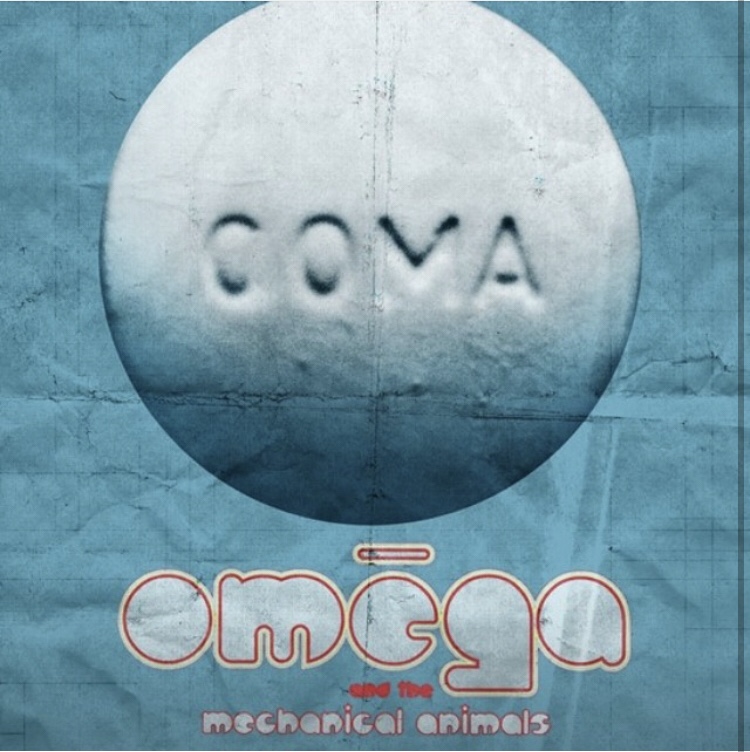
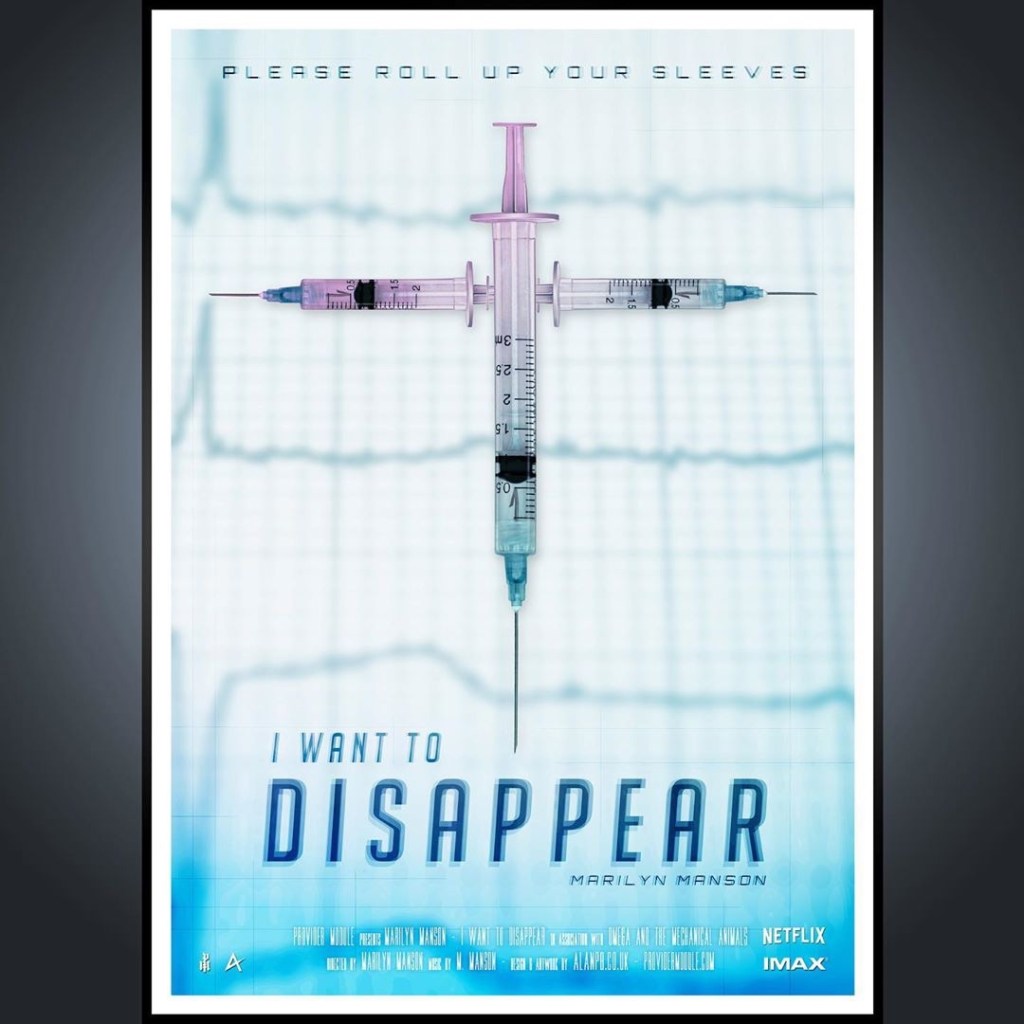
If the two psychological segues are analogous…then maybe the altered state that leads into Mechanical Animals is equally dramatic, if not equally destructive. There is subject matter that Mechanical Animals deals with more than the other two. Dope Show, dope stars, “It’s time for recess, please roll up your sleeves”, “I had a dream last night, Cedar Rapids!”, the pill with the word ‘COMA’ etched into it…need I say more? Drugs. It’s drugs.
Or something? Whatever other dimensions there are to those lyrical themes, they also emphasize a consciousness shift. I know we’re supposed to have the source analysis behind us behind us by now, but there’s an interview where Manson almost- but not quite -offers explication on this. He said that the story of Holy Wood is about “an innocent who is offered forbidden fruit.” This fits, since the altered state that leads into Mechanical Animals is roughly at the beginning of the album.
The garbled, dream-filtered version of HolyWood can indicate a way of interpreting the Mechanical Animals altered state within the centerpiece of Holy Wood. As The Hierophant is the recollection of Holy Wood within Antichrist Superstar, The Androgyne is the recollection of Mechanical Animals within Holy Wood.
6.
Adam wakes up from Mechanical Animals within Holy Wood and wakes up from Holy Wood in Antichrist Superstar. Mechanical Animals, however, has no direct representation of either of the other thirds. From a psychological point of view, this could either indicate suppression or escape.
In an interview with NYROCK in September of 2000, Manson said that the Omega song called Rock Is Dead was a parody of a typical, “rebellious” rock song. Manson also alluded to a parallel song on Holy Wood which I suspect is Disposable Teens. This would make Holy Wood’s opening suite a mirror image of the opening suite of Antichrist Superstar.
In The Shadow is a moment of wakefulness before a vision. The Hierophant is a vision before waking. With this in mind, I think the first four songs on the CD edition of Mechanical Animals are the entry to a lucid dream. During the first glimpse of the dream, both Omega and Adam exist side by side. The following three songs, starting with Disassociative, are the first genuine exertion of will power over the dream. Psychological disassociation is a break from psychological context / continuity, which is often a trauma response. This could give us a way to understand the usage of the space imagery.
Like the real thing, the space metaphors represent a void between worlds, and the space imagery only appears in the songs attributed to Adam. The Speed Of Pain confirms this by description within it’s lyrics, detailing how emotions effect our perception of time. The imagery of falling on a bladed surface from The Reflecting God appears again, this time with the blades being identified as memories. The intermediary state between worlds is then equated with psychological transitions. These psychological images are soon identified with external images like photography and fame in Posthuman.
In these songs and the final two on the album, Adam mourns an inability to make meaningful contact in the external world: milk is devoured, seeds spilled at the feet of children, sad endings planted in gardens to be plucked by their “throats” for no better reason than that they’re pretty.
The isolation of space, to be abstracted between worlds, affords escape but also separation from one’s own internal worlds. One outraces the speed of pain by allowing their memories to recede into the blackness of space, now as separate as different lifetimes (“Yesterday was a million years ago / In all my past lives I played an asshole”).
Seen here: my techie wife helping my color blind ass read the filtered lines
It is also in the songs of Adam that we learn the most about the white in Coma White. In both philosophical and cosmological terms, the Triptych is set in an amoral universe. Darkness and light are forces of nature, not good and evil.
Light seems to behave a lot like real light and real fire: the light of a dead star is indistinguishable from a real one, rather like photographs. Adam was “a hand grenade that never stopped exploding.” In his first glimpse of the empty landscape of his lucid dream, he imagines himself as “a spaceman / Burnt like a moth in a flame / And the world was so fucking gone.” The white light of Mechanical Animals is implacable and inhumane in it’s hunger. Coma herself, in her own lines in the song Posthuman, says that “all that glitters is cold.” This is true even for Omega: “God is white and unforgiving.”
This imagery remains consistent in the vision of The Androgyne as well: “Angels with needles poke through our eyes” to reveal “the ugly light of the world.” In Diamonds & Pollen, a soundscape reminiscent of Mechanical Animals that was included on one of the Disposable Teens singles, monkeys braid thread with gold needles amid “brilliant sluts and fire worship.”
Another significant connection between The Androgyne and Mechanical Animals is a character glimpsed in the tenth chapter of the Holy Wood novel: President White. In a particularly uncanny and horrific moment, President White simply orders a new daughter after the loss of Coma. Later, there is a coffin salute that mirrors the footage of the child saluting Kennedy’s coffin.
From Provider Module
7.
This is a reach, but when I first read that chapter I felt an intuition that this has happened before in the White family. I wondered if both President White’s wife and daughter had been replaced multiple times. I was reminded of the character Jack: between Kinderfeld and the autobiography The Long Hard Road Out of Hell, it’s easy to make a connection to Marilyn Manson’s grandfather, Jack Warner. In Holy Wood, ‘Jack’ as an abbreviation of John F. Kennedy is a more obvious interpretation. As lyrical themes, divorced from any other context, the two ‘Jacks’ can be interpreted as separate.
Within the consistency of the world building, though, the usage of ‘Jack’ suggests that they represent a single character. In a novel or a film, it would make narrative sense to treat the Jack in both Holy Wood and Antichrist Superstar as the same person. In President Dead, a connection is made with the Jack in Cruci-Fiction In Space: “President Dead is clueless and he’s / Caught in a headlight police state / God in his skull is stained glass.” Both the President and Jack have receptacles for heads: one is a wine cup and the other filters incoming light. The latter in particular is reminiscent of Jack Warner, whose moldy basement window was described as stained glass in the memoir.
In President Dead, Adam speculates about this distant antagonist. In Kinderfeld, Adam describes an invasive and unwanted psychological echo of Jack that can seize control whenever it wants and can only be suppressed with pain. It is also just as possible that suppression moves Jack closer to the driver’s seat, though, and the Disintegrator persona could simply be a new expression of him. Whether genuine escape is achieved or if Adam simply becomes an even more voracious Jack is not clear.
Disposable humans that can easily be replaced is echoed elsewhere. In several interviews, Manson described Omega as ersatz. With him being the researcher that he is, I refuse to believe that he doesn’t know any other word for ‘fake.’ So what’s with that one, specifically? It means something offered in place of something else.
If Holy Wood is the strict beginning of the Triptych, then substitutes for family are introduced early: The Love Song introduces the symbolic language of children as bullets, loaded into guns to be aimed and fired by parents. In The Fight Song and Disposable Teens, Adam realizes this for the first time and throws himself into an impulsive battle against the status quo that turns individuals into commodities to be used and discarded (“The death of one is a tragedy / The death of millions is just a statistic”). In so doing, Adam unwittingly walks into his assigned identity as an expendable destructive force (“I wanna thank you mom / I wanna thank you dad / For bringing this fucking world / To a bitter end”). The words Narcissus Narcosis in the next song title communicate a descent into sleep and his internal world of dreams.
8.
This is where we run into the real importance of psychological disassociation. Within Mechanical Animals, Adam alternates between black nothingness between worlds and a fantasy self as Omega, whose only thought is to take and consume as much as possible. Outside of Mechanical Animals, The Androgyne suite tells us that this entire episode is remembered in the worst possible light. Upon awakening during The Nobodies, Adam feels as if he received a cosmic vision telling him that the status quo is airtight and has no possible escape.
If the disassociated dream state after Disposable Teens is the “forbidden fruit” that Manson said was given to an “innocent”, then I think the suite called The Fallen is a calculated, weaponized use of the forbidden fruit. In Coma Black, Adam realizes that the object of his desire is dead and may have been dead for awhile. The placement of the song suggests that his discovery of the death of Coma was somehow a consequence of his second attack. If Coma may have been dead already than the question becomes: did the second, calculated use of the “forbidden fruit” kill Coma or did it simply reveal that she is dead?
From a poetic and musical perspective, the nature of the “forbidden fruit” can be a delicious and rich open-ended question. As is typical in the Triptych, the emotional, social and spiritual inflections are more clear than a literal event or object. This elevates the music to an equal footing with the narrative. The music has to drive it forward. It succeeds, in my opinion, and it’s the reason why the Triptych works as a “cumulative” album rather than musical theater.
From the point of view of a traditional, literal story, though…this just makes the nature of the “forbidden fruit” flatly mysterious. What exactly did Adam encounter during his first, juvenile act of rebellion in Disposable Teens? Was it a mind-altering drug? A weapon? Some sort of omniscience? Something drug-like seems likely to me, but until we actually see the novel or the film, we can’t really know.
From ProviderModule, of course
9.
There is another a fictional character that I’m surprised is not discussed as frequently as Coma White or Adam: The Hierophant. While this is more defensible than my feeling about President White using and replacing his family like Kleenex…it’s still far from a sure thing.
This is especially murky given the world-building so far. A love story is at the center in the beginning: Adam and Coma seem to exist “literally”, other characters less so.
Even if the usage of the name Jack has various non-literal meanings (Kennedy, Jack Warner, etc.), there is still a fictional point of view named Adam. When this fictional speaker / POV says the name Jack, it is natural to wonder if Adam is discussing memories of a person or is interacting with them in the present.
Or could the existence of Jack be like the existence of Omega or the Disintegrator? I wrote awhile ago that I think the song Kinderfeld describes a mental “echo” of Jack that exists in the mind of Adam. I clearly think that there is room for both. I have also made it clear that I think President White and Jack are the same character, at least on some level.
Holy Wood vinyl gatefold
I’m belaboring all this because, after the brush with death at the end of Holy Wood, we immediately meet someone who is filling the same niche as Jack. This period immediately after the attempt on Adam’s life is also a blend of memories and dreams. Even if the buzzing, mechanical voice at the beginning of Irresponsible Hate Anthemresembles Jack, it must be more of a dream-figure than an actual memory. An amalgam, as the feller says.
The opening song suite on Antichrist Superstar is called The Hierophant. The appearance of a new name suggests a new presence. It follows in my assessment that this new presence is simply the amalgam. The only “new” thing is a combination of dreams and memory. It may possess qualities that Adam remembers from Jack, but what did Adam do before he almost died? He made a last stand through the same means that created the altered state of Mechanical Animals.
Upon awakening, during the Of Red Earth suite, Adam no longer had access to the peaceful isolation of disassociation. The isolation enabled fantasies of becoming the hungry, unstoppable light that Adam once found threatening.
When Adam wakes up, the dissipation of the fantasy leaves the sour taste of complete bullshit, which then curdled into resentment and hatred. The side of Adam that the shouting, militant followers saw during The Fall Of Adam and King Kill 33 probably was not the same side that Adam saw of himself during Mechanical Animals. They saw an Adam whose ideals had been suffocated and replaced by the fury of the vengeful.
If Jack supplied memories for the amalgam, those final moments of righteous fury and despair supplied the dreams. This, I believe, is the ranting demagogue of Adam’s near-death fever dream. In my “reading” of the Triptych, this amalgam is what the suite title “The Hierophant” refers to; both an interpreter of mysteries and a mystery himself.
In the troubled nightmares before consciousness, this amalgam is both unstoppable and seductive. Adam is powerless to do anything but submit, regardless of what the amalgam-being demands of him (Irresponsible Hate Anthem & The Beautiful People).
While submission entails communion with other followers, Adam enjoys a kind of privacy: the emotional bluntness of the herd leaves him no outlet. He is then alone with his emotions and self-knowledge, which has an almost meditative security (Dried Up, Tied and Dead to the World).
More From Gio Blush Design
This next transition is one of the strongest and most interesting in the Triptych. For a work of art that is so complex and bombastic and colorful, it also contains powerful moments of subtlety. The succession of Tourniquet from Dried Up, Tied and Dead to the World depicts the tension between one’s private thoughts and the memories of others. Memories that impose relationships or other demands from the outside world.
The available chapter of the Holy Wood novel depicts Adam and Coma as lovers separated from one another. For those who have lost someone they love, it feels as though that person continues to exist in your thoughts. It’s been my experience, anyway. Adam had no knowledge of Coma’s death until after the fact. His belief was an impression of her that, for awhile, was alive longer than her body was.
There are some truly complicated emotional dynamics here. Adam’s dream companion, derived from the memory of Coma, is a fellow traveler with Adam across the veil. At this point, Adam is in a delirious stupor and probably believes himself dead. In one way, Adam and Coma achieved the impossible together and escaped death. In another way, Adam is alone with the lifeless remains of his love.
A personal note that may effect my perception of this: I have Borderline Personality Disorder, a mental illness that disposes one to black and white emotional reactions. To be more specific, black and white emotional responses to how we perceive relationships. These emotions concern our self-image: if anything goes wrong, those of us with BPD are likely to think it is because there is something wrong with ourselves. We have a masochistic tendency to feel like we are either pure evil or nothing. Literally, nothing: we feel either like we don’t exist or that our existence is less real than the existence of others.
More from ProviderModule
Adam seems to have a lot of BPD characteristics. The Mechanical Animals altered state went from pure light to a miserable false promise. This desolation and fury blend with his self-image, like someone with BPD. This “worst possible version” of himself is seen, in the delirious world of his dreams, as a separate person. This personification is a keeper of knowledge that Adam wishes he did not have.
Perhaps the Hierophant amalgam is the keeper of the memories of what literally happened during the events masked by the fever dream. Maybe they are things that only the worst version of himself can claim to know.
This is most definitely a postmodern story. The narrator is far from reliable and what the narrator feels is often more clear than what the narrator describes. It is on this level that one of the more dramatic moments in the Triptych occurs: Adam experiences a depth of masochism at which he begins to identify as the bearer of all evil and the deserving sacrifice: “Make your victim my head.” The chosen sacrifice is elevated by the choice. The wording is also reminiscent of the digression within the available chapter of the Holy Wood novel, when the narration mentions the Celtic linguistic root of the name “Kennedy”, meaning ‘ugly or wounded head.’
This same metaphorical language is how sacrifice is described in the third and fourth songs of Antichrist Superstar. Adam visualizes himself as a desiccated bundle, held together only by its’ bindings, connecting two souls. As per BPD catastrophising, if it fails to hold together then Adam will blame himself first and exonerate the other. The other who, in the continuity of the story, represents the memory of Coma.
Tied Up, Dried and Dead to the World transitioning to Tourniquet reveals the tension between the binding memories of others and one’s private thoughts. But what is it Adam thinks about in such privacy? Coma. Adam slips the compulsory bonds of all relationships only to treasure a lost relationship in solitude. The BPD tendencies that cause Adam to offer himself as the exonerating blood-payment for all evil also prioritize service to others in utter privacy, in both the privacy of his dream and in the army of brutal followers therein, whose psycholoical flatlines are as good as total privacy.
So. The white of the black and white emotions could compel Adam to think that he and Coma escaped death and accomplished the impossible together. The black in the black and white emotions demands Adam’s total submission to preserve the second, non-physical existence of Coma. This could satisfy Adam’s fantasy of turning back the clock on her death while appeasing the blood-price for the emergence of Adam’s worst possible version of himself.
Before moving on: I do not necesessarily believe that Marilyn Manson himself has Borderline Personality Disorder. I’m not a psychiatrist. But those who do have BPD will recognize emotional dynamics within the Triptych that look intimately familiar. It is also equally likely that Manson was writing about a character with BPD tendencies- perhaps, like the Hierophant himself, the character Adam is an amalgam of observation and imagination. I mentioned BPD in the first place because the resemblance is strong, regardless of what the case actually may be.
‘Fool’ Tarot card, included in the Fight Song single
There is another, less melancholy element in Adam’s fever dream. As one of the Major Arcana of the Tarot, the Hierophant may represent a link to genuine truth or holiness. The Hierophant may also embody a negative inversion of this: not truth but orthodoxy, not wisdom but power, not insight but bigotry.
If this is part of the Hierophant of Adam’s dreams, then this upside-down prophet would have acolytes after his own heart. His clergy would be the privileged and the powerful: The Beautiful People.
Most explicitly in Antichrist Superstar and Holy Wood, the Triptych examines the role of tribalism in human nature. For a stark look at this, compare Irresponsible Hate Anthem and Count To Six and Die (The Valley).
I have not spent a lot of time dwelling on the political levels of meaning within the Triptych because, in general, I think they are accessable enough on the surface. The continuity of the symbolism and storytelling requires it at this point, though.
I am convinced that Antichrist Superstar is as deeply political as Holy Wood. The opening lines of Irresponsible Hate Anthem represent a reductio-ad-absurdum of capitalism. Literally anything can be sold if someone wants to buy it and it is the nature of the “All-American” to sell it. Everything is transitional and transactional. Everything has a price, and death is the ultimate transition and the ultimate transaction. The psychological sublty of the movement between Tied Up, Dried and Dead to the World and Tourniquet has a small appearance here as well: the Hierophant demagogue addresses their victim as if their victimhood is their personal identity. Adam later offers his head, which in Tourniquet is elevated by its’ status as a sacrifice beyond the value that Adam places in it himself.
The reductio-ad-absurdum continues in the second song. The Beautiful People measure the value of something based on whether or not it is available for them to posess or consume. The mindlessness of the frenzy creates the emotional privacy that Adam comes to luxuriate in during songs three and four.
Let us not forget that this visionary dreamscape is happening in the wake of Count To Six and Die (The Valley). The song opens with a loud metallic crash, followed by the rotating chambers of a revolver. Later, there are a few dry clicks, telling us that the Roullette wheel landed on an empty chamber. There is another scenario involving guns that may or may not be loaded, though.
In the late nineteenth to early twentieth century, firing squad executions employed a detail of about six men, some with loaded guns and others with blanks. In On Killing: Learning to kill in war and society by Lieutenant Colonel David Grossman, a military psychologist, it says that studies in the early twentieth century revealed that most soldiers deliberately missed a lot of the time, or “aimed high.” This was because most people are in fact unwilling to kill. This supports a wider claim made by Grossman that a scientific comparison between destructive potential paired with the number of people who did die in World War I and World War II. Those numbers were vast, but the destructive potential of the weapons of the day would have enabled even more deaths if they were used as deliberately and destructively as possible.
Grossman states that this was the reason why a firing squad had five rifles loaded with blanks and only one with real ammunition: the psychological cost of killing is simply too high for most people to accept. The current story beat in the Triptych describes the followers of the Hierophant amalgam, a class of people interested exclusively in what they can own and exploit. The owned and exploited are a second class. A binary class war is as good a display of human tribalism as it gets, short of what we would recognize as “normal” war.
So what does this bring to a possible interpretation of Count To Six and Die (The Valley)? Establishments are self-perpetuating. Capitalist establishments share the economic philosophy of cancer cells: unregulated growth. If an establishment is “too big to fail,” then it needs a way of using humans to do things that a human may or may not want to. The ruling class that maintains this infallibility, therefore, need to be shielded from moral responsibility as much as soldiers in a warzone or a firing squad.
If this historical nuance is any part of our interpretation of the beat between the last song of Holy Wood and the first song of Antichrist Superstar, this consequence-free exploitation is also a luxury enjoyed by the Beautiful People. We would also be remiss if we didn’t consider the possibility that the fever dream before Innauguration of the Worm is a fantasy that protects Adam from what the worst possible version of himself knows. The lyrics in these songs and throughout refer to suppression frequently: “I better better better not say this / Better better better not tell”…”This is what you should fear / You are what you should fear…”
The linguistic pedant in me even wants to consider the construction of the word ‘innauguration.’ It contains the ‘augur’ phoneme, meaning to predict. A ‘hierophant’ is one who deciphers and interprets ancient mysteries.
I’ve actually bent over backwards a little bit to avoid dwelling too much on classical psychoanalytic reading of the Triptych. Sigmund Freud was a bad scientist by any modern standard. I find classical psychoanalysis hard to take seriously. That being said…Antichrist Superstar starts with a vision and moves onto a jarring, traumatic awakening. The suite that depicts the awakening contains a linguistic hint of auguring, or prophecy. There is no getting around the implication: after the vision, the awakening is itself foretold. This suggests a subconscious influence of the vision stretching into waking life. Perhaps this is the influence that is unmasked in the song Kinderfeld, which could bring us full circle to Jack setting the mental mold for the persona called the Disintigrator.
10.
From Gio Blush Design
The movement between the fourth and fifth songs on Holy Wood is an outburst followed by introspection. The four to five movement on Antichrist Superstar is introspection followed by an outburst.
However I think the transition between Disposable Teens and Target Audience (Narcissus Narcosis) is more aptly mirrored in the first two songs of Innauguration of the Worm: Little Horn and Cryptorchid.
Mirrored most aptly- a mirror image is an opposite-inverse. The outburst comes first: Little Horn is relentlessly driving, almost a single verse with one line for a partial chorus. Cyptorchid is similarly unconventional: one verse followed by an abrupt key change with a single line repeated over and over again.
On the subject of Cryptorchid…under what circumstances might a “worm consume the boy”? There’s probably only one interpretation that comes easily to mind: burial, perhaps murder. We’ve encountered burial and penetration like this before: A Place in the Dirt, with angels carrying needles to reveal the “ugly light of the world”. This also feels like an echo of a short story that Marilyn Manson attempted to publish before his music career took off: a mentally ill, housebound man murders his sister and has sex with her dead body. Later, he is buried alive with his eyes sewn shut. This is an idea that had been in Manson’s mind before he even began actively pursuing music.
Yet Adam, himself, is frequently identified as the Worm throughout Antichrist Superstar. This could mean that Adam is drawing nourishment from the death of his innocence. Oh- the worm does not consume the child, the worm consumes “the boy.” In Kinderfeld, the line “There’s no one left to save ourself” is attributed to The Boy in the printed lyrics. The voice of Jack is unintelligible noise somewhere between a whistle and a machine, as if even the memory of Jack is too horrible to listen closely to.
From the ‘Cryptorchid’ music video
The key change in the middle of the song of Cryptorchid- from overtly menacing to a soft, repetitive organ-like melody -could be the final thematic elaboration of the white light. Probably the harsher version of it, too; closer to A Place in the Dirt than Omega. In any event, Adam is definitely awake now.
If The Hierophant is a fever dream, then Little Horn and Cryptorchid are perhaps both a panicked spasm upon awakening and the first remembrance of what just happened. This remembrance is the first, fully-concsious stock-taking of the dream. Deformography is a rageful bloodletting that openly flaunts the black and white emotional mania of BPD: “I’ll lift you up like the sweetest angel / I’ll tear you down like a whore” and at the same time the speaker expresses helplessness in their rage: “I’ll make myself sick just to poison you”. Adam may have woken up from his fever dream but still feels the instinctive submission that he experienced in his dream, under the Hierophant created by his mind. Adam feels as if he can’t act on his own so his only path forward is mutually-assured destruction. Perhaps this overture toward waging a war against himself is an outgrowth of Adam consuming his prior state of being in Cryptorchid.
The world that he naively attempts to reason with (Wormboy) simply drags him back (Mister Superstar, Angel with the Scabbed Wings) to the version of himself that was hidden by his dreams of the Hierophant. This leaves us with the moment of anguished helplessness and self-awareness in Kinderfeld, before the appearance of the Disintigrator in the Triptych’s final movement.
This bears out the possibility of a subconscious influence from the fever dream reaching outward into Adam’s awakening. The auguring bound the Worm as firmly as his own soiled twine until he was forced to look the puppet master of his subconscious in the face and attempt to transcend it.
This brings us to the actual song called Antichrist Superstar, which carries a well-worn theme from earlier: things offered in place of something else, copies, clones, “xeroxes.” If the world wants the illusion of the Hierophant, then Adam will give it to them to secure his own freedom: “I shed my skin to feed the fake…cut the head off / Grows back hard / I am the Hydra / Now you’ll see your star”. Adam has blamed himself for everything he possibly can- now that path is dulled beyond feeling. There is nowhere to go but outward. If the world wants to take their Hierophant from him, then Adam will give it with the unbound masochism of one incapable of feeling pain or anything else. From here until the end, Adam tests the reality of the world he lives in to the point of obliteration. In the process, he fulfills the augury exerted by the Hierophant dream: on track 99, feedback envelopes a mechanical voice saying “When you are suffering, know that I…” and snuffs it out before it can finish it’s sentence. In the hallucinatory rally or concert where the dream of the Hierophant first appears, the sentence is completed: “When you are suffering, know that I have betrayed you.”
As an ending, the cyclical relationship between the Hierophant and the Disintegrator works better in a non-literal way: on uniquely lyrical terms. The Triptych is an innovative exploration of what the album is capable of as a medium, but stays within that format. A further step into musical theater or literal storytelling would lift the central burden off of the music and replace it with plot construction. I believe that music bears the standard best. Like the printed word, the special effects are more to my liking. At least if intimacy with the mind of an audience is a strength that the artist wants to make use of. All artistic mediums succeed when they invoke experiences outside of their medium. Great film and visual art create experiences that are not just visual, great literature creates experiences that go beyond language and great music goes further than sound. I have known Coma and Adam for most of my life as figures in a psychedellic, beautiful and transformative musical epic and I believe Marilyn Manson made the right choice.
Triptych playlist:
1. Inauguration of The Mechanical Christ (TLTOE)
2. The Reflecting God (TLTOE)
3. The Great Big White World (TLTOE)
4. The Love Song
5. Little Horn
6. Cryptorchid
7. Disposable Teens
8. Target Audience (Narcissus Narcosis)
9. Wormboy
10. Cruci-Fiction In Space
11. The Beautiful People
End of hypothetical disc 1 and beginning of hypothetical disc 2
Heyyyy sooo I’ve been really busy lately AND I’ve been working on a longpost which will be up very soon. So I decided to take a brain break!
I had no idea how fun this game was going to be until I started it. Within seconds I was yelling and bouncing around just like I normally do when playing Bloodborne or Mortal Kombat X. My attitude toward beat’em ups is kind of like my attitude toward dungeon crawlers, RPGs, MUDs or MUSHs. There is something so irreducibly simple and appealing about the design that I usually like them at least a little bit, even if they’re not particularly good.
The mechanics are intuitive enough for you to get ahold of the punch / kick basics easily but even the more unique stuff is just a few button mashes away from figuring out. Even before getting that far, though, there’s something about the Ska Studios art style that just charms the pants off of me. The Ska Studios graphic design actually meshes really well with how fun and lighthearted this game feels at first. You’re in a punk band and you wake up in the middle of the zombie apocalypse. I only just played through the very beginning so there may be more to it than that, but I love the apparent simplicity at this point. In fact, simplicity on a few levels seems like one of the strengths of this game. The controls are simple enough to figure out on your own and you’ll probably figure out stuff like the character building mechanic on accident in the course of messing around.
But the art style and the premise speak to something even more simple. The flying pieces of shrapnel and body parts and panicked bystanders and zombies and explosions make me think of certain cartoons I grew up watching. The original Powerpuff Girls, Courage The Corwardly Dog and Ed, Edd & Eddy all come to mind. I can even see a modern cartoon like the She-Ra reboot, Twelve Forever or even the creators of Over The Garden Wall or Gravity Falls attempting something like this if they wanted to go edgy. It would definitely be adult-oriented but…think of a creative team like the artists and writer(s) of Over The Garden Wall (my favorite recent cartoon). Based on that example, at least, they seem like they’re unafraid to go all the way with artistic ambition. Not afraid to be blunt while unafraid of going subtle…and with music. That kind of creative team could do something delicious with Charlie Murder.
Other than character building, there are other RPG-lite doodads like equipment and weapons. You also…seem to be able to rotate playable characters from the very beginning. Or, at least, a single save file contains your entire band. Each band member has a character class and I decided to go with the Mesmer first and then started again with the Berserker. So now my save file has a level 3 Berserker and a level 3 Mesmer but everyone else is still at level 1. When you decide to rotate your player character, you start at the beginning.
I know it might not sound like much on it’s face, but…it’s a fun work around for something that other games struggle with. At least the RPGs. Square went from each game having a million potentially playable characters to having mandatory small groups. I don’t know if I’ve played a game lately that simply has everyone available at the beginning like Charlie Murder, to be played and developed at the player’s discretion. Did I mention the simplicity, yet?
Our story begins with a near-death experience. Whomever you choose to start the game with, you wake up in a big’ol hellscape surrounded by demons and then you are jerked back to your body as a paramedic is defribulating your heart. Next to the ambulance, some zombies and demons(?) quietly watch you for a moment. Just as quickly as you left the beatdown in the afterlife, you find yourself in a new one. After a small tutorial walk past some trashed storefronts, you make it to a bar.
Over on the left: are those or are those not the same ninjas that board your ship at the beginning of Salt and Sanctuary?
This…feels kind of like a checkpoint? In Salt and Sanctuary (another gem from Ska Studios) the checkpoints look a lot like this. Except…in S&S, you only fight the inhabitants of another checkpoint if you’re claiming it for your creed or if you defect from your own creed. Here, the barflies simply start swarming you to begin with and the poor bartender only sticks his head back up once you’ve cleared them out.
Yep, Anar-Chi is one of your stats and the alcohol is a stat buff!
The beer taps that bestow stat buffs even feel a bit like the S&S checkpoints. In S&S, you can only distribute allocation points and alter your gear in checkpoints. The simplicity at the heart of the design may have either consolidated that aspect or…added another level of complication? See, in Charlie Murder, there is a traditional character building and allocation point system. When your character has gained a level, you’ll receive a smattering of allocation points you access with your phone.
(Oh about that- you know how many video games try to incoporate smartphones in ways that are supposed to be immersive? Like Silent Hill: Shattered Memories or The Legend of Zelda: Breath Of The Wild or a million others I’m just not thinking about? For some reason this grabs me more than any of those. You can even access the camera on your phone and the screen will just stay in side-scrolling mode while you angle around with your little phone screen. That presentation just adds to the overall charm, along with how you’re so often picking literal pocket change off of the street and throwing the arms of zombies back at them as projectiles)
Soooo there’s at least a little bit of a normal character building but…your collection of money also seems to be a factor. As you beat the crap out of zombies and take their pocket change, you’ll probably notice that you’ll have about five to seven dollars with modest grinding. At the bar, money is exchanged for the stat-buff booze and for tattoos that convey special abilities. Seeing as Charlie Murder came first, I wonder if this was an early, experimental germ of the salt gathering in S&S. The tattoo mechanic even bears a resemblance to the magical brands in that game. Then again…I haven’t actually used any of the alcohol, I just bought a bunch of it to be used later. Maybe the alcohol only bestows temporary buffs…? We’ll follow up on it, eventually.
The checkpoints in Charlie Murder even have a little bit of the same…exploration value as S&S, even if less hidden shortcuts to other areas are involved. Poking around will usually reveal some renewable weapon resources or low-level enemies to grind against.
You just don’t get this from a game like Diablo ❤
After the first “real” boss fight in the back room of the bar, there is a brief cutscene of the band kicking it in happier times. Maybe even the founding moment of the band. Everyone’s chilling on the couch and some friends just happen to have instruments laying around. One random thought leads to another and the magic happens. There is a brief flash-forward to the band’s eventual success, combined with a simple rhythm mini-game. Then the cuscene returns to one particular band member for whom the good’ol days weren’t so good.
Image culled from the Sopor Aeternus Instagram account
Anna-Varney Cantodea crafts albums that are distinct bodies of work. Any given Sopor Aeternus album (excluding compilations…like the one I’m about to list in this entry) has its own internal context. So the whole idea of a Sopor Aeternus playlist is either impossible or, optimistically, experimental.
Consider this my run at the experiement:
Soror
Always Within the Hour
Spellbound
At Sunset Through the Fields Aflame (version from TheSpiral Sacrifice)
Anima I
Hades’ “Pluton”
The Sleeper (version from POETICA: All beauty sleeps)
Do You Know My Name? (version from Ich tote mich…)
Children of the Corn
Beautiful Thorn
Baptisma (1989 demo version)
Beautiful
Eldorado (version from POETICA: All beauty sleeps)
Day of the Dead
Abschied
End of hypothetical “first disc” and the beginning of a “second disc” (Why yes, I am pretentious, I highly recommend it if only for fun 😀 )
To walk behind the Rows
Harvest Moon (Cornflowers part II)
Anima II
Coffin Break
Leeches & Deception
Poison
The Conqueror Worm (version from Flowers in Formaldehyde)
Into The Night
Sopor Fratrem Mortis Est
A Strange Thing to Say
Bitter Sweet
Consider This: The True Meaning of Love
Nightbreed
Tanz der Grausamkeit (version from Ich tote mich…)
Dead Souls
Helvetia Sexualis
Do You Know My Name? / What Has Happened While We Slept?
Something I’ve always wanted to write about, ever since I experienced the full force of passion that our first love affairs with music inspire in us when we are young, is what distinguishes the album as an artistic medium.
Rather like film and video recording, any collection of recordings or things recorded together is a record. Early experiments in film did not even necessarily regard video recording as relatable to narrative storytelling. What we now recognize as modern filmmaking is a hybrid between literature and film, since storytelling is presumed to be the ultimate point. For more on this subject I suggest you google Tania Modleski and cinematic excess. I don’t need to borrow too much from Modleski except that a created structure implicitly reveals its purpose through its design.
Writing and narrative require conceptual coherence since writing is a linguistic medium. Photography and audio recording do not: for something to be photographed or recorded, it need only be visible or audible. A photograph or an audio recording might be artistic or it might serve some other technical or commercial or any other conceivable function. Filmmaking and audio recording are not meant solely for art any more than writing is meant solely for storytelling.
Bringing audio recording to music creates a hybrid in the same way that bringing video recording to literature does. Like any other constructed object, it makes sense to infer intention behind its’ structure. One of my favorite movies is a horror film from 2002 called May. May has long, drawn out non-verbal parts that rely completely on visual storytelling and involve subject matter that is never frankly discussed in the dialogue of the script (this isn’t anything new and I’m sure we can all think of a ton of examples of this; I’m just using May to make a point). For me as a young teenager, the silent, purely visual scenes in May shifted the perspective and character of the film in a way that the script could not: in fact, as an adult it’s obvious that a script is only written to serve a specific function that works equally with the contributions of the actors, director, cinematographer, editor, etc.
The finished product of a photographed script uses the contribution of the writer in concert with every other force at work in front of and behind the camera. The same is true for an album. All art requires a bit of intimacy and exposure on the part of the artist but with films and albums the separation between conception, embodiment and execution is more obvious than something like a novel, which often comes to us resembling nothing more than a naked and singular work in spite of however much editing and re-writing may have happened before publication. Like all rules there are exceptions: my two favorite writers, Victor Hugo and William S. Burroughs, frequently used their writing as a kind of embodiment that would itself “tell” a story rather than use an impersonal and anonymous narrator. This sort of creative device is necessarily more common in modern film and music, however.
And now for the actual posts. I just wanted to nail down some basic ideas that are going to be used later before I get into what I really want to talk about.