SU Lucifer, volume 4 (spoilers)

This book feels a lot like an epilogue, with the prior volume (The Wild Hunt) being the actual “final chapter” with Lucifer as a main character.

In addition to feeling much like a concluding volume, there is also the matter of the Bleeding Cool article from last August. There it was stated that most of the new Sandman Universe comics were being discontinued, in particular House of Whispers, The Dreaming and Lucifer. The Wild Hunt arc, it seems, is the last of the run to be serialized as individual comics. The fourth story, The Devil at Heart, was published as a single graphic novel along with the three other collected editions.

At the end of The Wild Hunt, Lucifer attempted to thwart a prophecy that would compel him to return to Hell. The prophecy stipulated that Lucifer’s destiny would turn on whether or not he was supplanted as the one who calls and leads the Wild Hunt.

(The Wild Hunt, for clarity, was a magical/ceremonial expulsion of destructive yearning from the universe’s collective subconscious. The Hunted God was the target of this purging and destined to reincarnate forever so that the leeching can continue in each generation)

Lucifer, as the leader of the Hunt, whittled the soul of the Hunted God until it could no longer be perceived in future reincarnations. Lucifer then lost interest and the four permanent, primeval hunters were left dormant until roused by Odin. Lucifer would be supplanted if Odin, as the leader of the Hunt, stopped the heart of the Hunted God. Odin succeeded but, at the last moment, Lucifer replaced the dying heart of the Hunted God with his own, immortal heart.

This did not work the way Lucifer intended. We might speculate about the specifics of why. The most probable implication within the text of both The Wild Hunt and The Devil at Heart, is that Lucifer’s heart-switch was either too late or that the heart-switch itself finished the work of killing the Hunted God.

Lucifer, being the type-A perfectionist he is, will neither return to Hell nor admit defeat. His plan for remaining a step ahead is to invade the garden of Destiny of The Endless and remove each and every mention of his own name in Destiny’s book. For those who haven’t read the original Sandman, that basically excises you from having ever existed.

Naturally, this stops us from seeing Lucifer grapple with his failure. Since Lucifer’s vulnerability and fallibility were front and center in The Wild Hunt, this is a little unexpected. The emphasis on “human” (?) “frailness” is inverted in The Devil at Heart, though.

The first time I saw this page I thought “There’s no way that’s not inspired by Mike Dringeberg”

The fundamental idea of vulnerability and fallibility within Lucifer suggests that the First Among the Fallen might share commonality with mortals. In this most recent story, there are mortals who become invested with the qualities of Lucifer. Beverly Walsh, the modern incarnation of the Hunted God from The Wild Hunt, now has the heart of Lucifer beating in her chest. Behemoth, the cat that Lucifer adopted earlier, is now in the care of a boy whose father killed his own cat.

Behemoth and Beverly find each other again in the house that Lucifer built on the Fowler estate. They are joined by an ancient, magical human from China with one of Lucifer’s eyes. Next is Remiel, one of the two angels dispatched to Hell to oversee it in Lucifer’s absence. Lastly there is a crow, perpetually rummaging in some nearby garbage.

The stories that bring these characters together were reminiscent of how The Sandman would alternate between a central plot and collections of shorter stories involving peripheral characters. Also like The Sandman and it’s treatment of dreams, each of these characters represent a facet of a metaphysical experience they have in common. Biyu, the undead Chinese woman with one of Lucifer’s eyes, expresses the rebellious dimension of Lucifer while the crow is the trickster. Behemoth the kitty embodies the totems of Lucifer and Remiel, as one of the recent rulers of Hell, represents Lucifer’s domain.

This ties into another thematic consistency within both The Devil at Heart and the rest of the Dan Watters Lucifer stories: exorcism. Whether moving something inside of you to the outside removes that thing or releases it into the world.

The four changed beings attached to Lucifer have all experienced direct contact with him. They are also all channeling an abstracted representation of him in his absence. Inside v. outside is prominently featured in the plights of the other angels and in a small vignette about Francisco Goya.

Goya is portrayed as being so deeply haunted by fears of mortality and disease that he painted images of these things on the walls of his home. He tells his son that he did this as a kind of exorcism: to move his fear from inside to outside in order to remove their ability to affect them. The paintings are so vivid that a demon in Hell is able to use them as a gateway. This constitutes escape from an inescapable place (Hell) which for Lucifer merits punishment: before Goya’s horrified stare, Lucifer devours the demon. Goya channels this event into his painting Saturn Devouring His Son. Within this incident, he sees his broken relationship with his son and attempts to exorcise it like his other fears. His son still wants nothing to do with him even after he dies and wills his entire estate to him at the expense of every other family member.

The angels, meanwhile, are manifestations of God’s will. Lucifer, the first Angel, was the closest to the source. With Lucifer now removed from history, angels have stopped hearing the voice of God. Which, for many of them, means that God appears to be gone. They even begin to get hungry and ill. These mysteries are one of the reasons why Remiel temporarily leaves Hell to investigate.

This impact on the angels of The Silver City is where the biggest narrative risk is taken. Big fat ending spoilers here, just sayin.

Because the voice of God has disappeared without Lucifer and all angels are weakening, they begin cannibalizing each other. These panels are overlayed with sections of a letter from Lucifer to Mazikeen. In it Lucifer explains that the angels of The Silver City, because of their reliance on God, will sooner or later bring Lucifer back from non-existence.

Specifically he says that God made a cyclical universe and sooner or later there will be another war in the heavens and another rebel angel will fall to fill the void. So while the angels are attempting to kill and consume Remiel and Duma, Remiel escapes and is skewered through the wing by Michael. It even happens in the same place within the Silver City that Michael’s blade punctured the floor in his original battle with Lucifer. Shortly afterward, Remiel lands on Earth, cackling laugher in Lucifer’s unique lettering.

The very absence of Lucifer caused the war in The Silver City and the fall of a rebel angel to re-occur in the present. This is paralleled by infrequent vignettes about a young girl’s encounter with murder. She kills her infant brother because he cries too much at night. Afterward, her mother’s tears of grief keep her up at night. After that, her own crying keeps her up.

There is another set of vignettes about a separate pair of siblings in pre-history. One of them entertains a fantasy about killing the other. Like the little girl in the present, an opportunity to do this without getting caught presents itself. As the pre-historic man considers it, he briefly glimpses a frightening shadow on the wall and the earliest myth of Lucifer is born. He is frightened into not carrying out the murder.

With Lucifer’s name excised from the book of Destiny, he instead kills his brother and escapes exposure. This suggests that Lucifer’s non-existence was a factor in the murder committed by the child in the present.

The ancient fratricide was prevented by the appearance of Lucifer’s mythic archetype. The little girl who killed her newborn brother experiences anguish in the wake of her actions just in time for Remiel to become, for all intents and purposes, the “new Lucifer.”

The four beings gathered at the Fowler Estate are united by a void left by Lucifer. They are united by an aspiration to externalize Lucifer. Ultimately, the personal experiences they all had with Lucifer influenced them more than they influenced the world. If Lucifer removed himself from the book of Destiny, he should not have been around to give either his eye to Biyu or his heart to Beverly (sounds weirdly like a lyrical construction 😆).

Yet Beverly still has his heart and Biyu kept his eye until her eventual, withering death. Biyu also happened to have died at the same time Bev puts her hand on her head to offer comfort. After that, Bev traded barbs with Mazikeen while the lettering of her dialogue briefly changed to Lucifer’s lettering. This is not long before Bev leaves both Mazikeen and the story for the rest of the book.

Before she leaves, though, Beverly also has the lines “I’ll admit it. I went and fucked it up” spelled with Lucifer’s normal lettering. She is apparently talking to Mazikeen about the failure to replace Lucifer. If we entertain the possibility that Bevery’s lines that appear with Lucifer’s lettering are attributable to the heart of Lucifer, that statement could just as easily refer to Lucifer’s vanishing. He did it, after all, and his letter to Mazikeen described his vanishing as a “joke”, since the angels are bound to bring him back because of his enmeshment with God. Imitating Mazikeen’s speech-pattern is also the kind of dick move Lucifer is more likely to attempt than Beverly.

Remember to that Remiel was one of the four at the Fowler estate. Remiel was also the one who was the least interested in the attempt to fill Lucifer’s gap. Sure enough, the rebel among the Lucifer surrogates, who was a custodian of Lucifer’s former home, is the one who actually embodies the new Lucifer. The exorcism/suppression motif even continues with Remiel, since he frequently voices his fear that he may be a “fallen” angel since God sent him and Duma to oversee Hell. He worries constantly about being “fallen”. In the end, he does his highest duty to the angels of the Silver City by becoming the “First Among the Fallen”.

All of this is pretty ordinary for Sandman metaphysics. What completes it as Sandman metaphysics is Lucifer’s claim that his erasure is a “joke”. This would imply that he knows he will return, which means Remiel did not simply “fill the void” like Daniel did in the wake of Morpheus. Remiel seems to have literally “transmuted” into the same being, personality and memories and all.

The story clearly partakes in magic pertaining to the retroactive editing of time. It may be that the erasure was undone and now Lucifer has always existed. In spite of Remiel being the clear vessel of embodiment. This is what I meant by the biggest narrative risk.

As for being a satisfying read- it works best if you think of it as a coda to the three other volumes. As unlikely as a continuation looks right now, I think the child-murderer, Beverly Walsh, Biyu and Behemoth (alliteration lol) would be great for protagonists in future stories. As an ending, it totally works, especially with Lucifer’s arc revolving around escaping God’s plan. The vignette subplots provide the opportunity for the Francisco Goya digression which feels consistent with the appearance of William Blake in The Infernal Comedy. The function of the crow in the very the end also brings us full circle to Lucifer killing a huge pile of ravens in the prologue to every first volume of the new Sandman Universe comics (yes, ravens and crows are both black birds, no they are not the same- that might also play a role, come to think of it).

The crow even bridges us to Season of Mists, in a way. Speaking of callbacks, there are parts of this book that look a lot like Mike Dringeberg’s work on the very first Sandman comics. Just for the sake of clarity it is not him: the art is credited to Max Fiumara, Sebastian Fiumara and Brian Level.

Music Inspired by The Life And Times of Scrooge (review)

The one solo album from Tuomas Holopainen so far. Based on a comic he read as a boy which he described, in a documentary, as his favorite fictional story.

Song one, Glasgow 1877, establishes some key motifs. These include male spoken word narration alternating with female soprano vocals and a reoccurring climbing melody.

Tuomas uses instrumental songs more openly on this album than he has on a lot of prior Nightwish entries. One of my favorites here is Duel & Cloudscapes which introduces an energy-exchange between the drums and the strings that hits the same sweet spot as Ghost River from Imaginaerum. In particular it reminded me of the mixing on Ghost River from Imaginaerum’s instrumental companion. This dynamic between the drums and the strings is also recognizable on Cold Heart Of The Klondike.

My favorite instrumental (with Duel & Cloudscapes being my number two pick) is Goodbye, Papa. To Be Rich has minimal vocals and it’s instrumentation is easily as good as Goodbye, Papa, which it immediately follows.

My two favorite songs on this album overall are The Last Sled and A Lifetime Of Adventure. Both of them give instrumentation and singing equal shares of the foreground and they balance perfectly. A Lifetime Of Adventure pushes the combination further though and is better off for it.

That this album is modeled after a story probably gave Tuomas a specific arc function for each song that imposed more discipline than he normally exercises. This could be another reason why A Lifetime Of Adventure shines so brightly. The expressed sentiment, of a journey being greater than its’ destination, could have come directly from Imaginaerum. But somehow it is more believable than a lot of Imaginaerum’s lyrics. This does not necessarily mean that Music Inspired by The Life And Times of Scrooge is better than Imaginaerum, but Scrooge definitely sounds more carefully composed.

The repetition of the line “(t)o be rich” within A Lifetime Of Adventure also implies a link to that same song, which only has four lines: “Silent night, silent years / The cold heart haunting still / Sleepless watch of the night / And her face on the moon”. This feels almost Gatsby-ish which caught me off guard. In fact, me not knowing anything about the source material and just extrapolating everything from the lyrics was kind of fun. Especially since my wife saw a cartoon adaption of the comic when she was a kid. Her recollection was fun to compare against.

Mr. Robot playlist

1. The Order of Death- Public Image Ltd.

2. Walking in My Shoes- Depeche Mode

3. Pictures of You- The Cure

4. Where Is My Mind (Pixies cover)- Maxence Cyrin

5. The Hall of Mirrors- Kraftwerk

6. Daydreamin’(feat. Jill Scott)- Lupe Fiasco

7. This Ain’t No Hymn- Saint Savior

8. The Head That Controls Both Right and Left Sides Slobbers and Eats Meats Even Today- Bleach

9. Basket Case (Green Day cover)- Twinkle Twinkle Little Rock Star

10. Touch(feat. Paul Williams)- Daft Punk

11. Heroes and Villains- The Beach Boys

12. White Widow- Afterhours

13. Turn up the Radio- OK Go

14. The Moth & the Flame- Les Deux Love Orchestra

15. Flesh without Blood- Grimes

16. People Who Died- The Jim Carrol Band

Vigil: TNL play-through postscript (light spoilers)

The gaming experience is satisfying. As much as I love Metroidvania, the sub-genre at this point is risking over-exposure. While this is not the fault of the Vigil dev team specifically, it does make their task harder. To their credit, though, Vigil establishes its own identity in more than one way.

I know I go on a lot about how aesthetically pleasing this game is, but that’s one of the things that sets it apart. This matters especially since most recent Metroidvanias are stylistically developed and unique (Hollow Knight, Salt and Sanctuary, Blasphemous).

There are great dungeon-crawling and combat sweet spots in the beginning and middle. After that, things crawl a bit before returning to form and even going further in the concluding chapters.

The story has both hits and misses. I was pleasantly surprised by the fact that Vigil had a named character and interactions with NPCs that move the plot along with the player. I don’t know if the constraints this imposed on the script were a factor in sequence-breaking not being more fully utilized in new game plus. There are goodies to be had earlier than usual but the absence of alternative story sequencing feels like a missed opportunity.

In spite of that, this may have been a consequence of the narrative, though, the way FFVIIR would have compromised its own narrative experience if it had full open world.

This takes us back to the story. There are three distinct turning points that at least appear to be time jumps. There is also a kind of reversal of the beginning stakes before (after a fashion) returning to them. I think the decision to keep the relationship between Leila and Daisy front and center in the plot was for the best and the feigned reversal actually adds to the stakes of that relationship. The shifts between different “eras” and the detective work needed to connect the dots, though, are an established convention of both Metroidvania and Soulsborne.

So long as they don’t undermine the purpose the narrative serves (however big or small), narrative mysteries can add a lot to a game that uses circumstantial or visual storytelling. Bloodborne being a best-case scenario here. The suggestions of other plot layers make for fun speculation, such as the Porta Avernus gateways all being emanations of a single location (whether it’s the Cubic Crystal door in the Giantwood or somewhere else- such as the location glimpsed during the opening and closing cutscenes).

Another well-implemented mystery is what specifically Leila and Daisy are. There are a variety of possibilities ranging from normal human siblings channeling deities or direct manifestations of those deities. No matter what the metaphysical ruling is, it’s mystery goes well with the emotional simplicity. The literal question of what they are motivates the villainous forces around them, but who they are to each other motivates Leila.

The only actual narrative weakness I could find also goes with that, though. It’s a story structure that we have seen before. In particular, it reminded me of Heather Mason in Silent Hill 3. It is a touch unoriginal, but I think the story as a whole is decent. Making the stakes emotionally urgent also goes with the more personal narrative, which sets Vigil: The Longest Night apart from a lot of Metroidvania and Soulsborne entries.

Vigil: TLN end of blind play-through! Spoilers as usual

You could probably guess what my answer to the Doctor was. Before I got that far, though, there were some other odds and ends I wanted to explore.

First on the list was playing the Arctic ocarina in the Catacombs and seeing where the Porta Avernus takes us.

There are enemies in the Insidious Sewer that look like the statues on the sides, right? The same place where you find the boss that drops the Arctic ocarina?

Upon arriving in the Frozen Realm there is a stone structure that allows you to exit. Death’s Destination did not have a way out. I triggered the apparent “flash forward” after defeating the Ancient Guard there, though. So maybe it was designed to be a point of no return whereas the gateway conjured by the Arctic ocarina is not.

This turns out not to be the case. I later tried the Crimson ocarina again and Death’s Destination now has an exit. Maybe all ocarina gateways have an exit after the flash forward? Maybe after the flash forward they can no longer have immediate consequences? The fact that you can repeatedly challenge the bosses at the end of each during the current “era” would support that as well (including Death’s Destination).

The ruler of the Frozen Realm, Princess Downaly, drops the Frost Spear projectile spell and the Eternal Gaze. The latter I gave to Janis (after discovering her in the valley) in exchange for the Metallic Ocarina. While I was finishing what side quests I could, I managed to find all of the lost paintings. The painter in Maye rewards you with the Cerulean Ocarina, leaving us with two new places to go through the Porta Avernus.

When both of these are activated, Leila can warp to an area a few jumps away from the Uptancos boss encounter

The Cerulean ocarina takes us to the Shadow Disaster which I thought was a lot of fun. Both Death’s Destination and the Frozen Realm had nice platforming but the Shadow Disaster outdoes them. The Shadow Disaster also has a checkpoint of sorts since the platforming section lasts a little longer.

The resident boss, Uptancos, is a welcome change of pace. Maybe I was over-leveled because I took my sweet time with this game and did a lot of grinding, but the combat started to feel easy after awhile. The difficulty seemed to plateau around Bufonitte Lake so I was hungry for a challenge. I had to experiment with different strategies and spell combinations, which I had not done since Kelpie.

Speaking of the place where Kelpie resides, this is something I encountered while gathering paintings

For anyone who is interested, passive damage and fire damage work well, so you’ll want the Raging March spell equipped. You also need to carefully balance range combat and melee combat. I spent a lot of time dodging, so I found projectiles to be a good work-around (also on that note, use the Bouncing Fireball). It is likely possible to go through the entire battle with Uptancos without melee, but the fight speeds up when you take opportunities when they present themselves. Uptancos has an electric screen nuke that he needs to cool down from. That cool-down period, when Uptancos is just sitting on the ground, is a great time to lean in if you have a melee weapon with a fire buff. I had been using my enchantments on stealth “back attack” buffs though, so I just spammed with Bouncing Fireball.

Bumping off Uptancos wins you the mid-air dash. However, I’d like to mention something that I’d been noticing in all of the Porta Avernus worlds so far:

Shadow Disaster
Frozen Realm
Death’s Destination

Same jagged, stone ring in those three, all placed similarly. In the Frozen Realm and Death’s Destination, they appear before paths to the bosses open up. In the Shadow Disaster, it is inside the boss arena (check link below for more on this).

Moving on- only one more ocarina to try (not counting whatever I missed) and one more Porta Avernus journey. Upon playing the Metallic ocarina from Janis, the boss fight was almost instant:

To get right to the good part, this is what happens after defeating Dephil. Various item descriptions and lore snippets have referred to Dephil as a founding member of the Vigilant, or perhaps the founding member. And here she is talking about reading stories to Daisy in childhood. If you wanted to go further, you might notice that the names of the sisters borrow different phonemes from the name Dephil (Daisy + Leila).

Earlier, we experienced a jump forward in time that was at least a few generations. But we still do not know the exact length of the time that passed. When we hear about mythic-sounding events that contributed to the way things are now, we can’t help but wonder how close or distant to them Leila personally is. Dephil’s brief dialogue after defeating her makes it sound like she was a childhood caretaker of the sisters. Perhaps she was their mother.

This confusion over how near or far the sisters were to the distant past soon thickens. Remember the Doctor who wants us to hand over the Cubic Crystals? I of course told him to get bent and he revealed that what he really wants lies within the Giantwood. This does not combine well with the incident with him giving out placebos. And the explanation that he is doing it for the peace of mind of his patients was worn thin anyway.

Hilda agrees, so we then bee-line to the Giantwood, which opens a ton of lore in quick succession. Once inside, we find that there are notes and journal entries strewn about from various authors. They are Steve, York the Arch Priest, the Professor, Joseph (?) and a lay-priest educated by York.

These notes relate the discovery of a mysterious, destructive force that this cohort attempted to magically bind. They state that this seal is rooted in the souls or bodies of those that carried it out and depends on their shared participation. This procedure is modeled (with the guidance of York and the lay-priest) after an ancient religious event involving figures called the Holy Six. Five individuals are specified but there are suggestions of another, unnamed participant:

This guy keeps running off as soon as we find him and always leaves scribbly notes behind.

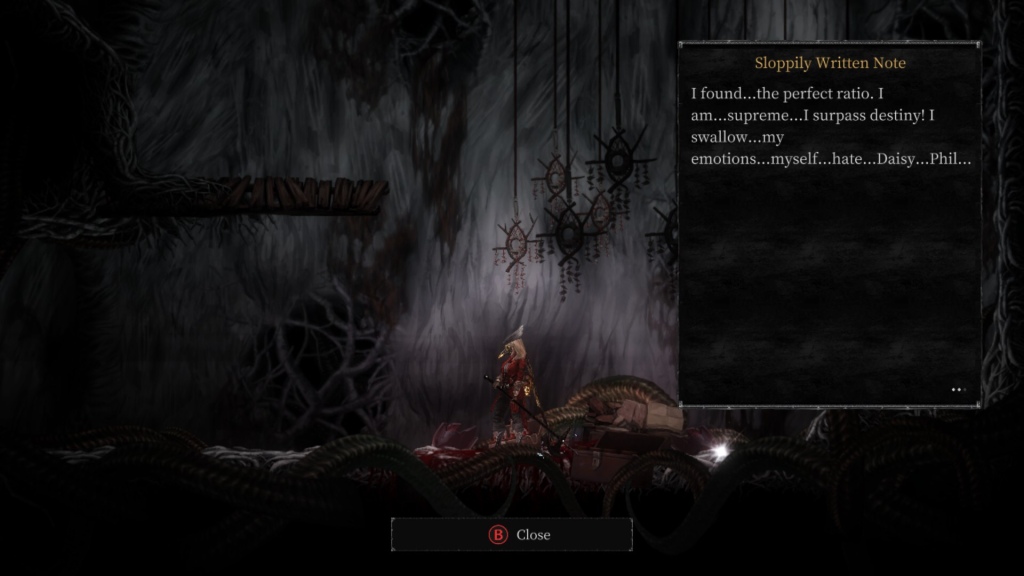
The dude clearly doesn’t like women and blames the Vigilants for something going wrong here. The author of the sloppily written notes says that women are weak and shrink before true power. We do not know of many ancient(?) female Vigilants but we do know of one. In the final sloppily written note, the names Daisy and Phil are mentioned close together but we don’t actually meet anyone named Phil. But the one bygone Vigilant we’ve met has the letters ‘phil‘ in her name.

So if Dephil was one of the six to seal the mystery danger in the Giantwood, she seems to have been blamed for not following through on something. The short, scrambling figure also said that the only remaining solution were “the sisters” and “one is dark” “one is light”.

So these six set out to the Giantwood to contain the mysterious threat. A magical ritual is implemented that explicitly calls for six participants. Running with the hypothesis that number six was Dephil, she evidently choked on her part.

In spite of that, the seal seems to have held. The notes within the Giantwood describe a long period of being trapped inside and the need to defend the exit from deserters. Since all participated in the ritual and any of them could then break it, a single deserter could ruin the whole thing. The entrance needed to be watched constantly. The seal wouldn’t be worth defending so bitterly if it hadn’t worked.

zillion Vigilant Swords stuck in this thing

The notes within the Giantwood also say that a “seige” of “heathens” was happening outside. Relics from other male Vigilants could be found within as well, like the sword of Wallace. It seems possible that Dephil bolted before the ritual was complete and then someone from the battle outside took her place.

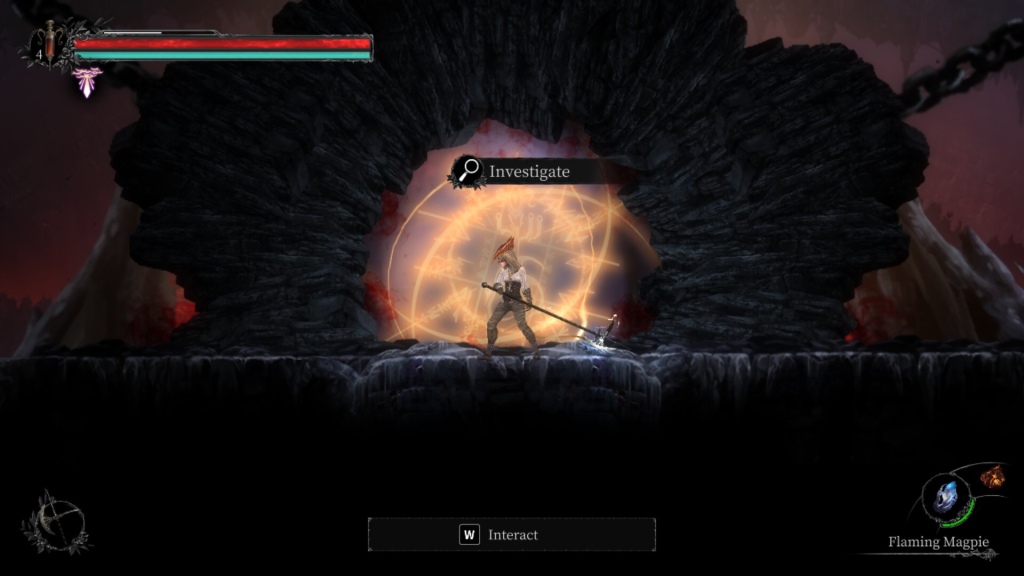
This note is found near Bufonitte Lake. Bufonitte Lake is to the immediate right of the Giantwood. If Dephil deserted, maybe she wrote those words

Leaving the mystery of the deserting Vigilant aside for now, there is another mystery here we can solve more easily. The final sloppily written note says that the author found the “perfect ratio”, which makes him “supreme” and enables him to “surpass destiny”. Our only frame of reference for ratios of any kind are the mixtures of Crimson earlier in the game. The “pale red” mixtures concocted by the Professor come to mind. Other notes make indirect statements about the ultimate fate of the Professor and the communion he achieved with the Sacred Wood. Which brings us to the boss fight in the Giantwood:

I guess this debunks my earlier theory that the Professor and the asylum Doctor are the same person

This is not a strategically challenging battle. Remember Raging March and Bouncing Fireball and you’ll be fine. You might also want to wear the Plague Doctor mask, the Crimson armor set and the Raven gloves for maximum poison resistance.

So the Professor evidently pulled off some kind of “uber-containment” that’s not the same as the seal of the Holy Six. If the seal is rooted in the bodies or souls of the participants, maybe the Professor somehow found a way to shift the majority of the containment power to himself.

This appears to hold true after his death, since an even worse plague and monster scourge envelopes Maye after this. So it at least looks like the mystery threat escaped. Relying on implication, it seemed like Hilda wanted us to “get there first” before the Doctor at the asylum who wanted the Cubic Crystals. If the goal of Hilda and Leila was to “kill it with fire” before it falls into the wrong hands, then it might follow that the Doctor wanted to somehow control the mystery threat.

In any case, killing it with fire doesn’t seemed to have made things any better. Here the game appears to take a sharp turn toward linearity, since every NPC tells you to investigate the same place and it turns out to be what I felt was a neat dungeon. During the difficulty plateau after Kelpie, the three sweet spots during this blind play-through were the Shadow Disaster, the Giantwood and the final dungeon.

In addition to a fun dungeon crawl, we also get some big lore bombs.

These dovetail, roughly, with the lore dumps from the Giantwood. There was a final step to the ritual that Dephil (or someone) couldn’t go through with. Meanwhile, a supernatural prodigy child has fallen into the hands of the modern day asylum Doctor.

The seal magic relies on its human summoners for its’ embodiment. The transformation of the Professor, for example. If Dephil’s reluctance complicated things, it may result in some sort of magical embodiment/possession/flesh alchemy that may have created a new being. Way back during the Bruna search, we found a note from the Professor explaining that his experiment with Bruna and Gram was based on a mistranslation. An archaic word he took for “couple” in fact meant “sisters”.

Perhaps my assessment of the names Daisy and Leila being derived from Dephil confused the relationship. Maybe a second experiment happened on the correct subjects, the “sisters” rather than the “couple”. The Goddess, likewise, has a dark counterpart.

Maybe the two sisters were in the Giantwood company, with the necessary six working the spell (that is either summoning or trapping in a body) on number seven. So baby sister has the primordial chaos sealed within her while the holy texts specify a correlating other half. Big sister catches that part.

We started the game catching the aftermath of the failed experiment on Bruna and Gram. Meanwhile we still do not know what happened during the time gap. It may be possible that Leila was present for those years but experienced something she cannot remember, and that we would not see.

Whatever it is, we have two significant canonical statements here. One of them is the ritual at the Giantwood. The other is that Daisy was a vessel for some kind of magic. After killing the Scholar of the Sacred Wood, both the Doctor and Daisy are gone. Sure enough, at the bottom of the final dungeon, the Doctor has Daisy tucked behind a Porta Avernus-like gateway in a somewhat altered state.

On the other side of the gateway, we find ourselves on a large, stone platform with arched portals on two opposite sides. A possession of Daisy’s may be used before a series of pillars but I was missing one. Having biffed that part I instead went to the central pillar to see what would happen.

The last two boss fights were my favorite in the game so far. Both of them make delightful use of platforming within the boss arenas. Something about that, in a sidescroller, really adds both challenge and fun for me. Creative incorporation of boss lairs was one of the big sweet spots of Hollow Knight imo and it was a fun high note for this game to end on.

Vigil: The Longest Night has a new game plus mode which you are immediately offered after the credit’s roll. Interestingly, you are allowed to keep all of your added abilities like the double jump and mid-air dash, which for sure makes the beginning feel different.

I’m not that far into my second run but it already feels like the replay value is gonna be great. The lore contains a few apparent reversals that work better when experienced in retrospect. I am a little disappointed with the inability to sequence break, though. The Metroidvania typically uses unlockable abilities as ways of controlling progress. To retain those abilities and have them before you would normally make use of them seems like a golden opportunity for the development team to implement different progression sequencing.

Some final thoughts:

https://ailixchaerea.blog/2021/01/09/vigil-tnl-play-through-postscript/

30 days of Final Fantasy music (yeah I’m doing it wrong but whatever)

1. Best prelude:

IX, at the very end of Memoria, outside of creation ❤️

2. Best chocobo theme:

Also IX

3. Moogle theme:

Good King Mog from XIV! (never actually played it but wifers showed me)

4. Best airship theme:

Looking For Friends from VI! That’s the song you hear on board the Falcon.

(The Hilda Garde music from IX also has a tendency to worm its way into my head. Like, all the time, and once it’s in it stays for awhile)

5. Best character theme:

I feel a lil conflicted there. It would either be Coin Song from VI or J-E-N-O-V-A from VII.

6. Best town theme:

Kids Run Through The City- VI

7. Best overworld theme:

Something from VI. Either Terra or Dark World

8. Best dungeon theme:

Another World Of Beasts from VI.

And I’ve always liked Phantom Forest from VI and Lurking In Darkness from VII. Neither one of those appear exclusively in dungeons but both are used in dungeons occasionally.

I kinda have to mention the Collapsed Express Way from the VII Remake. All the music from Shinra HQ in the remake could also merit honorable mentions.

9. Best battle theme:

Don’t Be Afraid- VIII

10. Best boss battle theme:

The Decisive Battle- VI

11. Best victory theme:

Out of the variations of the traditional I’d go with the version from VI. Out of the different ones, it’s XIII.

12. Best end boss theme:

Dancing Mad- VI

13. Best ending theme:

Credits’ roll from VII

14. Best mini-game theme:

Vamo Alla Flamenco- IX

15. Best in-game arrangement:

Opening – Bombing Mission, from VII. I’ve heard different orchestral versions but they always make it sound like it came from a Batman movie. Which I think is all wrong. The version from the VII Remake works for what it is, but it has a different character from the original.

16. Best piano arrangement:

Ahead On Our Way from the VII piano disc ❤️❤️❤️❤️❤️❤️❤️

The Main Theme from VII on that album is also exponentially more beautiful than the original

17. Best remastered track:

The Nightmare Begins from the soundtrack remaster for the PC version of FFVII. The most atmospheric version of that song.

18. Best orchestrated track:

Seven Seconds till the End- VIIR

19. Best non-Uematsu track:

Crimson Blitz from Ligthening Returns. That would be Masashi Hamauzu. Born Anew is also really cool (also by Hamauzu, in the first XIII game).

20. Best song from a game you haven’t played:

Final Steps of Faith (Nidhogg’s theme from FFXIV. I still gotta get started on that sooner or later)

21. Best song from a game on first console:

Mmmmm I’ve already covered a lot of VII-

HEY WAIT the title screen music from the PS1 Anthology version of V!!!!

22. Best song from a game you don’t like:

All of the cutscene music from Type-0

23. Song that makes you feel nostalgic:

Voices Drowned By Fireworks- VII

24. Song that makes you feel sad:

Other Side of the Mountain- VII

25. Song that makes you feel pumped:

Fight On!- VII

26. Song that makes you feel relaxed:

Dali Frontier Village- IX

27. Best track from mobile exclusive:

I never played a mobile exclusive unless you count IV: TAY? I played the Ultimate Collection for the PSP but TAY at least started as a mobile exclusive. I enjoyed the music from IV in general but I don’t remember if TAY had any original music? I didn’t finish it either but got to the final dungeon and found out I was pathetically under-leveled and trapped there

28. Best track from handheld exclusive:

The Price of Freedom- Crisis Core

29. Most underrated track:

Reunion- VII

30. Song with a special meaning-

Anxiety- VII. My favorite song from a video game

One more time with feeling! (last entry of 2020 w/ 30 games tag!)

1. The last single-player game you played:

Final Fantasy VII (PS1 port on Vita)

2. The last multiplayer game you played:

Very first Super Mario with my wife ❤️❤️

3. A game you’ve played through multiple times:

I meeaaan I have played through FFVII a bunch of times because I’m just persistently obsessed but just to shake it up- Salt and Sanctuary!

4. A game in your favorite genre:

I’m not even sure what my favorite genre even is…probably RPGs in general. I also appreciate RPGs with a little bit of puzzle box / dungeon crawling. And I’ve been playing a crap ton of action RPGs with a crazy maze Metroidvania thing going. Or just distinctive dungeon-design in general.

Let’s go with…Chrono Trigger?

5. A game in your backlog:

The Dishwasher: Vampire Smile

6. The game you’ve put the most hours into:

Outside of Final Fantasy in general, it’s gotta be Bloodborne. All the trophies and everything ^^

7. A game you’ve never finished:

Rise of The Tomb Raider (fingers crossed for getting that off the list soon)

8. A game in third person:

Most of what I play? Let’s say Diablo

9. A game in first person:

Sacrifices Must Be Made! Review forthcoming!!!!

10. A game you’ve replayed:

Final Fantasy VII Remake ^^

11. A game you play to relax:

Other than my PS1 FFVII port…almost any Pokémon game. LoZ: Ocarina of Time also helps me wind down.

12. A game that gets you excited:

Vigil: The Longest Night

13. A game from your favorite developers:

I don’t know if I have a specific favorite? I would love for Ska Studios to do something new sometime soon.

14. Your favorite indie game:

Salt and Sanctuary (speaking of ❤️)

15. Your favorite AAA game:

Bloodborne

16. Your favorite board game:

Chess!

17. Your favorite multiplayer game:

Hehe…Bloodborne…the PS4 port of the original Dark Souls also gets way more fun with partners

18. Your favorite single-player game:

FFVII

19. Your favorite game series:

FF

20. Your favorite game from childhood:

First NES Zelda game!

21. An overrated game:

Dark Souls

22. An underrated game:

The Space Between

23. Your guilty pleasure game:

World of Final Fantasy. It’s an utterly barefaced Pokémon clone but it does things that a lot of monster hunter games don’t, like interacting with multiple monsters in your party simultaneously without feeling cluttered.

24. A game based on a movie:

Mighty Morphin’ Power Rangers: The Movie! (Yes that is also a review currently in the works)

25. A game with an awesome soundtrack:

Silent Hill 4

26. A game with awesome artwork:

Blasphemous

27. A game with awesome voice acting:

Vampyr

28. A game best played with a controller:

Hollow Knight

29. A game best played with mouse and keyboard:

Diablo II

30. An upcoming game you’re excited for:

Hollow Knight: Silksong

The hard work of civility

Content warning

I’m pretty sure this is gonna annoy or piss off nearly everyone.

In both the 2016 and 2020 presidential elections here in America, there were widespread expressions of shock. Many Americans began to see a near-majority of us as being demonstrably evil. Or, at the very least, the other half sees evil as a tolerable state of normalcy.

I chose to use the meme above because of how confrontational it is. To forgive mistakes and to see the good in those that are guilty of evil feels very different now. Nearly impossible.

Nor am I exempt from this. Lots of queer people like myself get used to people-pleasing because we are so deprived of acceptance that any price might seem acceptable. I won’t belabor this point but I’ll say that, in order to reverse this destructive psychological tendency, I swung hard in the other direction.

I essentially adopted a policy of zero expectations from others and license to do whatever I want, without explanation or justification. Pure fairness.

This belief is also embodied in a well-known adage from Anton LaVey’s Satanic Bible: “If your happiness or success is offensive to someone, DESTROY THEM”

This continues to be one of my favorite quotes and I’ll probably embroider it on a homey lil doorway decoration that all cute, quaint little houses seem to have.

I believe in my lived truth: I cannot do otherwise. I know what it is like to learn the value of dignity the hard way. But even if the specific point of contact between lived truth and objective reality is difficult to perceive, it must be grappled with.

This would be true anyway, but the COVID-19 pandemic has made it unavoidable. The new, resilient and even more contagious strain that originated in the United Kingdom is now in America, and even before that we’ve fucked up our response so badly that we got travel-banned by the EU. Our negligence, as private individuals, is now pushing the limit of our healthcare, administrative and scientific infrastructure. Those who did not take the first lockdown seriously are now saying that we should have followed the order better the first time around. Reality has become so negotiable that we see it as our due when we make exceptions to break quarantine. Across America, hospitals are being filled to capacity and dead bodies are quickly and efficiently removed because of the need for more hospital beds. Our belief in our right to ignore the needs, humanity and mortality of others has enabled this pandemic to become what it is here.

There is, though, a less obvious but equally pressing need for greater unity. A society that values democracy as an aspiration will not change without minds being changed. Minds do not change without conversation. The portrayal of civility above as a naïve attempt to marry an unstoppable force with an immovable object is a lived reality in many respects. I have no desire to sit down with people who do not think I am as human as they are, or that the historical trauma of my ancestors was an acceptable price to pay for the proliferation of Western culture. But there is no other way forward.

In an adversarial duopoly such as the one America is subject to, there are convenient and practical reasons not to believe this. We are shown that the side opposite our own will stop at nothing to defeat us, including sabotage, deception and potentially even violence. We often feel that to play by the rules under those circumstances is a mistake. A friend of mine once said “When you try to be reasonable with unreasonable people, you get played.”

If you were not alive for it, then consider what racial integration in public schools must have looked like when Lyndon Johnson decided to enforce it with the military. At that time, it must have seemed like a question with a diversity of opinions on both sides and to claim that you are right and so many others are wrong would have sounded like sweeping arrogance. Yet we now take racial integration in society for granted. Democratic change happens through exposure to other ideas and sometimes that exposure must come through confrontation. A first blow needs to be struck sooner or later. When the abolitionist John Brown was publicly hung, a young solider named John Wilkes Booth was in attendance who would go on to assassinate Abraham Lincoln. Meanwhile, other contemporaries of Brown equated his willingness to die for the greater good with the crucifixion of Jesus Christ. The early skirmishes preceding change are always seen in the most polarizing and combative lights. If these necessary challenges to popular wisdom are to last, though, conflict cannot be the end even when it must be the beginning.

If not sooner, conversation must happen later. And the prospect makes my blood boil, at times. I grew up practicing a marginalized religion and my Christian neighbors spent both my childhood and their own trying to convert me and convince me that Western conquest could not have been that bad if Natives got Christianity out of it. The various rounds of bathroom panic create an expectation that myself and those who share my gender identity are sexual predators and that we are obligated to explain how we are not. Transphobia and stealth racism have become fashionable brands and a method for washed up political figures and celebrities to renew their cultural relevance. I have dated people who saw me as racially inferior and my gender identity as false and I simply took the time to civilly engage them in conversation about it when I could. And it has never gone well. I detest the prospect of nobly taking one on the chin for the moral edification of others for the rest of my life.

On the other hand, I could not have made it this far in my life and achieved this much success and happiness if I thought everyone who demonized me and people like me were demons themselves. This admission, though, must co-exist with the point of contact between lived truth and objective reality. What would such reconciliation actually look like?

I once had a traumatic encounter with someone who was released from prison mere weeks beforehand, having been jailed for victimizing others the way he did me. Might I, potentially, be required to shake that person’s hand, or the hands of those like him? During the few occasions where he approached me in public afterward, I could not even bring myself to make eye-contact with him. When he was seen around my mother’s workplace a few years later, I ended up binge drinking for days.

Perhaps there is a border to the territory of forgiveness. If so, I don’t know definitively where it is and I doubt anyone else does. I would also like to clarify that I am not equating violent people with those who give voice to bigotry. We are all familiar with the conversational slope of “what about”-ism, though. I am only relating that memory as my only experience that could furnish a worst-case scenario of forgiveness. Yes, someone who enables or condones evil might not be an evil person- but what about those who have committed predatory acts and have an established pattern of it? If conversation is necessary in the long run, then the scope of necessary engagement will probably include some painful conversations. If all movements for positive change start as a marginalized effort, though, then the fear of a bad outcome cannot stop us from trying.

There is a concept that has degraded from misuse by bad faith pundits in the last decade. This is the free market of ideas. Without those harrowing conversations, we cannot say that we have given the range and applicability of public discourse it’s due. The free market of ideas cannot be dismissed as a dishonest ploy from hipster commentators if there are ideas that have not entered the market for fear of bad company.

The true, ethical imperative of civility and dialogue can lead to frightening responsibilities and confrontations. It frightens me. But what alternative exists? If we see those who disagree with us as monsters in human form, what would the application of this belief look like? If we cannot deign to associate with them at all, then we cannot claim to be the victims of unfairness when they accuse us of being tribal and unreasonable. As potentially terrifying and mysterious as such negotiations may be, a pandemic in which our healthcare system is bursting at the seams is not the time to experiment with disposing of civility.

At the same time, though, we need to be able to recognize other common-sense needs. We need our Lyndon Johnsons and our John Browns and those who are willing to use their power unapologetically for the greater good. I absolutely support the push for Progressives in Congress to force a vote for Medicare for all and a greater stimulus effort because the health care system and our profit-driven society simply have not left us prepared to face things like a long quarantine during which we can’t work in person (or at all). Civility must be weighed in balance with external demands, but the degree to which other people create external demands means civility will keep coming up.

Other contemporary events, such as civilian violence, may also be attributable to others who feel driven by necessity. This has the appearance of an impossible and escalating gridlock. I acknowledge that it is possible, but I do not think it is necessary. Not only does civil discourse need to be weighed in balance with circumstantially necessary action. It must remain possible at roughly the same time (whether intermittently or perpetually).

This will not be easy. Yet when we are driven to act unilaterally, we can at least be honest about why. Those reasons being laid bare enables others to speak to us on the level at which we need to be heard.

-Leonard Cohen

Just finished Crisis Core: Final Fantasy VII for the first time (spoilers as usual)

After all this time, I have finally played and finished this game. And I went into it with a negative bias: with as much as I love the original Final Fantasy VII, I was bound to play it sooner or later but we all know the odds with later elaborations on cool stories (that do not necessarily need any). There is a lot that can go wrong. So I was not expecting it to come as close as it does to perfect. Perhaps it is perfect, for what it is.

The only problem I had with the game (if it ever qualified as a problem) was the kind of action RPG that it is. I think Crisis Core adheres to some sort of handheld action RPG formula that is also prominent in Final Fantasy: Type-0 which is my least favorite FF. Both Type-0 and Crisis Core have constant access to missions with varying degrees of relevance and irrelevance to the mainline story. At any given point in both games, one can access mini-raids that do not advance the story at all and you will sometimes be strongly pressured to do them.

A few times in Crisis Core, there are story beats with no obvious path forward. You will likely do a lot of these missions because it is easy to suspect that, since nothing appears to be happening, that the missions might trigger the next thing. Eventually, you realize it doesn’t work like that and then explore and trigger the next story event on accident. Since the PSP was a potential commercial risk for Sony, maybe they thought designing games that you can easily tune in and out of would be a way of playing it safe or appealing to “casual” gamers. Random fetch quests and random battles do not have a huge structural need for continuity.

For that reason, it is easy to spend lots of time playing either Crisis Core or Type-0 doing a lot of stuff with no cause and effect relationship with the story progression. This seems to be an emergent genre, and it is also a prequel and prequels have a little bit of reliance on the base game. This is what I mean when I say that Crisis Core: Final Fantasy VII may be perfect for what it is. It happens to be in a genre that I often find boring unless it has some other strength going for it. Luckily, Crisis Core does.

What I liked most about FFVII was it’s story. So it was bound to be something I would be looking for here. One of the reasons I was interested but not quite eager to play Crisis Core back when it first came out was a story concern. According to a few sources, there were now two more characters that were infused with Jenova cells as fetuses.

While Sephiroth is still basically just “possessed” by Jenova like all carriers of her cells, he is still somehow different. Even though all carriers are controlled by Jenova, it often looks like Sephiroth is the vehicle and enforcer of her will, up to and including exerting his own will through the clones. The original Final Fantasy VII offers Sephiroth’s fetal exposure as something that could set him apart from the rest of SOLDIER. With that understanding, adding more characters that were changed as fetuses would undermine the plot of the original.

There are degrees of this procedure, though, which creates specific differences between them. In the first two experiments, a woman named Gillian who had been infused with Jenova cells was the source of the experimental DNA. Genesis had Jenova cells generated by Gillian’s changed body mapped onto him as a fetus. This was done surgically with a donor mother. Angeal, then, was conceived by and birthed by Gillian.

This does not necessarily need to subvert the plot of the original, though. By the time of the mainline Final Fantasy VII, Sephiroth is the only remaining fetus-hybrid anyway. Additionally, his closeness to the Lifestream nexus point of transmigrating souls in the core of the planet constitutes his real usefulness to Jenova.

At the same time, Crisis Core has a story that does make distinctions between different kinds of fetus-hybrids. If Crisis Core was the only FFVII story I ever encountered, I would be forced to assume that the enigma of Sephiroth’s unique nature would be clarified somewhere else. Crisis Core ends with Genesis’ inert body being mysteriously carted off by SOLDIER. This, at least, made it clear that Square wanted loose ends to lead into other installments in an expanded universe (at that time, anyway).

But if you played the original, you know that the only word on how Sephiroth was exposed to Jenova’s cells in the first place is that it was while he was a fetus. In light of the additional lore in this prequel, though, being infused as a fetus can mean different things.

Is this a serious narrative weakness, though? I don’t think so. Not even a weakness, really, more like a complication. The only real consequence it could have is whether or not all Genesis and Angeal carriers are eradicated. There are a lot of them for all three of the fetal experiments. The plot of Advent Children relies on three Sephiroth carriers surviving by simply falling through the cracks during the Jenova Reunion. Assuming, for now, that there are no more Angeal or Genesis carriers isn’t that much of a big deal. And if Sephiroth’s real usefulness to Jenova is his location at the Lifestream transmigration nexus, that leaves the plot of the original game intact.

So in the end, there is nothing about Crisis Core that really contradicts or subverts the original, in terms of plot or lore continuity. Crisis Core does more than simply not fail, though.

Whether or not Crisis Core starts off on an easy path is a matter of interpretation. Zack Fair, our protagonist, is super stoked to be in SOLDIER and to fight for the global dominance of Shinra. For a fan of the original, in which Shinra is an unambiguous force of evil, this is jarring. Then again, all armies have their propaganda and their own true believers. Warriors on all sides always think they are right- so Zack being a warrior of conviction actually makes a lot of sense.

This is hint one that Zack is gonna have an arc that goes from naïveté to maturity. But for a while he plays the role of the big bouncy Boy Scout a little too well. Zack never gets as annoying as Snow from FFXIII but walks up to the line occasionally. Being a guileless and trusting recruit at first, Zack’s ideals are larger than life and quickly slide from white to black (musing whether he is a hero or a monster, etc).

Zack becomes aware of necessary shades of gray when he is assigned to track and neutralize Genesis and Angeal once they defect. Hollander and Genesis have an exchange in front of Zack that makes it clear that Angeal and Genesis need Hollander and his Shinra-based procedure that staves off their cell decay. If certain death is the motivation for Angeal and Genesis remaining loyal to Shinra, then the possibility of a non-Shinra source of sustenance is life-changing.

In other words, the Shinra super-SOLDIERs fight because they have to in order to survive. Genesis’ mood swings could have a few different explanations, but the revelation that he doesn’t have to be Hollander’s dog forever seems like a contender. Angeal, who is also subject to the cellular decay, rebels also but tries to maintain his early values, such as protecting his old relations and innocents who get trapped in the crossfire. Genesis wants to start over and Angeal wants autonomy but still clings to his prior obligations.

The dialectic of balancing individual need versus wider complications is emphasized more by a conversation between Zack and Sephiroth immediately before the fatal journey to Nibelheim. Sephiroth tells him that he might defect from Shinra soon but does not offer any explicit reason. The only implicit reasons are the recent events with Angeal and Genesis. It seems possible that Sephiroth is also questioning (he says he may defect) whether or not he would die without Shinra support. This would mean that his personally-felt loyalty to Shinra is now irrelevant, since he’s learning he might be nailed down to it anyway.

A loved one of mine shared bits of the Crisis Core soundtrack with me a long time ago, including a song called The Price Of Freedom. That phrase captures the emerging thematic concern at this point in the game.

Crisis Core is a prequel and is fundamentally tied up in a relationship with the OG Final Fantasy VII. It would be an extremely weak prequel, though, if it had nothing but it’s connection to the source material going for it. This questioning of genuine commitment versus coercion leads us to a personal narrative about Zack, which kicks into overdrive when Zack is forced to act independently.

After escaping the grasp of Hojo and his lab tech, Zack is soon cut loose from Shinra. He has digital access to internal Shinra documents stating that both Zack and Cloud are dead. Then the word goes out that some important Shinra “fugitive samples” have escaped.

The game from this point resembles an escort mission: maybe the most emotional escort mission I’ve seen in a video game in a while. Zack has watched his heroes turn sadistic and homicidal and was forced to put down a few of them himself. Cloud looks up to Zack as a role model but, now that he is on the other side of the hero-worship he indulged in himself, Zack is more willing to treat Cloud like an equal than his own heroes were.

After the Nibelheim disaster, though, Cloud ceases to be a mere “kid brother.” Zack witnessed the importance of Tifa and Nibelheim for Cloud and the destruction wrought there by his own former masters. After the loss of Sephiroth, Angeal and Genesis, Cloud is now Zack’s only surviving fellow traveler. This also makes Aerith more than a long-distance girlfriend for Zack: she is the last part of his old life that remains good.

FFXV was lauded for its portrayal of platonic love between male companions. I think I gotta say that Zack and Cloud do this better. And it’s built up by a succession of smaller moments, like Zack carrying Cloud around and re-dressing him in new clothes. Final Fantasy is famous for being dialogue-heavy, but a lot of the pathos of this bond is built by being non-verbal. Cloud might not talk back to Zack post-trauma, but Zack still makes an effort to discern his feelings and needs.

Zack always addresses Cloud as if he is lucid and paying attention. At this point in the story, all institutional sources of meaning have, for Zack, been revealed to be treacherous. Zack’s only values need to be the ones that he embodies himself. The function served by Zack’s relationship with Aerith as a motivator is a little reductive but it works as something real for him to be invested in, after his other idols are discredited. Cloud, though, is a living embodiment of this.

Before wrapping this up, there is another gameplay element I wanna mention: the modulating phases. This was almost…kind of…subversive in a good way?

In lieu of normal experience points, we now have a slot machine mechanic that starts up after a certain length of time. This basically limits the rewards of combat to its’ length, which can achieve a lot of the same ends as an exp leveling system. Easy foes get done away with easily so there is no risk and no reward, since the battles won’t last long enough for the modulating phase. Most of the numbers correspond to materia slots and two or three numbers of a kind will level up the materia in that particular slot. Solid 7’s are how Zack himself levels up.

This creates a feeling very similar to more conventional RPGs. Enemies below your level are quickly done away with and have minuscule rewards: the real grinding needs to happen with monsters close to your own level. The modulating phase slot machine is also how special, hard-hitting attacks similar to limit breaks are triggered.

Near the end, during Zack’s last stand outside of Midgar, you are clearly overwhelmed and most of us knew how this would go anyway. But you keep getting thrown into playable combat against the vast Shinra hoard with frequent modulating phases that buzz with static and roll irregularly, as if glitching. The slots even have some of their character illustrations go white and fuzzy and the screen will white out without giving you a specific set of three numbers. The poignance of this portrayal of Zack gradually dying crept up on me.

I might also be stating the obvious by mentioning the similarities with the portrayal of Zack’s last stand in Final Fantasy VII: Remake. Both versions have Zack saying the words “(t)he price of freedom is steep” and some very similar “camera angles.” If Square continues to insist that Crisis Core is not cannon, we’ll just have to see how that bears out in part 2 of the remake.

After all these years, I’ve now learned that this is where the image of Sephiroth at the start of Advent Children came from

My review of Crisis Core Reunion:

Crisis Core Reunion first impressions (sorta, also heavy spoilers)

Vigil: TLN play-through, part 3 (spoilers)

When we last left off, the plague in Maye Village had two possible origins: the mine and the flooded area. The unexpected time jump after the encounter in Death’s Destination caught me off guard and I didn’t want to miss out on any temporary events or side quests. Not knowing which path would advance the plot to the next beat and close any cool situational opportunities, I decided to start with the one that seemed the longest and most open-ended: the flooded area.

The Metroidvania sub-genre banks on the lure of exploration. There is, however, a way to either create an experience that feels the same but isn’t or to make a linear section more interesting before being truly turned loose. Final Fantasy Peasant nailed it when he said that Final Fantasy VII pulled off one of the greatest open-world fake outs by giving you a navigable world map after a rigidly linear beginning. Simply having the world map at all felt liberating after Midgar, but there are still terrain obstacles that can’t be crossed until later in the story.

Vigil accomplishes the same illusion in a much simpler way. Before I get into that, though, I want to emphasize that there is still enough exploration and hidden paths within the mine and the flooded area to have a lot of fun with. The careful control of the difficulty and it’s consistency with the character-building system frequently kept me engaged and interested in relatively small spaces, though. This often feels like lots of little frustrations that, once overcome, will make you feel like the incoming huge frustration is easily doable and you don’t realize how hard you are actually trying.

Again with those soft touches: the background scrolling immediately before Kelpie goes nicely with the droplets of water on the “camera lens”

Case and point: Kelpie. When this fight was first triggered, I was able to do enough damage with the same melee tactics that work for the random encounters in the area to make it feel potentially easy. More specifically, I’ve been cultivating a “heavy”, axe-weilding build. So axe-melee works for anywhere from 1/4 to 1/2 of Kelpie’s HP, then Kelpie burrows under the shore and begins a combination of range and heavy blunt-force attacks with limited hit box access. On attempt 2, I experimented with some spells and found that the short-range poison projectile that The Ancient Guard drops in Death’s Destination is very useful during the second half of the fight.

So here I am thinking I have a fool-proof strategy nailed down, but even with that you are never too big to fail. Like last time, I thought this would be easy and got lazy. Before I knew it, hours went by with repeated deaths and each and every time I was thinking it was gonna be easy. It pays to remember the little things: Like Bloodborne, never underestimate the advisability of rolling to the other side of huge monsters and spamming them from behind. Also, do not get so put off by the size and movement of Kelpie to forget that you can still do simple things like crouch and run out of range.

Stock up on negative status curatives and restoratives for stamina while doing all this and you’ll be fine. Upon defeat, Kelpie drops a key item called a Cubic Crystal & you now have access to a new, interconnected area. Almost like a palette cleanser, a bit of exploration beyond this point will bring you to the Gnawing Beast within the sewers, a substantially less challenging boss that drops the Arctic Ocarina. You know, like the Scarlet Ocarina that took you to Death’s Destination.

Sure enough, the guards back in Maye are talking about increased numbers of undead emerging from the cemetery and would like our assistance. Which would once again place us close to the Catacombs and the gateway to the other side, so it’s starting to look like another magical journey with the ocarina is just around the corner. But let’s check out some other leads first- such as the contagion’s possible origin in the mines.

Our old friend Hilda is found some distance beyond where we ran into her last time. She shares some lines from a song describing tree trunks with skulls embedded in them, just like the trees in the area.

From here there is some exploration to find the entrance to the mines, during which you could obtain the Flaming Magpie spell if you grabbed the stone from the hunters’ cabin earlier. Once we get there, though, the mines are a real platforming sweet spot.

Mine levels, like sewer levels, have a generalized reputation for being frustrating. Mystic Caves Zone from Sonic 2 comes to mind or the sewer section from the first Silent Hill game. Vigil, though, along with nearly every recent Metroidvania I’ve played, succeeds in avoiding this. As is typical of mine levels, there is mobile platforming. With enough attentiveness, you can navigate the pattern-memorization without needing to sacrifice health or progress. The mines reward effort but don’t hold you by the hand; like any well-designed game, you are never too big to fail.

The pre-boss combat is also tightly designed; enough small and moderate attackers simultaneously to make you think quickly but never overwhelming. Some of the monsters, like the one seen above, are familiar. The zombies that emerge from the ground and explode upon dying were first seen in the cemetery and the spikey dogs were first seen in the laboratory where Bruna was taken and transformed.

The nod to the cemetery underpins the possibility of revisiting the gateway to the other side, sooner or later. But this association is also blended with a new detail: miners who still look mostly human who also explode upon dying. Possibly a connection between the mining disaster and the antecedents of whatever is now going on in the graveyard? Maybe Dawn and those like her are right about the recent plague emerging from the mines after all. An eventual shortcut leading from Limestone Way to the flooded area also bears this up.

The boss fight, though, is probably the first easy one in Vigil. I appreciated the attempt to make the player exploit the spatial characteristics of the “arena”. The Erupting Flesh Cluster dominates the ceiling and sprays fire, forcing you to both hug the floor and climb platforms to avoid the streams of fire. If you have the Flaming Magpie spell, though, you can camp out at the rooms’ edges and spam arcane damage, since the Cluster’s hit box hardly moves and the Flaming Magpie can cross the whole screen.

After dispatching the Erupting Flesh Cluster and claiming the second Cubic Crystal, you might also elect to rescue some miners you encounter along the way. Soon, though, we rendezvous with Hilda who advances an interesting possibility on the origin of the plague. One begins to wonder if the Doctor in the plague mask back at the asylum is in fact the same person as the Professor from the beginning of the game, who experimented with Crimson on Bruna and Gram.

That the Doctor has contributed to the problem in any way- be it active or passive -appears credible. He cops to giving out placebos to placate the villagers. He also conveniently supplies a new possible origin for the plague at Bufonitte Lake when the flooded area and the mines are ruled out, which could potentially look like evasion.

During the placebo sub quest, I decided to give all of my sugar pills to the drunk, rich asshole in the tavern only to have Sillian kick me to the curb because of what it looks like ):

Bufonitte Lake and the process required to get there continue the upward quality of the platforming that began with the mines and the Ancient Battleground. En route, there are a ton of neat shortcuts and secrets to be discovered, often with the aid of the spell gifted to you by Hilda during her earlier visit. The lake itself has almost immediate access to a boss battle that yields a third Cubic Crystal. During the right-leaning vertical platforming necessary to reach Bufonitte Lake, it is also possible that you encountered this:

Evidently, they are a set of three, and are required to open this gateway. This also has a superficial consistency with an optional lore document at the lake that refers to a seal key divided between the Vigilant, the Shimmer Church and the Guard. When you return to the Doctor to check if the defeat of the scourge of the lake had any effect, though, he has moved onto another potential solution, requiring all three of the Cubic Crystals. Which he needs you to hand over. Because…you know…trust…right…?

This leaves us with three options: hand over the Cubic Crystals to the Doctor, play the Arctic Ocarina at the bottom of the Catacombs, or open the seal in the Giantwood Forest.

Here it might bear mentioning something that I should have done before I defeated the Ancient Guard earlier: utilize multiple save files. This time around, I got the memo before it was too late. What happens after this point should probably get its own blog post.

Some other odds and ends I wanted to mention-

Not knowing how quickly things might move once I dove back into the main quest line, I decided to mop up side quests and do some exploring off the beaten path. After rediscovering a passage I didn’t investigate very thoroughly the first time around, I pushed a little further and found this:

To my surprise, I wandered into the Salt and Sanctuary crossover event without even encountering the specific quest line. Other than the familiar face above, there are a few other monsters that look a lot like S&S creature design:

It’s been awhile since I last played Salt and Sanctuary, but I don’t think these particular creatures appear in that game. I mean…there is a superficial resemblance to the S&S Drop Spiders, but only in that they’re spiders. Beneath Lake Bufonitte, you encounter these beauties, which look like S&S creature design and are a bit closer to the mark:

They occasionally drop from the ceiling but still look distinctly different from Drop Spiders. If Ska Studios made original assets for Vigil during the collaboration…I can’t help but wonder if there is more to the crossover than the brief monster hunting excursion that lands you the frying pan from S&S? I mean, a quest line, a familiar enemy and a weapon were all that the crossover announcement on Steam promised..but those spider creatures do look distinctly like the work of Ska Studios, right? I may also be wrong, here, but to my eyes the large spider enemies appear to be rendered in a very specific art style that stands out from everything else in the game.

Speaking of Vigil’s art style, I have to gush about how beautiful this game is. Much of the art looks like offbeat, slightly uncanny illustrations from a book of fairy tales. The background scrolling makes this imagery look a little bit like a surreal pop-up book. Situational zooming and lighting adds a subtle touch of realism which also breathes life into the otherworldly touches.

Especially, like the moment shown above, when a quick, transitional movement shows several dynamic textures simultaneously. The bright, early morning moon is visible when Leila emerges from the rock face on her way out of the mines. Then, as the camera moves with Leila on her way down a ladder, the moon disappears behind a structure and the mist-covered forest moves into the frame. Both can only be seen simultaneously as she crouches to begin climbing, and for barely a second. This is just the right amount of realism, like when you see something surprisingly beautiful and then you take another step or your car goes around a bend and it’s gone.

Understated photorealistic textures, like rain, add a lot to the sense of scale created with the situational zooming and lighting. I know this isn’t an option for every gamer but it really, really pays to play this game on a machine with a quality graphics card. I’m sure this all pops beautifully on the Switch and will on the PS4 whenever that adaptation is made.

End of play-through:

https://ailixchaerea.blog/2021/01/09/vigil-tln-end-of-blind-play-through/