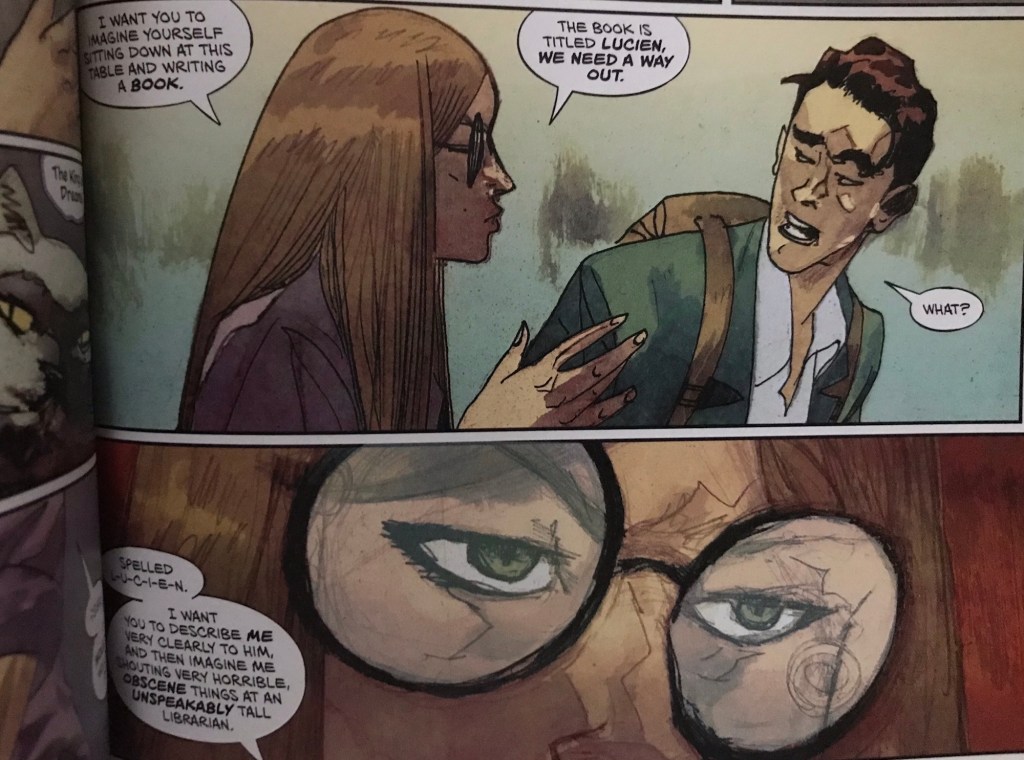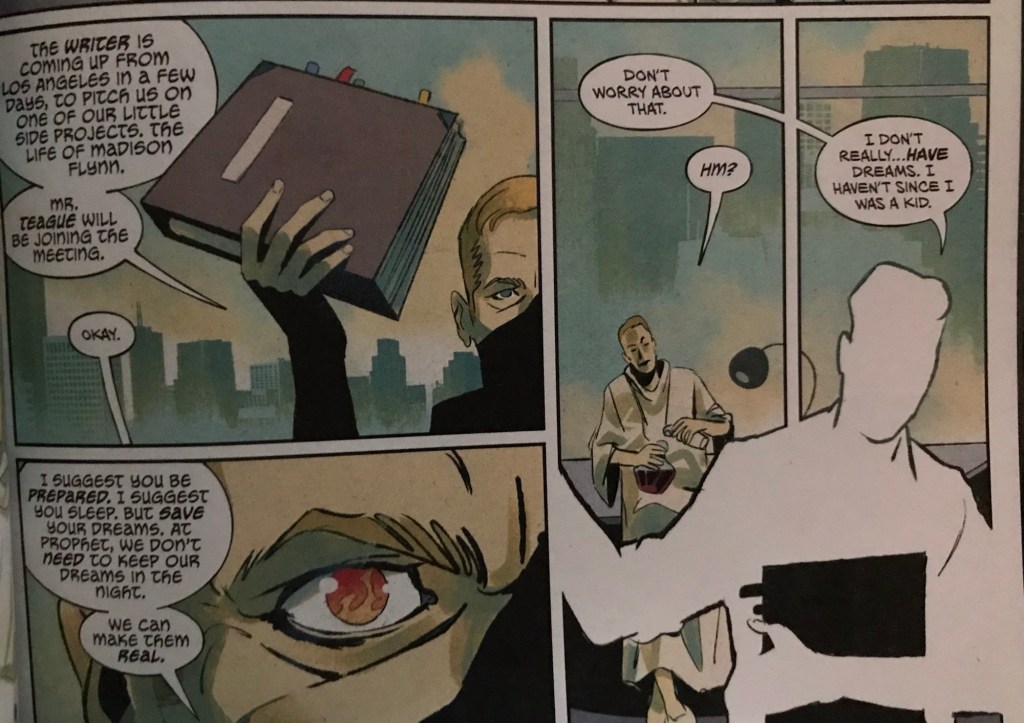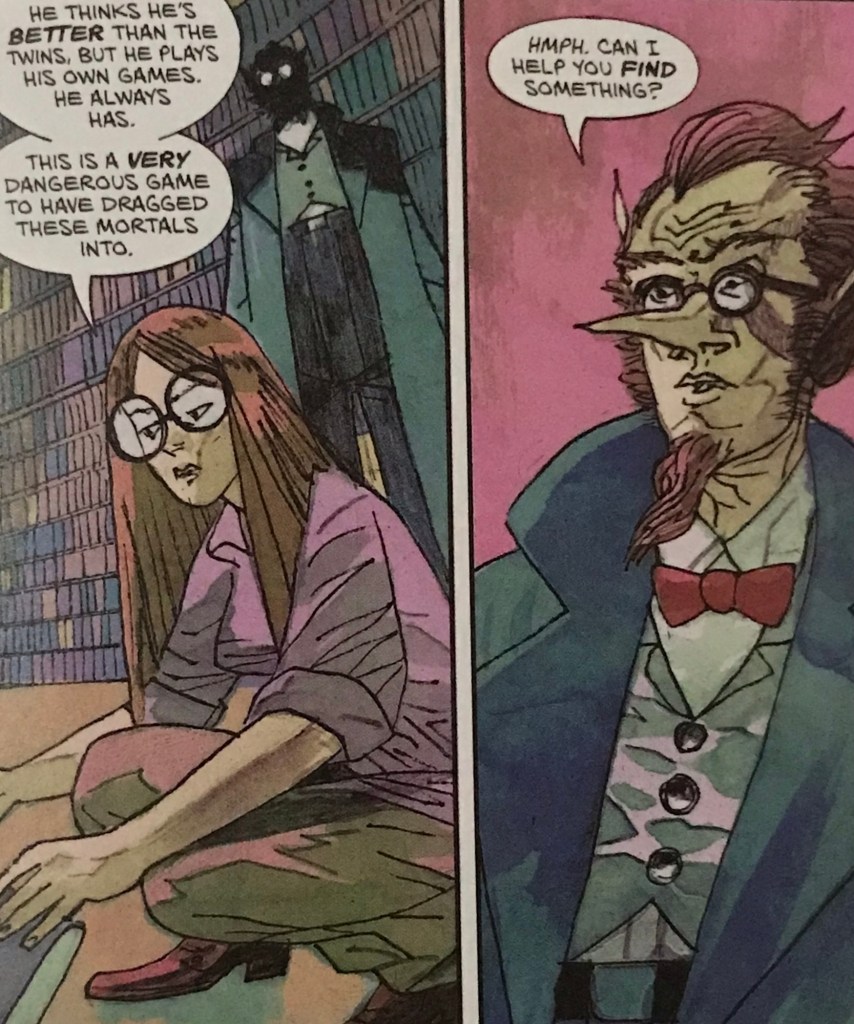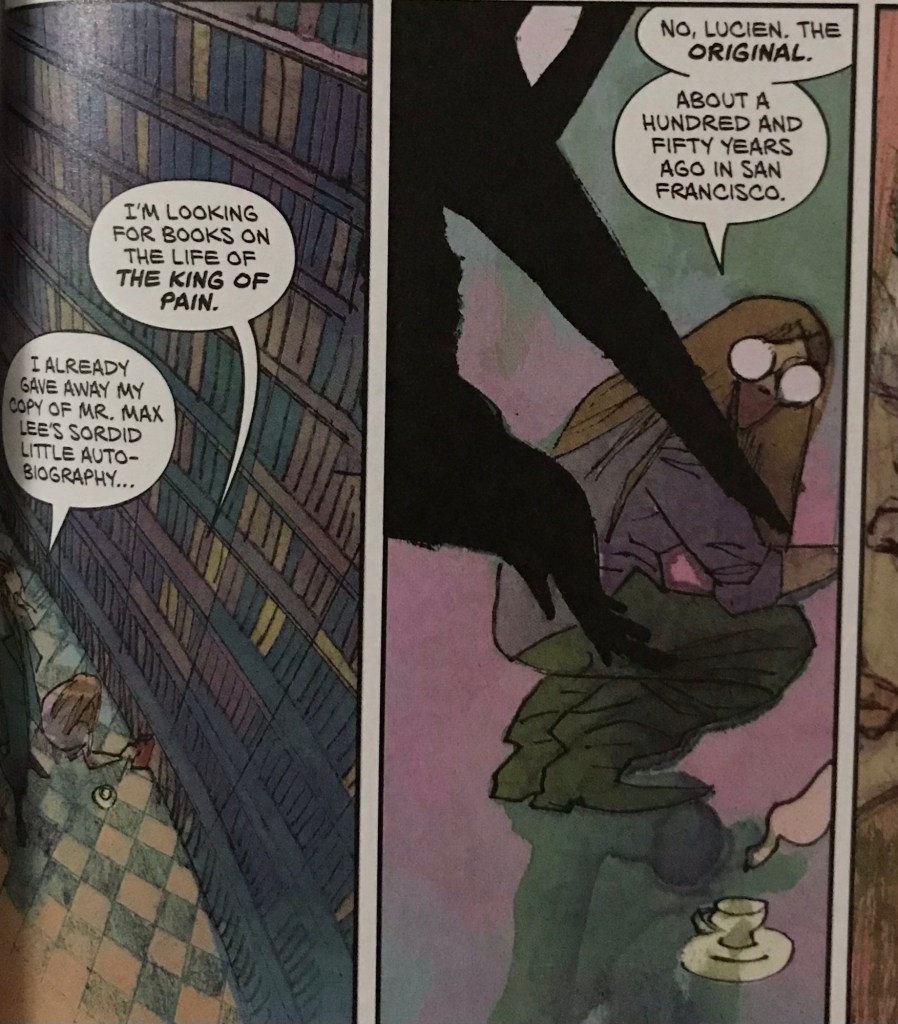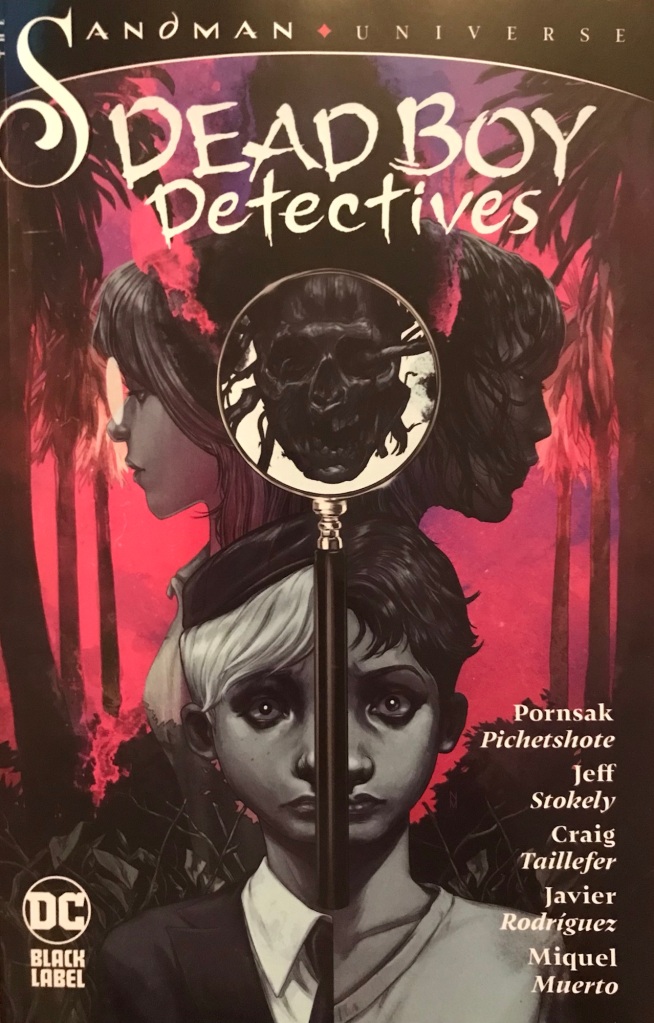
The Sandman Universe: Dead Boy Detectives, volume 1 review (spoilers)

Definitely recommended, if you liked ‘Season Of Mists’ from the original Sandman.

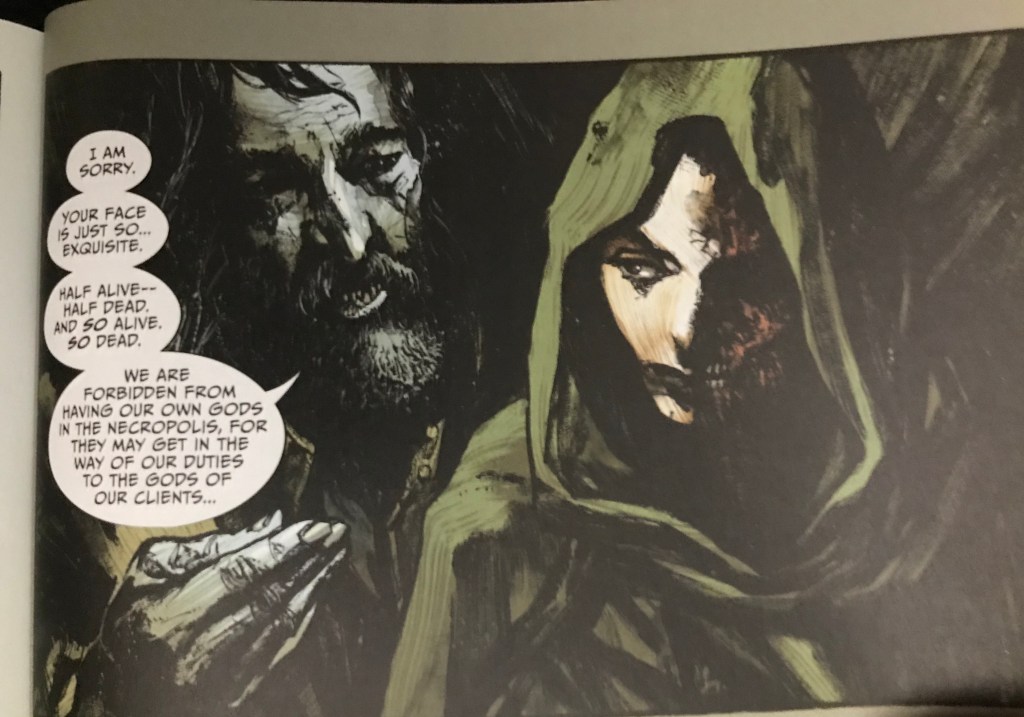
While Lucifer may have been the break out character of ‘Season of Mists’, Charles Rowland and Edwin Paine had an equally pivotal role in that story. Neil Gaiman even included Edwin Paine in the epigraph: “You don’t have to stay anywhere forever.” Paine and Rowland are also the ones to bring the self-determination theme into the foreground.

Lucifer, of course, was open about how Dream inspired him to abandon Hell but both of them have their own frames of reference with regard to freedom and duty. Charles Rowland and Edwin Paine systematically “figured out” self-determination due to a lack of any other options.

‘Season Of Mists’ spoilers incoming-

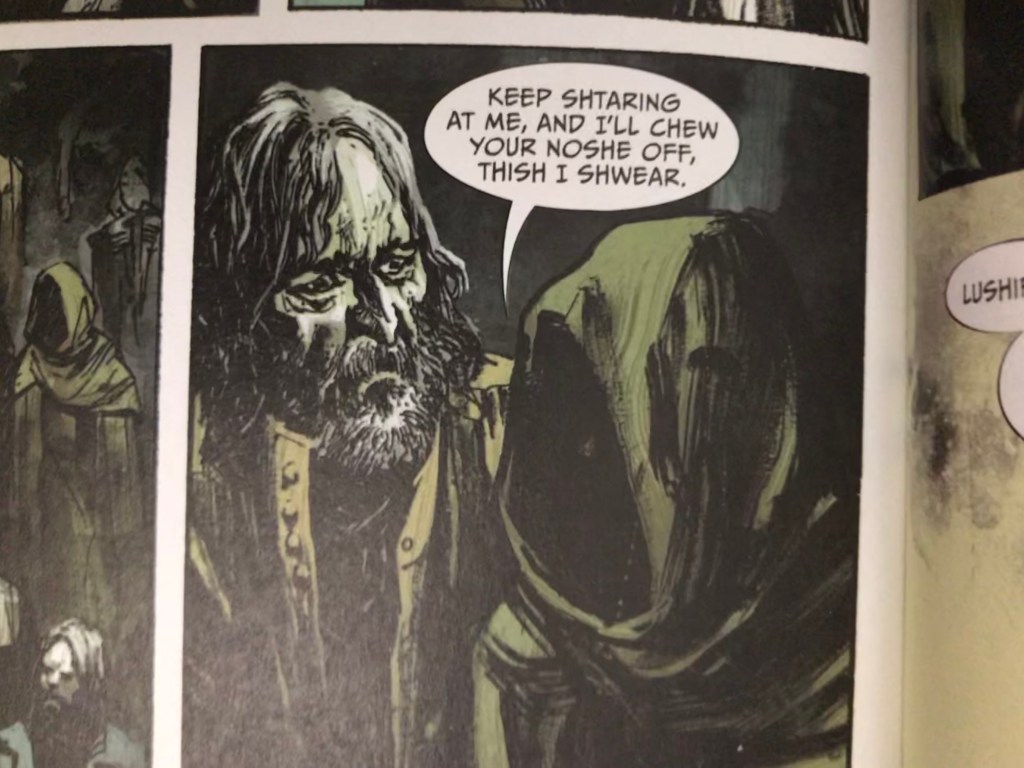
Hell is a separate plane of existence most easily accessed by untethered souls- the dreaming and the dead. When Paine and Rowland end up there, they have uncanny, disturbing experiences that fit in with Hell but undeniably resemble nightmares. At the same time, Hell has its residents and natives, with their own agency. While Dream is trapped on Earth, one of his former captors barters Dream’s helm in exchange for protection. Presumably, there was someone on the other side to barter with. Among the residents, though, are deceased souls that simply feel a sense of belonging to Hell. After Lucifer abandons his throne, many of those souls continue their eternity in the same way: wallowing in the echoes of their mortal suffering and guilt. Then there were the ones like Rowland and Paine, who were trapped by the Hell “insiders”, with no desire to continue business as usual.

The same bullies from 1915 who murdered Edwin get booted out like everyone else. Once they start terrorizing (and eventually killing) Charles, they make him endure a rant: they spent their short lives sacrificing animals and smaller children to Satan, hoping for super powers or whatever. They appear furious that they got nothing in return, other than importing a few unwilling souls to Hell through ritual sacrifice. In the words of one of them, “Nobody in Hell gave a toss!” However cheated they feel, though, they continue behaving the same way they always have.

If Hell attracts Hellions through psychic resonance, then it’s subconscious. When Hell is emptied, many of the ghosts are as conflicted as the dead 1915 bullies. By the end of this chapter, Charles Rowland concludes that this is because they are convinced they have no other choice. When Charles broaches the topic of running away, Edwin is hesitant at first: his bones are still in the attic of the boarding school where the chapter takes place. Charles, who is more recently dead, says “Well, so are mine. Not to mention my flesh and hair and stuff.” Not long after, Edwin comes around with his “(y)ou don’t have to stay anywhere forever” line.

This is the ‘Season Of Mists’ nuance that the new SU Dead Boy Detectives incorporates: the things that others persuade you to believe about yourself.

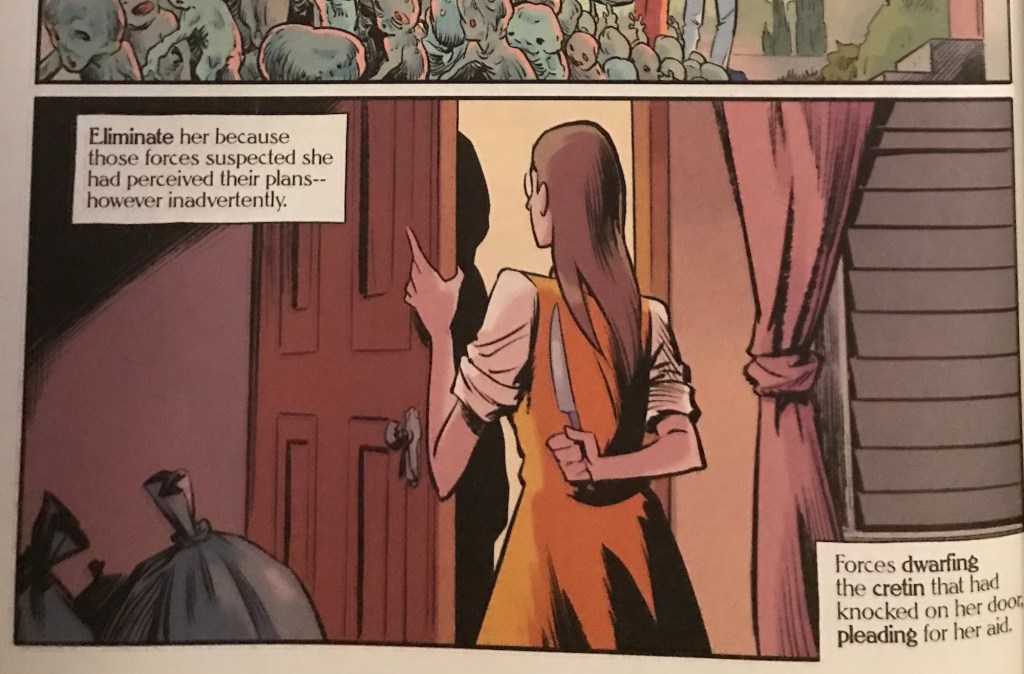
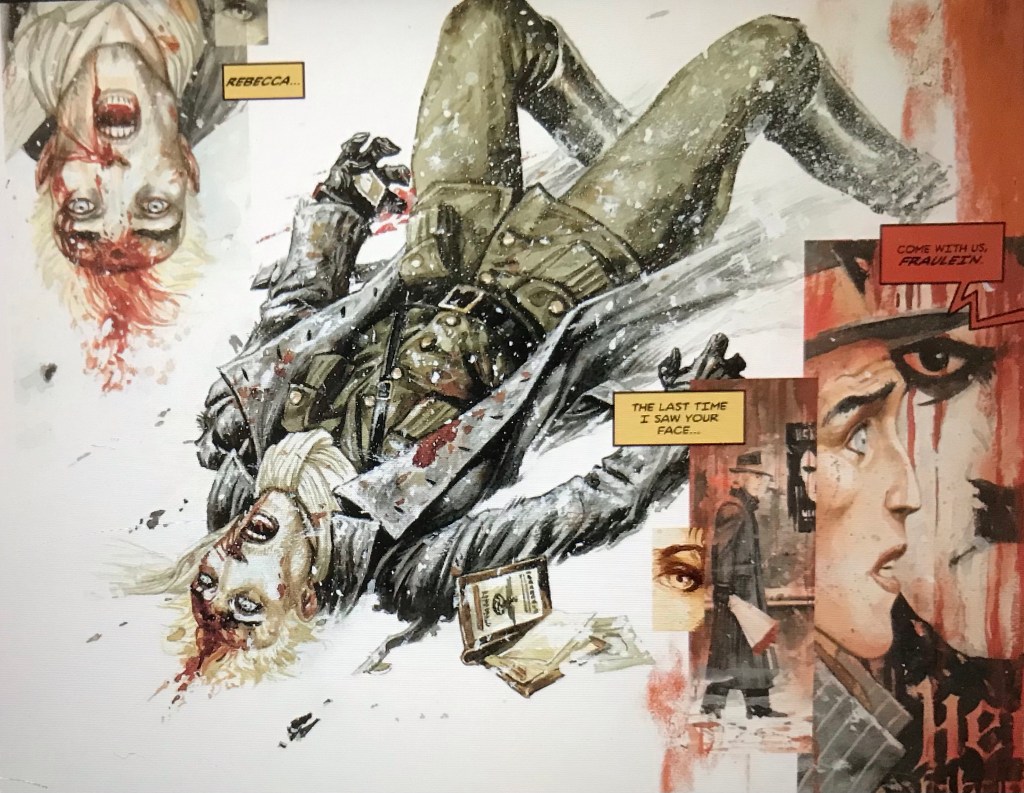
Also cool: it picks up where volume one of Nighmare Country left off with Thessaly. Like, exactly. We even see the Dead Boys version of Nightmare Country‘s last panel: Thessaly, answering a knock at the door, wearing yellow over white, holding a knife behind her back, with a garbage bag visible on the left. Immediately after she allowed Jamie to ask his one question.

Evidently, Thessaly’s involvement in this story is connected to the Madison Flynn drama.

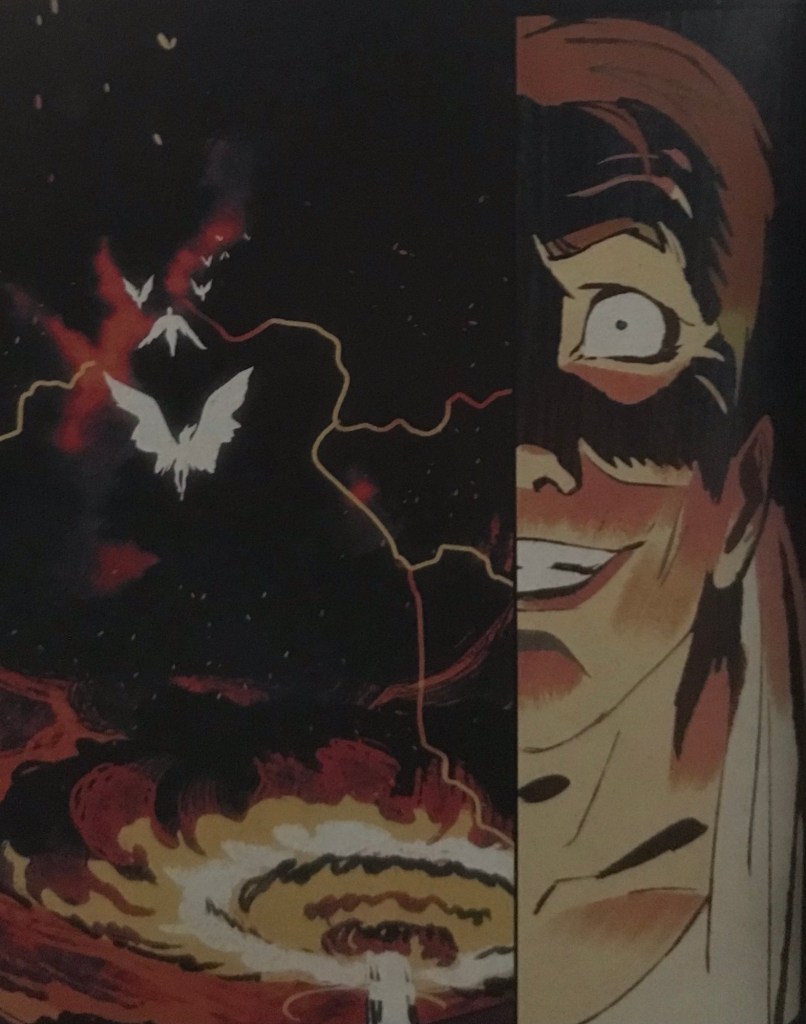
Beings like dream-kind, who are native to a psychic/astral environment, are sensitive to psychic vibrations. Nightmare Country book one ends with Jamie asking Flynn who killed her. They “feel it” when Flynn squeals from beyond the grave and they notice that Jamie was the one who heard her. Hence the spontaineous combustion. While Thessaly is sweeping up Jamie in a dust pan, she begins to think that the deadly gaze that found Jamie could easily have found her as well. Then there’s a knock at the door.

If the connection is that direct, then the brains behind Ecstasy and Agony empowered an amateur magician to take her off of the playing field.

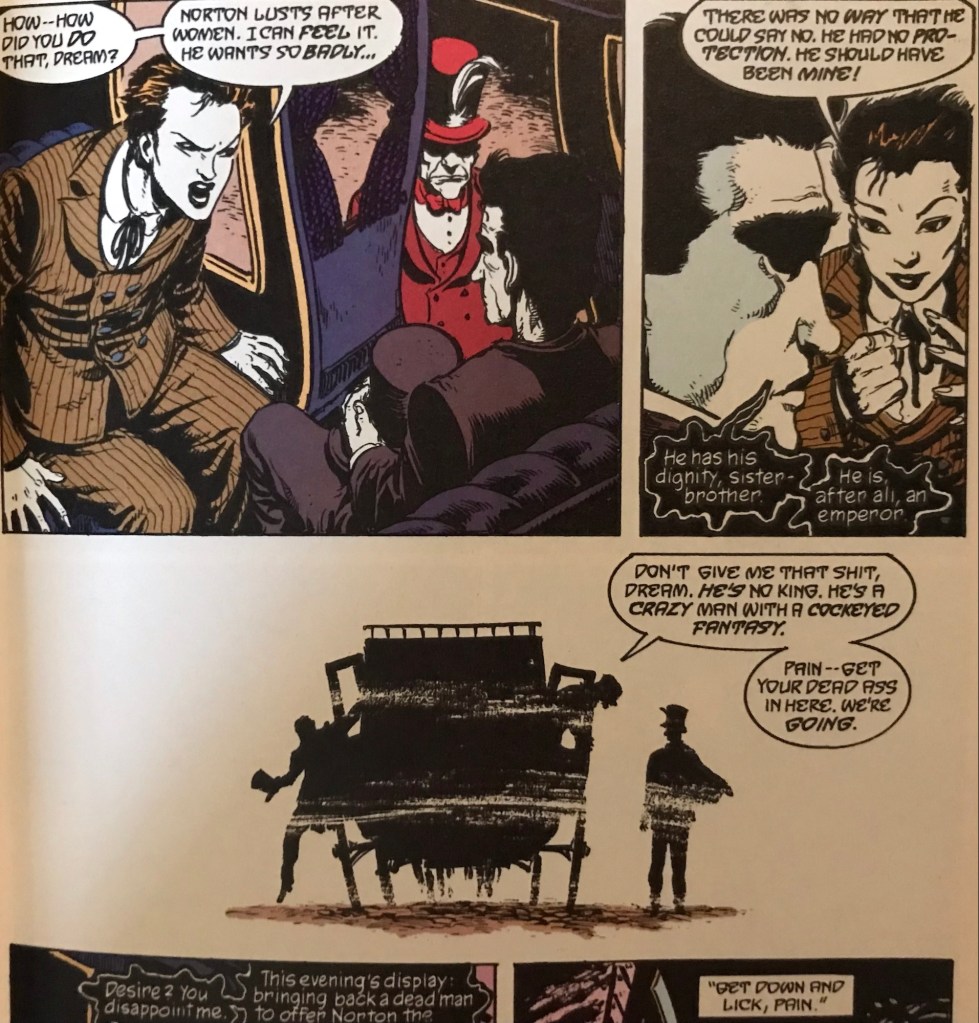
The “cretin” who knocked on Thessaly’s door wanted to resurrect his daughter. Amateur necromancy is extremely precarious and Thessaly refused. So he gets himself a kumanthong collection (kumanthongs being a Thai spirit embodied in a stillborn male fetus painted with varnish and gold leaf).

Kumanthongs derive their power from the innocence of dead babies. They are powerful but they have limits. Swarming a three-thousand year old witch in broad daylight and kidnapping her should be beyond those limits. In this, Thessaly sees the mysterious force that incinerated Jamie.

The grieving Thai father tries his luck with his imperfect understanding of ceremony and superstition. He starts with a collection of kumanthongs which are far more powerful than expected. He then proceeds to hold Thessaly captive and force her cooperation.

The metaphysics of ghosts happen according to different spiritual practices which means there are cultural differences. With the inherent chaos of amateur necromancy combined with the transplanting of a Thai ghost from one place to another, there is a lot of risk involved. The forces that empowered the father to capture Thessaly are maneuvered into a committed position: Thessaly cannot oppose them directly but she can take advantage of the role they chose, in the father’s necromancy. What’s more: the necromantic spell wants to stay active.

The kumanthongs and the binding circle they form around Thessaly are empowered by outside forces. She effectively harnesses the momentum of those forces.

Variant cover by Alex Eckman Lawn for The Sandman Universe: Dead Boy Detectives #5

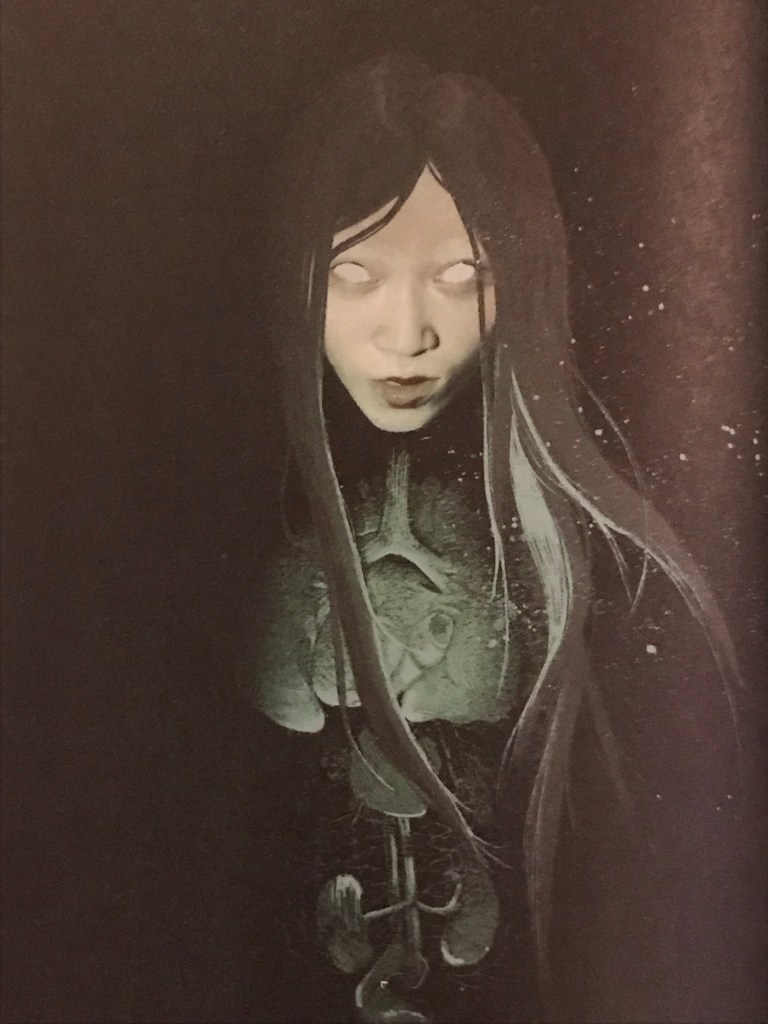
The man’s daughter returns as a krasue: a dangerous, nocturnal Thai ghost. The krasue’s head separates from her body at night to hunt victims, organs hanging from the neck. The narration tells us that the krasue is “the most savage, terrifying, and vengeful ghost of all.” During the day, she “lives as normal.” For a grieving parent, half of a reunion is better than none at all.

Because the kumanthongs are compelling Thessaly’s participation and containing her, they are something of a foundation stone for the whole spell. Which means the outside influence that made them stronger also empowers the spell and its consequences.

Since ghosts are shaped by mortal beliefs and practices, Paine and Rowland appear to have a unique asset that they take for granted: the ghost roads.

To the other ghosts, the boys look like they can teleport at will, anywhere they want. This isn’t wrong but it isn’t the whole picture. When Rowland and Paine do their instant-travel trick, they are moving through something that they call the ghost roads. For the boys, this is little more than a brief in-between state while travelling in spirit form. To the Thai ghosts who eventually follow them through it, it’s gruesome to the point that they prefer to close their eyes and be led by Paine and Rowland.

This mode of travel is usually reliable except for a few moments in the new Dead Boy Detectives when they are jerked to a separate destination, without warning.

The ghost roads, for those who linger long enough to take it in, are a panorama of ghosts, melted together into the surrounding landscape, forever monologueing about the memories of their living agony. A longtime Sandman reader may be tempted to compare this to the suicide forest, glimpsed briefly in Hell, until another connection is made plain.

A kumanthong in its “ghost road” state

The faces of the suffering ghosts, embedded in the landscape of the ghost roads, all look something like this. The first time we see such a face separate from the ghost roads, their body shape looks a lot like the kumanthongs. Specifically: the state the kumanthongs were in when they abducted Thessaly. This absolutely matters but consider the word choice in the panel above: among the Endless, isn’t there someone who knows suffering, inside and out? Whose mind frequently returns to the imagery of a pierced eyeball?

If the kumanthongs are the foundation for the botched resurrection spell…and if they can snatch Rowland and Paine directly from the ghost roads…could this tell us anything about the mysterious, external force that caught Thessaly off guard?

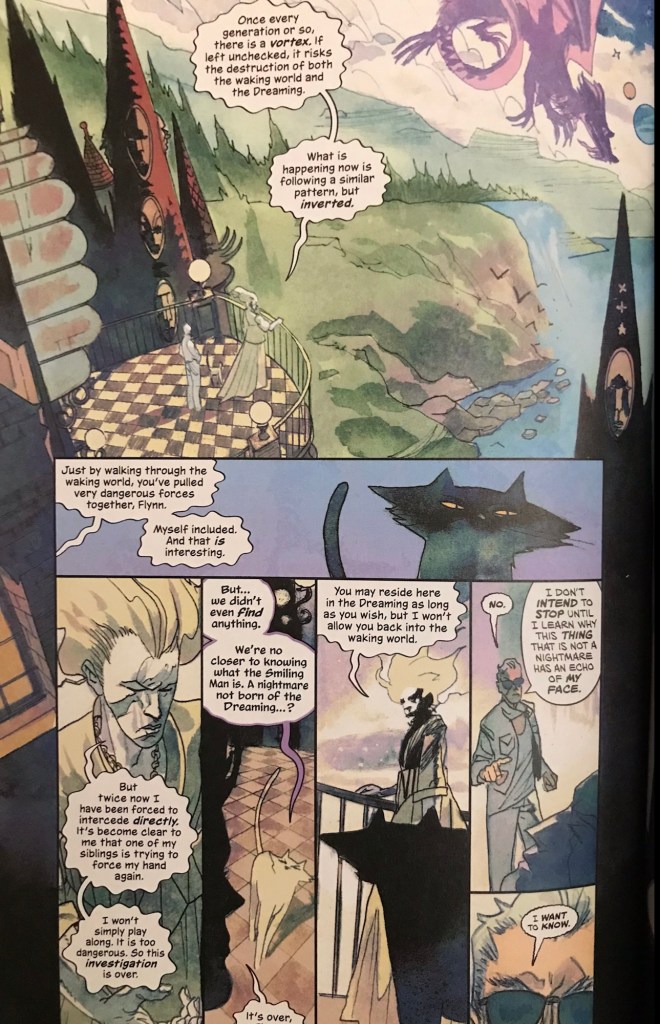
If this force was connected with Despair of The Endless, then it would line up with the role Desire played in Nightmare Country. Desire and Despair are frequent collaborators, after all, not to mention twins. If Desire and hir thralls are the “operators” then maybe Despair is the “backup.”

Speaking of Nightmare Country– the Corinthian keeps a notebook filled with his favorite memory-fragments from his first life. One of his favorites involves a mirror, rather like the mirrors that surround Despair in her own realm. If Desire’s servants (Ecstasy and Agony) are systematically killing the would-be authors of works about the Corinthian, it looks even more like the Corinthian is attached to some middle-ground between the machinations of the Endless twins. The Corinthian, by the way, was one of Morpheus’ favorite creations because he functions as a ‘dark mirror’ for humanity.

The Nightmare Country version of a scene glimpsed in one of Despair’s mirrors in ‘Brief Lives’
Or not…? This is the image from ‘Brief Lives.’ The hair is different, they’re wearing a shirt and they have a fork. No evidence of Corinthian features either but teeth eyes can slip through in a background detail like this.
The figure in this image appears to have gouged one eye out, which has at least a passing resemblance to the boy feeding his fingers to his eyes.
Maybe the visual similarities are closer to a reference rather than a direct connection. I wouldn’t be surprised if Nightmare Country was going for an uncanny resemblance

As cool as this is, though, another aspect of Despair is more relevant to the current Dead Boy Detectives story. Whenever anyone looks into a mirror in a state of despair, their reflection is visible in Despair’s realm, who looks back at them. In the total alienation of despair, all you have is yourself and despair has a way of diminishing even that. Despair warps your self-image and her cold gaze is the only one looking out at you from the mirror.

Even the symbolism of the kumanthongs relate to this: stillborn fetuses, painted gold, their innocence ceremonially bottled for later use. They derive their strength, in part, from the pure simplicity of that innocence. Such power, though, is not easy to wield. It is very simple and its momentum is unidirectional. Such is the power of a permanent, unchanging state of being.

Dom, a psychic who briefly cares for the Thai ghosts appearing in the wake of the spell, thinks something similar. He believes that these ghosts are especially vulnerable because they are children. In his mental narration, their innocence was “cut short”, like stunted beings for whom change is death.

Both Rowland and Paine have been children for decades. Paine only recently cleared his first century. When Rowland falls for a living friend, though, he begins to realize what permanent childhood could mean. Paine sees this as well and believes the solution is to narrow the scale of their activities. What Paine and Rowland have always done together was solve mysteries: that must suffice. The prospect of losing Rowland, though, awakened him to his own discontent with the narrow scale.

Similar frustrations with static existence come through in all of the Thai ghosts but Jai and Melvin stuck with me, in particular. Jai believes her parents moved to America to pursue shallow and mistaken values, which she equates with a generalized tendency of adults to accept comfort over thriving. She fears this, more than anything. Melvin, a loud chlid whose short life taught him the defensive value of a big personality, is perpetually haunted by stereotype threat. When faced with his own despair, he protects himself with fury and a drive toward retribution.

Like the kumanthongs, the energy of despair is unidirectional and gravitates toward itself. More than anything else, despair tempts you with the illusion of inevitability. Not unlike the magnetism between Hell and Hellions, in ‘Season Of Mists’. This dynamic and the realizaiton that you don’t have to stay anywhere (or remain in the same state) forever is the emotional core of this book, which is one thing that I do not want to spoil.

The Sandman Universe: Nightmare Country, volume 1 review (heavy spoiler warning)

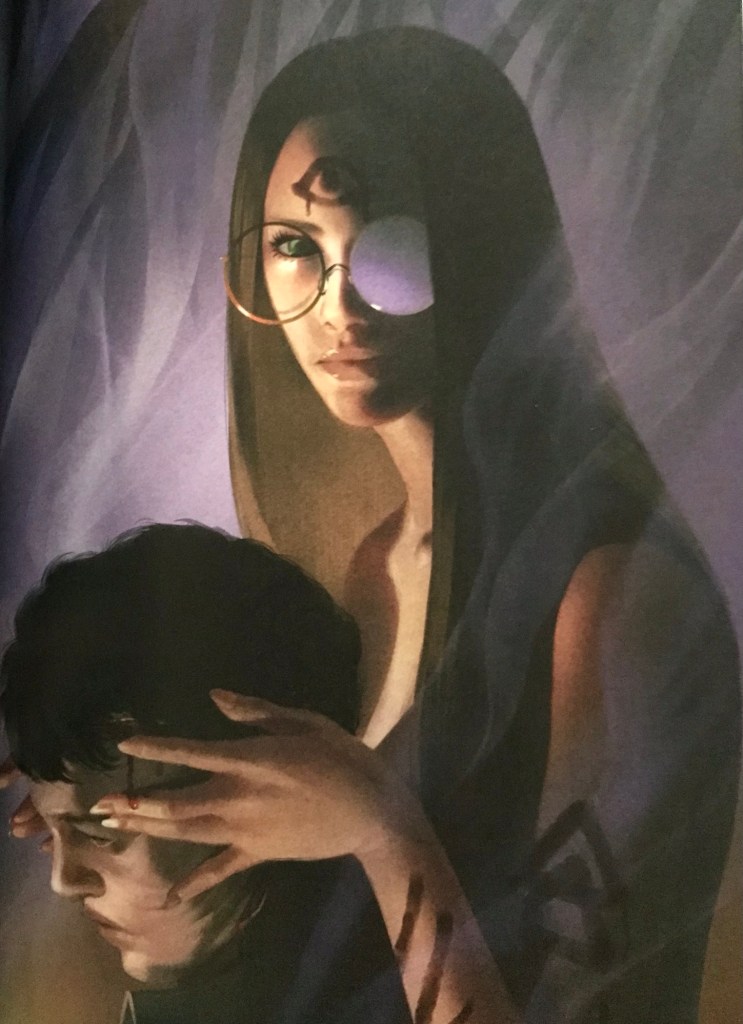
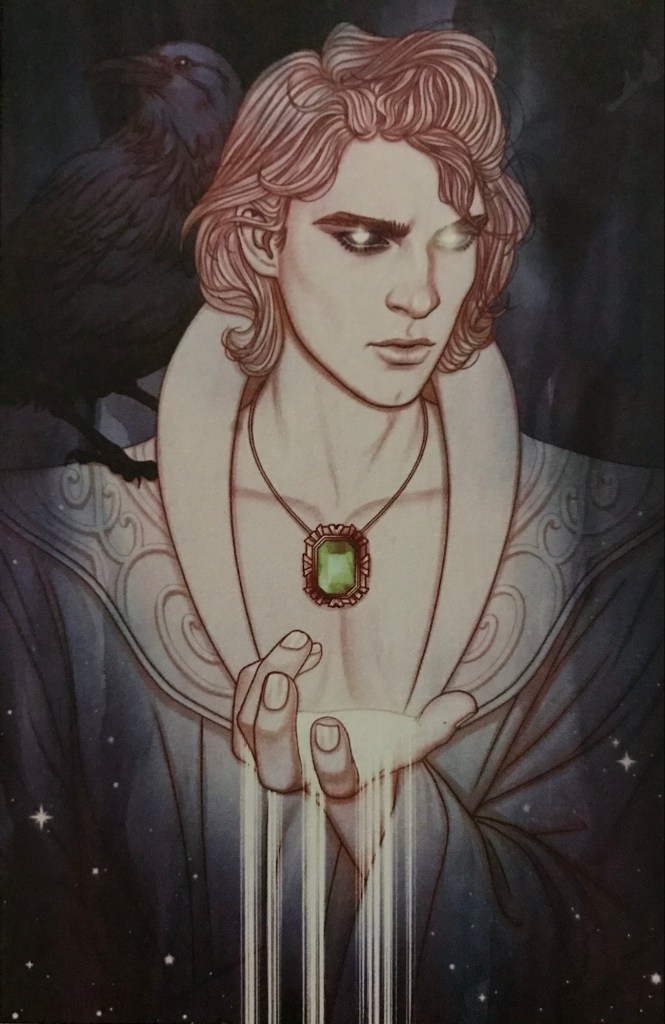
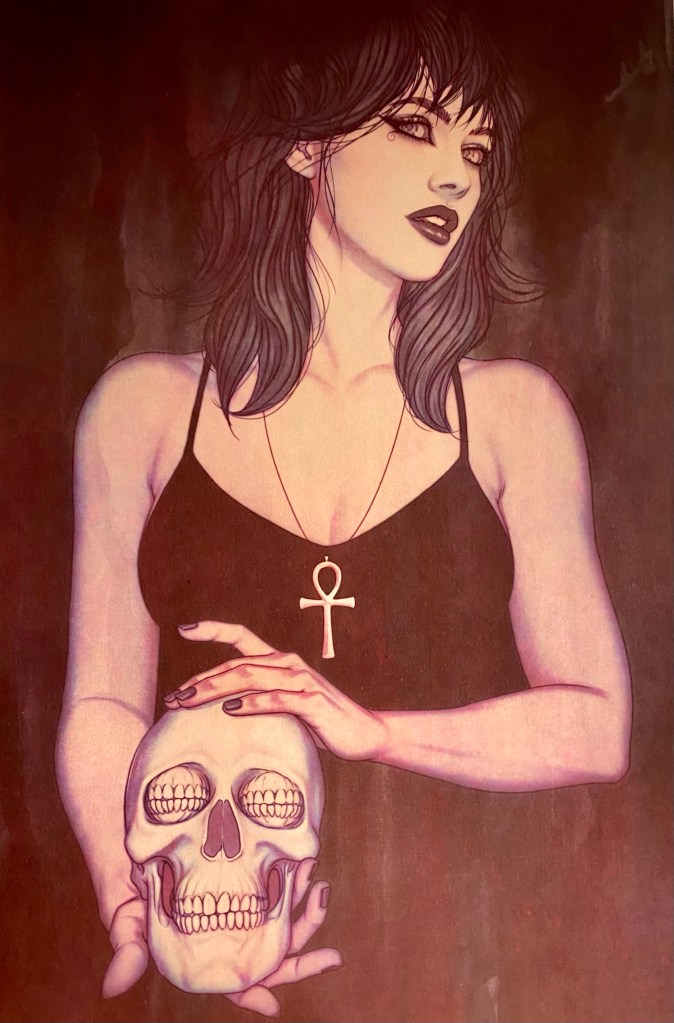
Mini-print of Death holding Corinthian’s skull by Jenny Frison ♥️ (packed into the hardcover edition)

The first volume of Nightmare Country riffs on the old enmity between Dream and Desire. The story turns on a struggle between the wealth of dreams and the desires that furnish their creation. Not unlike the wave-breaks against the Corinthian as he wades into the Shores of Night.

Volume one begins and ends with souls who are tortured by thwarted desire, with a strained relationship with dreams (of any kind).

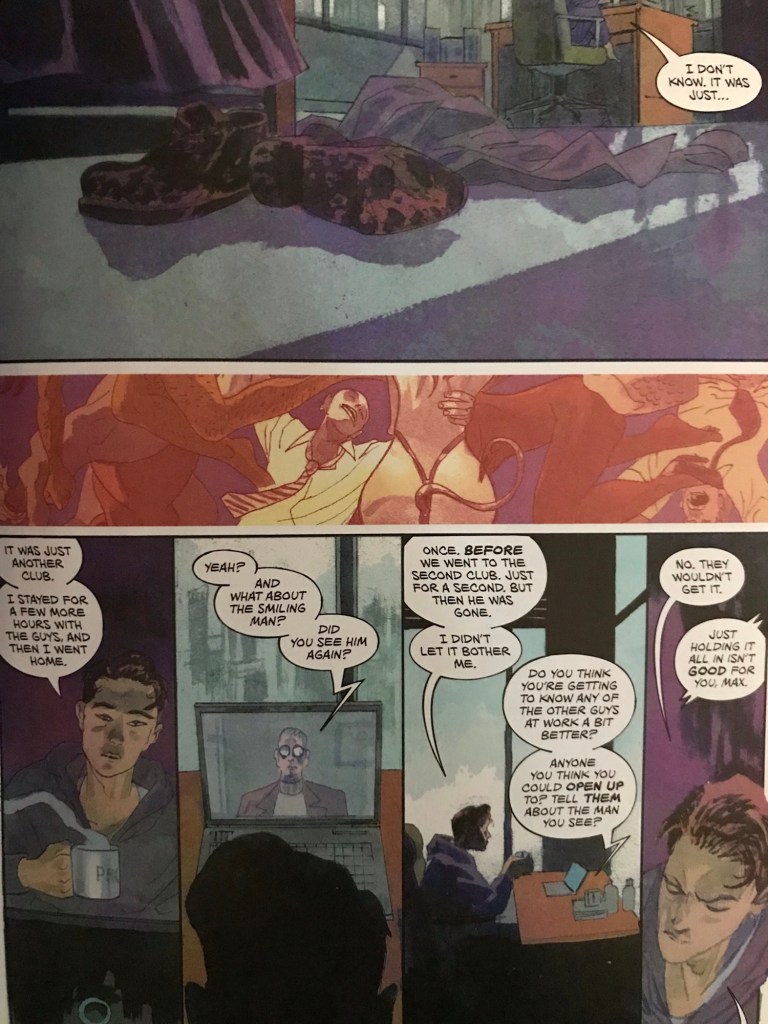
Both of them are presented with mysteries. Madison Flynn is an artist haunted by a persistant hallucination of a large, gelatinous figure with mouths for eyes, which she interprets in various states in her art. Jamie is commissioned to write a screenplay about a mysterious, legendary murder.

Flynn names her mystery the “smiling man” and her interpretations make an impression on one of her flings. Said fling falls asleep at her place and dreams about the pictures. While this is happening, we learn he is a regular victim of the Corinthian in his nightmare state. The usual havoc is about to ensue when the Corinthian notices the pictures.

Jamie’s mystery is a murder victim who turns out to be Flynn. The first one runs its course before our (ahem) eyes. The second mystery is almost immediately noticed by someone else: Thessaly, from the original Sandman, currently living under the name Lamia. Under any name, though, she never suffers obfuscation.

Lamia decides to save Jamie some legwork and channels a necromantic link through which he can speak directly to Flynn. When he asks her how she died, he sees a vision and bursts into flames. A moment before, he saw the eye of Desire bracketed by two uncanny faces: a gimp mask and a mutilated smile that would have been at home in some recent Batman comics. The faces are succeeded by the hook that is Despair’s sigil and a final image of an angel.

Jamie, it seems, is the latest in a number of victims. Taking Lucien’s word for it, Jamie is the sixteenth target in a particular series of attacks.

When Lucien brings it up, though, the body count rests at fourteen. Lucien discovers a book is missing from the Dreaming’s library and tracks it down: in the posession of the Corinthian who is, at that present moment, sitting in a diner with Flynn after finding her in the waking world.

Like a lot of awkward situations, it “wasn’t what it looked like.” The Corinthian was, in fact, talking to Flynn about her paintings and why his face is in them. The activities of the first Corinthian in the waking world, though, give Lucien reason to be vigilent. In his first flawed incarnation, the Corinthian became a menace- a mythic archetype among serial killers who eventually became one. The elder Dream of the Endless, Morpheus, uncreated him. The Corinthian had been a favorite creation of Morpheus, though, so he eventually recreated him taking pains to ensure that the new Corinthian would not have the weaknesses of the old.

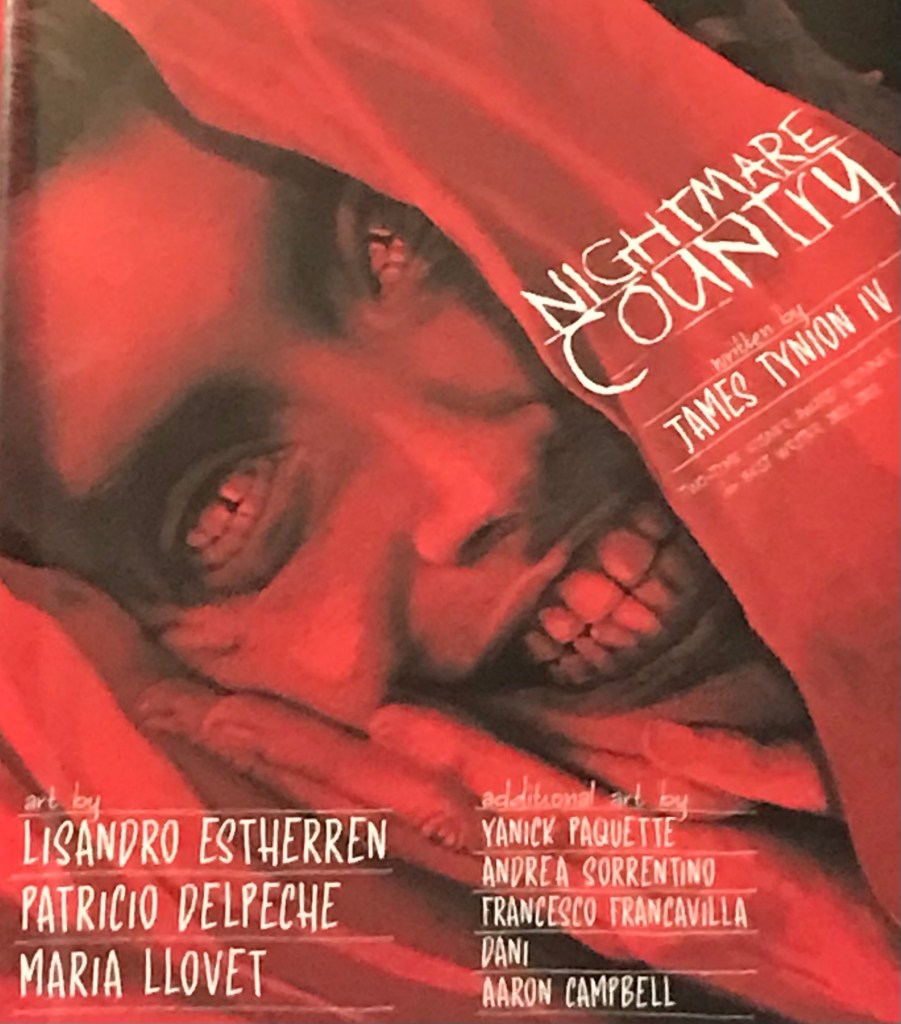
Certain activities in House of Whispers notwithstanding, the younger Corinthian has not pushed boundaries (the boundary around killing humans for fun, anyway). Nonetheless…the whole comic revolves around the fear of his appearance, what with Flynn being our major viewpoint character and her visions of the smiling man. The cover of volume one is the Corinthian’s face with a red filter, all three mouths grinning and bearing their teeth like angry chimps.

In ‘The Kindly Ones’, though, the younger Corinthian goes on a long, eventful fetch-quest that involves rescuing a baby. Morpheus sent Matthew with him but the Corinthian eventually returns alone, bringing the child safely to the Dreaming unsupervised. If this is the nightmare that launched a thousand serial killers, it’s not quite the same nightmare.

As likely as it may have been in the hands of another writer, the Corinthian is not the big bad of this story. Madison Flynn may be the most direct point of empathy for the reader but our perspective is divided largely between Flynn and the Corinthian. They’re basically the two main characters.

A good story does not say everything at once, though, and this is only the first volume. The identity behind the curtain might not even get us very far.

This agency is first seen in the apparent killers of the unwritten Corinthian texts: Mister Ecstasy and Mister Agony, who are quietly followed at all times by the same smiling apparition that haunts Flynn. They are, respectively, also the bearers of the grotesque smile and the gimp mask seen by Jamie before his death.

Although we are never told, explicitly, who is directing Agony and Ecstasy, we do see something happen, after the pair take an early victim. Mister Agony produces a pocket watch, which speaks to him when opened: “Madison Flynn. Age 20. Brooklyn, New York.” Given what we know of Flynn’s inclusion among the unwritten authors of the Corinthian, the equation is clear: Madison is the next author on the list. We know, at least, that the power above Agony and Ecstasy has an awareness of the Dreaming. More specifically- one of its natives.

‘A Hope In Hell’

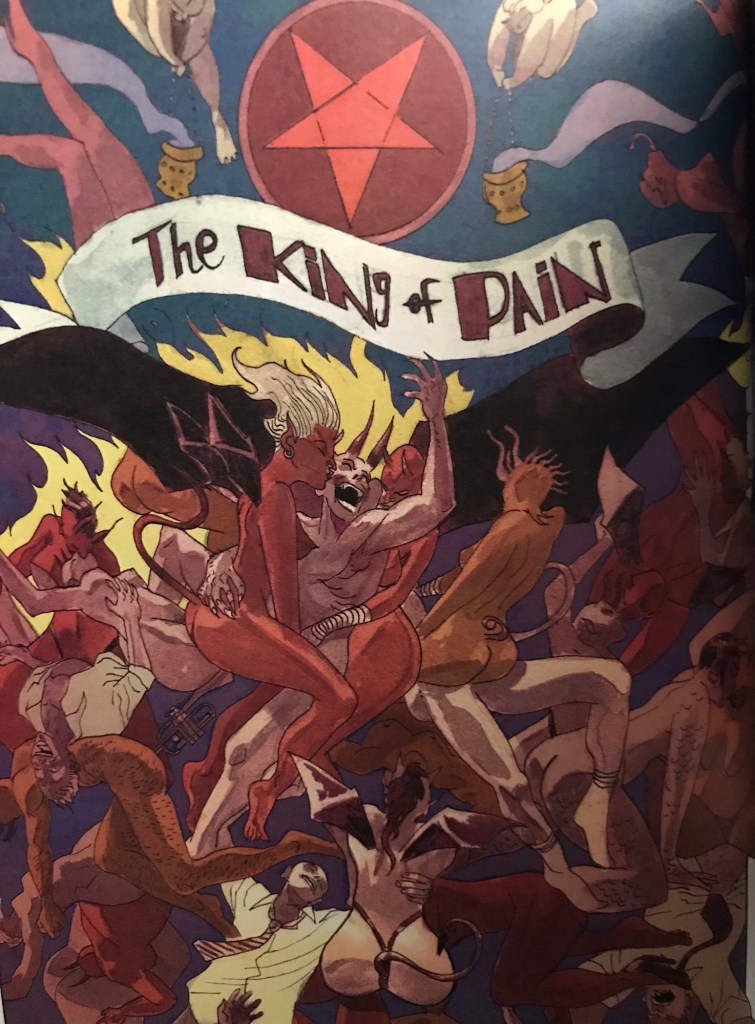
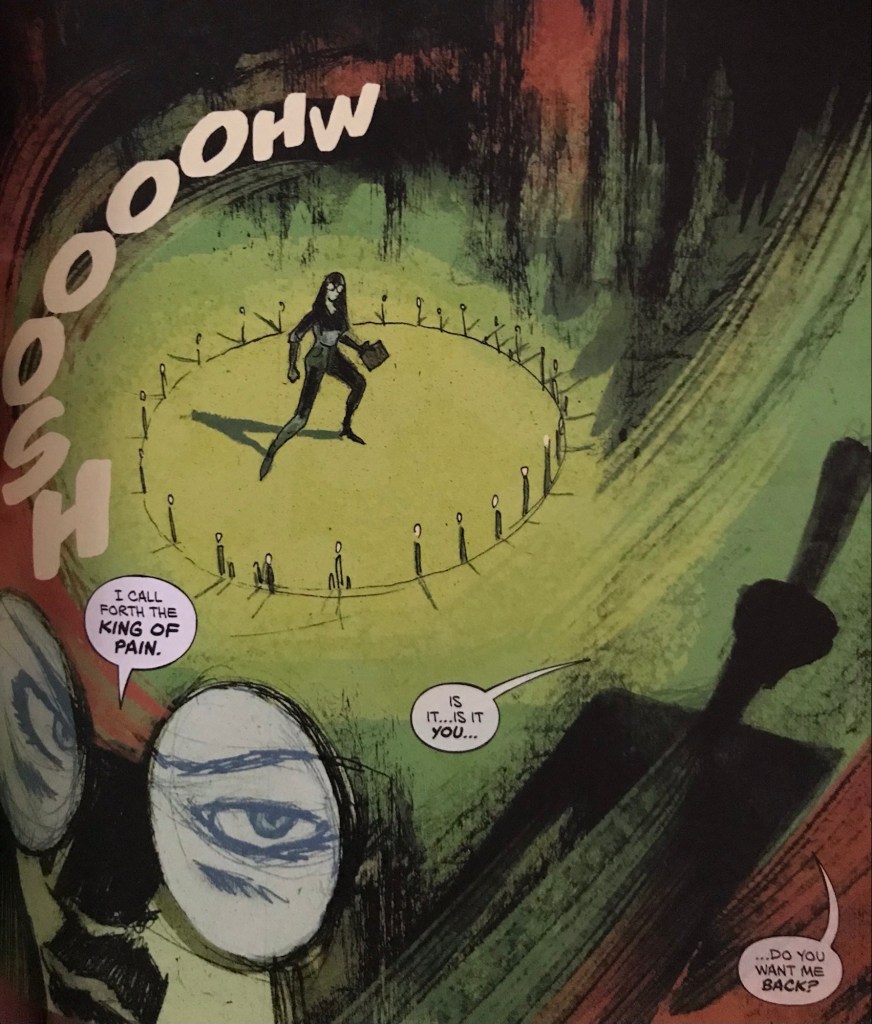
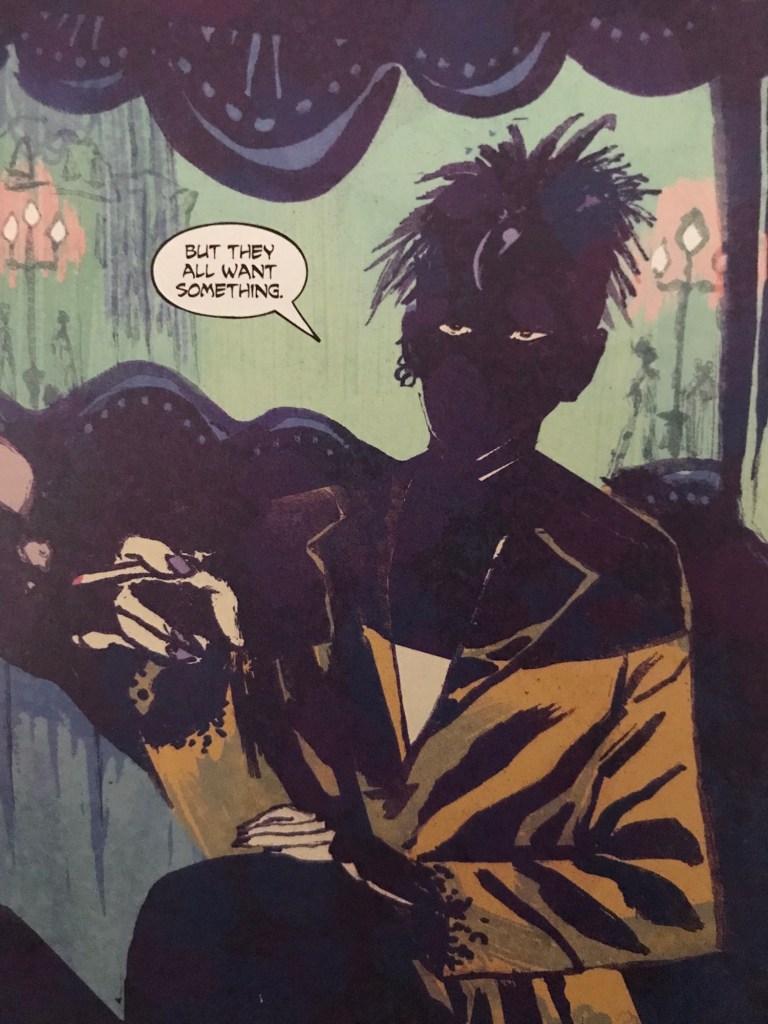
At first, I thought these were the same characters from ‘A Hope In Hell’. Tiny, fey-like demons can be seen during the challenge for Morpheus’s helm, referred to as “the twins”- Ecstasy and Agony. The appearance of an angel seems to confirm an association with Hell…but not for this reason. Daniel recognizes Agony and Ecstasy as “(b)ounty hunters, trained at the Unseen Cathedral”. Shortly, they’re both seen in the Threshold- the throne of Desire, whom they call their “employer”. In ‘Three Septembers And A January’, Desire employs an undead servant called the King of Pain.

‘Three Septembers And A January’

Also in ‘Three Septembers And A January’, the King of Pain began existence as a gambler that committed suicide over his debts. In his reanimated state, he has a frozen smile like Mister Ecstasy. When Daniel is summoned by the Corinthian, he says that the bounty hunters of the Unseen Cathedral used to be human and may, in some way, remain so. Maybe Desire has a pattern of using undead servants.

Let us not forget their third companion- the same “smiling man” that haunts the restless mind of Flynn. Flynn has not dreamed since childhood, which almost creates an association between the smiling man and a sleep-deprivation hallucination. In the world of The Sandman, dream-kind such as gods and nightmares are known to psychically manifest as hallucinations or entities in one’s dreams. If the smiling man is a nightmare or some other dream-kind, then maybe his resemblance to the Corinthian is more than skin-deep.

Even if he is dream-kind, though, he is obviously more aligned with Desire than Dream. And, presumably, to be aligned with Desire is to be aligned with Despair. Despair’s sigil was emphasized, in Jamie’s fatal vision, equally with Desire, hir servants and an ambiguous angel.

Ambiguity is rather the trouble with identifying angels in the Sandman universe. Angels bound to the Silver City have delicate, cursive lettering. The Silver City’s stewards of Hell are known to acquire similiar lettering to Lucifer but not quite the same.

At least, they do in the new Sandman Universe comics. Remiel kept his cursive writing until the end of Gaiman’s Sandman and even into Mike Carey’s Lucifer comics. During the SU Lucifer reboot with Dan Watters, the angel lettering in general began to resemble Lucifer’s.

‘Endless Nights’

I remember, when I first read the original Sandman comics, thinking that Desire and Lucifer had some of the most interesting lettering. I noticed they were similar but- in my mind, at least -they were impossible to confuse with each other. As an adult, I’m less certain. Possibly because the cursive angel lettering got phased out a long time ago. I suspected there was a vague thematic association going on in the Dan Watters Lucifer. Like, maybe Remiel’s lettering is changing because he is becoming acclimated to being the steward of Hell, and therefore more “of” Hell than the Silver City. For whatever reason, though, Lucifer’s lettering hasn’t been completely unique for years and now here we are. During the original Sandman, the lettering of Desire and Lucifer resembled each other but no one else.

‘A Hope In Hell’

Lucifer’s ‘e’ looks like a crescent moon with a line through the middle. Desire’s ‘e’ looks like a backwards 3. ’h’, ‘t’, ‘f’ ‘y’ and ‘a’ are also different. In general, though, Lucifer’s lettering looks like faux-Hebrew and Desire’s lettering is faux-Hellenist. Desire’s lettering also has more resemblances to the typical comic font.

So it looks like the angel in the pages of Nightmare Country could be said to have the post-Watters lettering. Which means that the lettering alone will not tell you which angel. My guess, right now, is that the Nightmare Country angel is an original character.

‘Nightmare Country’

And while the angels, in the SU, are a homogonous group, Desire is one of the Endless. Maybe the post-Watters SU emphasizes Lucifer’s nature as an angel more than his uniqueness. But the lettering of the Endless is always distinctive. If their voices issue from a source with no apparent connection to them, there almost must necessarily be a hidden connection.

Speaking of: Agony and Ecstasy. I hyperfocused on the lettering because it seemed like an avenue that could either confirm or deny the connection to ‘A Hope In Hell’. At the end of the first volume of Nightmare Country, Agony and Ecstasy are revealed to be former humans. Even before then, though, I overlooked an even more fundamental reason why Ecstasy and Agony cannot be demons: they have the same lettering as Dream. The first Dream, meaning Morpheus.

Dream of the Endless is connected to every dreamer and dream-kind but each singularity is not, necessarily, identical to him. Morpheus was also known to “store” his power in enchanted objects. One such stone, an emerald, ends up in the hands of Daniel Hall. Evidently, Dream put enough of himself into the emerald to regenerate his soul, giving us our second Dream. The undead husks of Agony and Ecstasy could be similarly invested. Sandman: Overture reveals that Desire would go at least as far for infiltration and espionage.

The Corinthian’s internal narration in Nightmare Country touches on his faint memories of his earlier existence; his defeat at the hands of Dream, at the serial killer convention. Mention is made of Morpheus’ parting curse: may none of the attendant serial killers ever succeed in ignoring who they are and what they’ve done. His curse was the withdrawal of a dream, exercised by the power of the Dreaming. Perhaps Ecstasy and Agony were once human serial killers who were somehow shaped by that expenditure of dream magic. One cursed by separation from the Dreaming would probably find the perfect outlet by serving Desire. In his mental narration, the Corinthian is also very aware of the differences between the current Dream and the Dream he once knew.

When Jamie asks Flynn who killed her, she reveals five images. Agony, Ecstasy, Desire and the mystery angel. And the sigil of Despair. Come to think of it, the smiling man resembles Despair almost as much as he resembles the Corinthian.

The Sandman Universe: Books of Magic review (spoilers)

I’ll come out and say it: the plot design lacked the finesse of the SU Dreaming and Lucifer and the originality of House of Whispers. But the SU Books of Magic has some of the most memorable character moments in the new Sandman Universe comics, though.

The main standout quality here is the portrayal of stereotype threat. Nearly everyone in Tim Hunter’s life tells him his dormant magic is so powerful that it might be a good idea to cut the universe’s losses and just kill him. This goes back to the very first miniseries which Neil Gaiman completed in 1993. There is even an arc running parallel to Tim Hunter that explores Tim’s genuine potential for destruction as sympathetically as possible.

Like Tim, Ellie is established early in the SU story. The reader gets to know her almost as well as they know Tim. Ellie is joined by two other classmates who are characterized, early on, as one bully and one anxious bystander. I wondered, more than once, if Ellie the teenager is modeled after the adult character from the older Hellblazer comics. If so, I wonder how/if Ellie and the two others (Fatima and Kevin) may factor into the upcoming Hellblazer young adult comics if DC is still committed to that.

As Tim is our main viewpoint character though, the weight of the stereotype threat is expressed largely by what it means for him. In other words: is Tim in fact a ticking time bomb that should be done away with?

The fear of this possibly has oppressed him long enough for Tim’s mind to subconsciously create a mirror image of his conscious good intentions. When this character first appeared, I initially thought it was a version of Tim from another timeline. Multiple timelines have appeared before in this story. If this were an “AU” evil Tim, the plot would probably require a deeper exploration of that timeline later.

That happens, incidentally, but for completely unrelated reasons: “evil Tim” is literally a dream made flesh, born from the fears and dark fantasies that Tim’s mentors engendered with their warnings of what he might become. The problem with possibilities, according to Lucien of the Dreaming, is that too narrow a choice can often be worse than none.

Tim’s future is frequently described to him as a narrow, binary choice: good or evil. The evil part is fleshed out with far more details by those who have been outside of the story’s timeline. One of the first of these people to meet Tim tried to kill him before any of those details materialize. This was a factor in Tim’s earlier decision not to pursue magic, since that choice would stop the “evil future” as surely as his death would. Tim later reversed that decision, though, since his magic is endemic to his being and is no worse than he chooses to be.

Changing your mind is also a thematic big deal which compliments the theme of stereotype threat. While also exacerbating some of the accompanying mysteries. After parting ways with Lucien, Tim encounters Emily Dickinson within the Dreaming. She explains to him that she left precise instructions for her family to burn all of her writing. Instead, her sister re-arranged her poems according to her liking and published them.

Tim understands this to mean that people are only free to interpret your nature and your legacy if you are dead and can no longer speak for yourself to them. He asks Emily if it’s true that, so long as you can think and act autonomously, it is never too late to change your mind. Emily agrees, adding that to be yourself or authentically adopt a commitment is to consciously express it consistently. Almost as soon as this happens, though, we learn that the most consistent antagonists throughout the SU comics and the miniseries are from a reality where this cannot be true of Tim.

The evil cabal of magicians called The Cold Flame is used as a red herring in the original miniseries. (There’s gotta be a pun in that somewhere) During the original miniseries, there were constant hints about the fabulous and chaotic world just outside of Tim’s point of view. This world is separated from Tim by the “trenchcoat brigade” and the lessons they teach. A battle between the trenchcoat brigade and the Cold Flame happens completely off-camera. Later, one of the trenchcoat mages (Mister E) attempts to kill him. This builds tension over whether the danger in that specific story comes from the outside world or Tim’s would-be protectors.

This works for the duration of the opening miniseries but a bigger story would necessarily show more of Tim’s world outside of his bubble. As it turns out, The Cold Flame comes from a timeline where Tim went full supervillain. Stopping him at all costs is the highest possible priority as far as they are concerned. In the third book, they are revealed to be adult, “alternate universe” versions of Ellie, Kevin and Fatima. They time-travelled to the present of the story in order to kill Tim before he can become the apocalyptic nightmare he is in their own world.

From the perspective of The Cold Flame, Tim’s good versus evil dilemma has already been resolved. This echoes the revelation at the end of the miniseries when Phantom Stranger states that Tim already gave explicit consent to learn magic when he agreed to be educated.

On one hand, your consent and commitment are yours to give or withhold no matter what at any time. On the other hand, your consent and commitment are out of your hands and already decided by others. As soon as Tim leaves the company of Emily Dickinson, Tim is abducted by the Dead Boy Detectives and put on trial for his wrongdoings.

With Tim as our main character, his perspective is the one we see the stereotype threat through. So it’s severity is determined by how much credit Tim gives it himself. So, from Tim’s point of view, what are his wrongdoings?

While Tim has not turned the world into a burning hellscape, he has been forced to kill twice in self-defense so far. Since Mister E had already told him a number of horror stories about how evil he’ll become, these incidents haunt Tim. Potentially, with enough fear and self-loathing, they could be seen as definite proof that he is evil.

In volume one, several members of The Cold Flame attack Tim in astral form and Tim levels them with a flick of his screwdriver-wand (between his hair, glasses, owl and magic screwdriver, only one of those was an knowing pop culture reference- the first three were in the original miniseries before Harry Potter was published). In volume two, a proxy of The Cold Flame was about to kill Ellie, Fatima and possibly Dr. Rose before Tim intervened.

This brings us back to the credibility of the stereotype threat and how it’s credibility effects its narrative function. Most of us who do not have antisocial personality disorder would probably need some time to psychologically process killing someone. The normal psychological impact of this experience is exacerbated by the messages Tim has received about being inherently evil. The normal mental hardship of killing is turned into a crisis in which Tim wonders if his accusers have been right all along regardless of his actual decisions.

Luckily, the bodies of the astral warriors are still biologically alive which means their souls can simply be “re-tethered” which Tim has a chance to do. This is what brings Ellie around to wondering if Tim actually is the world-ending menace her future self says he is. The insistence of the other accusers beyond this point convinces Ellie that they’re disingenuous which makes her abandon them altogether.

By the end of the story, all of the main characters have come around to Lucien’s point of view: a given range of possibilities is often limiting because such a range can bait ones’ mind into thinking there are no lateral, “third” options.

The risk of binary perspectives is pointed out several times. One of the starker examples of this happens in the garden of Destiny of The Endless. The last and most powerful of the eponymous books of magic to be gathered is the Book of Possibilities. And it can basically hack Destiny’s book.

This gave me a little bit of pause. The book of Destiny is basically the script for all of space and time- all alternate timelines, every hypothetical or imaginary event, literally everything. The beings and events that defy Destiny’s book in the original Sandman are singled out as startlingly unique, like the triple-goddess form of the Kindly Ones spontaneously appearing to herald the departure of Lucifer. Or even Delirium knowing more about her origins than Destiny himself.

The exceptions to Destiny’s surveyance stood out in the original Sandman. I get that the Book of Possibilities is supposed to be a crazy powerful object. But when an exception is used to signify how special something is…you probably shouldn’t wear out a single, specific standard of exception. It doesn’t break any suspension of disbelief or anything, but it is an unfortunate eyesore.

Getting back to binary versus lateral, the Book of Possibilities basically generates extra paths in Destiny’s garden on demand. And Ellie is the first character we see use the Book of Possibilities within Destiny’s garden. This serves to emphasize the importance of her changing opinion of Tim. But that’s not the only thing that it effects.

Like the role John Constantine and Dr. Rose play in the thematic treatment of binary-defiance. Before handing over one of the books of Magic to Tim, John Constantine elects to put Tim through a reliability test. There are multiple moving parts in this scene but one particular detail serves for our purposes: Tim is required, by a “demon” of impartiality, to sort different uses of magic into general good and bad categories. They soon stop being clear choices between good and bad and become choices between two equally bad events. Tim elects simply to attack the demon and end the charade.

This mirrors the event in Destiny’s garden with Ellie almost exactly, minus the actual Book of Possibilities. The placement of the “sorting” test makes it appear to be foreshadowing which just adds even more build-up to the revelatory use of the Book of Possibilities. This just brings us back to the exceptions to the scope of Destiny’s book being overused, though.

I realize that reading the original Sandman repeatedly for years might not be the frame of reference the SU writers intended, though. The four modern SU stories are supposed to be set within the world of The Sandman, not be an actual continuation. Kat Howard may have plotted this story with nothing else in mind other than the original Books of Magic miniseries. But between Tim exploring the Dreaming and the appearance of Destiny, it really starts to feel like A Game of You, in which the Endless are present but Morpheus/Daniel is not the main character(or barely, in A Game of You). Which makes the over-use of certain tropes hard to overlook.

Both John Constantine and Dr. Rose are interrogated multiple times by different characters for being both committed to Tim’s protection and prepared to kill him if necessary. This implicitly threads the binary-transcendence theme through the story from the beginning. Constantine walks all the way up to that line (remember the moving parts I mentioned?) but doesn’t cross it.

Rose, realizing she has to briefly assume the appearance of going on the offensive against Tim, takes another route to the party. If you’ve read either the opening miniseries or my post about it, you’ll remember that Dr. Occult transforms into a female alter-ego called Dr. Rose when she enters Faerie. During her brief ruse, she assumes her Dr. Occult identity. This moment enables Tim to play an instrumental part in Ellie’s perspective change.

In the SU Books of Magic, Dr. Occult exists almost exclusively as Dr. Rose and only assumes her male identity under specific pressure.

On that subject, I gotta mention how happy I am with Dr. Rose in general. I’m a trans lady so I would be a little sensitive to this, but it really, really looks like Dr. Rose is a trans lady. She even seems to refer to her Dr. Occult alter-ego as something separate from her but with specialized, limited use (“I’ll have to slip into someone less comfortable”).

Granted, using the apparent gender-swap as a last- minute plot device is a bit cringe, but it is portrayed as a temporary magic transformation. As in, a short-lived event, and it doesn’t tell us anything we don’t already know from context. Basically, it looks like her main, long term preference is Dr. Rose, and it’s played for zero laughs, gross-out moments or cheap pathos. That may be a low bar but honestly that’s where we’re at with trans inclusion.

Another character event I appreciated: seeing John Constantine be morally ambiguous for the first time. I’ve never actually read a Hellblazer comic so my knowledge of Constantine comes from The Sandman, the recent SU comics and the 2005 movie. In the movie, Keanu Reeves tried really hard to portray a morally indifferent character who does good things almost on accident. In The Sandman and the new SU stuff, Constantine barely has enough time in the foreground to show any range. So this was my first time seeing Constantine actually grapple with anything.

I also liked how much Howard committed to the stereotype threat/imposter syndrome theme. With a lot of fan communities, you gotta watch how you portray that. For some readers, a character voicing a belief is enough for it to appear canonical. Stereotype threat or imposter syndrome is most readily visible when multiple characters have clashing perspectives and there are clear reasons for both sides of the “disagreement” to have strong, emotional motivations. Then again, a lot of the cool narrative conflicts are conflicts of conviction, so good job Howard.

Let’s read Requiem: Vampire Knight! (Part 1)

I first read this comic as a teenager, when Heavy Metal magazine serialized the first English translation. This had to have been around 2004 and my dad and I had been bonding over our shared love of Stephen King and Anne Rice. Having gone through most of his vampire movie library together, a French vampire comic was a natural next step.

The cosmology was particularly interesting to me. Much of the story takes place in Hell, which is outside of space and time. For perspective, only living, three-dimensional, physical creatures are subject to linear time with a past, present and future. Once you are liberated from three-dimensional existence after death, the cosmology of this comic implies that your soul is also free from linear time.

In the place sometimes called Hell by its inhabitants (which is also known by some as Resurrection), all time is simultaneous. There are dimensional ruptures between different timelines, though, so a fragment from Earth at any point from multiple histories might manifest. To say nothing of the fact that all souls bound for Resurrection from any timeline enter Resurrection during its own “present”, which is separate from all other timelines.

Hopefully that wasn’t too garbled. Upon transmigrating to Resurrection, a soul will enter the care of a psychopomp called Lord Cryptos. Cryptos will put these souls through anguishing preparation which can actually cause them to vanish, never to enter a body again. Those souls who “graduate” from Cryptos’ “training” may assume the body of a few different supernatural beings. Those guilty of deliberate evil with little or no hypocrisy in their minds become vampires. Those who do so with hypocrisy become ghouls.

In the independent “timeline” of Resurrection, the flow of time is said to run backward. Whether this is literally true is not clear but it seems possible: vampires age backwards into infancy and after that their souls either disappear or transmigrate elsewhere. At the same time, the monarchy of Resurrection has many laws and traditions that enforce a backwards time-flow as a moral value. Having only read a little bit past where I did when I was fourteen, it could also be both for all I know.

Mention is made of an ethic called obscuritantism, which requires its’ adherents to consume something called Black Opium that suppresses memories of their mortal lifetimes. The vampires of Resurrection equate the obliteration of your past, mortal identity with the authenticity of your undead identity. On the other hand, ghouls frequently talk amongst themselves of their past lives and are reviled by vampires.

There is also a professional caste called archeologists who are tasked with burying the fragments of Earth that materialize through the dimensional rifts. They may selectively scavenge for technology or resources for the monarchy. In the absence of any wider context for the backward time-flow, the decay of the Earth fragments from the rifts looks like it…is just the archeologists burying stuff. Like, that aspect of the time-flow is enforced by the archeologists.

Since few fantasy stories reveal everything about their cosmologies up front, the gray areas between cosmic “rules” and the taboos of Resurrection’s vampire nation are ripe for tension-building. At this point (just after volume 3) it feels like it’s worth paying attention to the stated motives of those arrayed against the vampire nobility.

More to follow in two or three more posts

The Books of Magic review (light spoilers)

The collected edition of Neil Gaiman’s opening run on The Books of Magic is one of the most unconventional comics I’ve ever read. While plot construction is one of Gaiman’s strengths, this story does not rely on it much.

Or at least…it doesn’t rely on plot the way most stories do. Lots of stuff happens off camera. The central narrative details the education of a young boy named Timothy Hunter. Timothy has the potential to become the greatest magician of the current age and is taken in hand by DC/Vertigo’s “trenchcoat brigade”: John Constantine, Doctor Occult, Mister E and Phantom Stranger. While Tim is receiving all these words of wisdom, other characters are frequently rushing around doing other things.

Major characterization details are hinted at more than they are shown. With a bit of context this can be overlooked: Neil Gaiman wrote these comics when he was commissioned to do an ensemble story for DC featuring all of their occult characters. The four volumes anthologized in the collected edition were also meant to be a frame work that later stories would spring from. Meaning that Neil’s chief obligation to DC & Vertigo was to establish that a bunch of characters exist in the same universe so other writers could craft stories about them interacting with each other.

So, of course, many of those implied character beats are meant to be callbacks or references for the benefit of readers already familiar with the source materials. Neil Gaiman also took the opportunity to introduce several original characters besides Tim Hunter. One of them, Mister E, has a naming scheme that makes him fit in with the likes of Dr. Occult and Phantom Stranger. He’s a Neil Gaiman creation designed to fit into the overall DC occult universe. If you’re like me and you’re learning about many of these characters for the first time, it’s easy to assume Mister E is another pre-existing character.

Neil Gaiman cannot resist an opportunity to throw a wild card into situations where you are tempted to assume you know what is going on. With this in mind, the subtle introduction of Mister E has got to be intentional.

Another interesting original: Glory. The first time I ever heard of that character was in Sandman: Overture in 2013. The Books of Magic miniseries was first anthologized as a trade paperback book in 1993 though. In retrospect, it lines up: Neil Gaiman has said that he was thinking of the plot of Overture since the early nineties. He originally planned to publish the story that would become Overture as part of the original Sandman run. Even so…it’s a little hard not to be gobsmacked by that character’s appearance in an early nineties comic. For me, anyway.

Comic franchises like DC doing crossover ensemble stories have long been par for the course. When I say that The Books of Magic is one of the most unconventional comics I ever read, I mean the relationship between it’s stated subject matter and it’s script. Most of Timothy’s would-be mentors attempt to shelter and educate him. Tension mounts when Tim is not sheltered and instead learns firsthand. This, in turn, forms a response to the lectures.

Speaking of the lectures…consider the various qualities they attribute to magic. The lessons of Phantom Stranger and Mister E are the furthest from waking, physical life. The lessons of Constantine and Dr. Occult are the closest. Phantom Stranger and Mister E discuss universal generalities of time and space which relate to magic. Constantine and Dr. Occult discuss magic in terms of it’s accessibility from waking existence. The generalities often have smaller details which are consistent with the more specific lessons.

While traveling with John Constantine, Timothy meets magicians who reside in the physical world who discuss their magic in words that have double meanings that can just as easily be true of our reality. Upon arriving in America, Constantine says that, as a boy in England, the comics he read made America sound like a fantasy land. All America was to him as a child was a world where a lot of colorful, larger than life characters were- and also where he was not. As I read that I was reminded of the Atlantis vignette from the lesson of Phantom Stranger.

The Atlantean magician says that Atlantis itself is a symbol of the art (meaning magic). All interactions with Atlantis are with emanations of the original- not the original itself. Later, in the company of Dr. Occult (who occasionally transforms into a female alter ego named Rose), Timothy travels through Faerie, the Dreaming, Hell and a cave where dwells a bard singing songs about a mythic king who sleeps beneath all countries. This could be Heinrich Barbarossa, King Arthur, the Roman Emperor Julian, King Solomon or any other living king that passed into the myths of people who dreamt of their return.

The magical countries of Faerie, Hell, the Dreaming, Atlantis and America are all alternatives to physical reality that provide the opportunity for genuine change to manifest. Many of the magicians residing in the physical world that Timothy encounters have rather simplistic ways of “clipping out of bounds.” Zatana and her father (two of the pre-existing DC characters) discovered magic while talking backwards. Madame Xanadu, another established DC character, begins simply with a Tarot reading. She freely admits that the Tarot symbols could be interpreted on any number of symbolic levels or literally.

This all pops when Timothy and Constantine visit a magician who wants nothing more to do with the practice of magic and insists that anything else is a better use of time and effort.

Magic, for Baron Winter, is everything outside of reality. Atlantis and the fantasy realms of divergence are paths outside of reality that begin with imaginary contrast or re-interpretation. Earlier, with Phantom Stranger, Timothy’s encounter with the Atlantean magician is situated between the distant beginnings of the universe and the birth of human myth, rather like a link between them.

Anyone else think that there’s no way that isn’t the same Hamnet from the Midsummer Night’s Dream story in The Sandman?

It really starts to look like that when these characters are discussing magic they’re actually talking about imagination. However I don’t think The Books of Magic is a narrative treatise in the same way that Promethea is. Yet it is difficult to look past the prominent dialogue. Dialogue (or just someone talking to you without an answer) is a way of directing attention. While Tim is being lectured by Earth-dwelling magicians, a clash between the trenchcoat brigade and the evil magic cabal known as the Cold Flame happens elsewhere. One character in particular is reputed to have fought valiantly in Timothy’s defense. Later, when Tim is alone with him, he’s rather less protective. Details like that draw your attention to what is stated to Timothy versus what he directly observes.

Yes this relates to a plot point and the pay-off at the ending is realizing what happened much earlier while your attention was directed elsewhere. Come to think of it, I think there’s a word for a kind of stage performance you do where you carefully control the audience’s attention so you can do cool things in their blind spots that they don’t notice til later. Involves cutting people in half and rabbits in hats. Cain took a run at it in Season of Mists.

I’ve been light on spoilers so far but now I’m gonna get into some speculation that could spoil some stuff, in case you’d rather not know.

That this was written near the inception of the original Sandman comics appears significant. I have not yet read any of the following Books of Magic comics after this point that were not written by Gaiman. I do have the three recent Books of Magic collected editions from the Sandman Universe run, though, so I’ll probably review those sooner or later. I have also been meaning to review the SU House of Whispers comics but they’re just so dense that I think I better re-read them first.

Back on topic though: Gaiman said that the story that would eventually become The Sandman: Overture was in his head in the early nineties. He also originally intended to publish it within the original Sandman series. The appearance of Glory at Faerie in Books of Magic resembles what might be some early groundwork he was laying for his original Overture plan. The idea of the Gemworld, introduced in Books of Magic, could also tie into that.

Early in Overture, we see all manifestations of Dream, from the eyes of all who have seen him, all interact with each other. It at least seems possible that, along with the “emanation” metaphysics, those different facets are also intertwined with his soul. When Timothy encounters the Gemworld and the regions beyond it with Mister E, mention is made of diverse timelines and how they cluster in matrices of probability. Overture is the only other story within the world of The Sandman that also prominently features different timelines. Mister E also points out, in their journey through future timelines, a cancerous god whose soul forms a hive mind with his followers. I think this sounds like the mad star who became a dream vortex in Overture.

I don’t think I’m ready to commit to the theory that Mister E showed Timothy the foreclosed timeline of Overture but it sorta looks like it. This then leaves us with the conundrum of the mundane egg which also plays a role in the later Sandman Universe stories.

SU Lucifer, volume 4 (spoilers)

This book feels a lot like an epilogue, with the prior volume (The Wild Hunt) being the actual “final chapter” with Lucifer as a main character.

In addition to feeling much like a concluding volume, there is also the matter of the Bleeding Cool article from last August. There it was stated that most of the new Sandman Universe comics were being discontinued, in particular House of Whispers, The Dreaming and Lucifer. The Wild Hunt arc, it seems, is the last of the run to be serialized as individual comics. The fourth story, The Devil at Heart, was published as a single graphic novel along with the three other collected editions.

At the end of The Wild Hunt, Lucifer attempted to thwart a prophecy that would compel him to return to Hell. The prophecy stipulated that Lucifer’s destiny would turn on whether or not he was supplanted as the one who calls and leads the Wild Hunt.

(The Wild Hunt, for clarity, was a magical/ceremonial expulsion of destructive yearning from the universe’s collective subconscious. The Hunted God was the target of this purging and destined to reincarnate forever so that the leeching can continue in each generation)

Lucifer, as the leader of the Hunt, whittled the soul of the Hunted God until it could no longer be perceived in future reincarnations. Lucifer then lost interest and the four permanent, primeval hunters were left dormant until roused by Odin. Lucifer would be supplanted if Odin, as the leader of the Hunt, stopped the heart of the Hunted God. Odin succeeded but, at the last moment, Lucifer replaced the dying heart of the Hunted God with his own, immortal heart.

This did not work the way Lucifer intended. We might speculate about the specifics of why. The most probable implication within the text of both The Wild Hunt and The Devil at Heart, is that Lucifer’s heart-switch was either too late or that the heart-switch itself finished the work of killing the Hunted God.

Lucifer, being the type-A perfectionist he is, will neither return to Hell nor admit defeat. His plan for remaining a step ahead is to invade the garden of Destiny of The Endless and remove each and every mention of his own name in Destiny’s book. For those who haven’t read the original Sandman, that basically excises you from having ever existed.

Naturally, this stops us from seeing Lucifer grapple with his failure. Since Lucifer’s vulnerability and fallibility were front and center in The Wild Hunt, this is a little unexpected. The emphasis on “human” (?) “frailness” is inverted in The Devil at Heart, though.

The first time I saw this page I thought “There’s no way that’s not inspired by Mike Dringeberg”

The fundamental idea of vulnerability and fallibility within Lucifer suggests that the First Among the Fallen might share commonality with mortals. In this most recent story, there are mortals who become invested with the qualities of Lucifer. Beverly Walsh, the modern incarnation of the Hunted God from The Wild Hunt, now has the heart of Lucifer beating in her chest. Behemoth, the cat that Lucifer adopted earlier, is now in the care of a boy whose father killed his own cat.

Behemoth and Beverly find each other again in the house that Lucifer built on the Fowler estate. They are joined by an ancient, magical human from China with one of Lucifer’s eyes. Next is Remiel, one of the two angels dispatched to Hell to oversee it in Lucifer’s absence. Lastly there is a crow, perpetually rummaging in some nearby garbage.

The stories that bring these characters together were reminiscent of how The Sandman would alternate between a central plot and collections of shorter stories involving peripheral characters. Also like The Sandman and it’s treatment of dreams, each of these characters represent a facet of a metaphysical experience they have in common. Biyu, the undead Chinese woman with one of Lucifer’s eyes, expresses the rebellious dimension of Lucifer while the crow is the trickster. Behemoth the kitty embodies the totems of Lucifer and Remiel, as one of the recent rulers of Hell, represents Lucifer’s domain.

This ties into another thematic consistency within both The Devil at Heart and the rest of the Dan Watters Lucifer stories: exorcism. Whether moving something inside of you to the outside removes that thing or releases it into the world.

The four changed beings attached to Lucifer have all experienced direct contact with him. They are also all channeling an abstracted representation of him in his absence. Inside v. outside is prominently featured in the plights of the other angels and in a small vignette about Francisco Goya.

Goya is portrayed as being so deeply haunted by fears of mortality and disease that he painted images of these things on the walls of his home. He tells his son that he did this as a kind of exorcism: to move his fear from inside to outside in order to remove their ability to affect them. The paintings are so vivid that a demon in Hell is able to use them as a gateway. This constitutes escape from an inescapable place (Hell) which for Lucifer merits punishment: before Goya’s horrified stare, Lucifer devours the demon. Goya channels this event into his painting Saturn Devouring His Son. Within this incident, he sees his broken relationship with his son and attempts to exorcise it like his other fears. His son still wants nothing to do with him even after he dies and wills his entire estate to him at the expense of every other family member.

The angels, meanwhile, are manifestations of God’s will. Lucifer, the first Angel, was the closest to the source. With Lucifer now removed from history, angels have stopped hearing the voice of God. Which, for many of them, means that God appears to be gone. They even begin to get hungry and ill. These mysteries are one of the reasons why Remiel temporarily leaves Hell to investigate.

This impact on the angels of The Silver City is where the biggest narrative risk is taken. Big fat ending spoilers here, just sayin.

Because the voice of God has disappeared without Lucifer and all angels are weakening, they begin cannibalizing each other. These panels are overlayed with sections of a letter from Lucifer to Mazikeen. In it Lucifer explains that the angels of The Silver City, because of their reliance on God, will sooner or later bring Lucifer back from non-existence.

Specifically he says that God made a cyclical universe and sooner or later there will be another war in the heavens and another rebel angel will fall to fill the void. So while the angels are attempting to kill and consume Remiel and Duma, Remiel escapes and is skewered through the wing by Michael. It even happens in the same place within the Silver City that Michael’s blade punctured the floor in his original battle with Lucifer. Shortly afterward, Remiel lands on Earth, cackling laugher in Lucifer’s unique lettering.

The very absence of Lucifer caused the war in The Silver City and the fall of a rebel angel to re-occur in the present. This is paralleled by infrequent vignettes about a young girl’s encounter with murder. She kills her infant brother because he cries too much at night. Afterward, her mother’s tears of grief keep her up at night. After that, her own crying keeps her up.

There is another set of vignettes about a separate pair of siblings in pre-history. One of them entertains a fantasy about killing the other. Like the little girl in the present, an opportunity to do this without getting caught presents itself. As the pre-historic man considers it, he briefly glimpses a frightening shadow on the wall and the earliest myth of Lucifer is born. He is frightened into not carrying out the murder.

With Lucifer’s name excised from the book of Destiny, he instead kills his brother and escapes exposure. This suggests that Lucifer’s non-existence was a factor in the murder committed by the child in the present.

The ancient fratricide was prevented by the appearance of Lucifer’s mythic archetype. The little girl who killed her newborn brother experiences anguish in the wake of her actions just in time for Remiel to become, for all intents and purposes, the “new Lucifer.”

The four beings gathered at the Fowler Estate are united by a void left by Lucifer. They are united by an aspiration to externalize Lucifer. Ultimately, the personal experiences they all had with Lucifer influenced them more than they influenced the world. If Lucifer removed himself from the book of Destiny, he should not have been around to give either his eye to Biyu or his heart to Beverly (sounds weirdly like a lyrical construction 😆).

Yet Beverly still has his heart and Biyu kept his eye until her eventual, withering death. Biyu also happened to have died at the same time Bev puts her hand on her head to offer comfort. After that, Bev traded barbs with Mazikeen while the lettering of her dialogue briefly changed to Lucifer’s lettering. This is not long before Bev leaves both Mazikeen and the story for the rest of the book.

Before she leaves, though, Beverly also has the lines “I’ll admit it. I went and fucked it up” spelled with Lucifer’s normal lettering. She is apparently talking to Mazikeen about the failure to replace Lucifer. If we entertain the possibility that Bevery’s lines that appear with Lucifer’s lettering are attributable to the heart of Lucifer, that statement could just as easily refer to Lucifer’s vanishing. He did it, after all, and his letter to Mazikeen described his vanishing as a “joke”, since the angels are bound to bring him back because of his enmeshment with God. Imitating Mazikeen’s speech-pattern is also the kind of dick move Lucifer is more likely to attempt than Beverly.

Remember to that Remiel was one of the four at the Fowler estate. Remiel was also the one who was the least interested in the attempt to fill Lucifer’s gap. Sure enough, the rebel among the Lucifer surrogates, who was a custodian of Lucifer’s former home, is the one who actually embodies the new Lucifer. The exorcism/suppression motif even continues with Remiel, since he frequently voices his fear that he may be a “fallen” angel since God sent him and Duma to oversee Hell. He worries constantly about being “fallen”. In the end, he does his highest duty to the angels of the Silver City by becoming the “First Among the Fallen”.

All of this is pretty ordinary for Sandman metaphysics. What completes it as Sandman metaphysics is Lucifer’s claim that his erasure is a “joke”. This would imply that he knows he will return, which means Remiel did not simply “fill the void” like Daniel did in the wake of Morpheus. Remiel seems to have literally “transmuted” into the same being, personality and memories and all.

The story clearly partakes in magic pertaining to the retroactive editing of time. It may be that the erasure was undone and now Lucifer has always existed. In spite of Remiel being the clear vessel of embodiment. This is what I meant by the biggest narrative risk.

As for being a satisfying read- it works best if you think of it as a coda to the three other volumes. As unlikely as a continuation looks right now, I think the child-murderer, Beverly Walsh, Biyu and Behemoth (alliteration lol) would be great for protagonists in future stories. As an ending, it totally works, especially with Lucifer’s arc revolving around escaping God’s plan. The vignette subplots provide the opportunity for the Francisco Goya digression which feels consistent with the appearance of William Blake in The Infernal Comedy. The function of the crow in the very the end also brings us full circle to Lucifer killing a huge pile of ravens in the prologue to every first volume of the new Sandman Universe comics (yes, ravens and crows are both black birds, no they are not the same- that might also play a role, come to think of it).

The crow even bridges us to Season of Mists, in a way. Speaking of callbacks, there are parts of this book that look a lot like Mike Dringeberg’s work on the very first Sandman comics. Just for the sake of clarity it is not him: the art is credited to Max Fiumara, Sebastian Fiumara and Brian Level.

SU Lucifer, volume 3 (spoilers)

The third volume of The Sandman Universe: Lucifer, subtitled The Wild Hunt, draws us closer to one of the more daring threads in the prior installment (The Divine Tragedy).

Within the second volume, there is a memorable scene involving Lucifer, Caliban and the ancient Egyptian pantheon. To gain an audience with the Egyptian deities, Lucifer must weigh his heart against the feather of truth with Anubis. The scales balance and Lucifer says “My heart is never heavy. I do as I will, and never otherwise.” To which Anubis says “Would that all had it that easy.”

Later, Caliban attempts to follow his father and his own heart cannot balance against truth. Obviously, Caliban has more in common with a lot of us than Lucifer. The majority of us have had to do at least some things against our will, or have been forced to. To many, an entire existence with no involuntary compulsion sounds mythic.

The quality that the society of witches revered within Sycorax was her total refusal to live under the rules of another. Thessaly, who voices most of this, says that she herself would not have been brave enough to refuse both the overtures of the Moon and Lucifer. Thessaly expresses that most people are so desperate for power and safety that they would agree to anything for it. Essentially, it is the coin that is always accepted and Sycorax, in the eyes of Thessaly, has turned her freedom into something so precious that no coin can buy.

Between freedom as a naturally occurring absolute (Lucifer) and freedom as something to be gradually embodied over time (Sycorax), the latter is just easier to relate to. At the end of The Divine Tragedy, Lucifer has begged every pantheon to shelter Sycorax from the eventual wrath of Jehovah and very nearly fails- what eventually happens to her is something she consents to.

If someone spends a lot of time bending over backwards for another person while claiming they only pursue their own ends, it sews tension. One begins to wonder how honest with himself Lucifer is, when he claims he cannot be coerced. This tension is the main dynamic within The Wild Hunt.

It also involves some character details last glimpsed in the original Sandman. Such as Lucifer’s tendency to sew the seeds of violence and disaster within humans without even noticing he is doing it. The crimes of passion or deaths by accident that Lucifer passively engenders have never really been unpacked until now, and even this unpacking can go unnoticed. We see it a lot in these pages (with almost comedic repetition) but it is never commented on directly. The implication is enough, though: the members of the Wild Hunt claim that if the Hunt is not called regularly, than a build-up of bloodlust will accumulate within all sentient beings which then spills over.

The individual identities of the Wild Hunt support this as well: Thirst, the eldest, appeared when the first being to ever kill felt that desire. Thrill and Fear then manifested and, lastly, Honor, the youngest, whose lot it is to make violence permissible. The Wild Hunt is a ceremonial release of primal, destructive energy that once kept the world in balance. Odin was the original leader of the Wild Hunt and was later supplanted by Lucifer. Lucifer, being both famously goal-driven and wed to his own infallibility, whittled the soul of the Hunted God each time she manifested until she appeared to stop. This leaves the Wild Hunt hanging until Odin summons them in our third volume of the new Lucifer comics.

So you have antagonistic characters claiming that, if the ceremonial Hunt does not occur, a deadly reservoir of violence will grow in the universe. Our protagonist, meanwhile, seems to provoke death and destruction without even noticing or caring and they are also the one that effectively “stopped” the Hunt a long time ago. The one who stopped this release now seems to have a knack for randomly provoking release in others.

Lucifer’s long-protected fallibility is also highlighted in the opening pages. The opening narration says he was followed by Mazikeen (a daughter of Lilith, whose face has a living and a dead half) after abandoning Hell and eventually leaves him. Narrator says we wouldn’t quite dare to openly say that Lucifer was hesitating. And then, when words involving Mazikeen are uttered in the ancient Hellenist underworld of Hades, he is relieved. Odin says Lucifer is attempting to thwart the Hunt “for love.” The unspoken fallibility and dependence of Lucifer are a big deal in this story. To go light on the spoilers for once, whether he succeeds in this pursuit is left on the note of a genuine cliff hanger. This current story arc is not complete enough to be evaluated yet, but I really wanna know what happens next.

The Sandman Universe: Lucifer (spoiler review)

Out of the new Sandman Universe comics, this is my favorite. The Sandman Universe: Lucifer is on a tier close to the original Sandman and Moore’s Promethea. This is a great comic in general rather than a great Sandman story.

One reason is that, while the SU Lucifer shares the same cosmology as the Dreaming, what is happening is remote enough from the Dreaming for its relationship to be overlooked. Lucifer’s previous exploits in The Sandman provide context, but someone who has never read The Sandman can pick up these books and understand everything (albeit with the help of a close reading).

The shared cosmology with The Sandman, though, may be a subtle factor in another strength of this story. It employs subjectivity in a way that’s different from how The Sandman did. The key to that difference could lie in how Lucifer uses expectation as a structural and thematic device.

The first book, The Infernal Comedy, features fragments of a conversation between Lucifer and his son, Caliban, scattered throughout the story. This tempts you to wonder if it took place before or after the rest of the story. Later on, a story about an otherworldly, bleak village inhabited by Lucifer and the ghost of William Blake alternates with another story set in the 20th century, involving a detective whose wife has a brain tumor. Until the last few chapters, it is in no way clear whether the village story is happening simultaneously with the twentieth century story or if one preceded the other.

In the purgatorial village where Lucifer is, he repeatedly tries to dig up large statues and attacks spirits attempting to perform William Shakespeare’s The Tempest. If you were wondering what the biggest connections to the original Sandman were, this usage of The Tempest is one of them. The Tempest is deconstructed in a way similar to how the new Dreaming comics deconstruct the biblical story of Cain and Abel.

Near the end of The Infernal Comedy, we find out that the world containing Lucifer, Blake, other spirits and a mysterious caretaker are in a pocket dimension within the ancient skull of Sycorax. Sycorax, the Blue-Eyed Hag that occupied the island in The Tempest with her son Caliban and captive familiar Ariel, before the arrival of Prospero.

The story can be understood and appreciated without the context of The Sandman comics, but that context adds depth if you have read them. The second play that Shakespeare owed to Morpheus for the gift of inspiration was The Tempest. Sycorax, late in The Divine Tragedy, says that Morpheus commissioned the play in honor of her.

This matters because of the story at the end of The Wake. It contains, in Morpheus’ own explanation of why he wanted The Tempest to be written, the last explicit word on the angst that drove him to suicide. He says he wanted the play to be written because he may never leave his “island”, like Prospero. Shakespeare assures him “that can change. All men can change.” Morpheus says “I am not a man. And I do not change. I asked you earlier if you saw yourself reflected in your tale…I do not. I MAY not. I am Prince of stories, Will; but I have no story of my own. Nor shall I ever.”

Morpheus eventually let go because he was haunted by dreams of freedom beyond his responsibilities. If those were the feelings that caused him to inspire The Tempest, then SU Lucifer is telling us that the events of that play were modeled after Lucifer’s family. Sycorax says that Morpheus commissioned a play “about” her that doesn’t have her in it. Rather like how, in the background information provided within The Tempest, the father of Caliban is never mentioned.

What is the “story” that Morpheus wanted to tell by this absence? Thessaly says “The Moon would have made you Queen of The Tides, but you chose Lucifer instead. Lucifer would have made you Queen of Hell, and you chose to be yourself, instead. Your story has resonated down the ages, you know.”

If ever there was a mission statement for the opposite of Morpheus, it would be that. Lucifer has a similar legacy: in The Divine Tragedy, Lucifer attempts to bargain with various afterlives of different mythic pantheons in order to save Sycorax from the wrath of the angels.

(Some context for that: Within the pocket dimension inside of her skull, Lucifer uncovered a buried statue of Sycorax, causing the caretaker to remember that she is Sycorax. At that moment, she “wakes up” from the “dream” of the pocket dimension and rematerializes in the physical world. Angels from The Silver City state that this resurrection is a blasphemous aping of the return of Christ and must be answered. Lucifer negotiates with the angels and buys Sycorax three days before they kill her. He then tries to find a pantheon somewhere that will shelter her.)

When Lucifer approaches the entrance of the Egyptian afterlife, Anubis weighs his heart against the feather of truth and finds that they balance. Lucifer says he expected as much, because “My heart is never heavy. I do as I will, and never otherwise.” To which Anubis says “Would that all had it that easy.”

Lucifer clearly values his freedom as much as Sycorax values her own. But consider Thessaly’s wording: she says that Sycorax inspired generations of witches with this example. Thessaly also says that she, herself, would not have been brave enough to refuse the Moon or Lucifer and remain herself in preference over all else. What she is saying is that Sycorax embodied an ideal to aspire to. Perhaps not one that Thessaly or even most people could count on achieving, but an ideal worth striving for nonetheless.

When Anubis hears Lucifer claim that he never did a single thing against his will, he says “(w)ould that all had it that easy.” A life of absolute individualism is clearly not attainable for most of us. As if to emphasize this, Lucifer’s son, Caliban, attempts to follow him into the Egyptian afterlife. His heart fails the test and, when Lucifer finds him, he is wrestling with Apophis / Ammit.

In fact, Caliban may be the motivation for much of the plot in The Infernal Comedy and The Divine Tragedy. Early in The Infernal Comedy, Lucifer realizes that he abandoned his own son the same way that he himself was abandoned by God (as was the universe, in his estimation). This similarity to the author of his misery is too much for Lucifer to bear, so he resolves to repair his relationship with his son. He begins by putting him back in touch with Sycorax.

By the end of the first two volumes, though, Caliban became my favorite interpretation of Shakespeare’s character. In literary criticism, Caliban is dogged by the need many feel to define him. Is he a racial caricature, a comment on colonialism, a psychoanalytic foil to Prospero, etc. The Tempest is one of my favorite plays from William Shakespeare but I don’t think I ever saw a version of it that didn’t give me at least a little bit of racist-cringe. Caliban is also unlucky enough to be…potentially…one of the only passive antagonists I ever encountered in fiction.

His mother, Sycorax, died two years before Prospero and Miranda show up. So his angst over losing her coincides with Prospero’s arrival. It’s like Shakespeare knew that he wanted Prospero to kill Sycorax but was afraid Prospero wouldn’t be as sympathetic if that happened. So he left enough information for a reader/audience member to make an associative connection without saying it openly. So his hatred of Prospero comes off as just pettiness.

Caliban, in the SU Lucifer comics, struggles with feelings of belonging, having lost both of his parents early. The angelic court tempts Caliban with an offer to embrace him as one of their own (being the half-angel spawn of Lucifer, after all). To be made an angel, if he sabotages his father. In the end, though, he decides that the unchanging nature of angels is too static and gossamer an existence for him. He even says, “I will die…as Caliban” and Lucifer says “You prove yourself, at last, your mother’s son.”

I sensed a connection between this exchange with Caliban and Thessaly’s last moments with Sycorax. Thessaly sees Sycorax as the mythic hero of all witches and all those who wish to be free from control. The difference between mythic, sublime freedom and the reality of human struggle is highlighted by Lucifer effortlessly passing the feather test and Caliban being forced to fight Ammit. But Caliban gets there in the end, in the eyes of his father. His words about dying as himself, Caliban, because angelic existence is too static for growth and discovery also seem to echo the sentiment repeated near the end of volume three of The Dreaming: the point is to feel. Process constitutes identity and belonging- it is not simply a means to get there.

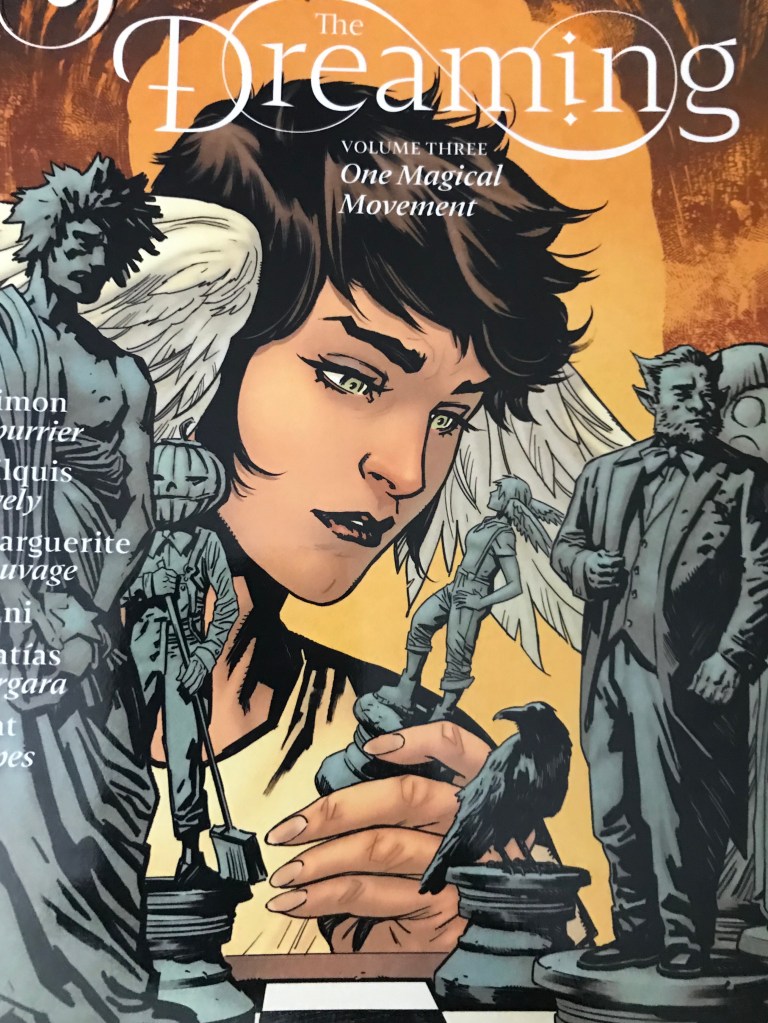
The Dreaming, volume 3: One Magical Movement (spoilers)

It came through. Not without loose ends and weaknesses, but…there’s still no getting around it. Some things that have a distinctive authorial fingerprint should not be continued by another person. My affection and reverence for the original Sandman by Neil Gaiman made me extremely skeptical of the idea that any other writer could pull it off. But here we are now.

How exactly this happened can be seen in a few of the key plot resolutions. In volume two, Empty Shells, Dora was our main character. The framing of the story doesn’t always position her as the clear protagonist in One Magical Movement, but Dora continues to be one of the driving forces of the plot. The mystery of her origin, which was set up in the first two books, is revealed to be centrally important to the whole story. As do mysteries in general.

The fate of Cain, keeper of the House of Mysteries, is also connected to the man responsible for Dora’s lost memories: Hyperion Keter. This is the same Mr. Keter whom we saw briefly, unconscious in a hospital bed, at the end of Empty Shells. Also at the end of Empty Shells, we learn that Fawney Rig was the setting of this confluence of events.

Dora, it turns out, is a Night Hag. A Night Hag is a regional variation of the Succubi/Incubi myth. One Magical Movement actually starts with a support group for ancient, supernatural creatures that are struggling to exist in the modern world. The forbidden pleasure they all share and revile (almost like recovering addicts) is to simply obey their nature without the consideration of a human brain. Nikki, a fey creature that got turned into a dragon by popular reinterpretation, barely stops herself from attacking an intoxicated night-swimmer she encounters in the ocean.

The support group decides to crash a Pride March, as it is constituted of mortals who wish simply to celebrate their existence and survival after a lifetime of secrecy. One of them, an ancient guardian spirit of sailors called The Gentle Goellan, wanders over to the radical Christian protesters. He begins to mutter an old sea shandy and instigates a brief riot. The Gentle Goellan felt a naked need to cause havoc within the protestors (apparently) and gravitated toward it like an oceanborn tempest, in which sailors would often invoke him. After the Pride Marchers come out unscathed, Nikki transforms into a literal draconic fairy.

The notion of following one’s nature in the face of adversity is central to both Dora’s arc and the story in general. Dora was doing exactly that when she first encountered Hyperion Keter: specifically, following her nature as a Night Hag. Hyperion- or Perry, as he is known to his intimates -simply chose to assert, in his loudest psychic voice, that she is not real.

This rid him of Dora but woke him up to an uncomfortable truth: humanity is dogged by too many unreal things to keep track of. Many of them, in their multitudes, are too dangerous to be borne. This realization moves Hyperion Keter to make it his life’s work to save humanity. He eventually learns that Dream, the embodiment of the intellect and imagination, had been magically trapped and held at Fawney Rig, in England.

This was done by Roderick Burgess in the very first Sandman comics and Hyperion decides to reverse-engineer Burgess’s spell. However, he does not use the magic in the same way: he does not want Dream trapped, merely exiled from the Dreaming. This creates a power vacuum that Hyperion fills with an alchemical AI. This AI has a consciousness whose subconscious hides an algorithm to systematically purge all irrationality from the Dreaming, which also removes it from the minds of all sentient beings.

This explains the appearance of Wan- the enigmatic moth deity -and the soggies from the first two volumes. The soggies were drones created by the AI to remove all superstition and irrationality and replace it with productive scientific and technological knowledge. Wan is the AI consciousness, unaware of its subconscious activities.

There is so much to unpack in these details, but I’ll start with a large commonality that might connect the finer ones. By this, I mean the nature of the Dreaming itself. In popular wisdom, we usually conceptualize dreams as taking place in our own heads, with no outside influence that did not originally come from waking experiences. Some people entertain the existence of a collective subconscious that all minds are equally connected to, but different individuals assert this with different degrees of literal or metaphorical meaning.

Those exceptions being accounted for, people commonly think of the space in which they dream as exclusive to themselves. In the world of The Sandman and The Dreaming, all dreams happen in the same place. Everyone has a mind of their own where their dreams are “born” into, but once you begin to dream, you take the contents of your mind into a universal space shared by all sentient beings. This model clearly has more in common with the collective subconscious than individual, mutually isolated minds.

This aspect of the world building is referred to and elaborated on throughout One Magical Movement. This is implicit in the beginning, with the struggling mythic creatures, and explicit at the end. It turns out ordinary modern skepticism is not the biggest threat to the fey, spirits and other magical beings.

Early in the book, Matthew the raven is picking up on a subtle but ever-present feeling that something is dying. He learns that he smells it everywhere because the world itself is dying. People everywhere are committing suicide because they are oppressed by a feeling of inescapable pointlessness, due to the soggies replacing all dreams with scientific knowledge. The motivation to go on living is missing without the irrational. One might say why was sacrificed for how.

While the story states that this is impacting mortals in particular, there are beings in the Dreaming who are similarly affected, such as Abel and Lucien. Abel, the keeper of the House of Secrets, is now struggling with life without his brother Cain, of the House of Mysteries (which might also be an imbalance between how and why). Lucien’s angst, meanwhile, stems from being cut off from his library of unwritten books, from which he frequently narrates. Irrationality is part of his why as well.

The three currently available Dreaming volumes all mention Lucien’s inability to narrate. They also conflate the omniscient third-person narrator with Lucien, Rose Walker and other characters. Meaning, a text box that initially appears to be a non-character narrator turns out to be Rose Walker, Lucien, etc.

This means that the reader’s point of view of the story is equated with reading a book that does not exist. In this fictional world, Lucien would only be narrating- and exchanging narration -if this comic came from his library of non-existent books. To say nothing of the fact that it is literally true that these stories are fictional, they are even set in a fictional dreaming world that contrasts with a fictional waking world in which these events were never “written.”

The story never gets any more meta than that, though, which is fortunate. If it did, it would risk upsetting the balance between the authority of the story’s fictional premise and the authority of the author/narrator.

The reason why I’m spending so much time on this is because it reflects on Simon Spurrier’s reading of the original Sandman comics. He clearly read those stories closely and lovingly, as that is where many of these ideas first appeared. The personal versus collective dialectic of the Dreaming are explored frankly in The Doll’s House, A Game Of You, Fables and Reflections and The Kindly Ones. The dialectic is present throughout the original comics, but those books in particular have plots that involve it directly.

The importance of the dialectic in One Magical Movement is where nothing or non-existence is located. This is also precedented in the original Sandman: the perpetrator and method of the death of Morpheus is one of the most fun uses of the McGuffin I’ve ever seen. This teasing Easter Egg hunt is contrasted against Morpheus’s clear desire to commit suicide. In One Magical Movement, nothingness is used similarly as a McGuffin.

The subconscious is usually imagined as a repository for all the backed up information that enters through your senses but is not immediately relevant. Frued famously described consciousness as housing the smallest portion of the mind. With Wan, though, the opposite is true: all of the personality is contained in his waking self and his subconscious (the Dark Moth) is an empty, sucking void of destruction.

Dora, who feels deeply and lives in the moment, is haunted by a forgotten past. Later, when she recovers it, it is clear that the only thing she ever lost was a name and a description of the nature she follows anyway (Night Hag). She could feel, was troubled by the fear that feeling was not enough, and eventually learned that the lost information pointed back to feeling. Her experience in the Fulcrum, the former home of Destruction, points her in the direction of hope back in Pathways and Emanations. Destruction, Lucien tells us, is a frozen moment between ending and beginning.

Hyperion, after scattering Dora’s identity with his declaration that she doesn’t exist, unknowingly wages war on the chaotic and irrational subconscious which saps the motivation and life from existence. On several plot and thematic layers, where nothingness is located and what it is doing shifts constantly. Even the narration, which is implicitly coming from a non-existent book, participates in the implementation of nothingness.

Likewise, the absence of Dream creates a void that needs to be filled and the AI that eventually gave birth to both Wan and the Dark Moth can only occupy a single physical location. Something from the Dreaming had to replace the AI so the AI could fully mature in the Dreaming. (This also gives Cain a brief but delicious opportunity to become a supervillain) This same phenomena is echoed when Wan volunteers to absorb the new dream vortex to spare the life of Daniel once he returns.

Like I said, there are loose ends but nothing that threatens the overall integrity of the story. Particularly, the fate of Ivy Walker, who is trapped in the world of the Mundane Egg that Daniel used to create a new universe during his exile from the Dreaming. It mirrors the saga of Daniel and his mother Hippolyta, but doesn’t do much more. That could be something future Dreaming comics may elaborate on.

Love the usage of the Bowie quote and it’s roots in the Sefirot ❤️

DC/Vertigo The Dreaming reboot

Yes, they’re still in the sleeves after I read them. They’re just so pretty ^^

Warning: no reservations about spoilers

A continuation of Neil Gaiman’s Sandman story without Neil Gaiman is both shocking and irresistible at first glance. The original Sandman run along with Sandman: Overture were all authored by Gaiman and were such a meticulous and careful body of work that it barely seems advisable to have anyone else at the helm. Even if the right perceptive and empathic author came along, the original Sandman stories unmistakably bear the stamp of Gaiman’s authorship. They just feel so much like Neil Gaiman stories that another author, however talented or well-intentioned, just wouldn’t be capable of picking up the same thread that I and so many others had lovingly followed.

To say nothing of the fact that there weren’t a whole lot of loose ends that needed tying up. At least, none that really mattered in my opinion, and Gaiman handles implication so deftly that details that were not explicitly played out before the reader are still intelligible.

(Those being things like what exactly was Loki doing, what was going on with the angels, etc)

One day I’m sure I’ll write a big fat text brick about how Gaiman’s run on The Sandman employed empty spaces and implication. That’s not this text brick, though.

So…at least in my assessment, there was no real need for a continuation. If a new story was going to be attempted, it would be about Daniel experiencing a wholly new plot, sequentially distinct from anything that happened earlier.

So I was dubious, but I couldn’t help but be reeled in by the sheer ambition of such an attempt. I also have to admit to simply wanting more of The Sandman after so many years. Overture was a very welcome development but it held no promise of things to come: simply a chance for a new reading of the base story.

As it turns out, this isn’t a Sandman continuation per se, but a reboot of a separate series that was contemporary with it, called The Dreaming. This comic involved Gaiman as a co-writer and consultant and he eventually dropped out of it altogether: it wasn’t turning out to be the sort of long running, elaborative story that he wanted so much as a series of one-off episodic plots. It did not long survive his absence.

This current incarnation of The Dreaming retains the basic concept and little else: as the name tells us, this is a story about the place rather than a specific individual. This time, the premise is being implemented in the (almost) direct aftermath of The Sandman’s ending. If not a Sandman continuation, this is at least a sequel series.

The previous Dreaming comics were driven by characters that played minor roles in the source material and so is this. Now, though, this doesn’t seem to be an adjustment in perspective that simply excludes Dream of The Endless, but a consequence of his actual absence.

The blurbs on the back of the two collected editions currently available state that Dream appears to have abdicated, after the example of Destruction and Lucifer, and that a botched love affair was a factor.

This didn’t inspire my confidence. While The Endless- such as Dream, Death, Destiny, etc. – are eternal beings, they possess distinct, individual identities that can in fact die and be “replaced”. These identities are denoted by a name separate from their function: the Dream that the series was once about is named Morpheus. Del is the personal name of Delirium of The Endless.

The old Sandman story saw the end of Morpheus as a character and a being called Daniel currently occupies the title of Dream of The Endless. Morpheus wrestled with his duties as Dream and his closeness to the inner lives of all sentient beings seemed to engender a growing need for an individual existence. He frequently had problematic romantic relationships with mortals that always ended because he could not bring himself to abandon his duties however much he wanted to.

Morpheus needed something that was psychologically impossible for him which caused him to walk into his own demise, to be replaced by a new incarnation named Daniel.

I have an edition of Sandman: Overture that contains Gaiman’s script and notes wherein he states his belief that Daniel is a fundamentally different character than Morpheus. Gaiman’s notes say that Morpheus would never approach someone in a familiar way or casually lay hands on another person, while Daniel is a warm, approachable presence who is not afraid of touching. This contrast is emphasized in Daniel and Morpheus’s speech balloons: Morpheus’s balloons are black with white letters and Daniel’s are white with black letters (both have wavy boarders).

While Gaiman has not written nearly as much material about Daniel as he has Morpheus, he clearly intended him to be a very different character. We’ve already seen Dream wrestle with his responsibilities and a growing need to be his own person. That was the story of Morpheus, which is now over.

Daniel falling into Morpheus’s rut hardly sounds like the different character Gaiman had in mind, nor is it a strong vouch for the originality of the new writers. Since only two collected editions are currently out, the overall success or failure of this cannot be judged yet. In the meantime, though, we may concern ourselves with how this new Dreaming series handles the setting and the characters that were once at the periphery.

In the first volume, Pathways and Emanations, we spend a lot of time with two older supporting characters: Lucien The Librarian and Mervyn Pumpkinhead. In Dream’s absence, Lucien has assumed temporary leadership of The Dreaming. Since Dream (embodied in Daniel) and The Dreaming have an interconnected existence, separation is catastrophic. The Dreaming is coming apart at the seams and Lucien is at his wits’ end trying to hold it together. Mervyn is also picking up a lot of slack on his own end and both feel abandoned and afraid.

We are also quickly acquainted with some new characters, including a refugee from another world named Dora who was given sanctuary in The Dreaming by Morpheus. She is British, has amnesia and will undergo a monstrous transformation when she’s in the wrong mood. We also meet some beings that are traveling from dream to dream that suddenly plop down roots halfway through the story. By roots I mean a large wooden ship 😛

Along with the structural vulnerability caused by Dream’s absence, there are a number of external pressures. Featureless, mute mannikin-like beings are pouring into The Dreaming in large numbers and an infant divinity, not so different from the Endless, is gestating in a fissure outside of Dream’s fortress.

The being that hatches from the fissure is part of a bigger, mysterious plot thread that simply isn’t finished yet. The faceless manikins, called Soggies by Mervyn, soon reveal an unfortunate weakness. Mervyn Pumpkinhead is in charge of the nuts and bolts of The Dreaming running smoothly, which is also the bedrock that many dreamers and traveling minds interact with. The Soggies get in the way without guidance so Mervyn is tasked with giving them things to do. Mervyn now has a burgeoning staff that is too numerous to govern effectively and too difficult to communicate with. Soon, he starts sounding off about the necessity of strong borders and invasive newcomers upsetting a perfectly good status quo. This goes exactly where it looks like it will.

Neil Gaiman hasn’t always been great at social commentary, but the original Sandman was never this blunt or awkward. It doesn’t compromise the integrity of Pathways and Emanations, but it is an eyesore. Luckily this use of Mervyn ends almost immediately when a new character, a nightmare called Judge Gallows, is introduced.

Nightmares have always been an interesting background detail in the world of The Sandman. In the past, Morpheus seemed to have a special passion for crafting them. They also belong to the species of dream that are actually sentient individuals, like Fiddlers’ Green, Brute, Glob, Cain, Abel, etc. Naturally, some of them are named characters, like the Corinthian and the Borghal Rantipole.

Morpheus appears to be driven by a rough idea while crafting a nightmare but the nightmare might not embody it completely at all times. The Corinthian, described by Morpheus as a “black mirror”, is designed to reflect everything about humanity that it chooses not to accept. However, the Corinthian, upon being recreated after his death, seems to have a patient and arguably benign personality.

As of the end of the Empty Shells book, Judge Gallows does not seem to have had much influence on the story that outlasts his destruction. This is the tricky part of reading things that aren’t finished yet. The real force behind the plot seems to be Dream’s disappearance, the person who accidentally forced him into it and the being that hatched in Daniel’s absence. If Judge Gallows turns out to be more than a bit character, that would be neat.

Mostly though, he just keeps the plot moving while the newborn deity gestates and allowing other arcs to develop. He creates a chance for Dora to recover her lost memories through forced closeness with Lucien and the sword of Destruction. This matters because Dora is the protagonist of the next book which gets into the more fundamental plot, regarding what specifically happened with Dream and what specifically is the entity that appeared in his absence.

Which brings us back to the problem of how Daniel is being handled. The Dreaming is ostensibly about the location and the characters that were in the background of The Sandman but it still uses Dream/Daniel to hold it together. Unfortunately, it also brings us back to how Daniel’s behavior looks a lot like Morpheus’s.

The unwelcome sense of repetition isn’t helped much by the prevalence of call-backs, particularly at the World’s End Inn with the different stories with different art styles and lettering. Those visual motifs are only used long enough to establish a plot point but it doesn’t go well with the lack of originality regarding Daniel.

Another possible thematic reason for the Worlds’ End callback is subversion. In the older frame story called Worlds’ End, each story was complete and would take over the foreground for its’ duration. These storytellers tell incomplete stories that cannot seize the foreground because they go in circles while more interesting stuff happens at the same time. This could be an attempt at deconstruction, signaling that the new Dreaming stories will break their consistency with The Sandman. That would be my preference, but as with so many things in these new stories, it’s too early to tell for sure.

The reason that I’m dwelling on what might be tiny details is because things that look like callbacks are rarely done on accident. Their presence alone begs you to wonder why. And the problem with things that occupy your attention that are meant to signal a break in continuity is that you inevitably wonder why not simply…break the continuity in a way that’s plainly visible?

Season of Mists, for example. That book starts in a way that barely resembles any other beginning in The Sandman and it’s simply allowed to speak for itself. I would love to be wrong about these nit-picky little worries but naturally it remains to be seen.

This reminds me of the other details that call back to commonplace motifs from The Sandman. Near the end of Pathways and Emanations, the baku from Japanese mythology that made an appearance in Dream Hunters are brought back. In Empty Shells, Dora uses the baku to sniff for Daniel’s scent trail across worlds. The search leads her to Hell, where a new demon character named Balam leads Dora and Matthew to the very bottom of the cosmos where lies the primordial serpent that surrounds the world. You know, like Jormungand. On their way to the serpent, the panels twist around until you are forced to hold the comic upside down.

Stuff like that was commonplace in The Sandman. Overture made the reader turn the book upside down a few times, used implication to guide unconventional panel progression and even had fold-out pages with events that follow the outside depicted on the inside. What I liked most about the panel experimentation were the ones that implied movement at dramatically significant moments. In Brief Lives (possibly my favorite Sandman book), there is a page that has several thin panels that are mostly empty except grass with more and more flowers in each. These panels show space behind Morpheus and, when they catch up with him, they are so thin that his body is contained in more than one of them. In these, we see that Morpheus’s hands are covered in blood and, as it drips onto the ground, it is turning into flowers.

These innovations all felt organic in the original Sandman and they often snuck up on you. The really imaginative ones were paired with jarring, unusual events and were often used to convey disorientation. The panels slowly turning upside down in Empty Shells is a bit of a one-off. In those first two books, nothing else like that happens- almost as if the script was trying it out to see how it went.

My only other thought concerns another concept first used in The Sandman (in Brief Lives, actually). Destruction tells Dream and Delirium that each of the Endless embodies both their function and it’s opposite. Destruction is also creation, Desire is also hatred and Dream is also reality. The newborn god that appears in the Dreaming- referred to erroneously as a new Endless -initially defines itself as clarity and that nothing hurts worse than to be “solved”.

The crack that this being is forming within is first found by Cain and Abel. Cain pushes his brother into it on a whim and emerges without his stutter- he even fakes the stutter a few times to keep Cain at ease. Cain himself then descends into the fissure to ask the unknown presence what ze did to Abel and if ze can change him back.

Cain introduces himself as the personification of murder itself and the new presence disagrees. Ze tells Cain that jealousy has always been at the heart of his story and reminds him that the sacrifice preferred by God was the livestock blood sacrifice of Abel. Cain was driven to kill Abel when his own sacrifice of vegetables was ignored. When the new presence says that Abel’s “hands were red long before yours” ze’s saying Abel’s murder was an act of both possessiveness and emulation.

The new center of the Dreaming says that it solves things, above all else. This implies that the new creature hatching in the absence of Dream embodies the opposite side of Dream’s coin mentioned by Destruction: reality. This encounter also has deep implications for the function of Cain and Abel within the Dreaming.

Since the beginning of The Sandman, we’ve learned that Cain lives in the House is Mysteries and Abel lives in the House of Secrets. They also hold dominion over those respective things: all mysteries belong to Cain and all secrets belong to Abel. What secrets and mysteries are within this story is touched on in a short piece in Fables and Reflections called The Parliament of Rooks.

Near the end, Abel tells Eve, Matthew and Daniel what rooks are actually doing when they form a circle around a chirping rook and then kill them. It turns out that this is a mystery and therefore belongs to Cain. Cain then kills Abel in the ineffectual and somewhat slap-stick way that he often does. (Cain frequently killed Abel in The Sandman although he never stayed dead- the brothers behaved rather like sitcom characters with Cain randomly killing Abel being a repeating gag).

Mysteries, according to Cain, may not be revealed. Abel, to whom all secrets belong, is less protective. When Abel is asked where ravens end up near the end of The Sandman, he says he doesn’t know because the answer is not a secret. Abel also goes on to ferret out secrets for Judge Gallows when he takes over the Dreaming.

This tells us that secrets may be known but that mysteries may not. The hatchling in The Dreaming embodies clarity, the opposite function that Dream embodies simultaneously with stories, and it is a clarity that abolishes mysteries and, for a while, allows secrets to be exploited.

Secrets and mysteries, it seems, are fundamental to the side of Dream that deals in stories and symbols. Stark clarity, perhaps, has no use for symbols and immediately reduces them to tangible values. This interpretation of Cain and Abel and their role within the Dreaming never occurred to me before reading these new comics and I’ll be interested to see what happens with it later, especially since, by the end of Empty Shells, the hatchling is less of an opposite of Dream than ze initially appeared to be. Especially since a few characters see a ghostly flicker of Cain’s old home, The House of Mysteries, after Abel kills him (and Cain, unlike his brother, seems to actually stay dead). As if Secrets and Mysteries need each other and one half will soon bring back the other.

If the function of Secrets and Mysteries are tied up in the eventual fate of the hatchling, I wonder how that will be impacted by the bombshell at the end of the second book where we learn that the hatchling has a symbiotic relationship with a human on life support in the Fawny Rig manor.