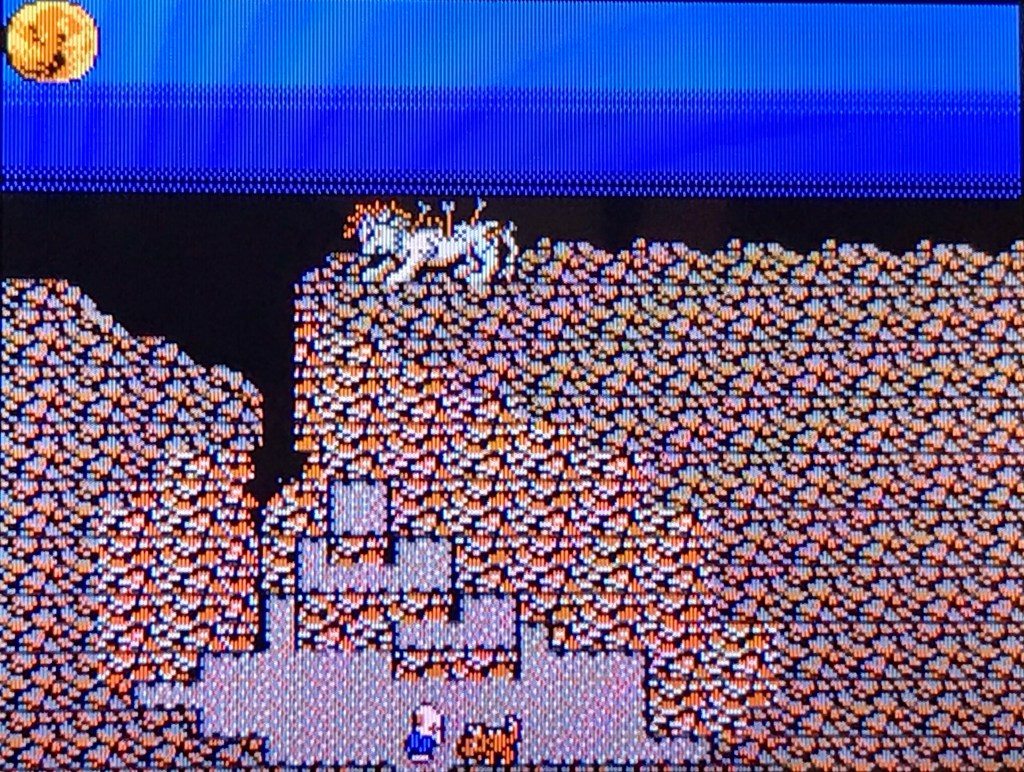
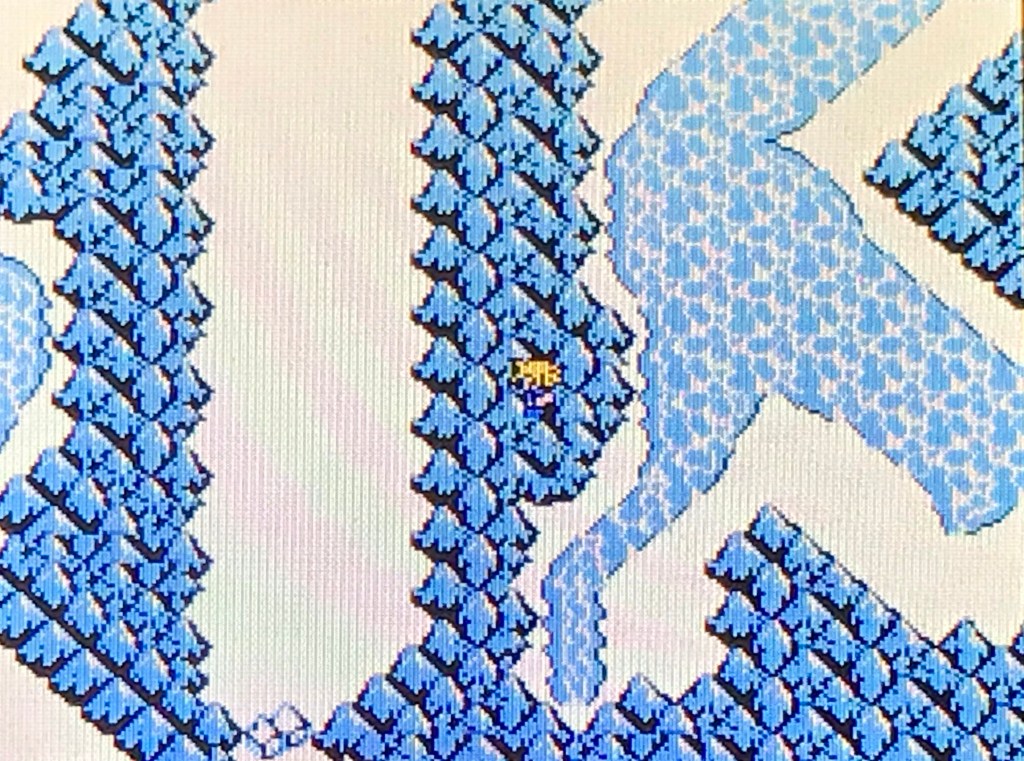
IX, at the very end of Memoria, outside of creation ❤️
2. Best chocobo theme:
Also IX
3. Moogle theme:
Good King Mog from XIV! (never actually played it but wifers showed me)
4. Best airship theme:
Looking For Friends from VI! That’s the song you hear on board the Falcon.
(The Hilda Garde music from IX also has a tendency to worm its way into my head. Like, all the time, and once it’s in it stays for awhile)
5. Best character theme:
I feel a lil conflicted there. It would either be Coin Song from VI or J-E-N-O-V-A from VII.
6. Best town theme:
Kids Run Through The City- VI
7. Best overworld theme:
Something from VI. Either Terra or Dark World
8. Best dungeon theme:
Another World Of Beasts from VI.
And I’ve always liked Phantom Forest from VI and Lurking In Darkness from VII. Neither one of those appear exclusively in dungeons but both are used in dungeons occasionally.
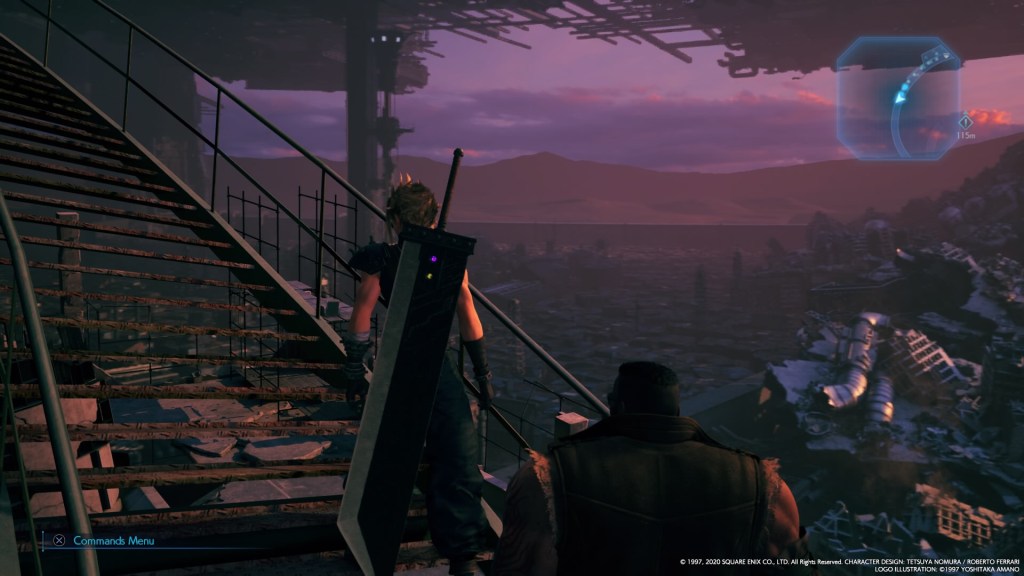
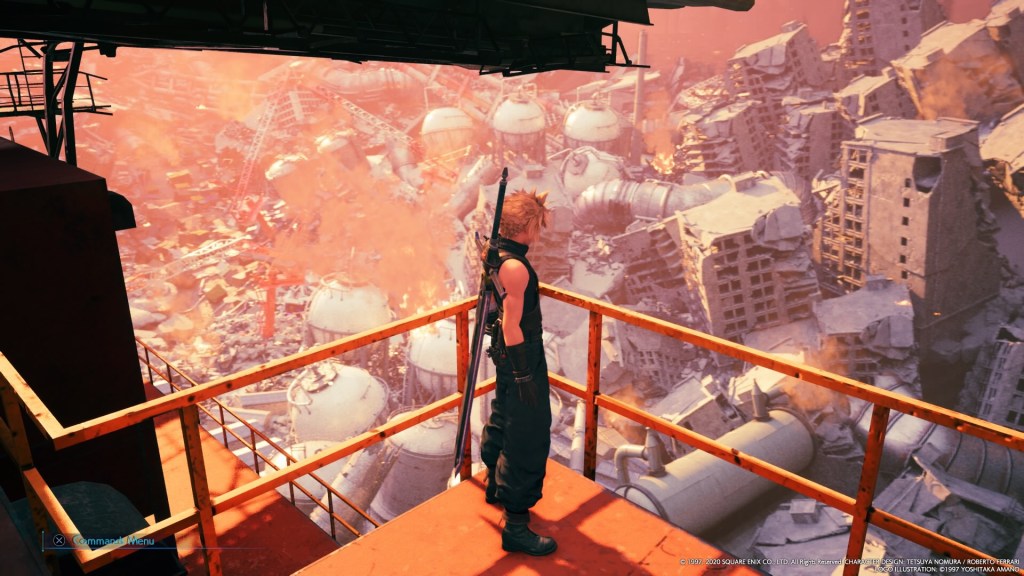
I kinda have to mention the Collapsed Express Way from the VII Remake. All the music from Shinra HQ in the remake could also merit honorable mentions.
9. Best battle theme:
Don’t Be Afraid- VIII
10. Best boss battle theme:
The Decisive Battle- VI
11. Best victory theme:
Out of the variations of the traditional I’d go with the version from VI. Out of the different ones, it’s XIII.
12. Best end boss theme:
Dancing Mad- VI
13. Best ending theme:
Credits’ roll from VII
14. Best mini-game theme:
Vamo Alla Flamenco- IX
15. Best in-game arrangement:
Opening – Bombing Mission, from VII. I’ve heard different orchestral versions but they always make it sound like it came from a Batman movie. Which I think is all wrong. The version from the VII Remake works for what it is, but it has a different character from the original.
16. Best piano arrangement:
Ahead On Our Way from the VII piano disc ❤️❤️❤️❤️❤️❤️❤️
The Main Theme from VII on that album is also exponentially more beautiful than the original
17. Best remastered track:
The Nightmare Begins from the soundtrack remaster for the PC version of FFVII. The most atmospheric version of that song.
18. Best orchestrated track:
Seven Seconds till the End- VIIR
19. Best non-Uematsu track:
Crimson Blitz from Ligthening Returns. That would be Masashi Hamauzu. Born Anew is also really cool (also by Hamauzu, in the first XIII game).
20. Best song from a game you haven’t played:
Final Steps of Faith (Nidhogg’s theme from FFXIV. I still gotta get started on that sooner or later)
21. Best song from a game on first console:
Mmmmm I’ve already covered a lot of VII-
HEY WAIT the title screen music from the PS1 Anthology version of V!!!!
22. Best song from a game you don’t like:
All of the cutscene music from Type-0
23. Song that makes you feel nostalgic:
Voices Drowned By Fireworks- VII
24. Song that makes you feel sad:
Other Side of the Mountain- VII
25. Song that makes you feel pumped:
Fight On!- VII
26. Song that makes you feel relaxed:
Dali Frontier Village- IX
27. Best track from mobile exclusive:
I never played a mobile exclusive unless you count IV: TAY? I played the Ultimate Collection for the PSP but TAY at least started as a mobile exclusive. I enjoyed the music from IV in general but I don’t remember if TAY had any original music? I didn’t finish it either but got to the final dungeon and found out I was pathetically under-leveled and trapped there
After all this time, I have finally played and finished this game. And I went into it with a negative bias: with as much as I love the original Final Fantasy VII, I was bound to play it sooner or later but we all know the odds with later elaborations on cool stories (that do not necessarily need any). There is a lot that can go wrong. So I was not expecting it to come as close as it does to perfect. Perhaps it is perfect, for what it is.
The only problem I had with the game (if it ever qualified as a problem) was the kind of action RPG that it is. I think Crisis Core adheres to some sort of handheld action RPG formula that is also prominent in Final Fantasy: Type-0 which is my least favorite FF. Both Type-0 and Crisis Core have constant access to missions with varying degrees of relevance and irrelevance to the mainline story. At any given point in both games, one can access mini-raids that do not advance the story at all and you will sometimes be strongly pressured to do them.
A few times in Crisis Core, there are story beats with no obvious path forward. You will likely do a lot of these missions because it is easy to suspect that, since nothing appears to be happening, that the missions might trigger the next thing. Eventually, you realize it doesn’t work like that and then explore and trigger the next story event on accident. Since the PSP was a potential commercial risk for Sony, maybe they thought designing games that you can easily tune in and out of would be a way of playing it safe or appealing to “casual” gamers. Random fetch quests and random battles do not have a huge structural need for continuity.
For that reason, it is easy to spend lots of time playing either Crisis Core or Type-0 doing a lot of stuff with no cause and effect relationship with the story progression. This seems to be an emergent genre, and it is also a prequel and prequels have a little bit of reliance on the base game. This is what I mean when I say that Crisis Core: Final Fantasy VII may be perfect for what it is. It happens to be in a genre that I often find boring unless it has some other strength going for it. Luckily, Crisis Core does.
What I liked most about FFVII was it’s story. So it was bound to be something I would be looking for here. One of the reasons I was interested but not quite eager to play Crisis Core back when it first came out was a story concern. According to a few sources, there were now two more characters that were infused with Jenova cells as fetuses.
While Sephiroth is still basically just “possessed” by Jenova like all carriers of her cells, he is still somehow different. Even though all carriers are controlled by Jenova, it often looks like Sephiroth is the vehicle and enforcer of her will, up to and including exerting his own will through the clones. The original Final Fantasy VII offers Sephiroth’s fetal exposure as something that could set him apart from the rest of SOLDIER. With that understanding, adding more characters that were changed as fetuses would undermine the plot of the original.
There are degrees of this procedure, though, which creates specific differences between them. In the first two experiments, a woman named Gillian who had been infused with Jenova cells was the source of the experimental DNA. Genesis had Jenova cells generated by Gillian’s changed body mapped onto him as a fetus. This was done surgically with a donor mother. Angeal, then, was conceived by and birthed by Gillian.
This does not necessarily need to subvert the plot of the original, though. By the time of the mainline Final Fantasy VII, Sephiroth is the only remaining fetus-hybrid anyway. Additionally, his closeness to the Lifestream nexus point of transmigrating souls in the core of the planet constitutes his real usefulness to Jenova.
At the same time, Crisis Core has a story that does make distinctions between different kinds of fetus-hybrids. If Crisis Core was the only FFVII story I ever encountered, I would be forced to assume that the enigma of Sephiroth’s unique nature would be clarified somewhere else. Crisis Core ends with Genesis’ inert body being mysteriously carted off by SOLDIER. This, at least, made it clear that Square wanted loose ends to lead into other installments in an expanded universe (at that time, anyway).
But if you played the original, you know that the only word on how Sephiroth was exposed to Jenova’s cells in the first place is that it was while he was a fetus. In light of the additional lore in this prequel, though, being infused as a fetus can mean different things.
Is this a serious narrative weakness, though? I don’t think so. Not even a weakness, really, more like a complication. The only real consequence it could have is whether or not all Genesis and Angeal carriers are eradicated. There are a lot of them for all three of the fetal experiments. The plot of Advent Children relies on three Sephiroth carriers surviving by simply falling through the cracks during the Jenova Reunion. Assuming, for now, that there are no more Angeal or Genesis carriers isn’t that much of a big deal. And if Sephiroth’s real usefulness to Jenova is his location at the Lifestream transmigration nexus, that leaves the plot of the original game intact.
So in the end, there is nothing about Crisis Core that really contradicts or subverts the original, in terms of plot or lore continuity. Crisis Core does more than simply not fail, though.
Whether or not Crisis Core starts off on an easy path is a matter of interpretation. Zack Fair, our protagonist, is super stoked to be in SOLDIER and to fight for the global dominance of Shinra. For a fan of the original, in which Shinra is an unambiguous force of evil, this is jarring. Then again, all armies have their propaganda and their own true believers. Warriors on all sides always think they are right- so Zack being a warrior of conviction actually makes a lot of sense.
This is hint one that Zack is gonna have an arc that goes from naïveté to maturity. But for a while he plays the role of the big bouncy Boy Scout a little too well. Zack never gets as annoying as Snow from FFXIII but walks up to the line occasionally. Being a guileless and trusting recruit at first, Zack’s ideals are larger than life and quickly slide from white to black (musing whether he is a hero or a monster, etc).
Zack becomes aware of necessary shades of gray when he is assigned to track and neutralize Genesis and Angeal once they defect. Hollander and Genesis have an exchange in front of Zack that makes it clear that Angeal and Genesis need Hollander and his Shinra-based procedure that staves off their cell decay. If certain death is the motivation for Angeal and Genesis remaining loyal to Shinra, then the possibility of a non-Shinra source of sustenance is life-changing.
In other words, the Shinra super-SOLDIERs fight because they have to in order to survive. Genesis’ mood swings could have a few different explanations, but the revelation that he doesn’t have to be Hollander’s dog forever seems like a contender. Angeal, who is also subject to the cellular decay, rebels also but tries to maintain his early values, such as protecting his old relations and innocents who get trapped in the crossfire. Genesis wants to start over and Angeal wants autonomy but still clings to his prior obligations.
The dialectic of balancing individual need versus wider complications is emphasized more by a conversation between Zack and Sephiroth immediately before the fatal journey to Nibelheim. Sephiroth tells him that he might defect from Shinra soon but does not offer any explicit reason. The only implicit reasons are the recent events with Angeal and Genesis. It seems possible that Sephiroth is also questioning (he says he may defect) whether or not he would die without Shinra support. This would mean that his personally-felt loyalty to Shinra is now irrelevant, since he’s learning he might be nailed down to it anyway.
A loved one of mine shared bits of the Crisis Core soundtrack with me a long time ago, including a song called The Price Of Freedom. That phrase captures the emerging thematic concern at this point in the game.
Crisis Core is a prequel and is fundamentally tied up in a relationship with the OG Final Fantasy VII. It would be an extremely weak prequel, though, if it had nothing but it’s connection to the source material going for it. This questioning of genuine commitment versus coercion leads us to a personal narrative about Zack, which kicks into overdrive when Zack is forced to act independently.
After escaping the grasp of Hojo and his lab tech, Zack is soon cut loose from Shinra. He has digital access to internal Shinra documents stating that both Zack and Cloud are dead. Then the word goes out that some important Shinra “fugitive samples” have escaped.
The game from this point resembles an escort mission: maybe the most emotional escort mission I’ve seen in a video game in a while. Zack has watched his heroes turn sadistic and homicidal and was forced to put down a few of them himself. Cloud looks up to Zack as a role model but, now that he is on the other side of the hero-worship he indulged in himself, Zack is more willing to treat Cloud like an equal than his own heroes were.
After the Nibelheim disaster, though, Cloud ceases to be a mere “kid brother.” Zack witnessed the importance of Tifa and Nibelheim for Cloud and the destruction wrought there by his own former masters. After the loss of Sephiroth, Angeal and Genesis, Cloud is now Zack’s only surviving fellow traveler. This also makes Aerith more than a long-distance girlfriend for Zack: she is the last part of his old life that remains good.
FFXV was lauded for its portrayal of platonic love between male companions. I think I gotta say that Zack and Cloud do this better. And it’s built up by a succession of smaller moments, like Zack carrying Cloud around and re-dressing him in new clothes. Final Fantasy is famous for being dialogue-heavy, but a lot of the pathos of this bond is built by being non-verbal. Cloud might not talk back to Zack post-trauma, but Zack still makes an effort to discern his feelings and needs.
Zack always addresses Cloud as if he is lucid and paying attention. At this point in the story, all institutional sources of meaning have, for Zack, been revealed to be treacherous. Zack’s only values need to be the ones that he embodies himself. The function served by Zack’s relationship with Aerith as a motivator is a little reductive but it works as something real for him to be invested in, after his other idols are discredited. Cloud, though, is a living embodiment of this.
Before wrapping this up, there is another gameplay element I wanna mention: the modulating phases. This was almost…kind of…subversive in a good way?
In lieu of normal experience points, we now have a slot machine mechanic that starts up after a certain length of time. This basically limits the rewards of combat to its’ length, which can achieve a lot of the same ends as an exp leveling system. Easy foes get done away with easily so there is no risk and no reward, since the battles won’t last long enough for the modulating phase. Most of the numbers correspond to materia slots and two or three numbers of a kind will level up the materia in that particular slot. Solid 7’s are how Zack himself levels up.
This creates a feeling very similar to more conventional RPGs. Enemies below your level are quickly done away with and have minuscule rewards: the real grinding needs to happen with monsters close to your own level. The modulating phase slot machine is also how special, hard-hitting attacks similar to limit breaks are triggered.
Near the end, during Zack’s last stand outside of Midgar, you are clearly overwhelmed and most of us knew how this would go anyway. But you keep getting thrown into playable combat against the vast Shinra hoard with frequent modulating phases that buzz with static and roll irregularly, as if glitching. The slots even have some of their character illustrations go white and fuzzy and the screen will white out without giving you a specific set of three numbers. The poignance of this portrayal of Zack gradually dying crept up on me.
I might also be stating the obvious by mentioning the similarities with the portrayal of Zack’s last stand in Final Fantasy VII: Remake. Both versions have Zack saying the words “(t)he price of freedom is steep” and some very similar “camera angles.” If Square continues to insist that Crisis Core is not cannon, we’ll just have to see how that bears out in part 2 of the remake.
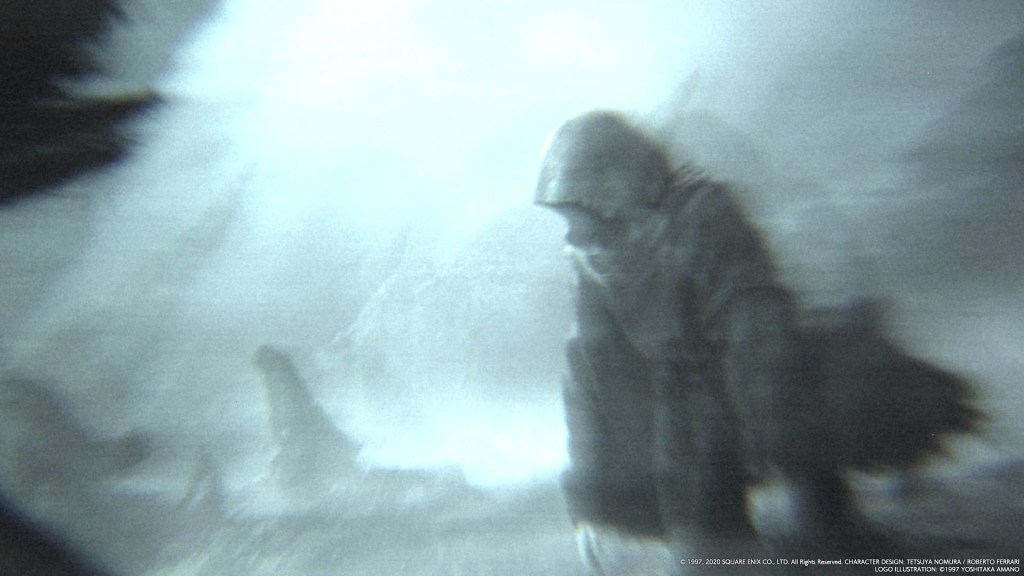
After all these years, I’ve now learned that this is where the image of Sephiroth at the start of Advent Children came from
In a recent interview for the Final Fantasy VII Remake Ultimania Guide, Tetsuya Nomura dropped some huge lore bombs. Among them was the very strong hint that the Whisper bosses at the end are Kadaj, Loz and Yazoo from Advent Children. The descriptions revealed by the assess materia, for all three, state that they are defending their timeline.
Later, the party catches a glimpse of events from Advent Children and Nanaki says “this is what will happen if we fail here today”.
Two paths that fork from the point of departure at the end of FFVIIR are discussed. One openly, the other by implication. Advent Children was a sequel to the original Final Fantasy VII. The path of the original that proceeds into Advent Children is what Nanaki said would happen if they “failed”. The path revealed by implication is what the party embarks on after they appear not to fail.
Kadaj, Loz and Yazoo are protecting the timeline that shaped them as they were in Advent Children. Three of the Whispers at the end are meddlers from outside of the timeline.
What about the giant Whisper Harbinger that looms in the background during that fight? It looks a hell of a lot like Sapphire Weapon. Why would a Weapon be intruding into another timeline?
The planet created the Weapons to defend itself in the event of an existential threat. They were originally created to combat Jenova (according to Ifalna) but so long as Jenova exists in an undead, “viral” state, they can’t go away. The planet will also lash out at any soul that’s been exposed to Jenova as it passes through the Lifestream on its way to its next existence (Geostigma).
It is intuitive to think that a Weapon is attacking another timeline because it poses an existential threat to the planet in its own timeline. Aerith, in her dialogue describing what she knows or has deduced about Sephiroth, says that she thinks that he has good intentions even if his actions are destructive (“he would probably say he would do anything to protect it”, loose paraphrase). Later, after the final boss fight, Sephiroth tells Cloud that he wants him to exist for as long as he himself does.
In the original game, Sephiroth never said or did anything that would suggest he cares about the planet. Nanaki’s remark implied that the timeline of the original FFVII was a worst case scenario, yet in the chronology (which ends with Dirge of Cerberus, if I’m not mistaken) nothing seems to back this up.
If Jenova ever fully corrupted the Lifestream and turned Gaia into a new Meteor, we haven’t seen it yet. Maybe this is a mystery that the Remake series might elucidate in the future.
If Sapphire Weapon is penetrating into a new timeline, it is equally possible that it’s either attacking Jenova or defending the planet in its own timeline. If Jenova ever succeeded in corrupting the Lifestream, though, would the planetary Weapons continue to distinguish between it’s wellbeing and attacking Jenova?
And if the Whispers are pure, spiritual agents of destiny, why do they seem beholden to Sephiroth? Why, at the end of FVIIR, does it seem like both Sephiroth and the Whispers are protecting the same thing?
This theory depends on the ultimate fate of the original timeline. Either Jenova “won” in the end, during some far future event we just haven’t seen, or Jenova was somehow subtly “winning” the whole time. Either way, the Gaia of the original timeline does not seem to exist.
The behavior of the Whisper Harbinger and the three boss Whispers begins to make sense in this situation. Kadaj, Loz and Yazoo have no other existence except for the one that happened in the original timeline. They want to “enforce” the chronology that happened in their own past because it’s the only way to guarantee their existence in a new timeline. Sephiroth, Sephiroth clones and Jenova attempting to shape the events of a separate timeline to conform to their own only makes sense if the world they originated from doesn’t exist any more.
An event like that would also explain why Sephiroth wants to protect Gaia and why Aerith sees him as a threat in spite of that. Jenova is a colony organism that exists by spreading its cells into more bodies. When such a body dies and it’s soul passes into the Lifestream, the essence of Jenova is now mixed up in the planetary transmigration cycle. Jenova exists through “possession”, almost like a demon whose cells can be both spirit and matter. If Jenova “possessed” every body and every soul on Gaia in the original timeline, then the Lifestream itself would be possessed. The Lifestream is the spiritual existence of the planet, so even beings like the Weapons would end up enslaved. (That Sapphire Weapon was originally right next to Sephiroth in the Northern Crater might also be a factor)
If the Gaia in that timeline ceased to exist, though, Jenova would be saddled with a Lifestream with no planet. The existence of both Jenova and Sephiroth would be dependent on that Lifestream, so it makes sense that they would stop at nothing to protect it. If you have a Lifestream with no planet then you would want to find a new one. In a parallel timeline, for instance, within the same planet it came from.
This possibility also clarifies what Nanaki meant when he said “This could very well be her last line of defense, it won’t be easy.” If Jenova would “burn out” a planet while possessing or consuming it, the search for a new planet to move the corrupted Lifestream into would be the last line of defense.
If the Whisper Harbinger actually is a Weapon that (like Kadaj, Loz and Yazoo) originated in a doomed timeline, what about the rest of the Whispers? If the world was destroyed in that timeline and the displaced souls are pushing through to the timeline next door, there’s gotta be more than three. Maybe all visitors from outside your timeline look like Whispers in this fictional world.
I suspect that the Whispers are not agents of destiny but migrating souls desperate to create a timeline that will bring them into existence. That would mean making sure everything happens the same way it did last time. Not a single detail can be out of place because every single detail probably played a role, ala “butterfly effect”. That would also explain things like resurrecting Barret after the Sephiroth clone skewered him- he’s not allowed to die like that because he didn’t the first time around.
This begs another question- the last boss fights in the game imply that Sephiroth and the Whispers are working toward the same end. The whole theory I just unpacked would also support that. However, Sephiroth and Jenova need to shape the neighboring timeline to resemble their own in order to preserve themselves. If the old timeline is recreated in every detail in the new one, though, both universes might end the same way.
Put simply, yes. I mean, there was a lot in the original that made you wonder about how it would play out “for real” and not all of it was even story-related: I mean…in the crashed Gelnika, there was a hostile gastropod with an attack called Creepy Touch. What exactly happens when one performs the Creepy Touch? I mean, I could tell you about the interpretation that my friends and I used to cackle over, but what actually happened? What exactly is a Dorky Face, and why are so many of them in the Shinra Mansion in Nibelheim?
When I was younger, I used to try to visualize what the combat would look like if it wasn’t a video game. My most recent frame of reference at the time was anime, so I kinda imagined some Z-fighter stuff like materia magic- casting bolt would probably look like a ki blast, for example. Later, I saw the Last Order anime with the non-delusory version of the Nibelheim incident and the travels of Zack and Cloud afterward. Both Zack and Cloud were infused with Jenova cells while in Hojo’s custody along with a mako bath (redundant for Zack, first time for Cloud). Cloud is unconscious for a lot of the story, though, so we mostly get to see Zack and Sephiroth in action. Sure enough, Zack flits around invisibly like a Z-fighter.
That last part actually sort of helped for my grasp of the in-world physics \ metaphysics: those who had been bathed in mako or injected with Jenova cells were supposed to be supernaturally formidable compared to ordinary people. For some reason, as a preteen, I was particularly attached to imagining the fight between the Turks and Cloud’s party during the return to Midgar as…basically…Dragon Ball Z with giant swords, firearms and electricity (no I’m not ignoring Trunks, let’s stay on topic).
For anyone who wondered about those nuts and bolts, Final Fantasy VIIRemake absolutely delivers. Setting the first installment completely within Midgar was a good choice for every obvious reason: the original had a very large and detailed world map. The lack of exploration within Midgar was a teasing absence. Digging up the key card to get back into Sector 5 during the third disc assuaged the yearning a little bit but there was just so much that you still couldn’t check out- like more of the upper plates.
So kudos on being Midgar-centric. There were also quite a few moments that had an absolutely beautiful sense of place. Sector 7 and Sector 5, in the remake, both took my breath away. The graphics were crisp and detailed but…well…Sector 7 and Sector 5 both remind me of my childhood. Not that my hometown is absolutely dilapidated and cobbled together from garbage but…well…um…uh…actually nevermind ._.
I know I’ve droned about this a lot in the other entries about the remake, but I absolutely adore how carefully this game builds a sense of distance and proportion with nearly all of its environments. Very understated at times, like how in Sector’s 7 & 5 you can catch glimpses of the sky in certain directions which contrasts with other moments that are wide, open areas that are definitely beneath a plate.
The lights look uncannily like stars sometimesSometimes, when you look closely at the pre-rendered far-off images, the rest of the environment can look slightly surreal
Even the sound design contributes to the sense of place. In some environments, when explosions go off, any sound you hear immediately afterward will be muffled as if you’re ears are ringing. The background chatter in the town areas always sounds natural and spontaneous. The music is also very well placed and the score has a nice back-and-forth with the diegetic music from jukeboxes \ stereos \ whatever.
On that note, I was pretty happy with the soundtrack. I may find it hard to tease apart how my love of the original colors this, but I appreciate how the soundtrack layers motifs from the original soundtrack. In the original, Words Drowned By Fireworks is memorably used during the Golden Saucer date. I think there is another use of the track before then but I can’t remember.
Anyway, in the Remake, the first time we hear music that uses partial melodies from Words Drowned By Fireworks is during a flashback to Nibelheim, when Tifa and Cloud made the promise. A potentially intact version of the whole song can be heard between Sector 5, Wall Market and the collapsed tunnel leading to Sector 7.
This gradual layering of motifs from the original soundtrack is also used with Lurking In Darkness. The complete song is first used, in a quiet and unobtrusive way, when Cloud is taken aside by Don Corneo’s goons and snatches of the melody can be heard in the sewers.
Also really liked certain understated “teases” used for foreshadowing, like the first time we hear Trail Of Blood, when Cloud is woken up in the middle of the night by a nearby Sephiroth clone.
First use of ‘Trail Of Blood’
While we’re talking about the soundtrack, I was so fucking happy when I heard the orchestral version of Listen To The Cries Of The Planet when Sephiroth takes Cloud to the edge of creation. I bounced so much I shook the camera my girlfriend was using to record my gameplay. I also loved what they did with the J-E-N-O-V-A music during the fight with Jenova Dreamweaver.
Not that I don’t like the well-known music like One Winged-Angel, but many of the more powerful moments from the original soundtrack were the understated ones. I wrote earlier that Who…Are You? made a huge impression on me the first few times I heard it. Lurking In Darkness is slightly jazzy and melancholy and is used in a few very different situations. My favorite overlooked song from the original is called Reunion and is first heard in the Northern Crater when Sephiroth is doing a number with Cloud’s disassociation.
So far, the remake has given much of the original music time to breathe, some in multiple fragments or versions. Not everything, of course, because this new version of FFVII isn’t done yet, but as much as it can.
I hesitate to say whether or not the gameplay of Final Fantasy VII Remake outperforms the original or if it simply keeps pace with it in terms of overall quality. I say in terms of overall quality because many of the specifics are very different. FFVIIR has a quick menu to use restorative spells and items while simultaneously walking around, kinda like the menu in Bloodborne. All combat, of course, takes place in the same map as everything else rather than its own combat screen. In my last entry, I complained a little about the inconvenience of needing to build the ATB bar in order to do anything other than attack, block or dodge. Which means you need to go in blindly swinging at least a little bit in order to strategize.
That gripe being vented, it can be satisfying to dive in button-mashing like you’re playing Smash. It’s just that you might not actually accomplish anything. This was a really big headache during the Rufus and Hell House boss fights which I struggled with. I hate running in circles, trying not to get hit, because I need the ATB gauge to fill up so I can heal and my health is too low to risk attacking to make it fill up faster.
Also, this game is pretty linear which was absolutely the right direction to go in. More than any other Final Fantasy game, VII is a vehicle for a story: to jeopardize the momentum of that story with random exploration like XV would have been catastrophic. Even within those parameters, though, there is still a lot to do between story beats.
Other detours in the original story that really worked for providing more content and building a sense of immersion are your first visits to Sector 7 and 5. If the Midgar AVALANCHE cell is cut off from the bigger organization, it stands to reason they would be on a super tight budget and Cloud would have a credible reason to help Tifa collect his fee. If this were a movie, I could easily see that part of the game being a dialogue-heavy character building scene.
When I said Sector 5 works in the same way, I guess I just meant both of the towns you see with Aerith. The towns are probably better designed than any other towns in any other game that I’ve played.
The giant, meandering collapsed tunnel near Sector 5 was very welcome, both the first time with Aerith and the second time with Cloud, Barret and Tifa. Making the collapsed tunnel an entry point for the underground Shinra laboratory was a genius way to expand the gameplay and flesh out the world-building. The mutated test subjects bore a slight resemblance to the beings in the pods at the mako reactor in Nibelheim. Placing this nuance of the world-building close to Elmyra’s explanation of Aerith’s abilities and heritage was also a good thematic touch. (Also I never played Crisis Core or Dirge Of Cerberus so I’m not familiar with all the lore but…Deepground, much…?)
There are still a few potential red herrings though. Potential because there are hints of more subtle relevance but nothing openly stated. Particularly with Eligor and the abandoned train station.
The train station has a beautiful interplay of lights from different sources that, when they get the smallest touch of saturation, creates a cool, dreamy, otherworldly effect. Later, when ghosts show up and you’re doing switch puzzles, the otherworldly lighting can almost make the train station feel like a Silent Hill game. And not in a bullshitty, pandering way like the horror survival level in Nier: Gestalt.
Eligor is also a nice, tough, satisfying boss fight. We get some framing when Tifa recalls Marlene talking about what happens to the children who go missing at night, realizing that she must have been talking about Eligor. Later, Eligor shows Aerith and Tifa an image of Marlene that leads Tifa to think that Eligor actually has her, which turns out to be false.
What I meant earlier by red herring is that I’m not sure why Eligor is in the game. Is the abandoned train station just super duper haunted? Full stop? Are beings like Eligor connected to the Whispers, since it showed Tifa something that could happen instead of something that did happen? What about the fact that Aerith appears to recognize Eligor, during her brief abduction by the ghosts?
What I appreciated about the illusory vision of Marlene is that it sews the question of whether she’s okay or not in a way that gives weight to Aerith’s rescue later on. Particularly since you actually get to play as Aerith as she rescues Marlene. The appearance of the Whispers near the end of the station also suggests a connection with Eligor. All of those add up to implications, though, since Eligor’s contribution to the story is never made clear.
Speaking of the story…
This is…pretty much…not a big dramatic departure from the source material. Many of the differences have to do with framing things and fleshing things out. The main innovation that wasn’t there in the original has to do with fate…or potential alternate timelines.
You are haunted, throughout the whole game, by ghostly, ephemeral beings called Whispers. When they touch you, they may make you get flashes of the past or the future. After the bombing of reactor 5, Cloud missed a shot with his grapple hook that he’s more than capable of making. As if some unseen force wants him to fall onto Aerith’s flower bed and bring Aerith into it.
Cloud, no stranger to hallucinations, sees a flash of the future in Sector 7 with the plate falling. Later, when he runs into the Sephiroth clone named Marco, Cloud briefly glimpses a jagged, rocky landscape that a player of the original will recognize as the Whirlwind Maze in the Northern Crater. In the original game, this event occurs about halfway through the story, just before the third fight with Jenova. Rather far into the future for Cloud at that time in the remake.
Like FFVIII and FFXIII, Final Fantasy VII Remake deals with predestination and the role of free will. Incidents like Cloud’s improbable miss at the reactor 5 bridge and the attacks of the Whispers suggest that the strings of fate are now visible, and Sephiroth invites Cloud to challenge destiny with him. Most shockingly of all, though (the title warned you about the spoilers)-
Zack.
When the party reaches the end of the chase on the highway, we see a cutscene on the outer edge of Midgar. It is broad daylight and Zack is fighting off hordes of Shinra soldiers. It looks a lot like the depictions of Zack’s last stand in the original and in Last Order, but why the fuck does it look like it’s currently happening, with the Whispers enveloping Midgar in the background? Maybe clashes between agents of destiny are spiritually significant events that can be seen by nearby ghosts? Why does the camera show you the empty chip bag with Stamp on it? Does it signify a particular era?
I freaked out so bad when I saw this for the first time. Like…like…um…what? Zack of all people? Seriously? Is Cloud gonna run into him and flip shit? Does this have consequences for Aerith…??
And then, minutes before the game actually ends, we see Zack carrying Cloud toward Midgar just as the party passes through that same location in the opposite direction. That means it was a flashback, right…? Maybe…? Why did Aerith just stop in her tracks like she felt something?
And which specific manifestation of Sephiroth did we just fight with? I mean, it was a psychic presence in the clones that moves between all carriers of Jenova cells, right? Sephiroth was injected with Jenova cells while he was still in the womb and has a closer relationship with her than any other character. Any being carrying Jenova cells can be influenced by either Jenova or Sephiroth. So it wouldn’t be going far at all to suppose that Sephiroth can “possess” the body of a clone with his mind, like a demonic possession. We see both Jenova and Sephiroth change into clones with number tattoos, so it seems pretty obvious.
So. Is the final boss fight the same psychic presence that was walking around inside the body of the clone carrying Jenova’s original body in his arms? Did Sephiroth simply move on to a new clone to possess at the moment of the final boss fight? Does the final boss fight even happen on a physical plain of existence? We know from the original that Sephiroth can jerk Cloud out of his own body if he’s moved to. Could it be like the final telepathic fight at the end of the first game (oh, and we even see a certain version that scene as well)?
Sephiroth “possessing” a cloneThe same clone, still carrying Jenova’s body like before, only without Sephiroth in control
Was the final battle an event on the astral plain or within a “collective dream” shared in everyone’s mind? Given what we know about Sephiroth and Jenova’s ability to affect the mind of anyone who carries her cells, it’s possible that the party is simply fighting a cell carrier that is “channeling” Sephiroth.
So did the party physically fight a “posessed” clone or did Sephiroth telepathically lash out and drag the minds of the party into his own imaginative construct?
So the question of “which” Sephiroth are we fighting has a handful of different answers. However, his wish to defy destiny and our glimpses of possible futures makes it hard to avoid another possibility: that he came from another timeline. Or the future, or something.
I seriously got nothing on that possibility, no idea what to think of it- it’s just too foreign from any analysis of this story that I ever encountered before playing this game. But the glimpses of other timelines at least imply that something like that might be possible. Especially considering something Nanaki says during the fight with the giant Whisper that looks like Sapphire Weapon: the whole party sees a glimpse of the opening scene from Advent Children and Nanaki says that it’s a vision of what will happen if they “fail here today”. Sooo….does that mean that the whole original time line is now off on a different course? That the events from the original to Advent Children are now not happening?
Oh and the big bad Whisper at the end looks a hell of a lot like Sapphire Weapon. Are the Weapons now involved in the new world-building with alternate timelines and destiny spirits? I don’t suppose I can complain about that. In the original, the appearance of the Weapons does seem a little out of nowhere, with only a tenuous connection to the previously established lore. So I appreciate that they are now trying to introduce the concept earlier.
Laying the groundwork for concepts that will be important later is something the remake really succeeded at. Cloud’s mako poisoning later is foreshadowed with Jessie’s father, and Jessie’s theory that those with mako poisoning are suspended between their body and the planet’s core, since mako is processed lifestream that still tries to transmigrate. Barret also makes a comment that’s relevant to both Cloud’s mako poisoning and to the last thing Sephiroth did during the Nibelheim incident:
Sephiroth’s original body, the one birthed by Lucrecia, is in the planet’s core after leaping into the mako in the reactor at Nibelheim. All appearances of Sephiroth during the present are either telepathic or channeled through the bodies of clones that carry Jenova’s cells.
Unless we’re gonna entertain the whole time travel thing…then I don’t know where the fuck that leaves us.
I have to echo a sentiment first expressed by the YouTuber The Night Sky Prince: Nomura says that the story will remain the same and that his only big point of departure is that someone from the original, who died, will not be dead this time. It really looks like that’s gonna be Zack. If Zack’s alive, I’m not sure how much room is left for the story to play out the way it did originally. A bit of a mixed message, but it’s drastic no matter how you interpret it.
For me, the really weird part of this is that the remake appears to be aware of the role that Zack plays in Cloud’s psyche and how Zack was turned into an alternate persona. Before Cloud wakes up in Aerith’s flower bed, he is having a conversation in his mind with someone else in SOLDIER 1st class gear. For the first few seconds, we don’t see the second person’s face, and it looks like it’s gonna turn out to be Zack. When we do see the face of the second person, it’s a second Cloud. So the writers were definitely aware of the role of Zack in Cloud’s arc. Soo…I’m not saying I think this will happen, but how the fuck would Cloud take it if he ran into Zack before he has the chance to work out his issues?
It’s a huge, huge gamble and I want it to work. No one wants this to work more than I do and I want the next chapter to come out right now. But keeping Zack alive can have very dramatic, far-reaching consequences for the story. I simply don’t see what Nomura can possibly mean if he says the story will be pretty much the same while also implying that Zack will be alive. And if this has some kind of consequence for Aerith, like not dying, she’ll cease to be a thematic mirror image of Sephiroth. The mirroring between Sephiroth and Aerith is absolutely fundamental to my understanding of the story and to keep Aerith alive would change the whole nature of the story. Maybe it will turn out to be a genius curve ball that will totally work and outstrip the original.
I hope so, anyway. There’s no denying the boldness of the step, and it is refreshing to see Square Enix regain the will to take risks, which was a fear I had after FFXV.
Soooo yes.
It was what I wanted and then some ❤️
If you’ve made it this far, perhaps you’d be interested in a lore theory:
Yesterday I played for nearly ten hours, wrapping up the Sector 5 sub quests and going all the way through to the sewers, just before Avalanche’s last stand at the Sector 7 plate support pillar.
Something I want to mention that I briefly touched on earlier is the combat system. Put simply, you can attack, dodge and block all you want but every other option requires you to invest at least a little patience. This can be like charging Barrett’s gun-arm or slowly, carefully building momentum with Cloud’s punisher mode. Most frequently, though, it’s the ATB gauge, which you fill by attacking, blocking and dodging.
This can be annoying at times, since in order to properly strategize you often need the assess materia, and materia can only be used once you’ve built up the ATB gauge. So you roll in and start banging away and just lumping any consequence that goes with that. This necessity can be maddening in near-defeat situations, like when you have to avoid a game over by either healing yourself or reviving someone else. You often have to dive back into the fray with almost no HP to fill your ATB gauge enough to use an item or a spell.
That is my only nit-pick so far though. Square Enix made me really afraid of their tendency toward appeasement with Final Fantasy XV. That game was designed to appeal so universally that the final product hardly took a single risk. If it seems like I mentioned random comparisons with XV in the last post, it’s because XV cast a long shadow. It was released in a partially complete state so they could trickle out a finished product that would accommodate fan reactions. To say nothing of the prissy lack of risk taking or difficulty. FFXV might be less fun if you just press X throughout every battle but the sad truth is that you can. If you chose the easy difficulty setting you could even play through the game with Carbuncle resurrecting you every time your HP reaches zero.
If that appeared to be Square’s emergent business model then I couldn’t help but worry about what might come next. FFVIIR, luckily, doesn’t repeat any of this. In fact I’ve been playing a lot of Mana games in the last few years and I rather like the strategy of getting in, spend your stamina/ATB/whatever gauge, get out and charge it again. The need to build the ATB gauge to even use an item is annoying but it isn’t a deal breaker.
There are also some interesting little doo-dads that borrow from other FF weapon and buffing systems. Each weapon comes with abilities that you can master and take with you, like in IX, or the Espers in VI. You can also craft weapons in a system that bears a superficial resemblance to the crystarium in XIII or the sphere grids in X. You can even add extra materia slots which adds to the strategy since you are less likely to wander into a battle with the wrong stuff equipped.
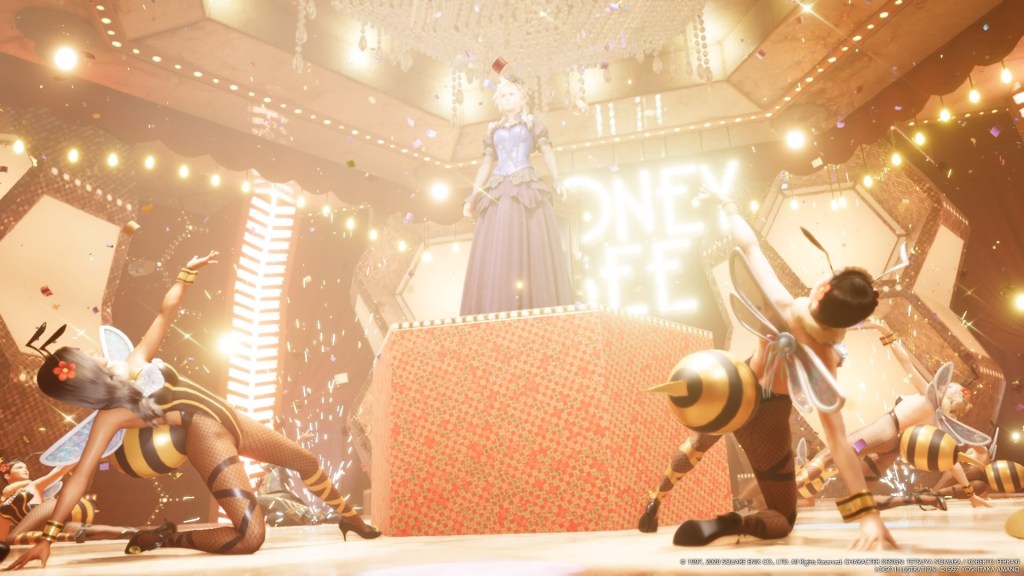
It was my worries about appeasement that made me sweat the cross dressing scene. Like, it didn’t happen in exactly the same way that it did in the original, and so much in this remake does not, but I kinda panicked. I was kinda afraid they may have made the cross dressing in Wall Market optional in order to appease in the opposite direction. I was kinda freaking out. And then Aerith walked Cloud’s spikey ass over to the Honey Bee Inn and all was right with the world.
Noticeably absent from original- the uncanny freak-out when Cloud walks in on a ghostly mirror image of himself. The ghost Cloud lunges at living Cloud and he blacks out. This was also the scene where we hear the song Who…Are You? for the first time. Later, Who…Are You? is paired with Jenova. When you first hear it used in relation with Jenova, the association with the hallucination in the Honey Bee Inn is nothing short of disturbing.
There is an echo of this event in the Remake, though, and it even happens around that time, even if it’s not at the same time. Before waking up in Aerith’s church, Cloud chats with a mysterious figure in a white void. At first I was so sure it was going to be Zack Fair. But it’s a second Cloud- perhaps alluding to the conflation in his mind.
Even with that difference I do appreciate how Wall Market and Don Corneo have been mentioned and foreshadowed, going back to the scuffle with Corneo goons in Sector 7. The constant background chatter about the long-reaching consequences of the Avalanche bombings dovetails nicely from the unexpected carnage after the first attack and Barret’s belief in needing to crack eggs to make omelets.
Not sure if my favorite quote from yesterday’s binge was “The Lady of Frost is the perfect companion for a man like you, Cloud” or “Never be afraid, Cloud”.
After a five day delay it finally freaking came in the mail. I don’t normally get on crazy fan-girl hype trains like this but this, for me, is a truly unique game. I got hooked on Final Fantasy VII around 2000 on the PC version but I played it for the first time in 1997, when PlayStation in general was new to me. I was around nine years old and I got my mom to rent it from Blockbuster.
I remember finding this add in a 1997 issue of GamePro. I think I had the magazine in the first place because it had a story on Tomb Raider II.
By 2000, the Zelda series and a monster-hunting PS1 game called Jade Cocoon were my two favorite games. And then Final Fantasy VII happened. And I still don’t think I’ve encountered a game that has a story that’s quite like it. Like I mentioned in my earlier FFVII entry, I think a lot of that may have been a series of happy accidents, of a ton of cooks pulling off a good soup against the odds.
However it happened, though, it happened, and if you clicked on this then I probably don’t need to catch you up. So because my nutty lil fan-girl heart won’t let me keep this to myself:
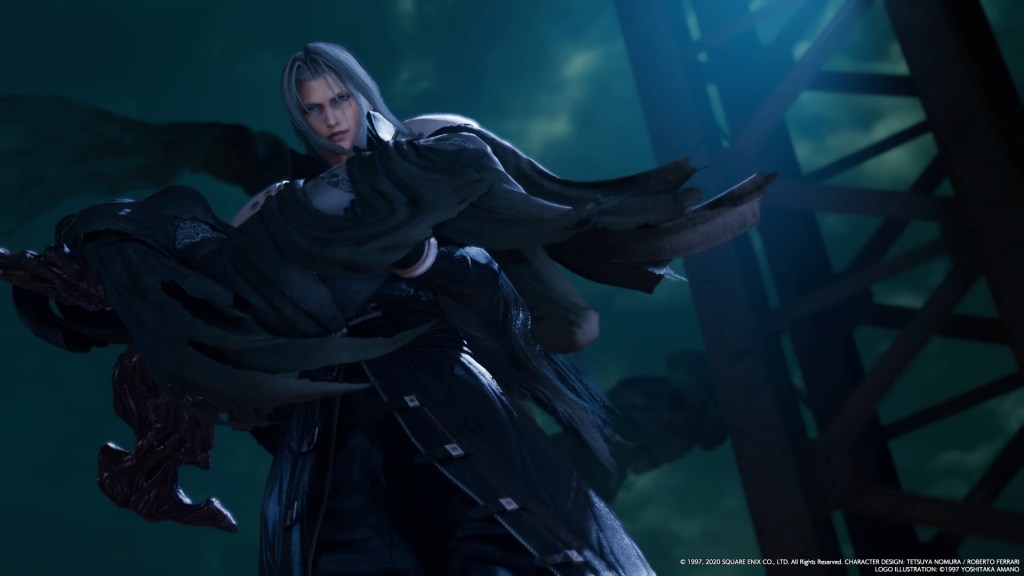
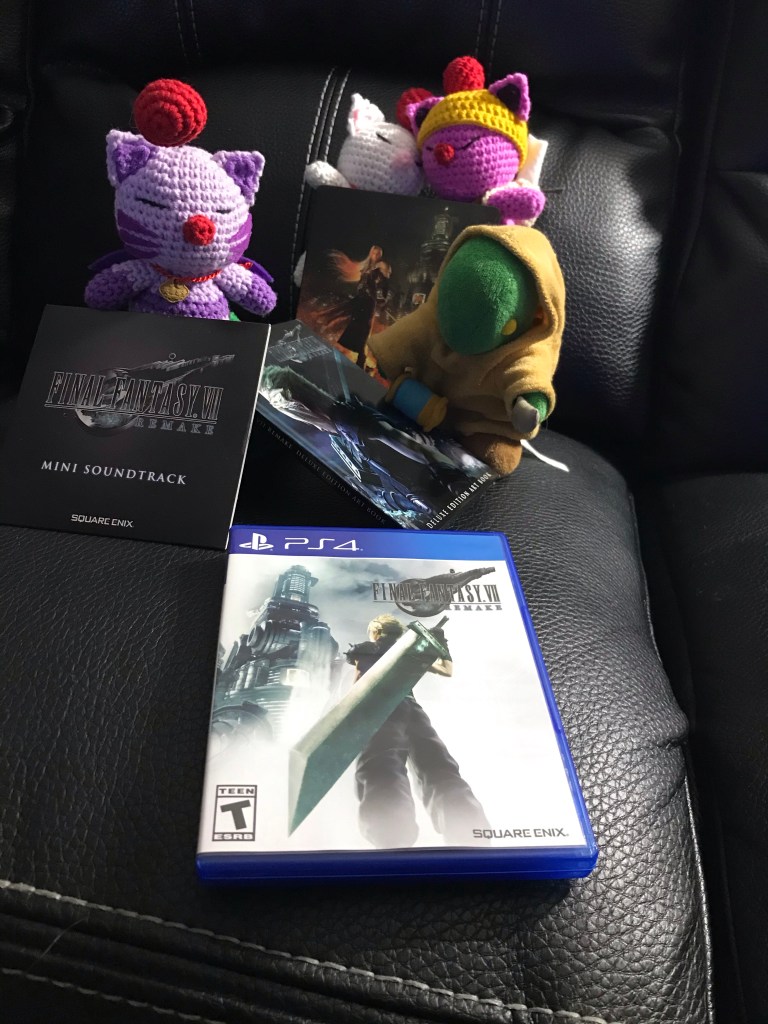
The Deluxe edition, with the art book, soundtrack sampler and tin casing with Sephoroth
By the way, the FFIX Moogles are from an Etsy dealer called nhimconshop ^^
Between today and yesterday I’ve played for over twelve hours and I’m only just getting to the Airbuster fight. Still nowhere near finished, and I’ll definitely upload a post later when I’ve played all the way through. I’m completely spazzing out over this though and I gotta get something out now.
I’ve written at length on this blog about how scenarios originally written for sprites and dialogue boxes don’t always make the best one-to-one adaptations for modern graphics and voice acting. From what I’ve seen so far, though, the early portions of this game definitely justify the use of both. During the bombing of Mako Reactor 1 in the beginning, I quickly noticed something that FFVIIR did better than XV: meaningful use of size and proportion.
FFXV is a good looking game, don’t get me wrong, and it has some really cool moments with summoning Astrals- Leviathan and Bahamut in particular. Not to mention flying around in the Regalia. But the sense of size in FFVIIR seems to hit harder, somehow. Inevitably, this has got to do with my love for the original tempting me to compare the different versions. And…well…nostalgia: if you remember locations and events in a story fondly you would naturally enjoy seeing a beautiful and thorough reinterpretation.
A few reimagined moments from the original are super pretty
Not that there isn’t depth to be appreciated in that comparison: I played through the original multiple times and I always wondered A. is mako a gas or a liquid and B. although it is made from the Lifestream does that mean that it is the same as the Lifestream? Is that why they’re both pale green? In the first Reactor, you see a giant pool of churning, luminous liquid with crashing waves folding in on each other like whirlpools.
At the same time, though, there is an appearance of thematic consistency to the presentation of size. When you first descend the ladders in the actual Reactor core at the beginning, you are coming out of a series of infiltration obstacles that make you feel both cramped and like you are being watched. The hugeness of the room with the mako pool and the Reactor core shocks you. Barret also asks an interesting question as you navigate the catwalks and ladders: if you fell in, would you just keep falling until you reached the heart of the planet? Anyone who has played the original game knows how important those words are.
LOVE the sense of size and distance in this game
Also loved the use of size and distance in Sector 7. Parts of it are cramped and dilapidated, but there’s also these gorgeous, sprawling distances, stretching out from beneath the plate.
Callbacks and contrasts are also implemented through music. A song called Lurking In The Darkness in the original soundtrack is heard for the first time in the remake in a new scene. Cloud is taken aside by some goons that look and sound like they work for Don Corneo, attempting to dig up dirt on Avalanche. (Remember, this is about my first impressions so I’m still early in the game).
A few different songs from the original soundtrack are used in different ways. The song On Our Way, in the original, isn’t heard until Kalm, before Cloud tells his version of the Nibelheim incident. In the remake, we hear it in Sector 7. In the original, we first hear Words Drowned By Fireworks when Cloud takes Aerith (or whoever) on a date in the Golden Saucer. In the remake, we hear Words Drowned By Fireworks in the flashback to Cloud and Tifa as kids.
(Is that true about the Golden Saucer date? I feel like I remember Words Drowned By Fireworks before then….even if the song is named after the scene)
Another cool bit of foreshadowing and cosmology-building is the story of what happened to Jessie’s father: mako poisoning. He never wakes up and Jessie has a theory on why: mako is the Lifestream, the Lifestream is the flow of transmigrating souls between lives. All souls pass through the center of the planet on their way to the next life. If her father’s body and brain are poisoned by mako energy it makes sense that his soul would be suspended between the center of the planet and his body.
She deduced this through a discipline called planetology. I don’t know if the word / concept of planetology existed before Dune, but that’s where I first encountered it. Not that this means that there’s some kind of epic Dune tie-in, but I think it’s cool that a related concept is now involved in FFVII. (It’s just an elaboration on ecology: when humans discovered space travel and started to own and buy and sell entire planets, they realized that the well being of an ecosystem hinges on the whole planet. So it’s changed to planetology)
All that about Jessie’s theory establishes an important concept that has a big role in the original story. I also appreciated how the clones are introduced earlier in the story. It validated a theory of mine that both Sephiroth and Jenova are not only controlling them but can actually possess the bodies of the clones and transform them. Ifalna tells us that Jenova is a shapeshifter in the original game, so that would account for Sephiroth’s apparent ability to travel vast distances instantly and Jenova’s different forms. Anyway, in the remake Cloud runs into a clone super early and Sephiroth possesses him. He actually makes Cloud hallucinate Sephiroth’s old appearance, black cape and all.
The combat system is also great. It’s not stupid simple like XV where you’re basically mashing one button over and over again and you can freely play as other party members. It also requires that you strategize in many of the same ways you did in the original- like pairing the elemental materia with a relevant element spell so you aren’t forced to constantly tap out your MP in order to exploit elemental weaknesses. There is also just as much necessity to consider how different materia impact your stats when doling them out.
If those of you who have played through the game already noticed my mention of the elemental materia, that means what you think it means: I did the big annoying Easter egg hunt en route to Mako Reactor 5. It bugged the hell out of me but I couldn’t let it go, I just had to get the materia. I also snagged the chocobo / moogle materia from inside the fan. This game has side quests, and they rope you in, but they don’t run the risk of derailing the story’s entire dramatic momentum like they do in XV.
Loving the shit out of this so far and can’t wait to keep playing ❤
Only a few days ago Square Enix dropped what is supposed to be the very last piece of DLC for Final Fantasy XV and it was…well…something. It was something, anyway.
Not altogether bad, but severely flawed in certain ways. Unfortunately, the flaws of this DLC echo many of the flaws in the base game so maybe that shouldn’t count too hard against it. One of the weaknesses echoed here is that it’s just too easy. I get that it’s short and episodic like all the other character chapter DLCs and not meant to last too long, but you can still pack a decent challenge into a small space. Again, though, the base game is almost startlingly easy compared to any other Final Fantasy game I’ve played so far.
I remember when I got to the point where Noctis wakes up in a daemon-covered Eos I was like “oh cool, now we’re starting the second half of the game”. That part does resemble how a lot of Final Fantasy games mark the middle of the story: FFVI is divided between the World of Balance for the first half and the World of Ruin for the second (I’ll try not to dwell on FFXV’s botched references to VI…). The middle of FFVII is marked by the appearance of Meteor in the sky, etc. While this isn’t exactly consistent with the pattern, FFXIII has you get kicked down to Pulse.
Soooo given the established precedents, night-covered daemon-ravaged Eos seriously looks like the second half is about to start. And then you get that notice saying that once you enter Insomnia the final battle is afoot. It was kind of a facepalm moment for me. I had barely been playing the game a few weeks by that point and I was seriously taking my time, trying to absorb as much as I could and do every side-quest I could find.
There were two reasons for this design choice: one of them is that the majority of the content is post-game. The second is that Square Enix was seriously considering a move toward a different business model focusing on MMO’s and mobile apps, with Final Fantasy XV being something of a transitional device. Square evidently planned on developing a ton of DLC for the game, to be released over the next few years, and how that would go would be guided somewhat by player feedback.
So it pretty much was an incomplete game upon its initial release. Maybe some of the super-easy, loosely-structured gameplay in the main storyline was supposed to afford wiggle room for other DLC and update doo-dads. Evidently the unfolding of the central storyline was also supposed to be guided by reactions from fans. The unfolding definitely was, but I guess there’s also room to infer that some of the actual plot details could have been governed by fans as well. The Ignis DLC, with its multiple endings that would impact the story going forward, may have opened up a door for multiple timelines. So who knows what that would have yielded if they hadn’t decided to stop at Episode Ardyn and put the rest of the planned story revelations into an upcoming novel or story collection.
Interestingly, though, out of the fan reactions that made it to the ears of Square Enix, no one had mentioned the super-easy difficulty as a problem. In fact, they thought the part where Noctis is stripped of his powers in Gralea was too hard. Sooo the game started shockingly easy and stayed shockingly easy throughout the exchange between Square and the players. So Episode Ardyn can’t be singled out for that, exactly. And I’m sorry if I seem like I’m spending a lot of time dwelling on a weakness that’s fundamental to the IP itself and not the specific fault of this DLC, but it messes with me. Because it’s so ubiquitous, in almost every facet of FFXV. The Pitioss Dungeon was the one clear exception. Costlemark Tower requires some persistence and grinding but isn’t really hard.
It also reflects badly on how Square Enix has developed other parts of the digital supplements, like the multiplayer expansion. It seems like quotas of monsters to hunt is something that gets plugged in a lot. I mean it’s most of what happens with the multiplayer expansion and the majority of things to do in Episode Ardyn involve wandering around and getting in fights. It’s like they want to do an “open sandbox” design but don’t really have a good idea as to how to flesh out the gameplay in the “open sandbox”. The multiplayer expansion consists entirely of kill quotas and the dungeons that get unlocked post-game from Ezma’s key are just successive subterranean rooms with monsters to kill. If Episode Ardyn was the last DLC for this game, they evidently decided to end with what they did the most of.
The biggest map in the DLC is the city of Insomnia during your raid, with items scattered all over that become visible when you knock out a shield generator, and gimme points for destroying signs and cars and balloons and megaphones along with push-over battles with Insomnia’s military (the Kingsglaive, maybe?). A few decades ago, there was a game called Rampage on the Nintendo 64, where you play as a claymation monster causing random havoc in a city, Godzilla-style. In elementary school there was only one other person in my sixth grade class who was as annoyingly hyper-active as me and we spent a loud, cackling evening once on that game. That was what Episode Ardyn reminded me of. Which is to say I had a little bit of fun. It was easy to the point where I only got KO’d once and it was a simple planning mistake, but I had fun. The music they used for the orgy of destruction also got a smile out of me: it’s this rap-like thing that reminds me of nu-metal, a late-childhood / early teens throwback for me.
But it’s simplistic, and after spending much of FFXV not being challenged at all, it’s just sort of…like…having another bowl of ice cream for dessert, after your ice cream dinner which was smothered with hot fudge, caramel and pieces of Oreo and Heath bar. Ice cream is nice and I pretty much always like ice cream, but there is such a thing as being overloaded on it.
That being said, the story complications weren’t s’bad. It was cool to see Ardyn get pulled out of the Angelguard prison after two millennia of somnolent captivity. By a young Verstael Besithia, no less, when he was young enough to have the features we’d see on the Magitek troops once they started cloning them from him…which is to say a face quite like our lil blonde friend Prompto in the base game. It seemed like a neat, subtle thing to do- seeing Verstael and Ardyn interact with each other was almost like a villainous mirror of Prompto and Noctis (what with Ardyn’s connection to the Caelum family).
Next, we have some follow-up to some other revelations from the prologue anime that got released back in February which set part of the stage of the DLC. When the crystal flashed and gave it’s choice for the throne, there were wing and blade-like shapes flaring out from it that looked like Bahamut. Implying that Bahamut chose Somnis and shafted Ardyn and causing people on YouTube to make theory videos about how Bahamut might be the real villain of FFXV.
Early in the DLC, we get a sort of convoluted reversal of that which I didn’t fully understand. At the end, though, there is a conversation between Bahamut and Ardyn that goes back to supporting the idea of Bahamut orchestrating Ardyn’s journey. Ardyn learns that his death will carry the daemons with it, and when they’re gone, the need for a divine steward (such as the Caelum family) will go away- essentially, that Ardyn and the kings of Lucis will perish together in the end, satisfying his desire for revenge.
Bahamut has a similar talk with Noctis near the end of the base game about accepting his destiny graciously, which creates a really nice parallel that links us back to the brotherly enmity we witnessed between Ardyn and Somnis and the role that destiny played between them. It’s a neat way of characterizing the Caelum family as a group with a light and a dark half that are both equally dependent on each other.
There were still a lot of glaring omissions, though. The Starscourge began with Ifrit’s rebellion and the Starscourge was the whole motivation for Ardyn becoming an Oracle. Late in the game, Bahamut and Ifrit continue to be big players. Has this all been about human proxies in a war between the gods? It’s definitely implied. Prolly not stated to maintain the impression that the human characters are still centrally important, though.
The possibility that the whole plot of FFXV is built around a proxy war between Bahamut and Ifrit also supports the presented narrative of the Caelum family, of it’s light and dark nature that are divided by enmity and united by mutual dependence. Noctis, Ardyn and Luna are all martyrs to a superhuman cause.
While Episode Ardyn may have aptly tied together a bunch of the themes thus far, I also think it supported one of the worst narrative qualities of FFXV. Most Final Fantasy games have a halfway point where the world is in danger and the priorities of every character are either turned on their head or otherwise re-evaluated. FFXV stops at the point where this would have happened- not just in terms of Final Fantasy‘s typical plot structuring, but they also truncate the main character arcs where, in older FF games, they would only just be taking off.
The characters of FFXV are barely required to re-examine or take ownership of themselves. Sure enough, one of our last images in the game is Noctis and Luna holding court in the afterlife. He seems to be sharing a happy ghostly existence with a woman he pined over but has not spoken to since childhood, so evidently the plot requirement that Noctis die has rewarded him for not growing up. All the pathos of tragic love rewarded with total indulgence, culminating in the most saccharine portrayal of tragic love I may have ever seen.
Just on it’s face, this is lazy and possibly repugnant storytelling that glorifies an unrealistic picture of romance. That’s bad enough. Especially with stuff like 13 Reasons Why and the Twilight books fresh in our memories. But it’s worse when so many of the older Final Fantasy stories have done better than that, often with love stories. In VII, Cloud found validation for his sublimated identification with Zach through Aerith, which is a kind of morbid fantasy ideal, but in the end he was nurtured by his friendship with Tifa, whom he had known since childhood. In FFVI, Locke gets wrapped up in a white knight complex over his failure to protect his dead girlfriend, Rachel, and during the World of Ruin segment, he can be found attempting to track down an Esper that he believes can revive the dead, which turns out not to be possible.
Even without keeping our focus on romantic subplots, a lot of similar things happen. FFIX involves the search for a soul, which both Zidane and Vivi have idealized as an unobtainable seal of approval entitling you to your existence, and both of them learn that you don’t need any deeper validation than your own subjectivity and lived experiences. I could go on.
I’m not saying old Final Fantasy games are Shakespeare or anything, but a few of these character arcs show genuine attention to detail and there’s no reason not to give credit where credit is due. And like I said, FFXV breaks the pattern of something that was (at least) admissibly pulled off in a lot of the older FF titles.
Another reason why I’m dwelling on the botched portrayal of tragic love between Noctis and Luna is that, in one of the polls Square Enix took among gamers, many reported that they would have liked to have seen Noctis and Luna get their “happy ending”. None of the fan responses brought up the issue that the relationship was over-romanticized and that it was based on A. a marriage contract between two nations and B. a childhood encounter between the two affianced. There are ways to deal with political marriages in narratively compelling ways, but trying to make the two marriage pawns “true lovers” on the strength of a childhood meeting years ago, and nothing else, is not the way to do it. I also feel like Episode Ardyn was meant to leave wiggle room for the “happy ending” with Bahamut placing Ardyn, fully clothed and with his social standing in Niflheim intact, at Angelguard again. And we hear no mention of the raid on Insomnia with the younger Regis in the base game, so presumably it was purged from the historical record, implying that Bahamut can manipulate time. That’s two DLC’s (counting Episode Ignis) that suggest multiple timelines.
I would maintain that everything I’ve written in this post so far is defensible but I’m about to get into territory that departs from actual sources and is total speculation on my part, or fix-it fic-ing.
What if FFXV actually had a second half after the global disaster, like every other FF game, and Noctis had the chance to make his own choices free of family obligation and unrealistic fantasies?
Who has been at Noctis’ side throughout the whole journey, expresses concern and regard for his emotions, treats him like an equal without pulling any paternal moralizing crap, and has a truly upsetting falling out with him that they bounce back from?
Prompto. You read that right. I think Prompto should be Noctis’ canonical love interest. I’m not saying this trait is always a telltale sign of closeted homosexuality in and of itself, but just think about it: Prompto is really vocal about thinking this or that girl is cute, way more vocal than any other character. The other guys in the brotherhood even rip on him over it, albeit gently. For all of his chauvinistic noisemaking, though, he never does anything chauvinistic, toward a female or anyone else. Prompto even seems to easily make platonic friendships with female characters (Iris and, in his own DLC, Aranea Highwind). You could rebut this by saying no other male character makes any romantic or sexual moves on any female character, but Prompto is the one who sounds off about it. Therefore, it is only in his case that the question is begged. Prompto makes a lot of noise about how straight he is, but when do you ever see him truly bent out of shape over a girl? Who is the only person whom he ever gets bent out of shape over? That would be Noctis.
Another rebuttal could be that Noctis shows no visible signs of being anything other than straight. I think this was a commonly voiced objection when Gotham briefly entertained a ship between Penguin and the Riddler. Viewers would complain that Edward Nygma, aka the Riddler, never frankly expressed attraction for a man. However, a lot of bisexuals can attest to the fact that it’s possible to cling to the illusion that you’re straight, regardless of feelings, if you only ever act on feelings for the opposite sex. This could just as easily be true of Noctis if the writers cared to take it in that direction.
If the game continued past the first glimpse of the World of Ruin, we also may have seen a different and more compelling story about demanding to live in spite of a prophecy requiring you to die. That, as a central theme, would have gone nicely with a new love interest once Luna was ruled out as a possibility. And by new love interest I mean Prompto. C’mon, Square, one unambiguous same-sex couple wouldn’t kill you. They sort of went there with Fang and Vanille in FFXIII, but it wasn’t frankly stated.
Is this me airing a fan-fic thought bubble? Totally, but I think it’s defensible by the standards of fan-fic thought bubbles. If that’s too wonky, then I guess I’m just saying FFXV has a story that’s abruptly short and compares badly to many of the older installments. Boom. Ended on an objectively arguable note.
I have, at last, vindicated the frustration of twenty-one year old Ailix and beat FFIV. There was a bit of the typical Final Fantasy difficulty spike before the final boss but nothing too spooky compared to VI, VII, VIII or XIII. As has been typical of this playthrough, all of the real grindy grind marathons have been entirely because I decided I wanted to. When I first played through FFVII I got on this crazy, single-minded kick of wanting every character’s ultima(te) weapon. FFIV was pretty quick and painless in that regard. The one that really seemed to require effort was Edge’s Masamune and Murasame, since one of them is pretty deep in the final dungeon and protected by some fairly tough monsters. Excalibur, meanwhile, was a fetch quest that’s kind of a walk in the park if you’ve waited until the very end of the game to do it. I may be inclined to be blasé, though, since I had already completed the Feymarch dungeon and collected the rat tail without knowing what it was for beforehand. As frustrating as that particular dungeon was at times, I had a lot of fun with it.
If you’re reading this for helpful notes it may behoove me to mention that you might want to have both Porom and Rosa in your party for the final battle with Zeromis. With Rosa absolutely maxed out, of course, with Holy in her repertoire. You’ll also want to buy as much elixirs and dry ethers from the Hummingway cave as you can (the Hummingway cave had a bit of a Twin Peaks vibe. Lots of colorfully dressed short creatures making discordant, electrical-sounding noises…).
Basically, if you Holy spam the crap out of Zeromis with another reasonably maxed out white mage on healing detail with everyone else doing decent damage (having Rydia summon Bahamut repeatedly sure won’t hurt, if you’ve managed to navigate the Cave of the Father) while being absolutely shameless with keeping everyone doused with elixirs, you should do okay. I didn’t feel too much like a lame-ass for using elixirs like that, since Zeromis will screen nuke you repeatedly and if you get stuck in a rut of trying to revive multiple party members with phoenix downs on one turn and then healing them another…well, that gets you in a downward spiral that’s real hard to climb out of. I mean…if you have the Asura summon, that could be occasionally helpful, but what she does once summoned is just too random to be reliable.
BTW I deduced the thing about having two white mages in retrospect: I just went in with my normal arrangement (Rosa, Edge, Cecil, Rydia and Kain) and almost didn’t make it. Basically, Rosa was on both Holy and healing duty. Which turned out not to be feasible. And I barely had enough elixirs. I was one away from being out, with only Rydia and Kain still alive, when Kain came down from a Jump and wasted the bastard. Rydia was pretty low on MP also; I’d more or less resigned myself to dying while trying to get her to Osmose her way back up to the point of being able to summon when Kain miraculously won the fight. A satisfying final boss, really. When judged solely as a boss fight, anyway.
This game has many of the same narrative strengths and weaknesses of Final Fantasy XIII. Both stories do a great job of discussing themes while also being lazy with plot construction. When a story does a good job of discussing ideas while failing to get you to care about its characters it creates a funny feeling of watching something archetypal. Which could turn out to be true, but even then, those archetypal tropes and comments don’t create depth in and of themselves.
The concept of Zemis/Zeromis ties into both the thematic strength and the narrative weakness. With fantasy stories about fictional worlds that could, potentially, be constructed in a total vacuum with no reliance on the real world, the consistency and integrity of the world building is more open ended and therefore more delicate. With no correlating outside material (other than other sources taking place in the same fictional universe) you’re kind of trusting the storyteller 100%. You are anyway in a lot of cases, but the totality of the storyteller’s job get’s starker and more delicate the more unrestricted they are.
The really big narrative weakness in Final Fantasy IV is something that can easily happen in fantasy stories with an alien-invasion plot. World A is the world we spend most of our time in and it’s the one we get the most immersed in (Earth or Gaia or whatever. The Blue Planet). Since the unfolding of a plot has to happen through gradual revelations, there are necessarily parts that look like blank spots until they are revealed or explained, and the mystery of the blank spaces is usually something that keeps you interested until the end.
Anyway, there were obscured plot details that were resolved with the appearance of World B: The Red Planet, or the moon. In a fantasy setting, bringing in a separate world that informs things about another has the potential of subverting one set of rules with a completely new set of rules. Final Fantasy IX sidestepped this by having the Terrans be almost completely off-camera- we only see their biomechanical creations and future host bodies. Same goes for Jenova and the Cetra in VII- the original worlds of both groups are totally off-camera with only the most relevant details being visible.
In Final Fantasy IV, we get to set foot on the other world. I mean, we don’t get full immersion- the aliens are still in cold storage waiting for their custodians to find and prepare their new home. We have the Crystal Palace, the Cave of the Father, Hummingway village and the Lunar ruins- that last one I haven’t explored yet, though.
With both IV and IX, you could argue that the World B changes the rules up to that point. In IX, though, less things are stated openly. Some people have a variety of theories about whether or not Necron was present beforehand, what precisely is happening in Memoria, why Memoria is there, etc. I have my own interpretations of all that which I might get into in a later post, and I think the game offers more than a Rorschach ink blot to go off of. What I mean is that you can credibly infer what is going on from the implications. But because so much is implied in IX, it’s possible to finish that game with a personal interpretation that keeps everything in the same world with the same set of rules. I don’t think that’s sound way to “read” FFIX, but because so much is not said openly, the player has a lot of latitude to make their own interpretations. FFIV has less latitude, though.
For one, Zemis/Zeromis is tied directly to both the thematic threads and his utterances are so reminiscent of certain plot points that it’s hard not to think that he’s talking literally about how the fictional world works. And he does not say much. He only tells Golbez that his commitment to a path of darkness is irrevocable and that “the crystal cannot cleanse your sins”. This isn’t just a thematic nod, since the story on the mythgraven sword describes a hero who goes from “dark” to “light”. I mean, we see moral reversals and forgiveness all the time in this game- Cecil razed Rydia’s village at the very beginning, after all. But the mythgraven blade tells us that the journey through sin and absolution is literally a part of the world building mechanics. And Zemis’s transformation into Zeromis is only explained as his hatred “growing stronger” after his death. Which supports the possibility that moral and spiritual states of being have material expressions in the world of Final Fantasy IV.
Before moving on, there is a phrase describing a trope that covers events like this: the power of love. Trinity brings Neo back to life with her love in the first Matrix film. Steve Martin changes the polarity of the earth to stop a plane from taking off to keep a girl he likes nearby in LA Story. That’s basically how the “power of love” trope works.
While what happens with Zeromis is credited to hatred, it still has the basic mechanics of the “power of love” trope. Something happens for no other reason than a powerful emotional cry going out to the universe. You could reasonably call it the “power of prayer” also. Harry Potter takes advantage of the power of love trope, but also manages to incorporate it into its world building, making it less of a naked, self-justifying trope. I’m not sure if Final Fantasy IV makes that transition successfully or not. It’s clearly supposed to.
The reason I’m droning on about this trope and it’s common usage, though, is because it’s widely disliked for a reason close to all this: the power of love trope has a tendency to subvert the constancy of the world building or “rules” of a story. It’s a commonly used deus ex machina. This is also the risk of bringing in the rules of a second fictional world when the player/reader/viewer/whatever has spent so much time getting used to the rules of a first one.
This destabilizing risk at play with both the “power of love” trope and the appearance of a second set of fictional rules are tied together in that the aliens in FFIV are something of a founder race of the first planet. The Tower of Babil has been there for the entire history of the Kingdom of Eblan. It seems like that, anyway, no one there seems to remember a time when it wasn’t there. The Lunarians also know a ton of specifics about how the crystals work and the Earthlings seem like they just worship them as forces of nature that have always been there.
The crystals are the McGuffin tying this plot together and it seriously looks like the Lunarians have all the answers regarding them. The Lunarians have also been technologically advanced for much longer than the Earthlings and will even sow bits of knowledge Prometheus-style (Cecil’s dad and the airship technology…). So it looks like the crystals may actually be a creation of the Lunarians- not divine elemental sources after all, but technology that controls the elements. An apparently controversial technology- the mythgraven blade says one thing and Zeromis says another -but still technology in all likelihood.
Because the Lunarians are the founder race and this is a story about ancient aliens, we have to take their assessments of the relevant McGuffins as definitive. You can’t explain any of the ending events of FFIV as part of the prior set of rules for the first planet, since the inhabitants of the second planet created the whole situation. The second planet has all the answers, so the paradigm shift is unavoidable. And the central plot dynamic has to do with material expressions of spiritual states of being, as spoken by an authoritative second planet source, so the “power of love” trope is equally unavoidable.
Paradigm-shifting plot-twists can be pulled off in the late stages of the story but not if the player or reader has to accept too many radical breaks in consistency too quickly. If a plot-twist effects earlier plot mechanics, it has to somehow be addressed, or the reader or gamer feels like they’re trying to swallow something either sight-unseen or with incomplete information. Witness the timeline issues that are never brought up again (unless it happens in Interlude or After Years, in which case I will happily eat my words. Even if it does happen in those, though, the original game was presented as a standalone story for years sooo….those last two games must be taken as after-the-fact retcons).
As I explained in my last post, this is brought up by the appearance of airships and the lifespans of Cecil and Golbez. The same Lunarian introduced the airship technology and fathered both of those characters. This Lunarian is also the brother of Fusoya, our first friendly denizen of the moon, who is ancient- presumably thousands of years old. Not very many Lunarians are awake, so Fusoya and his brother are probably ancient caretakers of the planet.
Probably. The age of each brother is not specified but the rest of the story only leaves room for so many possibilities. If the two brothers are caretakers for the rest of the sleeping planet and one of them is canonically stated to be the caretaker since the era when the Tower of Babil was constructed…what about the second brother? On one hand, airship technology was only introduced in the recent past and there’s no reason to think that Cecil is any older than the other adult-ish(?) characters. On the other hand…we are told nothing about the background of Golbez, other than he has the same father as Cecil. Then there’s Mount Ordeals and the legend of the Paladin inscribed on the mythgraven blade, which the village of Mysidia has known about since time immemorial. When Cecil transforms into a Paladin and draws the mythgraven blade, he hears the voice of his father. Did Lunarian Number Two plant the mythgraven blade thousands of years ago? Apparently. So are both Lunarian brothers thousands of years old? What exactly caused Lunarian Number Two to go rogue and start doing his own thing on the Blue Planet in the last few decades?
The parentage of Cecil and all of these complications are introduced very quickly near the end of the game and are never addressed in the first game in the trilogy. The consequences that the plot-twist has for the plot so far are never addressed, which compromises the continuity. The paradigm shift with the Lunarian founder race and the elements of the “power of love” then start to be a bit of an eyesore.
There are other weaknesses in the story, but in my opinion this is the really big one. That being said, the thematic discussion of redemption holds up well. Between Cecil, Kain and Golbez there are three major character arcs that involve stark examples of absolution. Rydia’s reappearance from the Feymarch does a good job of bearing this up as well. When Cecil gets shipwrecked near Mysidia, he has every reason to think Rydia is dead, which renders his treachery to the village of Mist complete and snatches away his last shred of redemption in his own eyes. It’s a great way to set up the Paladin transformation, and when Rydia comes back it stops her from being another female character predictably sacrificed to develop a male one through tragedy. I also appreciated that Golbez elected to stay on the moon at the end of the game, as it echoes Cecil’s expiation arc. Despair is also examined hand in hand with redemption, which makes sense: redemption is transcendence, despair is being cut off from transcendence. Self-sacrifice or suicide can be ways of narratively exploring the link between the two and a ton of characters attempt to off themselves. The link and the mingled hope and despair implicit in it is even stated by one character after Cid appears to blow himself up: “Why do so many choose death so easily?”
There are other expressions of this a little further from the foreground. The four demonic guardians of the crystals (typically represented by the Four Fiends in older FF games) are now named after demons from the Inferno section of Dante’s Divine Comedy. The last fight with them, with all four at once as a single being, even has a loose consistency with the deeper circles of Hell reserved for betrayers. In Inferno, people’s bodies frequently combine. In one canto, a scorpion stings one of the condemned souls, the soul turns to ash, then the ash swarms around the scorpion, absorbs it and turns into a hybrid. Obviously that has no bearing on the plot of FFIV, but it’s a way of keeping a relevant theme in the background. Then there’s Namingway constantly offering to change your name for you, which is rather on the nose.
If I really wanted to bog myself down in minutia, I could get into the thematic comparison between temporal and spatial world views. Theological concepts like salvation and damnation are typically part of a temporal cosmology where a grand timeline of the universe is privileged over local circumstances. In the worlds of Judaism, Christianity and Islam, all of humanity, everywhere, all has a common destiny which involves salvation for some and damnation for others. Salvation and damnation seem to be consequences of the timeline’s eventual end. In spatial cosmologies though, locations and nature are privileged over any possible timeline. Ancient pre-Christian belief systems in the West, for example, with deities embodying different natural forces. This is also exemplified by the reaction that both Vikings and some Native Americans had to Christian missionaries: they appreciated the Christian origin story as relevant to a certain group of humans…but fundamentally believed that different people originated in realms that are so different as to almost put them on the level of other planets or species. That different humans, like different non-humans, can be literally worlds apart. I imagine that some interpretation involving this is possible with this game, what with involving language of salvation and damnation combined with a world organized by four different elements. Which could possibly play into the thematic structure examining despair and redemption, side by side.
Maybe some of the writers and developers were thinking about things like that. Or maybe they were just reaching for different sources from religion and mythology which, as a fantasy writer myself, I understand is very fun to do just in and of itself. When I was in middle school a friend and I made our own table top game that was literally just a giant amalgam of mythology and religion. So no hate on that front. There’s at least enough suggestions of a temporal versus spatial thematic layer to raise the question, though.
As interested as I am in this kind of nutty interpretation, though, compelling thematic structures are not enough to create a good story in and of itself. In fact, I think this very disparity is something that Final Fantasy games historically have a messy relationship with. FFXIII is an even better case and point than IV, in both how it can go very right in one way and horribly wrong in another. I can only think of two, maybe three, Final Fantasy games that really got the balance right, and even the way in which the successes compare with the failures are interesting. Since I seem to be losing inhibitions with being a full tilt weeb, I’m sure I’ll write a longer post unpacking that even more eventually.
I was too sick to go to work today and, while I was largely confined to the one room in which I was resting, I still managed to make the most of my stolen time. I did more preparation for my imminent move and comfortably fielded my way through a job interview by phone (I rang off feeling rather good about it ^^). Being quite ill, though, and not being up to much activity in general, I naturally sank a few hours into a gaming binge.
I know this probably doesn’t matter that much, but just in case anyone was wondering- last spring I thought I would have consistent access to a SNES on which to play the original FFIV, which I was totally stoked about since the 16 bit graphics and text-based dialogue suited the game so much better than the upgrades on the DS remake. Oh yeah, and the DS version had a few completely insane difficulty spikes.
In the end I ended up not being around the SNES all that much so I eventually ended up getting a digital copy on my Vita as part of the Final Fantasy IV: Complete Collection, which luckily turned out to be quite faithful to what I had seen on the 16 bit version until then. Just a few graphical bells and whistles with some spells and summon monsters and some spruced up cut scenes, looking sorta like PS1 but perfectly good on the Vita’s smaller screen. With said cut scenes, I like that they preserved a bit of the chibi aesthetic they seemed to be going for on the DS, which goes well with the high fantasy and occasional whimsy. And the fact that it was kept to the cut scenes stopped it from effecting the tone of the overall story too much, which was for the best.
Anyway, since my first encounter with Golbez in the Dwarven Castle drove me completely bugsh!t I kinda didn’t do a damn thing for freaking ever but grind Rydia relentlessly until she learned bio…and still couldn’t stop sweating it. Like…most sources I found said that bio deals non-elemental damage so Golbez shifting his weaknesses shouldn’t matter against it, but…but…is that, like, just the DS version? In the original were there other complications that didn’t have to do with elemental weaknesses? Is he just gonna incessantly deck anyone you try to revive with phoenix downs during a fight where you need to revive everyone except Rydia……????? X_X
Luckily, that fight turned out to be a complete push over this time around. And whether this was a serendipitous sweet spot of the original or the product of Square observing it’s unfolding franchise over the years, the pacing of the incremental difficulty was pretty damn solid. I haven’t finished it yet- I think I may be poised before the final battle? Just finished off the Babil Giant and round 2 of the Archfiends? -but so far I’ve never felt like I need to break off the main story progression in order to grind. Part of that might have to do with the excessive grinding I did early on but it can’t be all of it. I did, however, instantly want to drop everything as soon as I had the Falcon Airship and just hyperfocus on the Sylph Cave and the Passage of The Eidolons. As soon as I found those two locations I knew I had found something that I’d been missing from most recent FF games. Both of those (one of them more than the other) are crazy hard and optional and I totally couldn’t pry myself loose. Part of it was that, as hard as the monster encounters were, they train you to think about prioritizing which character’s turn at what moment, which relates to one weakness.
Before this point there were a few awkward, mandatory battles where you could tell that the developers wanted that lesson to come through. I’m thinking of the first time you fight each of the Archfiends. In all fairness those really are simple rock-paper-scissor exercises. Just try different elements until you find the weakness. I don’t know if this is just my download or what, but I’ve never gotten the Libra spell to work when I needed it. I know that some of the debuffs never work on bosses since they’d probably be game-breaking if you could just silence, toad, mini, hold or confuse whenever you wanted. But all Libra is supposed to do is tell you their max HP, weaknesses and items they drop. I mean…with a lot of FF games, finding the correct strategy for a boss fight usually isn’t what makes it hard, it’s actually implementing the strategy while making allowances for set backs (a character with a necessary job get’s KO’d, keeping buffs in working order, managing disposables, etc). With the first Archfiend fights, though, I felt like I spent more time coming up with strategies. Maybe that’s not a bad thing, but for FF fans of my generation it’s a bit of a curve-ball. But with the Sylph Cave, the Passage of The Eidolons and the fights with Asura and Leviathan, I feel like the trial and error process was smoother and more fun.
Before I move past this, though, I can’t help but notice that FFXIII and XIII-2 handled buffs and debuffs better than almost any other Final Fantasy I’ve played. Reactions to the XIII games are divisive but I think the combat system is one of it’s unambiguous successes. This gives me pause since, for so long, I simply didn’t notice how inept the Final Fantasy series had been with the finer points of RPG combat.
I think part of this could be chalked up to that fact that I got hooked on FF when I was young, particularly with V-X, and with my limited frame of reference as a child, surface level circumstances usually made enough sense on their own. After all, it did make intuitive sense that debuffs would be handicapped or maybe altogether useless against most bosses- if they didn’t cap them in some way, the game would be too easy and the story’s tone and sense of proportion would be compromised. I think that inference also caused me to hand-wave away any consideration of buffs or even character specific command options like steal, jump, etc during any time that’s not a random monster fight.
What that does, though, is condition you to think of the combat system as having two modes with two corresponding approaches: boss fights and not boss fights. It really doesn’t get any finer than that, a lot of the time. If there’s any circumstantial variation, it probably begins and ends with elemental weaknesses, with a few exceptions here and there to spice things up (killing Soulcage in IX with healing magic, keeping Ruby Weapon totally prostrate for the whole battle with Dazers in VII, etc). However, the paradigm system in XIII makes it very convenient to use buffs and debuffs often- so often that there are a few characters that specialize in them. XIII also had a cool elaboration on the limit break mechanic introduced in VII that tied into the paradigm system through the “ravager” function. If you’re fighting a complete tank, you can have your party go largely on the defensive with “medics”, “synergists” and “saboteurs” buffing and debuffing while a “ravager” does middling but steady damage to build their limit gauge for a big devastating offensive every few turns. What that means is that, even if you’re overwhelmed and the pacing of a battle only leaves a little bit of breathing room for decision making, you still learn to make the best of your smaller window and gradually you get better at spur of the moment decisions. After playing FFXIII, the combat mechanics in the older games start to feel a little vanilla.
I don’t mean they’re utterly boring all the time- it’s just that once you’ve been made aware of the weaknesses through comparison, you really can’t unsee them. While the combat system in FFIV doesn’t go much further than the likes of, oh, VI, VII and IX, it nonetheless distinguishes itself among the 90’s Final Fantasy games.
Theeennnnnn….there’s the story…when you look at the body of work of either a franchise or an individual content creator it’s always interesting when you can see ideas developing. Like, when I saw Lynch’s Blue Velvet, it seemed obvious to me that it was an early draft of concepts that would later be fleshed out more in Twin Peaks. If that doesn’t make me a horrible trog, then what about my reaction to the original Dark Souls when I thought it was a tepid, unsatisfying first draft of Bloodborne?
Anyway, FF recycles a handful of concepts often- pantheism, Gaia theory, evil empires, a first villain embodying institutional evils (nationalism, organized religion, etc) that turns out to be the pawn of a second more mysterious villain -but FFIV uses a few more specific ideas that are developed later on in FFIX. Particularly, the alien invasion in a high fantasy setting. Both IV and IX are science fiction stories disguised as fantasy stories. If I wanted, I could take this in a whole other tangent about how FFXIII is a fantasy story disguised as a science fiction story, but I’ll resist that temptation (for now).
I mean…alien invasions…that’s basically what’s going on in both IV and IX. One planet gets destroyed, the inhabitants are preserved in either a non-physical or dormant state, and its stewards attempt to terraform your home planet (I’m still cracked up by the fact that FF stories are usually set on planets called Terra that are being terraformed or, in some cases, your home planet is being terraformed by aliens from a different planet called Terra).
The differences between the portrayals of the sleeping aliens are interesting. In IX (can’t help listing it first, I played it first 😛 ) the steward is a figure named Garland, a name recycled from the first FF game, who at times seriously appears to be a digital AI being. Garland is not confined to any one physical body and, when he first appears, the story frames him in such a way that his presence is synonymous with the spaceship called The Invincible. This could just be thematic nuance- the sight of Garland being thematically linked with the sinister mystery of The Invincible and the opaque origins of Kuja -but later we are tempted to think it may be more than that.
After Garland appears to be dead he telepathically communicates with Zidane while the party navigates Memoria. IX also states, firmly, that none of the dormant Terrans have been decanted yet. Neither Zidane nor Kuja are natal Terrans: both beings were created as war machines, to stop the cycle of death and rebirth, draining out the pre-existing souls via mist so they can be replaced with the Terran souls in Garland’s custody. Even the genomes (is that a proper noun? Genomes?) in the village of Bran Bal are meant to be empty vessels that the Terrans will be placed inside of. Before we learn all this, all the other manifestations of the Terran presence are technology they left behind or deceptively presented by Kuja for the planetary natives to misuse. And throughout the whole game we have Vivi wondering out loud if the fact that he rolled off of an assembly line makes his soul any less real than that of any other sentient being.
Vivi’s whole journey as a character is about whether or not your own subjective certainty of your existence has any bearing on your real existence. Very Blade Runner. And that wasn’t lost on my dad as he watched me play IX as a kid- he watched me go through the whole Terra \ Bran Bal segment and he kept calling the genomes Skin Jobs. Even now, as I’m writing this, before I type “Terran” I have to check myself so I don’t type Skin Job. Anyway, all of that taken with the fact that Garland exists in a form separate from his body seems to imply that he’s a creation like Zidane and Kuja, maybe that body isn’t even the real seat of his personality- it could just as easily be the Ilifa Tree or The Invincible.
In FFIV, the alien stewards are a pair of brothers who, unlike Garland, seem to be natal aliens (Lunarians this time, instead of Terrans). How long these two have been awake, as well as the length of the Lunarian life span, is not clear. Like IX, these aliens have technological doo dads that have been sitting around on the planet they’re trying to invade for millennia. A race of people inhabiting the Eblan region seem to remember one of these knick knacks (the Tower of Babil) being there for their entire recorded history. The two waking Lunarians were present and involved during the Tower’s construction- or at least they have knowledge of it that makes it look like they were.
They have a similar perspective on the function of the eight crystals on both respective planets, which could mean that even those have been created and planted by the Lunarians. Lunarian Number Two went to Earth and introduced airship technology, Prometheus-style, and at the start of the game we get a cut scene explaining that airships appeared within recent history. Perhaps the initial contact happened thousands of years ago and the pro-active meddling by the Lunarians is a recent event. This ambiguity (did contact happen in distant or recent history) is harder to overlook once we learn that Cecil and Golbez are descended from Lunarian Number Two (yeah, the dude does have a name, but I’m trying not to bog you down in jargon). Both Golbez and Cecil are referred to as his sons. It’s not clear if this is figurative (in the sense that they’re descendants) or if Lunarian Number Two is literally their bio dad. Cecil, at least, has a normal human life span and is like, 20-30’s, whenever twinkish bishi dudes are considered adults. At the point in the game I’m in, it’s still not clear how long Golbez has been around. It is said that he’s the older brother. Maybe all this will be cleared up in just a few days of game play, idk just now. The chronology seems vague so far, though.
Speaking of the alien stewards, I think it’s kinda neat that we get one of them as a playable party member for awhile. It reminded me of getting Edea in the party near the end of VIII, or how when I was playing VII I kept thinking how cool it would be to get Sephiroth in your party outside of the flashback sequence. Lunarian Number One doesn’t stick around very long, but it’s cool to have him during the time that you do, though.
About the playable characters, I also appreciate how you get a spectrum of different magic users throughout the game that demonstrate what the developing characters will eventually be capable of (Tellah, Palom, Porom, Lunarian Number One). It makes it more satisfying when Rydia and Rosa start getting all of their respective black mage and white mage skills. Also, the pacing of this story is so dang fast and so many characters appear to die so quickly that I don’t know what to think of the fact that four of the previously dead characters are now alive at the end. In a different game it would either be tonal whiplash, gimmicky or both. But this is a game with chibi sprites in a strip club, an underground continent of dwarves and a space ship that takes you to the moon and plot details unfolding a mile a minute so yeah. Rapid fire character deaths and resurrections shouldn’t be that disruptive in the end. Really, the whimsy combined with some of the more dramatic details gives this game a lot of it’s memorability.
Not that it doesn’t get stupid at times. I wanted to yell at Cecil when he attempted to dismiss the females from the party before going to the moon. I mean…it’s not necessarily sexist, since Cecil has a guilt complex a mile thick and watching Edge forgive Kain could have plucked one of his heart strings in a way that would make him want Rydia out of harms way (he feels responsible for her well being because of other plot details). But, like, on the other hand…she’s a goddamn summoner. And she totally saved everyone’s ass when they were about to get murdered by Golbez. The girl is a goddamn tank and Cecil is pulling some gallant manly man shit and asking her and Rosa to sit out the final battle. Thank god they didn’t listen. Seriously, fuck you, Cecil. At least in that moment.
Anyway, we’ll see how the closing chapters unfold. So far so good, though.
As a truly relentless Final Fantasy fan girl, I couldn’t resist a recent opportunity to grab a copy of Final Fantasy Adventure to play on my old-ass Gameboy that I got for a birthday present when I was like nine. I go through little fits and starts with that particular handheld, largely with regard to the LoZ Oracle games. The plot for those games are such that I don’t feel lost after taking a long break, at least with Ages: the side quests between dungeons are so hard and involved that I don’t think you’re meant to approach the game with any sense of dramatic momentum in different parts in the story, not even the open-ended, episodic kind between the side quests in Majora’s Mask. Before that, the last Gameboy game that really grabbed me was Metroid II: Return of Samus, which could potentially be the best economic usage of the Gameboy’s limited information space for visual storytelling- possibly the most carefully designed thing that I know of for the Gameboy, followed by LoZ: Link’s Awakening.
Final Fantasy Adventure is not carefully designed by any standard. Especially when compared with other games for the platform (Metroid II for instance) that have a careful way of directing your awareness of your surroundings and their possibilities. As a child, most of the video games I obtained without help from my parents were from garage sales, which meant that I had a ton of games but no instruction manuals or any other supplemental material it was meant to be packaged with. Over time, this made me good at determining how successful a game was based entirely on it’s ability to present itself. Link’s Awakening has a very plain story progress route and there’s almost no way to mistake what the next step in your journey is. Metroid II is tough but fair: it gives you everything you need to figure it out on your own, even if it takes some extra effort and patience, kinda like the better Tomb Raider games.
Final Fantasy Adventure is just awkward. And it’s not like the first NES Zelda game where the confusion typically comes from not having the game manual and the map it’s packaged with. I sorta thought it would be, though: the online vendor I got my FF Adventure copy from packaged it with the manual and an officially licensed map. That map can be helpful at times and even potentially necessary: I don’t think I would have figured out that the axes can be used to cut down trees if it wasn’t for the explanations of different items, spells, etc. on the back of the map. But some situations and story junctures just don’t offer any way for you to figure them out on your own. Like walking figure 8’s around palm trees to get to the Oasis Cave: was there actually a common gaming convention that led people to do this on their own in the early nineties? Like, was there some reason why it would be an intuitive thing to try on your own? There’s that kid in the village who gives the “palm trees & 8” hint but there’s just no puzzle like that before hand that would prompt you to be thinking about that.
The route to the Dwarf Cave is almost as bad (what is it with FF and doing frustrating things that involve dwarves? FFIV, much?). At that point you’ve had the axe for awhile and, if I remember correctly, the item description doesn’t actually tell you that you can chop down trees, and there’s nothing about the route to that area or the nearby village that would prompt you to experiment with the axe. Which is where the map packaged with the game comes in handy with the item descriptions, or, you know, online forums.
Those are pretty much the only two serious flaws in the story sequencing, but there were other problems. Because those problems only interfere with your progression now and then, it’s fair to call them mere oddities. Such as the dead ends in some of the dungeons. Some of the levels have multiple floors with pits that drop you down to the floor below. The floor you get dropped down into may be filled with monsters or some other slap on the wrist for your carelessness. In my head I took to nicknaming those rooms murderholes- I think I gleaned that phrase from a book. I’m pretty sure they were holes in castles that could be used for unleashing molten lead in the event of an invasion? Or a pit with animals in it? The phrase murderhole had something to do with a trap, anyway. It’s probably just a google search away but nevermind.
Anyway, I assumed a few of the dead end rooms in dungeons were murderholes. And sometimes they were. But usually they were just dead ends. Period. Were they put there as misdirection to add to the challenge? Maybe, but I sorta doubt it. The possibility has both odd and oddly amusing implications. I mean…it’s clear, at a glance, that this game borrows heavily from earlier Zelda games, and like early Zelda games, you are taught early on to test blank walls for breakable sections (using disposable mattocks, rather than Zelda-style bombs). If you find a dead end that doesn’t have pits on a higher floor dropping you down, and if the number of explorable directions aren’t numerous enough for a dead end to be confusing from a navigation stand point, then…are they supposed to trick you into thinking they connect somewhere else through a breakable wall? Is that supposed to be the nature of the misdirection? Are they banking on you being an avid late eighties’ Zelda gamer?
I mean, I know that game was popular and deliberately inverting popular mechanics is a way in which influence shows itself (see some of today’s Dark Souls derivatives). But if the mechanic that you’re trying to turn inside out is that specific…well…it’s just odd. And it happens several times throughout the game. If the dead ends aren’t there to throw off your sense of direction, not murderholes that you get dropped into from an upper floor and not attempting to mislead you with strangely specific suggestions of breakable walls then…well…then they seriously start to look like authentic dead ends. Which is either lazy or guided by some principle that I just can’t account for. Maybe they have some other function that I haven’t figured out. But they sure do look pointless.
Then there are the narrative glitches. Only one of these really bothers me, though, and it’s why Dr. Bowow has a robot in the submerged Dime Tower while he talks about it as if it’s this mysterious, lost thing that no one has found since it’s disappearance. I mean, that’s the only way to make sense of him giving you cryptic hints about where it is- that he does not actually know. But the robot says Dr. Bowow put him there…so…yeah. I’m also choosing not to dwell on the fact that his name is Dr. Bowow, seeing as it’s probably a script with a clunky Japanese to English translation from the early nineties.
There are also parts of the explanations from Cibba that seem a little incomplete. I mean, when you get to the parts of the game where he’s telling you what to do, he’ll get you from point A to point B easily enough, but the reasons why his suggestions are true are not very obvious. I mean, it seems apparent that you need to excavate the ruins of the ancient Vandole civilization because 1. Julius and Fuji are at the Mana Tree and 2. the Vandole empire were the only humans to ever make contact in the past. So using the route that they built (via Dime Tower) is simply the most straightforward way of getting to the Mana Tree and thereby stop Julius’s influence over it. But that’s never spelled out in so many words. No character appears to make that connection on their own. It is 100% implied. As far as I can tell, it makes perfect sense, and it ain’t no crime to make the player think a little about what’s going on- I rather like that -but the implication is done so awkwardly that I don’t know for sure if it’s intentional.
While the progression route, dungeon design and script have problems that range from lazy to surreal, though, I have to say I enjoyed Final Fantasy Adventure more than I’ve enjoyed any Gameboy game since I was a teenager getting wrapped up in Metroid II. Part of this has to be nostalgia. I remember visiting out of state relatives with my mother as a five year old, some of whom were teenagers, and I would watch one of the older girls play a Gameboy over her shoulder. Within seconds of booting up Final Fantasy Adventure, I was almost positive this was the game I had watched my older cousin play. I also started gaming in early childhood way back when, so the appearance of early nineties video games is bound to tug on my heart strings in and of itself. But the game has genuine strengths of it’s own, though.
The thing that hit me first was how fun the exploration is (at least when the obtuseness of the next necessary step wasn’t driving me crazy). Maybe nostalgia has more to do with this than I’m consciously aware of, but I don’t think so. I’m pretty sure there were a ton of things that were done very well in video games in the late eighties and early nineties that a few modern developers are having real problems with. Like open world.
I never played Skyrim and some of my friends never fail to remind me of what a luddite trog I am because of it. And I have no reason to doubt that it’s reputation for a good open world game is justified. I’m sure it is. But some other developers like Square Enix (oh, how the mighty forget) seem to be choking in their effort to keep up with it’s popularity. I mean…they destroyed the pacing of FFXV by totally shoe-horning the open world quality. You’re literally tempted to break off the main story whenever you damn well feel like it. And there’s not much in the story that hinges on exploration, so it just comes off as a distraction. Which is strange and annoying since, back in the nineties when Square developed FFVI, the whole second half of the game was open world and the majority of the possible exploration was linked directly to the story arcs of the main characters. Once you have your second airship could either go straight to Vector and fight Kefka, or you could explore a whole other half of the game that develops a ton of back story and motivation for most of the characters. Square anticipated the modern fascination with open world before they even made the switch to 3D graphics and then utterly failed at it, while Western developers are making the sub-genre their own.
*huff* Anyway! Let’s try to keep the ranting to a minimum. I think the joy of exploration was something that old school JRPGs were really good at, whether it’s open world in the same way as FFVI or if it’s something like FFVII or Pokémon where you end up navigating an overworld even though the progression route is linear. Or even like the first Zelda game, which most of us fell in love with through random exploring and deduction. For the most part, Final Fantasy Adventure offers fun exploration in the same way. Another thing I liked about this game also has to do with a facet that might turn off a lot of modern Final Fantasy fans: it really doesn’t feel like a Final Fantasy game most of the time. That’s probably because our assumptions of what an FF game is are tied up with things like turn based combat and multiple playable party members. Kinda like FFXV (DLC notwithstanding), you only get one playable character with NPCs backing you up at times. Maybe this says things about the sort of mind that I have, but if something looks intriguing enough, I don’t care if it breaks consistency with other things that it’s supposed to be a part of. If it’s done well, the broken consistency makes me more interested. And since that aspect reeled me in, the other wrinkles that do relate to other Final Fantasy games are both uncanny and fun.
This is true of the FF hallmarks within Final Fantasy Adventure in general, but it’s especially true of the usage of certain boss monsters. Like Lich and Iflyte. Lich was one of the four elemental Fiends in the very first FF game, and when the original development team got together for one last hurrah with FFIX, they brought back the four Fiends as guardians of the keys that unlock the ancient, extra-terrestrial vessel containing the souls of Terra (can you still call something extra-terrestrial if they come from a planet called Terra? *looks lost*). The usage of Lich in FF Adventure is kinda similar to IX- it’s guarding the spell that let’s you access the Vandole ruins…which in turn leads you to the Dime Tower. Both Adventure and IX use the Fiend(s) as guardians of either a lost race of ancient aliens or a lost race of ancient humans. Does it necessarily mean anything? Maybe. Probably not. But I think it’s cool and it makes my little lore loving brain spin. Also…Iflyte looks like a rather typical devil. Sorta like Ifrit…a common summon monster in most FF games and one with lore significance in XV. Lore significance that ties into an ancient founder race. And Iflyte/Ifrit is guarding the Sword of Mana, which is itself a key to the ruins…connecting this creature to the same gate-keeping function as Lich, Fiends, etc.
Again, it probably doesn’t mean a damn, but I still find it fun to think about. The whole thing with the Tree of Mana being on this unreachable place that’s close to the sky also makes me think of both FFIII (floating world in there), FFIV (the moon) & FFXIII (Cocoon). It even seems to be an inverse parallel to things like Meteor in FFVII and Pandemonium (the vessel of the Terran souls) in IX. It’s just an interesting development in a central and re-occurring part of the common mythology that echoes between many of the FF games. My curiosity is also tickled a little by the fact that FF Adventure was retro-actively included in the Mana series as it’s first game. Does this mean that Fuij, as the last gemma capable of becoming a Mana Tree when the prior one dies, is the final Mana Tree period? She has no children, and it seems like the heirs to the Mana family are born before they transform into the Mana Tree. And if the subsequent Mana games build on that mythology, does that mean that the whole Mana series is situated at the end of it’s own mythic timeline? Like an apocalyptic or post-rapture sorta deal? You don’t usually see things like that in a lot of mainstream fantasy stories. One of the reasons I’ve gotten attached to Hollow Knight, lately. Then again, I haven’t played any other Mana game to completion ( I did briefly poke around with Secret of Mana, though) so I don’t know. I could be totally off base with that.
The music can be uneven in Final Fantasy Adventure, but it gets better as the game progresses and starts to add a certain gravity near the end. I’m a sucker for music- no other art form captures my emotions quite as fully. And the music helps to give the ending it’s sneaky pathos. Sumo defeats Julius in the end, but his effect on the Mana Tree and the world are irreparable. Fuji becomes the new Mana Tree, and as the end credits roll we see Sumo having these little silent interactions with other NPC’s that look almost like he’s saying good bye. It all ends with Sumo bringing his chocobo back to the wild. It’s not a huge deal, but…well…the chocobo has mechanical body parts from Dr. Bowow replacing his broken limbs. One of them appears to be a steel plate on his face. Yet the chochobo goes back to it’s own kind. As if everything is going back to normal except Sumo. No particular plot point is effected by this, but I appreciate how understated and melancholy it is.
This is one hell of a messy game, but still a fun and rewarding one in the end. It’s very clunky and awkward and very retro, but for me there’s enough happy coincidence at work to make those qualities add to the memorability of the game, along with it’s genuine strengths.