At long last, Vigil: The Longest Night is now available to the public!
I am still very much in the beginning- I have barely been able to surpass the territory covered in the open beta event from earlier this year. During the open beta, I commented on problems with the collision detection and button response time. While there are some imperfections with where on the ladder or ledge will grab, those issues are largely gone with one conspicuous exception. There is a vertical platforming area between Maye village and the entrance to the first dungeon. At the same time, there is a waterfall in the area which needs to be perpetually animated. The button-response and collision detection with the climbable ledges gets worse when the game needs to animate a large volume of smaller animations. Outside of this area, though, I did not struggle with the platforming.
Something I do not remember from the open beta is automatic zooming in and out depending on location. Other side-scrollers that have implemented it, like Salt and Sanctuary, usually streamline the process so as to not draw any attention to it. Which is perfectly understandable if the perspective-shift is just meant to make navigation easier and has no relationship with the overall style of the game. In Vigil, though, situational zooming is used in a way that makes the world feel bigger and makes the different art styles used for different effects feel much more like a unified whole. The situational zooming really pops when trees are rustling or something close to the foreground moves.
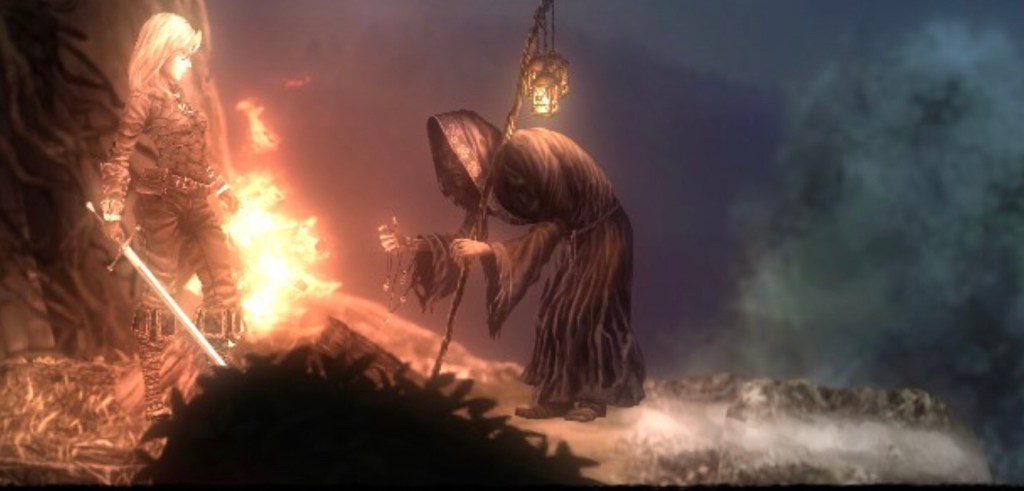
The opening cutscene feels somehow more detailed or longer than it was in the beta. Whether it is or not, though, the specific art style of the cutscene (above and below) also helps all of the different stylistic influences feel like a bigger whole. Consequently, Leila’s sword-swings and other quick movements look way more authentic and natural this time than they did in the beta.
The greater visual continuity really, really came together. And it’s beautiful. Perhaps more importantly, though, it gives Vigil a more distinct identity. Which matters a lot since 2D side-scrolling “Soulsborne/Metroidvania” has now caught on as a recognizable sub-genre, adding to the imperative for newer additions to distinguish themselves.
While I’m talking about “Soulsborne/Metroidvania” as a sub-genre, there is also an optional Salt and Sanctuary and Vigil crossover event. I don’t know how to communicate how exciting that is to me. In my opinion, Salt and Sanctuary was not just one of the first “2D Souls” side-scrollers, but it captured something basic about the format itself. If it was not for S&S, we probably would have saw more typical action-RPG mechanics in Hollow Knight and Blasphemous, like exp, leveling, etc. Aside from all that, though, S&S is simply one of my favorite games and I could not be more stoked to see what Vigil + S&S is like.
One thing that has become fairly common to both “Soulsborne” and games that blend the formula with side-scrolling is ambiguity. This is probably because Hidetaka Miyazaki, the main creative force behind Dark Souls and Bloodborne, often uses circumstantial and visual storytelling. Vigil inverts this trope by giving us Leila, a named protagonist, with a family and a hometown (apparently- at least in the very beginning). What’s more is that she is no-nonsense, perceptive and goal-driven. If there is any use of an unreliable narrator at all in this story, it does not look like it would be Leila.
The difficulty was also adjusted since the open beta. The boss of the first dungeon actually required some persistence, experimentation and grinding. Like a lot of “Soulsborne/Metroidvania” games, leveling in Vigil is based on an allocation point system. The threshold for leveling up, in the very beginning, is pretty low, so those first few easily-obtained levels are a satisfying and engaging way of introducing the player to the skill-tree. This is fortunate, since I suspect that throughout the game you will need to be proficient in different combat styles. The accessible introduction to the character-building makes experimentation with different builds more accessible as well.
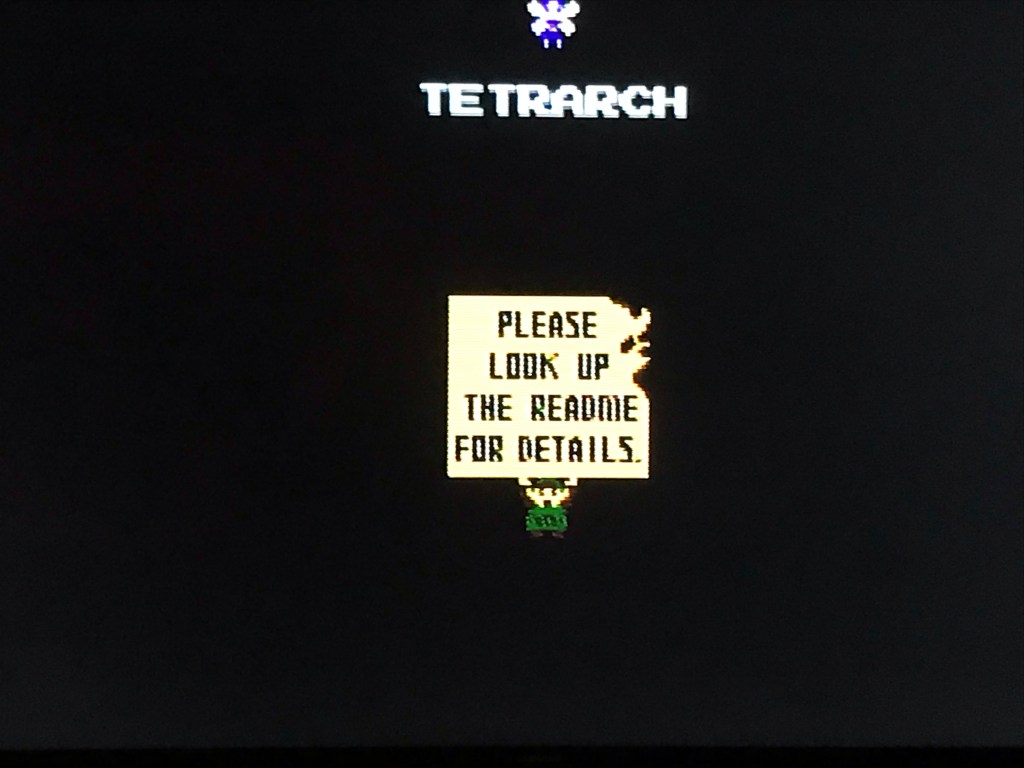
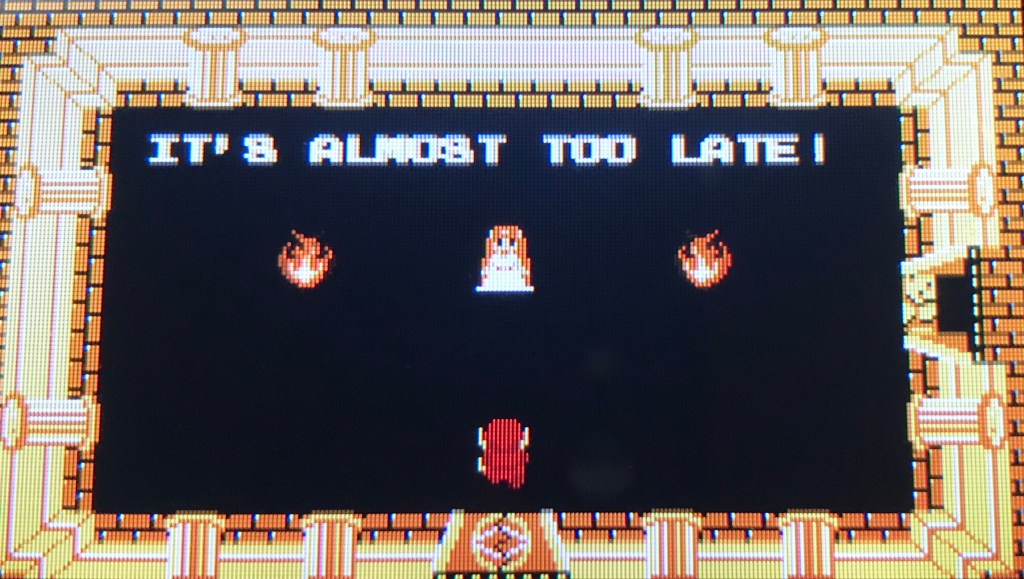
The Legend of Zelda: Outlands is a rom hack of the original 1986 The Legend of Zelda by Challenge Games that dates back to May 15, 2001. Chronologically, this game is situated as a hypothetical “Zelda 3” that immediately follows Zelda II: The Adventure of Link. It also uses details from the Ninetendo 64 Zelda games, such as multiple ocarina songs, Gorons, the Gerudo and the Kokiri. GameMakr24, the author of this hack, also carefully preserved familiar sights like the black rooms with white dialogue and familiar enemy AI, spawning and spatial design. These familiar touches combined with the late nineties ideas add up to a cool “what if” scenario, as if the world of Ocarina of Time existed a decade earlier.
Immediately after the events of Zelda II, the Thunderbird has apparently survived and has discovered the location of the Triforce of Power in the Outlands beyond Hyrule. The Thunderbird imprisoned the Tetrarch Fairies that stand guard over this third of the Triforce and now must be released by Link in order to get it back.
Upon release, rare physical cartridges of this rom hack were produced, packaged like the original with a printed world map. While I would love to have one of these maps simply for its raw coolness, I instead played it the way so many of us played the original years ago: completely dependent on trial and error.
I WISH I actually had this
This being a rom hack of the 1986 Zelda, it naturally has the same overhead design and nearly all of the same textures and sprites along with some from Zelda II. Sometimes, basic movements, hit boxes and attacks used by a monster from the prior games will be dressed up in a new sprite. The AI and hit boxes of peahats and keese are swapped with each other. In an early dungeon there is a mini boss that moves back and forth and breathes three fireballs at a time, like the dragon from the first game, but is now a giant skeleton.
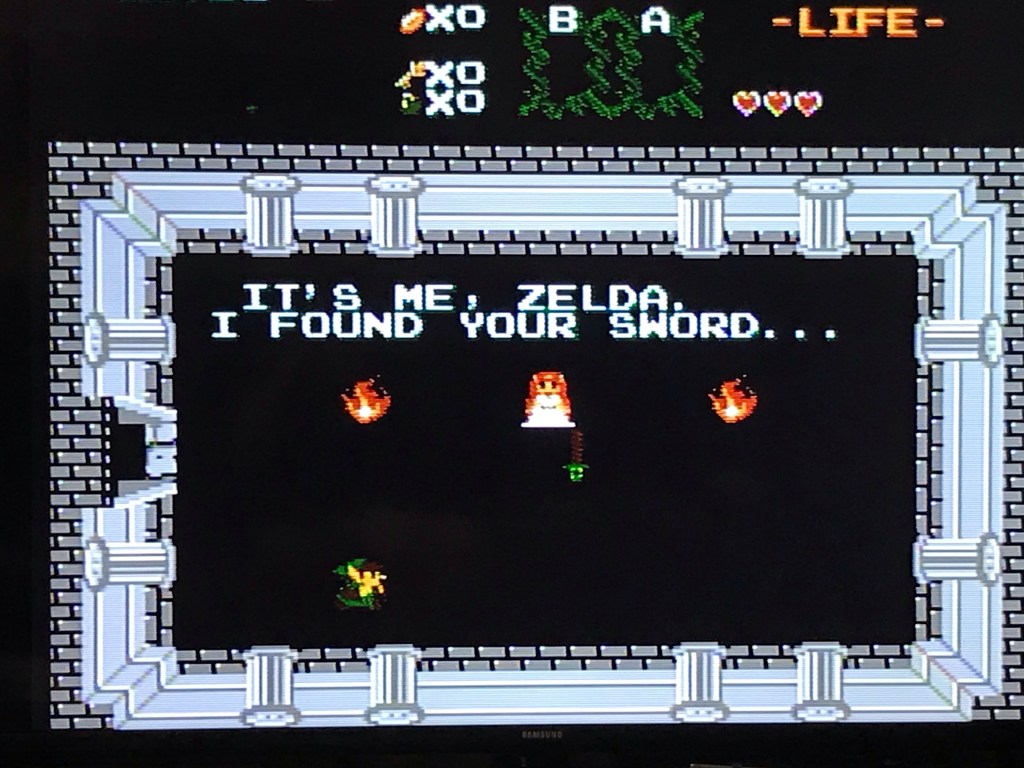
A lot about this game feels quite familiar, though, in spite of these differences. Like the first game, you start completely naked: the opening text crawl tells you nothing about where to go and only the vaguest hint of what to do. You don’t even have a sword, but at least the first Zelda put an old man in a cave directly in front of you to meet that need. This time, you won’t have a sword until you get to the first dungeon, and guess who gives it to you:
Princess Zelda herself is a constant companion, helping out in almost every dungeon
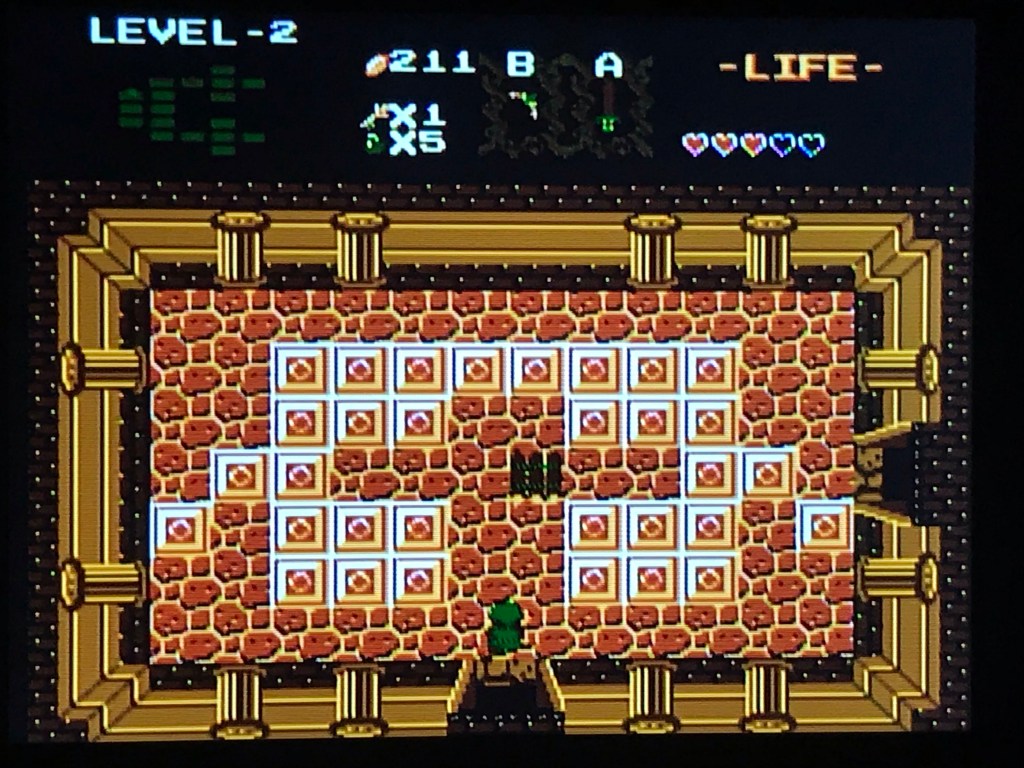
A key difference between this rom hack and many official Zelda games is the necessity of going back and forth between dungeons before and after releasing the Tetrarch Fairies. In level 2, there is a moblin that refuses to let you pass to the next room unless you feed him some meat (Kinda like in the first Zelda, remember? “Grumble, grumble…”?). This meat, however, is in an underground side-scrolling area in level 3, perpetuating Dracula’s tradition of storing meat in secret stone compartments.
Requires meatOne meat later
Having given the moblin the meat, you will go on to discover a raft that will carry you to a water-isolated place on the map where, for enough rupees, you can buy a Kokiri sword, a Goron shield, a bow and some arrows. The bow and arrows turn out to be extremely useful in dungeon 3- nothing else can kill the tektites efficiently that early in the game.
The bow is also necessary to kill the one-eyed blobby thing in dungeon 4. After that, the door to the left unlocks and Zelda will give you the ocarina. This is necessary to get the step ladder from dungeon one, which is guarded by a monster that resembles digdogger from the first game and, with the ocarina, can be done away with in a similar way. The door at the bottom of the screen will open up and the step ladder is all yours.
The step ladder, meanwhile, allows you to cross gaps that are roughly the size of a sprite which you need for multiple dungeons and overworld navigation.
Around the time you have secured 4-5 Tetrarch Fairies, you will probably notice that the Gerudos usually do one of two things- steal your money and hoard heart containers. On the continent accessible with the raft, there is a cave with a Gerudo who will give you The Staff Of Byrna once you have twelve heart containers. As she stands guard she says that she can only give the staff to “the hero”.
The staff itself, which deals damage, doesn’t expend rupees like the bow and doesn’t require full health like the sword beam, is an all-purpose reliable range weapon. So long as all you want to do is attack- the boomerang and the bow can collect objects for you and you will definitely want to gather stuff from a distance in this game. The Staff of Byrna also fires the slowest projectiles.
Since the staff doesn’t “cost” anything to fire, you may find yourself using it a lot against enemies that deal range damage and are too unapproachable for melee combat. And the enemies most likely to fit that description usually turn out to be the hostile Subrosians/wizards/whatever.
(after googling I learned that they are called Wizzrobes but I’ve been thinking of them as potion vendors from ALttP or Subrosians for too long already)
Little details like that can get you to speculate on the finer story details. Is there a reason why the Gerudos have the weapon that you are most likely to use against the wizards/Subrosians? You usually find the Subrosians/wizards close to the ninth dungeon that has the Spectacle Rock music from the original LoZ. What exactly is the nature of the relationship between the Gerudos and the Subrosian-thingie-people and how does it connect to what’s going on with the Thunderbird and the Tetrarch Fairies? What about the Gerudos gathering the objects (heart containers) that you need to collect for the staff? I like stuff like that, that’s organized enough to imply story threads.
Classic Zelda weirdness near the end
Rather like the original, the first play-through only gets you half of the content of the game and that’s where I’m at right now. This is basically a custom edit of the first Zelda game but it feels weirdly authentic. The final dungeon and final boss, in particular, really made me feel like I’m playing an actual “lost” Zelda game. In fact, more than once, it made me feel the same way I felt when I played Ocarina of Time as a preteen.
First question is “When are words?” Are they the first thing you see or not?
Consider the first Zelda game. You’re just plopped somewhere with three directions and a cave after an opening cut scene telling you to find the triforce pieces but not telling you how. You are only spoken to if you enter caves, holes in the ground or certain rooms in dungeons. You don’t even get to read what’s written in the letter a hole-dweller asks you to deliver.
Words are only accessed by interacting, spatially, with your environment. They help to connect dots but the words themselves are not relied upon to convey a narrative. The opening text-crawl did as much of that as the game needed. In fact, if the narrative was “opened” by the text crawl, does it have any closure? There is more dialogue to read upon defeating Ganon and rescuing Zelda, but how much of your time spent playing was actually spent reading? If the text crawl opened the narrative, the rest of the narrative must necessarily be visual and procedural as you play.
Why must it? Because the gameplay will necessarily make up the majority of your experience with the narrative, and the only text that could possibly follow up on the opening text crawl (however loosely) can only be accessed through playing. Any Westerner who has played the first Zelda game, though, knows that the translations were famously obtuse. “Master using it and…” etc. So, for myself and many other Westerners in the early nineties, even the in-game text we would discover required a little bit of interpretation even after unlocking it through gameplay.
1986’s TheLegend of Zelda, in my opinion, embodies the principle of an open world game. Nearly every detail of “how” you progress through the game needs to be deduced by the player, and the game only allows you to deduce by exploring and experimenting with different ways to interact with beings, objects and places. The only way to progress is to look for possibilities and test them.
What would explicit direction add to this? What does direction even look like? When you put in Sonic, it’s obvious just from the gameplay that you are expected to run to the right as fast as possible. Final Fantasy VII has dialogue. Lara Croft has a voice over explaining what specific buttons do.
If all this is still a little esoteric, ask yourself: should a game tell a story? If so, should it use the same narrative devices as a novel or a film? If not, what does the player’s experience consist of?
A video game might tell a story without requiring narrative structuring to make sense. Metroid II: Return of Samus and Bloodborne communicate the bulk of their stories through visual and circumstantial storytelling. The player sees things and is put in situations that reveal the story by implication. This means that the gameplay and the graphics do most of the work with storytelling.
If you know that the story will be told without words, that means you can use the words the player does hear and read with more freedom, since it is not their job to tell you the “important parts” of what’s going on. If the core story is relayed through gameplay experience, you can even have the diegetic text and speech contrast with the gameplay or supplement it. In Bloodborne, most non-player characters are completely incapable of understanding what’s going on around them for themselves, let alone helping you out.
Of course, the first Dark Souls game used similar storytelling years before Bloodborne, leading a YouTuber called RagnarRox to call the game “Zelda for grownups.” This was not meant to imply that Zelda was childlike- simply that Dark Souls built upon 1986’s LoZ implementation of open world and non-linear story-telling. No one tells you what to do in a Soulsborne game: it is up to you to experiment and figure it out, and most of the time if an NPC has something useful to say the meaning will not be literal or direct.
Another way to use words in a game that does not rely on them to do all of the work of storytelling, is to use their placement to determine their meaning. The majority of words in the first Zelda game are in the opening text-crawl. Words give you a naked premise and almost everything else that follows up on that premise is gameplay, meaning the interpretation of the player is needed for it to make narrative sense. It’s not that the words are “wrong”: it is that they are part of a bigger whole that involves things that are not words.
The Silent Hill games use this strategy often. The majority of Silent Hill characters do not know how the magic of the town works or what is going on: all they know are their own experiences. In Silent Hill 2, regarded by many as the most successful in the series, NPCs are used in a way that’s even less useful to the player than the NPCs in Bloodborne. James Sunderland, SH2’s main character, runs into a few different people, none of whom seem nearly as aware of the mysterious danger of the town as him. Each character has their own mutually exclusive set of concerns and separate reactions to the magic of the town.
The behavior that reveals that the other characters are not experiencing the same thing as James also usually put him at risk, such as getting locked in a room with a monster by both Laura and Angela. Neither one seem to know that James could die as a result of their actions and the monster that Angela leaves James with even has a name that speaks to its importance for her and it’s mystery to James: Abstract Daddy. To whom is the Daddy Abstract? To James, at least. Angela was yelling about “daddy” just before the fight. This tells us that every outsider who enters Silent Hill sees something with unique importance to them. The specific content of what the NPC’s say does not reveal as much as the patterns of their stories: each one is personal and traumatizing. Except for Mary which, along with Pyramid Head, reveals how the town is creating the personal, isolating hell of James like it does for everyone else.
So far, though, I’ve spent a lot of time taking about how the relationship between words and experience can inform storytelling. As a fiction writer, I can’t help but be biased in that direction. What I have not discussed, though, are video games where storytelling is either peripheral or nonexistent.
Some of my favorite memories of the PS1 involve a development studio called Artdink. In particular, two games that they created: Tail of the Sun and Aquanaut’s Holiday. Those- along with LoZ -were the very first open world games I ever played. In Aquanaut’s Holiday, the only thing there was to do was explore the ocean floor and attempt to communicate with sea creatures. Tail of the Sun was about a tribe of ancient cave people with a legend that the Tail of the Sun can only be caught from a tower of ivory. Hunting mammoths for their ivory constitutes a small portion of what the free-roaming world has to offer, though. Offbeat animals and oddities were found in the most remote and unexpected places. One of them was a pair of human legs with an ass. No upper body. Zero context. Then again, the only context offered by Tail of the Sun’s story is pretty minuscule, anyway.
Both games refuse to tell the player how to spend the majority of the time in their worlds. This makes them almost pure experience / gameplay with almost no reliance on words or any narrative. (The only modern successor to this pattern that I know of is an independent developer named Loren Schmidt, who has done some of the best non-narrative game design of the last few years. Link to her itch.io page below)
Perhaps the very first Donkey Kong and Mario games are the furthest possible extreme in this direction: no one who has ever enjoyed those games ever did so for the story.
It all depends on the nature of the piece you want to create- a story, a procedural/visual experience, both or neither. Like so many other artistic mediums, success depends on the nature of the germ (be it narrative, visual or something else) remaining consistent.
Consider Heavy Rain from Quantic Dream. It’s possible to finish the game in a few hours but a single play-through will not show you all the game has to offer. In fact, the majority of the game’s content can only be enjoyed with multiple play-throughs. The length of time of the story is relatively fixed (almost like the run time of a film) because the narrative is as close to cinematic as the technology of that day would allow. It is modeled after a film and time passes at the same rate as a conventional television crime drama. To say nothing of the fact that the plot is built on a race against time.
How would the dramatic momentum be effected if you could just go and do whatever you want as soon as you felt like it? If you take a break for weeks to mop up side quests off the beaten path would you be able to go back to the story and feel the same sense of urgency? I know I rip on FFXV way too often (in spite of the fact that there’s a lot I enjoyed about it) but that is precisely the weakness that the open world dimension brought to that game.
Games that are dominated and defined by their narrative typically rely on words more than any other kind. Although there are just as many narrative-dominant games that use sights, sounds and situations to do the same job that words do (Silent Hill, Bloodborne, etc).
Put simply, yes. I mean, there was a lot in the original that made you wonder about how it would play out “for real” and not all of it was even story-related: I mean…in the crashed Gelnika, there was a hostile gastropod with an attack called Creepy Touch. What exactly happens when one performs the Creepy Touch? I mean, I could tell you about the interpretation that my friends and I used to cackle over, but what actually happened? What exactly is a Dorky Face, and why are so many of them in the Shinra Mansion in Nibelheim?
When I was younger, I used to try to visualize what the combat would look like if it wasn’t a video game. My most recent frame of reference at the time was anime, so I kinda imagined some Z-fighter stuff like materia magic- casting bolt would probably look like a ki blast, for example. Later, I saw the Last Order anime with the non-delusory version of the Nibelheim incident and the travels of Zack and Cloud afterward. Both Zack and Cloud were infused with Jenova cells while in Hojo’s custody along with a mako bath (redundant for Zack, first time for Cloud). Cloud is unconscious for a lot of the story, though, so we mostly get to see Zack and Sephiroth in action. Sure enough, Zack flits around invisibly like a Z-fighter.
That last part actually sort of helped for my grasp of the in-world physics \ metaphysics: those who had been bathed in mako or injected with Jenova cells were supposed to be supernaturally formidable compared to ordinary people. For some reason, as a preteen, I was particularly attached to imagining the fight between the Turks and Cloud’s party during the return to Midgar as…basically…Dragon Ball Z with giant swords, firearms and electricity (no I’m not ignoring Trunks, let’s stay on topic).
For anyone who wondered about those nuts and bolts, Final Fantasy VIIRemake absolutely delivers. Setting the first installment completely within Midgar was a good choice for every obvious reason: the original had a very large and detailed world map. The lack of exploration within Midgar was a teasing absence. Digging up the key card to get back into Sector 5 during the third disc assuaged the yearning a little bit but there was just so much that you still couldn’t check out- like more of the upper plates.
So kudos on being Midgar-centric. There were also quite a few moments that had an absolutely beautiful sense of place. Sector 7 and Sector 5, in the remake, both took my breath away. The graphics were crisp and detailed but…well…Sector 7 and Sector 5 both remind me of my childhood. Not that my hometown is absolutely dilapidated and cobbled together from garbage but…well…um…uh…actually nevermind ._.
I know I’ve droned about this a lot in the other entries about the remake, but I absolutely adore how carefully this game builds a sense of distance and proportion with nearly all of its environments. Very understated at times, like how in Sector’s 7 & 5 you can catch glimpses of the sky in certain directions which contrasts with other moments that are wide, open areas that are definitely beneath a plate.
The lights look uncannily like stars sometimesSometimes, when you look closely at the pre-rendered far-off images, the rest of the environment can look slightly surreal
Even the sound design contributes to the sense of place. In some environments, when explosions go off, any sound you hear immediately afterward will be muffled as if you’re ears are ringing. The background chatter in the town areas always sounds natural and spontaneous. The music is also very well placed and the score has a nice back-and-forth with the diegetic music from jukeboxes \ stereos \ whatever.
On that note, I was pretty happy with the soundtrack. I may find it hard to tease apart how my love of the original colors this, but I appreciate how the soundtrack layers motifs from the original soundtrack. In the original, Words Drowned By Fireworks is memorably used during the Golden Saucer date. I think there is another use of the track before then but I can’t remember.
Anyway, in the Remake, the first time we hear music that uses partial melodies from Words Drowned By Fireworks is during a flashback to Nibelheim, when Tifa and Cloud made the promise. A potentially intact version of the whole song can be heard between Sector 5, Wall Market and the collapsed tunnel leading to Sector 7.
This gradual layering of motifs from the original soundtrack is also used with Lurking In Darkness. The complete song is first used, in a quiet and unobtrusive way, when Cloud is taken aside by Don Corneo’s goons and snatches of the melody can be heard in the sewers.
Also really liked certain understated “teases” used for foreshadowing, like the first time we hear Trail Of Blood, when Cloud is woken up in the middle of the night by a nearby Sephiroth clone.
First use of ‘Trail Of Blood’
While we’re talking about the soundtrack, I was so fucking happy when I heard the orchestral version of Listen To The Cries Of The Planet when Sephiroth takes Cloud to the edge of creation. I bounced so much I shook the camera my girlfriend was using to record my gameplay. I also loved what they did with the J-E-N-O-V-A music during the fight with Jenova Dreamweaver.
Not that I don’t like the well-known music like One Winged-Angel, but many of the more powerful moments from the original soundtrack were the understated ones. I wrote earlier that Who…Are You? made a huge impression on me the first few times I heard it. Lurking In Darkness is slightly jazzy and melancholy and is used in a few very different situations. My favorite overlooked song from the original is called Reunion and is first heard in the Northern Crater when Sephiroth is doing a number with Cloud’s disassociation.
So far, the remake has given much of the original music time to breathe, some in multiple fragments or versions. Not everything, of course, because this new version of FFVII isn’t done yet, but as much as it can.
I hesitate to say whether or not the gameplay of Final Fantasy VII Remake outperforms the original or if it simply keeps pace with it in terms of overall quality. I say in terms of overall quality because many of the specifics are very different. FFVIIR has a quick menu to use restorative spells and items while simultaneously walking around, kinda like the menu in Bloodborne. All combat, of course, takes place in the same map as everything else rather than its own combat screen. In my last entry, I complained a little about the inconvenience of needing to build the ATB bar in order to do anything other than attack, block or dodge. Which means you need to go in blindly swinging at least a little bit in order to strategize.
That gripe being vented, it can be satisfying to dive in button-mashing like you’re playing Smash. It’s just that you might not actually accomplish anything. This was a really big headache during the Rufus and Hell House boss fights which I struggled with. I hate running in circles, trying not to get hit, because I need the ATB gauge to fill up so I can heal and my health is too low to risk attacking to make it fill up faster.
Also, this game is pretty linear which was absolutely the right direction to go in. More than any other Final Fantasy game, VII is a vehicle for a story: to jeopardize the momentum of that story with random exploration like XV would have been catastrophic. Even within those parameters, though, there is still a lot to do between story beats.
Other detours in the original story that really worked for providing more content and building a sense of immersion are your first visits to Sector 7 and 5. If the Midgar AVALANCHE cell is cut off from the bigger organization, it stands to reason they would be on a super tight budget and Cloud would have a credible reason to help Tifa collect his fee. If this were a movie, I could easily see that part of the game being a dialogue-heavy character building scene.
When I said Sector 5 works in the same way, I guess I just meant both of the towns you see with Aerith. The towns are probably better designed than any other towns in any other game that I’ve played.
The giant, meandering collapsed tunnel near Sector 5 was very welcome, both the first time with Aerith and the second time with Cloud, Barret and Tifa. Making the collapsed tunnel an entry point for the underground Shinra laboratory was a genius way to expand the gameplay and flesh out the world-building. The mutated test subjects bore a slight resemblance to the beings in the pods at the mako reactor in Nibelheim. Placing this nuance of the world-building close to Elmyra’s explanation of Aerith’s abilities and heritage was also a good thematic touch. (Also I never played Crisis Core or Dirge Of Cerberus so I’m not familiar with all the lore but…Deepground, much…?)
There are still a few potential red herrings though. Potential because there are hints of more subtle relevance but nothing openly stated. Particularly with Eligor and the abandoned train station.
The train station has a beautiful interplay of lights from different sources that, when they get the smallest touch of saturation, creates a cool, dreamy, otherworldly effect. Later, when ghosts show up and you’re doing switch puzzles, the otherworldly lighting can almost make the train station feel like a Silent Hill game. And not in a bullshitty, pandering way like the horror survival level in Nier: Gestalt.
Eligor is also a nice, tough, satisfying boss fight. We get some framing when Tifa recalls Marlene talking about what happens to the children who go missing at night, realizing that she must have been talking about Eligor. Later, Eligor shows Aerith and Tifa an image of Marlene that leads Tifa to think that Eligor actually has her, which turns out to be false.
What I meant earlier by red herring is that I’m not sure why Eligor is in the game. Is the abandoned train station just super duper haunted? Full stop? Are beings like Eligor connected to the Whispers, since it showed Tifa something that could happen instead of something that did happen? What about the fact that Aerith appears to recognize Eligor, during her brief abduction by the ghosts?
What I appreciated about the illusory vision of Marlene is that it sews the question of whether she’s okay or not in a way that gives weight to Aerith’s rescue later on. Particularly since you actually get to play as Aerith as she rescues Marlene. The appearance of the Whispers near the end of the station also suggests a connection with Eligor. All of those add up to implications, though, since Eligor’s contribution to the story is never made clear.
Speaking of the story…
This is…pretty much…not a big dramatic departure from the source material. Many of the differences have to do with framing things and fleshing things out. The main innovation that wasn’t there in the original has to do with fate…or potential alternate timelines.
You are haunted, throughout the whole game, by ghostly, ephemeral beings called Whispers. When they touch you, they may make you get flashes of the past or the future. After the bombing of reactor 5, Cloud missed a shot with his grapple hook that he’s more than capable of making. As if some unseen force wants him to fall onto Aerith’s flower bed and bring Aerith into it.
Cloud, no stranger to hallucinations, sees a flash of the future in Sector 7 with the plate falling. Later, when he runs into the Sephiroth clone named Marco, Cloud briefly glimpses a jagged, rocky landscape that a player of the original will recognize as the Whirlwind Maze in the Northern Crater. In the original game, this event occurs about halfway through the story, just before the third fight with Jenova. Rather far into the future for Cloud at that time in the remake.
Like FFVIII and FFXIII, Final Fantasy VII Remake deals with predestination and the role of free will. Incidents like Cloud’s improbable miss at the reactor 5 bridge and the attacks of the Whispers suggest that the strings of fate are now visible, and Sephiroth invites Cloud to challenge destiny with him. Most shockingly of all, though (the title warned you about the spoilers)-
Zack.
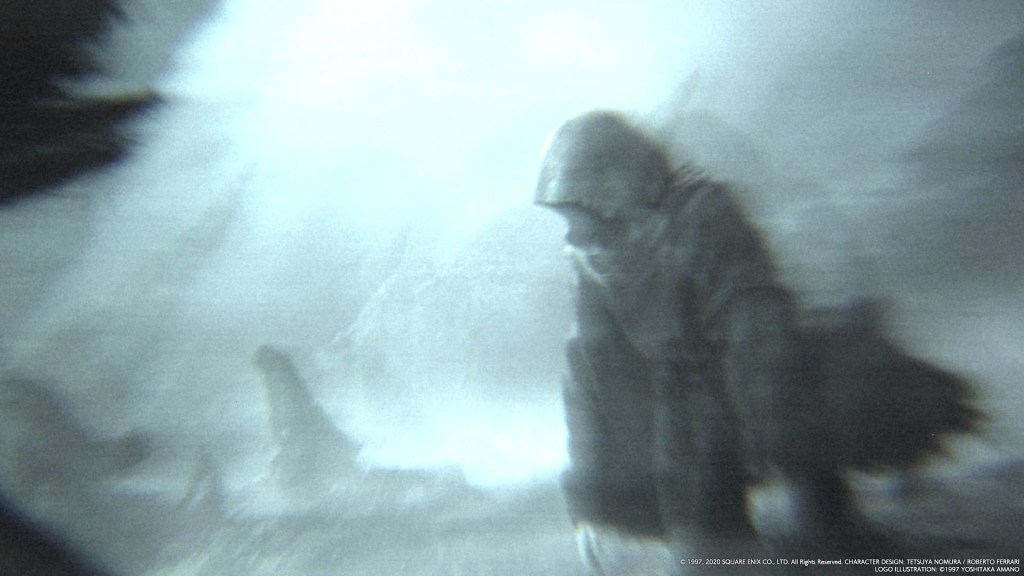
When the party reaches the end of the chase on the highway, we see a cutscene on the outer edge of Midgar. It is broad daylight and Zack is fighting off hordes of Shinra soldiers. It looks a lot like the depictions of Zack’s last stand in the original and in Last Order, but why the fuck does it look like it’s currently happening, with the Whispers enveloping Midgar in the background? Maybe clashes between agents of destiny are spiritually significant events that can be seen by nearby ghosts? Why does the camera show you the empty chip bag with Stamp on it? Does it signify a particular era?
I freaked out so bad when I saw this for the first time. Like…like…um…what? Zack of all people? Seriously? Is Cloud gonna run into him and flip shit? Does this have consequences for Aerith…??
And then, minutes before the game actually ends, we see Zack carrying Cloud toward Midgar just as the party passes through that same location in the opposite direction. That means it was a flashback, right…? Maybe…? Why did Aerith just stop in her tracks like she felt something?
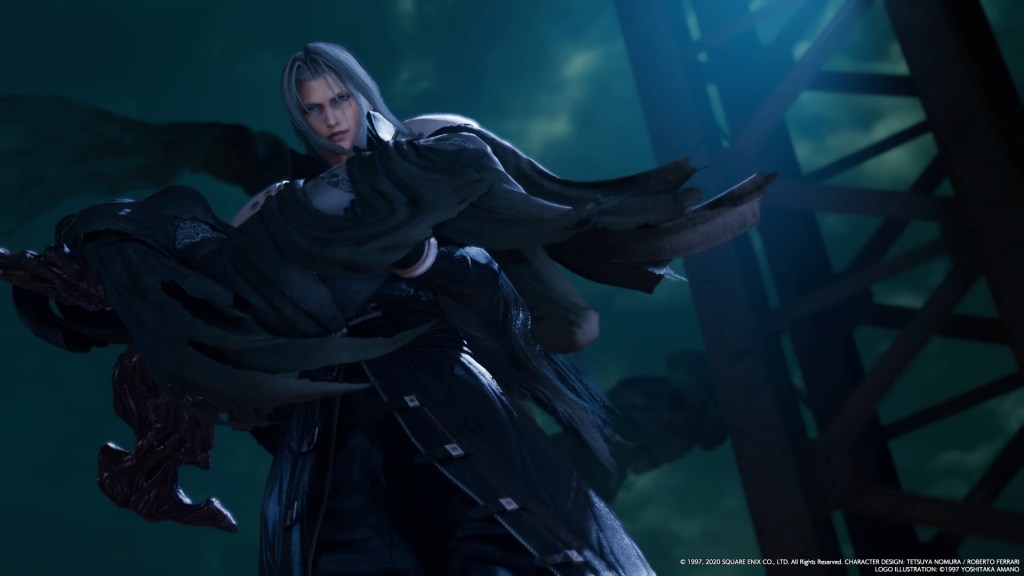
And which specific manifestation of Sephiroth did we just fight with? I mean, it was a psychic presence in the clones that moves between all carriers of Jenova cells, right? Sephiroth was injected with Jenova cells while he was still in the womb and has a closer relationship with her than any other character. Any being carrying Jenova cells can be influenced by either Jenova or Sephiroth. So it wouldn’t be going far at all to suppose that Sephiroth can “possess” the body of a clone with his mind, like a demonic possession. We see both Jenova and Sephiroth change into clones with number tattoos, so it seems pretty obvious.
So. Is the final boss fight the same psychic presence that was walking around inside the body of the clone carrying Jenova’s original body in his arms? Did Sephiroth simply move on to a new clone to possess at the moment of the final boss fight? Does the final boss fight even happen on a physical plain of existence? We know from the original that Sephiroth can jerk Cloud out of his own body if he’s moved to. Could it be like the final telepathic fight at the end of the first game (oh, and we even see a certain version that scene as well)?
Sephiroth “possessing” a cloneThe same clone, still carrying Jenova’s body like before, only without Sephiroth in control
Was the final battle an event on the astral plain or within a “collective dream” shared in everyone’s mind? Given what we know about Sephiroth and Jenova’s ability to affect the mind of anyone who carries her cells, it’s possible that the party is simply fighting a cell carrier that is “channeling” Sephiroth.
So did the party physically fight a “posessed” clone or did Sephiroth telepathically lash out and drag the minds of the party into his own imaginative construct?
So the question of “which” Sephiroth are we fighting has a handful of different answers. However, his wish to defy destiny and our glimpses of possible futures makes it hard to avoid another possibility: that he came from another timeline. Or the future, or something.
I seriously got nothing on that possibility, no idea what to think of it- it’s just too foreign from any analysis of this story that I ever encountered before playing this game. But the glimpses of other timelines at least imply that something like that might be possible. Especially considering something Nanaki says during the fight with the giant Whisper that looks like Sapphire Weapon: the whole party sees a glimpse of the opening scene from Advent Children and Nanaki says that it’s a vision of what will happen if they “fail here today”. Sooo….does that mean that the whole original time line is now off on a different course? That the events from the original to Advent Children are now not happening?
Oh and the big bad Whisper at the end looks a hell of a lot like Sapphire Weapon. Are the Weapons now involved in the new world-building with alternate timelines and destiny spirits? I don’t suppose I can complain about that. In the original, the appearance of the Weapons does seem a little out of nowhere, with only a tenuous connection to the previously established lore. So I appreciate that they are now trying to introduce the concept earlier.
Laying the groundwork for concepts that will be important later is something the remake really succeeded at. Cloud’s mako poisoning later is foreshadowed with Jessie’s father, and Jessie’s theory that those with mako poisoning are suspended between their body and the planet’s core, since mako is processed lifestream that still tries to transmigrate. Barret also makes a comment that’s relevant to both Cloud’s mako poisoning and to the last thing Sephiroth did during the Nibelheim incident:
Sephiroth’s original body, the one birthed by Lucrecia, is in the planet’s core after leaping into the mako in the reactor at Nibelheim. All appearances of Sephiroth during the present are either telepathic or channeled through the bodies of clones that carry Jenova’s cells.
Unless we’re gonna entertain the whole time travel thing…then I don’t know where the fuck that leaves us.
I have to echo a sentiment first expressed by the YouTuber The Night Sky Prince: Nomura says that the story will remain the same and that his only big point of departure is that someone from the original, who died, will not be dead this time. It really looks like that’s gonna be Zack. If Zack’s alive, I’m not sure how much room is left for the story to play out the way it did originally. A bit of a mixed message, but it’s drastic no matter how you interpret it.
For me, the really weird part of this is that the remake appears to be aware of the role that Zack plays in Cloud’s psyche and how Zack was turned into an alternate persona. Before Cloud wakes up in Aerith’s flower bed, he is having a conversation in his mind with someone else in SOLDIER 1st class gear. For the first few seconds, we don’t see the second person’s face, and it looks like it’s gonna turn out to be Zack. When we do see the face of the second person, it’s a second Cloud. So the writers were definitely aware of the role of Zack in Cloud’s arc. Soo…I’m not saying I think this will happen, but how the fuck would Cloud take it if he ran into Zack before he has the chance to work out his issues?
It’s a huge, huge gamble and I want it to work. No one wants this to work more than I do and I want the next chapter to come out right now. But keeping Zack alive can have very dramatic, far-reaching consequences for the story. I simply don’t see what Nomura can possibly mean if he says the story will be pretty much the same while also implying that Zack will be alive. And if this has some kind of consequence for Aerith, like not dying, she’ll cease to be a thematic mirror image of Sephiroth. The mirroring between Sephiroth and Aerith is absolutely fundamental to my understanding of the story and to keep Aerith alive would change the whole nature of the story. Maybe it will turn out to be a genius curve ball that will totally work and outstrip the original.
I hope so, anyway. There’s no denying the boldness of the step, and it is refreshing to see Square Enix regain the will to take risks, which was a fear I had after FFXV.
Soooo yes.
It was what I wanted and then some ❤️
If you’ve made it this far, perhaps you’d be interested in a lore theory:
Yesterday I played for nearly ten hours, wrapping up the Sector 5 sub quests and going all the way through to the sewers, just before Avalanche’s last stand at the Sector 7 plate support pillar.
Something I want to mention that I briefly touched on earlier is the combat system. Put simply, you can attack, dodge and block all you want but every other option requires you to invest at least a little patience. This can be like charging Barrett’s gun-arm or slowly, carefully building momentum with Cloud’s punisher mode. Most frequently, though, it’s the ATB gauge, which you fill by attacking, blocking and dodging.
This can be annoying at times, since in order to properly strategize you often need the assess materia, and materia can only be used once you’ve built up the ATB gauge. So you roll in and start banging away and just lumping any consequence that goes with that. This necessity can be maddening in near-defeat situations, like when you have to avoid a game over by either healing yourself or reviving someone else. You often have to dive back into the fray with almost no HP to fill your ATB gauge enough to use an item or a spell.
That is my only nit-pick so far though. Square Enix made me really afraid of their tendency toward appeasement with Final Fantasy XV. That game was designed to appeal so universally that the final product hardly took a single risk. If it seems like I mentioned random comparisons with XV in the last post, it’s because XV cast a long shadow. It was released in a partially complete state so they could trickle out a finished product that would accommodate fan reactions. To say nothing of the prissy lack of risk taking or difficulty. FFXV might be less fun if you just press X throughout every battle but the sad truth is that you can. If you chose the easy difficulty setting you could even play through the game with Carbuncle resurrecting you every time your HP reaches zero.
If that appeared to be Square’s emergent business model then I couldn’t help but worry about what might come next. FFVIIR, luckily, doesn’t repeat any of this. In fact I’ve been playing a lot of Mana games in the last few years and I rather like the strategy of getting in, spend your stamina/ATB/whatever gauge, get out and charge it again. The need to build the ATB gauge to even use an item is annoying but it isn’t a deal breaker.
There are also some interesting little doo-dads that borrow from other FF weapon and buffing systems. Each weapon comes with abilities that you can master and take with you, like in IX, or the Espers in VI. You can also craft weapons in a system that bears a superficial resemblance to the crystarium in XIII or the sphere grids in X. You can even add extra materia slots which adds to the strategy since you are less likely to wander into a battle with the wrong stuff equipped.
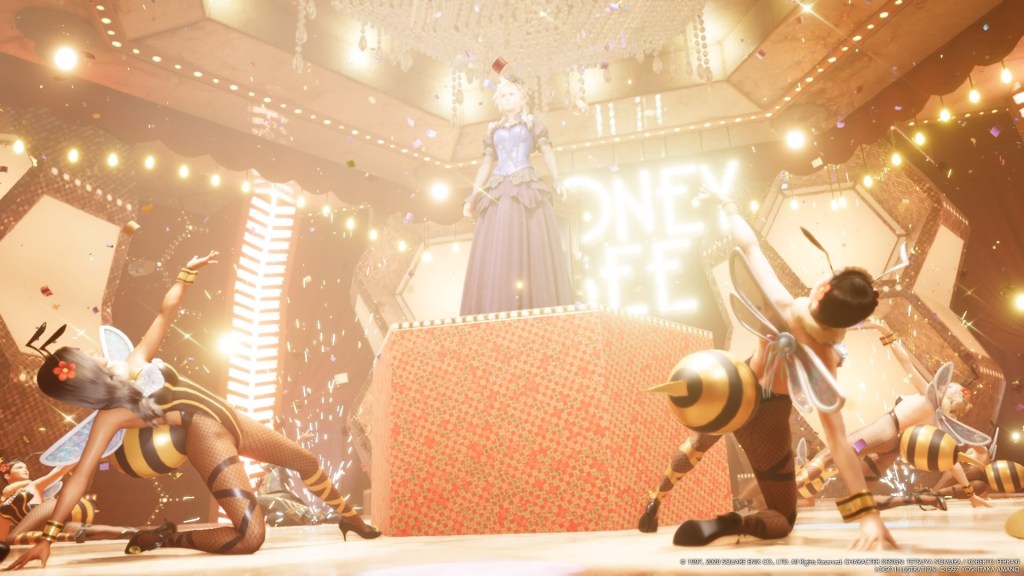
It was my worries about appeasement that made me sweat the cross dressing scene. Like, it didn’t happen in exactly the same way that it did in the original, and so much in this remake does not, but I kinda panicked. I was kinda afraid they may have made the cross dressing in Wall Market optional in order to appease in the opposite direction. I was kinda freaking out. And then Aerith walked Cloud’s spikey ass over to the Honey Bee Inn and all was right with the world.
Noticeably absent from original- the uncanny freak-out when Cloud walks in on a ghostly mirror image of himself. The ghost Cloud lunges at living Cloud and he blacks out. This was also the scene where we hear the song Who…Are You? for the first time. Later, Who…Are You? is paired with Jenova. When you first hear it used in relation with Jenova, the association with the hallucination in the Honey Bee Inn is nothing short of disturbing.
There is an echo of this event in the Remake, though, and it even happens around that time, even if it’s not at the same time. Before waking up in Aerith’s church, Cloud chats with a mysterious figure in a white void. At first I was so sure it was going to be Zack Fair. But it’s a second Cloud- perhaps alluding to the conflation in his mind.
Even with that difference I do appreciate how Wall Market and Don Corneo have been mentioned and foreshadowed, going back to the scuffle with Corneo goons in Sector 7. The constant background chatter about the long-reaching consequences of the Avalanche bombings dovetails nicely from the unexpected carnage after the first attack and Barret’s belief in needing to crack eggs to make omelets.
Not sure if my favorite quote from yesterday’s binge was “The Lady of Frost is the perfect companion for a man like you, Cloud” or “Never be afraid, Cloud”.
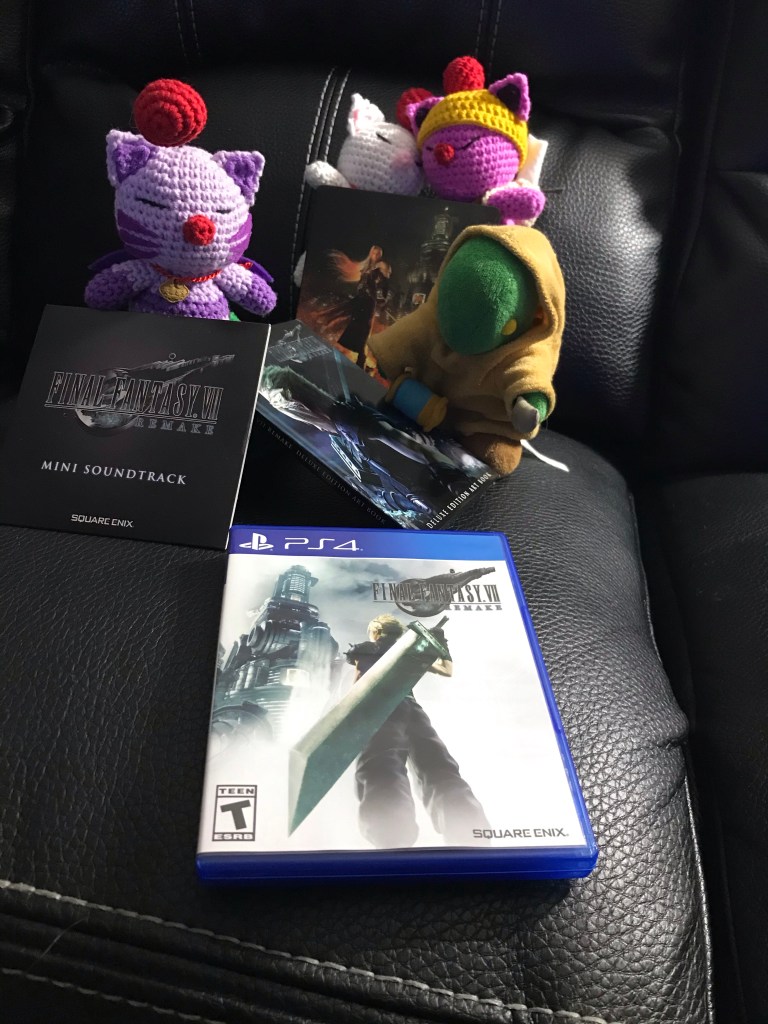
After a five day delay it finally freaking came in the mail. I don’t normally get on crazy fan-girl hype trains like this but this, for me, is a truly unique game. I got hooked on Final Fantasy VII around 2000 on the PC version but I played it for the first time in 1997, when PlayStation in general was new to me. I was around nine years old and I got my mom to rent it from Blockbuster.
I remember finding this add in a 1997 issue of GamePro. I think I had the magazine in the first place because it had a story on Tomb Raider II.
By 2000, the Zelda series and a monster-hunting PS1 game called Jade Cocoon were my two favorite games. And then Final Fantasy VII happened. And I still don’t think I’ve encountered a game that has a story that’s quite like it. Like I mentioned in my earlier FFVII entry, I think a lot of that may have been a series of happy accidents, of a ton of cooks pulling off a good soup against the odds.
However it happened, though, it happened, and if you clicked on this then I probably don’t need to catch you up. So because my nutty lil fan-girl heart won’t let me keep this to myself:
The Deluxe edition, with the art book, soundtrack sampler and tin casing with Sephoroth
By the way, the FFIX Moogles are from an Etsy dealer called nhimconshop ^^
Between today and yesterday I’ve played for over twelve hours and I’m only just getting to the Airbuster fight. Still nowhere near finished, and I’ll definitely upload a post later when I’ve played all the way through. I’m completely spazzing out over this though and I gotta get something out now.
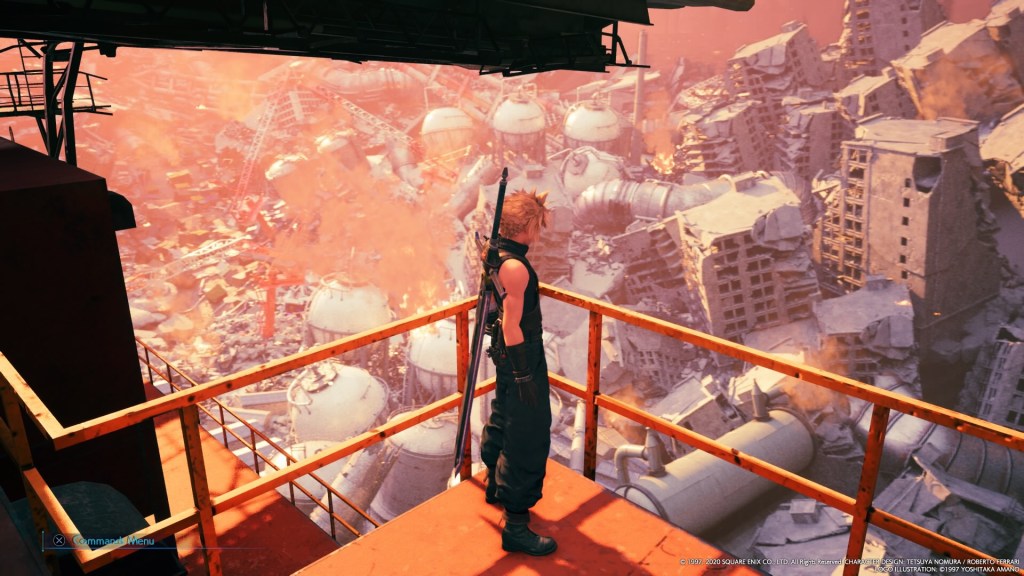
I’ve written at length on this blog about how scenarios originally written for sprites and dialogue boxes don’t always make the best one-to-one adaptations for modern graphics and voice acting. From what I’ve seen so far, though, the early portions of this game definitely justify the use of both. During the bombing of Mako Reactor 1 in the beginning, I quickly noticed something that FFVIIR did better than XV: meaningful use of size and proportion.
FFXV is a good looking game, don’t get me wrong, and it has some really cool moments with summoning Astrals- Leviathan and Bahamut in particular. Not to mention flying around in the Regalia. But the sense of size in FFVIIR seems to hit harder, somehow. Inevitably, this has got to do with my love for the original tempting me to compare the different versions. And…well…nostalgia: if you remember locations and events in a story fondly you would naturally enjoy seeing a beautiful and thorough reinterpretation.
A few reimagined moments from the original are super pretty
Not that there isn’t depth to be appreciated in that comparison: I played through the original multiple times and I always wondered A. is mako a gas or a liquid and B. although it is made from the Lifestream does that mean that it is the same as the Lifestream? Is that why they’re both pale green? In the first Reactor, you see a giant pool of churning, luminous liquid with crashing waves folding in on each other like whirlpools.
At the same time, though, there is an appearance of thematic consistency to the presentation of size. When you first descend the ladders in the actual Reactor core at the beginning, you are coming out of a series of infiltration obstacles that make you feel both cramped and like you are being watched. The hugeness of the room with the mako pool and the Reactor core shocks you. Barret also asks an interesting question as you navigate the catwalks and ladders: if you fell in, would you just keep falling until you reached the heart of the planet? Anyone who has played the original game knows how important those words are.
LOVE the sense of size and distance in this game
Also loved the use of size and distance in Sector 7. Parts of it are cramped and dilapidated, but there’s also these gorgeous, sprawling distances, stretching out from beneath the plate.
Callbacks and contrasts are also implemented through music. A song called Lurking In The Darkness in the original soundtrack is heard for the first time in the remake in a new scene. Cloud is taken aside by some goons that look and sound like they work for Don Corneo, attempting to dig up dirt on Avalanche. (Remember, this is about my first impressions so I’m still early in the game).
A few different songs from the original soundtrack are used in different ways. The song On Our Way, in the original, isn’t heard until Kalm, before Cloud tells his version of the Nibelheim incident. In the remake, we hear it in Sector 7. In the original, we first hear Words Drowned By Fireworks when Cloud takes Aerith (or whoever) on a date in the Golden Saucer. In the remake, we hear Words Drowned By Fireworks in the flashback to Cloud and Tifa as kids.
(Is that true about the Golden Saucer date? I feel like I remember Words Drowned By Fireworks before then….even if the song is named after the scene)
Another cool bit of foreshadowing and cosmology-building is the story of what happened to Jessie’s father: mako poisoning. He never wakes up and Jessie has a theory on why: mako is the Lifestream, the Lifestream is the flow of transmigrating souls between lives. All souls pass through the center of the planet on their way to the next life. If her father’s body and brain are poisoned by mako energy it makes sense that his soul would be suspended between the center of the planet and his body.
She deduced this through a discipline called planetology. I don’t know if the word / concept of planetology existed before Dune, but that’s where I first encountered it. Not that this means that there’s some kind of epic Dune tie-in, but I think it’s cool that a related concept is now involved in FFVII. (It’s just an elaboration on ecology: when humans discovered space travel and started to own and buy and sell entire planets, they realized that the well being of an ecosystem hinges on the whole planet. So it’s changed to planetology)
All that about Jessie’s theory establishes an important concept that has a big role in the original story. I also appreciated how the clones are introduced earlier in the story. It validated a theory of mine that both Sephiroth and Jenova are not only controlling them but can actually possess the bodies of the clones and transform them. Ifalna tells us that Jenova is a shapeshifter in the original game, so that would account for Sephiroth’s apparent ability to travel vast distances instantly and Jenova’s different forms. Anyway, in the remake Cloud runs into a clone super early and Sephiroth possesses him. He actually makes Cloud hallucinate Sephiroth’s old appearance, black cape and all.
The combat system is also great. It’s not stupid simple like XV where you’re basically mashing one button over and over again and you can freely play as other party members. It also requires that you strategize in many of the same ways you did in the original- like pairing the elemental materia with a relevant element spell so you aren’t forced to constantly tap out your MP in order to exploit elemental weaknesses. There is also just as much necessity to consider how different materia impact your stats when doling them out.
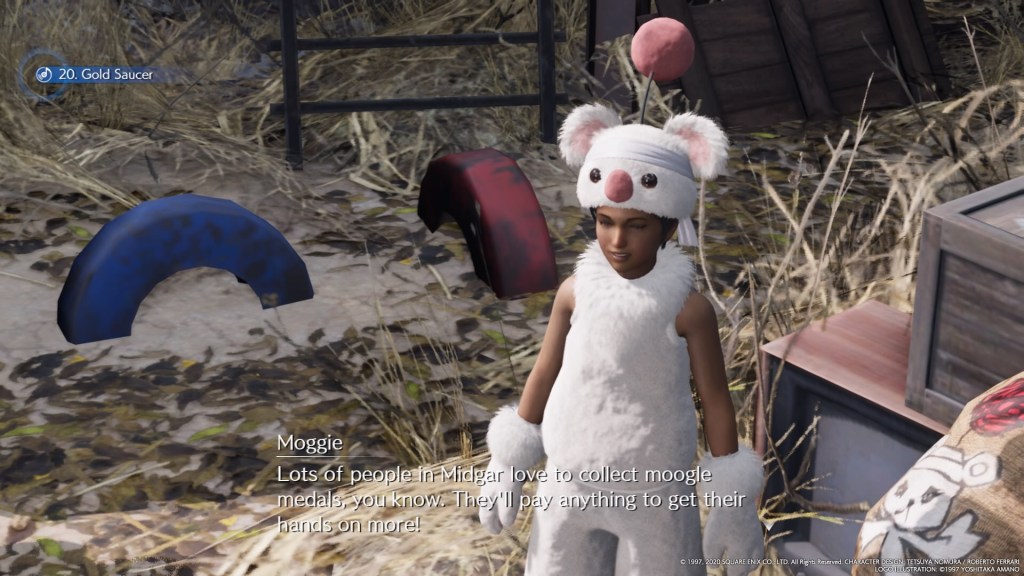
If those of you who have played through the game already noticed my mention of the elemental materia, that means what you think it means: I did the big annoying Easter egg hunt en route to Mako Reactor 5. It bugged the hell out of me but I couldn’t let it go, I just had to get the materia. I also snagged the chocobo / moogle materia from inside the fan. This game has side quests, and they rope you in, but they don’t run the risk of derailing the story’s entire dramatic momentum like they do in XV.
Loving the shit out of this so far and can’t wait to keep playing ❤
As soon as Salt and Sanctuary came out I was smitten. That game captured the 50% of my brain that Bloodborne did not take over. It’s still my favorite game available for the PS Vita, and to date it looks like no follow up is planned (nor has there been any new updates from Ska Studios, the developers).
Recently though, while I was putzing around on a Salt and Sanctuary Facebook group, someone uploaded pics of a new game currently in development called Vigil: The Longest Night. The art style immediately grabbed me, and I love side-scrolling Soulsborne \ Metroidvania hybrids even if…they kinda stumbled over each other as soon as it became clear that there was a market for them.
Like, by the time Blasphemous came out, I had already been seriously hooked by both Salt and Sanctuary and Hollow Knight. Blasphemous was a perfectly good game with great level design, platforming and combat, but I just couldn’t get into it since I’d been neck deep in similar things recently.
What caught my attention about Vigil: The Longest Night though was the enthusiasm it seemed to garner among my fellow S&S fans. My appetite was also freshly whetted by a recent Symphony Of The Night play through so I couldn’t have been more stoked when I got wind of a recent open beta event. Best believe I snatched that shit up ^^
This being a demo of the beta version, I wasn’t surprised to run into a few hiccups, some of which may very well have been the fault of my machine. There was some truly aggravating collision detection with climbable/grabable surfaces. The second biggest annoyance was the lagging, which would get worse whenever I loaded a file immediately after a death and the game would get stuck whenever I got killed by the first boss.
Speaking of, the lagging made that fight unplayable for awhile. Luckily, this demo is generous with exp, enabling you to either brute force it or experiment with unlockable combat upgrades. Which isn’t such a different beginning- it reminded me of the Festering Banquet and the Sodden Knight from Salt and Sanctuary, really.
Personally, my breakthrough with boss one came when I lost patience, tried playing it like Bloodborne and got totally confrontational. As in, keep rolling past them and spam from behind. Which makes me wonder if, when Vigil is finally released, it will be the kind of game that rewards aggressiveness the way Bloodborne did, where attempting to play it safe is the quickest way to die.
After that fight, we get our first taste of familiar Meteoidvania level design. We find a locked door that separates two halves of an area we see separately at first. It was also around this point that I found that the lagging almost completely disappeared when I turned off every graphical bell and whistle in the ‘video’ menu. Which was fortunate for my nerves since that’s when the platforming ramps up…and I don’t think my sanity could survive platforming at that pace.
The art style clearly excels at creating an understated sense of relative depth across different textures and layers of the background and foreground. Up to and including facial features and skin.
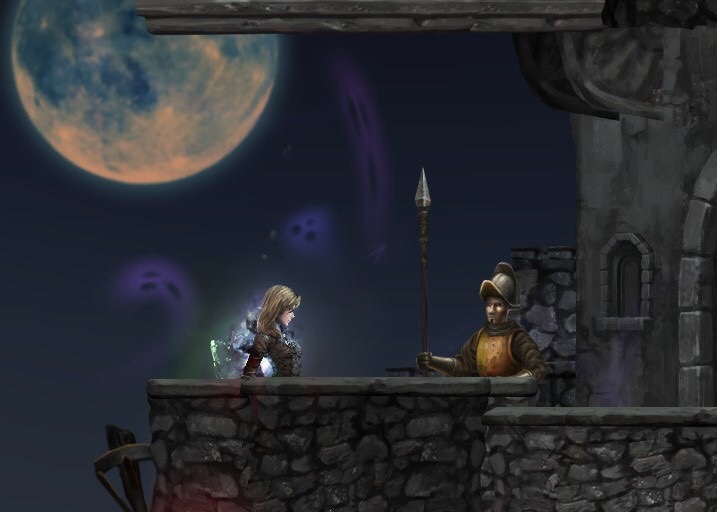
As the old woman with the lantern shows us, this game also succeeds at fanciful yet uncanny fluctuations of proportion. One minute I’m reminded of The Nightmare Before Christmas, the next I’m thinking that Leila, as she descends a ladder with a full moon behind her, looks like she leapt out of something like Batman: The Animated Series or a Genndy Tartakovsky creation like Samurai Jack.
Yes I have a flaming magic pike shoved in the back of my neck, what of it?
Not that it doesn’t have its weaknesses here and there. Leila’s face and her faster leg and arm movements and sword-swings often look like PSP graphics. It just messes with my sense of immersion, is all. A single, cohesive art style would be for the best. Imagery with a frank resemblance to CGI should be kept to an absolute minimum except when something is supposed to starkly contrast with everything else.
After turning off all of the graphical options like dynamic trees and saturation and whatnot, the occasional use of CGI-looking imagery meshed a little better but was far from seamless. Leila’s facial profile and cloak still looked a little bit like they came from a PSP, but the tentative steps into 3D made the second boss fight both eerie and gorgeous. The shrieking monstrosity’s girth and arms seem like they’re about to pop through the screen occasionally.
In fact, with all of the graphical enhancements turned off in the pause menu, Vigil: The Longest Night has a very memorable beauty. Faces often have an offbeat look reminiscent of fairly tales. The 2.5D graphics shine the best, though, inside of houses and caverns.
In fact, everything really starts to go uphill very fast near the end of the demo. When you make contact with Maye Village you find that, unlike many other Soulsborne protagonists, Leila is actually well-known in her town and seems to have specific relationships that we get to modestly explore in dialogue. We encounter stories about a young couple and their recent elopement. A suspicious and pedantic professor keeps mentioning the relevance of mythology and then we pass through a small clique of eerie and serious looking women, raving about a “DEITY”. Shortly after that, we’re in an underground cave with this shit going on:
The music that was available on the demo also stood out well. In the menu screen and the opening level area I particularly liked the use of music boxes and oboes. The cemetery music was another highlight. Nice change of pace with the strumming guitar and the keyboard. Both the music and the sound design partake in the general upward swing near the demo’s end.
Other than some glitches that I’m sure will be patched well before the game officially launches, my only real complaint are some awkward English translations that make some of the dialogue in the town of Maye feel a little wooden. And that’s probably gonna see some attention before launch as well. I like how Leila is not a player-insert like protagonists of Dark Souls, S&S and Bloodborne (even the Knight in Hollow Knight is something of a silent enigma that the player can project themselves onto…in spite of having very character-specific lore that stops them from being an “everybug”).
I mean I do appreciate ambiguity in story-telling, especially if it allows other strengths of the given medium to shine through. But we’re all very familiar with Hidetaka Miyazaki’s brand of uncertainty and Leila is just a breath of fresh air. Really, I can’t freaking wait for this game to actually be playable in its entirety.
Two days ago I played a Sega CD for the first time as well as the definitive version of one of my favorite games from my childhood: Earthworm Jim.
This is a game that I played so often that I basically have the progression route for a whole play through etched in the muscle memory of my hands. The only other games that I might have a similar intimacy with are Mega Man 3, Sonic 2 and maybe the first Tomb Raider game. That last one is a real maybe but I wouldn’t rule it out. Final Fantasy VII may be my favorite video game period but that came into my life at a much later time.
Even with that deep level of nostalgia and rote memorization, though, there is still so much to be delighted by. Not to say nostalgia still isn’t mixed up in it though 0.0
For one, consider the era it came out in. It was the early nineties and Nickelodeon and Cartoon Network were just ramping up. I remember Nickelodeon being turned on a lot in my home and my parents liked it more than I did. You see, I was probably around four years old, and almost everything on that channel terrified me. I remember an episode of Rugrats that had a freaky as hell dream sequence.
My mom was also a big fan of The Ren & StimpyShow and the niche it carved out for itself. People these days seem to call it toilet humor. When I look back on things like the episode where Ren had cavities, I’m more tempted to call it comedic body horror.
Whatever it was, though, it caught on and we got things like Rocko’s Modern Life, Aaahh!!! Real Monsters, Eek The Cat, Cow and Chicken and Space Goofs. And Little Kid Ailix liked every single one of them more than Ren & Stimpy. Cow and Chicken was probably my favorite. Maybe you could lump in Ed Edd n Eddy if you cared to. That hooked me also.
Considering that Earthworm Jim dropped in the early nineties and its blend of juvenile humor and absurdity, I think it’s fair to say that it was part of the same general trend. Earthworm Jim also may have had more personality than all of them, though.
I mean, who else remembers Boogerman? Nonstop toilets, nonstop boogers, nonstop monsters made of literal crap, it just played out the whole toilet humor gimmick to death. I was in elementary school back then and that game was somehow really popular with my peers. But it was a lifeless golem made of pandering gimmicky bullshit. I mean I’m being way more articulate than Little Kid Ailix was, but Little Kid Ailix knew that Boogerman was built on two or three gags being cycled over and over again. It was a distillation of all of the laziest tendencies of the Ren & Stimpy derivatives.
Don’t get me wrong, Earthworm Jim was totally one of those derivatives as well, but it was more than that. In fact, the gross out jokes were kind of the smallest part of the whole equation. There were other gags to, but even those gags were just one part of the whole.
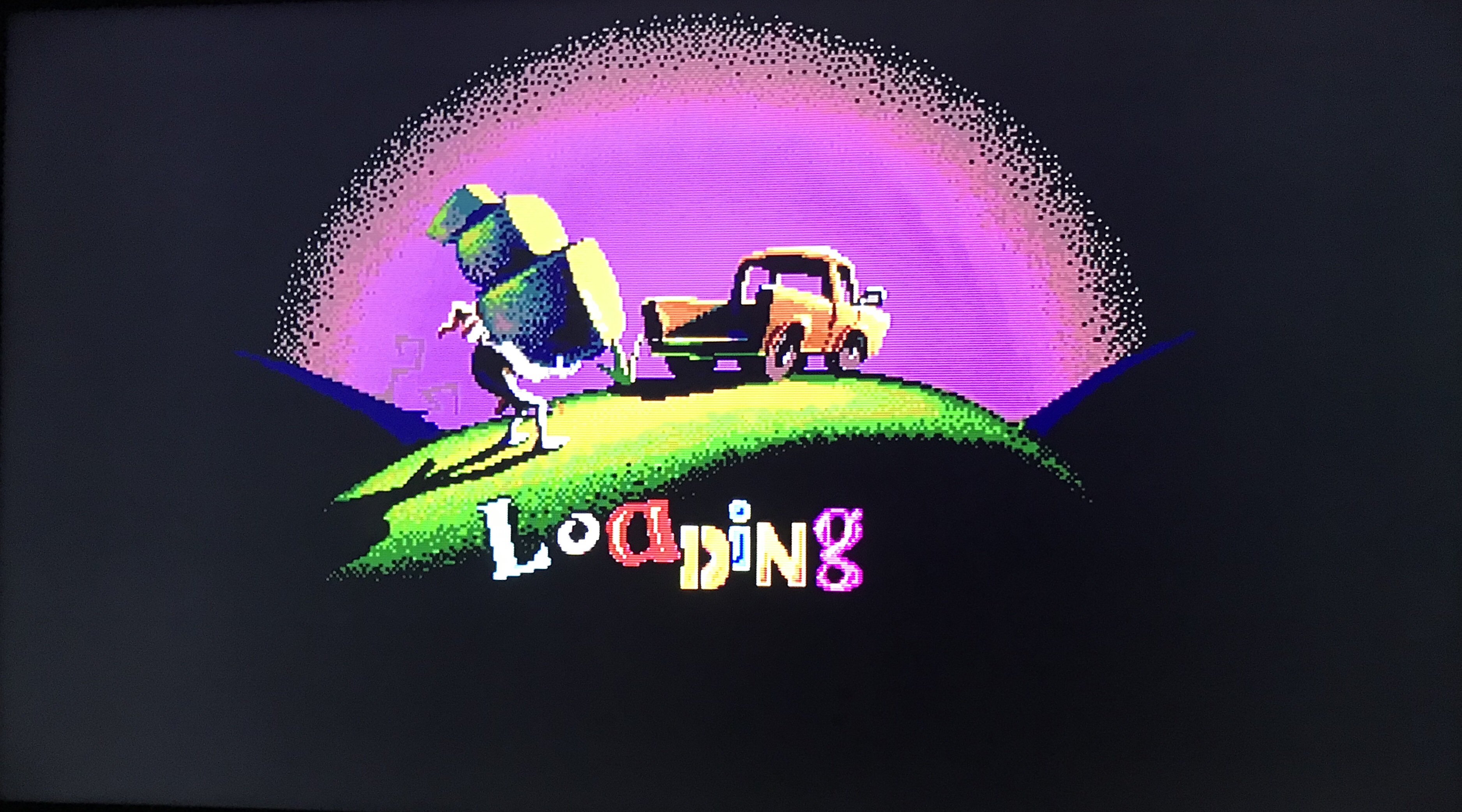
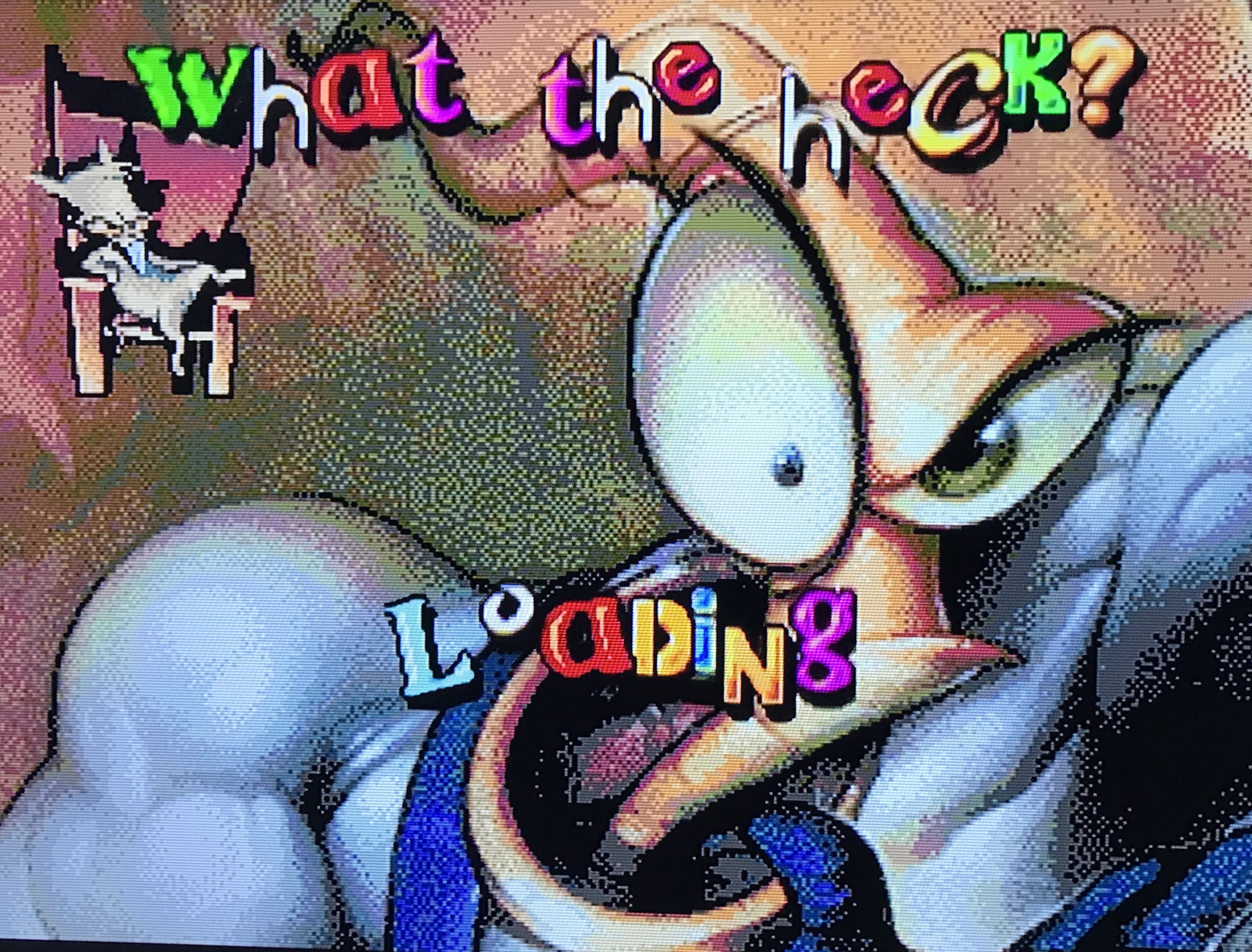
(Is it just me or do the loading screens in the special edition look like the title screens from shows that were part of the What A Cartoon block from Cartoon Network?)
I mean, the For Pete’s Sake level, for example. That clearly relies on a big versus small gag. Jim is big and Jim is protecting Pete who is small. If Pete get’s hurt, Pete turns into a giant red bulldog monster with throbbing veins, clutches Jim in his teeth and drags him back a few obstacles behind where he was. It’s a classic gag, sorta reminiscent of Looney Toons, really.
But look at all the other details that the game gets you to take for granted. What planet are you on and why can you see space? Why does this seem to be the only level that gives you a sense of having just come from the interstellar race with Psycrow that you do between every level?
The music also adds something. It adds something during every second of the game, because Tommy Tallarico is an angel sent to Earth to make beautiful beautiful music. But in For Pete’s Sake the music is restrained, which lets everything else go to the foreground. But still has this droning, rhythmic, science fiction quality.
Oh, and this tonal balance that happens between the normal gag stuff, cuteness and eerie atmosphere? It shifts dramatically in the second to last level, Intestinal Distress. The level is weirdly minimal, save for the appearance of being inside of someone’s digestive tract. And the music is…well…horror movie music. I can’t think of any other way to describe it. Sure enough, the last level is called Buttville.
During one of my early play throughs, I remember the growing realization that the final boss and villain of the game, Queen Slug For A Butt, is bodily connected to Buttville. As in, you are actually inside her and your progression to the exit- AKA her asshole -triggers the final boss fight. Little Kid Ailix was like “is this…seriously what it looks like????”
That, needless to say, goes beyond “toilet humor” and is truly weird. And the music in this level. The track commonly known as Falling, in a different context, could actually create a feeling of vertigo and dread. I almost wanna say it reminds me of falling into Hell. Certain puns come to mind, like “the belly of the beast”.
Actually, at the age I was when I first played this, it hooked my imagination. I’ve always written stories, almost compulsively, and Little Kid Ailix was set on a kick of designing stories set inside of bodies.
Anyway, on the special edition for the Sega CD, one of the first things you’ll notice is that the soundtrack is so crisp and perfect that the music alone could fully justify it. It’s just that good. If you’ve played the SNES or Gameboy Advance ports and thought they were markedly inferior to the Sega original, then the Sega CD sound quality makes them absolute garbage by comparison. Maybe it was re-recorded- I don’t know just now. I do know that the Sega CD was capable of CD quality sound so it wouldn’t surprise me.
And while I love how smooth the muscle memory of my endless play throughs can make things, my heart was instantly warmed to find out how many of the levels are expanded. In the part of New Junk City where Jim is suddenly without his suit, he announces “I’m nude!” with a Southern drawl.
Did Jim have a Southern accent in the WB cartoon series? I don’t think he did. But the “Ahm noood” combined with his “woah Nelly!” from the original makes me think he was meant to be Southern in the game. Could that be why there’s a loading screen with him *snickers* loading stuff into a truck bed? It also seems consistent with the banjo music that plays when you race against Psycrow. And yes, banjos are a commonly recognized hallmark of Earthworm Jim music. Banjos, science fictiony electronic beats, parodies of music from nineteen-thirties Disney cartoons and industrial rock. And it all fits into the same atmospheric whole. Did I mention the composer, Tommy Tallarico, is a freaking gift?
So I was wrapping up the Psycrow race after What The Heck? when this shit happened
I blink and I’m like “What the fuck is this shit??”
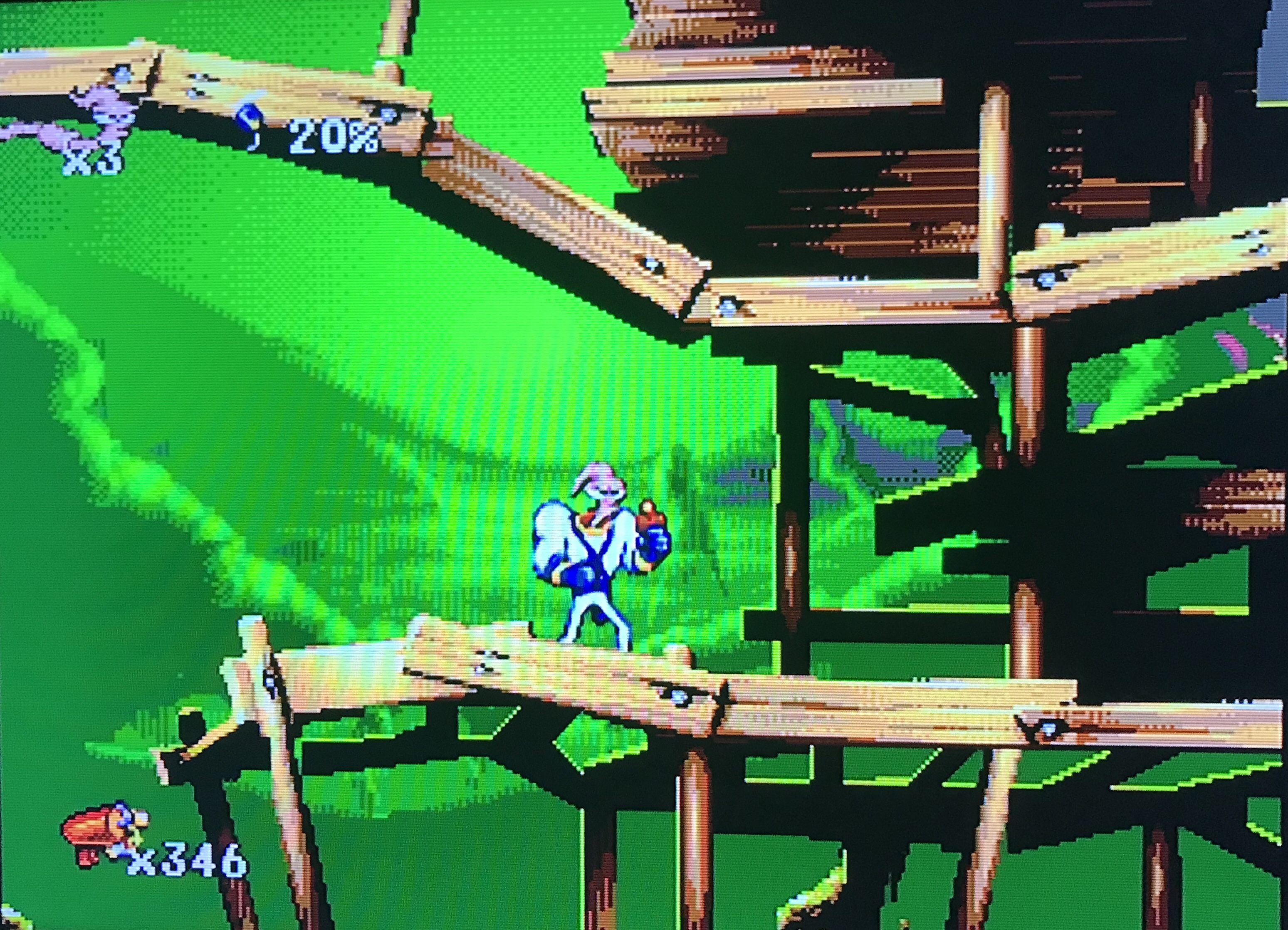
This shit wasn’t in the original game. After tooling around for a minute, I notice the music for this new level has creepy, empty wind sounds and dry wooden creaks, like a plank dangling from its nail off of a crappy cobbled-together fort. And what is that pink thing? It’s kind of like…a dinosaur? I guess? Are those nostrils or its eye sockets? They’re empty so I wanna go with nostrils. Please let them be nostrils.
So you inch up to it, it starts to stalk you, it speeds up and…and…what the fuck are those sounds it’s making? It sounds crazed and hungry, but what are the actual noises? Hoots? Grunts? Gibbers? All of the above?
Whatever this nightmare fuel is, you gotta deal with it throughout the whole level. In fact there are a few puzzles built around getting the pink, sightless, hooting crazy fucker to crash into things to remove barriers or step on levers to launch you into the air.
What delighted me more than all that, though, was that this new level, called Big Bruty, required me to use all of the same problem solving strategies I used as a seven year old. It re-connected me with Little Kid Ailix’s feeling of having solved a few puzzles, got a game over but still eager to press on in spite of the frustration. This bizarre little curve ball of a level actually made me feel a lot of things that I haven’t felt for a long, long time.
It was a very pleasant night of gaming with my amazing girlfriend, in other words. And a lovely way to get re-acquainted with a gleeful part of my childhood. Now I kinda wanna see if that graphic novel the original devs are working on is in any way obtainable
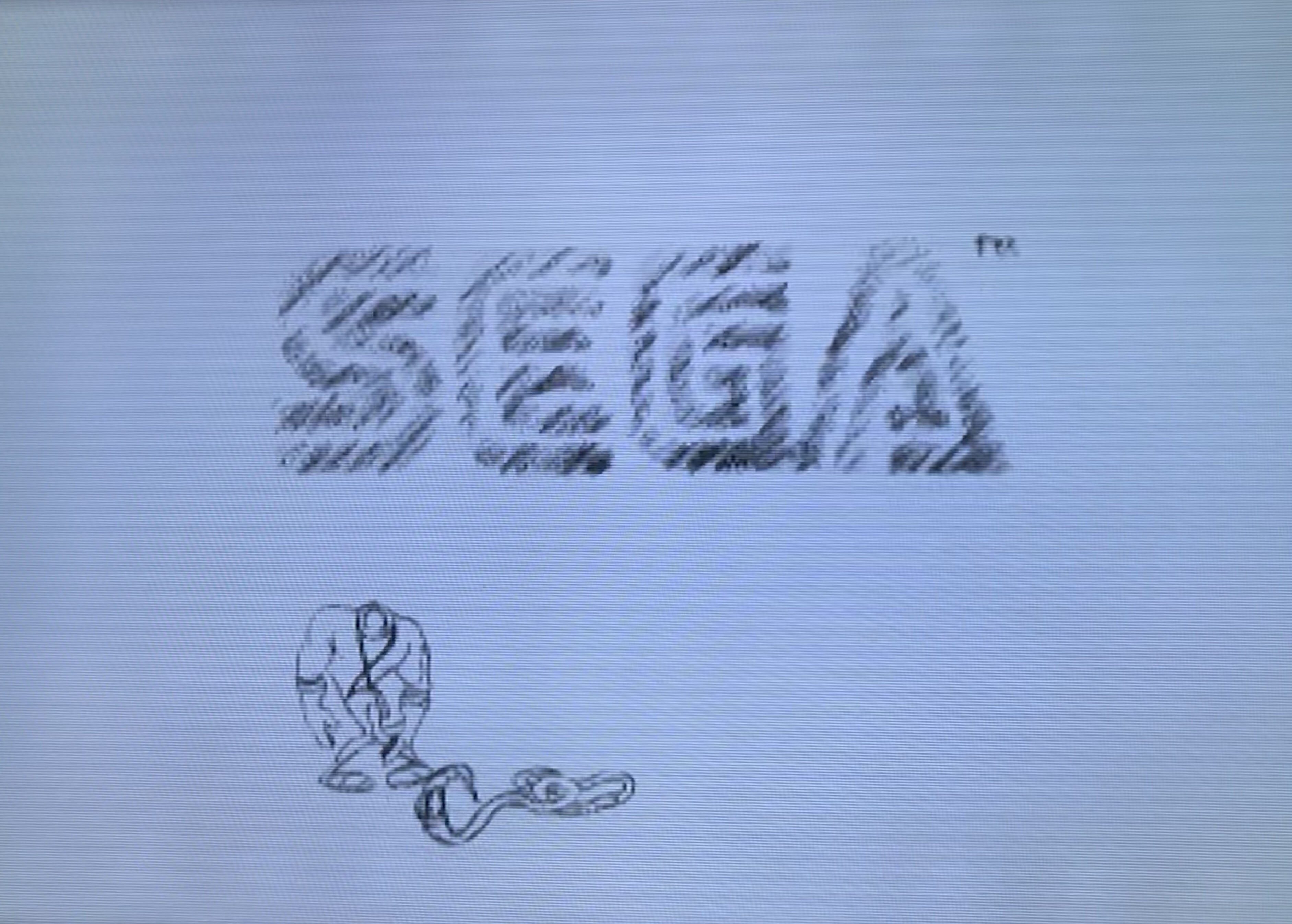
(Eat your heart out, Doug Funnie, someone did the black and white pencil intro better then you! 😀 )
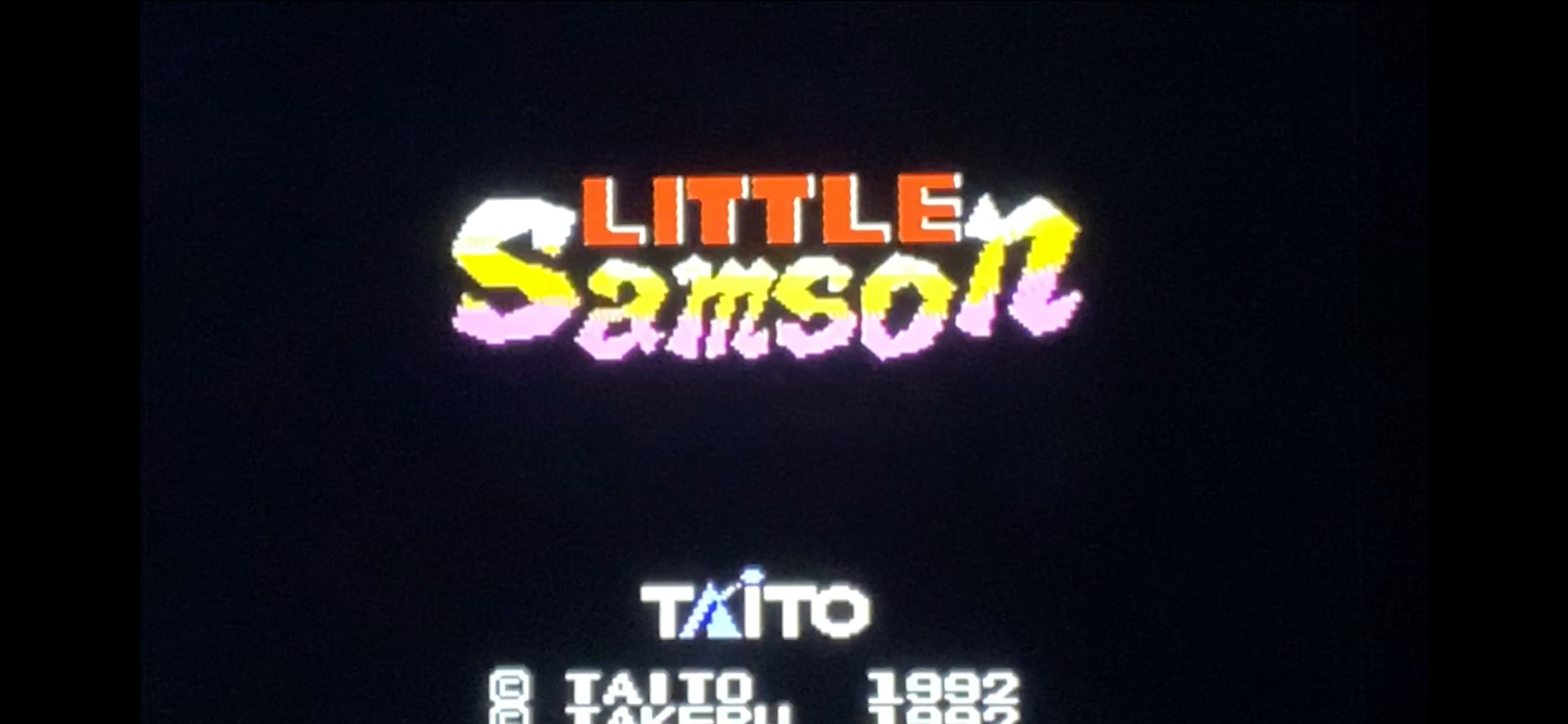
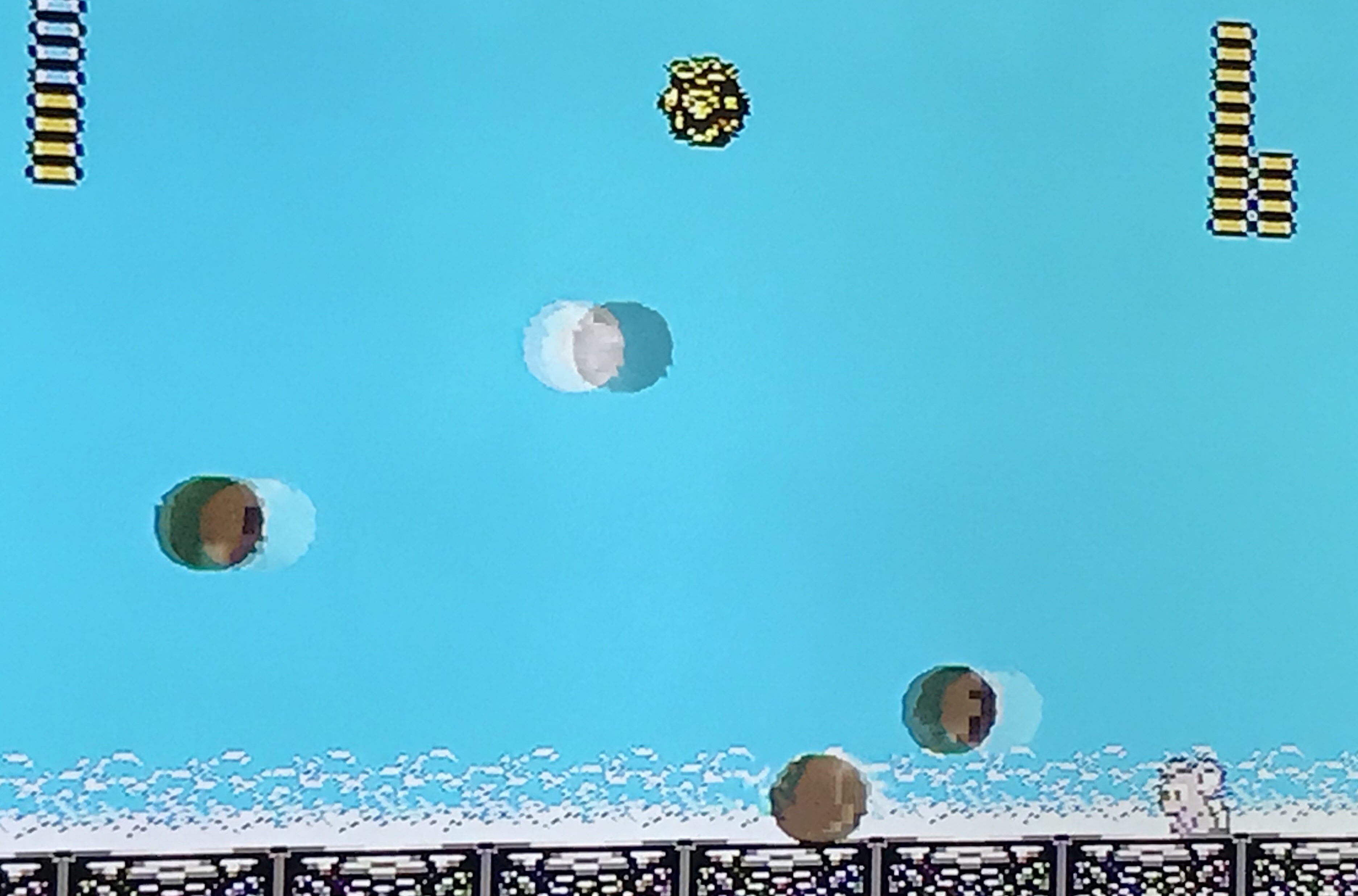
Today I was treated to a chance to play a special NES rarity called Little Samson. Why this game didn’t blow up into a franchise is beyond me since it has got to be one of the most well-designed NES games I’ve ever played.
I feel like I should qualify this a little: by “well-designed” I mean neatly designed. Neatness is not the only measure of good design. The early Mega Man games, for example, do not take the time to carefully and systematically flesh-out concepts in a way that lets you easily build on one after another. Sequential concept elaboration is simply a design convention and there are other possible approaches.
As I was playing Little Samson with my significant other (whose video game library is gloriously encyclopedic) I had a thought that captured the nature of this distinction: if you want something with teeth right now, put in Mega Man 3 and start with either the Shadow Man or the Gemini Man stage. And yes, while most Mega Man games have a “rock paper scissors” affinity pattern that usually leaves a rather sequential path to quick victory, you have the choice of starting in one of several different levels.
Most people my age though, who didn’t have the benefit of guides back in the early nineties, relied heavily on trial and error. Which meant you would deduce things in a stage you were in no way prepared for and apply them to the platforming in other stages. Eventually these deductions would get you acclimated enough to the platforming and general level design that the easiest possible stage to beat through platforming alone would become apparent.
A less clunky way of putting this is that Mega Man games typically have non-linear design, which places a greater emphasis on trial and error and deduction. Little Samson, meanwhile, has a linear design.
The teeth come eventually, though. The opening stages are little more than obstacle courses that teach you the rudiments of handling the four player characters. These basically function as a tutorial that shows you the basic uses for each playable character’s specialized abilities.
So rather than confronting you directly with multiple layers of difficulty, like Mega Man, the ways to approach different obstacles are broken down for you in the beginning. It is up to you to determine where and how to use these strategies. Later, when the “real campaign” starts, you will normally find that the following stages will accommodate one of the player characters more than the others. This is the period bracketed between the first and second boss fights.
While the second fight is pretty hard, you may begin to be a little dismayed at what appears to be a flaw in the neatness of the design: the dragon pc will get you most of the way through the first two bosses. Which could tempt you to think that the dragon might be the all-purpose boss-killer.
Boss number three will immediately disabuse you of this, to say nothing of the third stage levels requiring more pc rotation than anything beforehand, with the dragon and the mouse being the most useful for the platforming and the golem being useful for some annoyingly persistent enemies. And for nothing else: the golem can barely platform at all. Then you fight a boss that’s unapproachable for any pc except the mouse with two hit points.
The third stage and the third boss are also a great opportunity to address how original this game looks. In fact, I don’t know of any other NES game that looks quite like it. Your main pc, Little Samson himself, reminds me of the child version of Son Goku from Dragon Ball. The sorcerer in the opening cut-scene also reminded me of Dalton from Chrono Trigger. What do Chrono Trigger and Dragon Ball have in common? Akira Toriyama!
(Now I’m kinda torn…does he look more like Dalton or Piccolo…?)
Turns out, the art was done by someone named Yuko Nakamura, for whom I can find no other credits. Which is unfortunate because there are some delightfully wild style variations.
The figures in the palace at the beginning, with their robes and headdresses, look almost Babylonian. Rather like your Toriyama-esque main character, there are some sprites that have a cutesy chibi vibe, like the bubble-breathing diosaurs. The pink dragon pc also reminds me of Icarus, the dragon Gohan adopted in Dragon Ball Z: The Tree Of Might and the different villainous sorcerers all sort of look like Piccolo. The second boss looks like a cross between a dinosaur and a Giger-style xenomorph. A later boss transforms into a huge dragon that takes up most of the screen. Later levels have large purple cartoon hands reaching out of the ground along with stone corridors with Egyptian hieroglyphics.
Against any expectation the prior levels and creatures may have furnished, the third stage either looks like an alien planet or some sort of cutesy Mordor. Big’ol starscape in the background with vanishing platforms that either look like chemicals or energy with glowing heads that shoot projectiles. And when the long vertical wall platforms become more common you really tend to rely on the mouse pc.
So you’re doing precise platforming while you’re dodging energy projectiles with a mouse with a standard HP limit of two hits. With the same mouse, you also have to win a boss fight with a sorcerer made of floating demonic skulls with lil bombs like the kind Samus Aran drops with her morph ball. On an alien planet. I did say the teeth come eventually.
Which is another interesting gameplay elaboration. All pcs have different max HP limits. My SO and I were utilizing a quick-save feature that wasn’t in the original game (don’t ask ’cause I ain’t telling :p ). So the quick save may have made this seem like more of a feature than it was meant to be, but I noticed that I was trying to anticipate future pc rotations.
If I noticed that I was relying a lot on the mouse with two HP, for example, I would collect as many HP buffing power-ups as I could so my mouse wouldn’t be a one hit kill. I really started hoarding the HP buffs in stage two when I realized the blue bastard boss fight is best approached with the dragon and therefore needed that pc to have a higher max HP than is standard.
This feature also holds true for other power-ups as well. Every pc has its own unique health bar which means they all need to be healed individually. This calculation is deepened by the fact that you don’t simply lose the pc and keep playing with others when they hit zero: you die if you reach zero in any form. So you need to be thinking of which pc will receive what power-up when you find it.
The music also changes based on what pc you’re using which, at times, can be a lil bit annoying. Which is too bad since the music is pretty good in general.
From the opening tutorials, you learn that the golem, mouse and dragon are the most specialized playable characters with Little Samson being “a jack of all trades, master of nothing”. It’s normal to use Samson early in a stage while you’re assessing which specialization(s) will suit the stage best. Which means you spend a lot of time listening to Samson’s music, and that can be pretty grating. I really prefer a full immersion experience with music and sound and everything happening when it’s supposed to, but while I was playing the third stage I actually muted the game.
That was kind of a disappointing time for that to set in since so many design choices really come together beautifully in the third stage. Not that it’s anything more than an annoyance. If it gets to you that much you can just switch characters. And anyway the final level has its own music regardless of which pc you choose.
Speaking of the last level, Little Samson has a final boss fight that will make you hopelessly dependent on your ability to memorize jumping patterns with the character with the least HP because they happen to deal the most damage (unless you’ve collected buffs). In a few different puzzles and situations you can rotate transformations for alternate dodging and attacking but not this time.
(THIS fucker X_X)
On the other hand. It is also possible to use different characters as meat shields and adroitly switch back to the mouse in time to spam with your morph ball bombs. That’s what my SO did after I spent several minutes fixating on jumping, which actually worked like a dream.
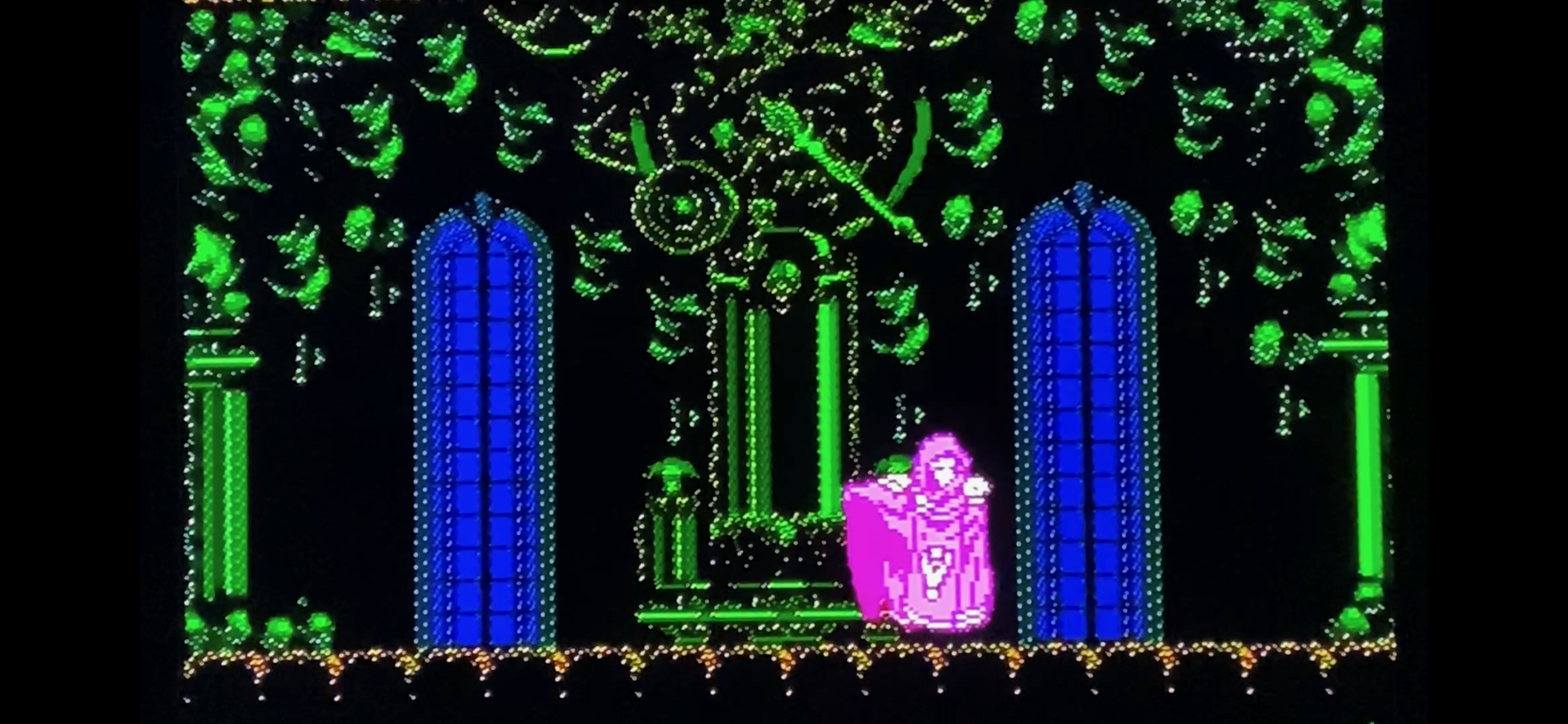
(Then we got a nice lil cliffhanger going on post-credits with this guy flashing on his throne after the four sorcerers wink out of existence)
After we beat the game, my partner showed me a bunch of images to use in this blog as well as some footage of our play through. On one recording we could hear my voice saying “this is simultaneously one of the cutest, weirdest and hardest things I’ve ever played.”
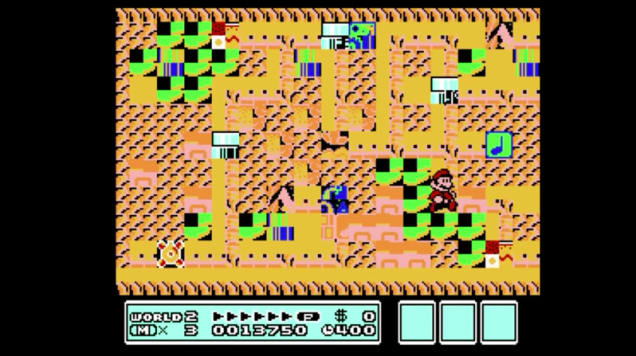
Which is an assessment that I stand by. The difficulty is pitch perfect, it plays fair and it combines a handful of influences from Mega Man to Mario while having a character that’s all it’s own. I remember, when I played the third Mario game, I was in disbelief that it was actually available for the NES- it looked like it should be a SNES game. Little Samson‘s graphics are nearly at the same level of sophistication, especially with cool little gimmicks here and there like rotating sprites. I’m gonna be jonesing on how cool this is for awhile and I’m still surprised that this game didn’t pick up the momentum that it should have (yeah I know it was released just as the SNES was getting off the ground but it’s not fair D: )
As a prose writer it’s easy for me to get attached to my sandbox mentality. When you hit your stride with a story, you luxuriate in your solitary ownership of the process so much that it could potentially spoil you for anything that requires any diversification. Just lately I’ve been skimming the RPG Maker website since I’m way too much of a wuss to actually get a real engine and attempt ground-up game design.
Not that it was ever a terribly good idea to go into game design completely on your own in the first place: in the eighties and nineties, a game we would consider simple by modern standards would be a neck-deep passion project of a small handful of developers. The fact that the Mortal Kombat games were pioneered for 16-bit arcade cabinets by two people may have been uncommon for the time but by today’s standards it’s almost Herculean. Being a total Final Fantasy fan girl, I’ve been following the development of the FFVII Remake and the FFVIII Remaster with bated breath and the developers have said repeatedly that video game development is rapidly reaching par with filmmaking as the most expensive and collaborative of art forms.
This specific comparison has been on my mind lately because I recently finished playing through a game called The Space Between that I first found out about through John Wolf’s YouTube channel. Put simply, The Space Between is completely narrative driven; no puzzles, no combat, no normal video game mechanics of any kind. Your job is simply to move through the linear story through exploration and dialogue. In other words, it’s an interactive short film.
In the last few years (going on decades) this has hardly been unique: we’ve all heard of the TellTale Games along with Quantic Dream and Dontnod Entertainment: interactive video game “films” have pretty much blossomed into their own genre (to say nothing of visual novel games). Most of them, though, typically rely on a combination of polished graphics (whether that’s attempted photo-realism or an emulation of hand-drawn art) and exploiting opportunities to work in more conventional gaming mechanics into the cinematic narrative. Telltale Games produced two Batman games that use elements of stealth, puzzle-solving and beat’em up combat. Life Is Strange relies on puzzles and Vampyr is an action-RPG. These games also typically have ordinary and recognizable situational and narrative cues that give you a pretty clear idea about where things are going.
With films, there are definitely several precedents for auteurs forgoing these expedients: something like Elias Merhige’s Begotten or David Lynch’s InlandEmpire require you to take it in like a painting or a sculpture. These films are almost purely visual with little to no use of narrative craft. When I was in college I encountered a helpful way of describing this in an essay by Tania Modleski about cinematic excess. According to Modleski, cinematic excess is when the visual content overwhelms or outpaces the narrative content. According to this model of filmmaking as visual art and narrative craft, mainstream film is basically a hybrid medium: stories are largely what people are looking for from a mainstream film, making them a combination of literature and graphic art. A “pure” film, with no emphasis on literature, would probably be something like Dali’s Andalusian Dog, since it’s a series of images that are held together by a thematic thread but has no frankly expressed story. Begotten and the films of Kenneth Anger could also be classified as “pure” filmmaking with little to no reliance on literature.
Before I go on, I just want to bottom-line the fact that Modleski’s breakdown is meant to be descriptive and not judgemental: something that uses visual presentation along with a story is, in the most literal sense, a hybrid of literature and graphic art. Even dramatic writing is a sort of hybrid since, along with its visual presentation, drama and theater often have their own academic and artistic partitions. A novelist and a playwright are not interchangeable.
The application to video games should be pretty clear: something like Pong or the very first Mario or Donkey Kong games are good examples of “pure” video games. They have virtually no reliance on story-telling of any kind- all of the content is in the gameplay. No one who has ever enjoyed those games has ever required narrative context for them to make sense.
When video games became more mainstream in the late eighties and early nineties, fictional scenarios were implemented more and more to make them conventionally compelling, since stories are something we all have some familiarity with. It could be argued that this was where the expectation that video games be as “real” as possible emerged. Since then, the majority of popular video games, like popular films, have been literary hybrids according to the Tania Modleski analysis. Clearly, Telltale Games, Quantic Dream and Dontnod Entertainment have become specialists in this hybridization, making it even more frank with their cinematic influence (not that they were the first game developers to be seriously influenced by film, obviously).
I’m bringing all this up because it offers a more streamlined way to talk about the use of narrative devices in video games. Specifically where The Space Between is concerned. If video games have widely adopted literary hybridization with the same success that filmmaking has, then the recent popularity of linear, cinematic video games is a useful point of comparison. Life Is Strange is a hybrid game and The Space Between is definitely, obviously a hybrid game. But even between hybrids (and especially between ones influenced by film) there are degrees of specialization and craft convention.
If, for the sake of argument, we designate subgenres like Metroidvania and Soulsborne as the middle of the spectrum (since they often employ a vast, single map, mostly visual storytelling and a narrative pace that hinges on puzzles, combat and other ordinary gaming mechanics) then The Space Between easily lies closer toward the cinematic end of the spectrum.
Like I said, the story is firmly linear and, as the player, your participation is limited to putting one foot in front of another until the end. What makes playing this game different from watcing someone else play it is that, from a first person perspective, you have a deeper sense of immersion and participation (although your interactions and relationships are dictated by the script). You hear things happening around you based on your movements and locations which gives the impression that your actions matter, that you are tapping on one side and something on the other side is tapping back (very literally in some cases). One of the cooler instances of this involves…snipping sounds.
This is where we get into spoilers (if you wanna close out of this and experience the game for yourself, I’ll include a download link at the bottom of the entry). Your player character has had a lifelong relationship with someone named Daniel, apparently going back to childhood. Potentially. There are only so many ordinary ways where one ends up in a blanket fort with chairs, talking to someone on the outside. I guess this doesn’t necessarily have to be in childhood. It’s a flashback, at any rate. So Martin (our player character) tells Daniel he doesn’t want him inside with him, but he doesn’t want him to leave either. He asks him to put his hand on the blanket and Martin touches back. Martin then asks if he feels his hand or the blanket. This flashback establishes some basic thematic language and has a few parallel echoes later on. It’s presented as fundamentally important for Martin but the specific nature of his relationship with Daniel is almost never frankly stated. Almost.
During another scene that could potentially be a continuation of the flashback, Martin tells Daniel to get a pair of scissors and cut one hole above and another below. When this flashback(?) ends and we’re back in the present, we’re standing in rows of sheets hung out to dry outside of an apartment building. As you’re passing through the corridors of sheets you hear one snip. A little while later, you hear another. After that, you glimpse a sheet with one hole near the top and one near the bottom. If there was any doubt that was what it sounds like, later on you see a curtain sucked around a human outline with a hole in its face and another between its legs.
Since many of the flashbacks seem to be dropped during conversations with another character named Clara, it’s probable that Martin is actually talking about these events as you, the player, are shown them. This possibility is emphasized even more later on when the momentum near the end picks up, when he says “Clara don’t do this” when eerie events that resemble his connection to Daniel start happening. If Clara is doing anything, the only potential reason the player is given is because of what Martin told her. The fact that the player has been in Martin’s POV during the mid-conversation flashbacks that show his story adds to the sense of participation. Even after the sections where you are basically forced to sit in Martin’s POV and watch him talk, you are put in very ambiguous and tense situations that will not progress until you go where you have to go to trigger the events.
Essentially, you are shown a visceral vulnerability of the player character that may or may not have been vocalized before, then, following this huge, personal surrender, the protagonist loses all sense of control and safety. Fear was overcome to let another person in, and then the fear was justified in spades. You’re not even sure of the exact threat and you will not learn how badly you fucked up until you walk yourself into the worst of it.
Think of the cut-scene in the second BioShock game where your awful ending will not happen until you press a button, and you will press the button because you can’t do anything else. That’s kinda what’s going on.
If The Space Between was a short film, the ending and the momentum that’s built up by Martin’s trust and his subsequent betrayal is where we would get the real payoff of the literary and photographic hybridization. There is even a word from early twentieth century German film that’s easily applicable to this: expressionism. Put simply, an expressionist film is set in a vacuum, establishes its own “rules” in the course of its story and needs no context. David Lynch has probably done more heavy lifting than anyone toward updating and localizing German expressionism for America with films like Ereaserhead, Lost Highway and Mulholland Drive. Those films are not set in a vacuum, but the real world locations that they are set in tend to not inform the internal rules of the “world” any more than a vacuum. Usually, a psychological or emotional continuity takes priority over a literal one. All of the visual cues and character decisions make sense, but only if you accept the subjective dominance of one specific character over all others, since the things that have emotional connotations for them will end up controlling everything else.
If The Space Between was a film, the ending is where Martin’s psychological continuity would start replacing the literal continuity in the foreground. What makes this kind of narrative device different from, say, something like the Pink Floyd film The Wall which is strictly about a character’s internal life, is that The Space Between tries to draw your attention to an objective world that definitely exists but is still invisible.
The game begins with what appears to be a newspaper article about the body of Martin Melanson, a well-known architect, being found in a hollow within a wall. So we have a definite statement of something happening, but everything else is totally subjective. David Lynch has done similar things, such as in Lost Highway when Fred Madsen appears to magically change into Pete Dayton while he’s in prison. Pete is released from prison and the story, through visual cues, seriously begins to look like a separate, parallel event to the Fred Madsen story. What stops the viewer from firmly deciding that Pete Dayton is in a separate story is that he was followed out of prison and is being surveilled by two FBI agents from the Fred Madsen story. The presence of the FBI agents are a constant reminder that, no matter how much this looks like a broken continuity, one thing is still chronologically following the other. Like The Space Between, something is definitely happening in the real world, but the subjective continuity makes it totally invisible.
For film, this is an example of a well-established device that relies completely on the visual cues and the performances of the actors to overwhelm a frankly stated plot. The plot is overwhelmed with a visual and dramatic continuity that still has a thematic relationship with the plot, even while leaving it behind.
As much as I enjoyed The Space Between, though, I couldn’t help but wonder: what makes this different from an interactive film? Does its presentation as a video game actually bring any real hybridization, or is this simply a film via video game?
As previously stated, the orientation of the player in Martin’s first person point of view does much to differentiate the experience from that of watching a film. Dialogue is used often but many of the essential stories told by Martin are shown directly to the player through flashbacks rather than through explication. The next difference may not be a substantial one but The Space Between utilizes the same graphics as early nineties PS1 games which has a few different consequences.
One of them, which is admittedly negotiable, is nostalgia-tinged uncanniness for those of us that grew up with the PS1. It creates the experience of finding something startlingly foreign within something familiar. It also uses some commonplace technological limitations from that era to good effect. Most early PlayStation games used text-based dialogue to save information space and, rather like those very games, The Space Between‘s text dialogue allows the communication between characters to share the foreground with the atmosphere created by the music.
Which is to say, the dialogue happens within a sonic atmosphere rather than interrupting or embodying it like voice acting would. This, both for this game and older games, is a huge gain for the immersion. It’s this immersion that enables the player to be directly in touch with the subjective continuity as it takes over the objective one, making it an effective blending of cinematic trope with classic video game presentation. The first person player experience plays into the success of the expressionist structure.
Now….as cool as I think this game is and as much as I’m enjoying reviewing it, this review was not originally the point of this entry. What I wanted to talk about in the first place were ideas from filmmaking seeping into other mediums. There are a few different reasons for this.
The more selfish ones are, as the opening paragraph states, that I am growing curious about other art forms than the one I’m most accustomed to. So I’m skimming the more, shall we say, vanilla edges of game development. I’ve also had ideas for screenplays that I’ve been seriously excited about in the past but, realistically, filmmaking can be very difficult to get into. Which hasn’t stopped me from roughing out screenplays, but genuine difficulties exist. So perhaps it’s prudent to be aware of other expedients.
Was this what Christoph Frey, the mind behind The Space Between was thinking when he made that game?
I can think of some reasons why it may not have been, such as a wish to simply make an uncanny and dreamlike work of art, but if he was thinking about an alternative to filmmaking, I could hardly blame him. Alejandro Jodorowsky, a renowned filmmaker by any standard, struggled for decades to make a sequel to his 1970 classic El Topo and, recently, has decided that his vision was too pressing to wait any further on the convenience of the film industry. He then turned to an artist he trusted deeply and elected to make the El Topo sequel, called The Sons Of El Topo, into comics. I have read the first hard back English language volume, Cain, and Abel is expected to get a hard back English release later this year.
Being the pragmatic and opportunistic magpie that I am, I always jump at the opportunity to learn more about how my own ideas may benefit from similar adjustments. My recent desire to throw myself into RPG Maker started with a conversation with a friend about making our own video game together. My mind took off but at the time I wasn’t aware how obtainable RPG Maker software is. As I plotted the story out I realized I cared too much about it to let go and so resolved myself to write it as a novel. And then I saw the bad-ass retro SNES and Gameboy-style assets and skins on RPG Maker and now I just don’t know. So the pros and cons of different kinds of artistic hybridization have been on my mind lately, how a story may change from one medium to another. Especially since this particular story of mine is connected to the same world-building project of two different novels I have in the works.
Why not do both the game and the book? Good question, why not indeed. Neil Gaiman did a few different retellings of Neverwhere for different mediums. Butttttt Iiii dunnnoooo…..I like the idea of a creative exchange between different mediums that are all involved in the same project. Such things have their flaws, as the expanded FFXV and Kingdom Hearts universes attest, but…I wanna 😡
And, at least, I think the multi-volume El Topo saga indicates that success might just be obtainable on that front. Several things that had a very specific function in the original film, that worked specifically as cinematic techniques, have been translated to intriguing effect in the comic book continuation.
For example, the cross dressing and the seemingly random fetish imagery. Film, like theater, can get so subjective at times that you wonder if there is meant to be any actual context (I.e. expressionism). El Topo exploited this potential well. The protagonists’ transformation has a lot to do with a female phantom-self, a kind of Jungian anima, that may or may not actually exist. This female reflection is portrayed by an actress but, when she speaks, she has a male voice. Later, in a separate setting, an apparently female character also has a male voice-over when she speaks. Does the female reflection of El Topo exist in the same way that the named characters do? What about the same phenomena appearing casually in a different place?
The comic continuation has made it clear that at least some of these things literally exist: male to female cross dressers do, in fact, seem to be common place. Particularly in the clergy. And that El Topo, post-martyrdom, is venerated by Christians, Jews, Hindus and Muslims. This could either mean that El Topo has literally synthesized all of these religions into one or that this is a non-literal way of indicating that El Topo is universally revered in the fictional world. It is also now clear that the honey-combs that appeared at El Topos grave were not an illusory symbol but literally appeared as his dying miracle.
Another smaller but cool wrinkle is that the ghost of El Topo and the appearance of his sons are all meticulously drawn to resemble Jodorowsky himself in his performance in the original movie. Cain is identical to the violent pre-apotheosis El Topo and Abel is identical to post-apotheosis El Topo. El Topo’s actual ghost looks simply the way he did at the moment of his death. In the beginning, when El Topo’s final massacre near the end of his life is retold, the artist is very precise is recreating Jodorowsky’s specific facial expressions and it’s freaking beautiful.
The precise nuts and bolts there remain to be seen for English speakers, and my French is a little rusty right now so I don’t know if I’d be up to tackling the older digital versions of the French run. Another thing that has yet to be seen is whether or not the female version of El Topo will be revealed to have a literal existence after El Topo is dead- she was an essential character in the film and I would love to see her again in the comic.
So yeah. I find some of Jodorowsky’s words rather applicable to my current predicament: “There is no failure, only a change of direction”. Closed doors can definitely lead to successes of their own with the right mindset as he himself has made clear.
Link to the Ichio page where Christoph Frey’s The Space Between can be purchased-