
Big’ol spoiler warning
From ‘Mothering Invention’ onward, much of the narrative slides into flashback mode, which makes sense. The plot depends on a lot of things that happened off-camera and- if I hadn’t read ‘Old Is The New New’ between ‘Mothering Invention’ and ‘”Okay”‘ -I don’t know how the story would have hit me. Since the stories in ‘Old Is The New New’ were equal parts experimental fun time and retrospective storytelling, I wonder if a lot of fans simply went from ‘Mothering Invention’ to ‘”Okay”‘ during the original run.
Minus ‘Old Is The New New’, the majority of the plot does take place in the twentieth-to-twenty-first century. I’m starting with a nitpick because I’ve wrestled with similar issues in my own writing, lately. Sometimes there is no convenient place in the central narrative for things with too much distance from the main plot. In the absence of an opportune flashback occasion, what else is there to be done except simply write more stories covering the remote-yet-meaningful plot points?
Situating the ‘Old Is The New New’ anthology as volume eight in the collected editions makes sense…but it can also hit like a recap of a bunch of information that should have been better integrated. I suppose it looks conspicuous to me because there simply wasn’t that much non-linearity beforehand. Yes there have been big, complicated, explosive plots with lots of things to pay attention to…but it was all rather linear. The most obvious breaks from this are the flashbacks with Ananke and her sister, six-thousand years ago, in ‘Mothering Invention’.
Yet those ‘Mothering Invention’ flashbacks can function as a bridge.
Before then, The Wicked + The Divine never got metafictive but it played footsie with it. The 1234 panels in the early books remind me of conventions in comic-scripting. A few of the collected editions contain Kieron Gillen’s scripts at the end and he writes with care and intention: relatively few older comic-writing conventions are present. But those 1234 panels really remind me of certain Alan Moore and Neil Gaiman scripts, divorced from the actual comics. Panels are often numbered to denote sequencing and there are a lot of scripts where the most common things an illustrator will read are ‘panel 1…panel 2…panel 3…’. The 1234 panels also tend to appear during the moments that feel the most non-linear, like Dionysus’ first appearance in the story at the rave.
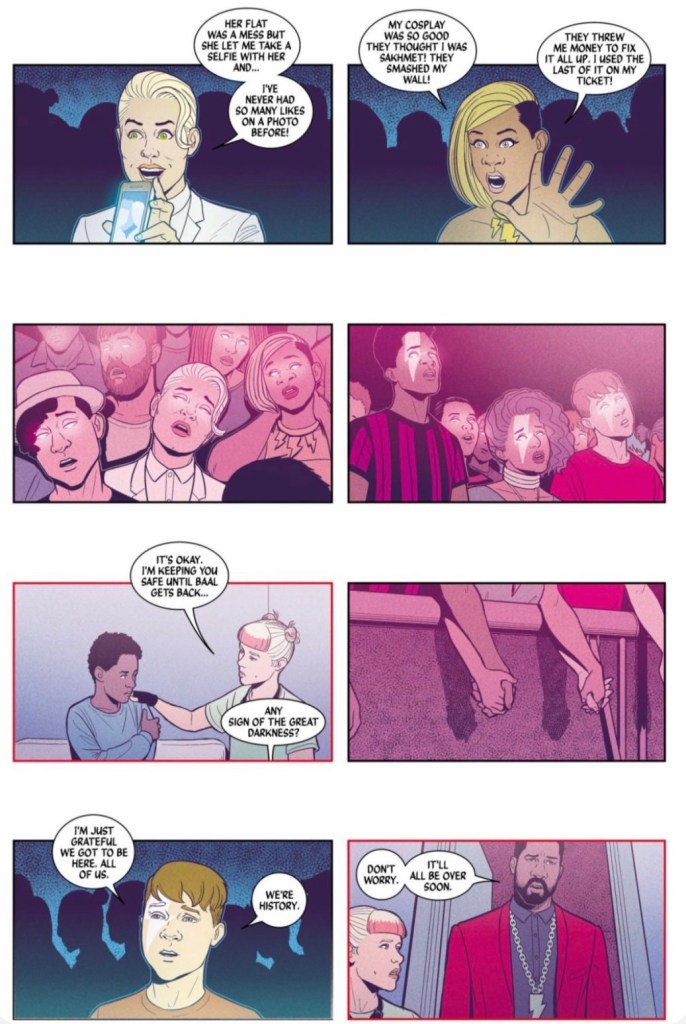
Another metafictive slow burn is the presence of the Pantheon fandom. No, characters dressing up as each other is not definitive metafiction but it’s always happening in the background. ‘Mothering Invention’ then foregrounds the possibility that the prior incarnations of the Pantheon all had loose resemblances to each other anyway. Sometimes, the appearance of one 2014 divinity may have been inherited from a prior incarnation of another one.
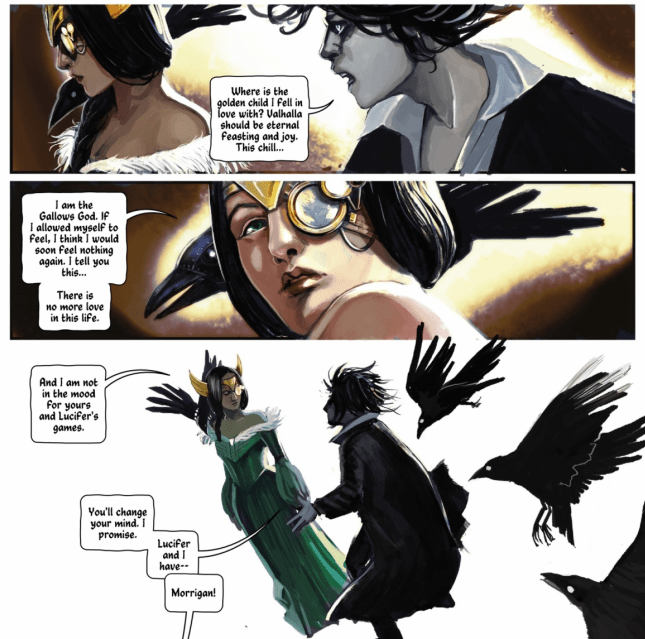
Then there’s the mystery of Ananke’s sister and the god of her sister. Six-thousand years ago, Ananke resolved to choose the divinities that “take the children”. Her sister adds that her god will always be among them. Once Ananke’s sister returns for the first time, a familiar topic comes up:
Ananke: “Would…you like to sing? It is your greatest gift.”
Sister: “To sing? It’s all I ever wanted.”
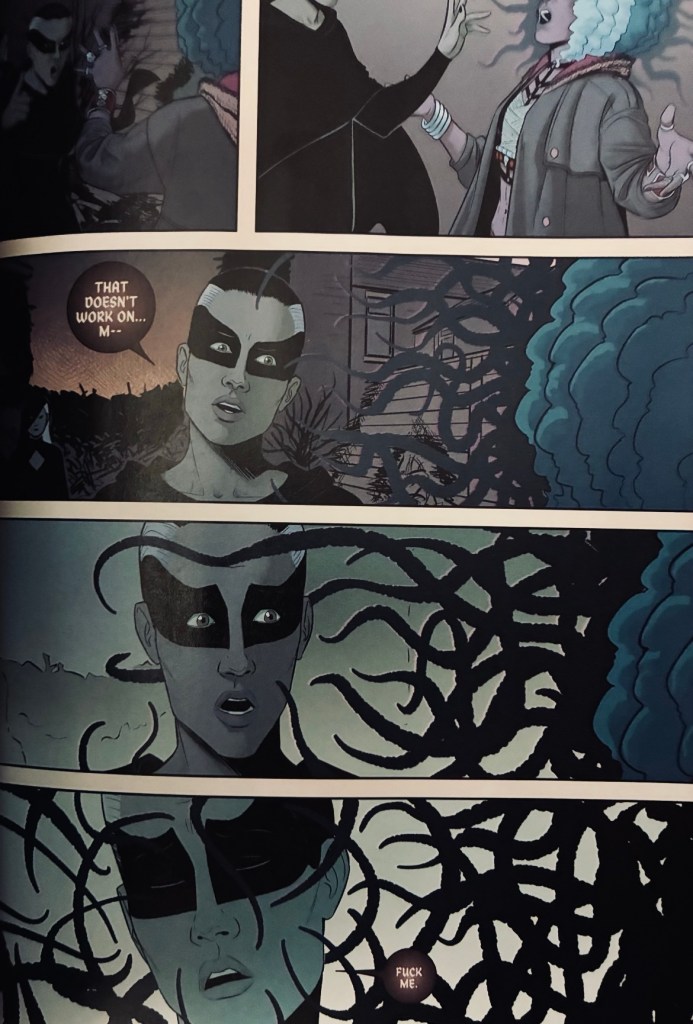
Then snap, like Persephone. Sixty-five times, over the millennia. Chapter 36 begins with sixty-six panels across eleven pages. Sixty-five of them are snap panels and nine of those depict Ananke’s sister escaping with a familiar set of tongue-tentacles in evidence (in an unfamiliar shade of green). Eight others show the “I’ve missed you” hug.
Chapter 37 starts with ninety panels of black across nine pages, beginning with Egypt 3127 BC. Directly after the 37 title page, there are a pair of distressed blue eyes (or eyes covered with blue transparency).
Among the sixty-five snap panels at the start of 36, one of them is dated Egypt 3128 BC. This is one of the panels with Ananke hugging her sister, saying “I missed you.”
Back in 37, another transition waits after the ninety black squares, dated Crete 3037 BC. Each one of the chapter 36 panels was marked with a date and location consistent with the intervals between recurrences. The black panels in chapter 37 are just one successive year after another, until Crete 3037 BC. If chapter 36 started with the recurrence intervals from Ananke’s perspective, then chapter 37 is portraying her sister’s perspective on an early interval between recurrences.
Crete 3037 BC brings us to a girl or a woman with blue eyes and reddish hair, kneeling on a beach and raking her face with her fingernails, saying “Never again.”
To me, that girl resembles 2014 Amaterasu. Yet 2014 Morrigan is known to claw at her face with her fingernails.
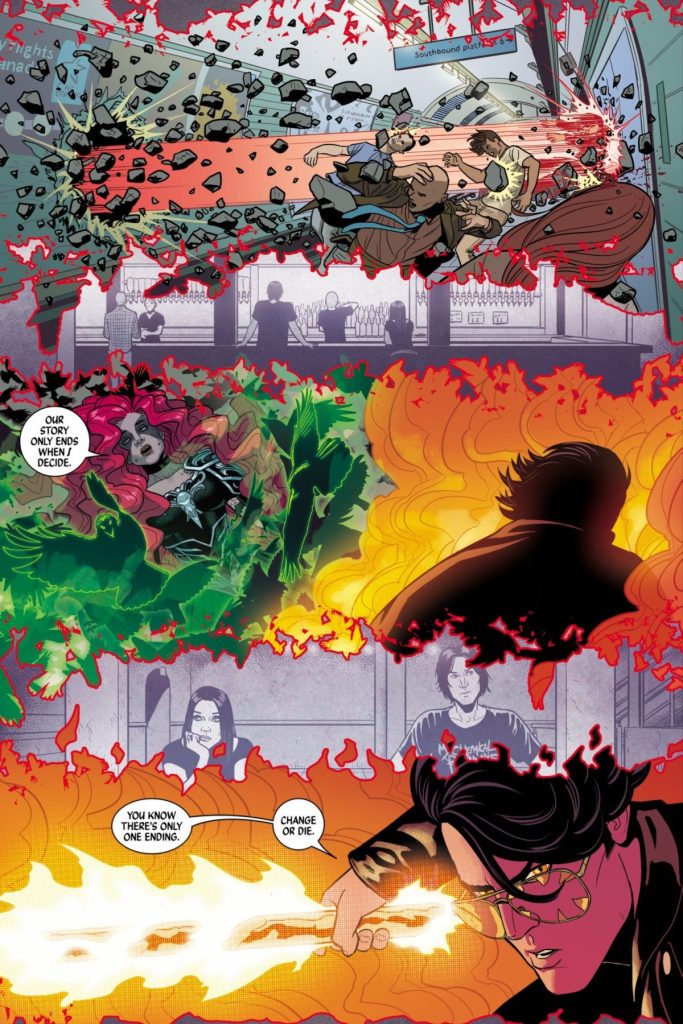
Shortly afterward, the visual pacing and panel arrangement slides neatly back into typical narrative context. During the Morrigan and Baphomet’s break-up fight, there is a succession of battle images and older relationship images. A positive relationship image circles around, Baphomet’s resolve wavers and the Morrigan claims the win. That’s at least one instance when the reader perspective is equated with a character perspective. This has happened before this point but not very often.
Then we step a bit closer to the fourth wall again, with Ananke meeting Robert Graves in 1944, which was a fun scene to read. The only Robert Graves I’ve ever read were the novels I, Claudius and Claudius The God but it was still cool to see him in a comic. He is approached by a mysterious stranger and they spend a night drinking and talking:
“The first of the gods was my sister’s. Maiden, mother, crone. An effective slight of hand. Easy to fall for. I thought…one could use that, eh? (…) Oh, I was everywhere. The things I’ve seen and the things that have seen me. This quiet white goddess, wandering around… (…) I offer them godhood. Choose the right verse, the divine poetry to recite. Of course they can’t resist it. (…) It’s our secret language. Like…trees? We’re like trees? I told the druids something like that…Twelve trees, and the thirteenth, the elder tree, which is death.”
At a glance, it looks like the perpetuating of the White Goddess lore and her connections to the triple goddess made by Graves was orchestrated by Ananke. She planted the idea in his head to give her chosen ruse the appearance of universal, mythic relevance.
Oh, wait…the last recurrence cycle before that point ended in ’23, didn’t it? Is there any reason in particular why Ananke might be either unusually desperate to cement her hold on the Pantheon, as well as feeling the need to vent to a sympathetic ear? Such as seeing something that conforms to a six-thousand year old lie that her sister left her with?
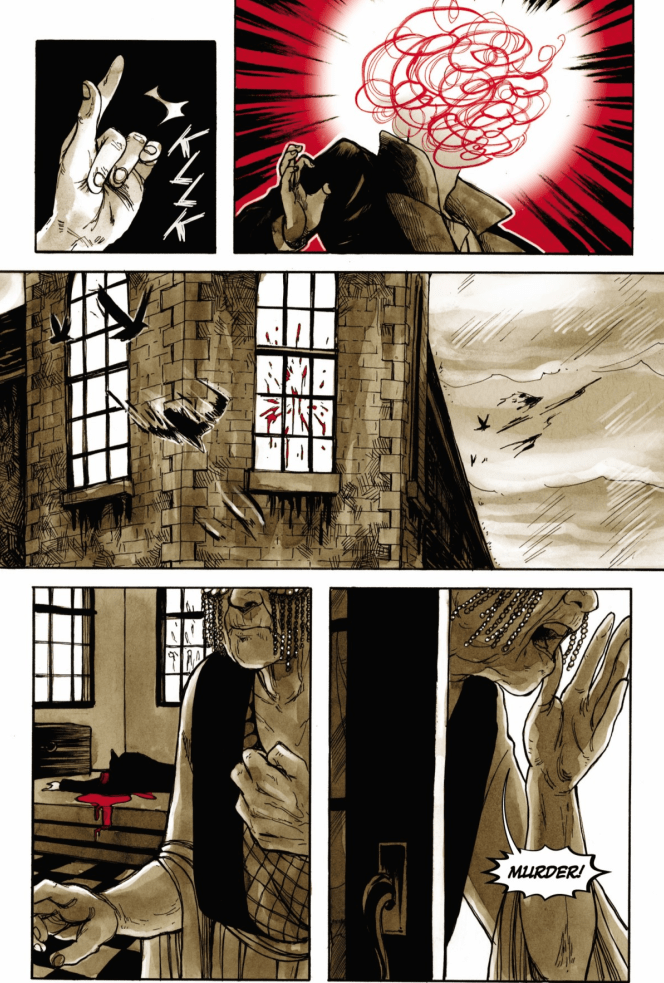
In both 1923 and 2014, a psychic amplifier is built by Woden and the Norns which can easily be used for mind-control. Earlier, in ‘Of The Devil’s Party’, Ananke implies that gods do not create art: their existence and their actions are their art. The ripples of cause and effect from short, powerful lives.
Put a fucking pin in that, btw.
Baal, Set, Woden and the Norns agree with Ananke’s assessment of gods and art. They believe it generalizable to humanity, whom they see as entering an age of decadence, democracy, electric light and creative exuberance. This is the degenerate zeitgeist of the masses and it is- to their horror -in ascension.
Determine to head off this trend, Set and Baal begin killing other gods to siphon their powers and their remaining time, ala Prometheus gambit. Roughly five gods are sacrificed to create an apocalyptic summoning, to put humanity on the right track again. Woden dies with his hands on the machine, which may or may not function as a sixth sacrifice. Later that year, the four remaining Pantheon members agree to commit suicide as a means of countering the apocalyptic wish. It won’t cancel it out completely but- according to Ananke -if they can reduce five-to-six wishes for the apocalypse to one or two, then that can be managed eventually.
It may seem dubious to equate the 1923 amplifier with the 2014 amplifier…but they both have the same being locked in their cores.
This being dates back to the 1831 story ‘Modern Romance’ which was, for me, one of the sweetest moments in the whole comic.
In 1831, the Pantheon is mourning the passing of Hades. Not Lucifer- the Greek underworld deity called Hades. Lucifer himself is occupied trying to resurrect Hades.
According to context, the resurrection cannot be done because of Ananke’s harvest: such a thing would entail drawing the life force of Hades back out of her, which isn’t happening. What emerges is, in the words of romantic era Woden, a new being, made by the Pantheon. For the first time in their history, the Pantheon members reckon the prospect of familial legacy:
Woden: “It is not a monster. It is not Hades, returned. It is one who was created by us. (…) It is new. It deserves better. (…) You are alive. You will go on long after we are gone. (…) Do you understand?”
Romantic-era Woden disappears at the touch of the purple being and it assumes her likeness. Inanna approaches them. They say “You killed three children. You did it…as part of an accord. For power. For Glamour. For this…”
She extends a deadly hand to Inanna who begs mercy on behalf of the child of Lucifer, whom she carries in her womb. The new being with the lavender word balloons and pale letters withdraws her hand. She says “You are not my sister” and walks away.
Much later, in Inanna’s journal:
“I find myself dwelling on my sister’s final words…whatever we made was not a monster but a creature. (…) Creatures are all that is created by God. Monsters are those that God rejects. (…) Instead, this creature rejected its gods.”
She goes on to muse about what to name her child when Ananke shows up with the snap.
Inanna: “I thought perhaps you would let us escape.”
Ananke: “No, Inanna. No one escapes. (…) Especially not you.”
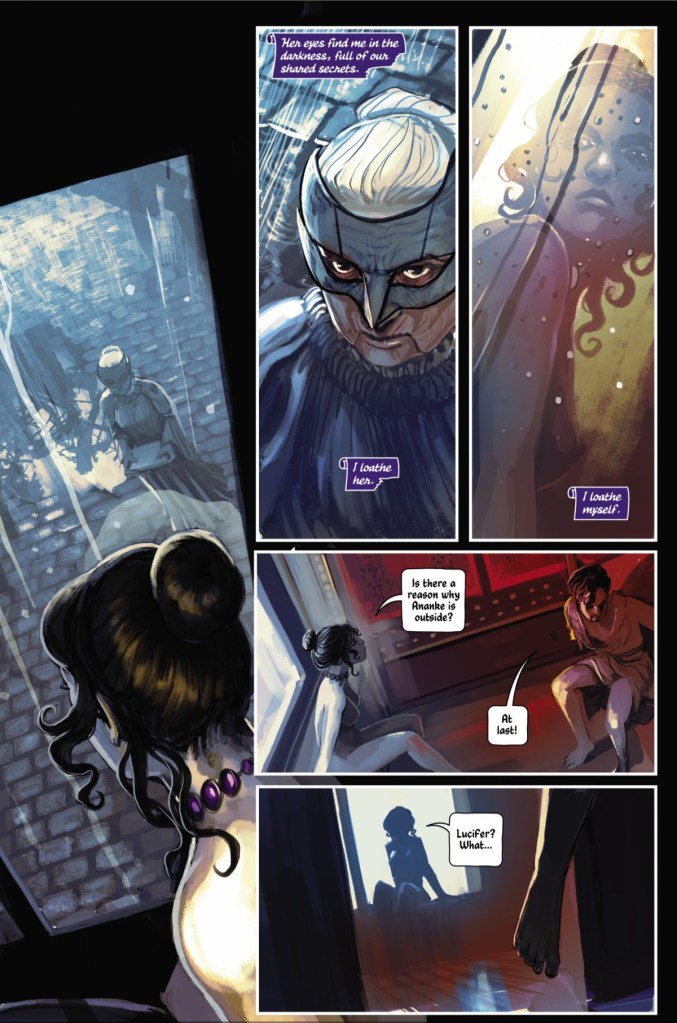
‘Modern Romance’ made me question the origin and nature of 2014 Inanna. 2014 Inanna is the only one before then who had purple word balloons with white letters. 1831 Inanna speaks in normal black-and-white word balloons and her journal writing is white-on-purple.
It is obvious, at this point, that no Pantheon member has ever given birth to start a family of their own. Because of the six-thousand year old stipulation of her sister: sister’s god is always among those that “take the children”. I may have my sequencing wrong but I thought her sister’s stipulation about her personal god was a fundamental part of Ananke’s ruse over the years. Some variation of the triple goddess is always present and Ananke’s successive lifetimes hide in the shadow of the triple goddess. The triple goddess is the only Pantheon member whose name and nature could specify a woman at any stage of her life, after all, whose universality could function as an interpretive back door.
So no normal child-bearing families for the Pantheon but one of them inevitably does procreate. Ananke claimed the ability to specify the soul-harvester in each generation and her sister claimed one of those slots to forever belong to her god. Ananke simply stops this from ever happening by only permitting one child which she makes the avatar of Minerva- her younger self. No specific origin for any one Minerva is ever shown which almost makes me wonder if Ananke herself simply gives birth to Minerva each time.
Ananke’s sister told her something else, though. Before her first death, the divine sister is traveling with her grandson, whom she tells not to worry.
Divine sister’s grandson: “What final magic have you?”
Divine sister: “Oh, a simple lie. (…) It will lead her astray, as she thinks that my lie alone is what can eternally defeat her. The only hope is that one of the children will find the real way out of the trap.”
This lie was the last thing she spoke before dying: if her god ever gives birth, the recurrence will end. Ananke will be claimed, for all time, by a “great darkness”. Ananke considers this and says “The mother begetting a child other than me means, by definition, I will not be the child any more. The cycle breaks. I see. I can handle that.”
After that point, Ananke trots out the story of the great darkness now and then to keep the Pantheon in line. Ananke had no reason to consider the existence of such a thing until 1923, when the Baal-and-Set-gang enact five-to-six wishes for global catastrophe. This was also the first actual use of the purple girl amplifier. Ananke incorporates both the amplifier and its destructive magical payload into a great darkness puppet, should an object lesson be called for.
So…do I have to belabor the Frankenstein references, from ‘Modern Romance’? That story deconstructs both the Promethean myth that Frankenstein partakes of as well as an oft-repeated anecdote about how the book was written. Mary Shelley-Wollstoncraft, Percy Shelley, John Polidori, Lord Byron and Lord Byron’s wife are holed up for the winter and pass the time writing horror stories. Female Woden maps onto Mary Shelley, male Morrigan maps onto Mary’s husband Percy and Inanna and Lucifer are, of course, the Byrons. Maybe this is superficial but I liked it. Romantic era Lucifer tries to resurrect Greek Hades, fails and creates a beautiful and deadly enigma. Lady Woden is the only one of them to recognize how unprecedented this is and attempts to take the child in hand. Woden, in this comic, is quite the techie and romantic era Woden is like any of the others. She has robot ravens on her shoulders with visible rivets. Her missing eye has a mechanical replacement. There’s just something poetic about super-scientific Woden playing the role of Mary Shelley, welcoming the newborn into the world.
Eventually, though, the newborn is imprisoned and used to create the fictional great darkness. Ananke undoubtedly had the idea as part of her manipulation but I wondered if maybe she was playing catch-up with her own fears. A terrible moment in 1923 when she wonders if the great darkness was always real before getting it together enough to incorporate the new development. Perhaps she thought that the apocalyptic conspiracy of the Set-and-Baal-gang was, itself, the apparition of the great darkness.
This actually goes hand-in-hand with one of the oldest strengths of the comic: making the obvious less obvious. 2014 Woden was open about being a pervert and megalomaniac and being out for number one. He shouted his motives from the rooftops but almost nothing else about who he was or what he was doing was portrayed for the first half of the story. Of course he used the purple girl machine to turn hundreds of people into slaves. A good stage magician knows how to direct the attention of the audience, after all.
Another wonderful use of apparent truth and expectation is tongues. It is not immediately apparent what tongue-singing is but it is apparent what everyone thinks of it. It seems to be purely a matter of interpretation until Laura awakens as Persephone, with her black tentacles that appear whenever she sings (not to mention the only character who uses tongue-singing in combat). Before that confirmation arrives, though, we get a tiny and painful scene with Tara; known to all as Fucking Tara. At the time of her apparent death, she also appears to be the only Pantheon member whose performances are not immediately pacifying. If anything, the crowd hates her worse than anyone else. It’s easy to chalk up her devastation to frailty but no other Pantheon member ever experienced this. The average human has nothing bad to say about listening to the tongue-singing of any Pantheon member. Organic unpopularity is a factor but it cannot be the only one.
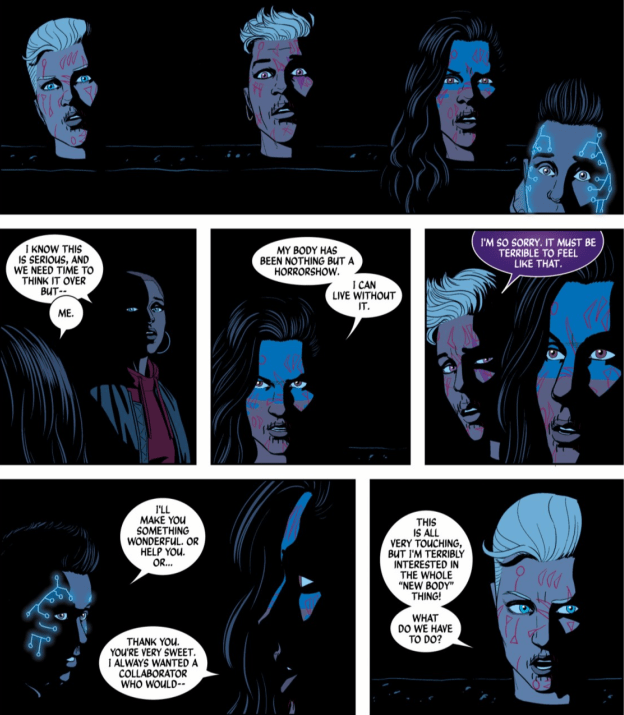
Tara had decided to actually compose music with intention. That was the problem. She simply chose to write music instead of singing tongues. In Tara’s journal she writes “If I had another second, I’d play another chord. (…) I’d write another line. (…) I’d try to drag what’s up here…” indicating her head, “…out here.”
Ananke also said that her nature as a member of the Pantheon is inscrutable to her. To Ananke, Tara just looks like a blob of random, echoing no particular god from antiquity. At the same time, Ananke needs four heads for her regeneration and Tara is a suicide risk. A vain, stupid blob who is too weird for comfort. No great loss.
I believe Ananke didn’t recognize Tara (nor anyone else) because Tara did not fall into an archetype like the others. The others all saw and heard things that they wanted to worship and embody.
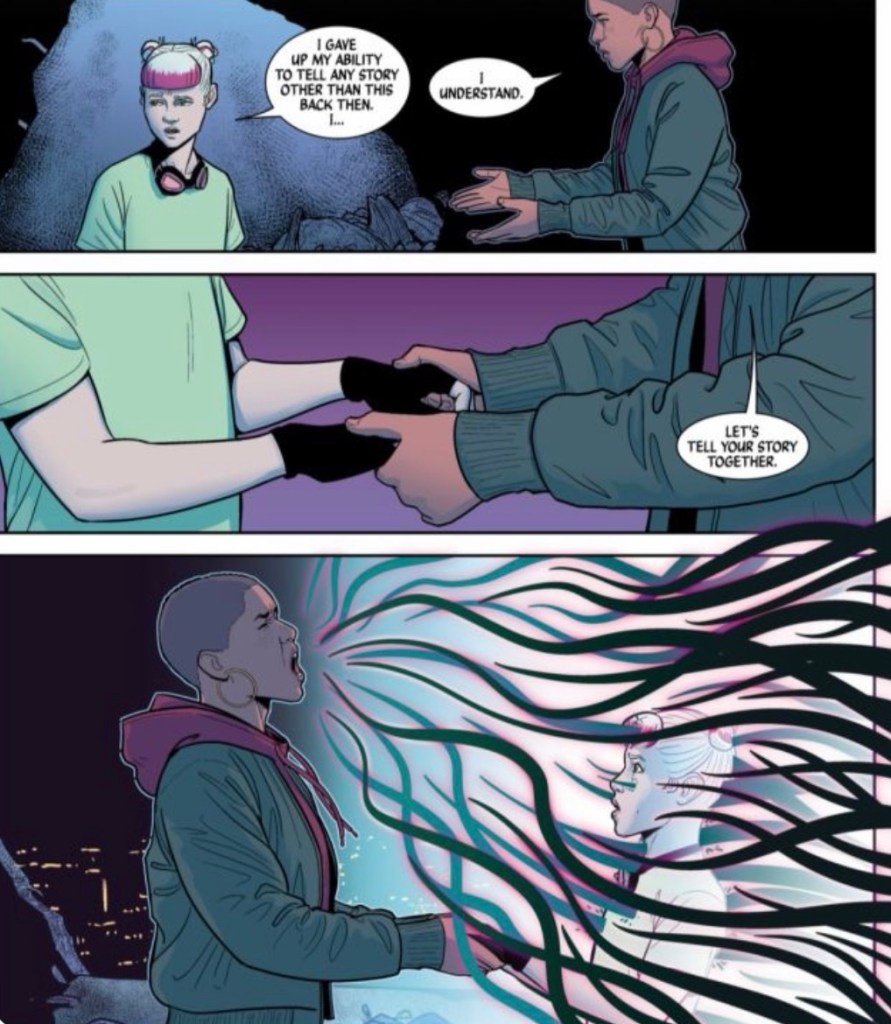
There is a precedent for Tara, though: Ananke’s divine sister. Tara is the one character who actually heard the voice of the divine like Ananke’s sister did. Tara practices magic and spirituality through direct experimentation and observation. But the authenticity of discovery has no value in a world full of ideas of what the divine and the spiritual should be- not to mention the divinities who literally broadcast their psychic fingerprints.
Six-thousand years ago, the triple goddess had no wealth of names; only the solitary perception and the solitary spiritual practice of Ananke’s sister. Tara had the worst run out of any other 2014 Pantheon member but- by the end of the final volume, when all the other characters have decided to live normal human lives and be happy about it -Tara is the only one left with both a shot at immortality and an appetite for it.
The endings of all the other characters still make sense, though, and the meaning of Ananke’s name can tell us why.
Why do most people end up reducing themselves to definitions and functions to the exclusion of their souls? Necessity…or something close enough to be mistaken for it: the evil of convenience. The need to fit into the bullshit because ‘it’s the way things are.’
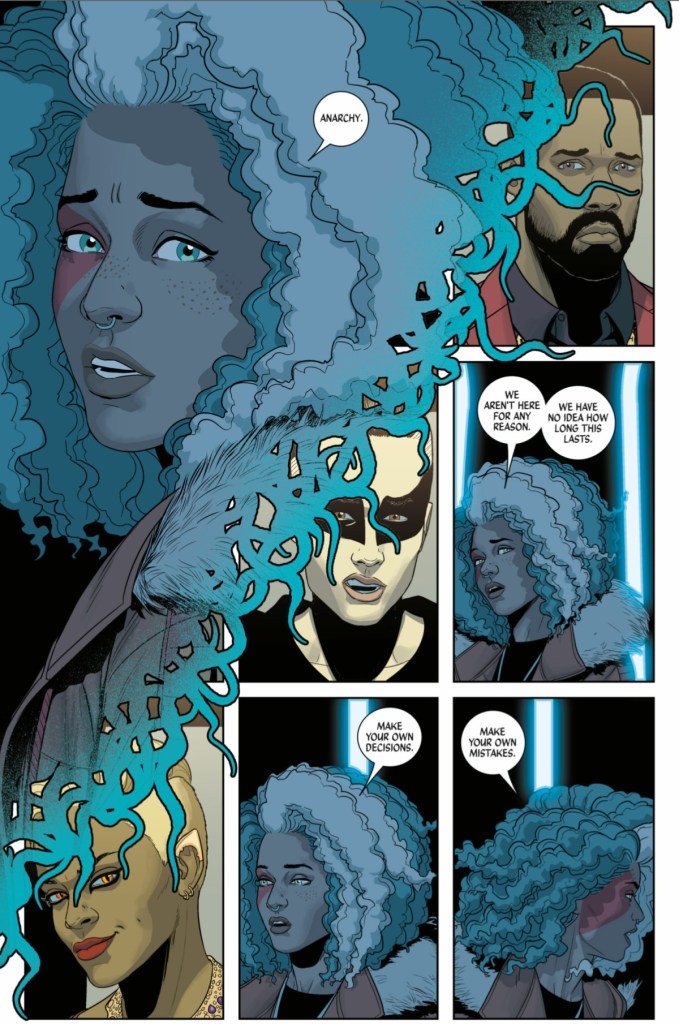
In the absence of those definitions, Laura and Cassandra fall in love in the long run. It’s interesting to me that only Persephone was able to reach Lucifer on the level she needed to be spoken to, in the end. Shortly before then, Laura saw Cassandra kiss her other Norn-selves goodbye and was momentarily jealous. Laura-Persephone has things in common with the triple goddess emanations like the Norns and the Morrigan. Like the triple goddesses, Persephone has concentric selves that loop through others.
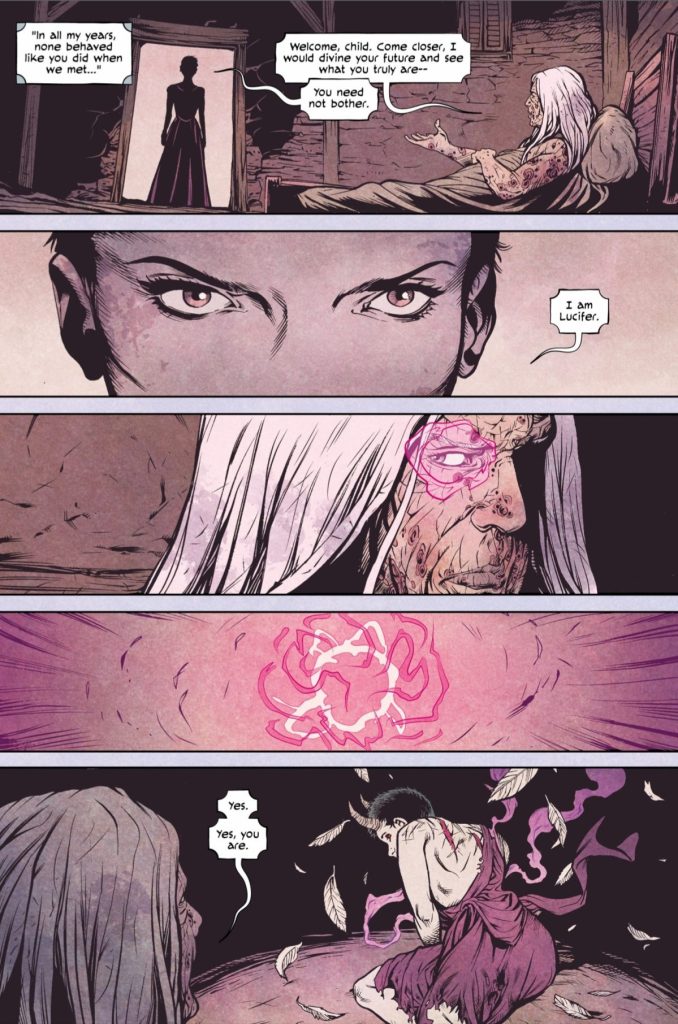
Persephone’s emanations outside of herself appear to be what enabled her to make intimate psychic contact with Cassandra, Ananke and Lucifer. If a looping of selves has anything to do with that, though, it cannot be everything. Persephone is very much aware of how close her innermost self is to the other. I don’t think she would have been able to seduce Lucifer back to humanity if she didn’t respect the other enough to love them.