
Spoiler warnings for ‘The Faust Act’, ‘Fandemonium’ and ‘Commercial Suicide’
The Wicked + The Divine makes an interesting first impression. Like Watchmen, the succession of individual stories in the foreground has progressively bigger implications for the world in takes place in. Por exemplo-
Not every deity is included in every version of the recurrence.
Every ninety years, you see, twelve deities will seize a mortal avatar in which they will exist for two years before dying. Perhaps more accurately, the twelve will surface from below a living person’s identity. Such a person will realize that their life has been a straight arrow leading to that moment and they typically experience this as the emergence of their one true self.
To be sure, the recurrence has regulars. Ananke, Baal, Minerva, the Morrigan, Amaterasu and a few others have been present for nearly all of the story thus far. Susanoo-no-Mikoto, the Japanese storm god, was briefly present in the beginning but (as of the end of volume three) never again. The present rendering of Woden is (so far) constantly wearing a human-scale, Daft Punk-like mech suit. Woden is also a passive, willing cat’s paw for Ananke which requires that he not be known well by anyone but Ananke (he’s also morally and emotionally bankrupt which is a happy accident under the circumstances).
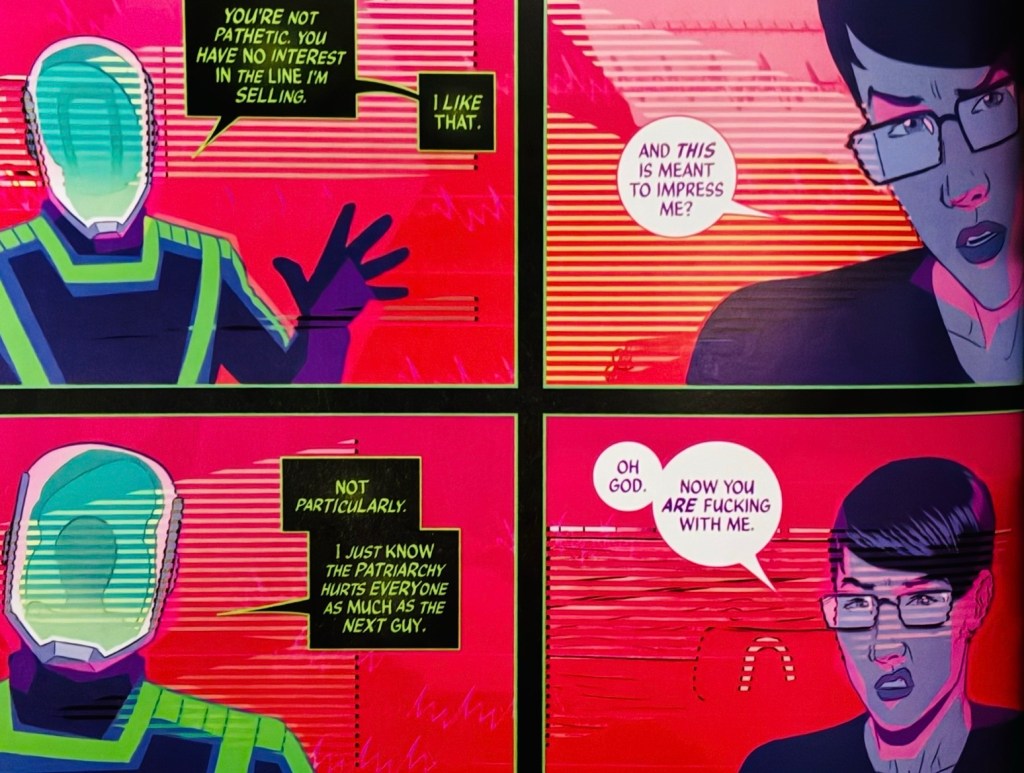
His rapport with Ananke the matriarch, combined with the mech suit…makes me wonder if his life is prolonged without any participation in the recurrence (he says, in ‘Fandemonium’, that he would trade his two years for Luci’s months but who knows if that can be trusted). Ananke wouldn’t want him getting too close to anyone, after all, especially if the rest of the Pantheon are potential targets. If the suit is technology than that could have wonky world-building consequences…which may be on-brand. So far, we have no idea what the historical timeline looks like even if the subject matter tempts assumptions. You can approach The Wicked + The Divine with no knowledge of mythology and- so long as you’re willing to read closely and carefully -be okay.
Most people who pick this up, though, will likely have some familiarity with the subject matter. Which is, itself, incorporated into the backdrop. Contextual recognition is funny, though. As of the end of ‘Commercial Suicide’, we don’t know what the ancient world even looked like in this story, even though it’s easy to slide into assuming that these characters must have had some cumulative background going back to the dawn of humanity (at least) to the present. So far, though, no such thing has actually been spelled out.
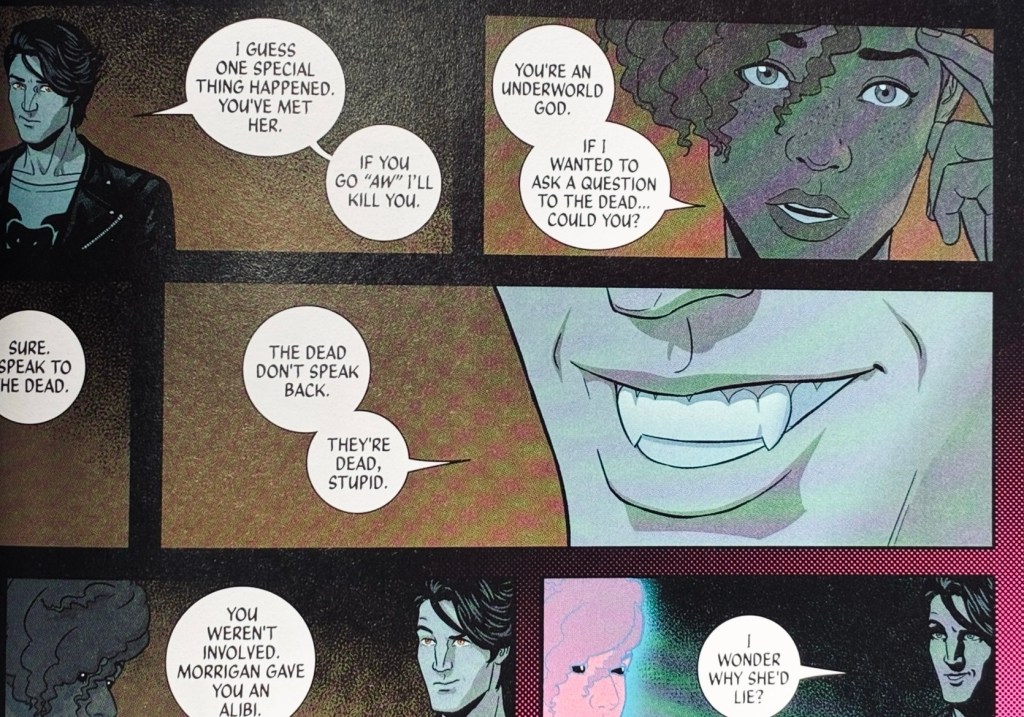
There’s probably no reason to be that corrosively skeptical, right? Just because contextual knowledge puts you at ease does not make it definitionally wrong. The hope of confirmation or denial of context makes things exciting, though. Maybe I’ve been reading too many hyper-subjective comics for too long but I get excited when second and third parties within the story confirm things. While speaking with the media, Ananke implies that there is an institutional relationship between the Pantheon and nation-states.
So the Pantheon is not hermetically distinct from the “rest of the world”. It operates within it. At the beginning of ‘The Faust Act’, Cassandra the journalist approaches Amaterasu as if the Pantheon must be a bunch of deluded, dipshit humans. Her words and behavior, later on, reveal that this must have been a ruse. Even if she never believed that they are “gods” in the sense that most people mean it, she still understood from the begining that something supernatural is at work.
Cassandra, btw, gets really interesting really quick. She gets shafted by the implicit narrative sympathies of a few different scenes in book one. That, alone, ends up making her really mysterious. Then, as time passes, we see that Cassandra’s experience with the divinities is far deeper than it looked. She knows that they are supernatural beings whom goverments defer to and she’s unafraid of them. Kind of a Constantine vibe.
Cassandra’s constant narrative sidelining in ‘The Faust Act’ stands out, especially among all the other characters for whom strength is being seen and embodied. She is one of two characters (beside Laura, the apparent protagonist) who are perpetually outside looking in. Laura wants to join the Pantheon; Cassandra doesn’t. Because Cassandra is more willing to get her hands dirty, though, she seems to fall into the Pantheon’s orbit faster.
Oh, those groups of twelve that reincarnate every ninety years? They are permitted up to two years per cycle; dying early is definitely a thing. When Cassandra awakens as Urdr of the Norns in ‘Fandemonium’, it lines up with the looming deaths of Inanna and Tara, as if an absence is being filled. After Lucifer’s death, Laura briefly manages to conjure fire with a snap of the fingers and eventually awakens as Persephone. Three gods die early, two more emerge and Ananke is always present but never counted among the twelve.
Ananke appeared to kill Persephone as soon as she manifested but the first page of ‘Rising Action’ has a diagram of all fourteen deities that we’ve seen so far. Lucifer, Inanna and Tara are colored over in red and Persephone’s image is not.
The way in which some characters appear to come and go from the twelve feels important. It even echoes the ways in which character interactions happen consistently through euphemism, literal description and withheld contact. We’re probably getting way too close to the ‘real life analogues’ to be taken seriously but…the Pantheon seems to represent the highest echelon of power through embodiment and attention. However elevated the Pantheon may be in the mind of someone like Laura, it is not the end of the game: it is the one true game board and- while many rules are spelled out -just as many rules need to be discovered through practice. What the Pantheon represents, to most people, is unanimous: ultimate power and indulgence beyond which calculation doesn’t matter. That means all calculations behind that line happen in a kind of void. In that void, it is best to take everything with a grain of salt. No rule book, after all.
Which brings me back to how skillfully The Wicked + The Divine uses expectation. The familiar connotations of many of these names (Inanna, Lucifer, Odin, etc.) create the illusion of a logical starting point. Sort of like “Oh look, it’s this character and now they’re like this.”
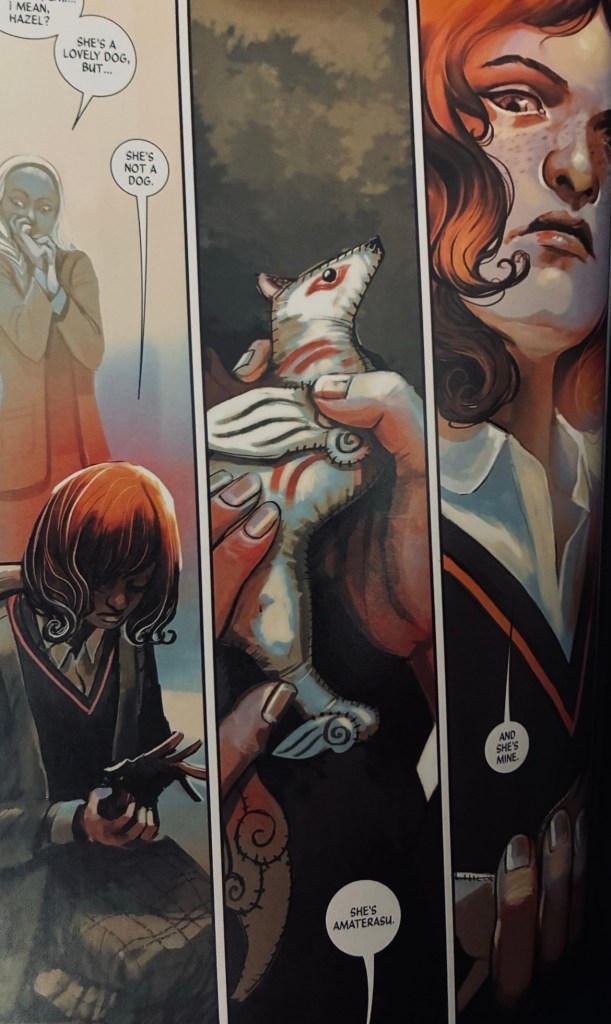
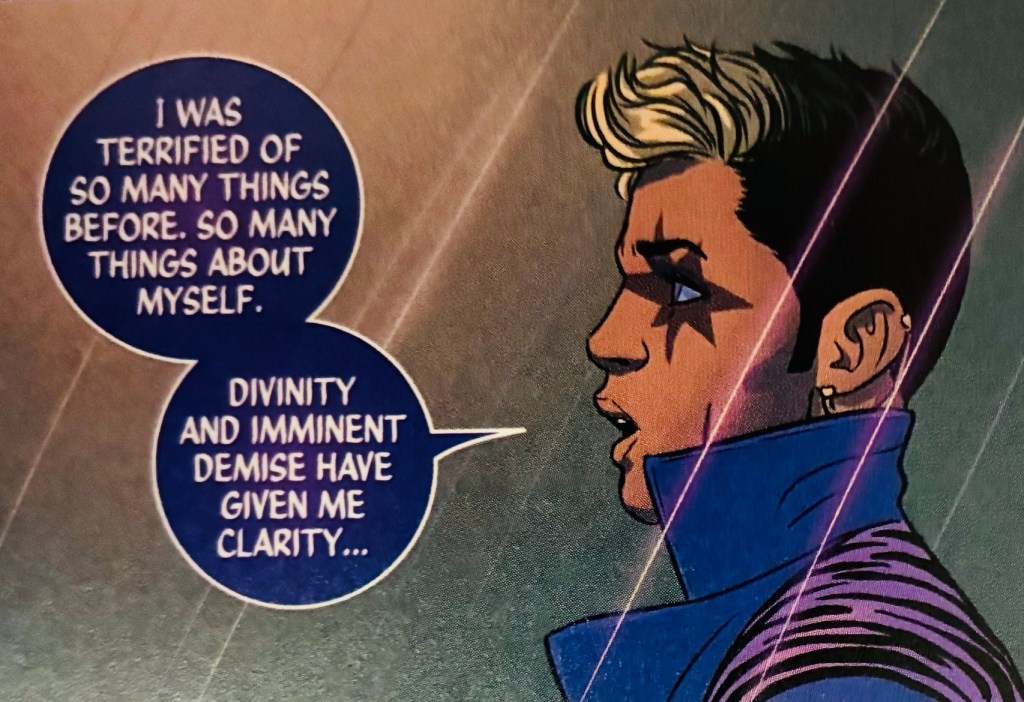
Once I learned how precarious that line of thought was, every other apparent reference stood out. The actual mythology of Inanna plays a subtle but inescapable role in my main non-blog writing project. Then, during Inanna’s first appearance in this comic, there is a star design over one of his eyes, which reminded me of the star from Bowie’s Blackstar album. There’s a brick on this site about that one and its thematic treatment of ceremonial sacrifice. A friend who is more visually attentive than I pointed out several of the celebrity musician character designs. Turns out I was way off on a few of them. The way Amaterasu interacts with other people and how other people treat her made me think of Grimes, at first. Kate Bush is a better match, though. Woden has an obvious Daft Punk thing. Lucifer and Tara are immediately evocative (to me, anyway) of associative groups of celebrities rather than specific ones. Lucifer and Tara are celebrities that put everyone’s teeth on edge: one of them thrives on animosity and Tara brings it out in other people no matter what she does or says.
Speaking of Tara- her associated references don’t work on the same level as anyone else’s. Other people can’t even agree on what deity she represents or if she is somehow an original one. Baphomet is a recent emergence, after all.
Inanna’s actual appearance and diction is more reminiscent of Prince. Prince diction is not the same as Bowie diction. An anal person could spiral out from that. No, the Prince/Bowie stuff are just references; this is Inanna. Inanna is just a reference; this is actually an original character. The visual nods to famous musicians are just a thematic expression of the analogues with the cult of celebrity; don’t overthink it. The analogues with the cult of celebrity are modern lead-ins to timeless subject matter; don’t overthink it.
That cycle can easily cause someone to over-correct in the other direction: every visual and textual reference is REAL and immediately relevant. The dialogue between characters expresses itself in tiers of language, including exclusion. Perpetual dialogue that weaves in and out of language sews the seeds of a collective subconscious cosmology.

