
Content warning
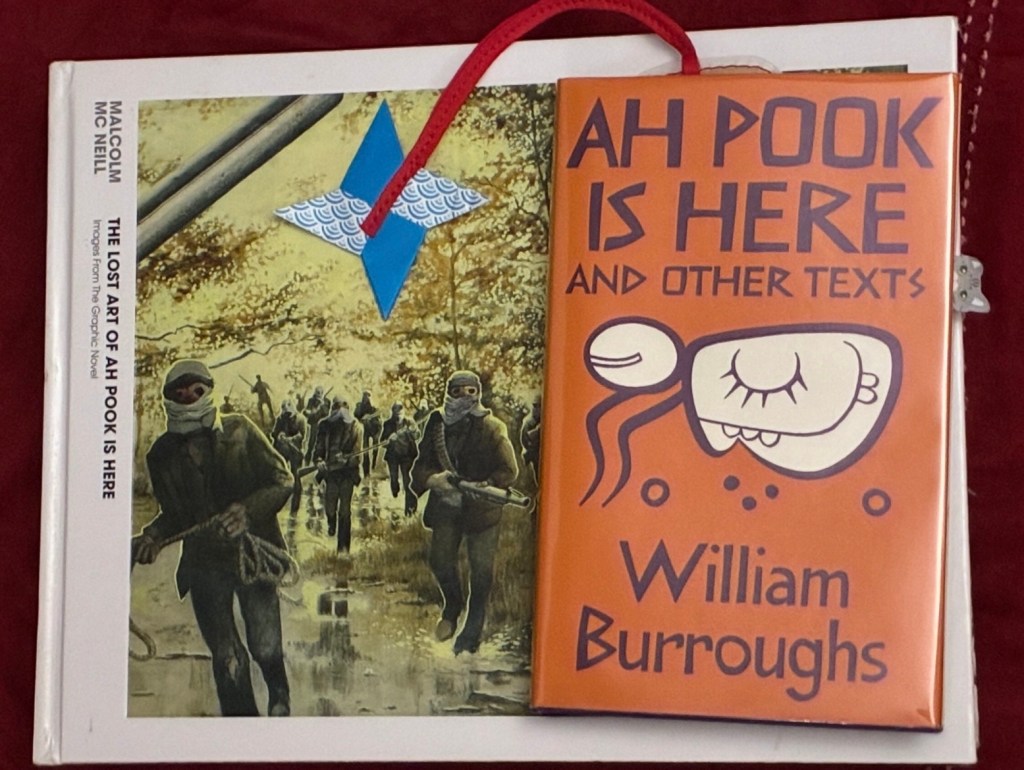
William S. Burroughs and Malcolm McNeill spent a solid chunk of the seventies working on this only to lose the interest of every prospective publisher. It was not to be a typical ‘panels and word balloons’ comic nor a prose book with accompanying illustrations. According to Burroughs, there would have been roughly a hundred pages of art with no text- thirty of which would be in full color -and around fifty pages of only text and an unspecified range of combined images and text.
In the spring of 1970, Malcolm McNeill began publishing Cyclops: an adult comics anthology in his native England. McNeill met Burroughs when they began collaborating over mail on a comic strip called The Unspeakable Mr. Hart.
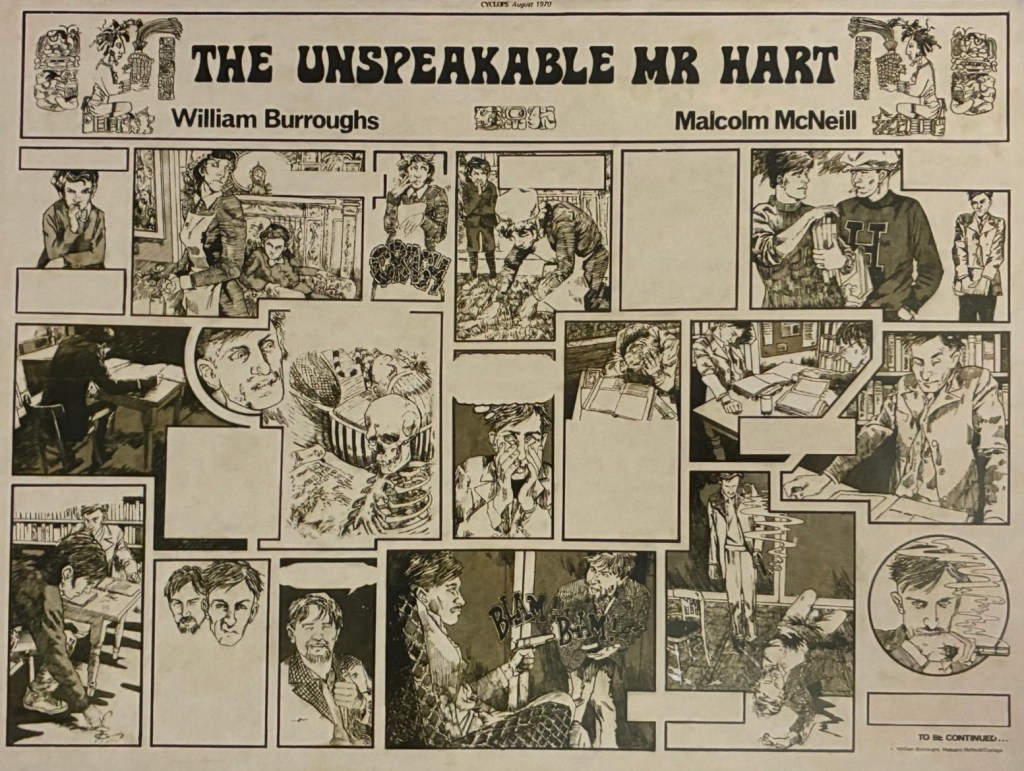
The tone of the collaboration changed once Burroughs got his first glimpse of the comic. McNeill seemed to have drawn the villain-protagonist John Stanley Hart with a surprising resemblance to Burroughs himself, with no prior knowledge of what the author looked like. After that, Burroughs insisted on an in-person meeting and the project grew.
I, at least, wonder if the Unspeakable Mr. Hart strips from Cyclops would have made it into the finished product. The art is memorable but obviously dated. If there’s anything that looks like this in modern comics, I’m not aware of it. It is vaguely reminiscent of the black-and-white drawings of Moebius from the late seventies. It also reminds me of a certain kind of black-and-white art style common in pornographic comics from the early twentieth century through (I suspect…?) the eighties. Seventies and eighties issues of Heavy Metal were full of comic strips that looked vaguely like The Unspeakable Mr. Hart. I remember watching the movie The Green Mile which featured an abusive prison guard with a fondness for so-called “Tijuana Bibles”- short pornographic comic strips from the early twentieth century, usually depicting scenes with the famous faces of the day. In the visual language of The Green Mile, that Tijuana Bible is a visual cue that this is not the present.
Maybe those art styles didn’t look quite so antiquated in the seventies…but the antiquated vibe fits the time travel themes. Especially in a story about manipulating the psychic intersection between language and time.
Ah Pook Is Here encapsulates several fixtures that date back as early as The Yage Letters and the word hoard (Naked Lunch, The Soft Machine, Dead Fingers Talk, The Ticket That Exploded and Nova Express).
In those sophomore works, the collective subconscious is gate-kept by non-corporeal outsiders. The psychological and metabolic need of addiction is a leash that humans wear when their demiurgic keepers take them out for walks on the astral plane. This is a recurring narrative through-line in the word hoard but it is also the backdrop for several of the word hoard’s most memorable uses of visual language.
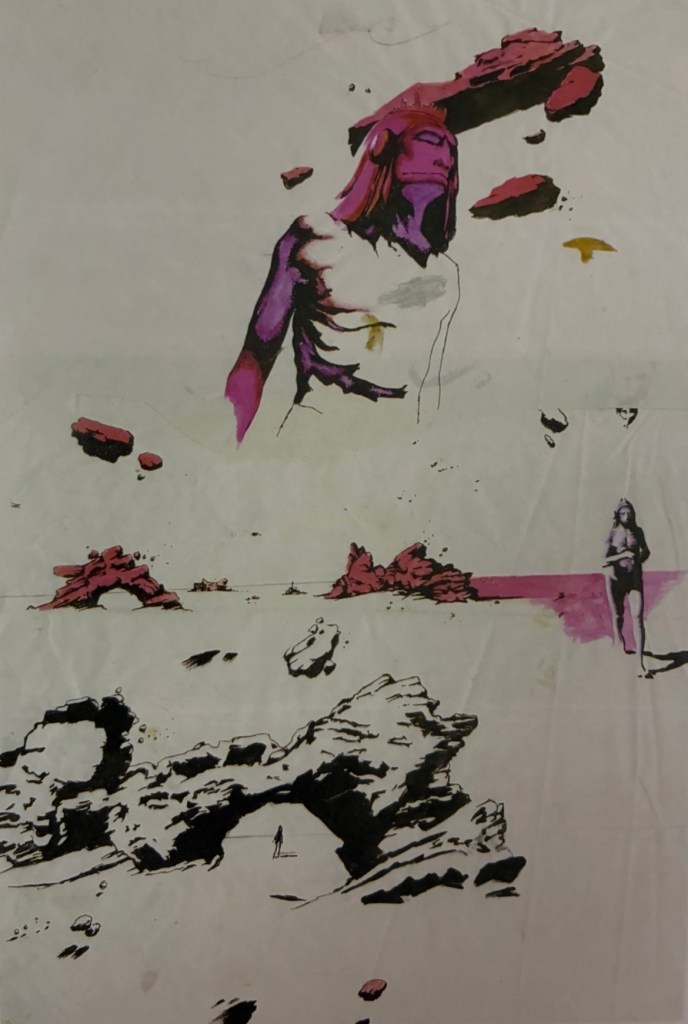
One of these is the consistency of colors up and down the dimensional ladder. One of the more memorable establishing instances from The Ticket That Exploded happens in the ‘in a strange bed’ vignette. ‘In a strange bed’ begins with two characters- Lykin and Bradley -arriving on a foreign planet after the controls of their craft were seized by an outside force. Lykin surveys their surroundings:
“-A fantastic landscape of multicolored rock carved like statues of molten blue lava interspaced with stalagmites of a pearly white intensity he had never experienced in his previous explorations – The sky was like a green ocean – There were four suns on the horizon around the plateau, each sun of a different color – Blue, green, red, and one (much larger than the others) a brilliant silver -“
Lykin accepts an adaptive mutation from two humanoids in a swamp and the viewpoint character is now different- a boy called Ali, in a separate, recognizably urban, Earthling environment. All of the colors which were simultaneous in the prior section are now paired with separate, sequential dimensional planes explored by Ali. Throughout the word hoard, these dimensional color pairings remain consistent (most visibly within Nova Express).
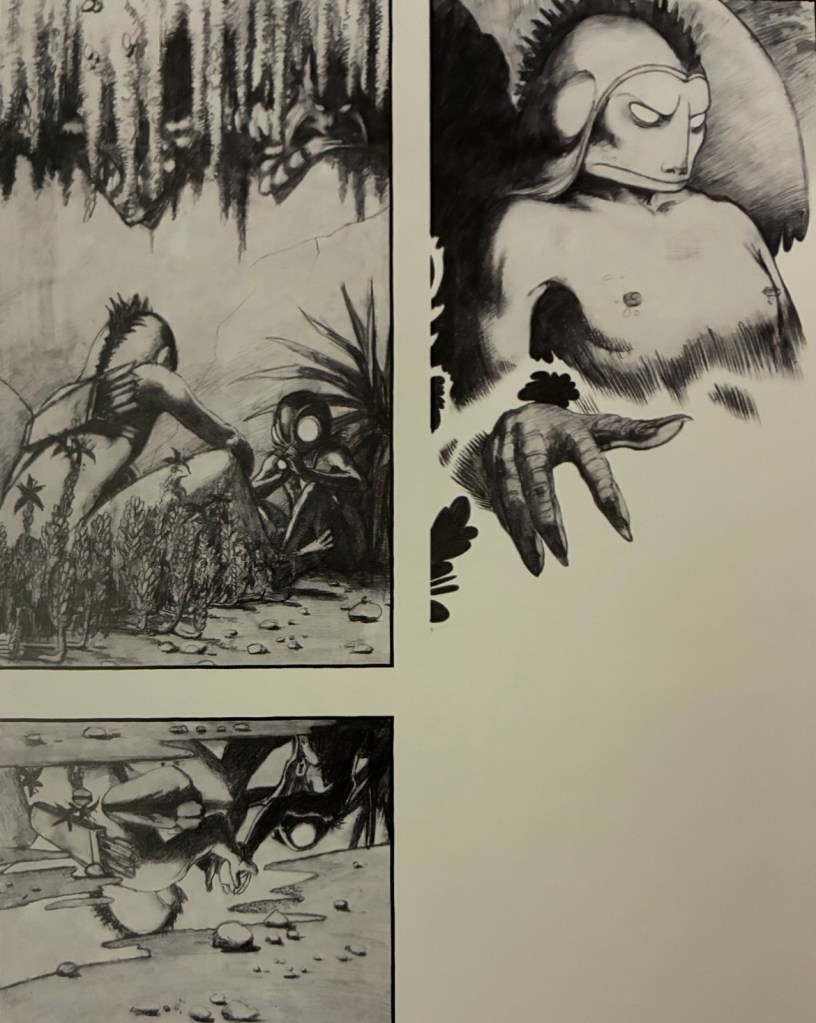
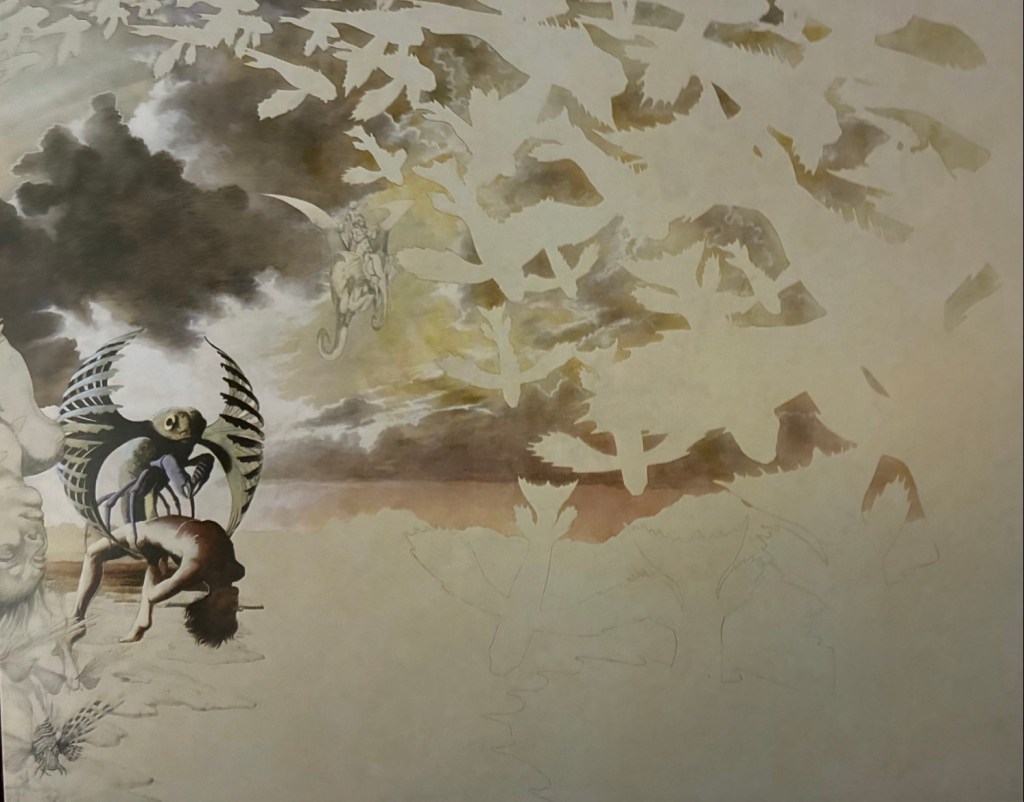
Similar uses of color and layout are evident in Malcolm McNeill’s art for Ah Pook Is Here. Many of these instances are expressed through reflections of the sky visible in water or within implied symmetry in images without reflective surfaces. This starts out fairly normal with reflections within mud puddles and large bodies of water and develop into imaginative, dream-like panoramas that spread both vertically and horizontally.
This nuance feels particularly relevant since a glimpse at this material inspired Alan Moore to write Watchmen. Moore believed Ah Pook Is Here mapped out the far boundaries of what is conceptually possible through picture-and-text storytelling. He then wanted to write his own exploration of those boundaries which eventually developed into Watchmen. Similarities between the art of Malcolm McNeill and Dave Gibbons are apparent in how horizons look throughout Watchmen, the Black Freighter comic-within-a-comic and in the alternating colors of the panels and divided halves in the chapter ‘Fearful Symmetry’ which is eventually worked into the overall comic.
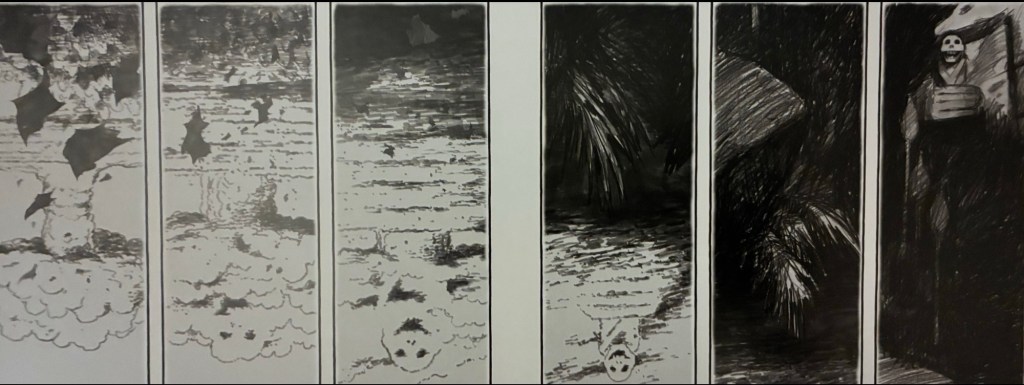
In the text Burroughs wrote for Ah Pook Is Here, inside/outside color associations are established in events that immediately succeed the exploits of Mr. Hart.
Now, the core of the plot: sympathetic magic. Summoning or establishing contact through the resonance of mirroring. To modern humans, the limits of psychic energy can only be discerned through the conceptual limits of language. A belief based on external observation becomes linguistically codified and its reality after that point is most readily expressed through investment in the linguistic architecture of belief.
What follows from this point depends on Burroughs’ own idiosyncratic reading of the Mayan codices. According to Burroughs, divine concepts such as the Seed God, the young Corn God and the Death God began as observational categories of cyclical events but eventually became monoliths of belief. A monolithic belief summons its own reality. Because of the hermetic seal on literacy dividing the Mayan priesthood and the rest of the population, these symbols were only read and interpreted by people who were taught the context of the cosmology and the calendar system through which these concepts first emerged.
Thousands of years of data, distilled into a condensed symbol system to be read only by people who are trained to read it. This granularity allows the priesthood to know what they are looking at but- because of the messiness of knowledge transmission -these categories become abstracted over time (however specific the data behind those abstractions may have been). This priesthood also had strict control over the symbol systems that ordinary people could regularly read and interpret and all such symbols were necessarily derived from the priesthood. The uniformity puts unanimous weight behind the factor of sympathetic magic.
Burroughs seemed to describe these things as inferences that followed his reading of the Mayan codices, rather than literal content. I’ve been an avid reader of Burroughs for much of my life and I can only explain what he thought of the Mayan codices. I can theorize as to why he thought those things but I certainly can’t speak to degrees of literal accuracy or inaccuracy.
In any event- Mr. Hart makes the same connections and resolves to use the symbol system of the Mayan codices to control and neutralize death itself. Death itself is a condensed concept / symbol because death necessarily entails the amount of time behind the existence of things it acts on. Death, in this paradigm, has no face without contact via identification. A startled face beholding the end. The repetition of symbols associated with the deity Ah Pook in response to Mr. Hart’s studies and machinations are one of our major visual themes in both the treatment within Ah Pook Is Here and other texts and The Lost Art of Ah Pook Is Here by McNeill.
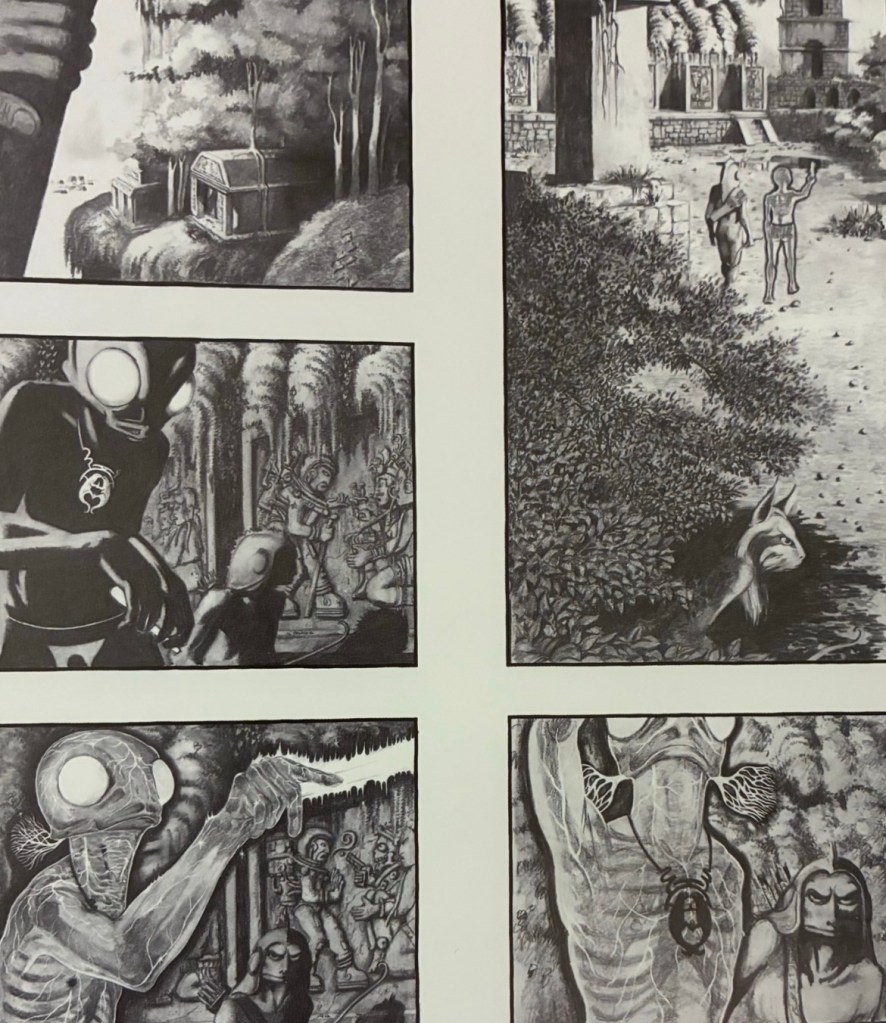
Teeth and eyes come up a lot. While studying the Dresden Codex, Mr. Hart “glimpses the death formula. Across the table a gawky youth drops his glasses on the floor. One lens is broken.”
Mr. Hart kills his friend and companion, Clinch Smith, to maintain control over his discoveries. He then decides to play it safe and simply wipe out the entire Smith family. A younger brother named Guy flees to South America where he “joins Audrey Carsons in a remote finca in the Andes.
Audrey Carsons: Eerie ghostly rotten vulnerable reckless he possesses at the same time the cold intelligence of Mr. Hart. He is Hart’s alter ego and nemesis.
Guy Smith: He is the buck-toothed Mayan Death God before the face was broken and twisted by altered pressure, features wrenched out of focus, body emaciated by distant hungers. A face where time has never been.
Old Sarge: Has the close-cropped iron-gray hair and ruddy complexion of a regular army man. There is also a suggestion of the Polar Star God in his appearance.”
Earlier, after John Hart shot Clinch and then asked nobody in particular “‘How did this happen?’
Ghost voice of Clinch Smith: ‘Death asked to be paid in kind, John.'”
Sure enough, Clinch’s younger brother Guy becomes a partial avatar of the Mayan Death God.
Audrey Carsons is “Hart’s alter ego and nemesis.” Remember how McNeill drew Mr. Hart with an uncanny resemblance to Burroughs, sight-unseen?
In other letters and conversations, Burroughs said that Kim Carsons, the main character of The Place of Dead Roads which he wrote later, was the closest thing he ever wrote to a character that represented himself and his aspirations. If Audrey is a forerunner of Kim and Malcolm McNeill actually did unknowingly draw Burroughs’ face onto Mr. Hart…that would be some rich synchronicity.
It is just as likely, though, that McNeill’s rendering of Hart was simply an uncanny coincidence which planted a seed in the mind of Burroughs.
This is one of the things that makes me wonder about the shadow cast by Ah Pook Is Here over Burroughs’ latter-day trilogy Cities of the Red Night, The Place of Dead Roads and The Western Lands…not to mention earlier work like The Wild Boys and Port of Saints. Old Sarge is one of the first characters introduced in Port of Saints. Five novels, at least, between the late seventies and the early nineties, were influenced by Ah Pook Is Here or derived from it (we could, if we wanted, split hairs about The Wild Boys and Port of Saints, since Burroughs said later that they would have made more sense if they were published as a single novel).
A preoccupation with the Mayan codices and their alleged insights into timeline manipulation were present in his work going back to The Soft Machine. Related concepts were detailed in Naked Lunch but The Soft Machine contained the first specific references (as far as I can tell). The Soft Machine also marks the first explicit mention of the possibility of things from other timelines (diseases and other forms of life, weather phenomena, etc.) punching through into ours in ‘Pretend an interest’. The very last reference to this in Burroughs’ bibliography was in Ghost of Chance (“I will loose on them the blood of Christ!”).
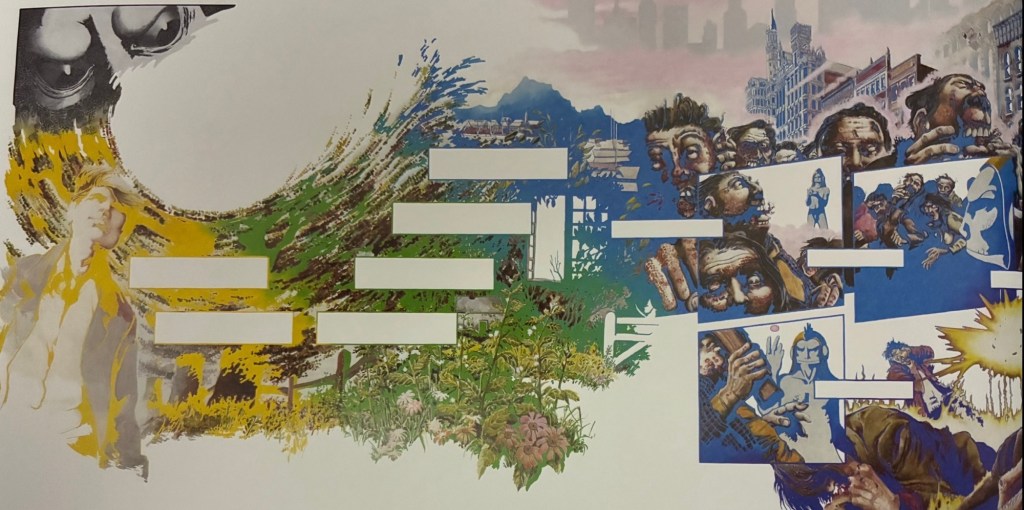
The story treatment by Burroughs and the images of McNeill begin to line up more specifically after Mr. Hart is gone from the center of the narrative. An “iguana boy” called Cumhu often occupies the foreground after that point. Like the resonances between Lykin and Ali in The Ticket That Exploded, Cumhu’s visionary journey sends ripples through adjacent timelines, usually in the vicinity of other emanations of his own soul.
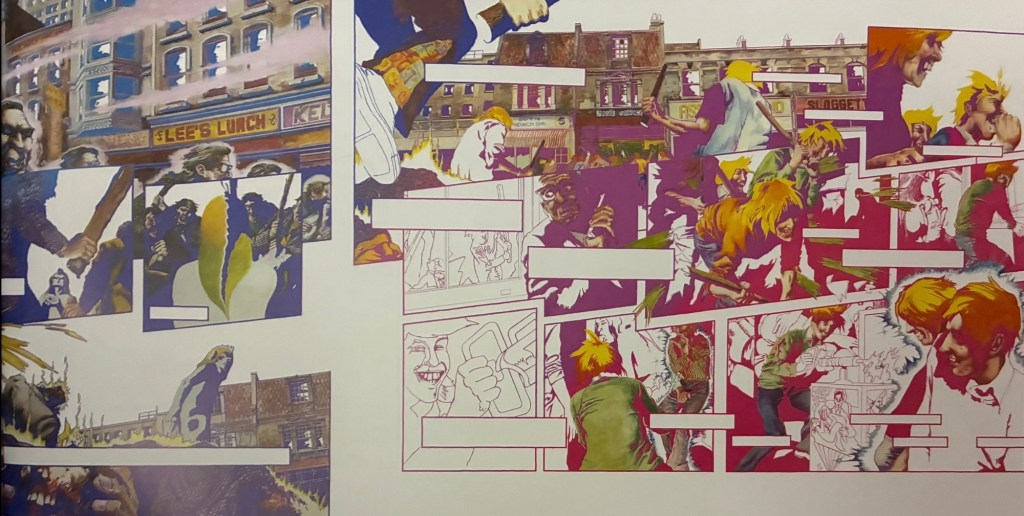
The vignettes detailing the travels of Cumhu and his cohort (other humanoids such as Jimmy the Shrew and various other-timeline versions of Audrey and Guy) sometimes alternate with the version of Guy in the timeline we last saw him in, who is engaged in similar astral travel. Like many psychic visionary testimonials, there is mention of being shut out, as though your brain can make phone calls to other planes but- if no one picks up the phone -you’re just kind of stuck waiting. Guy enters a familiar but empty estate where he “hardly expects Audrey Carsons to be there.” Sure enough, Audrey is gone, as though the ‘phone call’ with the location denoted by the finca imagery is now over with.
The works of Burroughs furnish other possibilities, of course. Usually, when this happens in Burroughs, it signifies the foreclosure of a timeline; a moment in which someone realizes that they survived a timeline edit. What that means is that the circumstances that shaped you are now gone from the past but the consequences remain in your perspective, such as in ‘Hauser and O’Brien’ at the end of Naked Lunch or at the beginning of Dead Fingers Talk.
After Cumhu steals the timeline manipulation texts from his father, he is assailed by “two pot-bellied green guards” whom he promptly shoots full of arrows. Later, in Cities of the Red Night, Burroughs would write of Venusian combatants called the Green Guard. “Genetic eunuchs: pot-bellied and strong.” Cities of the Red Night also features characters called Audrey Carsons, Clinch Todd and a later arrival called Guy.
Given the importance of ancient linguistic constructs invested with the psychic energy of belief, I suspect the blank-verse fragments in Burroughs’ treatment represent markers on a temporal map, accessed through associative resonance with whoever hears them. Since these sections are derived from earlier text within Ah Pook Is Here, the original placement and meaning is clearly meant to inform the cut-up / fold-in meaning; creating an effect comparable to associatively-spliced film.
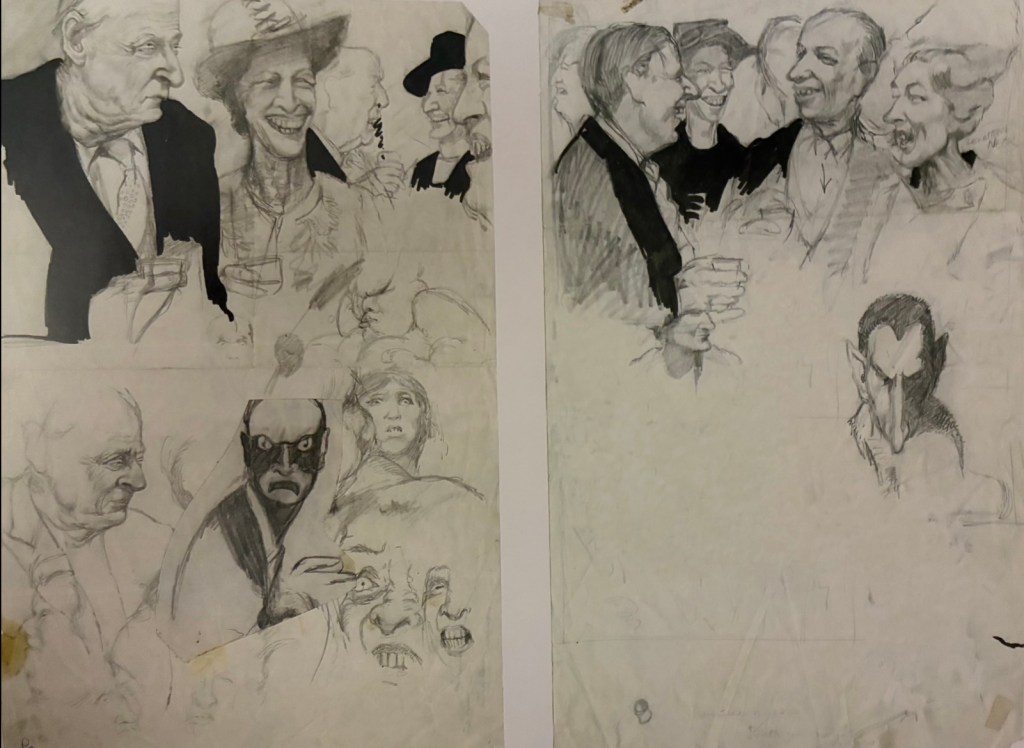
Cracks in the surface of space-time above temporal fault lines appear to be a factor in how avatars of deities manifest through currently living humans. Deities are timeless beings. When their timelessness is forced to intersect with the third dimension, it makes sense that their personalities would simply “gather” around corresponding three-dimensional occasions. No divine avatar mentioned in Ah Pook Is Here (or anywhere else in Burroughs) was specifically born to be that avatar. Anyone could be an avatar depending on circumstance. It follows that avatars such as Guy Smith and Old Sarge were occasioned by the timeline fuckery of Mr. Hart. Guy Smith appears to have embodied Ah Pook / Ah Puch as a direct consequence of his brother’s murder.
Oh hey- another name listed for Ah Pook in the notes republished in The Lost Art of Ah Pook Is Here is The Undoer. What’s one of the key experiences written about by Burroughs? Surviving timeline edits. Realizing that the past occasions for your present self no longer exist. In other words: the realization that a fundamental part of your existence has been undone. Both forceful influence and undoing can proliferate on the same associative, linguistic basis.
Ripples through other timelines soon accumulate and effect the timeline of origin and Mr. Hart is back at the center of things, doing his best to fight back which serves only as engagement bait for his opposition throughout the space-time continuum. He does not fare well in the ensuing timeline shuffles. His proxies are haunted by shadow-people-like entities called Black Captains, which causes him to drum up racist fervor at “American First” rallies (I shit you not: this was in a story treatment for a comic from the late seventies. Check out Ah Pook Is Here and other texts if the rare book prices aren’t too scary).
The proposed narrative ends with a scene reminiscent of the early chapters of Cities of the Red Night–
“Red brick buildings and a blue canal where the Mary Celeste floats at anchor. The boys, with sea bags and costumes of 19th century seamen, walk up the gang plank. The Garden is a red glow of ruined cities in the distance. The sails are raised and the anchor hoisted. Young Guy plays taps as the sun fades and blue twilight settles. The boat is moving. The boys wave from the rigging. An 1890 reporter rushes up.
‘What about Mr. Hart?‘
Audrey is in the crow’s nest with a telescope. He points with his left hand.
Mr. Hart’s deserted and ruined mansion, graffiti on the walls.
AH POOK WAS HERE
Here lived a stupid vulgar son of a bitch who
thought he could hire DEATH as a company cop.”
Cities of the Red Night and The Place of Dead Roads both revolve around the sudden editing and the sudden foreclosure of timelines. The Western Lands may feel like a quieter read since there are less radically imaginative and immersive settings. Much of The Western Lands feels like a ‘creative non-fiction’ approach to the same material.
‘Creative non-fiction’ is a phrase that usually describes the subjective gray areas in things like autobiographies and memoirs in which personal subjectivity takes the foreground. The content of a brain is most readily known to others through personal testimony. We all have a personal point of view. We know others have them largely through inductive reasoning from our own experiences. Personal thoughts and reactions happen but- in the context of something like a memoir -they have to be taken on faith. Many of these ideas were real and deadly serious to Burroughs himself.
While The Soft Machine may mark his first explicit comments on timelines and the Mayan codices, they intersect with other ideas which go back further in his work. Burroughs was also fond of the painter Bryon Gysin’s remarks about how painting was decades ahead of writing. Many of Burroughs’ most daring literary experiments depend on treating literature and linguistic constructs like three-dimensional objects: something that can be turned around, looked at (and perhaps entered) from various angles. After the death of Gysin, Burroughs threw himself into painting (his reverence for Gysin was such that he dared not paint while Gysin was alive). He gave David Cronenberg his blessing for adapting Naked Lunch but declined to participate in it. Before then, Burroughs attempted several other breakthroughs into visual mediums without success and Ah Pook Is Here was likely his most ambitious and full-hearted effort.

