
It gets personal, just fyi
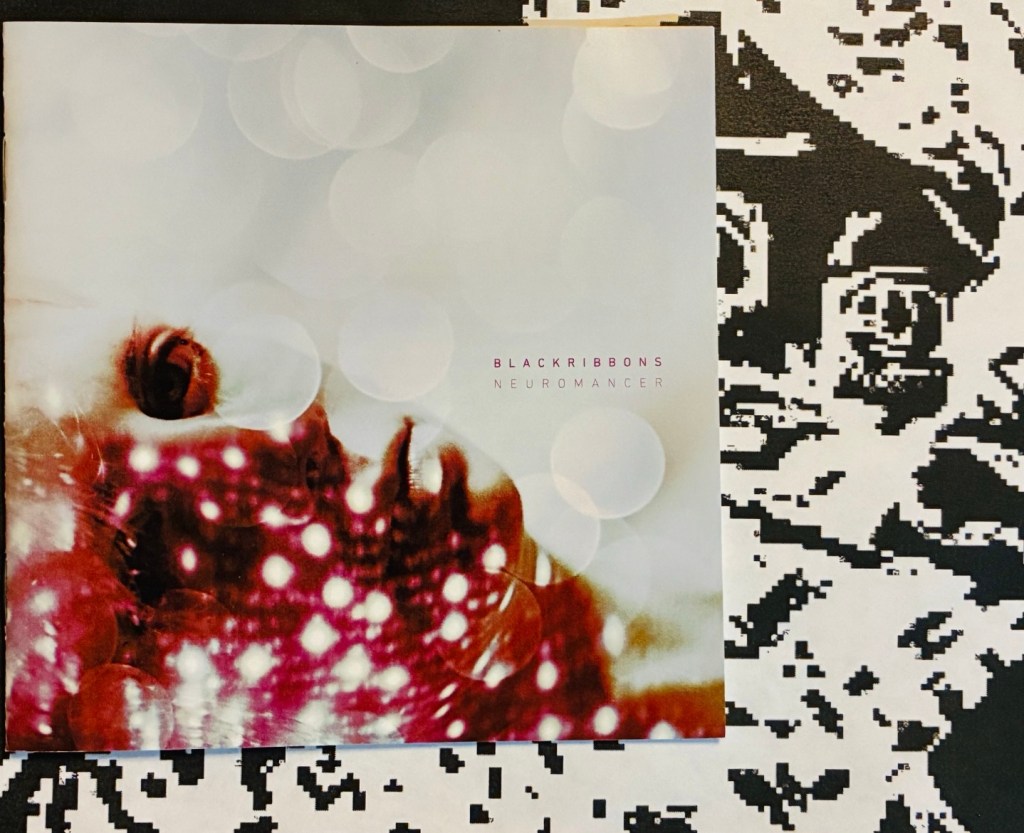
I first heard Neuromancer by Black Ribbons on October 30th, 2012, when I opened an e-mail. The email contained either a YouTube or an audio-streaming link, basically giving anyone who subscribed to the newsletter for Daniel Victor’s Neverending White Lights band a kind of short-lived digital listening party.
I was in a relationship that was cresting on a sweet spot, just before the obvious problems I was ignoring the whole time had to be reckoned with. We were never officially “dating” but we were never without each other for long. There were times early on when I told him: I’m not going to be good company tonight. I’m either gonna be practicing keyboard or doing homework. He said he didn’t care: he seemed to want me to just be physically present and talk to him when I was disposed to. Things reached a point where we slept in the same bed together more often than not. He constantly saw other people and I mostly did so to reassure him that I wasn’t obsessed with him (I was).
(Not that it was a chore every time: the best sex I ever had with a man was one of those relational digressions. I said so in front of the “main boyfriend” once and he seemed rather less indifferent than he led me to believe)
This particular partner could not stand to listen to me talk for long. He loved listening during the first few minutes when I hit upon something interesting to me. He’d look at me and grin a little. If he had a drink, he’d listen for a little longer and- if I said anything emotional -he’d get instantly hooked. Even while hooked, though, it never lasted long. Looking back, I think my monologues gave him sensory overload, since he’d usually leave to go eat something, smoke a cigarette, pull up something on his phone- the things people seem to do when their clearing their own mental air.
Music was a topic that would get me talking in the way that he found entertaining in the short-run and suffocating in the long-run. On that particular October night, we were both comfortably wasted. My mind was busy and his was not. So I sat there in front of my laptop, listening to Neuromancer from beginning to end, answering in monosyllables when spoken to.
The album was not what I expected.
Daniel Victor first hooked me with his Neverending White Lights project which was the most daring attempt at musical world building I knew of, at the time. It was not a narrative or concept-driven body of work but the three existent Neverending White Lights albums are internally-consistent in a way that most people compare to the concept album.
The one recognizable factor in every Neverending White Lights song was the musicianship by Daniel Victor. He sang lead but not most of the time: it was more normal for a given NWL album to have a large group of guest vocalists, each voice distinctive yet fitting into the conceit of the whole like characters in a movie. Victor himself might play a single character or several. It was ethereal, artsy, florid and ambitious and it went straight through my heart.
Black Ribbons and the only album attributed to the project represented something more focused and recognizably genre-savvy in the world of pop-rock. There is an obvious gothy early-eighties post-punk / new romantic emphasis. The first song, The Fear, reminds me vaguely of The Killing Moon by Echo & the Bunnymen, which had fall associations for me. I was a clerk in a liquor store which meant a lot of time was spent listening to whatever was playing on the radio at the time. During the fall, post-punk and new-romantic became a bit more common ’cause, you know, goth emphasis + Halloween, etc.
Sylvana is one of the most infectious singles I know of. It is also one of two songs on Neuromancer for which I suspect the lyrics came last. One thing that won me over to Daniel Victor early was that he understood the various functions lyrics could serve (to say nothing of the flexibility of handing those lyrics over to be interpreted by another voice). Where to place lyrics and what to do with them depends completely on the kind of song being written.
Sylvana and Kill For The Kiss both sound like a drum beat or a bass line was the first thing to be written, with words only entering the picture once the danceable backbone was intact. I’m honestly surprised that Sylvana didn’t see more mainstream success. I got kinda excited a few years later when I found a music video for it on a YouTube channel called Cat On Pillow.
It was one of a few, you see. The first Cat On Pillow I ever encountered was in my early twenties and I relied on their YouTube channel for bootleg recordings of musical theater numbers that sounded like they were recorded with a concealed device. That one fell off the radar and- several years later -I found another YouTube channel called Cat On Pillow.
This one was also music focused but mostly consisted of little visual-collage videos. Eventually, a music video for Sylvana showed up on their channel which- at times -appeared smooth and professional enough to be official. This iteration of Cat On Pillow mostly specialized in stringing clips together along musical themes. So my instinct was to look for sources and I found none.
It started with what looked like the kind of moving-car-people-standing-up-through-the-sunroof footage that’s typically associated with spring break and bonfires in the middle of nowhere. It was splicey but not amateur-splicey: just bouncy party-themed editing. The car stops somewhere in the desert. There were a few seconds of footage of guys fucking around at what appeared to be a fire pit before cutting away. A girl in a tank top and super-short cutoff jeans was half-in, half-out of the car.
This was still relatively early in the song. The girl was on camera when the chorus is sung for the first time and most of the video from that point consisted of the girl’s languid, model-like voguing within and on top of the car.
A charitable assumption would be that this was a privately-shot video made by fans. The woman was obviously the focus but most of it felt so bald as to be…not quite finished with editing? Maybe additional footage was supposed to be used but this was all they could put together before running out of money (or whatever the issue was)?
It lasted for a long time on YouTube before it was taken down. If a cease and desist letter was involved, I wonder if it came from Daniel Victor or the girl in the video. Most of the second half focused on her so exclusively that I wondered if it was leaked from someone’s professional portfolio: perhaps a submission for something. I don’t think I’ve seen a single recognizable scrap of that video anywhere on the internet since around 2015.
Three years before then, though-
I was in a warm cocoon of liquor and music because my current partner wouldn’t listen to me talk about it. The first half of Neuromancer consisted of bangers that worked well together. In the second half, gradual layers of complication were added. The first four songs would have made a rock-solid EP. The following seven songs made it a substantial album. From Teardrops onward, each song was just a little more busy than the last. We were still in the land of “nothing but solid pop-rock here; don’t overthink it” but each successive song immersed me more. At no point did it set foot in prog or any other genre where attempts are made to sonically portray large, abstract things. Yet all of Daniel Victor’s apprehension of layered, fantastical soundscape-building from NWL was used within a concise genre album. An exploration of the extraordinary through the ordinary.
When I woke up the next morning, I knew how the album made me feel in those moments but I remained in disbelief. Daniel Victor doing a genre album…? And it worked as well as his sprawling, artsy material?
This required a more focused, sober listening. Which I never got around to. Those first four songs- The Fear, Sylvana, All I Ever Wanted and Kill For The Kiss -would end up on a lot of playlists in the years to come. I just never felt like listening to it from beginning to end. For over a decade. Yes, those first four are fun and juicy and approachable. I was not indifferent to the rest so much as uncomfortable with it. The memory of that first, perfect listing no longer felt trustworthy and- if a sliver of truth was buried in the layers of warm, fluffy, intoxicated haze -I no longer cared.
Then I listened to it all the way through last night. No particular reason- just felt like it. And there it was. The successive nuances from Teardrops onward- all of it. Each elaborative note exactly as I remembered it. Which is funny because- for nearly a decade -I would have told you that I forgot what the second half sounded like and that I no longer cared to know. But I must have remembered. As I write this, I know that I remembered every little sonic nuance better than I remembered most nights with that former partner.
Another Lover Calling marks a turning point; it is the most musically complicated song on the album up until then. The electric guitar takes up more of the foreground yet it reaches no further than the atmospheric territory of the synths. Maybe just a bit further but it doesn’t have to.
Honey Inside is an interesting and potent blend of musical layering and lyrics both blunt and poetic. We got the usual synths and drum beats but more immersive for being more scaled back. It’s layered enough and musically busy enough to be distinguishable from the rest of the album but also feels scaled back in a more personal away. If I were in a band, Honey Inside is a song I would wonder about covering; how exactly to reinterpreted it with the basic components intact.
In Sheila, the guitar does a partial quote of a melodic snatch shared by Teardrops, Pretty Little Tears. During the “Sheila” chant, the melodic quote stretches and warps into something that resembles The Fear, which surprised me all those years ago. No it was not a big deal exactly but I wasn’t expecting something like a repeated musical passage to work so well in this context.
We transition, then, to The Pressure- the darkest emotional point in the album. It starts stripped down and then builds into a storming wall of guitars and high-pitched synthesizers, investing the ordinary jilted lovers’ rant with towering theatricality and pathos.
Lover, Only You feels like the outside of a newly-cracked egg. It was obviously the next step forward but- just as obviously -unlike anything that came before. It is more ambient and atmospheric than the rest of Neuromancer which adds to the queasiness of its balance. It works and it is consistent and somehow disorienting for that reason.

