
Content warning as well as sweeping spoilers for Lore Olympus
I don’t remember what random scrolling path led me to this webcomic in 2019 but I remember that the elegance was apparent. Persephone + Hades among the Olympians, reimagined in the 2010s. A fairly conservative premise with vast potential in the right hands.
Last night, I finished the eleventh, final volume of the entire run of Lore Olympus which was published in hardback earlier this month. In the afterward, author and illustrator Rachel Smythe wrote about a familiar thought pattern: characters and archetypes, going back to childhood, which you cannot stop thinking about and reimagining.
Mythology and folklore from my own ethnic background loomed large in my early years. Patterns from these will always inform part of my relationship with storytelling. Mediterranean mythology has never been a major preoccupation of mine. I was definitely smitten with certain Mediterranean stories as a middle schooler: Bernard Evslin wrote a quirky and memorable telling of the connection between Nisus and Scylla which stayed with me my entire life. Mostly, though, the mythology I read on my downtime was usually Celtic, Nordic or Japanese. A friend of mine would eventually introduce me to Jewish lore and Lilith was a perpetual fixture in both of our minds for a while.
For me, these preoccupations have ways of blending with other concepts in the long run. I’ve rarely dwelt in a single body of ideas long enough to fully flesh out my version of them. Lore Olympus represents a juicy possibility which I’ve always appreciated and wondered about but was never close enough to my lane to explore and I was bound to get sucked in.
I don’t know if this involves what people call the ‘ineffable’ quality of myth or if this is simply a consequence of cultural saturation…but they seem to come with a self-explanatory simplicity. They generate their own context. It’s the reason why we don’t get bogged down with, say, the necessary incest resulting from a cast of characters with an exclusive bloodline.
One of Rachel Smythe’s strengths is balancing this natural freedom from context with a new imaginative context. Smythe never reaches too far with any imaginative nuance in the moment but all those short leaps eventually add up. In the end…modern psychology, down-to-earth values, all these things that require tangible justification and context have a clear line of sight to things that make their own.
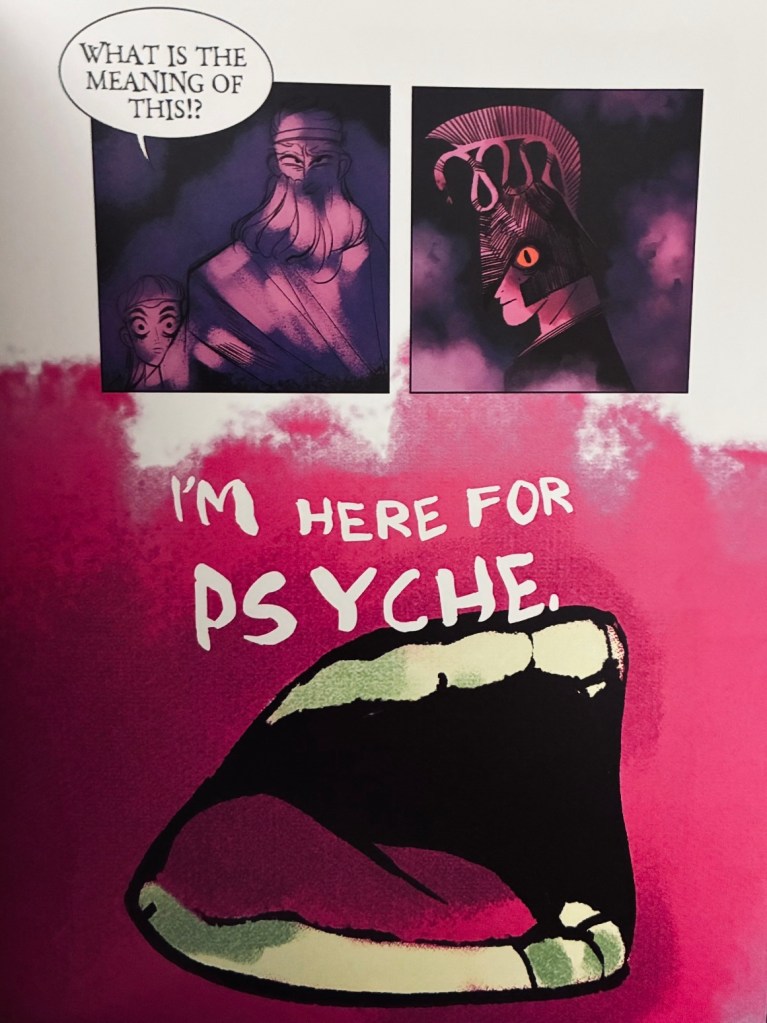
The incremental short distances that add up also includes the art. Rachel Smythe both wrote and drew Lore Olympus. Maybe this has more to do with the kinds of comics I normally read…but that to me seems both impressive and rare. When I’ve written scripts for comics, I’ve usually assumed that I should write out every little visual nuance like a film director from hell. To me, the freedom to both write and draw feels intoxicating and it makes me want to ask Smythe a million little random, annoying questions.
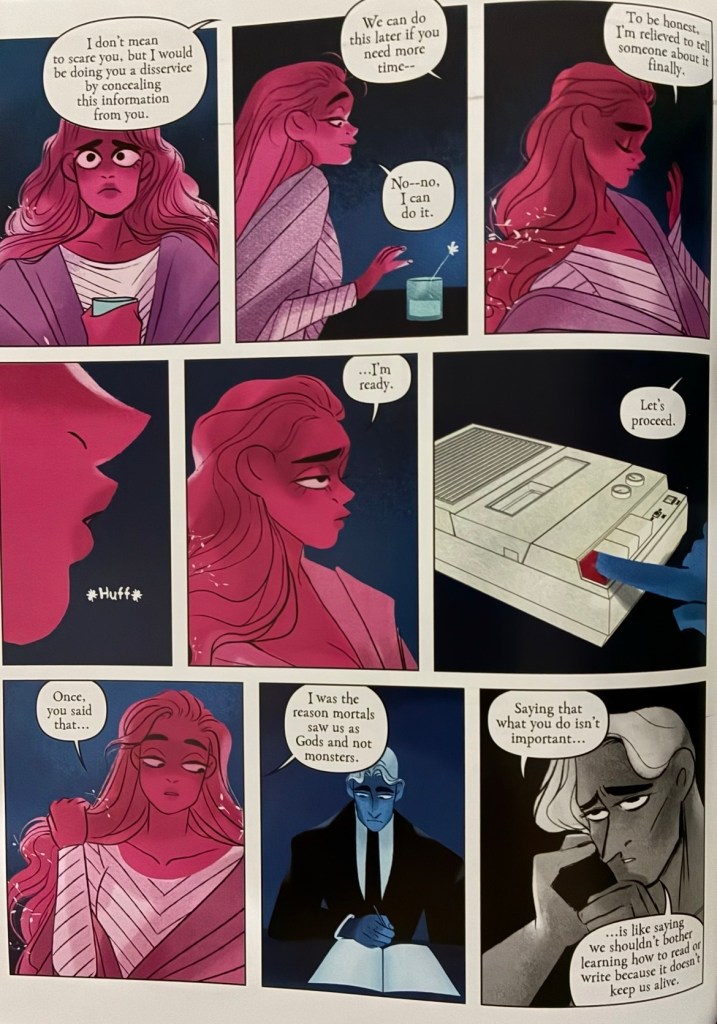
When Hades is recording Persephone’s telling of the massacre of the village, most of the visual pacing is framed by Persephone’s vocal delivery. We got the usual alternating between the story being told and the character telling it. I’ve written scenes with a similar structure myself. A single character’s monologue is a convenient spring-board that also facilitates an easy return to the main thread. I understand that kind of riffing. But since Rachel Smythe both wrote and drew this…even the simple jumps are invested with possible intention. Maybe it’s simply the intimacy and the trust of that moment between Persephone and Hades but the cuts back to Persephone’s presence in the room and her facial expressions does a lot of heavy lifting. Some of my random, annoying questions would concern the cuts to and from Persephone’s facial expressions and the recall-narrative. Smythe’s art may not be what you would call hyper-realistic but the characters and locations still have enough personality to connect them with emotional realism.
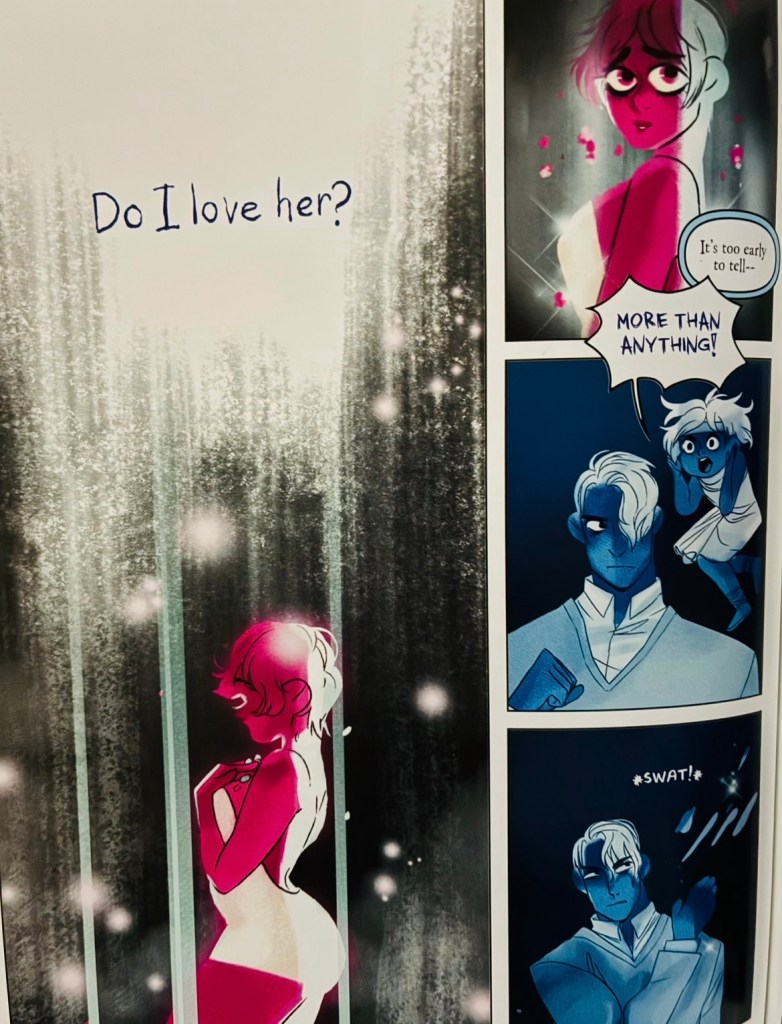
There are parts of Lore Olympus which have visual language reminiscent of Gendy Tartakovsky: the creator of Dexter’s Laboratory, The Powerpuff Girls, Samurai Jack, etc. (Not that I would sell short Primal.) An animated adaptation helmed by both Smythe and Tartakovsky feels like a stylistically rich possibility.
Things on the Samarai Jack to Primal spectrum shows that he could probably visually contextualize human shapes across a comparable spectrum of realism and subjectivity. Lore Olympus would be something of a tone shift from his usual work, though.
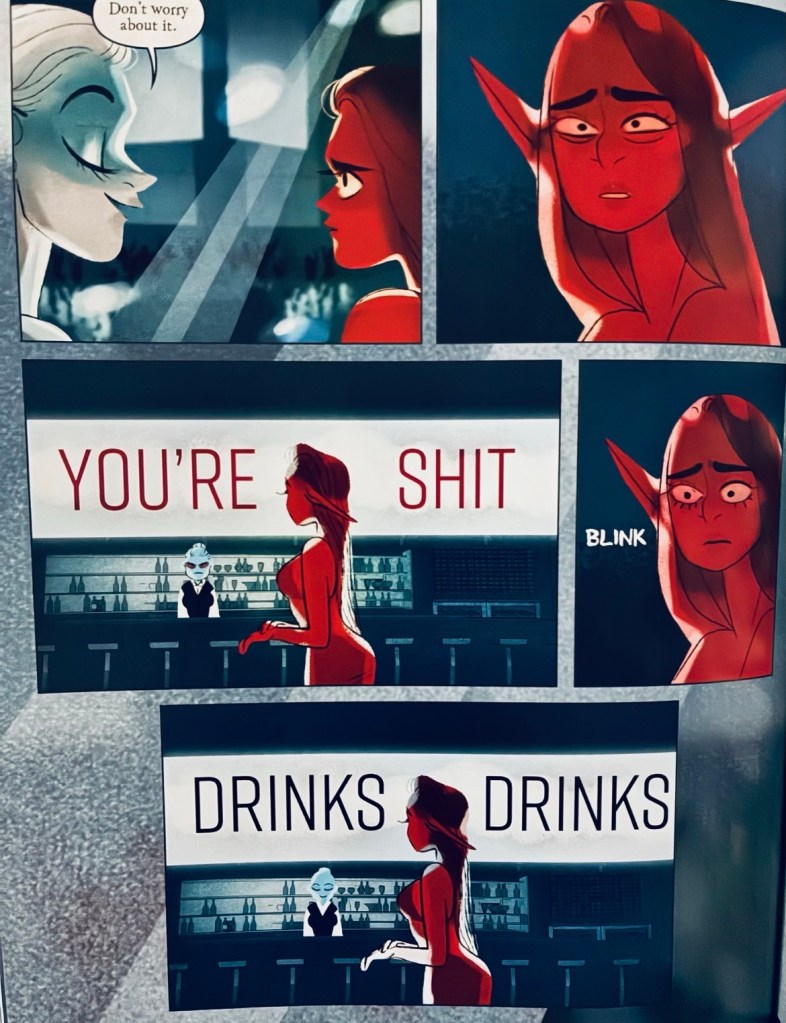
Rachel Smythe’s art style, in and of itself, does not necessarily attest to such an influence. It is more of a similitude of certain moments with multiple visual stages.
Something that both artists have in common is a grasp of visual shorthand normally used for slapstick for both pathos and action (while not necessarily being in a hurry to leave the comedy behind). I also suspect Smythe’s art style (like Tartakovsky’s) might reflect the influence nineteen-sixties cartoons, comics and advertising.
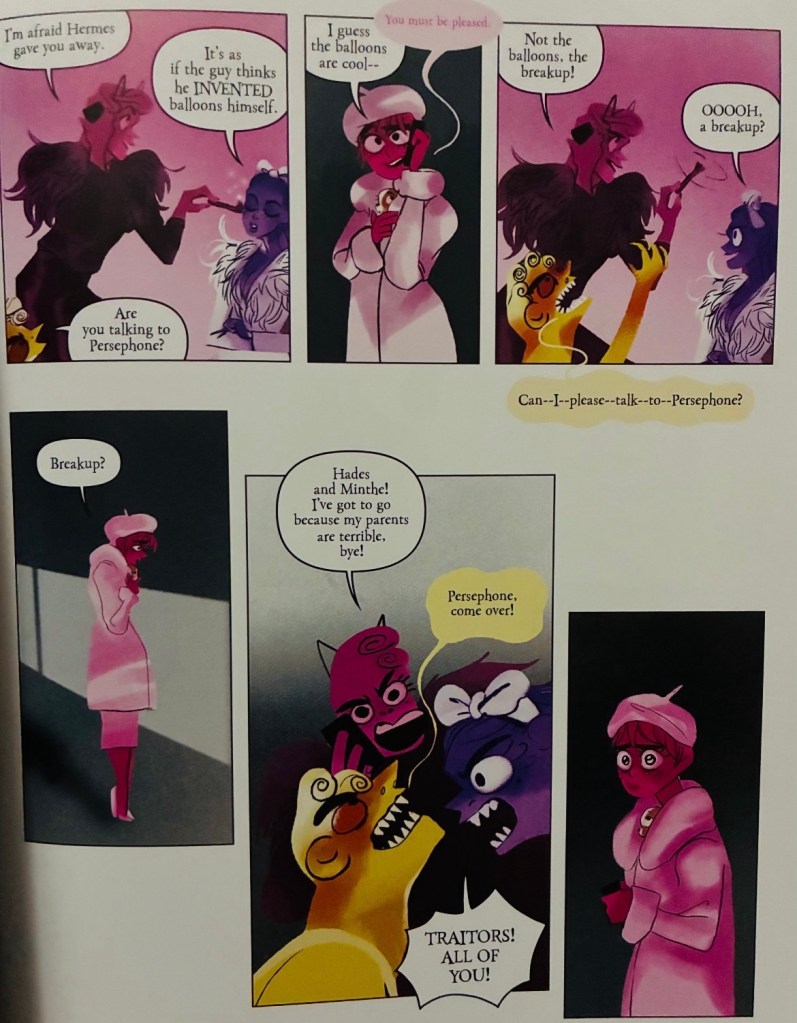
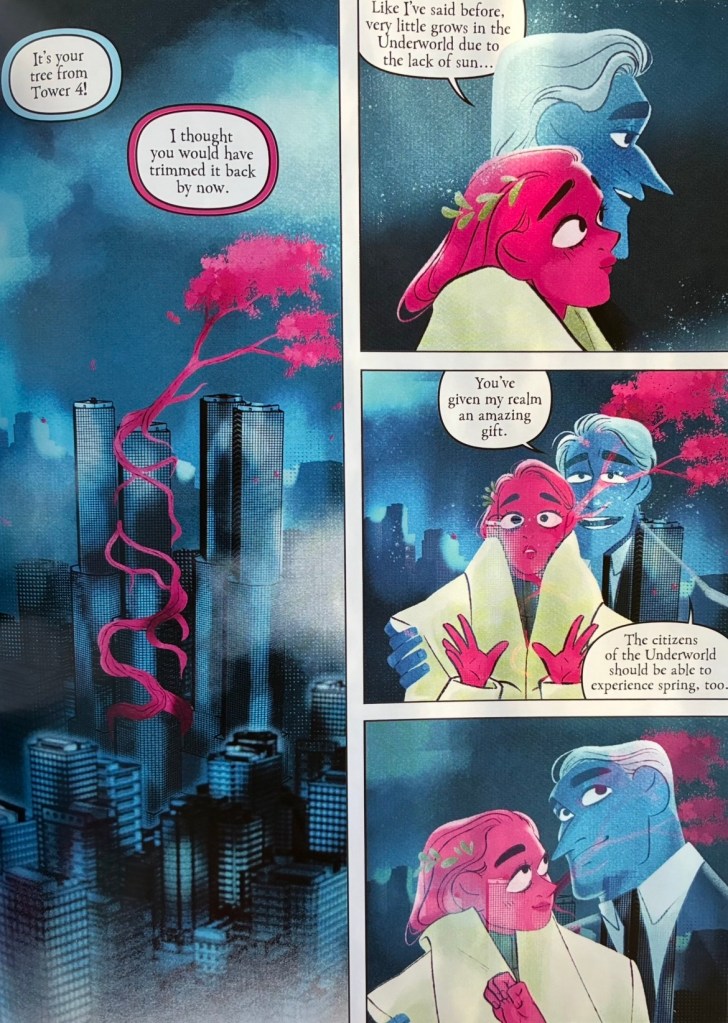
Operative word ‘suspect’. The only artistic influence I actually know was mentioned by Smythe was Sailor Moon. Even if the nineteen-sixties resemblances are accidental, they still add something. Amid the moral and sexual revolutions, the fifties and the post-WWII boom in consumer culture and the advent of television were historically recent. A certain handshake between style and fantasies of wealth and power had acquired a distinct popular shorthand that remains relevant. This visual language turned wealth and power into the modern version of a fantasy realm, like Atlantis or Hy Brasil or ancient world conceptions of the sea. It is magical and filled with possibility because it is somewhere that you are not.
The short narrative leaps add up as well. Lots of things that are taken for granted in Greek mythology (to say nothing of mythology in general) are played absolutely straight with just a little bit more context added each time. Several times, I’ve wanted to drop the comic and promptly look up whether a certain event actually happened in the mythology or not but I never did because I knew I was too invested in Smythe’s vision.
The Titanomachy, for example, has several dark and complicated zingers. Everyone knows that Greek mythology is filled with sexual intrigue, hidden pregnancies and jealousy. In Smythe’s story, mollifying Kronos by playing on his attraction to his daughter Hera was the gambit that first tipped the balance away from the Titans and toward the future Olympians. This was first portrayed as a plan conceived by both Hera and Zeus. Later, we have reason to believe that it may have been Zeus’s idea, even if Hera did the hard part.
Within the psychological realism of Lore Olympus, this feels almost like a BPD creation myth: the primordial triangulation that freed the children from the homicidal father. The perpetual mind games, cheating, lying and score-keeping hits different after that revelation.
Another simple detail with more complication trailing behind it: wrath. I myself have always had a murky and complicated relationship with anger. It many ways, I still do not know how to talk about my own anger clearly. Many popular attitudes about anger are so grating to me as to make me want to avoid the topic altogether. This has made me suspicious of almost all popular wisdom on the subject and I have had this mistrust from a very young age. I remember, in elementary school, several stories about a special daughter who received a number of blessings upon her birth. The first two or three followed rather typical patterns and the last one varied from story to story. The nature of the topical reinterpretation was always obvious and modern-sounding. I don’t know if this trope has any relationship with mythology (let alone Persephone) but it had a rote quality; presented as something that should be recognized to begin with, which always put me on edge.
Whether or not such a mythological link exists, Rachel Smythe applied it to the birth of Persephone. Lore Olympus, with it’s vivid and imaginative and modern world, does not try to front-load anything topical. When we reach the end of the list of blessings received by Persephone upon birth, Eris simply grins and says “(W)rath.”
World mythology is filled with visceral, emotional reactions leading to a transformation and / or a curse. Three visceral moments of wrath stood out to me in Lore Olympus: Hera cursing the hotel clerk who was selling Persephone’s stuff online (including a single used sock), Persephone cursing Minthe and Apollo cursing Daphne. A deity’s eyes will turn white and the wrath will simply erupt outward, regardless of executive function, like an orgasm. There is no question of ulterior motive or masking; the reality is apparent and inevitable. While wrath is simply wrath, this expression of it is so primal as to almost shake off easy emotional classification.
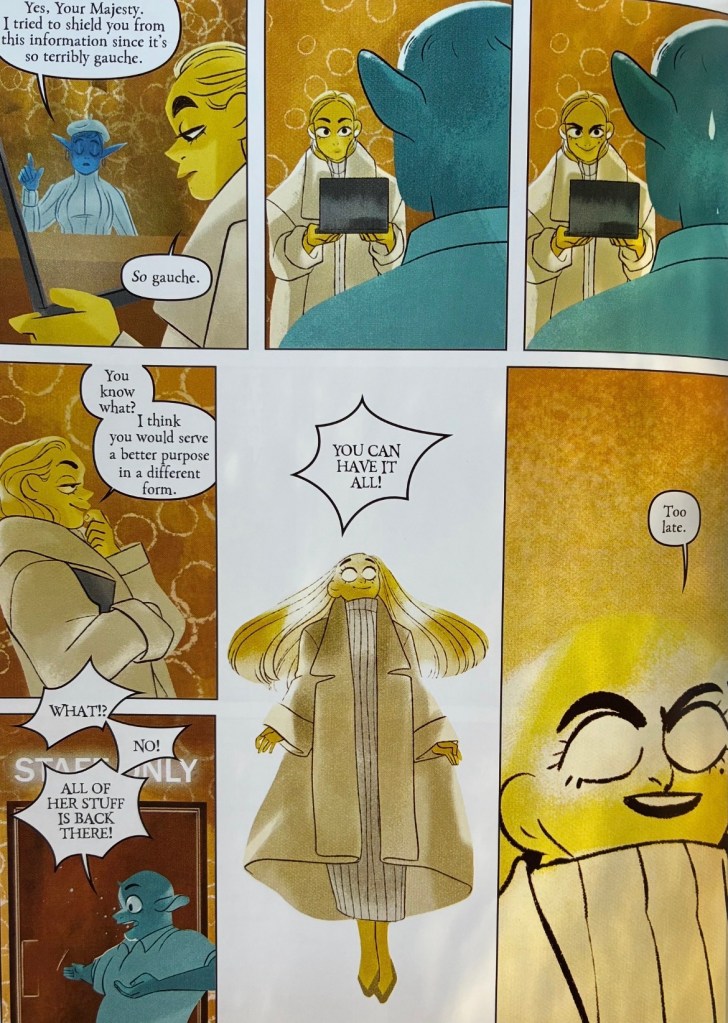
Hera’s mouth and cheeks. In the central white panel. She almost looks childishly delighted. This also ties into the thematic function of the worlds “(t)oo late.” “Too late”, in the English speaking world, is often subject to interpretation. Especially in an emotional context. Often, those words invite the accusation of a “gotcha” move; the triggering of a rhetorical or conversational trap. When Apollo tracks down Helios, seeking dirt on Persephone he can weaponize, Helios opens with “Each and every one of us is capable of acts of wrath.” “Each and every one of us” does not speak to a psychological generalization so much as a literal statement about the nature of the gods. Unlike most of the gods, the solar deity Helios is always is a giant form which dovetails with another aspect of the Olympian nature.
The Olympians are Titans. No Olympian can admit this and primal, emotional eruptions bring out their more Titan-like traits. Every Olympian knows something about the white eyes and the curses. The really bad moments, though, cause them to grow into giants and may include other more monstrous transformations.
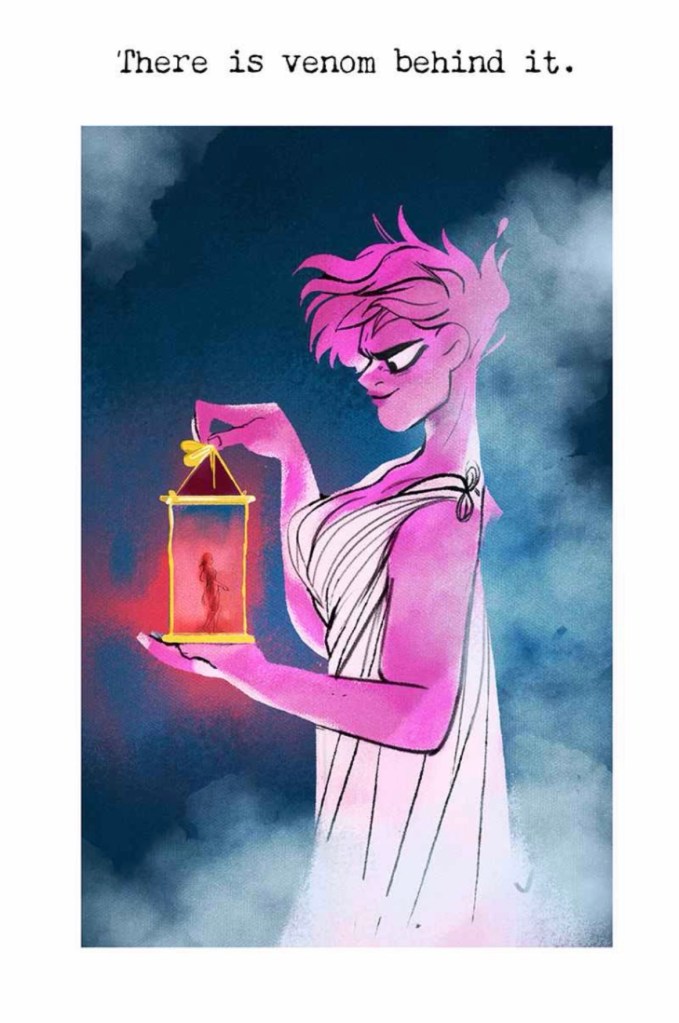
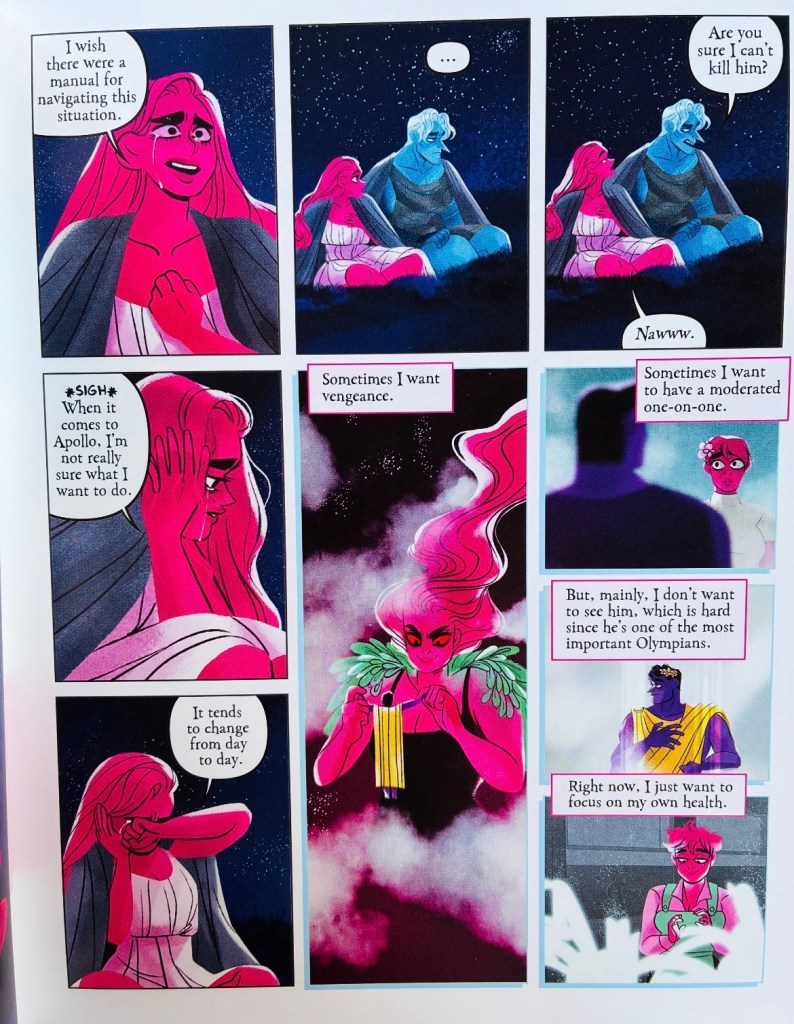
During the outpouring of wrath that cast a shadow over her youth, Persephone grew into a giantess. She is a giant when she thinks about her anger in the privacy of her mind. On one occasion, we see Hades fly into deep rage. He becomes a giant with sharp, predator-like teeth. The teeth made me wonder about his more understated patterns. Rachel Smythe uses short conceptual leaps to cover large distances and not everything is literal. Ares is portrayed with sharp teeth when he’s begging his son Eros to let him talk to Persephone while he has her on the phone. This moment and a few others like it are using sharp teeth to signify what they usually signify in this kind of art style: animalistic hunger or anger.
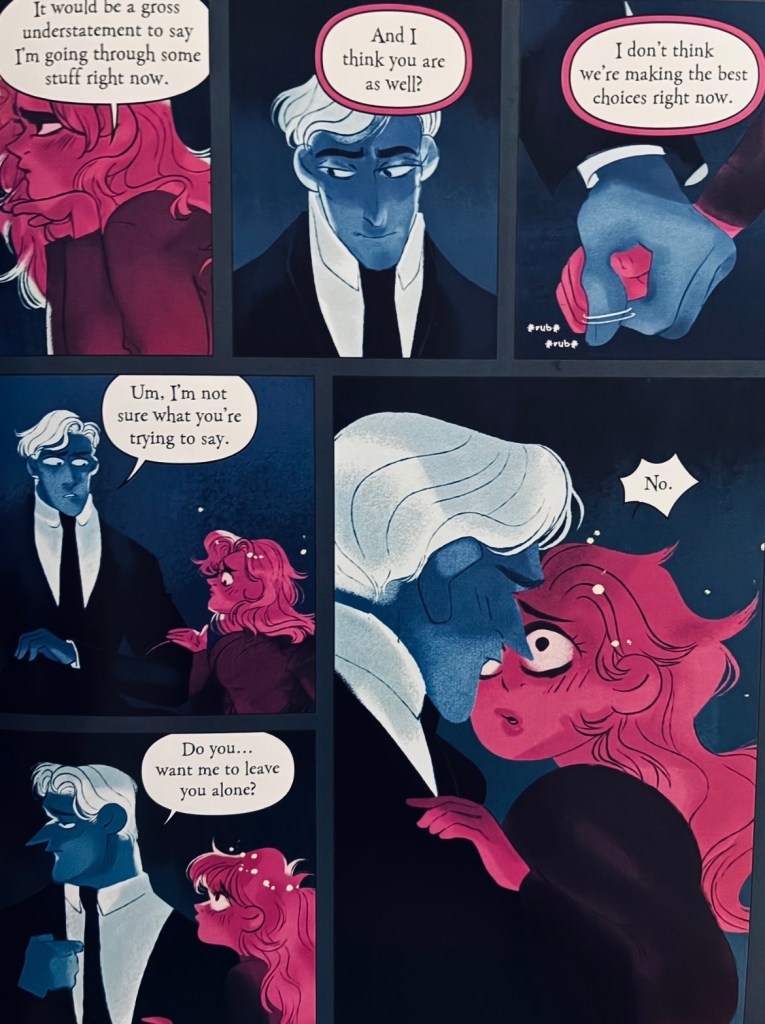
I don’t think this non-literal reading of sharp teeth applies to Hades since we only see it happen with him during and after he hears about Persephone’s rape at the hands of Apollo. Just now…I don’t remember how often we see Hades laugh before that moment or if he is ever seen laughing before then. Once Hades calms down, he and Persephone spend some alone time in the mortal realm. Persephone makes him laugh a few times and his teeth are sharp when his mouth opens.
Hades has a reputation for being stodgy, introverted and serious. None of the Olympians like to reflect on their Titanic lineage. The men, in particular, are hyper-sensitive of the possibility of resembling Kronos; none more so than Hades, who was Kronos’ first-born and his first victim. When Minthe completely loses her shit and starts scrounging for any ammo she can use against Hades, she compares him to Kronos. This is before the relationship with Persephone is official, so while Hades is nursing his wounds, he is visited by Hera. One thing leads to another and they bone. At first glance, this looks rather typical. Hera and Zeus cheat on each other constantly and Hades is a stoic personality whom others enjoy getting a rise out of. On the surface, it looks like Hera instigated a fling for no better reason than that she could, in addition to venting her resentment for her husband. By the end of the story, we know that Hades and Hera were both wounded by Kronos in ways in which no other Olympian was. That particular encounter between Hera and Hades happened because Hera, in all likelihood, knows better than any other contemporary just how much it hurts Hades to be compared to their father.
Later, when Hades and Persephone have their brief vacation to the mortal world, Hades laughs in front of her. He also may be laughing in front of the audience for the first time and he could only bring himself to do it after Persephone saw him in his Titan form. I believe that Hades’ dour reputation was shaped by him refusing to laugh in public because he laughs like a Titan. Maybe the sharp-toothed laughter is non-literal in the sense that it signifies how his laughter sounds to his own ears: like a Titan, which is to say his father. That laughter obviously needs a lot of security in order to come out.
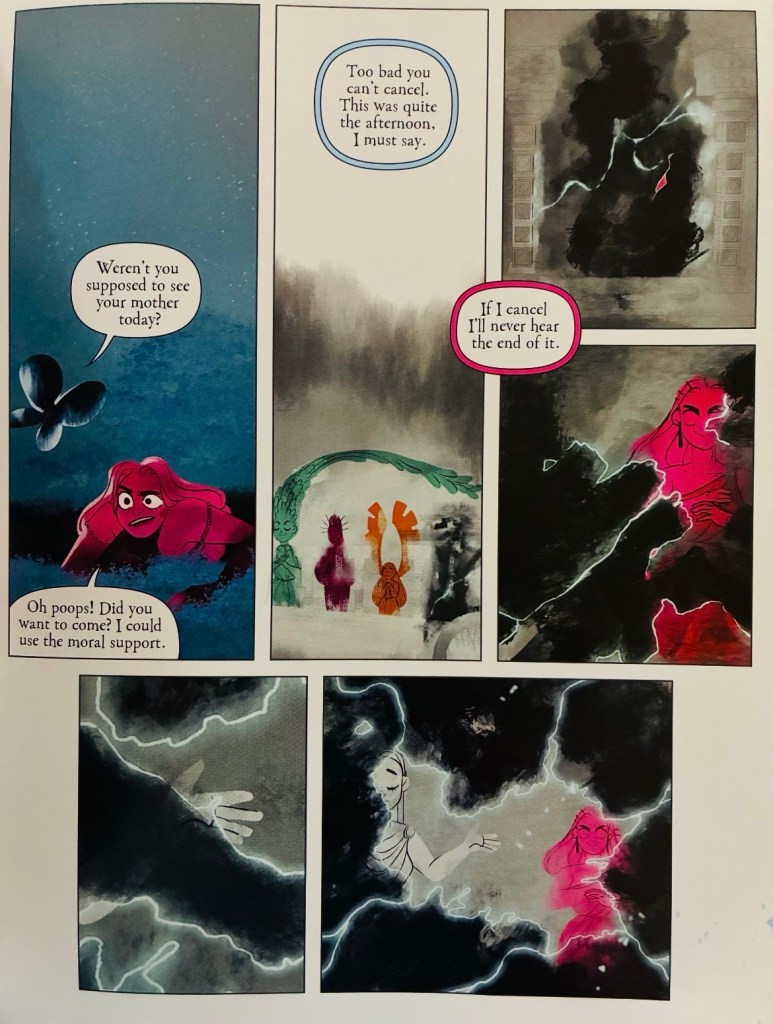
Another simple fact of the mythology which Rachel Smythe worked well with was the whole topic of fertility goddesses. The mythological circumstances are simple in that fertility goddesses seem to be rare. With an enthusiastic reimagining, it does not take much effort to ask why.
At no point does Rachel Smythe invent her own total, explanatory backdrop. She takes the mysteries one at a time and fills in the blanks as she goes.
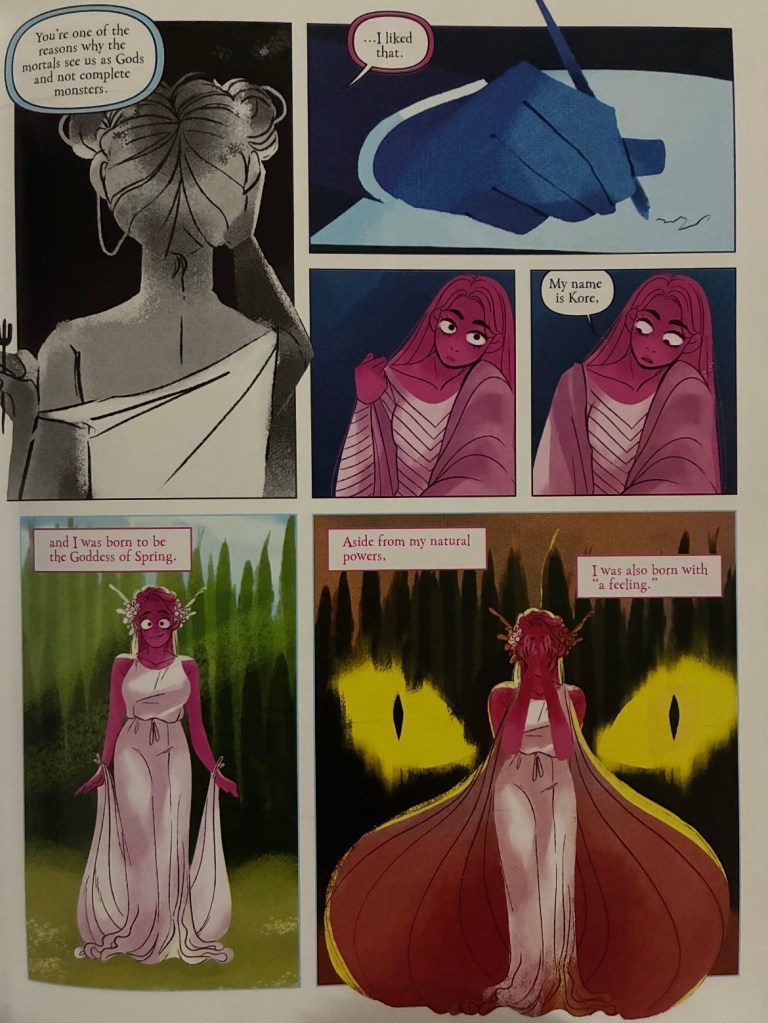
Plot mechanics being what they are, though, there comes a point where holistic answers make more sense. Ares shows Persephone a grotto where an ancient fertility goddess cult met to worship. Persephone touches a mural and goes into an altered state enabling psychic communion with the deceased Titaness Metis.
This addresses a number of dots which were connected for the audience through an unexpected source: Ares, who has a sociopathic grasp of empathy. He can recognize emotions in others but mostly sees them as an opportunity to set them off for his amusement. Ares is also an associate of Zeus and Apollo. While Ares isn’t the kind to grow a conscience, his predatory instinct for emotional abuse can make him just as uncomfortable to his friends as anyone else. To the aggravation of Zeus, Ares susses out how Ouranos devoured Gaia, Kronos devoured Rhea and Zeus devoured Metis. Each one of these male gods became the head of the pantheon of their day after consuming a fertility goddess.
When Persephone touches the mural, the painting of Metis has glowing, white eyes. The same connection that all gods have to the Titans also connects Persephone to every other fertility goddess.
This brings us to Rachel Smythe’s use of negative space. No child of Ouranos nor Gaia ever saw the sky until Kronos destroyed the god of the sky: Ouranos. Ouranos himself covered the sky with his being so it could be his alone. As far as the created universe is concerned, the sky did not exist until the god of the sky was vanquished.
The story ends with the latter beats of Persephone’s myth: the division of the year into the seasons. This plot structure is followed yet it also is accompanied by some of Smythe’s most radically imaginative moments. One such moment is a second act for the Titanomachy, revolving around Kronos.
With the ultimate defeat of Kronos, Gaia is restored. As both the Underworld and the mortal realm require Persephone to be present, Gaia imposes the divisions of the year.
The sky did not exist until the god of the sky was destroyed. Time did not exist until the god of time was destroyed.
Lots of modern retellings of old stories like to have the whole chronology behind their plot. What Rachel Smythe did was situate many of the foundational Olympus-era myths within a timeless, reoccurring Titanomachy which needed to conclude before the dawn of time.
If you’ve read my Sandman Universe posts then you know that I’m fascinated with artistic renderings of timelessness and the perspectives of timeless beings.
Such things can, of course, be thematic rather than literal. One of my favorite movies is Julie Taymor’s adaptation of Shakespeare’s Titus Andronicus. The film employees a conceit of a twentieth-century child entering a dream-like, timeless dimension of archetypes.
Maybe someone out there thinks that this makes Julie Taymor’s Titus a fantasy film but I don’t think anyone will hang their whole interpretation on it. I would not necessarily insist on it here, either. I still can’t resist certain possibilities, though, such as metaphysics.
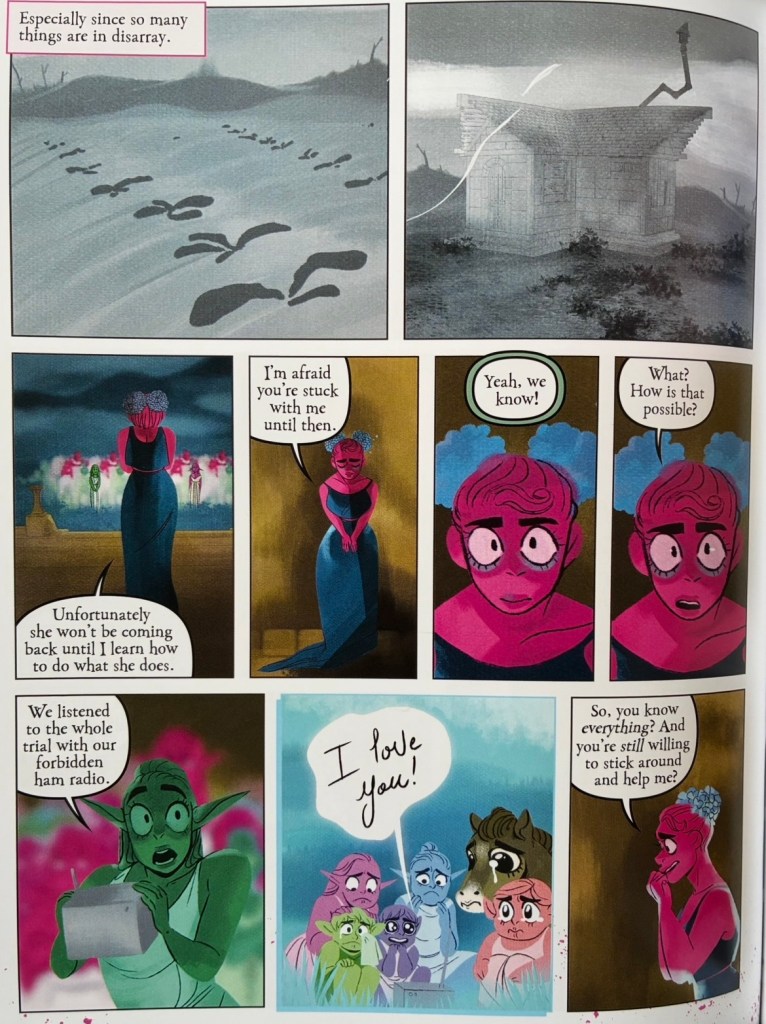
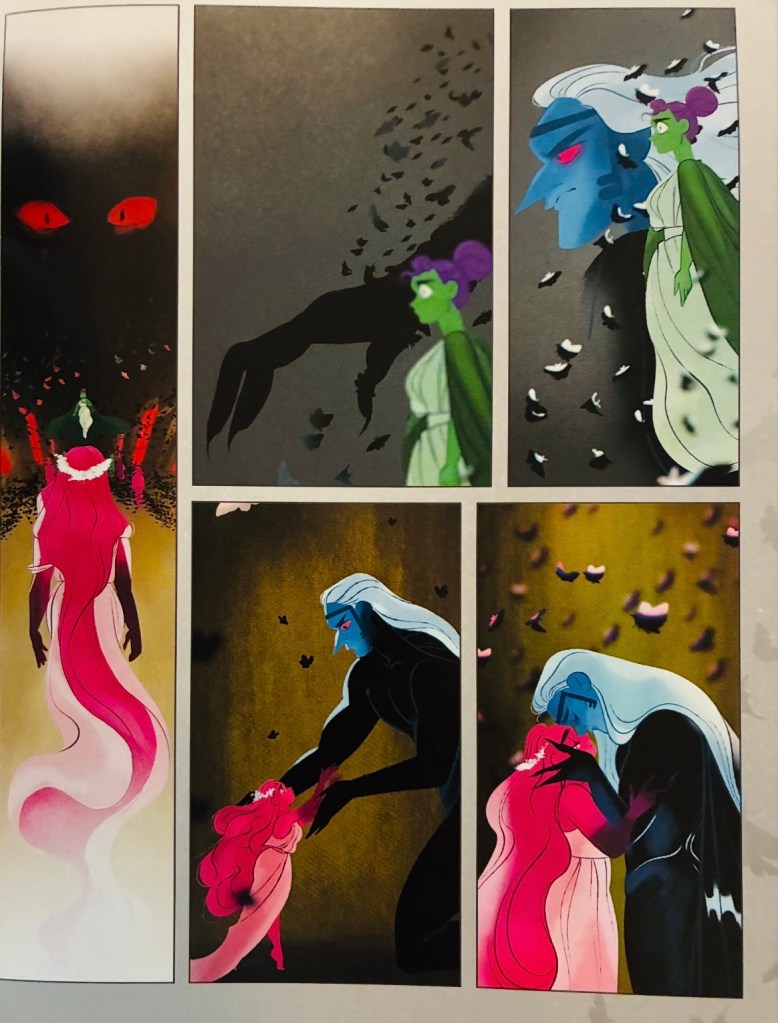
The metaphysical separation of Olympus, the Underworld and the mortal realm happens between the defeat of Ouranos and the defeat of Kronos. This is set in motion when Apollo tells Zeus of Persephone’s adolescent act of wrath. In the interest of not getting bogged down in plot summary…let’s just say that Zeus put Persephone on trial before Olympus because of this act of wrath. This ends with the separation of realms. The mortal world was not isolated on planet Earth, in the third dimension, until then.
This made me a little eager to read into things for a hot minute. In the page above, the two upper squares caught my attention. For some reason…I was like: that’s not World War II, is it…?
Prolly not. It’s prolly just the transitional chaos of Demeter being contained in Olympus and Persephone getting situated taking over her job for the moment.
These metaphysics are far from the plot, btw. This isn’t really that kind of story. They feel all the more authentic, though, for their rare incursions into our more emotional and psychological theater. The ground does not ask for permission before cracking open.
There is so much more I could keep going about. I was fascinated by the analogues between Persephone’s relationship with Hades and Eros’ relationship with Psyche. Episode 277, Wound part two, contains a visceral reckoning with Apollo that feels potentially unprecedented. To say the very least…it is the kind of thing you never see in real life. Arrows of true love don’t exist, after all.
Instead I’ll just say that I fucking love this.