
Light spoilers
When we last left our adventurers, they were on the trail of Darius in the Gulgur Volcano. Unbeknownst to them, General Braak escaped Hans, Biggs and Wedge, leaving them to fall into the hands of three enigmatic beings who appear to be capable of mind control. When the Vahn squad catches up with Darius, they find him in conversation with a voice that he is seeing outside of his head for the first time: Malacore, whom Darius released from the Crystal of Water.
A later encounter with the esper Ramah puts much of this in perspective: the crystals are doing their usual elemental control thing (either placed there by the gods or left there as energy siphons for malevolent outsiders, depending on cosmology).
What effects the crystals effects the espers. This entanglement has come up in older FFs but here we have an additional layer: elemental guardians, like Salamander and Bismarck- residing either with their crystal or at its former location. Quetzalcoatl is both an elemental guardian and an esper. Quetzalcoatl leaves nethicite behind and Salamander does not. Ramah then introduces a fourth layer: the Archareons, rulers of the Esper World. Presumably beings older and more powerful than Ramah and the other espers seen thus far.
In the distant past, both human and esper worlds were affected by a phenomenon which- on the third dimension -manifested as the disappearance of all light from the sky. Humanity remembered this as the era of the Blackmoon. It choked the biosphere, obviously, yet had consequences beyond it. The espers appear to have been affected just as much and- having longer lifespans and more of a multidimensional perspective than humans -resolved never to allow it to happen again.
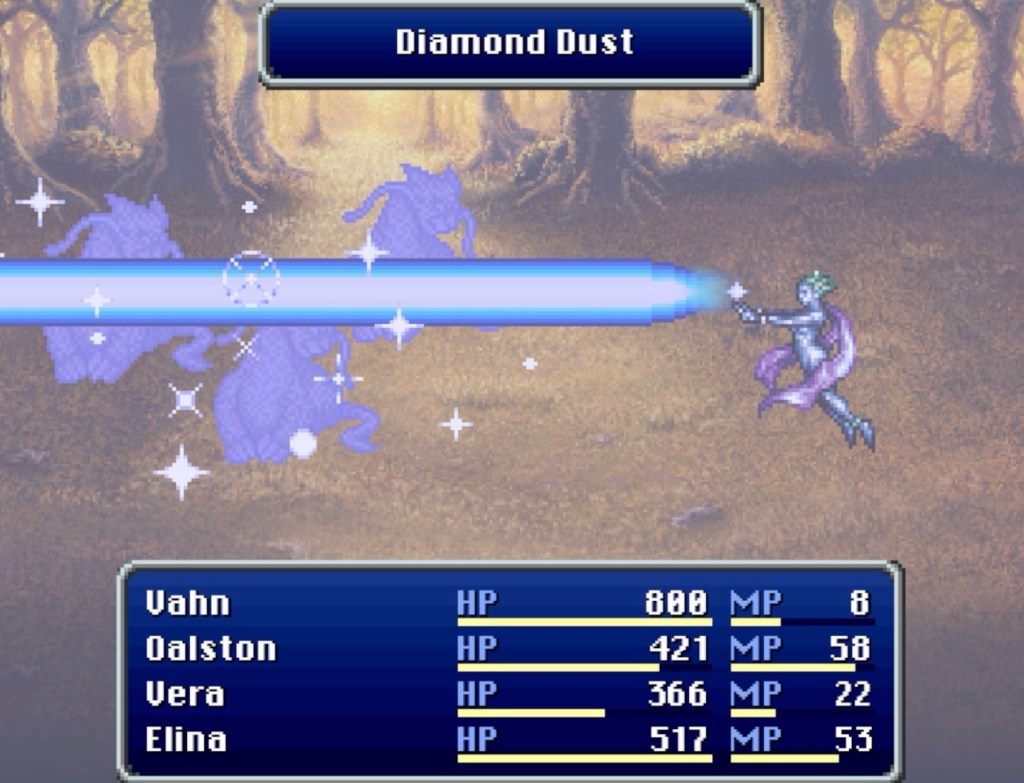
Despite their immortality and non-locality, the Archareons can only perceive this event through the dark glass of prophecy. While prophecy on the esper scale may see farther than on the human one, both humans and espers relate to it in the same way. A prophecy, for these purposes, is an amorphous thing: a statement from the future with a limited range of success or failure conditions.
Malacore, who was subsumed by the Water Crystal before Darius released him, is the one who is actually capable of manipulating the crystals in such a way that the Blackmoon Prophecy may be fulfilled. This prophecy specifies that Malacore’s opposition is the axis on which Malacore’s decision will turn. From the Archareons’ perspective, Vahn and the party are the ones actually swinging the axe and therefore they are the ones who must be stopped.
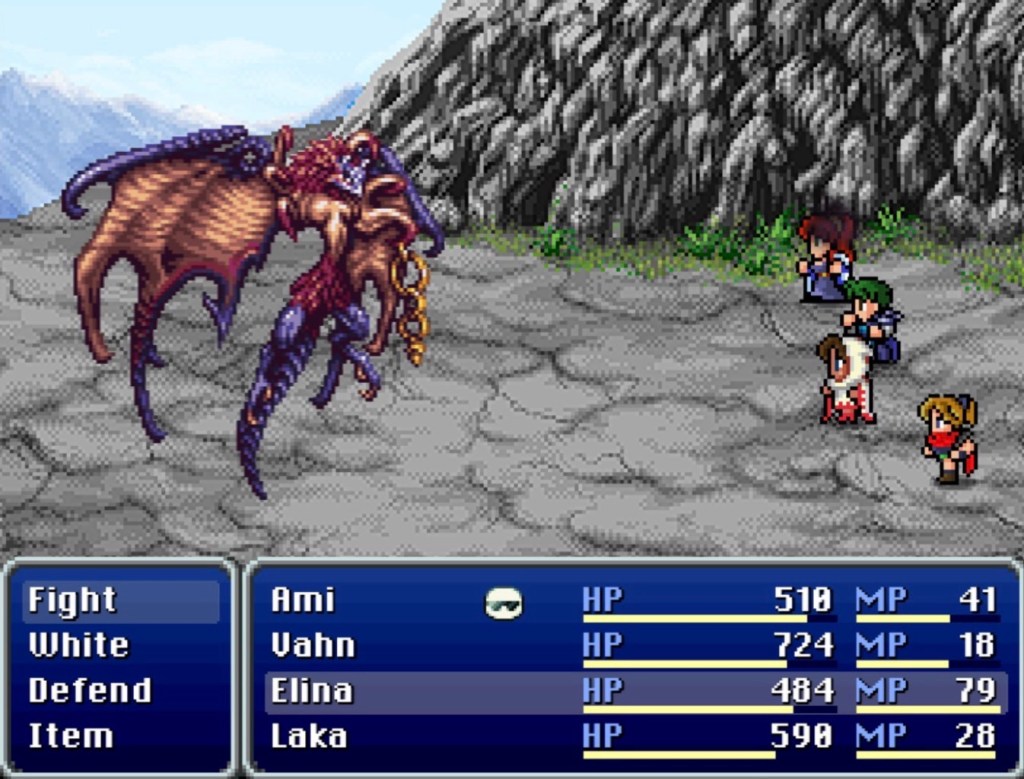
The Archareons are also having non-human pattern-matching issues: Darius was a dragoon from Branch. Vahn is also a dragoon from Branch. As far as they are concerned, “these kinds of humans” appear to be working in concert. Almost immediately after acquiring the ship with which to travel to the continent of the Wind Shrine, they are capsized by an Archareon. This Archareon was summoned by Gylfi: the one we saw fighting Hans, Biggs and Wedge at the Water Shrine.
Now…Malacore shoves, espers push back. Gylfi appeared to comfortably take some responsibility for what is happening both with Darius and the crystals. Is Gylfi a third-dimensional proxy for the Esper World Archareons? Or a collaborator with Malacore? Both seem possible, just now.
Espers also introduce our first actual taste of character customization: nethicite crystals. Obviously magicite exists in this game but its only use appears to be teaching Vera how to summon different esper spirits. Nethicite can be equipped to anyone, bestowing passive buffs and additional points for various stats upon leveling. These are, of course, good for cultivating stat emphases in the long run and circumstantial protection immediately.
So far, I have encountered three nethicite-yielding boss fights in the main plot: Syldra (MP leveling bonus), Quetzalcoatl (defense and HP leveling bonus) and Atomos (magic leveling bonus).
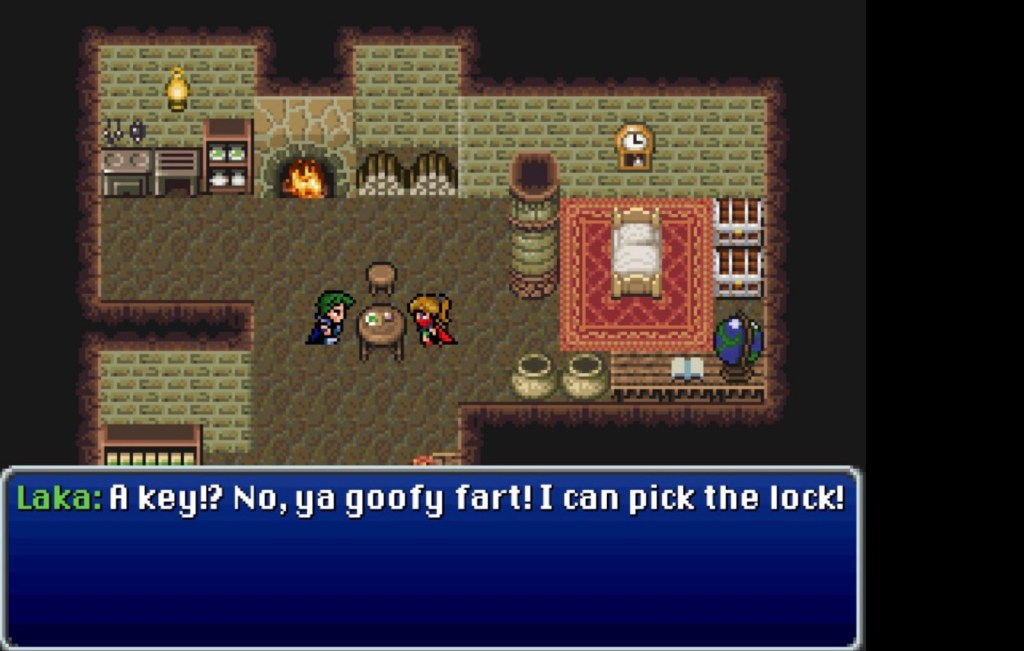
Considering how I acquired the Valefor nethicite on Mount Palumpu, I think this may be a good time to talk about other game play factors that start loosening up. Laka the thief is recruited shortly before entering the Naddaha Pyramid, which I appreciated. I like FF thieves; both for the stealth build and the perpetual item-farming. Goblins can be encountered in the vicinity and an interesting little item can be stolen from them: Goblin Glove, with a little book icon. This comes in handy post-Naddaha once Ami the blue mage (my favorite FF mage class) is recruited. I’m wondering if those book items are how Ami will be learning most of her blue magic? Stealing the items from the relevant monster makes a lot of sense. I can see how this might annoy some people but coordination between thieves and blue mages kinda hits me where I live.
Anyway: Goblin Punch will make Valefor way less scary (Valefor’s nethicite crystal boosts HP, speed and vigor upon leveling).
We also start seeing some recognizable dungeon-design conventions from the mainline series around here. Naddaha Pyramid is a FFIV-style gauntlet of winding paths and high encounter rates. The treacherous swamp of Connal Curach has stone-to-bridge jumps and thick fog, like the shipwreck graveyard from V.
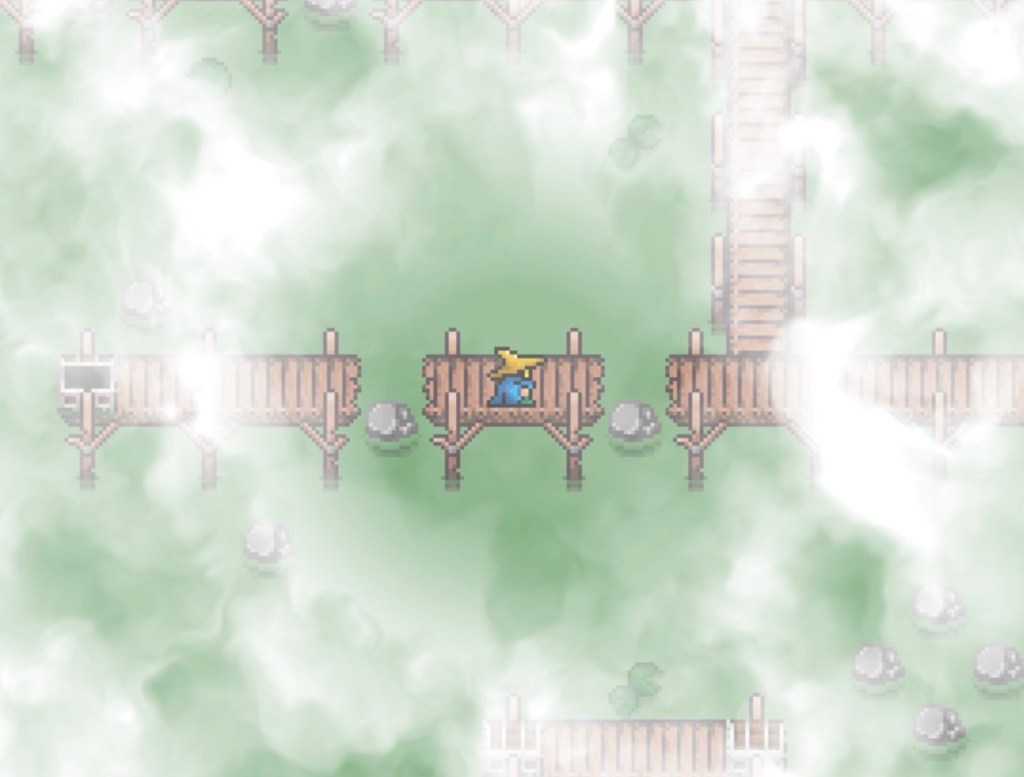
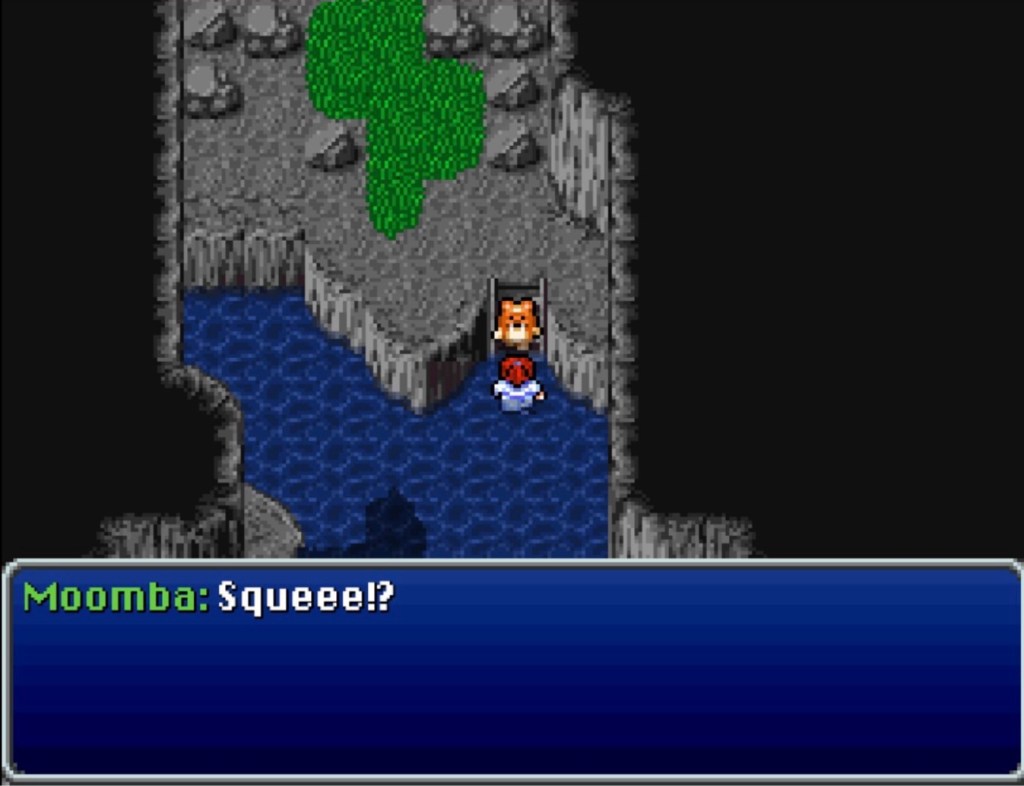
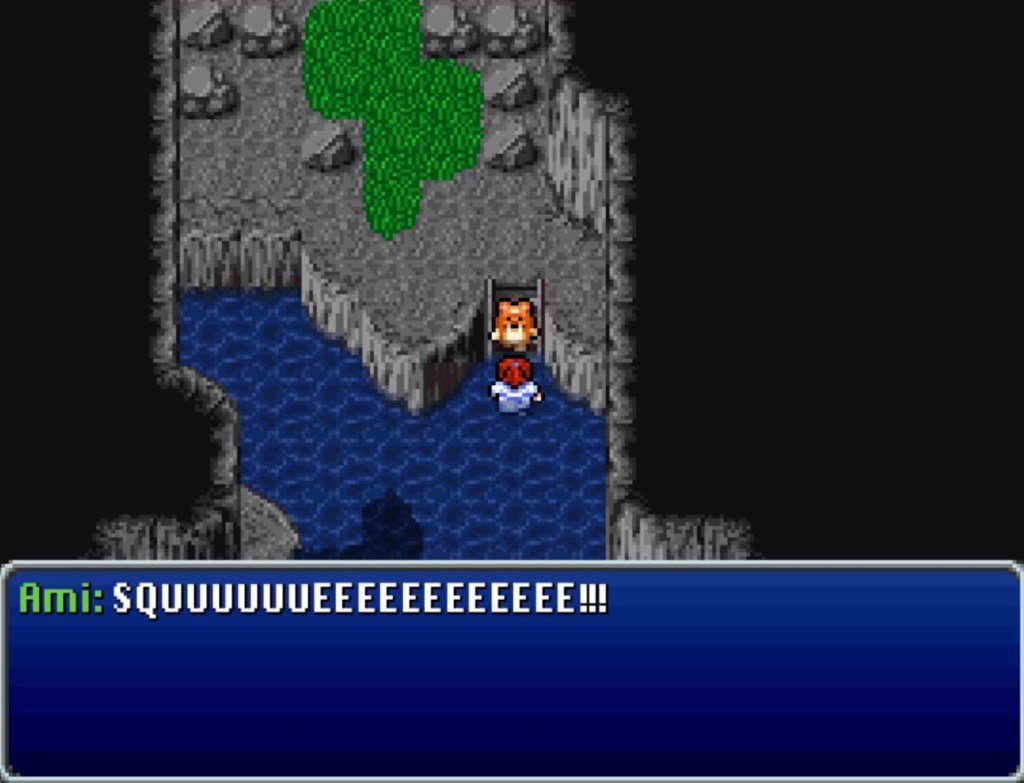
Also during the Laka-to-Ami-juncture- the obstacle transcendence abilities of the party leader have so far appeared to be removing single-tile obstructions. Elina with the Mysidian glyph barriers, Laka with picking locks and Ami with persuading the Moombas of Mount Palumpu to step out of the way.
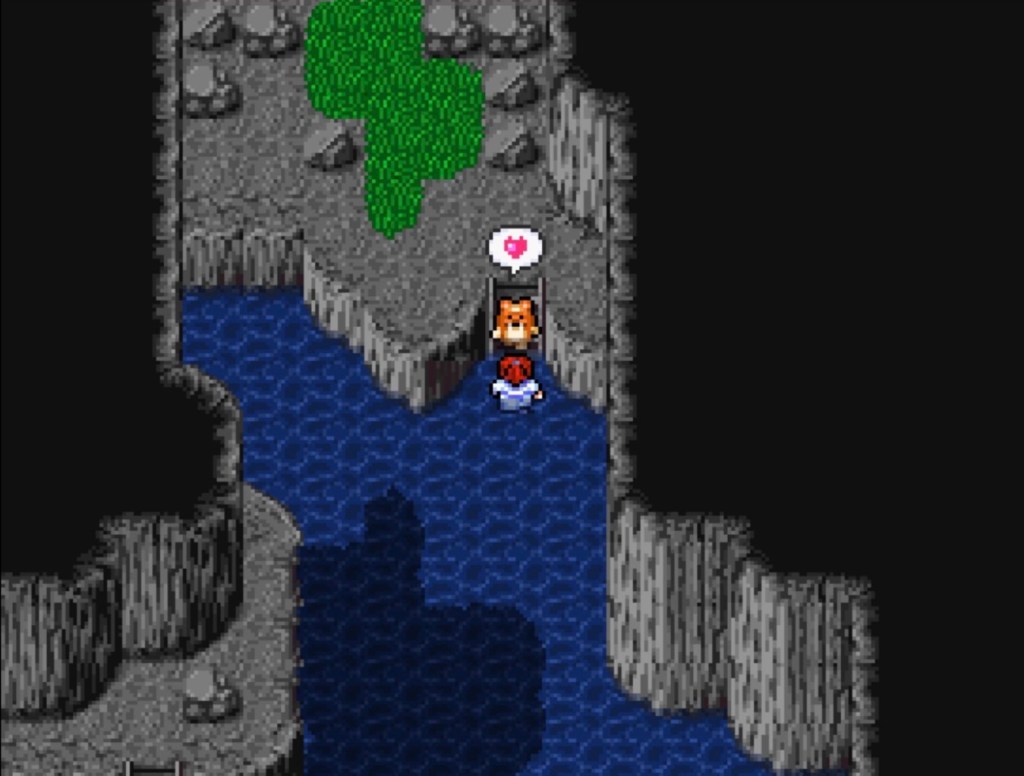
The music gets a little more diverse at this point. The Naddaha Pyramid has what at least sounds like the music in Ultimecia’s final dungeon from VIII (on a related note, music in boss fights have been from VIII and V, thus far). Once the party starts making their way through Mount Palumpu toward the Wind Shrine, the music gets distinctly non-retro themed. Like, recognizable low notes on a violin in a distinctly non-midi format. The mines of Kohlingen have a version of the ‘Phantom Forest’ from VI with a lot of woodwind instruments and a bit less harp-plucking than expected. I liked it though.
Since so much of what we are listening to comes from mainline Final Fantasy games, the music choices can sound a little referential at times. I’m still kinda waiting to see if certain associations expand or not, like all the FFVI musical cues happening in relation to the nation of Ivalice. Or the FFV boss music during the fights with Gylfi and his cohort.
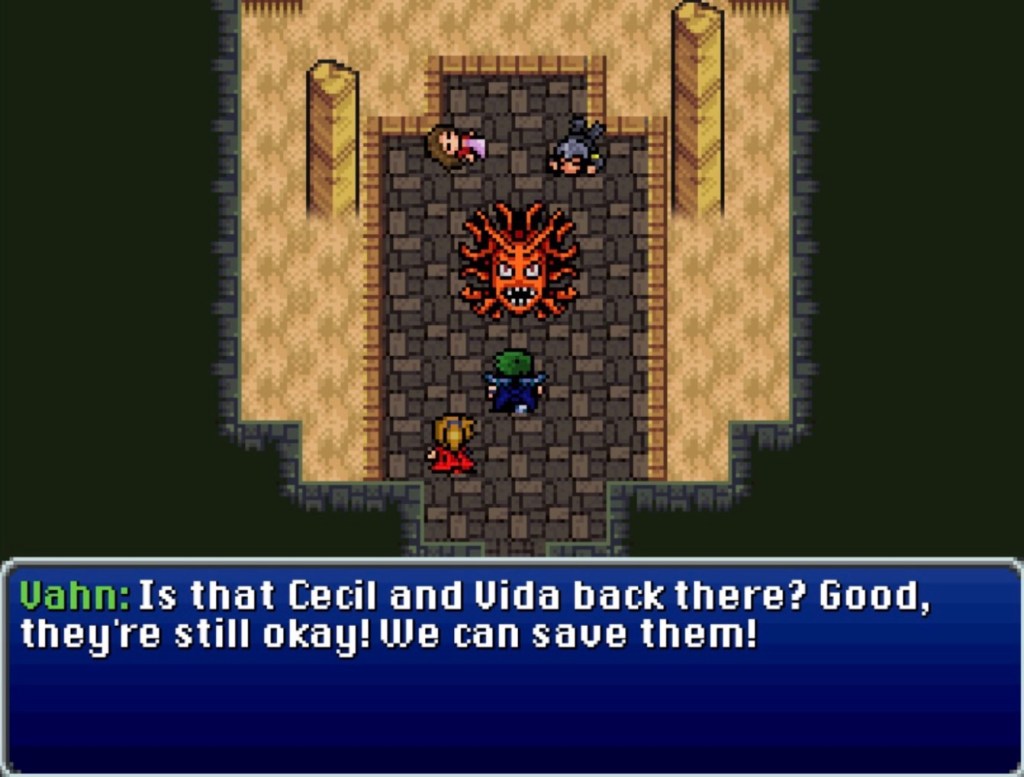
It is also impossible not to notice just how many place names and character names are taken from other FFs. Lots of main characters like Balthier and Cecil. The name ‘Vahn’ also comes from a pre-existing game but he’s also the only one with a main character name doing main character stuff.
It is easy for me to imagine certain things. Like each mainline FF takes place in its own tangent universe. These tangents proceed from a convex arc, enabling them to go as far as possible without intersecting. Final Fantasy Blackmoon Prophecy may be a lateral level above or below. If the main character from a mainline FF is, perhaps, causing the mutually exclusive tangent…than Blackmoon Prophecy appears to be a level up or down from there. The souls of the divergence-authors are now circulating in a contained environment, with everyone else. If Vahn got caught in the web of the story, then maybe it is because it could have happened to anyone in this version of Gaia.
Some other things I wanted to mention-
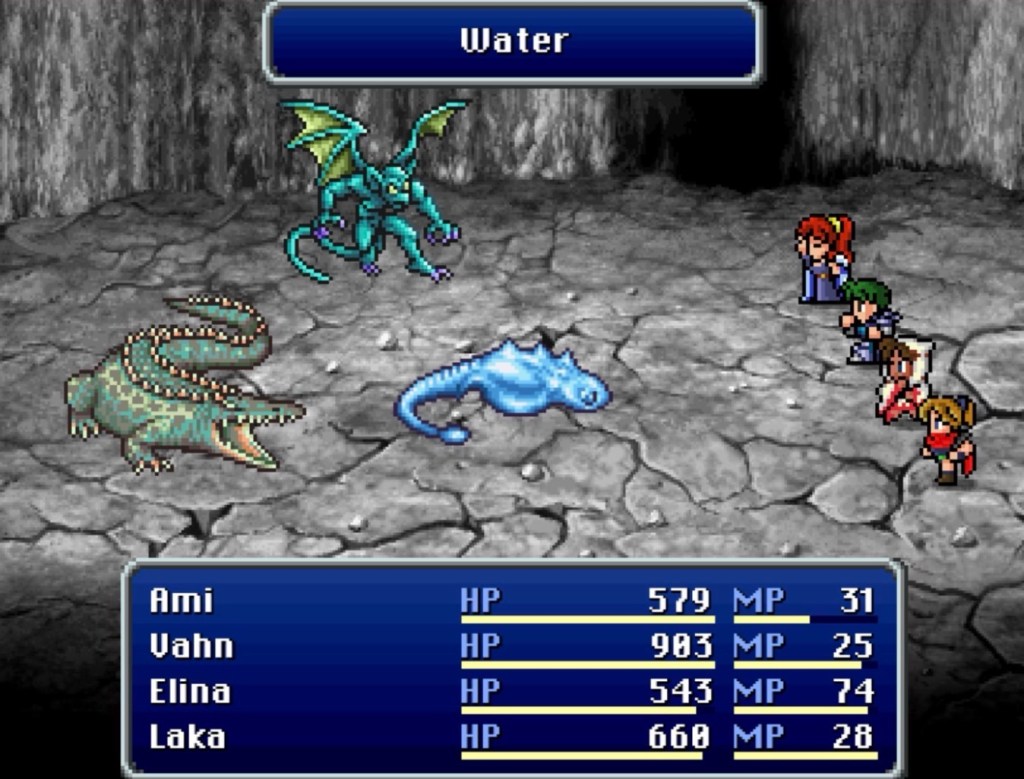
The blue Whip creature on the ground has a tent if Laka can manage to successfully ‘steal’ from it. Laka is level 8, here, with 39 for luck and 56 for speed. Vahn is the only one with a better luck stat and Laka is obviously the fastest party member so far. Laka always moves before anyone else has a chance but she can only steal a tent from a Whip once every few dozen attempts. For now, it looks like the luck stat determines whether the ‘steal’ command works or not, as in most other Final Fantasy games.
Also- the Headless monsters you can encounter between the Rift Shrine and Connal Curach? Kinda look like female Armadullahans? You can steal Spirit Shards from them. ‘Shards’ are basically permanent, single-increment stat boosters, like the stat+ and ‘source’ items from VII. The stat+ and ‘source’ droppers were hidden in the crashed Gelnika, though. The demake of VII for the NES (the Lugia2009 version- not the Chinese bootleg it was based on) had a lot of monsters late in the game that dropped stat+ items, which felt like a way to add some character build freedom near the end. We’ll see how Babineau implements stat+ / shard droppers going forward.
The Headless are also damage sponges who can hit the whole party at once, though, so have fun with that.
Here’s the sauce
Here’s the next post

