
Spoiler warning for the first two Tomb Raider games
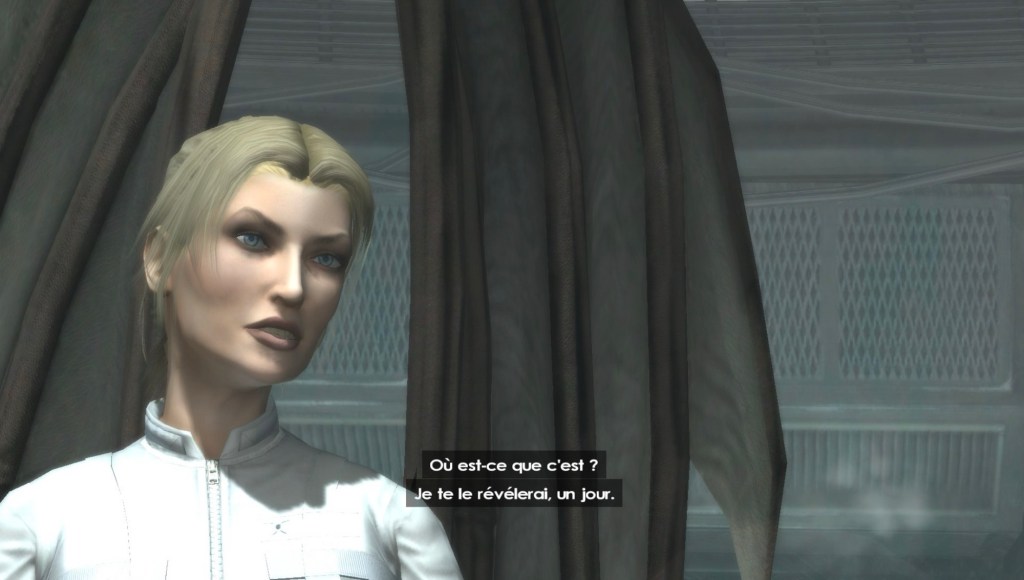
Adrienne Wilkinson, the motion capture actress for Jacqueline Natla in Tomb Raider: Legacy of Atlantis says that Natla is archetypically necessitated by the kind of story that Tomb Raider tells; a larger-than-life foil for a larger-than-life heroine. A pair that makes one another more of what they are. Alix Wilton Regan- the motion capture actress for Lara -says that all the men listen to Natla. This caught Adrienne off guard but she agreed. Adrienne also said that Natla is ‘walking wounded.’ The implication is that this wound and the need to hide it effect her interactions with both the outer bureaucracy that she navigates and her nemesis.
Understatement of the century, right? Natla is the only surviving Atlantean immortal and she was exiled by the other three. She was a source of civil unrest in Atlantis and- if we factor in the lore of Tomb Raider: Anniversary -she attacked and mutilated Qualopec. Qualopec looks like he relies more on a kind of mechanical walker on his back than his legs.
Then there is the enigma of Lara’s Atlantean doppelgänger. What could that mean, if not that Lara is descended from an Atlantean who was engineered in a ‘soldier mold’?
This also strongly implies a negative arc for Lara.
Lara is of Atlantean descent. This could make her a natural fit beside Natla. Lara is not descended from the immortal ruling class, though: if the Atlantean doppelgänger is one of the Atlanteans that Lara is descended from…that would make Lara the descendant of a clone.
Natla obviously has no objection to using the Atlantean cloning technology for cannon fodder. She refers to them as “lingering wimps.” In all fairness, the Atlanteans that come from the biomechanical eggs seem to mostly just shuffle around in one place, following lizard brain prompts in the absence of orders. If these beings are capable of breeding with humans and producing offspring with executive function…such lineage would not endear one to Natla.
Natla is a surviving tyrant; Lara is the descendant of a slave. This adds dimension to both Natla’s cruelty and Lara’s bravery. Natla may offer the legitimization of a fellow Atlantean existing in the world of humans. The refusal of this offer shifts things back to the older paradigm: who cares about the line of a xeroxed slave anyway.
Natla’s initial contracting of Lara contained the prospect of both acceptance and rejection. What’s more: Lara is a wealthy orphan, like Batman. Different Tomb Raider continuities have different versions of her background. In nearly all versions, though, she lost her parents early.
The nuance of Qualopec from Tomb Raider: Anniversary places an echo of the question of acceptance versus rejection in Natla’s own heart. One of her accusers faced her in person, with the evidence against her marked on his body. Natla was not simply caught and exposed; the evidence against her was unassailable. She was disgraced.
Natla’s wealth, power and experience are a soothing balm: who cares about parents or moral debt. Who cares about money or countries or any of the games the monkeys play to pass the time while their owners decide what to do with them. All that is for animals. We are divinities.
Yet Lara only has eyes for number one. Number one is always herself.
Lara may be more human than Atlantean but ‘human’ is, of course, a broad category.
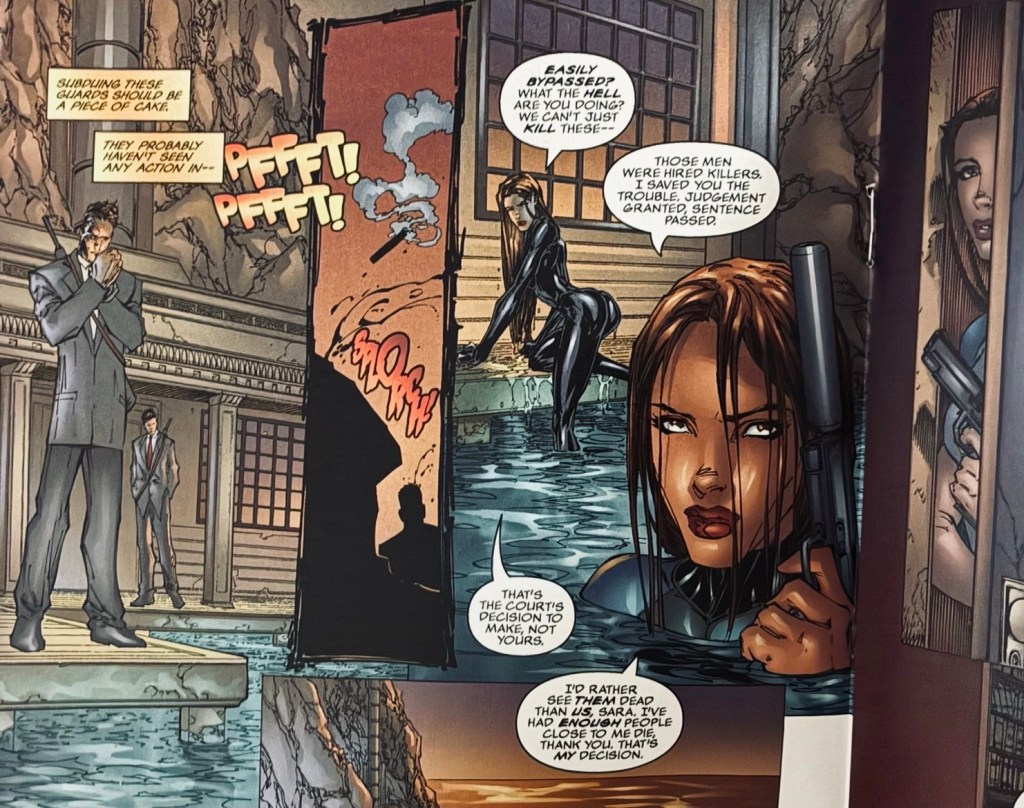
The entanglements of Lara’s human parents vary with the continuities but both the second Tomb Raider game and the then-contemporary crossover with the Witchblade comic agreed on some fine points.
The expedition that leads to Lara’s involvement in Witchblade was commissioned by one Lucas Moralto; an old friend of her father.
To date I’ve only managed to get my hands on issue one of Tomb Raider Witchblade Revisted, issue one of Witchblade Tomb Raider (yes, the first two arcs actually have those names) and part two of Dark Crossings. There is definitely more story material for this than I am currently aware of. The stories with Lara Croft are included in Witchblade omnibuses but not in a single, accessible source.
From what I’ve read, though, Lara’s human parents had mob ties. Lucas Moralto was the head of the Moralto crime family and the inheritor of their vendetta against the Scarponi family. When Lucas gets his hands on the supernatural relic that he paid Lara to collect, he uses it to kill as many living carriers of the Scarponi name as he can.
Since Lara’s appearance in Witchblade was contemporary with the release of Tomb Raider II, I find myself reminded of Fiamma Nera.
The only context offered by Tomb Raider II for its own story is that Lara is looking for a magical Chinese artifact called the Dagger of Xian and she’s trying to get it before another party does, called Fiamma Nera.
This name refers to a cult lead by a man named Marco Bartoli. Lara meets one of Marco’s goons outside of a massive, sealed door beneath the Great Wall of China. Lara gets what answers there are to be had from him and then strikes the apparent heart of Fiamma Nera: a dilapidated neighborhood amid the canals of Venice. She faces thugs with baseball bats, attack dogs and masked figures with silencers on their pistols.
One wonders if Lara heard about both the Dagger of Xian and Fiamma Nera through sources made available by her parents’ underworld connections.
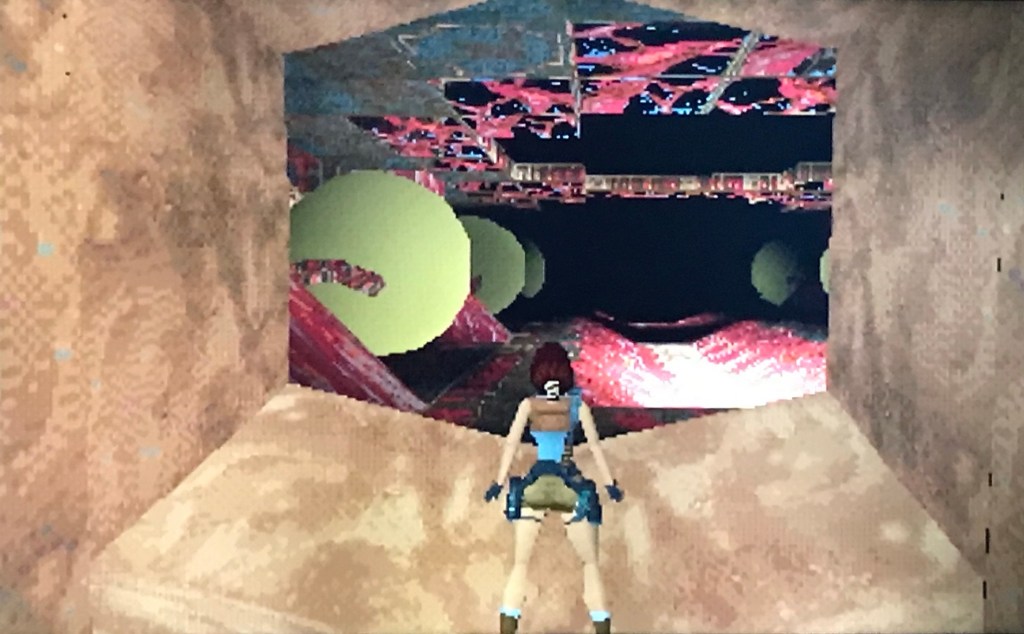
These conclusions always made sense to me because of the tonal emphasis of the first two Tomb Raider games. You spend a lot of your time in silence and in the dark. Music is always circumstantial. The environmental horror themes become even more explicit in Tomb Raider II. Not only are there more ugly, gun-toting humans to kill but there’s a level in which you start at the bottom of the ocean. You briefly travel through an adjacent dimensional space with floating islands and eerie, silent, floating humanoid figures.
Tomb Raider, for me, has always had a foot in the horror genre. Consider also the kind of player-identification that Lara invites. She is a world-class athlete with military-grade combat awareness. She has guns- things she holds in her hands or her arms. Mostly, though, she does a lot of running, jumping, grabbing and sneaking. She has the body and abilities of a super-heroine but that is effectively all she has. On one hand, Lara is a lone powerhouse. On the other, she is always alone and usually on an enemy’s home turf.
Obviously, more human and humanoid enemies in Tomb Raider II was the result of the first Tomb Raider being successful enough to merit a higher budget.
From the outside, though, it looks like Lara once had a pattern of accepting contracts with minimal human collateral. In the second game, she appears not to have that inhibition. As if her encounter with Jacqueline Natla changed her.
Speculations come easily from here. For my part, I find myself thinking of the kinds of monsters Lara faced in Atlantis.
They were all manufactured inside of the biomechanical eggs. There are common warrior molds. The hunched over, animalistic, growling Atlanteans may have come from a different mold but the clones from the warrior mold are more in demand. Natla made soldiers on a regular basis. The ‘soldier Atlanteans’ were likely the ones with appendages from other animals and energy projectiles. What about the groaning, leaping, more zombie-like ones, then?
I’ve wondered if they were maybe from a laborer mold. There’s not much Atlantean infrastructure to maintain these days, so maybe they’ve turned feral from neglect. Maybe Natla tried to force laborer clones into the roles of soldier clones.
Whichever form they took, though, they looked rather monstrous. They have certain kinds of specialized appendages and they look as though they were created without skin. Despite being ‘skinless’, they seems immune to pain and fatigue.
Whether they are actually ‘skinless’ or if this is a natural trait that we don’t have context for…the spawn of the Atlantean eggs looked like grisly, demonic meat puppets. After a trek through a lost city filled with living nightmares, what final boss awaits us?
Natla, in her ‘natural state’…which is a lot like the one we’ve been seeing. She does not change much but she does have functional, bat-like wings. After a gauntlet of horrors, Natla is not exactly horrible. She is the same Natla we’ve always known- with wings and energy projectiles. Beautiful and terrible, like an alien angel come to judge humanity. However satisfied Lara may have been to take Natla down, I find it hard to believe that she didn’t see a bit of herself in her.

